Category Archives: Education

ESO: Dark spot on Neptune observed by telescope on Earth for first time

A new report from the European Southern Observatory (ESO):

Mysterious Neptune dark spot detected from Earth for the first time

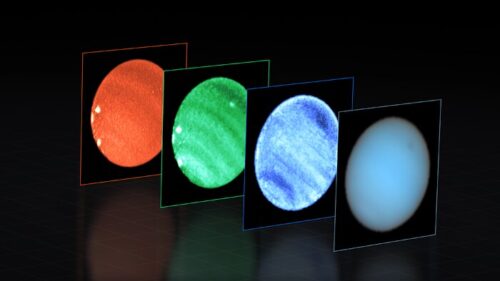
This image shows Neptune observed with the MUSE instrument at ESO’s Very Large Telescope (VLT). At each pixel within Neptune, MUSE splits the incoming light into its constituent colours or wavelengths. This is similar to obtaining images at thousands of different wavelengths all at once, which provides a wealth of valuable information to astronomers. The image to the right combines all colours captured by MUSE into a “natural” view of Neptune, where a dark spot can be seen to the upper-right. Then we see images at specific wavelengths: 551 nanometres (blue), 831 nm (green), and 848 nm (red); note that the colours are only indicative, for display purposes. The dark spot is most prominent at shorter (bluer) wavelengths. Right next to this dark spot MUSE also captured a small bright one, seen here only in the middle image at 831 nm and located deep in the atmosphere. This type of deep bright cloud had never been identified before on the planet. The images also show several other shallower bright spots towards the bottom-left edge of Neptune, seen at long wavelengths. Imaging Neptune’s dark spot from the ground was only possible thanks to the VLT’s Adaptive Optics Facility, which corrects the blur caused by atmospheric turbulence and allows MUSE to obtain crystal clear images. To better highlight the subtle dark and bright features on the planet, the astronomers carefully processed the MUSE data, obtaining what you see here.

Using ESO’s Very Large Telescope (VLT), astronomers have observed a large dark spot in Neptune’s atmosphere, with an unexpected smaller bright spot adjacent to it. This is the first time a dark spot on the planet has ever been observed with a telescope on Earth. These occasional features in the blue background of Neptune’s atmosphere are a mystery to astronomers, and the new results provide further clues as to their nature and origin.

Large spots are common features in the atmospheres of giant planets, the most famous being Jupiter’s Great Red Spot. On Neptune, a dark spot was first discovered by NASA’s Voyager 2 in 1989, before disappearing a few years later.

Since the first discovery of a dark spot, I’ve always wondered what these short-lived and elusive dark features are,”

says Patrick Irwin, Professor at the University of Oxford in the UK and lead investigator of the study published today in Nature Astronomy.

Irwin and his team used data from ESO’s VLT to rule out the possibility that dark spots are caused by a ‘clearing’ in the clouds. The new observations indicate instead that dark spots are likely the result of air particles darkening in a layer below the main visible haze layer, as ices and hazes mix in Neptune’s atmosphere.

Coming to this conclusion was no easy feat because dark spots are not permanent features of Neptune’s atmosphere and astronomers had never before been able to study them in sufficient detail. The opportunity came after the NASA/ESA Hubble Space Telescope discovered several dark spots in Neptune’s atmosphere, including one in the planet’s northern hemisphere first noticed in 2018. Irwin and his team immediately got to work studying it from the ground — with an instrument that is ideally suited to these challenging observations.

Using the VLT’s Multi Unit Spectroscopic Explorer (MUSE), the researchers were able to split reflected sunlight from Neptune and its spot into its component colours, or wavelengths, and obtain a 3D spectrum [1]. This meant they could study the spot in more detail than was possible before.

I’m absolutely thrilled to have been able to not only make the first detection of a dark spot from the ground, but also record for the very first time a reflection spectrum of such a feature,

says Irwin.

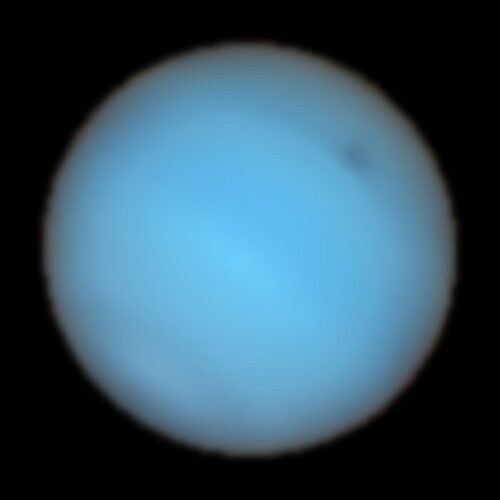
This image shows Neptune observed with the MUSE instrument at ESO’s Very Large Telescope. At each pixel within Neptune, MUSE splits the incoming light into its constituent colours or wavelengths. This is similar to obtaining images at thousands of different wavelengths all at once, which provides a wealth of valuable information to astronomers. This image combines all colours captured by MUSE into a “natural” view of Neptune, where a dark spot can be seen to the upper-right.

Since different wavelengths probe different depths in Neptune’s atmosphere, having a spectrum enabled astronomers to better determine the height at which the dark spot sits in the planet’s atmosphere. The spectrum also provided information on the chemical composition of the different layers of the atmosphere, which gave the team clues as to why the spot appeared dark.

The observations also offered up a surprise result.

In the process we discovered a rare deep bright cloud type that had never been identified before, even from space,”

says study co-author Michael Wong, a researcher at the University of California, Berkeley, USA. This rare cloud type appeared as a bright spot right beside the larger main dark spot, the VLT data showing that the new ‘deep bright cloud’ was at the same level in the atmosphere as the main dark spot. This means it is a completely new type of feature compared to the small ‘companion’ clouds of high-altitude methane ice that have been previously observed.

With the help of ESO’s VLT, it is now possible for astronomers to study features like these spots from Earth. “This is an astounding increase in humanity’s ability to observe the cosmos.

At first, we could only detect these spots by sending a spacecraft there, like Voyager. Then we gained the ability to make them out remotely with Hubble. Finally, technology has advanced to enable this from the ground,

concludes Wong, before adding, jokingly:

This could put me out of work as a Hubble observer!

Notes

[1] MUSE is a 3D spectrograph that allows astronomers to observe the entirety of an astronomical object, like Neptune, in one go. At each pixel, the instrument measures the intensity of light as a function of its colour or wavelength. The resulting data form a 3D set in which each pixel of the image has a full spectrum of light. In total, MUSE measures over 3500 colours. The instrument is designed to take advantage of adaptive optics, which corrects for the turbulence in the Earth’s atmosphere, resulting in sharper images than otherwise possible. Without this combination of features, studying a Neptune dark spot from the ground would not have been possible.

=== Amazon Ads ===

Celestron – NexStar 130SLT Computerized Telescope –
Compact and Portable –
Newtonian Reflector Optical Design –
SkyAlign Technology –
Computerized Hand Control –
130mm Aperture

===

An Infinity of Worlds:
Cosmic Inflation and the Beginning of the Universe

ESO: New type star may help explain magnetars

A new report from the European Southern Observatory (ESO):

New type of star gives clues to mysterious origin of magnetars

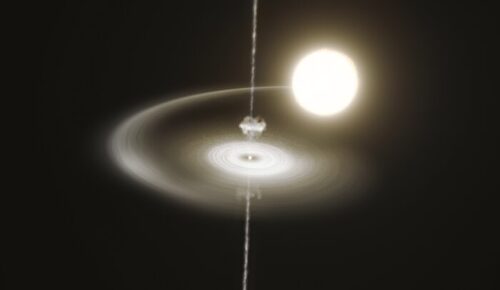
Magnetars are the strongest magnets in the Universe. These super-dense dead stars with ultra-strong magnetic fields can be found all over our galaxy but astronomers don’t know exactly how they form. Now, using multiple telescopes around the world, including European Southern Observatory (ESO) facilities, researchers have uncovered a living star that is likely to become a magnetar. This finding marks the discovery of a new type of astronomical object — massive magnetic helium stars — and sheds light on the origin of magnetars.

Despite having been observed for over 100 years, the enigmatic nature of the star HD 45166 could not be easily explained by conventional models, and little was known about it beyond the fact that it is one of a pair of stars [1], is rich in helium and is a few times more massive than our Sun.

This star became a bit of an obsession of mine,”

says Tomer Shenar, the lead author of a study on this object published today in Science and an astronomer at the University of Amsterdam, the Netherlands.

Tomer and I refer to HD 45166 as the ‘zombie star,”

says co-author and ESO astronomer Julia Bodensteiner, based in Germany.

This is not only because this star is so unique, but also because I jokingly said that it turns Tomer into a zombie.

Having studied similar helium-rich stars before, Shenar thought magnetic fields could crack the case. Indeed, magnetic fields are known to influence the behaviour of stars and could explain why traditional models failed to describe HD 45166, which is located about 3000 light-years away in the constellation Monoceros.

I remember having a Eureka moment while reading the literature: ‘What if the star is magnetic?’,

says Shenar, who is currently based at the Centre for Astrobiology in Madrid, Spain.

Shenar and his team set out to study the star using multiple facilities around the globe. The main observations were conducted in February 2022 using an instrument on the Canada-France-Hawaii Telescope that can detect and measure magnetic fields. The team also relied on key archive data taken with the Fiber-fed Extended Range Optical Spectrograph (FEROS) at ESO’s La Silla Observatory in Chile.

Once the observations were in, Shenar asked co-author Gregg Wade, an expert on magnetic fields in stars at the Royal Military College of Canada, to examine the data. Wade’s response confirmed Shenar’s hunch:

Well my friend, whatever this thing is — it is definitely magnetic.

Shenar’s team had found that the star has an incredibly strong magnetic field, of 43 000 gauss, making HD 45166 the most magnetic massive star found to date [2].

The entire surface of the helium star is as magnetic as the strongest human-made magnets,

explains co-author Pablo Marchant, an astronomer at KU Leuven’s Institute of Astronomy in Belgium.

This observation marks the discovery of the very first massive magnetic helium star.

It is exciting to uncover a new type of astronomical object,” says Shenar, ”especially when it’s been hiding in plain sight all along.

Moreover, it provides clues to the origin of magnetars, compact dead stars laced with magnetic fields at least a billion times stronger than the one in HD 45166. The team’s calculations suggest that this star will end its life as a magnetar. As it collapses under its own gravity, its magnetic field will strengthen, and the star will eventually become a very compact core with a magnetic field of around 100 trillion gauss [3] — the most powerful type of magnet in the Universe.

Shenar and his team also found that HD 45166 has a mass smaller than previously reported, around twice the mass of the Sun, and that its stellar pair orbits at a far larger distance than believed before. Furthermore, their research indicates that HD 45166 formed through the merger of two smaller helium-rich stars.

Our findings completely reshape our understanding of HD 45166,”

concludes Bodensteiner.

Notes

[1] While HD 45166 is a binary system, in this text HD 45166 refers to the helium-rich star, not to both stars.

[2] The magnetic field of 43 000 gauss is the strongest magnetic field ever detected in a star that exceeds the Chandrasekhar mass limit, which is the critical limit above which stars may collapse into neutron stars (magnetars are a type of neutron star).

[3] In this text, a billion refers to one followed by nine zeros and a trillion refers to one followed by 12 zeros.

=== Amazon Ads ===

Celestron – NexStar 130SLT Computerized Telescope –
Compact and Portable –
Newtonian Reflector Optical Design –
SkyAlign Technology –
Computerized Hand Control –
130mm Aperture

===

Envisioning Exoplanets:
Searching for Life in the Galaxy

Space arts roundup – Aug.14.2023

This Space arts roundup offers a selection of news and resources from the intersection of space and the arts.

**  Ax-2 Mission | John Shoffner announced International Space Art Content winners from the ISS – Axiom Space

Axiom Space is guided by the vision of a thriving home in space that benefits every human, everywhere. The leader in providing space infrastructure as a service, Axiom offers end-to-end missions to the International Space Station today while privately developing its successor – a permanent commercial destination in Earth’s orbit that will sustain human growth off the planet and bring untold benefits back home. More information about Axiom can be found at www.axiomspace.com.

See also the gallery of submissions to the Space Art Contest for the Axiom mission.

** Moon Gallery is an

international collaborative artwork and a gallery of ideas worth sending to the Moon. Moon Gallery aims to set up the first permanent museum on the Moon. Moon Gallery will launch 100 artefacts to the Moon within the compact format of 10 x 10 x 1cm plate on a lunar lander exterior panelling as early as 2025. In this Petri-dish-like gallery, we are developing a culture for future interplanetary society. What are the ideas we want to promote into the future? What are the ideas we want to leave behind?

A collection of art pieces were sent to the ISS in February 2022 on the NG-17 mission of the Northrop-Grumman Cygnus cargo spacecraft. For this test mission, the gallery grid featured

 … 8×8 cells housing 64 physical artefacts and one engraved AR artwork. Sixty-five art projects featured in the gallery reached the final frontier of human habitation and marked the historical meeting point of the Moon Gallery and the cosmos. Reaching low Earth orbit on our way to the Moon is the first step in extending our cultural dialogue to space.

Check out an image at Instagram of the housing floating on the ISS.

See the gallery of diverse artwork for the Moon mission. More info at their LinkTree page.

** A profile of Don Davis in the final episode of the Artist Depiction film series about noted space artists:

** A European Ariane 5 rocket launched last April  with a student’s artwork  on the noseconeAriane 5 rocket decorated with winning Juice artwork – ESA

ESA’s Jupiter Icy Moons Explorer (Juice) will launch in April on an Ariane 5 rocket. The nosecone faring has been decorated with the winning artwork in the JUICE Up Your Rocket!’ competition. The artwork came from 9-year-old Yaryna.

Here is a video about the “JUICE Up Your Rocket!” art project:

The Jupiter Icy moons Explorer (Juice) is an ESA planetary exploration mission currently under construction, development and testing at different sites across Europe. This is the seventh episode of a series, in which we take the viewer behind the scenes of the European space industry, space technology and planetary science community around the Juice mission.

In this Episode Manuela Baroni, head of the Juice Project Control Section, presents the idea and results of the ‘JUICE Up Your Rocket!’ competition, which invited children from all over the world to create a work of art related to the mission. The winning artwork will be placed on the nose (fairing) of the rocket that will launch Juice into space!

This episode is part of a film project that will result in a one-hour documentary film to be released before the launch of Juice. Produced for ESA by Lightcurve Films. Original music by William Zeitler. Animations by Rafael Andres (ESA).

** The STAR SPHERE | Space Inspiration Project is a Sony sponsored project to support creativity inspired by space.  The Art from Space Perspectives

… is not limited to creating works such as photographs, videos, movies, and media art from images and footage taken by the space camera.

We will work on various creative activities with many people, including artists and creators, by offering new inspiration from experiences connecting with space through operation of our satellite and content that brings users various forms of “Space perspectives.”

It will have the possibility to bring about inspiration in creativity in all kinds of domains, from creations such as artworks including paintings and sculptures, design in fashion and architecture, animation, games, narratives, and poetry to expressions and performances such as music, theater, and dance. STAR SPHERE will unleash space for artists and creators with the latest technology and entertainment that imparts fresh meanings of space.

Here is a profile of Hiroshi Sugimoto, the first partner in this initiative: Inspiring Space Experiences × Hiroshi Sugimoto

** Boldly Going: Planet and The Roddenberry Foundation Collaboration Planet Labs

The company Planet Labs has built, launched, and operated hundreds of small satellites in orbit that provide near continuous high resolution images of the entire surface of the Earth. On January of 2022, three dozen Planet satellites were taken into orbit on a SpaceX Falcon 9 rocket. The side panels of ten of the satellites were engraved with artwork and quotes selected from submissions from over 1000 fans of Star Trek and Gene Roddenberry.

A Planet SuperDove with the Boldly Go Campaign artwork laser etched onto its side panels. Credit: Planet Labs PBC

Here is a video from Planet about The Boldly Go Campaign:

We recently launched 36 Planet SuperDove satellites with SpaceX, with a select number of these satellites featuring Star Trek inspired quotes as a part of Planet and Roddenberry Foundation’s shared commitment to make the world a more sustainable and secure place. The Roddenberry Foundation’s Rod Roddenberry, son of Star Trek Creator’s Gene Roddenberry, gets the scoop from our very own VP of Launch Mike Safyan on how sats are reaching the final frontier…of making the world a better place. Watch now!

** Sci-Fi Short Documentary “Artist Depiction by Steve R. Dodd” | DUST

Working at home in Tennessee with no internet or computer, Steve R. Dodd has created hundreds of beautiful ‘spacescapes’ visions of a positive future. Now 69 years old, this is his first on camera interview.

“Artist Depiction by Steve R. Dodd” directed by Brett Ryan Bonowicz

Connect with the Filmmaker:
https://twitter.com/BRBonowicz
https://twitter.com/artistdepiction
https://www.clindar.net/

** An interview with artist James Vaughan: NSS Space Forum – From Fashion to Space: An Artist’s Adventures, A Conversation with James Vaughan – Youtube. This video presents a conversation with

… James Vaughan, aerospace illustrator and primary cover artist for Ad Astra magazine. Ad Astra Editor-in-Chief Rod Pyle sits down to talk with Jim about his stunning work in illustrating the future of spaceflight, his career in Chicago’s advertising and fashion industries, and what makes some of his landmark works stand out in a crowded field–and why everyone from NASA’s Kennedy Space Center to Lockheed Martin, to the NSS have engaged him to communicate their vision. Enjoy this informative and fun space forum with one of the most prominent space artists of today.

** Lunar lander to include artist’s engraving

The artist Sacha Jafri has placed an engraving on Astrobotic‘s Peregrine lunar lander, which will be launched to the Moon on the first flight of the ULA Vulcan rocket. The UK company Spacebit worked with Jafri on the installation of the artwork on the lander.

** Winning entries in the 2023 Commercial Crew Program Children’s Artwork contest can be seen here. Here’s more info on the

Don’t see any word yet on whether there will be a 2024 contest

** The Earthling Project‘s  Art gallery has a large selection of space inspired artworks submitted by earthlings from all over the globe.

=====

=== The Art of C. Sergent Lindsey ===

SpaceX Delivers the Goods” by C. Sergent Lindsey printed on phone cover. Available at Fine Art America.

Night sky highlights for August 2023

** What’s Up: August 2023 Skywatching Tips from NASA – NASA JPL

What are some skywatching highlights in August 2023?
Saturn reaches opposition this month, meaning it’s at its biggest and brightest for the year, and visible all night. The “shooting stars” of the annual Perseid meteors are a must-see, overnight on August 12th. And this month brings two full moons – the second of which is a “Super Blue Moon.”

0:00 Intro
0:11 Saturn at opposition
0:40 Pairings of the Moon, stars, and planets
1:05 Perseid meteor shower
2:16 Super Blue Moon
3:46 August Moon phases

Additional information about topics covered in this episode of What’s Up, along with still images from the video, and the video transcript, are available at https://solarsystem.nasa.gov/skywatch….

** Tonight’s Sky: August 2023 – Space Telescope Science InstituteTonight’s Sky

In August, a flock of star-studded figures soars overhead. Look for the Vega and Lyra constellations, which point to Epsilon Lyrae and the Ring Nebula. You can also spot three bright summer stars: Vega, Deneb, and Altair, which form the Summer Triangle. Keep watching for space-based views of these and other stars and nebulas.

** What to see in the night sky: August 2023BBC Sky at Night Magazine

Astronomers Pete Lawrence and Paul Abel reveal the best things to see in the night sky this month, including Mercury and Venus, Saturn at opposition, Comet C/2020 V2 (ZTF), a perigee full Moon and the Perseid meteor shower.

** Sky & Telescope’s Sky Tour Podcast – August 2023 – Sky & Telescope Youtube

Our monthly Sky Tour #astronomy #podcast provides an informative and entertaining 10-minute guided tour of the nighttime sky. Listen to the August episode and stalk a Blue #moon; peek perchance at some #Perseids; welcome #Saturn to the evening sky; and gaze at the center of the #milkyway.

See also

** What’s in the Night Sky August 2023 🌌 Perseid Meteor Shower | Super Blue MoonAlyn Wallace

00:00 Intro
00:27 Super Sturgeon Moon
01:00 Super Blue Moon
01:50 Perseid Meteor Shower
05:00 Milky Way
05:57 Planets
07:18 #WITNS Winners

** Night Sky Notebook August 2023Peter Detterline

** See also:


An image of Jupiter, taken by the NASA/ESA Hubble Space Telescope on 25 August 2020, was captured when the planet was 653 million kilometres from Earth. Hubble’s sharp view is giving researchers an updated weather report on the monster planet’s turbulent atmosphere, including a remarkable new storm brewing, and a cousin of the Great Red Spot changing colour — again. The new image also features Jupiter’s icy moon Europa.

=== Amazon Ads ===

Celestron
70mm Travel Scope
Portable Refractor Telescope
Fully-Coated Glass Optics
Ideal Telescope for Beginners
BONUS Astronomy Software Package

==

Stellaris: People of the Stars

ESO: Two exoplanets may share same orbit

A new report from the European Southern Observatory (ESO):

Does this exoplanet have a sibling sharing the same orbit?

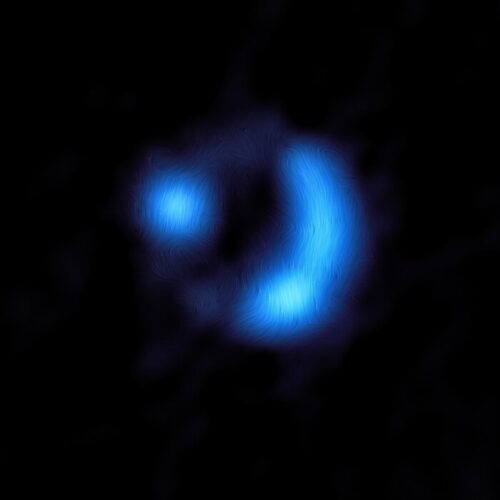
This image, taken with the Atacama Large Millimeter/submillimeter Array (ALMA), in which ESO is a partner, shows the young planetary system PDS 70, located nearly 400 light-years away from Earth. The system features a star at its centre, around which the planet PDS 70 b (highlighted with a solid yellow circle) is orbiting. On the same orbit as PDS 70b, indicated by a solid yellow ellipse, astronomers have detected a cloud of debris (circled by a yellow dotted line) that could be the building blocks of a new planet or the remnants of one already formed. The ring-like structure that dominates the image is a circumstellar disc of material, out of which planets are forming. There is in fact another planet in this system: PDS 70c, seen at 3 o’clock right next to the inner rim of the disc.

Using the Atacama Large Millimeter/submillimeter Array (ALMA), astronomers have found the possible ‘sibling’ of a planet orbiting a distant star. The team has detected a cloud of debris that might be sharing this planet’s orbit and which, they believe, could be the building blocks of a new planet or the remnants of one already formed. If confirmed, this discovery would be the strongest evidence yet that two exoplanets can share one orbit.

“Two decades ago it was predicted in theory that pairs of planets of similar mass may share the same orbit around their star, the so-called Trojan or co-orbital planets. For the first time, we have found evidence in favour of that idea,”

says Olga Balsalobre-Ruza, a student at the Centre for Astrobiology in Madrid, Spain who led the paper published today in Astronomy & Astrophysics.

Trojans, rocky bodies in the same orbit as a planet, are common in our own Solar System [1], the most famous example being the Trojan asteroids of Jupiter — more than 12 000 rocky bodies that are in the same orbit around the Sun as the gas giant. Astronomers have predicted that Trojans, in particular Trojan planets, could also exist around a star other than our Sun, but evidence for them is scant.

“Exotrojans [Trojan planets outside the Solar System] have so far been like unicorns: they are allowed to exist by theory but no one has ever detected them,”

says co-author Jorge Lillo-Box, a senior researcher at the Centre for Astrobiology.

Now, an international team of scientists have used ALMA, in which ESO is a partner, to find the strongest observational evidence yet that Trojan planets could exist — in the PDS 70 system. This young star is known to host two giant, Jupiter-like planets, PDS 70b and PDS 70c. By analysing archival ALMA observations of this system, the team spotted a cloud of debris at the location in PDS 70b’s orbit where Trojans are expected to exist.

Trojans occupy the so-called Lagrangian zones, two extended regions in a planet’s orbit where the combined gravitational pull of the star and the planet can trap material. Studying these two regions of PDS 70b’s orbit, astronomers detected a faint signal from one of them, indicating that a cloud of debris with a mass up to roughly two times that of our Moon might reside there.

The team believes this cloud of debris could point to an existing Trojan world in this system, or a planet in the process of forming.

“Who could imagine two worlds that share the duration of the year and the habitability conditions? Our work is the first evidence that this kind of world could exist,” […] “We can imagine that a planet can share its orbit with thousands of asteroids as in the case of Jupiter, but it is mind blowing to me that planets could share the same orbit.”

[says Balsalobre-Ruza.]

“Our research is a first step to look for co-orbital planets very early in their formation,”

says co-author Nuria Huélamo, a senior researcher at the Centre for Astrobiology.

“It opens up new questions on the formation of Trojans, how they evolve and how frequent they are in different planetary systems,”

adds Itziar De Gregorio-Monsalvo, ESO Head of the Office for Science in Chile, who also contributed to this research.

To fully confirm their detection, the team will need to wait until after 2026, when they will aim to use ALMA to see if both PDS 70b and its sibling cloud of debris move significantly along their orbit together around the star.

“This would be a breakthrough in the exoplanetary field,”

says Balsalobre-Ruza.

“The future of this topic is very exciting and we look forward to the extended ALMA capabilities, planned for 2030, which will dramatically improve the array’s ability to characterise Trojans in many other stars,”

concludes De Gregorio-Monsalvo.

Notes

[1] When asteroids in Jupiter’s orbit were first discovered, they were named after heroes of the Trojan war, giving rise to the name Trojans to refer to these objects.

=== Amazon Ad ===

Celestron – NexStar 130SLT Computerized Telescope –
Compact and Portable –
Newtonian Reflector Optical Design –
SkyAlign Technology –
Computerized Hand Control –
130mm Aperture