Here is a new selection of videos, articles, and news items about space habitats (govt and commercial), living in space, and space settlement.
=== International Space Station & NASA
** The International Space Station marks 25 years of continuous crew | SpaceNews on Youtube
The International Space Station marked the 25th anniversary of continuous human presence amid questions about what will replace it and when.
See also The International Space Station Marks 25 Years of Continuous Human Presence | NASA – Dec.2.2025
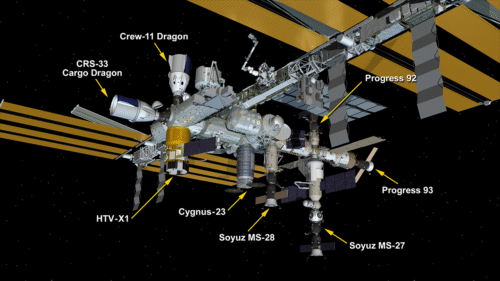
** ISS parking spaces full: Space Station First: All Docking Ports Fully Occupied, 8 Spacecraft on Orbit | NASA – Dec.1.2025
For the first time in International Space Station history, all eight docking ports aboard the orbital outpost are occupied following the reinstallation of Northrop Grumman’s Cygnus XL cargo spacecraft to the Earth-facing port of the station’s Unity module. The eight spacecraft attached to the complex are: two SpaceX Dragons, Cygnus XL, JAXA’s (Japan Aerospace Exploration Agency) HTV-X1, two Roscosmos Soyuz crew spacecraft, and two Progress cargo ships.
This milestone follows the reattachment of the Cygnus XL spacecraft, supporting the Northrop Grumman-23 commercial resupply services mission for NASA, which was removed last week by the robotics officer at the agency’s Mission Control Center in Houston using the space station’s Canadarm2 robotic arm. The Cygnus XL movement was coordinated between NASA, Northrop Grumman, and Roscosmos to provide appropriate clearance for the arriving crewed Soyuz MS-28 spacecraft on Nov. 27.
Cygnus will remain attached to the orbiting laboratory until no earlier than March 2026, when it is scheduled to safely depart and dispose of up to 11,000 pounds of trash and unneeded cargo when it harmlessly burns up in Earth’s atmosphere.
** HTV-X1 launch | SciNews
JAXA’s first HTV-X cargo transfer spacecraft (HTV-X1) was launched by the seventh H3 Launch Vehicle (H3-24W / H3 F7) from the Yoshinobu Launch Complex, Tanegashima Space Center, Japan, on 26 October 2025, at 00:00:15 UTC (09:00:15 JST). Credit: JAXA
See also JAXA’s HTV-X1 launched to ISS aboard H3 Rocket | NASASpaceFlight.com – Oct.25.2025
** NASA Astronaut Jonny Kim Advances Research Aboard Space Station | NASA Johnson
NASA astronaut Jonny Kim is wrapping up his first mission aboard the International Space Station in early December. During his stay, Kim conducted scientific experiments and technology demonstrations to benefit humanity on Earth and advance NASA’s Artemis campaign in preparation for future human missions to Mars. Take a look at some of the science Kim completed during his mission: https://go.nasa.gov/4atrCZb
** Astronaut Discuss Life In Space With The Washington Post’s Global Summit Thursday, November 20, 2025 | NASA Video
Aboard the International Space Station, NASA astronaut Zena Cardman discussed life and work aboard the orbital outpost during an in-flight interview Nov. 20 with attendees of the Washington Post’s Global Women’s Summit Meeting. Cardman is in the midst of a long-duration mission aboard the microgravity laboratory to advance scientific knowledge and demonstrate new technologies for future human and robotic exploration flights as part of NASA’s Moon and Mars exploration approach, including lunar missions through NASA’s Artemis program.
=== Commercial space habitats
** Axiom Space
— Habitat window view:
The AxEO (Axiom Space Earth Observatory) features 8 of the largest window panes ever constructed for space. The special acrylic formulation for the windows was tested on the exterior of the International Space Station and post-flight analysis confirmed its compatibility with the… pic.twitter.com/XhSCrarT9n
— Michael L-A (@CommanderMLA) December 5, 2025
— Axiom and Elevation Space to develop systems and techniques for sending and returning payloads to and from the Axiom space station: Axiom Space, ElevationSpace Sign Agreement to Assess High-Frequency Re-Entry and Recovery Services | Axiom Space – Oct.30.2025
Axiom Space, a leader in human spaceflight services and developer of era-defining space infrastructure, and ElevationSpace Inc., a pioneering Japanese startup specializing in space environment utilization and recovery platforms, have signed a Memorandum of Understanding (MOU) to explore collaborative opportunities in high-frequency re-entry and recovery services for commercial space stations.
This strategic partnership aims to leverage the strengths of both companies to enhance the capabilities of orbital infrastructure, including the future Axiom Station. The collaboration will focus on technology demonstrations involving ElevationSpace’s ELS-RS payload handling and re-entry/recovery systems, which are designed to optimize operations in low-Earth orbit and beyond. The ELS-RS system once complete, will provide capabilities to store scientific data/payloads under controlled conditions and return them quickly and safely to an exact, specified location on the planet. This will enable Axiom Space to deliver important research to our customers and partners with increased speed and flexibility.
— Axiom and Resonac to study semiconductor manufacturing in microgravity on the Axiom station : Axiom Space and Resonac Sign MOU to Advance Space-Based Semiconductor Manufacturing | Axiom Space – Oct.1.2025
Axiom Space, a leader in commercial space infrastructure, and Resonac Corporation (“Resonac”), a leading provider of cutting-edge materials solutions in the semiconductor industry, have signed a Memorandum of Understanding (MOU) to collaborate on the research, development and manufacturing of high-performance semiconductor materials in the environment of space. This collaboration paves the way toward leveraging microgravity to advance next-generation chip technologies and accelerate the in-space manufacturing market.
“The unique environment of space offers immense potential for advancing semiconductor materials, especially in crystal growth,” said Masato Fukushima, Resonac Chief Technology Officer. “Partnering with Axiom Space, we aim to accelerate experiments and drive innovation in materials, fostering industrial growth and societal progress.”
— Habitat window glass testing
Proof acceptance testing is underway for the Crew Quarter Window Glass Debris Pane. What seems like a simple screening is actually a detailed process that looks for flaws in each pane of glass by applying an envelope of loads the pane will experience through launch and while on… pic.twitter.com/L33paXINx3
— Axiom Space (@Axiom_Space) November 17, 2025
— Windows and shutters for the Axiom station:
Functional testing of the Crew Quarter Window Shutter Assembly is underway. Axiom Station crewmembers will be able to operate the window shutters from inside their rooms to block light, heat, and protect them from the orbital debris environment. pic.twitter.com/HtvSnhzFx1
— Axiom Space (@Axiom_Space) October 28, 2025
** Starlab – Voyager Technologies
— Interview with Dylan Taylor, CEO of Voyager: Space CEO explains why he believes private space stations are a viable business | Ars Technica – Dec.1.2025
… Time is running out for NASA if it wants to establish continuity from the International Space Station, which will reach its end of life in 2030, with a follow-on station ready to go before then.
One of the more intriguing companies in the competition is Voyager Technologies, which recently announced a strategic investment from Janus Henderson, a global investment firm. In another sign that the competition is heating up, Voyager also just hired John Baum away from Vast, where he was the company’s business development leader.
To get a sense of this competition and how Voyager is coming along with its Starlab space station project, Ars spoke with the firm’s chairman, Dylan Taylor….
— Habitat airlock
.@voyagertech_ brings proven flight heritage to Starlab. The Bishop Airlock, the first and only commercial airlock on the International Space Station, supports advanced robotics testing, on-orbit maneuvers, payload transfers, efficient trash deployment, and more. That same level… pic.twitter.com/xF24Rmp8tD
— Starlab (@Starlab_Space) December 1, 2025
— Cybersecurity audit passed
Starlab is proud to announce that we have successfully passed our CMMC Level 2 audit, a milestone achieved by less than 0.5 percent of companies in the Defense Industrial Base. This certification validates the strength of our cybersecurity program and confirms full implementation… pic.twitter.com/TwyvPCicNp
— Starlab (@Starlab_Space) December 3, 2025
— Reimagining Space Stations for the Commercial Age | SpaceNews on Youtube
In this episode of Space Minds, host Mike Gruss sits down with Marshall Smith, CEO of Starlab Space for a fireside chat at the Johns Hopkins University Bloomberg Center, the next installment of the Center’s Discovery Series.
In the fireside chat, they explored how today’s commercial space pioneers are turning concepts once rooted in science fiction into operational reality.
Smith reflects on his path from NASA engineer to leading the development of a next-generation commercial space station—one designed for science, manufacturing, and a future where private industry drives a sustainable economy in low Earth orbit. From market demand to design philosophy to the race toward a 2029 launch, Smith explains why he believes continuous human presence in space is essential, and how innovations in microgravity research and AI-driven operations could redefine what’s possible both on orbit and on Earth.
— Leidos Inc to provide assistance in assembly, integration, and testing of Starlab station: Starlab Names Leidos as Primary Assembly, Integration and Testing Provider | Starlab – Nov.5.2025
Today, we announced that @LeidosInc will lead Starlab’s U.S.-based assembly, integration and testing (AI&T) activities for our next-generation space station. The collaboration reflects Starlab’s ongoing strategy to align with proven aerospace leaders and reduce risk across… pic.twitter.com/pa099Gp9ry
— Starlab (@Starlab_Space) November 5, 2025
— Preliminary design review (PDR) of subsystems:
The second week of our subsystem PDR review is underway. We’re evaluating major elements, confirming that design requirements are met, and that systems are ready to advance toward final integration. Together, these reviews validate that the station’s architecture, subsystems, and… pic.twitter.com/UwNeLRi8Nm
— Starlab (@Starlab_Space) October 29, 2025
— Starlab conference: Starlab European User Conference – Berlin, Germany – Oct.20-22.2025
The inaugural Starlab European User Conference brings together industry professionals, Space Agency representatives, policy makers and researchers to explore how the Low-Earth Orbit and microgravity environment can be leveraged for high-impact research and the development of new products and technologies.
Attendees will learn about the latest advances in human space exploration and explore how Starlab’s cutting-edge capabilities will enable groundbreaking research in fields such as materials science, biotechnology, and Earth observation. The event offers a unique platform for networking, collaboration, and learning, featuring keynote speeches, panel discussions and workshops.
** VAST
— MOUs signed with two countries:
- Vast and the Maldives Space Research Organisation Sign Memorandum of Understanding to Engage Republic of Maldives Space Industry | VAST – Nov.25.2025
- Vast and the Colombian Space Agency Sign Memorandum of Understanding (MOU) to Advance Space Cooperation in Latin America | VAST – Nov.20.2025
— Docking adapter milestone:
Haven-1 docking adapter fit check at Vast headquarters. In October, we completed the fit check of Haven-1’s fully tested passive docking hardware—likely the first flight model passive docking adapter for a commercial station. This milestone marks a major step toward launch. pic.twitter.com/M5eI7GDcJL
— Vast (@vast) December 3, 2025
— Food systems development:
Our Food Systems team has completed its first in-house freeze-drying run. This marks a major step in our work to develop food designed specifically for spaceflight. Each batch helps us refine flavor, texture, and rehydration as we build a nutrition program for future crews. pic.twitter.com/LId43lKHpp
— Vast (@vast) November 26, 2025
— VAST launches 500 kg Haven Demo spacecraft to test technologies for Haven-1 space station: Vast completes Haven-1 structural testing, launches pathfinder mission | NASASpaceFlight.com – Nov.3.2025
Mission Success.
Haven Demo, our Haven-1 space station technologies test bed is now on orbit and healthy. Watch footage from our onboard cameras in full duration 4K. More to come. pic.twitter.com/nlVD3I5TpG
— Vast (@vast) November 4, 2025
— Meanwhile, Haven-1 construction and testing continues:
The next phase of Haven-1 begins.
The flight primary structure has returned to Vast headquarters in Long Beach, CA for the final weld inspections and integration. pic.twitter.com/P12hiDOqFX
— Vast (@vast) November 1, 2025
— Vast: American-made space stations | VAST Youtube
The final weld of Haven-1’s primary structure marks the completion of the first space station flight article to be built and manufactured in the US in over 20 years. It’s the third major structure that Vast has completed in two years.
— How Vast plans to keep humanity in orbit | SpaceNews
In this episode of Space Minds, host David Ariosto speaks with Max Haot, CEO of Vast, the ambitious aerospace company based in Long Beach, California, one of a very companies few working diligently towards the first commercial space station.
Just days after the successful launch of Vast’s pathfinder mission, Haot shares what it was like to see their Haven demo spacecraft come to life in orbit — from tense moments in the control room to the triumph of first contact. We talk about their next big step, Haven-1, set to become one of the first privately built, human-rated orbital habitat, and how Vast plans to ensure a seamless transition from the International Space Station to a new era of commercial space infrastructure. Haot also discusses safety, competition, and the future business of living and working in low Earth orbit — all part of Vast’s vision to make space permanently accessible.
…
Time Markers
00:00 – Episode introduction
00:33 – Welcome Max
00:45 – A big week
05:03 – Industry superstitions
05:52 – Purpose of the Haven demo mission
08:30 – Haven demo described (with on-orbit video)
10:14 – What is Haven-1
10:33 – Dragon spacecraft and Haven-1
13:17 – Safety and business pressures
20:25 – NASA collaboration and commercial balance
21:11 – Haven-2, Falcon Heavy and Starship
22:48 – Competition and the race for first
27:58 – Business model and customers
=== Chinese space habitats
** The Shenzhou-20 crew capsule suffered a debris impact in early November while docked to China’s Tiangong space station. This led to the Shenzhou-20 astronauts returning on the capsule that had brought the Shenzhou-21 crew to the station. A new capsule was subsequently sent uncrewed to the Tiangong station to use for the eventual return of the the Shenzhou-21 crew. The damaged capsule will be returned uncrewed.
- Shenzhou-20 spaceship to make uncrewed return to Earth: spokesperson | Xinhua – Dec.1.2025
- Shenzhou 22 launches uncrewed to Chinese Tiangong space station | NASASpaceFlight.com – Nov.24.2025
- Space junk strike on China’s astronaut capsule highlights need for a space rescue service, experts say | Space.com – Nov.22.2025
- China’s Shenzhou 20 astronauts return to Earth on different spacecraft after finding window cracks in their own (video) | Space.com – Nov.14.2025
- Chinese astronauts face delayed return to Earth after spacecraft possibly hit by small debris | Orlando Sentinel – Nov.11.2025
- Space debris may have hit a Chinese spacecraft, delaying return of Shenzhou 20 astronauts | Space.com – Nov.5.2025
— Shenzhou 21 Completes Record 13-Day Mission, Rescues Crew from Tiangong Space Station | CNSA Watcher
— Shenzhou-21 spacecraft lands on Earth after 204-day space mission | CNSA Watcher
The Shenzhou-21 manned spacecraft successfully returned to Earth on November 14, 2025. Astronauts Chen Dong, Chen Zhongrui, and Wang Jie safely exited the spacecraft in good health after a 204-day space journey. Congratulations to them on setting a new record for the longest individual stay in orbit by Chinese astronauts.
** Shenzhou-21 docking | SciNews
The Shenzhou-21 crew spacecraft autonomously docked to the forward port of the Tianhe Core Module (天和核心舱) on 31 October 2025, at 19:22 UTC (1 November, at 03:22 China Standard Time). Shenzhou-21 (神舟二十一) is the tenth crew of three astronauts on a mission to the China Space Station (中国空间站): Zhang Lu (张陆, commander), Wu Fei (武飞) and Zhang Hong Zhang (张洪章).
Credit: China National Space Administration (CNSA)/China Central Television (CCTV)
Shenzhou-21 docking
** Shenzhou-21 hatch opening | SciNews
The Shenzhou-21 crew entered the Tianhe Core Module (天和核心舱) on 31 October 2025, at 20:58 UTC (1 November, at 04:58 China Standard Time). Shenzhou-21 (神舟二十一) is the tenth crew of three astronauts on a mission to the China Space Station (中国空间站): Zhang Lu (张陆, commander), Wu Fei (武飞) and Zhang Hong Zhang (张洪章).
Credit: China National Space Administration (CNSA)/China Central Television (CCTV) Shenzhou-21 hatch opening,
** Shenzhou-20 and Shenzhou-21 crews are grilling chicken wings in Tiangong space station. | CNSA Watcher – Archives
Wow, the Shenzhou-20 and Shenzhou-21 crews are grilling chicken wings in the space station, according to a video on China Aerospace’s Weibo account.
=== In-space habitation
** Joe Carroll talks spin and artificial gravity. Joe made a special presentation to this program that you will want to see. – The Space Show, Tuesday, Oct. 14, 2025
=== Lunar habitation
** Another Burst in the Books: Inflatable Habitat Test | Lockheed-Martin on Youtube
We recently conducted our fourth inflatable habitat burst test in Littleton, Colorado—this time featuring a new penetration plate, an opening that could one day serve as a window or hatch for an astronaut.
The test reached 267 psi—over five times its design pressure—demonstrating the strength and reliability of our inflatable habitat technology.
As humanity moves closer to returning to the Moon through NASA’s Artemis program, we are advancing technologies that will enable astronauts to live and work safely in space, paving the way for a sustainable lunar economy and beyond.
See also:
- Another Burst in the Books! | Lockheed-Martin – Oct.8.2025
- Lockheed Martin’s Lunar Inflatable Habitat Passes Key Burst Test | Aviation Week Network – Nov.13.2025
- Inflatable Habitats: Expanding Space Exploration | Lockheed Martin – Feb.12.2024
** International Lunar program sustainability: ISS lessons learned as applied for Lunar exploration | Space Renaissance
Abstract:
The International space station program is a humanity’s achievement from many different perspectives.
15 nations are united together to design, construct and operate the in-orbit technical and scientific facility with permanent human presence for 25 years (38 years taking into account previous orbital station – MIR).
Now we’re at the stage when we’re aiming to keep our LEO capabilities and at the same time to make a next step – to establish peaceful research and exploration of the Moon and Cis-Lunar space.
The subject of the lecture is to highlight the perspectives of Lunar exploration as an international endeavor and to show how technical and programmatic principles of the ISS program will help to provide necessary sustainability of the International Lunar program.
Bio:
Dmitry Zarubin, Engineering Fellow Space Research Institute of the Russian Academy of Sciences. Key responsibilities are Systems Engineering and Project Management in Lunar Exploration. Previously Dmitry was a part of the ISS Roscosmos and RSC Energia managment team, participant and a co-chair of several ISS and Lunar Gateway technical teams. Dmitry is a member of the IAF Space Exploration and Human Space Flight Committees. Founding member of the IDSEA (International Deep Space Exploration Association, China). An expert for COPUOS Action Team on Lunar Activities Consultation (ATLAC).
=== Settlement
** SRIC4 #04: “The Civilization Survival Scale and Space Settlement” | Space Renaissance
Abstract:
The Civilization Survival Scale provides a powerful argument based in evolutionary biology for human expansion into space. It recognizes that the survival of a civilization, as the survival of a species, is dependent on its ability to adapt highly diverse and changing habits. Unlike the very popular Kardashev Scale, which is built around ever greater energy consumption, the Civilization Survival Scale is based firmly on the principles of evolutionary biology. It recognizes that the survival of human civilization lies in replacing the brute force approach of the Kardashev Scale with a scientific approach based on acquiring the technology and knowledge to adapt to diverse habitats.
The technology we develop to build communities in diverse habitats throughout the Solar System will expand our ability to thrive in diverse environments here on Earth. Rather than abandoning the Earth, the Civilization Survival Scale demonstrates how humanity expanding into the Solar System and beyond enhances the survivability and quality of life for humans on Earth. The advanced food production systems required to sustain communities in space will enable farming on Earth to become more resilient to environmental disruptions while expanding it to new environments. Similarly, recycling technology developed by communities in space will be used to reduce the environmental impact of communities on Earth. The Civilization Survival Scale provides a solid scientific foundation for justifying our need to evolve into a spacefaring society. It illustrates that the best hope of humanity surviving into the future is to become a Level 2 Civilization on the Civilization Survival Scale by developing the technology to multiple habitats in our solar system.
An essential Bio:
Thomas L. Matula, Ph.D. is a Professor of Business Administration at Sul Ross State University in Texas and holds a Ph.D. in Business Administration from New Mexico State University. Sul Ross State University is now offering an MBA in Space Commerce. This is an excerpt from a book in progress: Astrosettlement: An Evolutionary Strategy for Space Settlement..
** LivingInSpace Workshop 13.11.2025 | Space Renaissance
The Living in Space Workshop was organized by ACES Worldwide and Space Renaissance International (SRI), with the support of 14 organizations, including The Alliance for Collaboration in the Exploration of Space (ACES Worldwide); Space Renaissance International (SRI); the National Space Society (NSS); the Moon Village Association (MVA); the International Moonbase Alliance (IMA), The Space Development Foundation Inc. (SDF); The Mars Society; Life to and Beyond; For All Moonkind; the Lifeboat Foundation; Space and Satellite Professionals International; the Alternatively Planetary Futures Institute, and Innova Space.
The following presentations were given:
• Joseph Pelton (US) Chair of ACES Worldwide “Introduction of Living-in-Space Initiatives and Plans for Future and 14 Alliance members”
• Adriano V. Autino (ITALY) Space Renaissance International (SRI) CEO & Founder “SRI IV World Congress and Registration Information”
• Armen Papazian (UK) Economist and Author (UK & UAE) “The Monetization of Space”
• Werner Grandl (AUSTRIA) SRI Board, Chair on Space Habitats Committee, Architect (Austria) “The Simulation of Gravity in Rotating Space Habitats”
• Bernard Foing (NETHERLAND) SRI President, LUNEX Chair, Retired ESA Scientist “Space for All”
• Susan Jewell (US) MD, SRI Board, CEO of Mars-Moon Astronautics Academy and Research Science (MMAARS) “Integrative Space Health, Agentic AI and Precision Medicine”
• Peter Swan (US) Chief Architect, International Space Elevator Consortium “Modern-Day Space Elevators, as Permanent Space Transportation Infrastructures and how they will open up Space!”
• Frank White (US) author of The Overview Effect: Space Exploration and Human Evolution “Advances in Rockets and Robots”
• Upasana Desgupta (INDIA) Assoc. Prof. of Space Law, India, ACES WW Vice Chair “Space Policy & Regulation for Deep Space Exploration, Development & Settlements”
• Thais Russomanno (BRAZIL, UK) MD. CEO of Innova Space “Latest Advances in Space Medical Research”
• James Green (US) Former Chief Scientist of NASA “Space Shields to Terraform Mars”
• Luigina Feretti (ITALY) SRI, Former Director of Istituto di Radioastronomia (INAF) “Protection from solar and cosmic radiations: state of the art “
• Eric Dahlstrom (NZ) co-founder of Space institute of NZ and Vatasala Khetawat (INDIA) “Advances in Nuclear Fusion Space Transportation Systems and their Safey for Deep Space Missions”
• Adriano V. Autino (ITALY) SRI CEO & Founder “Living and Working in Free-Space: a Choice of Freedom!”
• Joseph Pelton (US) Chair of ACES Worldwide “Living in Space Workshop conclusions”
** Railroad to Mars, with Halen Mattison (CEO of General Galactic) | Arkaea Media Group
Halen Mattison left SpaceX because Elon told him his vision was too long-term. He wanted to build the propellant infrastructure that would unlock Mars and everything between here and there, but the timeline didn’t fit SpaceX’s roadmap. So he started General Galactic to do it himself.
His team is developing Genesis, a water electrolysis propulsion system that delivers hydrazine-level thrust and xenon-level efficiency using the safest, cheapest, most abundant propellant in the solar system. The company is targeting an orbital demonstration in 2026, with a long-term vision to operate refueling depots from LEO to Mars.
Inside the episode:
• Why the space industry’s fear of new technology is creating a sitting-duck opportunity
• How water electrolysis unlocks both near-term mobility services and long-term ISRU infrastructure
• What “specific impulse” actually means for mission economics and why it matters more than people think
• The Starship refueling challenge and why cryogenic propellant depots will work at scale
• Sequencing from mobility-as-a-service to lunar fuel production to gas stations on Mars
• Why consensus-following investors miss the most ambitious bets and how to tell the contrarian story
=== Other space habitat and settlement news and articles:
- Calendar:
- Beyond Earth Symposium: From Space Habitat to Space Town: Creating a Clear Pathway, American University Washington College of Law, Washington D.C., February 24-25, 2026. | Beyond Earth Institute
- National Space Society‘s 44th Annual International Space Development Conference (ISDC) 2026, June 4-7, 2026, McLean, Virginia
- ISS:
- Station Trio Nears Departure During Busy Day of Blood Research | NASA – Dec.4.2025
- Hatches Open, Station Crew Expands to 10 | NASA – Nov.27.2025
- NASA Astronaut Chris Williams, Crewmates Arrive at Space Station | NASA – Nov.27.2025
- Three Crewmates Aboard Soyuz Approaching Station for Docking | NASA – Nov.27.2025
- Trio Aboard Soyuz Launches to Station for Docking Today | NASA – Nov.27.2025
- The Overview Effect: Astronaut Perspectives from 25 Years in Low Earth Orbit | NASA – Nov.23.2025
- Week Wraps with Fluid Physics, Stem Cell Research as New Crew Preps Begin | NASA – Nov.21.2025
- 25 Years of the International Space Station: What archaeology tells us about living and working in space | Phys.org – Nov.10.2025
- ‘Space Explorers: Ultimate Edition’ VR app brings users to ISS and space to their homes | collectSPACE – Nov.3.2025
- Resources:
- ISS | NASA
- ISS in Real Time – “Explore 25 years onboard the International Space Station. This multimedia project replays every day of the past 25 years onboard and consists entirely of historical mission material.”
- ISS Archaeology | Boldly Going Where No Archaeologists Have Gone Before
- Amateur Radio on ISS (ARISS)
- Commercial habitats:
- China:
- Europe:
- ESA Confirms Bold Move to Build the Moon’s First-Ever Space Station | Daily Galaxy – Dec.2.2025
- ESA Commits to Being an Anchor Customer for LEO Cargo Return Services | European Spaceflight – Nov.28.2025
- ESA to Procure ISS Cargo Service to Meet Common Cost Obligations | EuropeanSpaceflight.com – Oct.6.2025
- Russia
- Lunar habitation & settlement
- OrbitAID and ispace Sign Memorandum of Understanding Aimed at Developing Sustainable Lunar Infrastructure | ispace – Oct.23.2025
- Blue Origin details lunar exploration progress amid Artemis 3 contract shakeup | Spaceflight Now – Oct.28.2025
- Closing the Loop on Lunar Exploration: Material Return | Payload – Oct.29.2025
- China’s is on Track to Beat the US to Extract Lunar Water | Payload – Oct.24.2025
- Update on NASA’s Human Landing System (HLS) Program: Public-Private Partnership Advancing Artemis Sustainable Lunar Exploration | NASA Technical Reports Server (NTRS) – Sept.29.2025
- To the Moon (and Beyond): How Impulse Can Deliver More Mass to the Lunar Surface | Impulse Space – Oct.14.2025
- New DARPA ‘field guide’ looks for ways to jump-start a moon economy | Space.com – Oct.5.2025
- Mars habitation & settlement
- Habitat technologies:
- Settlement technologies:
- General settlement topics:
- First Wheelchair User in Space | Leonard David – Nov.26.2025
- “Live in a Healthy Space” Design Contest | NSS – Fall 2025 Contest is now open. Entries must be submitted by November 30, 2025, 11:59 pm Pacific Standard Time.
- Best of the Rest: Lunar and Mars Day 1 | Payload Space – Oct.15.2025
- Payload’s Lunar and Mars Economy Summit: Day 2 | Payload Space – Oct.16.2025
- Funding Colonisation: How do we pay for the grand ambition of populating the solar system? | Peter Hague at Planetocracy – Oct.6.2025
- Resources:
=== Earth views from ISS
** This Week in Orbit | 4K Earth Views from Space (Nov 20–26, 2025) | Sen
Take a peaceful break above the world. This week’s episode brings you more mesmerising 4K views of Earth from Sen’s cameras aboard the International Space Station — captured between 20–26 November 2025.
Float over cities, coastlines, storms, mountains and oceans and create a calming, inspiring orbit around our planet. Perfect for relaxation, studying, focus, mindfulness, sleep, or simply reconnecting with the beauty of Earth.
** Live Video from the International Space Station (Official NASA Stream) | NASA
Watch live video from the International Space Station, including inside views when the crew aboard the space station is on duty. Views of Earth are also streamed from an external camera located outside of the space station. During periods of signal loss due to handover between communications satellites, a blue screen is displayed.
The space station orbits Earth about 250 miles (425 kilometers) above the surface. An international partnership of five space agencies from 15 countries operates the station, and it has been continuously occupied since November 2000. It’s a microgravity laboratory where science, research, and human innovation make way for new technologies and research breakthroughs not possible on Earth. More: https://go.nasa.gov/3CkVtC8
Did you know you can spot the station without a telescope? It looks like a fast-moving star, but you have to know when to look up. Sign up for text messages or email alerts to let you know when (and where) to spot the station and wave to the crew: https://spotthestation.nasa.gov
====
====

=== Amazon Ads ===
Lego Ideas International Space Station
Toy Blocks, Present, Space, Boys, Girls, Ages 16 and Up
====
Outpost in Orbit:
A Pictorial & Verbal History of the Space Station