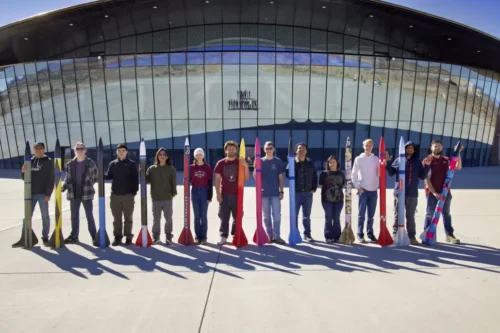
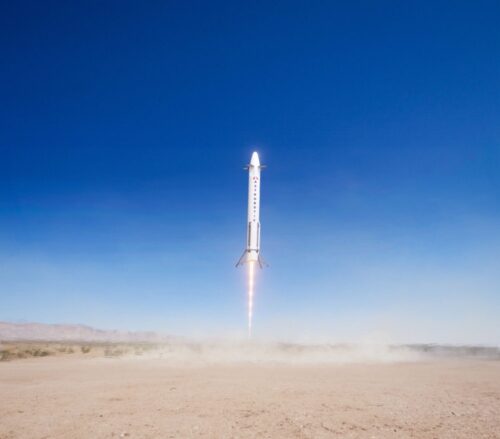
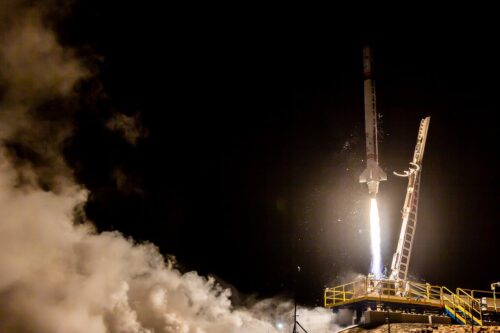
Students from New Mexico State University (NMSU) and the Albuquerque Heights Composite Squadron (a.k.a. Spirit Squadron), unit NM-083 of the Civil Air Patrol, completed a series of rocket launches at Spaceport America on Saturday, Feb. 14, 2026.
Saturday’s event was coordinated in part by NMSU Mechanical and Aerospace Engineering student Joshua Davila, who serves as the Atomic Aggies’ (the competition rocketry team of NMSU) National Association of Rocketry (NAR) Section #982 President and Solid Propulsions Lead. In addition to identifying the NAR fliers from NMSU, Davila also involved seven American Rocketry Challenge (ARC) teams throughout the region to promote Saturday’s event as an opportunity to conduct preliminary launches.
“We, the Atomic Aggies, are incredibly proud of the growing community of local rocketry enthusiasts we are building connections with,” said Davila. “We’re thrilled to have local American rocketry challenge teams joining us for launches at Spaceport America.” The NMSU students who launched represented the Atomic Aggies Rocketry Team. Of the team members in attendance, 10 earned their Level 1 certifications from the National Association of Rocketry (NAR) for succeeding in launching their rockets up to 1,700 feet. Of the 11 rockets launched from the spaceport, 10 achieved successful flights.
Led by Lt. Col. Michael O’Dell, the Albuquerque Civil Air Patrol team members were able to launch their rocket three times, completing the preliminary work for their ARC launches. The ARC is the world’s largest student rocket competition, and boasts over 1,100 middle and high school teams who will be competing at Great Meadow Foundation in The Plains, Va., in May of 2026.
“The annual American Rocketry Challenge provides our Civil Air Patrol cadets a five-month long hands-on science and engineering challenge, and they love it,” O’Dell commented. “I brag about our students and how bright they are, but for me this represents another opportunity; to showcase New Mexico. This group and those that follow will all go off to universities and set loftier goals and with this experience coupled with these types of partnerships, we can keep some of them right here in our state.”
…
New Mexico students brought rockets they designed and built to Spaceport America on Saturday, Feb. 14, 2026 and launched them. Credits: Spaceport America
The Friends of Amateur Rocketry – Oxidizers Uninhibited Tournament (FAR‑OUT) is back, bringing one of the most innovative grassroots rocketry competitions in the country to the Mojave Desert. This first‑of‑its‑kind event showcases commercial‑off‑the‑shelf (COTS) hybrids, research hybrids, and research liquid engines as teams compete to most accurately hit a pre‑simulated “contract” apogee. With scoring groups ranging from 5,000’ to 110,000’—and exhibition flights reaching up to 240,000’—FAR‑OUT highlights precision engineering at every level. Teams may also static fire on‑site to demonstrate motor efficiency.
The tournament kicks off Wednesday, May 27, 2026, with an opening ceremony and technical conference at the Stuart Witt Event Center at Mojave Air & Space Port. The conference features poster sessions, podium presentations, and industry tours with local aerospace partners. Setup and test days run Thursday and Friday, followed by three full days of launches from May 30 through June 1 at the Friends of Amateur Rocketry site. FAR‑OUT continues to grow as a celebration of experimental rocketry, hands‑on engineering, and the unique flight‑test ecosystem of Mojave.
Such technology should eventually lead to space transports with aircraft-like operation. That is, orbital flight and return followed by rapid reflight with minimal preparation. Vehicles should fly thousands of times with only occasional refurbishment and, most importantly, spacefare should fall to levels similar to long distance airfare.
In the decades following the launch of Sputnik 1, missile derived expendable launchers dominated and progress towards reusable transports moved at a slow crawl. The one major attempt at reusablity, the Space Shuttle, was a major disappointment, providing no reduction in space transport costs due to the lengthy refurbishment and component replacements after each flight. However, progress sped up considerably in the past decade with the arrival of the SpaceX Falcon 9, whose boosters have achieved 276 reflights and 305 landings as of May.8.2024.
Reusable rocket powered vehicle designs fall roughly into the following five categories:
Below are reports on several projects and programs that fall into at least one of these categories.
** SpaceX Starship – Preparations for 4th test flight, Elon Musk design update, construction of new launch tower, etc.
Starship news highlights since the last update:
The 4th test flight is expected by end of May and could happen as early as the middle of the month.
Elon Musk gave an update to an assembly of workers at Starbase in Boca Chica, Texas. Some items of interest:
The 4th test flight will attempt a soft landing of the booster onto the Gulf of Mexico waters.
The sea landing will emulate the return of a booster into the grasp of the mounting arms (i.e. the flycatcher) on the launch tower. If this goes well, the fifth test mission may attempt an actual booster catch on the launch tower at Starbase.
The priority for the Starship upper stage is to survive reentry and a soft landing on the water.
Starship will need to survive several ocean returns before attempting a tower catch.
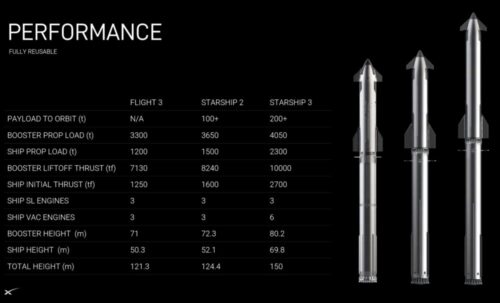
The Starship Version 3 will take 200+ tons to orbit using upgraded Raptor engines, 6 engines instead of 3 in ship stage, and longer stages. (See Starship Performance table below.)
Establishing a self-sustainable city on Mars remains the top priority.
A lunar base will be a side-benefit of the Mars program.
The fluid transfer test on the 3rd test flight went well.
The transfer of propellants between two Starships in orbit will be tested in 2025.
The uncrewed Starship lunar landing demo mission will also include lifting off from the lunar surface.
The goal of SpaceX is to build the technologies necessary to make life multiplanetary. This is the first time in the 4-billion-year history of Earth that it’s possible to realize that goal and protect the light of consciousness.
At Starbase on Thursday, April 4, SpaceX Chief Engineer Elon Musk provided an update on the company’s plans to send humanity to Mars, the best destination to begin making life multiplanetary.
All of SpaceX’s current programs, including Falcon, Dragon, Starlink, and Starship are integral to developing the technologies necessary to make missions to Mars a reality. The update included near-term priorities for Starship that will unlock its ability to be fully and rapidly reusable, the core enabler for transforming humanity’s ability to send large amounts of payload to orbit and beyond. With more flight tests, significant vehicle upgrades, and missions returning astronauts to the surface of the Moon with NASA’s Artemis Program all coming soon, excitement will continue to be guaranteed with Starship.
The talk also includes the mechanics and challenges of traveling to Mars, along with what we’re building today to enable sending around a million people and several million tonnes to the Martian surface in the years to come.
At Starbase, @ElonMusk provided an update on the company’s plans to send humanity to Mars, the best destination to begin making life multiplanetary pic.twitter.com/PiX8XOgQs5
** Some slides and videos of interest from Elon Musk’s presentation:
Starship upgrades
A comparison of the performance for three generations of Starship designs. Table shown by Elon Musk in Starbase talk on April 4th. Credit: SpaceX
Catching a Super Heavy booster:
The update included near-term priorities for Starship that will unlock its ability to be fully and rapidly reusable, the core enabler for transforming humanity’s ability to send large amounts of payload to orbit and beyond pic.twitter.com/bkxS7fNSnt
The propellant transfer test on third flight apparently went well according to Amit Kshatriya, the deputy associate administrator for NASA’s Moon to Mars Program:
“He also noted that the inter-tank cryogenic propellant transfer test on the third Starship flight last month was successful by all accounts, although analysis of data from it is ongoing.” – Jeff Foust on Twitter
Kshatriya provide two slides outlining the propellant transfer demonstration mission:
** Kshatriya confirmed the fourth flight test should happen in May:
NASA’s Amit Kshatriya says at an advisory committee meeting this morning that the agency expects SpaceX to attempt its next Starship/Super Heavy test flight by the end of May.
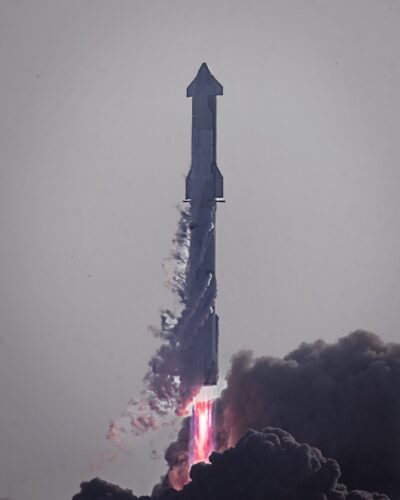
On March 14, 2024, Starship successfully lifted off at 8:25 a.m. CT from Starbase in Texas and went on to accomplish several major milestones and firsts.
Starship’s six second stage Raptor engines all started successfully and powered the vehicle to its expected orbit, becoming the first Starship to complete its full-duration ascent burn. Starship went on to experience its first ever entry from space, providing valuable data on heating and vehicle control during hypersonic reentry. Live views of entry were made possible by Starlink terminals operating on Starship.
This rapid iterative development approach has been the basis for all of SpaceX’s major innovative advancements, including Falcon, Dragon, and Starlink. Recursive improvement is essential as we work to build a fully reusable transportation system capable of carrying both crew and cargo to Earth orbit, help humanity return to the Moon, and ultimately travel to Mars and beyond.
** “Ellie in Space” interview with Eric Berger, who is following up on his book Liftoff[commission link] about the early days of SpaceX with a new book titled Reentry [commission link], which focuses on the development of the reusable Falcon 9 and its impact on the space industry.
For lots of background info on Starship, see the SpaceX Starship report, which is published by NewSpace Global and for which I was the primary author. The initial version came out in March 2023 and then we updated it in May 2023 to include coverage of the first flight test.
==================
Check out the The Lurio Report
for news and analysis of key developments in NewSpace
The latest issue: Starlink’s Progress, Vulcan, Moon Landing Attempts
Vol. 19, No. 1, February 2, 2024
Space Frontier Foundation Award for NewSpace Journalism
— Falcon 9 booster achieves 20 flights for the first time.
Since its first mission in November 2020, this single first stage has launched eight astronauts and more than 500 satellites, totaling 261+ metric tons to orbit in under four years pic.twitter.com/FVQwhAJto6
As of May 2nd, three boosters had reached 20 flights. Flying 20 times was the most recent milestone for F9 booster reuse. Elon Musk in January said the next goal is to qualify F9 boosters for 40 flights.
The engines on the boosters can be swapped out between flights and used on different boosters. Some engines have now been reused more than the most-flown booster:
Main engine cutoff and stage separation. One of the nine Merlin engines powering tonight’s first stage is our flight leader, powering its 22nd mission to Earth orbit pic.twitter.com/xkTrPdOdsW
… SpaceX is now launching at a rate of one mission every 2.7 days this year. Consider that, from the mid-1980s through the 2010s, the record for the total number of launches worldwide in any given year was 129. This year alone, SpaceX is on pace for between 130 and 140 total launches.
But with Tuesday evening’s mission, there was a singular number that stood out: 300. The Falcon family, which includes the Falcon 9 and Falcon Heavy boosters, recorded its 300th successful first-stage landing.
…
In the fleet’s lifetime, then, SpaceX has landed about 85 percent of the Falcon rockets it has launched. These days, more than 90 percent of all its missions launch on previously flown boosters. So rocket recycling is totally a thing.
** More Falcon 9 news and articles:
With the Maxar-1 launch of two Worldview satellites on May 2nd, “Falcon 9 has now successfully delivered payloads into orbit successfully 300 times in a row since the Amos 6 explosion.” – Alejandro Alcantarilla Romera (Alex)
it is returning a previously flown Electron rocket first stage tank into the Electron production line for the first time in preparation for reflying the stage. The step is a significant milestone in Rocket Lab’s development program to make Electron the world’s first reusable small orbital launch vehicle.
The booster was recovered from mission in January. This is the same booster structure but presumably with different engines and/or other supporting subsystems.
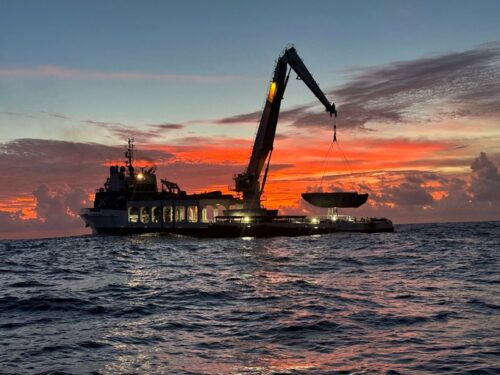
Rocket Lab has successfully recovered multiple Electron first stages from previous missions by returning them to Earth under a parachute after launch, splashing them down in the ocean, then collecting them onto a specially modified boat for transfer back to Rocket Lab’s production complex. All previously recovered boosters have undergone extensive analysis to inform an iterative development process to make Electron reusable, but this is the first time a tank has been moved back onto the standard production line in preparation for reflight.The stage was successfully launched and recovered as part of the ‘Four of a Kind’ mission on 31 January 2024 and has already passed more acceptance tests than any other recovered Electron stage, including:
Tank pressurization test – a process that filled the carbon composite tank with inert gas and held it in excess of maximum operating pressure for more than 20x longer than the standard Electron flight duration;
Helium leak check – a stringent process that determines there are no leaks in the tank; and
Carbon fiber structural testing – including ultrasonic assessment and other non-destructive tests to confirm no delamination of the carbon composite tank fibers.
The tank will
undergo final fit out and rigorous qualification and acceptance testing to the same standard as a brand-new Electron tank to determine the recovered stage’s suitability for reflight.
If successful, this would be the second rocket to reuse a liquid fuel booster tank following SpaceX’s success with reuse of the Falcon 9 first stages.
** Testing begins for first complete Archimedes engine. Nine of Archimedes engines will power the first stage of the reusable Neutron rocket and one in a configuration for vacuum will power the second stage.
Isn’t it beautiful!? Say hello to our first complete Archimedes engine.
It’s already out the door of our Engine Development Complex in Long Beach and installed on the test stand in Mississippi at @NASAStennis ready for first hot fire.
Fun Fact: The photo below was taken just a few hours from the one above. Engine went from checkout tests in Kent, WA to the test site in Moses Lake, WA & installed on the stand all within a day. A huge advantage to our speed is proximity of our test site. #rapidbydesignpic.twitter.com/lXgf1vushg
** Relativity Space– Focus on Terran R development with initial launch in 2026
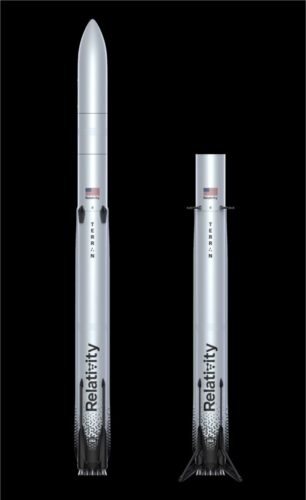
Relativity is making progress on development of the Terran R mid-range launcher with a reusable first stage. The current expectation is for the first launch to happen in 2026. The company recently chose not to compete for a military launch contract since it required launches in 2025: Relativity Space delays NSSL bid, focuses on 2026 Terran R debut | SpaceNews – Apr.10.2024
— Progress on Cape Canaveral launch facility:
Soarin’ over Launch Complex 16, Cape Canaveral, FL. – making room for something big, #TerranR launch pad in progress.
✔️ Site cleared
✔️ Site grubbed
Waterline install in progress pic.twitter.com/WxQyoWxYVg
— Relativity tests the aerodynamics of the Terran R design: Relatively Speaking: Wind Tunnel Terran R Testing Explained
Join the aerodynamics team on a behind the scenes deep dive into Terran R wind tunnel testing at NASA Langley Unitary Plan Wind Tunnel facility.
Simulating a Terran R flight, the data collected is crucial in determining driving load cases for a reliable and reusable Terran R, informing critical design points and cases to ensure stage 1 landing back on Earth.
00:00 – 00:44 Why invest in a model and wind tunnel testing? 00:45 – 1:04 What are the key advantages of wind tunnel testing? 1:05 – 1:43 What is a wind tunnel? 1:44 – 2:10 NASA Langley UPWT facilities overview 2:11 – 2:55 Testing objectives 2:55 – 3:31 Units of measurement: Mach, Reynolds, and Schlieren 3:32 – 4:13 End goal: Stage 1 safe re-entry
The sounds of @NASA Stennis Space Center—from E1 thrust chamber assembly testing to E2 gas generator and R Stand engine testing—enjoy. 1,000+ tests in the books including over 50 Aeon R engine tests and counting since the R Stand was activated in October 2023.
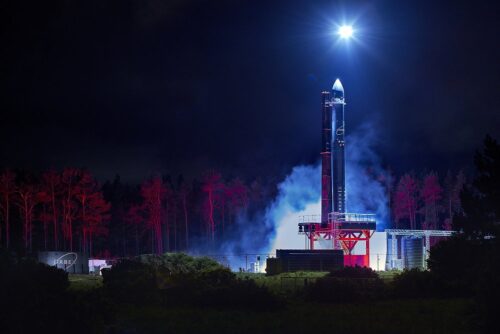
Orbex is a UK company based in Scotland that is developing a two-stage rocket vehicle they call Orbex Prime. The Prime’s first stage is reusable. The 19 meter tall rocket will put payloads up to 180 kg into a sun-synchronous orbits when launched from the company’s spaceport, currently under construction in Sutherland, Scotland. The company was founded in 2015 and has raised backing from private and government sources including ESA and UK.
The company has developed its own engines. The first stage uses six engines and the upper stage one. The engines burn a bio-propane fuel, which the company says is “that cuts carbon emissions by 90% compared to old-fashioned hydrocarbons“.
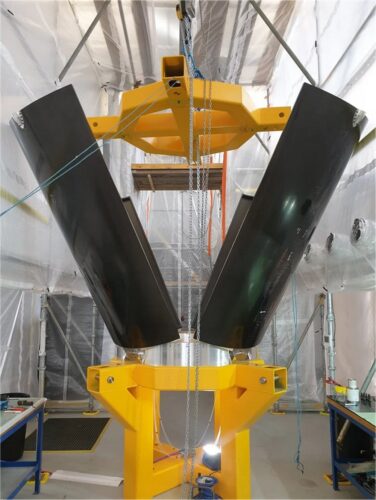
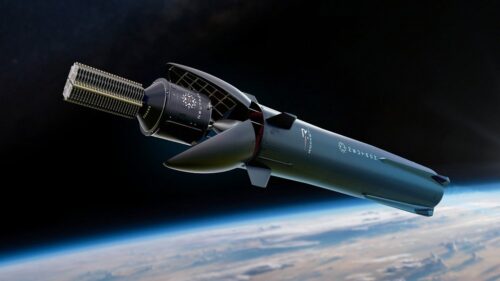
Orbex’s Prime rocket will consist of two stages, and the REFLIGHT system repurposes the interstage structure located between the stages. After Stage 1 detaches from Stage 2, the interstage on top of Stage 1 reconfigures into four ‘petals’ which fold out and create drag forces that passively reorients and slows the spent rocket stage’s descent to Earth.
The company claims this technology
enables recovery of the launch vehicle by repurposing existing structural features, while adding very little additional weight to the vehicle. It thereby enables reusability with very limited overall performance penalty and no additional rocket propulsion emissions in the upper atmosphere during re-entry. This should be compared to other reusable launch systems using powered descent (rocket engine firings) to slow down the vehicle during re-entry and landing.
A prototype of the Petal Fold drag brake system for Orbex Prime rocket: Credits: Orbex
The stage will be recovered at sea:
In combination with a lightweight parachute the drag created by the petals will enable Stage 1’s to perform a low velocity landing at sea.
Orbex will then recover the floating Stage 1 and return it to its factory in Forres for refurbishment and/or recycling. During descent and recovery, there will be no debris left in orbit, on land or in sea, creating a ‘circular rocket economy’.
The company was also awarded a patent for “coaxial tank structure” design that situates the fuel tank within the liquid oxygen tank: Coaxial Tank Patent Orbex | Orbex – Feb.2024
Very small rockets which copy the traditional `stacked` tank architecture of larger rockets are less efficient and cost-effective than their larger counterparts, because they carry much less fuel per unit of ‘dry mass’. This central inefficiency was the major engineering challenge that the Orbex team set out to solve with the Orbex Prime architecture.
The Orbex team created a unique answer to that challenge, by nesting the fuel tank within an outer tank of liquid oxygen. This tank arrangement has unique synergies with Orbex’s choice of bio-propane as a rocket fuel because bio-propane does not freeze solid when chilled to the same temperature as liquid oxygen. The coaxial tank structure thus removes surplus components and sub-systems such as insulation, extra bulkheads, external pipework, heavy tank walls and thermal conditioning equipment.
The first launch of Prime should be within the next year or so.
** Radian Aerospace – Single-stage-to-orbit (SSTO) spaceplane with sled launch
A rocket-driven sled would hurl the Radian One winged vehicle on a trajectory to orbit after a quick trip down a 2-mile long track. (Arguably, the sled is a booster stage.)
Five methane/liquid oxygen engines power the vehicle in the latest design. The sled would used three of the same engines. Radian One is designed to carry as many as 5 passengers to LEO and a total payload of up to 2270 kg . The vehicle can return from orbit with up to 4540 kg and land at any airport with a long enough runway. The goal is a 48-hour turnaround for reflight.
Introducing #RadianOne! Today, we’re revealing the latest renders of Radian One’s groundbreaking design as well as our new website! We’re thrilled to unveil the revolutionary capabilities of the world’s first fully integrated #spaceplane.
The company aims to fly by 2030 and provide transportation services to the commercial space stations that are expecting to be operating by then. The company raised $27M in 2022 and is currently pursuing a new funding round.
Here is an interview with Livingston Holder, Radian’s CTO and a cofounder (posted Apr.30.2024):
The first single-stage-to-orbit (SSTO) space plane? That’s exactly what we’re discussing on this week’s Pathfinder podcast. We interview Livingston Holder, cofounder and CTO of Radian Aerospace, which is developing a fully reusable space plane designed for horizontal launch and landing.
SSTO? Essentially, SSTO vehicles are designed to reach orbit using a single stage without discarding any hardware.
We explore Livingston’s background as a former USAF astronaut as well as the Seattle-based startup’s roadmap to build the world’s first SSTO space transport vehicle. In addition, we cover:
– Radian’s technology advantage – Cultural and operational shifts in space missions – Market positioning of SSTO – Future applications and impact on space ops
** Boeing Starliner crew vehicle is scheduled to launch no earlier than May 10th on a ULA Vulcan rocket for its first crewed mission to the ISS. The original target launch date was May 6th but it was aborted due to a valve problem on the Vulcan upper stage.
This is a demonstration mission and so has two astronauts (Barry “Butch” Wilmore and Suni Williams) on board. The operational missions will carry four. After leaving the ISS, the reusable spacecraft will return for a touch down on dry land via parachutes and airbag cushioning.
— Watch Boeing Starliner fly to space in ascent profile animation – VideoFromSpace
This animation shows Boeing Starliner launching to space on board a United Launch Alliance Atlas V rocket. Starliner is one of two spacecraft built to carry astronauts to and from the International Space Station.
— NASA’s Boeing Crew Flight Test Readiness Review (April 25, 2024) – NASA Video
NASA and Boeing leadership will discuss the flight test readiness review for the first crewed launch of the company’s Starliner spacecraft to the International Space Station. NASA’s Boeing Crew Flight Test will carry NASA astronauts Butch Wilmore and Suni Williams to and from the microgravity laboratory on an end-to-end test of the Starliner system.
Participants: • Jim Free, NASA associate administrator • Ken Bowersox, associate administrator, NASA’s Space Operations Mission Directorate • Steve Stich, manager, NASA’s Commercial Crew Program • Dana Weigel, manager, NASA’s International Space Station Program • Mark Nappi, vice president and program manager, Boeing Commercial Crew Program
** ULA considering multi-mission scenarios for Vulcan upper stage:
Faced with competitors building their own reusable heavy-lift rocket, United Launch Alliance is devising plans to keep the upper stage of its Vulcan Centaur rockets in space, where they might tug satellites or counter Chinese threats.
These upper stages could be loaded with more propellant than needed for their initial launch duties, allowing them to stay in orbit and handle other tasks for weeks or months, ULA CEO Tory Bruno told Defense One on the sidelines of the Space Symposium conference.
“I can go off and serve a spacecraft and move spacecraft and get in between Chinese anti-satellite weapons on orbit and things we’re trying to protect. I can do all kinds of missions that are with a reusable upper stage,” Bruno said.
A project at ULA designed a version of the Centaur that could remain in space for long periods and provide space tug, satellite refueling, and other in-orbit service. Called the Advanced Cryogenic Evolved Stage (ACES), the Integrated Vehicle Fluids system would use the liquid Hydrogen/Oxygen propellants not only for propulsion but also to fuel internal combustion engines that would drive electric generators in place of batteries. The boil off gases from the two cryogenic-propellants would also be used for attitude thrusters and to self-pressurize the propellant tanks (see autogenous pressurization), eliminating the need for hydrazine fuel and helium, resp.
Unfortunately, neither ULA’s owners (Boeing and Lockheed-Martin) nor the military decided to fund the project beyond the study phase. The Centaur V does have some of the features of ACES such as a larger diameter but not the IVF systems.
** Sierra Space’s Dream Chaser crew vehicle debut flight slips till at least September:
According to the above article, the ULA Vulcan rocket
which had its maiden flight in January, likely won’t fly again until the fall, in part due to delays with the payload: Sierra Space’s Dream Chaser vehicle.
…
ULA needs this second certification flight before it can start flying missions for the Space Force. Company officials previously said they plan to fly four national security missions this year, but “with Sierra Space on the Cert-2 mission now moving to no earlier than September, we have three Vulcan NSSL missions planned for the remainder of the year but will fly when our customers are ready,” the company said in a statement.
We have a special On Orbit episode from SATELLITE 2024 this week, a fireside chat with Impulse Space CEO Tom Mueller. Mueller is considered one of the world’s leading spacecraft propulsion experts. As one of SpaceX‘s founding members, he led the development of propulsion systems for the Falcon 1, Falcon 9, Falcon Heavy, and Starship Launch Vehicles, as well as the Dragon line of spacecraft. His work was crucial in the development of reusable rocket technology.
Mueller spoke with Via Satellite editor-in-chief Mark Holmes during SATELLITE about his new company Impulse Space, an in-space transportation company working to deliver payloads to LEO, GEO, the Moon, Mars and beyond. Mueller describes his vision for Impulse Space to provide the transportation for the space economy of the future with Mira and the recently announced Helios kick stage.
** Portal Space Systems developing in-space vehicles powered by solar thermal propulsion:
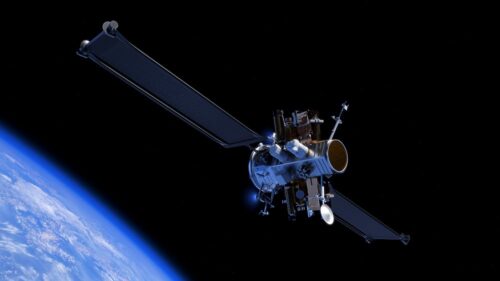
Portal Space emerged from stealth mode on April 30th and revealed the design of their Supernova satellite bus, which
… is engineered from the ground up for maneuverability and features a novel solar-thermal propulsion system. With a payload-agnostic design and 500 kg mass, Supernova boasts a remarkable 6 km/s delta-v, setting a new standard for in-space mobility with 50 times the range of existing products on the market.
That means that the system can perform currently impossible mission needs, like moving from Low Earth Orbit to geostationary orbit in hours or even the moon in just days.
“The space industry hasn’t fundamentally improved satellite bus technology in decades. Our nation is developing 6th-generation fighter aircraft technology but still uses 1st-generation satellite buses. Portal’s Supernova is designed around the customer need for unparalleled mobility and extended mission life,” said Jeff Thornburg, CEO of Portal Space Systems and former architect of SpaceX’s Raptor Engine. “Our novel solar-thermal propulsion system and bus design, combined with our compatibility to support any customer payload, sets us apart. We provide an over 50x improvement in current spacecraft mobility. For our customers, that means the ability to have spacecraft on orbit that are able to respond in real-time to events in any orbital regime.”
New funding for PLD lifts total investment to 120 Million euros. The latest funding will go primarily to expanding facilities needed to support development and operations of the Miura 5 small launcher. The vehicle’s first stage booster will be recovered via parachute return into the ocean.
** LandSpace – Vertical takeoff and landing test flight to 10 km planned for June
LANDSPACE also mentions the hopper will land on a newly built pad ~5km from the mission control center, which can be seen on the Sentinel-2 satellite images. https://t.co/82NmfTKLMqpic.twitter.com/xPflTtT3cn
— China ‘N Asia Spaceflight ️ (@CNSpaceflight) April 17, 2024
** 130-ton reusable engine by CNSA completes 15 tests, paving way for reusable carrier rockets – CNSA Watcher – Archives
Exciting breakthrough! The 130-ton reusable liquid oxygen kerosene engine independently developed by the Sixth Academy of Aerospace Technology Group has completed 15 repeated tests, laying the foundation for the maiden flight of reusable carrier rockets. (Source: Sixth Academy of Aerospace Technology Group)
** China to use adjustable ‘net’ to catch reusable rockets – See an animation – VideoFromSpace
[China’s primary government space organization, China Aerospace Science and Technology Corporation (CASC),] is developing reusable rockets to launch in 2025 and 2026. See the ‘net’ technology they will use to catch the booster when it returns to Earth in this animation.
The six spaceflight participants include Ed Dwight, who was a candidate for the NASA astronaut corp in the early 1960s. If selected he would have been the first African American astronaut.
—- This would be the second flight since the booster failure on Sept. 12.2022 and the first with passengers on board.
SERA aims to make spaceflight available to as wide an array of people around the world as possible.
“Despite the trillions spent by governments, there have usually been only a handful of people in space at any given time over the last three decades,” says Sam Hutchison, Co-Founder of SERA. “The unimaginably rich material and energy resources of the solar system remain entirely untapped. With launch costs coming down this is all about to change, and SERA wants to make sure that everyone on Earth has the chance to participate in the growth of the offworld economy.”
Excited to team with SERA, the Space Exploration & Research Agency, to support such an inspiring initiative that makes space more accessible to so many countries! We’re looking forward to flying these future astronauts on #NewShepard and hearing their perspectives about the… https://t.co/R3XEtVkRow
VG announced that the flight window for the ‘Galactic 07’ commercial mission will open Saturday, June 8, 2024. This will be the Company’s second spaceflight for 2024. Commercial flights began with Galactic 01 on May 25, 2023. VSS Unity has flown 12 flights to suborbital space in total since December 2018. Galactic 07 will be the final flight for VSS Unity and the first-gen vehicle design.
Virgin Galactic’s top priority goal is operational status for the Delta class version of the SpaceShipTwo vehicles by 2026. The Delta spaceships will be capable of eight space missions per month with up to six passengers per flight. Such can make VG’s suborbital flight business profitable. Flight tests should begin in 2025. The company says it has “cash equivalents and marketable securities of $982 million as of December 31, 2023“, which they believe is sufficient to sustain VG through the inauguration of Delta class operations.
[Virgin Galactic] announced that it has opened a new system integration facility in Southern California for the Company’s Delta Class spaceships. This ground-based test facility, which houses a testing platform known as an “Iron Bird,” has begun tests of initial subsystems and will add components over the course of the year to increase its scope and effectiveness.
Using an Iron Bird test rig is common practice in aerospace development programs and allows Virgin Galactic to test and verify the operation of dozens of Delta subsystems – including avionics, feather actuation, pneumatics and hydraulics. This strategic investment is an important building block to ensure efficient production and safe operations of the Delta Class spaceships, allowing the team to validate the functionality of components early in the development process.
The Iron Bird is just one ground testing method used in the development of the Delta spaceship. A static test article will stress major structural components to verify structural integrity data and determine the design and ultimate limit loads of the structure, which will both optimize the flight test program and support our overall turn time objectives.
Final assembly of the Delta ships will take place at Virgin Galactic’s new Delta facility in Phoenix, Arizona.
VG is posting occasional reports on Youtube about the development of the Delta vehicles. Here are three posted so far:
The Delta class spaceships will be powered by our record-breaking hybrid rocket system. In this installment of #DeltaDiaries, Byron Henning, Vice President, Rocket Systems gives insights into the next generation system for Delta.
— #DeltaDiaries: What is a Digital Thread? – Virgin Galactic
What is a digital thread? A digital thread allows us to track the full lifecycle and performance of every vehicle part, from design to manufacturing, to quality control, to spaceflight operations. It tracks and displays everything we need to know about our Delta spaceships. Gabe Williams, Sr. Chief Engineer, Spaceships tells us more on #DeltaDiaries.
The simulator, essential for pilot training, also plays a pivotal role in designing our new Delta fleet. It’s used by various engineering disciplines to ensure systems are spaceflight-ready. Join us in #DeltaDiaries as Virgin Galactic Pilot Jameel Janjua discusses its importance in developing our Delta Class spaceships.
Doug makes many good points but I always feel compelled to respond to such critiques of the field. In the early 2000s, I and many others in the New Space community were enthusiastic promoters of suborbital human spaceflight. The expectation was that reusable suborbital vehicles for space tourism would provide the key first step to eventual development of commercial reusable orbital space transportation. Suborbital transports would provide key technical knowledge about how to build and operate rocket powered vehicles with the fast turnaround times and robustness of aircraft. Perhaps most importantly, the profits from this market would fund the development of the more challenging orbital transports.
However, things did not work out this way. SpaceX proved that with enough capital and will power, a company could go directly to orbit without an intermediate suborbital phase. (Will note that even SpaceX practiced landing with the low altitude Grasshopper vehicle.)
There were several companies that took on the challenge of suborbital spaceflight. I think an appropriate metaphor for the creation of a new technological market like this one is that of a group of people attempting to run across a wide field filled with booby traps, land mines, poisonous snakes, Komodo dragons, and other nasties. Most will fall victim to a fatal hazard but usually a couple make it across to the treasures awaiting them. However, there’s a finite chance that they all are victimized. The field of suborbital spaceflight certainly left all the entrants inactive or damaged to some degree:
Blue Origin came closest to expectations in the way the company learned a great deal from New Shepard about reusable rocket engines and flying, landing and reusing a rocket vehicle. Blue has always been secretive but it’s known that they lost at least a couple of test vehicles. It’s clear also that early on they made suborbital a sideline activity of lower priority to the New Glenn orbital program.
Virgin Galactic made bad design choices with the selection of hybrid propulsion, which they struggled to scale up from the SpaceShipOne system. The air-launched winged vehicle configuration did not lead to a viable orbital system. In retrospect, it was certainly unusual that such a project remained funded for nearly 20 years between its founding and the first revenue from commercial flights. The two accidents that Doug mentions were certainly disasters but difficult to argue they were due to a rush to launch.
XCOR and several other startups came up with designs that were probably technically viable but they never raised sufficient capital or made enough money from initiatives like rocket racing to sustain development of their vehicles.
All this being said, I remain convinced that suborbital flight services for adventurous private individuals, i.e. space tourism, and for science experiments and technology tests will gradually become a sustainable industry. Space tourist suborbital flights remain infrequent and very expensive but prices are set by supply and demand. The fact that Blue and VG easily find customers for their infrequent flights even at extravagant ticket prices indicates that demand is there. If the flight rate eventually rises, then ticket prices will fall accordingly. Orbital flight tickets will also fall in price but suborbital looks always to be substantially cheaper. And some people will prefer a brief adventure to a multi-day stay in orbit.
Finally, I’ll note that luck plays a big role in successfully traversing a dangerous field even for those extremely agile in avoiding pitfalls. For example, Elon Musk often talks about the situation at the end of 2008 when he was out of money and sleeping on the couches of friends. With a deep recession underway, finding new private investors was unlikely. Fortunately, the success of the fourth Falcon 1 launch, which came after three failures, gave SpaceX just enough credibility to win the NASA contract for commercial ISS cargo services. As recounted in Eric Berger’s book, Liftoff[commission link], that fourth flight very nearly didn’t happen. If it had not, then SpaceX probably would not have survived 2008 and Elon would be portrayed as just another amateur space mogul like Andrew Beal and Walter Kistler who promised affordable space transportation but fell far short. Rockets with reusable boosters that land vertically 20 times or more (see above) would remain dismissed by most aerospace pundits as fantasies. Fortunately, SpaceX did survive and we can hope they and others successfully traverse the hazardous passage to fully reusable, low-cost space transports.
Astrobotic and the U.S. Air Force Research Laboratory (AFRL) Rocket Propulsion Division at Edwards Air Force Base have entered into a Cooperative Research & Development Agreement (CRADA) to enhance both organizations’ capabilities and collaborate in the development of advanced liquid rocket engine, rotating detonation rocket engine (RDRE) technologies, and on-base rocket flight testing capabilities using Astrobotic reusable rockets.
“This agreement between Astrobotic and AFRL will enable joint work on new rocket engine technologies, including their applications to in-space propulsion, along with their early flight demonstrations. For Astrobotic, working with AFRL, this rocket-engine flight testbed will demonstrate future capabilities in rocket propulsion such as RDREs and novel additively manufactured materials for high-temperature, high-pressure, chemically-reacting gas environments,” said Dr. Javier Urzay, Chief of the Combustion Devices Branch at AFRL, “These technologies are still at a relatively early development stage but have potential game-changing impacts for liquid and solid rocket propulsion systems relevant for Air and Space Force’s missions.”
The collaboration will help Astrobotic design, develop, test, and demonstrate emerging commercial capabilities with critical applications to air and space military operations, including tactically responsive space access, hypersonic propulsion and testing, and tactical point-to-point rocket transport of cargo. Under the CRADA, AFRL and Astrobotic plan to use Astrobotic’s Xodiac and Xogdor-class vertical-takeoff, vertical-landing (VTVL) rockets to flight test new liquid rocket engines, integrated systems, payloads, and concepts of operation to mature these types of capabilities.
A rendering of the Xogdor rocket in development at Astrobotic. Credits: Astrobotic
=== Other reusable rocket and space vehicle related news, articles, etc:
Was great to spend some time at NASA’s Stennis Space Center with @launcher (@vast) team yesterday as they tested the fully-integrated E-2 engine for a two-minute burn — blue flame achieved with kerosene! pic.twitter.com/WfzPLx9TP4
Rocket reusability will lead to space transports with aircraft-like operation. That is, orbital flight and return followed by rapid reflight with minimal preparation. Vehicles should fly thousands of times with only occasional refurbishment and, most importantly, spacefare should fall to levels similar to long distance airfare.
Reusable rocket powered vehicle designs fall roughly into the following five categories:
—- The third orbital test flight (OFT-3) successfully demonstrated several key Starship capabilities
On March 14th, SpaceX flew a Starship for the third time. The flight test fulfilled a number of goals beyond those accomplished in the previous two flights. See this SpaceX overview: Starship’s Third Flight Test | SpaceX – Mar.14.2024
OFT-3 highlights:
For second time, all 33 Raptor engines on the Super Heavy booster fired from liftoff through hot-stage separation.
The separation again went well, with the Starship upper stage successfully lighting its six Raptors and continuing towards orbit.
After the hot-stage separation:
The booster did a flip maneuver and completed a boostback burn to propel itself towards the splashdown target in the Gulf. In the second test flight, while the booster was orienting itself for the boostback burn, its engines began to turn off and one blew up, destroying the entire vehicle.
As the the booster neared the surface of the Gulf, it began to light up engines for a soft landing onto the Gulf waters and then sink to the bottom. At a few hundred meters above the surface, something happened and “the vehicle experienced a RUD (that’s SpaceX-speak for “rapid unscheduled disassembly”)“. As of the time of this posting, SpaceX has not revealed what caused the RUD.
Following the separation, the Starship upper stage continued firing its engines for the full duration and reached a near orbital velocity when the engines were shut down.
Video imagery via Starlink showed the vehicle rotating slowly around its long axis.
SpaceX planned to fire a Raptor to demonstrate a powered de-orbit but they canceled the firing due to the rotation.
The orbit had a low perigee that brought it into the atmosphere and caused Starship to reenter over the Indian Ocean even without the de-orbit engine thrust.
As the vehicle entered the atmosphere, the video displayed the bright glow of the hot gasses around the vehicle.
The vehicle struggled to maintain its orientation and began tumbling. Eventually the video and data connection died and presumably the breakup of the vehicle began soon after.
During the coast phase in orbit, two important tests were carried out:
Opening and closing the Starship’s payload door, which will be needed for Starlink Gen 2 satellite deployments.
A propellant transfer demonstration.
—- FAA suspends Starship license until an investigation into the problems of this flight is completed. This happens automatically if there is any variation from the approved flight plan significant enough to be classified as a mishap:
The mishap investigation should not significantly increase the time to the launch of the fourth Starship since both stages achieved their primary goals and the problems were not as serious as for the first two test flights. SpaceX will actually do the investigating and the FAA will then evaluate the results. If they are deemed satisfactory, the FAA issues a statement about the completion of the investigation and sometime after that they issue a modification to the current launch license that approves another flight.
It should be pointed out that the Starship is basically operational now as an expendable launch vehicle. The boosters functioned properly through stage separation and the second stage on OFT-3 would have reached a full orbit with just a brief extension of the firing of the Raptors. Reusability, however, is key to SpaceX’s plans for the vehicle and it won’t be declared operational until the booster does a soft landing and the Starship stage survives reentry and makes a soft landing as well.
Speaking at the Satellite 2024 conference March 19, Gwynne Shotwell, president and chief operating officer of SpaceX, said the company was still reviewing the data from the vehicle’s third integrated launch March 14 but expected to be ready to fly again soon.
“We’re still going through the data” from the flight, she said when asked about the analysis of data from the mission. “It was an incredibly successful flight. We hit exactly where we wanted to go.”
…
“We’ll figure out what happened on both stages,” she said, not discussing what may have gone wrong with either, “and get back to flight hopefully in about six weeks,” or early May.
Shotwell doubted they would launch any Starlink satellites during the mission.
Speaking at the Space Capitol III event by Payload March 18, Kelvin Coleman, FAA associate administrator for commercial space transportation, said he did not anticipate that investigation to turn up any major issues that could significantly delay the next launch.
The FAA also hopes to move soon to a license that covers multiples flights
… Coleman said the agency wants to move to a process where the license is valid for “portfolio of launches” rather than individual ones. That is particularly important, he added, because SpaceX is planning six to nine more Starship launches this year.
That is part of a broader effort to streamline the launch licensing process to address criticism from industry and Congress that the FAA is moving too slowly on approving launch licenses under a new set of regulations known as Part 450. …
SpaceX is preparing to follow up its third flight of Starship – one that achieved another leap forward with the world’s largest rocket in history – with the IFT-4 mission. Potentially as early as May, the fourth flight is expected to pair Booster 11 with Ship 29, with the latter already back at the launch site for its Static Fire test campaign.
A static firing test of the 6 Raptor engines on Ship 29 took place on March 25th :
—- Another test firing, this time of only one engine, took place on March 27th. This presumably tests for a de-orbit firing.
STATIC FIRE 2 for Ship 29. This time it does indeed look like the in-space firing test with a single Raptor. That may conclude Static Fire testing for the Ship ahead of IFT-4.https://t.co/skVzGw4vkSpic.twitter.com/o3wOcVEojn
Launch through booster landing attempt and shutdown of Starship upper stage engines: Blastoff! SpaceX Starship launches to space on 3rd integrated test flight– VideoFromSpace
Starship entry into the atmosphere: Wow! Watch SpaceX Starship re-enter Earth’s atmosphere in these incredible views – VideoFromSpace
Enjoy this incredible audio and video from the launch pad and various locations of the most powerful rocket to ever fly, SpaceX’s Starship on its third integrated flight test, IFT3! 4K slow motion captured on various ZCam’s, BlackMagic 12K Ursa, RED Komodo X and G2 4.6K with SIGMA lenses and Meade Telescopes.
SpaceX’s third launch of Starship took place on March 14th, 2024, from Starbase, TX. Both the Super Heavy booster and the Starship upper stage completed their full duration burn placing them on nominal trajectories. However, neither survived their full reentry or landing tests.
A fresh view of flight three along with some imagery of the aftermath. Plus, a new barrel section for Booster 14 outside the Mega Bay and work on the segments of the second tower continues at the Sanchez lot.
—- Starship activity at Cape Canaveral and the Kennedy Space Center
There has been little activity visible in the past few months at the Starship launch tower built at launch complex 39A. However, in the past week or so there has been some work around the pillars of the orbital launch mount and one was taken down. No word yet on what is the plan for the mount.
SpaceX removed yesterday one of the legs of the orbital launch mount at Starship’s pad within LC-39A. It’s unknown whether more will be removed at this time. This clip is on real time as captured by our Space Coast Live cameras.https://t.co/bWDuxt1M5Upic.twitter.com/M3eBsRSlVM
— Alejandro Alcantarilla Romera (Alex) (@Alexphysics13) March 23, 2024
—- More Starship related articles, reports, and other web resources.
For background on Starship see the SpaceX Starship report, which is published by NewSpace Global and for which I was the primary author. The initial version came out in March 2023 and then we updated it in May to include coverage of the first flight test.
==================
Check out the The Lurio Report
for news and analysis of key developments in NewSpace
The latest issue: Starlink’s Progress, Vulcan, Moon Landing Attempts
Vol. 19, No. 1, February 2, 2024
Space Frontier Foundation Award for NewSpace Journalism
—- Overview of booster recovery at sea: Revolutionizing Rocket Reusability – SpaceX’s Mini Navy – NASASpaceflight
The vital role of Autonomous Spaceport Droneships (ASDS) in revolutionizing rocket reusability. In this detailed video, we unravel the necessity of droneships for high-performance missions, the evolution of these marine marvels, and the unique technology that sets them apart from ordinary barges. Discover how SpaceX’s marine assets contribute to their mission success, defy conventional recovery methods, and what the future holds for these floating launch pads. Whether you’re a space enthusiast or curious about marine engineering, this video is packed with insights into the intersection of aerospace and maritime technology. Don’t forget to like, share, and subscribe for more space exploration content!
The LOA [Letter of Intent] establishes a strategic collaboration that positions The Bahamas as a global destination for witnessing booster landings.
SpaceX, a pioneer in space exploration, is currently finalizing mission designs where one of the company’s autonomous droneships will serve as a Falcon 9 landing location east of The Exumas, offering a spectacle that will be visible only in The Bahamas. This unique opportunity sets the stage for tourists to witness awe-inspiring space events from cruise ships, resorts, and various tourist hotspots, solidifying The Bahamas’ position as a key player in the emerging space tourism industry.
The exclusive visibility of rocket landings on an autonomous droneship from various Bahamian islands distinguishes this destination as the only one of its kind worldwide.
—- Polaris Dawn – Development progress “heating up”
Things are heating up w/Polaris Dawn mission. We spent last week completing most of the EVA suit acceptance test procedure. This was the first time we wore the final assembled suits as opposed to the development or training suits. There are big milestones ahead (CEIT, vacuum…
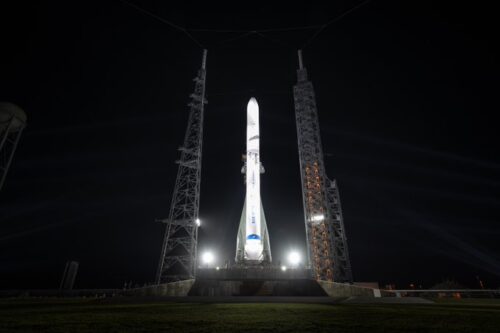
In late February and early March, Blue successfully carried out three cryogenic propellant filling tests of the New Glenn first stage on the pad at Launch Complex 36. This was the first time a full stack of first and second stages with functional hardware had been rolled to the pad.
After the tanking tests, the stack was rolled back to the integration facility to prepare for returning to the pad for static firing tests of the seven BE-4 engines on the first stage. Several upper stages are in development for the flight tests expected to start late this year.
Blue is planning for an initial fleet of four boosters, as each New Glenn first stage is intended to be reused at least 25 times. With experience gained from 22 successful propulsive landings of New Shepard’s propulsion module, it is not unreasonable that Blue will be able to achieve its goal of successfully landing New Glenn’s first stage on the maiden launch. However, a landing platform is yet to be seen after the company scrapped its Jacklyn ship in 2022 in favor of a more simplified barge-like system.
A reusable second stage appears to remain a goal:
Blue Origin recently filed updated site plans for LC-36 as part of a permit to upgrade the facility. Included in the plans was a new site at the northeast corner of the complex, referred to as an MKX Test Stand. With propellant lines running to this site from the pad’s main tank farm, this could be a new test stand to support the development of the company’s Clipper program, which aims to be a reusable second stage for New Glenn. It is also possible that the area may be related to Blue’s lunar lander program, as there are two variants of the Blue Moon lander — MK1 and MK2.
—- Reusablity a top priority:
New Glenn’s reusable first stage aims for a minimum of 25 missions and will land on a sea-based platform located roughly 620 miles (1,000 kilometers) downrange. Why is reusability so important? It reduces waste and radically lowers cost per launch to increase access to space. pic.twitter.com/46VwxsdSbw
—- BE-4 engines tested in Huntsville on a famous test stand: Test Stand 4670: Building on a Legacy
Once a pivotal platform for the testing of Saturn V and Space Shuttle engines, Test Stand 4670 at NASA’s Marshall Space Flight Center in Huntsville, Alabama, has witnessed the power of innovation and the spirit of exploration. Experience the transformation of Test Stand 4670 as this historic site has come back to life, blending the rich heritage of NASA’s golden era with the cutting-edge technology of today testing our BE-4 and BE-3U engines. The rumble is back in the Rocket City.
—- Crew vehicle – Blue developing reusable crew transport vehicle
For a time, the crew project was on the back burner, but it has now become a major initiative within Blue Origin, with the company hiring staff to develop the vehicle.
The first public hint of this renewed interest came last June, when NASA announced that Blue Origin was one of seven companies to sign an unfunded Space Act Agreement to design advanced commercial space projects. Later, in a document explaining this selection process, NASA revealed that Blue Origin was working on a “commercial space transportation system.” This included a reusable spacecraft that would launch on the New Glenn rocket.
No debut date for the crew vehicle released yet but more information is likely to be released by Blue later this year.
** Sierra Space – Dream Chaser in final tests before launch
—- Thermal vacuum testing in Ohio:
Dream Chaser has arrived at NASA’s Armstrong In-Space Propulsion facility in Ohio for thermal vacuum testing. This will be its last testing phase in Ohio before it makes its way to @NASAKennedy in Florida. pic.twitter.com/rCLM7hlhZo
—- Vibration test report: Dream Chaser Spaceplane Environmental Test Campaign at NASA Armstrong Test Facility – Feb.27.2024
The Dream Chaser spaceplane is running through it’s environmental test campaign at NASA Neil A. Armstrong Test Facility in Ohio. These critical tests will ensure Dream Chaser is ready for the launch pad later this year for the NASA CRS-2 Mission to the International Space Station.
The upper stage of the Stoke fully reusable rocket, now named Nova, uses an innovative design combining a capsule-like heat shield with a ring of thrusters along the outer edge. Previously, a prototype with 15 thrusters underwent static firings and then powered a short flight of the Hopper 2 demonstrator.
The hydrogen fuel for the thrusters first travels through passages in the heat shield to cool it before going into the combustion chambers of the thrusters. The company is now testing a ring of 30 thrusters as will be used on the operational stage.
Stoke Space also clarified, “Our heat shield is engineered for active cooling at multiple critical mission stages, ensuring optimal protection, performance, and mobility to, through, and from space.”
When asked whether there were any specific engineering issues with pumping the hydrogen through the longer-than-usual channels, the company responded, “We’ve encountered no significant challenges in this regard. Engine test and Hopper flight data validated analytical predictions made by our in-house tools, confirming the ability to manage these requirements.”
Differential throttling of the thrusters provides control of the orientation and direction of the vehicle:
“All of those thrusters have individual throttle control ability,” [Stoke CEO Andy] Lapsa said. “They actually have throttle control in two different places. One is with the pumps, so the bulk engine thrust can be throttled. Then the relative thrust from one side to the other can be managed by the individual thrusters.”
The goal is 24 hour turnaround between orbital flights of Nova. The company sees delivery of satellites and other payloads to space as a viable market and also the capture and return to earth of spacecraft at end of their working life or that have become derelicts.
—- Recent tests of thrust chamber for Aeon R engines that will power the Terran R rocket: Aeon R Thrust Chamber Assembly Testing | NASA Stennis – Relativity Space/YouTube – Mar.19.2024
2 weeks. 18 hot fires. 335 seconds of blue fire. The team closed out another round of Aeon R thrust chamber assembly (TCA) testing, screening 4 different injector designs and ramping up full-power high mixture-ratio (MR) testing.
Hats off to the crew for executing 2+ hotfires each day with precision, speed, and nimbleness.
—- Reusable engine turbopumps: A video about the development of the liquid oxygen and methane turbopumps for the Aeon engines to power the reusable Terran R rocket: Relatively Speaking: Aeon R Turbopumps Explained – Relativity Space/YouTube – Feb 27, 2024.
We’re taking a deep dive into Aeon R’s turbopumps, the heart of Aeon R. With additive manufacturing, we’re refining our turbopump design, reducing parts and enhancing efficiency. Hear directly from the team on our approach to design, testing, and iteration.
0:00 – 0:27 Turbopumps explained 0:28: -1:14 Dual Shaft system explained 1:15 – 1:29 What makes our turbopump unique 1:30 – 2:16 Long Beach Component Test Yard 2:17 – 2:42 Testing turbopumps 2:43 –3:01 Benefits of testing in our backyard 3:02 – 3:50 Collaborative teams
Learn more about Aeon R: https://bit.ly/aeonr
** Introducing: Ascender H1 Variant Orbital Airship – John Powell
This is the newest version of the Ascender orbit airship designed to carry cargo to space. It’s the final stage of ATO, the airship to orbit program. The H1 is the latest update in development of this class of vehicle and the directly result of decades of development and test flights. ATO is changing the very nature of space travel.
=== Hypersonic rocket vehicles– Long distance point-to-point
** Stratolaunch Talon A-1 hypersonic rocket vehicle flies successfully
Stratolaunch’s hypersonic test vehicle Talon A-1 (TA-1) was carried on March 9th by the company’s gigantic Roc aircraft over the Pacific to a point where it was dropped. The vehicle’s Hadley engine, built by Ursa Major Technologies, fired and accelerated the vehicle and made a sustained climb in altitude, before eventually exhausting its fuel and then made a controlled water landing. The engine uses liquid oxygen and kerosene propellants and can produce 5,000 pounds-force of thrust. The exact top speed attained has not been released publicly but “reached high supersonic speeds approaching Mach 5” according to the company.
While the TA-1 was expendable and lost at sea, the next test flight later this year will be carried out by the reusable TA-2. A third vehicle, TA-3, is under construction and will also be reusable. The Talon vehicles are precursors to future operational hypersonic and space vehicles.
[ Update: Additional info and video released by Stratolaunch:
First steps are hard. They require careful planning, calculated risk, and most of all, courage. We took a daring first step earlier this month with the completion of TA-1’s first powered flight, reaching high supersonic speeds approaching Mach 5. The flight was a landmark moment… pic.twitter.com/u56CdTGrCK
First steps are hard. They require careful planning, calculated risk, and most of all, courage. We took a daring first step earlier this month with the completion of TA-1’s first powered flight, reaching high supersonic speeds approaching Mach 5. The flight was a landmark moment on our path to providing our customers and nation a reusable and routine hypersonic test capability. Congratulations to the Stratolaunch team and our partners on this achievement! Stay tuned on our progress as we prepare to fly our first fully reusable Talon-A vehicle, TA-2, later this year.
TA-1 first flight complete ☑️ The dawn is now breaking on the era of reusability.
Debuting in this week’s edition of @AviationWeek, TA-2 the first fully recoverable hypersonic vehicle able to land on a runway and fly again.
Progress is speeding up, keep up with us! pic.twitter.com/9RnRxQmDQB
Venus Aerospace’s supersonic flight test drone successfully completed its inaugural flight on Feb 24, 2024. The eight foot, 300lb drone was dropped at an altitude of 12,000 ft and accelerated to a top speed of Mach 0.9, flying for 10 miles. It was powered by a hydrogen peroxide monopropellant engine at 80% thrust in order to not exceed Mach 1. The test successfully demonstrated flight controls, stability, one leg of the ultimate Rotating Detonation Rocket Engine (RDRE) propulsion system, telemetry, ground operations, and air launch. “Using an air-launched platform and a rocket-with-wing configuration allows us to cheaply and quickly get to the minimum viable test of our RDRE as a hypersonic engine. The team executed with professionalism and has a wealth of data to anchor and tweak for the next flight,” says CTO & Co-Founder Andrew Duggleby.
“This is how you do hard things: one bite at a time. Up next is RDRE flight, and ultimately hypersonic flight, proving that the RDRE is the engine that unlocks the hypersonic economy,” says CEO & Co-Founder Sarah “Sassie” Duggleby.
These prototypes are to prepare for the development of the Stargazer hypersonic point-to-point transport vehicle.
Based on the company’s latest tests, Duggleby said Venus is now increasingly confident that it will be able to combine its rocket engine with air-breathing technology—using the forward motion of the engine to ingest air for combustion—to create what is known as a rocket-based combined cycle engine. Such an engine, if it can be realized, will allow Venus to see excellent performance at a wide variety of altitudes and velocities. The idea has been largely theoretical until now, developed mostly in universities rather than pursued for commercial purposes.
“We’re now 100 percent compelled by this path,” Duggleby said. “I’m convinced that this is going to be the engine that unlocks the hypersonic economy.”
=== Europe
** MaiaSpace– Funding from French government if orbit reached
The HyPrSpace OB-1 and Latitude Zephyr rockets will be the smallest of the lot and will be capable of delivering between 100 and 200 kilograms to low Earth orbit. The Sirius 1, Sirius 13, and Sirius 15 rockets will be capable of delivering between 175 and 1,100 kilograms to orbit. The Prometheus-powered Maia rocket is expected to be the most powerful, with a payload capacity of up to three tonnes when launched in its expendable configuration.
The agreement with the French state will see each company receive a small upfront payment to secure the flights. The bulk of the €400 million, which will be supplied through the France 2030 initiative, will, however, only be awarded if the companies manage to launch a maiden flight of their respective vehicles between 2026 and 2028. As a result, the actual development process will need to be funded through other public programmes or through private investment.
China is accelerating the development of both 4-meter-diameter and 5-meter-diameter reusable rockets, with their inaugural flights scheduled for 2025 and 2026, respectively. CCTV article.
As one of the leading Chinese commercial launch companies, Landspace is currently operating the medium-lift methalox-fueled Zhuque-2, and plans to roll out the heavy-lift Zhuque-3 rocket. The latter is a partially reusable rocket with similar specifications to SpaceX’s Falcon-9, and could represent one of the first “Chinese Falcon 9s” to be available.
While there are strong resemblances between the two rockets, the Zhuque-3 has some differences, including the choice of propellant (methane), materials used (stainless steel), and its rocket booster recovery approach.
In this episode, we deep dive into these topics, while also going over the history of Landspace. Enjoy!
00:00 Introduction 00:17 Landspace’s Beginnings 02:06 The First (Failed) rocket: the Zhuque-1 03:32 All-in on Liquid-fueled Rockets 4:03 the Medium-lift Zhuque-2 & How it’s Different 5:33 Landspace’s own Launch Site 7:21 the Reusable Stainless Steel Zhuque-3 10:12 Recovering Rockets on Land! 11:18 Perspectives for 2024 and 2025
—- More Land Space reports:
LANDSPACE to test Zhuque-3’s 10km VTVL vertical take-off and landing in June. CEO aims for 20+ reusable flights, first launch next year. Capacity over 18 tons, price drop from $8500 per kg to $2800 per kg is expected. Source:https://t.co/5zLiYVzURNpic.twitter.com/4FPFWj8qpk
ZQ-3 transportation & erection vehicle. It looks like the payloads with upstage will be lifted to the erected rocket by crank sitting at the top of the tower. via LandSpace patents https://t.co/MD9e9FiHbspic.twitter.com/UApgmPtEZR
China’s main state-owned contractor plans test flights for two new large diameter reusable rockets in the next couple of years, despite existing commercial reusability efforts.
The China Aerospace Science and Technology Corporation (CASC) plans to launch four-meter and five-meter-diameter reusable rockets for the first time in 2025 and 2026 respectively, Wang Wei, a deputy to the National People’s Congress, told China News Service March 4.
** Chinese reusable rocket developers:
CASC (China Aerospace Science and Technology Corp) – China’s primary space agency
** RLV LEX-02 prototype winged space vehicle – Successful mid-altitude drop flight and landing test
The Indian Space Research Organization (ISRO) has been developing reusable rocket technology starting with the RLV-TD (Reusable Launch Vehicle – Technology Demonstrator) program. The program aimed to launch a reusable winged uncrewed vehicle, similar to the X-37, atop an expendable booster.
The configuration of RLV-TD is similar to that of an aircraft and combines the complexity of both launch vehicles and aircraft. The winged RLV-TD has been configured to act as a flying test bed to evaluate various technologies, namely, hypersonic flight, autonomous landing and powered cruise flight.
A RLV-TD prototype was successfully flight tested on May 23, 2016 after a drop from a helicopter. Another winged vehicle was tested in 2023 in a similar drop test called RLV-LEX-01. Then on March 22, 2024, the LEX-02 experiment involved a second drop test with an improved prototype vehicle named Pushpak: ISRO achieves yet another success in the RLV Landing Experiment | ISRO – Mar.22.2024
ISRO has achieved a major milestone in the area of Reusable launch vehicle (RLV) technology, through the RLV LEX-02 landing experiment, the second of the series, conducted at Aeronautical Test Range (ATR), Chitradurga in Karnataka today morning at 7:10 hrs IST.
After the RLV-LEX-01 mission was accomplished last year, RLV-LEX-02 demonstrated the autonomous landing capability of RLV from off-nominal initial conditions at release from Helicopter. The RLV was made to undertake more difficult manoeuvres with dispersions, correct both cross-range and downrange and land on the runway in a fully autonomous mode. The winged vehicle, called Pushpak, was lifted by an Indian Airforce Chinook helicopter and was released from 4.5 km altitude. After release at a distance of 4 km from the runway, Pushpak autonomously approached the runway along with cross-range corrections. It landed precisely on the runway and came to a halt using its brake parachute, landing gear brakes and nose wheel steering system.
This mission successfully simulated the approach and high-speed landing conditions of RLV returning from space. With this second mission, ISRO has re-validated the indigenously developed technologies in the areas of navigation, control systems, landing gear and deceleration systems essential for performing a high-speed autonomous landing of a space-returning vehicle. The winged body and all flight systems used in RLV-LEX-01 were reused in the RLV-LEX-02 mission after due certification/clearances. Hence reuse capability of flight hardware and flight systems is also demonstrated in this mission. Based on the observations from RLV-LEX-01, the airframe structure and landing gear were strengthened to tolerate higher landing loads.
More about the project:
=== Reusable suborbital rocket vehicles for tourism, science & technology
** Astrobotic reusable rockets – Night flights of Xodiac
Astrobotic’s Propulsion & Test department flew Xodiac, a vertical-takeoff, vertical-landing (VTVL) reusable terrestrial rocket, for its first-ever night flight. The tethered night test prepared Xodiac for upcoming flight testing with the NASA TechLeap Prize’s Nighttime Precision Landing Challenge, managed by NASA’s Flight Opportunities program. TechLeap is designed to rapidly identify and develop technologies of interest to the agency using a series of challenges, and the Nighttime Precision Landing Challenge will test the ability of three winning payloads to map a lunar surface for navigation in near-total darkness.
Flights for TechLeap are slated to begin in April, continuing Xodiac’s flight heritage of over 160 successful flights. The Nighttime Precision Landing Challenge flights will also mark the debut of Astrobotic’s Lunar Surface Proving Ground (LSPG), a high-fidelity 3D test field that will mimic the topography and optical properties of the Moon’s surface. The size of two football fields, the LSPG will provide a unique simulated lunar topography to enhance the realism of payload flight tests aboard Xodiac.
More flight campaigns later this year:
These TechLeap payload flights will be Xodiac’s first major flight campaign of 2024. Xodiac is also scheduled to fly campaigns this year for NASA’s TechRise Student Challenge, Draper, San Diego State University, and Astrobotic’s Robotics & Surface Systems department. The latter campaign will test Astrobotic’s novel hazard detection and avoidance system that will help guide its Griffin lander to a soft landing on the Moon’s south pole.
… the company will increase the flight rate of New Shepard. That vehicle performed a payload-only flight in December, the first since a launch mishap more than 15 months earlier. A crewed flight, the first since August 2022, will take place “very soon,” he said, but was not more specific.
Blue Origin has not disclosed how many New Shepard flights it plans for this year. “We are definitely getting back on track this year with New Shepard,” he said. “We want to get on a nice pace or rhythm here where we’re launching regularly, mostly astronaut flights but there will be payload flights mixed in there as well.”
DIU wants two types of utility multi-orbit logistics vehicles (m-OLV). A light version should host or transport one or more payloads in the 50 kg payload range. A heavy version will tackle payloads in the 500 kg range.
And DIU also wants a
fuel depot capable of storing and transferring sufficient chemical and/or electrical propellant to a m-OLV or self-propelled satellite to achieve a LEO-to-GEO transfer
Three companies obtained contracts. Blue Origin obtained funding
to demonstrate a heavy utilitym-OLV system utilizing their ‘Blue Ring’ platform [see above]. Blue Origin is in the final stages of developing the Dark-Sky-1 mission system, which will demonstrate core mission operation and flight system capabilities.
Northrop Grumman’s Space Logistics in-space servicing subsidiary received support for its
suite of in-space refueling technologies, including the Active Refueling Moule (ARM) and Passive Refueling Module (PRM), in concert with complementary efforts sponsored by Space Systems Command (SSC). The refueling system includes elements to successfully dock and transfer fuel, as well as a refueling payload that handles fuel transfer. SSC contracted with Northrop Grumman to fly the PRM on an operational mission.
Spacebilt, formerly Skycorp, is the third company to receive a DIU contract, which will be used to further validate
their approach In Space Assembly and Manufacturing for enabling their m-OLV product for DoD use cases. Since award, Spacebilt has progressed toward a mass manufacturable product, conducted risk reduction missions to the International Space Station for their flight hardware, and maturity of their commercially available avionics hardware. Spacebilt is working toward a Q4 2026 launch for the first mOLV STARcraft.
The company makes reusability a key feature of their spacecraft:
Until now, space systems have been mission focused and disposable. Tomorrow, spacecraft will be updated to suit changing customer needs. Reusability reduces lifecycle cost by 80%.
=== Other reusable rocket and space vehicle related news:
Find here the latest news and updates on reusable rocket powered vehicles in operation and in development. (See also the previous Roundup from November 2023.) Such technology should eventually lead to space transports with aircraft-like operation. That is, orbital flight and return followed by rapid reflight with minimal preparation. Vehicles should fly thousands of times with only occasional refurbishment and, most importantly, spacefare should fall to levels similar to long distance airfare.
In the decades following the launch of Sputnik 1, missile derived expendable launchers dominated and progress towards reusable transports moved at a slow crawl. The one major attempt at reusablity, the Space Shuttle, was a major disappointment, providing no reduction in space transport costs due to the lengthy refurbishment and component replacements after each flight. However, progress sped up considerably in the past decade with the arrival of the SpaceX Falcon 9, whose boosters have achieved 248 reflights and 277 landings as of Feb.26.2024.
Reusable rocket powered vehicle designs fall roughly into the following five categories:
Below are reports on several projects and programs that fall into at least one of these categories.
** SpaceX Starship – Third orbital flight test expected in March.
Recent remarks from Elon Musk indicate that the third test flight could happen by mid-March. The test will launch the combo of Starship 28 and Super Heavy Booster 10, which have been undergoing preparations for the flight for several months including repeated trips to and from the orbital launch site for cryogenic pressure tests, engine firings, etc. In mid-February the stages were stacked atop the launch mount and twice an attempt at a wet dress rehearsal was made but each time the propellant filling was stopped prematurely and the rehearsal ended. Subsequently, the Starship was de-stacked and moved to the nearby suborbital test area for engine testing, starting with a spin prime test on Feb.26th (spin prime refers to a test of the engine turbopumps). Booster 10 was moved back to the production site.
[ Update: Just after posting this item, the FAA announced that the mishap investigation with SpaceX has been completed. Presumably, they will soon issue a permit for the next flight test.
The FAA has closed the mishap investigation into the second Starship test flight. pic.twitter.com/jZe8z8VULu
SpaceX must implement 17 corrective actions. Seven on the boosters and ten on the Starship upper stage.
SpaceX also has an update describing the second test flight and reasons for the loss of the two stages. For the booster:
Following stage separation, Super Heavy initiated its boostback burn, which sends commands to 13 of the vehicle’s 33 Raptor engines to propel the rocket toward its intended landing location. During this burn, several engines began shutting down before one engine failed energetically, quickly cascading to a rapid unscheduled disassembly (RUD) of the booster. The vehicle breakup occurred more than three and a half minutes into the flight at an altitude of ~90 km over the Gulf of Mexico.
The most likely root cause for the booster RUD was determined to be filter blockage where liquid oxygen is supplied to the engines, leading to a loss of inlet pressure in engine oxidizer turbopumps that eventually resulted in one engine failing in a way that resulted in loss of the vehicle. SpaceX has since implemented hardware changes inside future booster oxidizer tanks to improve propellant filtration capabilities and refined operations to increase reliability.
For the Starship stage:
At vehicle separation, Starship’s upper stage successfully lit all six Raptor engines and flew a normal ascent until approximately seven minutes into the flight, when a planned vent of excess liquid oxygen propellant began. Additional propellant had been loaded on the spacecraft before launch in order to gather data representative of future payload deploy missions and needed to be disposed of prior to reentry to meet required propellant mass targets at splashdown.
A leak in the aft section of the spacecraft that developed when the liquid oxygen vent was initiated resulted in a combustion event and subsequent fires that led to a loss of communication between the spacecraft’s flight computers. This resulted in a commanded shut down of all six engines prior to completion of the ascent burn, followed by the Autonomous Flight Safety System detecting a mission rule violation and activating the flight termination system, leading to vehicle breakup. The flight test’s conclusion came when the spacecraft was as at an altitude of ~150 km and a velocity of ~24,000 km/h, becoming the first Starship to reach outer space.
SpaceX has implemented hardware changes on upcoming Starship vehicles to improve leak reduction, fire protection, and refined operations associated with the propellant vent to increase reliability. The previously planned move from a hydraulic steering system for the vehicle’s Raptor engines to an entirely electric system also removes potential sources of flammability.
The update goes on to say the measures to protect the launch pad worked well and few fixes were required after the test.
The next test flight will implement various
performance upgrades, including the debut of a new electronic Thrust Vector Control system for Starship’s upper stage Raptor engines and improving the speed of propellant loading operations prior to launch.
]
The company is preparing for up to nine test flights in 2024. The rate of production of vehicles should be sufficient for such a test program as indicated by this recent image of four Super Heavy boosters inside the Megabay 1 at Starbase:
Super Heavy boosters for the next three flights, with a fourth ready to stack, in the Starbase Megabay pic.twitter.com/0GLwlDvjNu
New permanent buildings are replacing the tent-like structures used for production of major components, particularly the steel ring segments that make up the structure of each stage.
Construction of the second Megabay is nearing completion.
These bays are used for the stacking of the steel ring segments, engine installation, and other final assembly operations on the Starship stages.
Construction of an office building and parking garage has begun.
Massey’s site: The former gun club site has become more than just a storage site.
New vehicle stages undergo initial cryogenic and stress testing here.
Similar testing for new structure designs
An engine test facility is under construction.
This video from RGV Aerial Photography gives a sky view of Starbase along with a narration of recent changes. (Note that they divide the Production Site is divided into two sections: the Sanchez open yard area and the Build site.)
And here is a summary of recent SpaceX activities at Starbase and in Florida:
—- SpaceX has now revealed where it would like to put the second launch tower at Starbase:
SpaceX is asking the US Army Corps of Engineers for permission to fill 0.16 acres of wetlands to build a second orbital launchpad, replacing the current suborbital launch pad and test stand at Boca Chica Beach
—- Starship activity at Cape Canaveral and the Kennedy Space Center is becoming more visible again after a long period when not much was happening in public view. In 2022 SpaceX built a Starship launch tower adjacent to the Pad-39A complex used for Falcon 9/Heavy launches and Crew Dragon missions. Several sections for a second tower were assembled at the company’s facility on Roberts Road. However, work on the Pad-39A tower and the second tower were suspended without any public explanation.
The Pad-39A Starship facility work was perhaps stopped due to concerns at NASA that a Starship accident could damage the nearby Falcon launch facility and leave the agency without a domestic means of sending crews to the ISS. A new service tower at SLC-40 is nearly complete and it will enable Crew Dragon flights from there. Perhaps, after SpaceX has demonstrated a crew launch from SLC-40, work on the Pad-39A tower and launch mount will resume.
Recently, most of those tower sections at Roberts Road have been sent via barges to Starbase in Boca Chica for the second tower there (see above item). However, a second tower at the Cape remains very much a priority. Recently, it was revealed that an environmental impact study is underway for a second Starship launch facility: Proposed Action – Space Force Starship EIS.
The study will consider two possible locations:
Space Launch Complex 37, from which the final Delta-4 Heavy rocket will lift off in March.
A new SLC-50 site within the Cape Canaveral Air Station site between SLC-37 and SLC-40.
Starlab Space LLC (Starlab Space), the transatlantic joint venture between Voyager Space and Airbus, today announced the selection of SpaceX to launch the Starlab commercial space station to low-Earth orbit (LEO). Starship, SpaceX’s fully reusable transportation system designed to carry both crew and cargo to Earth orbit, the Moon, Mars and beyond, will launch Starlab in a single mission prior to the decommissioning of the International Space Station.
“SpaceX’s history of success and reliability led our team to select Starship to orbit Starlab,” said Dylan Taylor, Chairman and CEO, Voyager Space. “SpaceX is the unmatched leader for high-cadence launches and we are proud Starlab will be launched to orbit in a single flight by Starship.”
—- Elon Musk gave a talk on January 8th to Starbase employees about the status and future of the Starship program. His presentation was quite informative but one could easily have missed some important items during his lengthy discourse. This video has edited out everything but his key statements and packs them into about 10 minutes:
—- More Starship related articles, reports, and other web resources.
For background on Starship see the SpaceX Starship report, which is published by NewSpace Global and for which I was the primary author. The initial version came out in March 2023 and then we updated it in May to include coverage of the first flight test.
==================
Check out the The Lurio Report
for news and analysis of key developments in NewSpace
The latest issue: Starlink’s Progress, Vulcan, Moon Landing Attempts
Vol. 19, No. 1, February 2, 2024
Space Frontier Foundation Award for NewSpace Journalism
The Falcon program continues to be extremely active as shown by the accumulation of 313 launches so far. The company hopes to do as many as 150 Falcon launches this year. The majority of these will carry Starlink satellites to low earth orbit but there will be many other commercial and government payloads as well.
Reusability plays a major role in Falcon operations and is key to the affordability of the Starlink constellation. There have been 248 reflights and 277 landings as of Feb. 25th. Some boosters have flown 19 times and the company now believes they can fly up to 40 times. An engine has flow 22 times:
Main engine cutoff and stage separation. One of the nine Merlin engines powering tonight’s first stage is our flight leader, powering its 22nd mission to Earth orbit pic.twitter.com/xkTrPdOdsW
—- Polaris Dawn – First EVA from Dragon could happen this summer.
Polaris Dawn is a private Crew Dragon mission sponsored by Jared Isaacman. Currently, the mission is targeted for launch sometime in the summer of 2024. The goals of the mission include:
“… flying higher than any Dragon mission to date and endeavoring to reach the highest Earth orbit ever flown [by a crewed vehicle].“
“Orbiting through portions of the Van Allen radiation belt, Polaris Dawn will conduct research with the aim of better understanding the effects of spaceflight and space radiation on human health.“
“… the crew will conduct scientific research designed to advance both human health on Earth and our understanding of human health during future long-duration spaceflights“
“…first crew to test Starlink laser-based communications in space, providing valuable data for future space communications system necessary for missions to the Moon, Mars and beyond.“
“At approximately 700 kilometers above the Earth, the crew will attempt the first-ever commercial extravehicular activity (EVA) with SpaceX-designed extravehicular activity (EVA) spacesuits, upgraded from the current intravehicular (IVA) suit.“
—- X-37 launches on Falcon Heavy – A high apogee orbit for USAF spaceplane
A Falcon Heavy rocket put one of the two reusable X-37 spaceplanes into orbit on December 28, 2023. The vehicle will carry out a classified mission for the US Air Force. Previous missions have lasted as long as two years before the winged vehicles returned for landings either in California or at Cape Canaveral, Florida.
This mission differs from previous ones in going to a much higher orbit. The spaceplane has been tracked by civilian observers:
Amateur observations of the spaceplane indicate it is flying in a highly elliptical orbit ranging between 201 and 24,133 miles in altitude (323 and 38,838 kilometers). The orbit is inclined 59.1 degrees to the equator.
An interesting video report from the Wall Street Journal about the X-37 and its Chinese counterpart of similar design and size:
Both the U.S. and China launched secretive space missions using high-tech space planes right before the new year. The U.S. blasted its autonomous X-37B plane up in a SpaceX Falcon Heavy rocket just weeks after China dispatched its own Shenlong spacecraft, sparking lots of speculation about where the planes are going and whether they could be used as space weapons.
I take a look at what the U.S.’s Boeing-made X-37B space plane is capable of doing, and how these launches underscore the intensifying space race between superpowers.
0:00 X-37B secret mission 0:39 X-37B features 1:21 Potential space applications 3:24 New mission to deep space? 4:55 The U.S.-China space race
** Blue Origin New Glenn – BE-4 Methalox engines drive Vulcan to orbit & New Glenn 1st stage rolls out
Blue Origin activity has ramped considerably in the past few months at the Cape. The company appears to be making good progress towards the first launch of the New Glenn heavy lift rocket later this year. They aim to launch twice by the end of the year.
Our New Glenn vehicle successfully rolled out and upended today for the first time on the pad at Launch Complex 36 (LC-36). This milestone represents the first view of the advanced heavy-lift vehicle, which will support a multitude of customer missions and Blue Origin programs, including returning to the Moon as part of NASA’s Artemis program.
Everything on the pad is real New Glenn hardware. The upending is one in a series of major manufacturing and integrated test milestones in preparation for New Glenn’s first launch later this year. The test campaign enables our teams to practice, validate, and increase proficiency in vehicle integration, transport, ground support, and launch operations. These tests do not require engines, which are hotfiring at the historic 4670 Test Stand in Huntsville and Launch Site One in West Texas.
A view of the first fully stacked New Glenn vehicle raised at Launch Complex 36. It will undergo a series of tanking and mechanical system tests. Credits: Blue Origin
The announcement goes on to say:
The tests will demonstrate cryogenic fluid loading, pressure control, and the venting system
The launch pad and ground systems are complete and will be activated for the first time
The reusable first stage is designed for a minimum of 25 missions
The stage will land on a sea-based platform located about 620 miles (1,000 km) downrange.
More about preparations underway for getting New Glenn off the ground.
—- Testing of the BE-4 engines for the New Glenn rocket:
A louder rumble in Rocket City! We just completed our first BE-4 engine hotfire test at the historic Test Stand 4670 in Huntsville. We also continue to test BE-4 engines at our Texas facility. The BE-4 engine produces 550,000 pounds of thrust and is our most powerful engine yet. pic.twitter.com/iyLb3p67PE
“12 docking ports, each able to accommodate payloads weighing up to 500 kilograms“
Can hold “payloads weighing up to two and a half tons“
“offers 3,000 meters per second of delta V, or change in velocity, to maneuver to different orbits“
Can deliver payloads to particular orbits and can also host a payload, providing it with services such as power, communications, etc.
Can act as a refueling depot since it is re-fuelable and can also refuel other spacecraft
** Sierra Space – Vulcan launch of Tenacity, first Dream Chaser cargo vehicle, expected by summer
The successful launch of the first ULA Vulcan expendable rocket on January 8th sets up the countdown to the first launch of the reusable Dream Chaser lifting-body vehicle by late spring or early summer of this year. The Dream Chaser won a NASA contract for seven flights of cargo to the ISS. As with the SpaceX Dragon, Dream Chasers can also return cargo to the ground, unlike the single-use Northrop Grumman Cygnus cargo carrier that burns up on reentry.
The Dream Chaser is currently in preparation for tests to insure it can survive the vibrations of launch:
A video about the testing: Sierra Space’s Dream Chaser Spaceplane at NASA’s Armstrong Test Facility in Ohio –Sierra Space
The stage is set for the reveal of Dream Chaser in full launch configuration atop the world’s largest vibration table at NASA’s Armstrong Test Facility in Ohio. More to come.
Rocket Lab’s recent launch of an Electron two stage rocket included the successful recovery of the first stage. The stage returned via parachute to a soft landing onto the ocean where it floated until lifted into a recovery vessel. The company has recovered first stages on some previous missions but has not yet reused a stage. However, an engine has flown twice.
The ‘Four Of A Kind’ mission for Spire’s customer NorthStar successfully launched from Rocket Lab Launch Complex 1 in New Zealand at 19:34 NZDT / 06:34 UTC. Rocket Lab’s Electron rocket deployed four Space Situational Awareness (SSA) satellites to a 530km circular Earth orbit where the satellites, built and operated by Spire, will monitor near-Earth objects from space to provide timely and precise information for space object detection, tracking, orbit determination, collision avoidance, navigation, and proximity alerts. The mission was Rocket Lab’s 43rd Electron launch overall, bringing the Company’s record of successfully deployed satellites to 176. The mission was the first of a busy launch year for Rocket Lab, with the Company scheduled to launch more in 2024 than any previous year since the Company began missions in 2017.
The mission also resulted in the successful return of the rocket’s first stage after launch as part of Rocket Lab’s plan to evolve Electron into a reusable rocket. After launch and stage separation, Electron’s booster made its way back to Earth under a parachute and splashed down in the Pacific Ocean at approximately 17 minutes post lift-off. Rocket Lab’s recovery operations are currently underway to retrieve the stage and bring it back to the Company’s production complex for a post-launch review and analysis before proceeding to one of the program’s final tasks: reusing a previously-launched first stage on a future mission.
Note that the small first stage for the Electron does not use propulsive braking on its return. Surviving the fall from high altitude relies instead on a layer of thermal protection as it heats up from the air drag. The drag slows the fall to the point it can release the parachute. See the Reusable Rockets section at Rocket Lab for more details.
The first stage also tested a thermal protection panel that the company plans to use on the reusable Neutron mid-sized launcher:
Spot the difference: On our recent recovery mission, we added a sample Neutron thermal protection system (TPS) panel to Electron to see how well Neutron’s structural materials hold up on the return journey from space. Durability and reusability are critical aspects of Neutron’s… pic.twitter.com/hG7qASbz9l
The Neutron booster stage will be too large for parachute return but will have sufficient scale to enable propulsive braking similar to the SpaceX Falcon 9.
** Stoke Space – Update on development of a fully reusable vehicle.
The previous Roundup include a lengthy section on Stoke Space’s unique design of a two stage fully reusable rocket. Stoke CEO Andy Lapsa adds lots of interesting additional details in this interview with NASASpaceflight:
In this episode of NSF Live, Das will talk with Andy Lapsa, CEO of Stoke Space. Topics will include Aerospike Engines, the path to flight, the next testing milestones, and much more.
Component testing for our MethaLox Full-Flow Staged Combustion stage 1 engine is in full swing. Here, we are testing the fuel pre-burner, which powers the fuel leg of the engine. The flame is expected since it’s burning a… pic.twitter.com/eeuYnr1et6
We’ve got another big year ahead of us at Relativity. Here’s a preview of what you can expect to see in the months ahead:
Propulsion progress: Block upgrades to the design of our Aeon R engines to unlock power and performance. We’ll be testing lots of different component configurations and doing hot fires at various power levels throughout the year.
Vehicle architecture: Progressing from preliminary design review (PDR) to critical design review (CDR), getting us significantly closer to our flight-ready vehicle.
Manufacturing: How our production teams drive rapid iteration cycles. And, how we are building out our HQ to meet the production demands of Terran R at scale.
Testing: Expand our testing campaigns to dive into data collection for many of Terran R’s core elements. And yes, lots and lots more hot fire coming your way with engine testing!
Infrastructure: Continue the build-out of engine and stage test stands at NASA Stennis in Mississippi, the development of our new and improved larger launch pad at, LC-16 in Cape Canaveral, and our headquarters in Long Beach to ramp up manufacturing.
—- Two videos about engine development: Relatively Speaking: How Engines are Manufactured at Relativity
Our teams wholeheartedly embrace iteration, leveraging additive techniques for rapid engine component development. This approach accelerates our design process, leading to improved performance and unprecedented testing speed. In less than 2 years, we progressed from sizing Aeon R to completing a successful mission duty cycle, conducting over 1,000 component and subsystem tests along the way. This rapid data accumulation culminated in this month’s successful MDC.
Check out this behind the scenes look at our iterative approach to engine design from blank sheet sketches to fire breathing engines.
0:00 – 0:20 Intro: How Engines are Manufactured at Relativity 0:21– 00:44 The Benefits of Powder Bed Fusion Printing 00:43 –1:20 Unlocking Rapid Iteration 1:20 – 2:08 How Powder Bed Fusion Works 2:09 – 2:42 Powder Bed Fusion in Practice: Gas Generator Injector 2:43 – 3:33 Part Assembly Line Journey to Full Assembly 3:34 – 4:19 End: The Power of Iterative Design
Learn more about Aeon R: https://bit.ly/aeonr
—- Relatively Speaking: Aeon R Engine Explained
Taking it back chalkboard style, we’re breaking down our Aeon R engine 101 style, explaining how our Aeon R engine systems work together to create thrust. We’ll cover how each subsystem collaborates to produce blue fire.
Aeon R Engine, By the Numbers: ✔️13x engines powering Terran R ✔️258,000 lbf each, for a combined liftoff thrust of 3,354,000 lbf ✔️ High-pressure gas generator cycle ✔️ LOX/Methane propellants
0:00 – 0:34: Introduction: What is a Rocket Engine. 0:35 – 0:56: The Purpose of a Rocket: Understanding the Principle of Conservation of Momentum. 0:57 – 1:34: Understanding the Functionality of a Thrust Chamber Assembly. 1:35 – 2:31: Insight into the Operations of a Gas Generator. 2:32 – 2:55: The Crucial Role of Valves.
=== Hypersonic rocket vehicles– Long distance point-to-point
** POLARIS– Flying demonstrator Mira with aerospike engine
Polaris is a German company developing a long distance spaceplane they call AURORA. They have built a series of sub-scale demonstrators “of increasing size, mass and complexity“. So far the demonstrators have used turbojets for propulsion but the current Mira prototype also includes an aerospike rocket engine:
MIRA is a dedicated validation vehicle for in flight-demonstration and testing of linear aerospike rocket engines. Linear aerospikes form a novel class or rocket engines that offer large performance increases compared to conventional rocket engines. Flight-testing including engine in-flight ignition and operation will be conducted under a Bundeswehr/BAAINBw study contract awarded in April 2023. The first flight under turbine power was successfully conducted on 26th of October, 2023 at Peenemünde Airport. Flights under rocket-power will follow soon. Similar to ATHENA, MIRA is licensed for BVLOS operation with a telemetry range of 20 km. MIRA is also equipped with a redundant flight termination system (FTS). MIRA is the largest and most complex vehicle built and flown by POLARIS so far. The total development time from begin of vehicle design from scratch until first flight was just six and a half months.
NOVA will be the final demonstrator before the spaceplane. The main purpose is the demonstration of safe and repeatable rocket-powered supersonic flight capability at high altitudes, while fulfilling the full regulatory framework required for airport-based operation. The first flight is planned for 2024.
NOVA will be nearly 7 meters long and include four kerosene fueled jet turbines and one aerospike engine.
The Boosters for European Space Transportation (BEST!) initiative is being managed by ESA’s Space Transportation Directorate under its Future Launcher Preparatory Programme (FLPP). According to the initiative’s call, the aim of BEST! is to allow the development of new launcher architectures or the improvement of existing launch systems. That second element is an interesting addition as it goes on to state that concept studies should focus on a liquid reusable booster or a reusable first stage.
The management of Europe’s primary launch system provider, Arianespace, disputed the need for reusability when selecting the design for Ariane 6, the successor to its Ariane 5 workhorse expendable rocket. However, the success of Falcon 9 in lowering space access costs and attracting most of the available payload market has forced Arianespace to begin several projects involving development of reusable rockets (e.g., see next item about MaiaSpace). The BEST! initiative looks to be another source of funding for Arianespace’s reusability program:
The phrasing of “liquid reusable booster” and the fact that the programme will potentially be aimed at existing launch systems suggests that this may be part of an Ariane 6 evolution. If this is not one of the direct aims of the initiative, ArianeGroup will certainly be in a position to utilize BEST! as a means to fund, at least partially, the transfer of the knowledge gained during the ongoing development of the reusable booster demonstrator Themis to an evolved Ariane 6 variant.
** MaiaSpace– Developing a partially reusable microlauncher
ArianeSpace created the subsidiary MaiaSpace to develop a low cost launcher with a reusable first stage that can deliver up to 3 tonnes to low earth orbit. The first stage will be powered by the Prometheus® engine, an ESA and ArianeGroup engine that uses liquid Methane and LOX propellants. The booster will land on a sea platform similar to the Falcon 9.
The goal is to fly the first orbital mission by the end of 2025.
** PLD Space– Gains in funding for MIURA 5 medium lifter
PLD Space had a successful first launch last year of the MIURA 1 suborbital rocket. The lessons learned from this test will apply to development of MIURA 5, an orbital two stage rocket whose first stage will return via parachute for recovery and reuse. They aim for an initial launch of MIURA 5 in 2025.
The contract signed today by ESA and PLD Space supports the Miura 5 launch service development by co-funding to the value of €1.3 million to develop a modular, customisable, payload accommodation system. Designed to release all types of satellites with as much flexibility as possible, the payload system – called MOSPA for Modular Solution for Payload Adapter – will allow PLD Space to offer its customers a wider range of missions and services, including accommodation of CubeSats, nanosatellites and microsatellites. The development of the modular payload adapter will be done in partnership with OCCAM Space.
The European Space Agency (ESA) started a project in 2023 to sponsor commercial development and operation of a craft to take and return cargo to the ISS and other future space stations in low earth orbit. The program is clearly inspired by the success of NASA’s commercial cargo program, which includes vehicles operated by SpaceX, Northrop Grumman, and Sierra Space.
Proposals will be submitted this month. The goal is for a demonstration mission by 2028.
The reusable Nyx spacecraft from the Exploration Company is one design that meets the requirement to take a minimum of 4000 kilograms to LEO and bring 2000 kilograms back to earth.
BOOM: Chinese Zhuque-3 rocket challenges SpaceX with successful hop test – PointOrView
BIG BREAKING: Here comes another Chinese private firm challenging SpaceX with successful hop test to achieve reusability of rockets. China’s Landspace conducts first vertical takeoff, vertical landing (VTVL) test for reusable stainless steel rocket. Chinese launch startup Landspace executed a first vertical takeoff, vertical landing with a test article Friday at a launch and recovery site at Jiuquan spaceport.
The Zhuque-3 VTVL-1 reusable vertical take-off and landing recovery verification rocket lifted off from Landspace facilities at Jiuquan Satellite Launch Center at 3:00 a.m. Eastern (0800 UTC), Jan. 19.
The methane-liquid oxygen test article reached an altitude of around 350 meters during its roughly 60-second flight before setting down in a designated landing area. The landing had an accuracy of about 2.4m and a landing speed of about 0.75m/second, according to Landspace.
The test is part of the development of the stainless steel Zhuque-3 rocket first announced in November 2023. The company is aiming for the first flight of Zhuque-3 in 2025. The company earlier planned to execute this first VTVL test last month.
The funds will be used for research and development of its first liquid propellant rocket. The 60-meter-tall, 4.2-meter-diameter Gravity-2 will use nine 100-ton-thrust Yuanli-85 gas generator, variable thrust kerosene engines for the first stage and be supported by solid boosters. The first stage is planned to be reusable.
On January 31, Tianhui Aerospace successfully completed the first complete ignition test of its independently developed 85-ton staged combustion pumping cycle liquid oxygen kerosene engine ‘Qiaolong No. 1’ at the Tongchuan test base. “
On January 31, the 85-ton staged combustion pumping cycle liquid oxygen kerosene engine “Qiaolong No. 1” independently developed by Tianhui Aerospace successfully completed the complete engine ignition test at the Tongchuan test base. This ignition verified the correctness of the ignition and shutdown timing of the entire engine system. It also verified the advantages of the new staged combustion extraction cycle engine using structural fusion design…
The engines would be provided for the rockets of other companies as well as Space Circling’s own reusable vehicles:
The Huilong-1 would have a length of 38 meters, a 3.35-meter-diameter core stage and 2.25-meter-diameter boosters. It is to be capable of lifting five metric tons to sun-synchronous orbit.
The larger Huilong-2 would be capable of carrying nine tons to geosynchronous transfer orbit or 25 tons to LEO.
** Other Chinese reusable rocket developers:
CASC (China Aerospace Science and Technology Corp) – China’s primary space agency
=== Reusable suborbital rocket vehicles for tourism, science & technology
** Suborbital is worth the effort…
Back in 1990s and early 2000s, many advocates for entrepreneurial commercial space development promoted a step-by-step approach that could provide a viable path to low cost orbital space transports. This would require less capital to start with and the revenue generated along the way would sustain the startups as they developed increasingly capable vehicles.
In particular, we hailed the development of reusable suborbital rockets (e.g. see my Space Review article from 2003) and the introduction of prizes like the $10M Ansari X PRIZE, won in 2003 by the Burt Rutan’s SpaceShipOne project, and NASA’s Centennial Challenges.
SpaceX became a success despite skipping the suborbital spaceflight option (except for the Grasshopper test flights) and prize competitions. Elon and NASA supplied sufficient capital to enable SpaceX to go a more direct route to orbit. However, these approaches did benefit other NewSpace participants.
Blue Origin is using the lessons learned from their reusable suborbital New Shepard (see next item) for development of the New Glenn booster :
Building on experience operating its reusable New Shepard suborbital launch system, Blue plans to land its New Glenn rockets beginning with the first flight. “That sounds aggressive, but it’s not,” Jones said. “Think about how many times we’ve landed New Shepard right on the dime. All of the avionics systems, flight systems and everything that we’ve learned, we’ve transferred over—even the people have all come to work for New Glenn—and so I feel pretty confident.” – Aviation Week
Note also that the New Glenn upper stage uses a vacuum version of the BE-3 engine that powers the New Shepard. The multiple test flights of New Shepard will no doubt contribute to making the New Glenn propulsion system more reliable.
A New Shepard rocket booster failed during an uncrewed flight on Sept. 12, 2022. The capsule fired its emergency abort motor and successfully separated from the booster and landed with its science and technology payloads undamaged. The investigation found
the direct cause of the mishap to be a structural fatigue failure of the BE-3PM engine nozzle during powered flight. The structural fatigue was caused by operational temperatures that exceeded the expected and analyzed values of the nozzle material.
Blue Origin implemented
corrective actions, including design changes to the combustion chamber and operating parameters, which have reduced engine nozzle bulk and hot-streak temperatures. Additional design changes to the nozzle have improved structural performance under thermal and dynamic loads.
The flight carried 33 payloads from NASA, academia, research institutions, and commercial companies, bringing the number of payloads flown on New Shepard to more than 150. Club for the Future, Blue Origin’s nonprofit, flew 38,000 postcards as part of its Postcards to Space program.
The long delay before resuming flights led to some speculation that Blue might end its suborbital program so as to focus more resources on development of its New Glenn orbital rocket (see above). However, company management express support for New Shepard following the successful NS-24 flight:
Demand for New Shepard flights continues to grow and we’re looking forward to increasing our flight cadence in 2024.
On January 26th, Virgin Galactic successfully flew the VSS Unity spacecraft on
its first spaceflight of 2024 and 11th mission to date. Today’s ‘Galactic 06’ flight marked the first time all four seats aboard VSS Unity were occupied by private astronauts.
Following the flight, Virgin Galactic discovered that a pin used in the attachment of the SpaceShipTwo to the carrier aircraft had fallen out at some point after the spacecraft had detached. This had no affect on the rocket plane, which successfully completed its mission:
Assuming no major delay from this problem, the company’s next mission is planned for the second quarter of 2024 and “will include both a researcher and private astronauts“.
In November of 2023 the company announced that it would reduce flights from monthly to quarterly in 2024. This would release additional funding for the development of the Delta class ships. (See Q3 2023 Earnings presentation – Nov.8.2023 (pdf).)
The next-gen Delta vehicles will be more robust than the current VSS Unity model. Deltas will fly up to two times per week versus once per month for Unity. The Deltas will fly with 6 customers versus the current maximum of 4. At the expected prices of $450k per person or $600k per seat for research flights, monthly revenues could reach close to $30M, which is more that 10 times the current max income.
The goal is to begin testing the Delta ships in 2025 and then start commercial flights in 2026. A new carrier mothership would be built after the ramp up of the Delta fleet.
=== Other reusable rocket and space vehicle related news:
Significant progress is being made towards space transportation systems that operate repeatedly rather than just fly once and then discarded. Reusable rocket powered vehicles will eventually lower the cost of access to space by orders of magnitude from expendables when the vehicles can fly hundreds of times with only brief refurbishment between flights.
While the Space Shuttle program aimed for cost-effective reusablity, the extensive refurbishment, if not rebuilding, after each flight prevented the Shuttles from making any progress towards lower cost space access.
The multiple recoveries and reuses of SpaceX Falcon 9 first stages have proven that lower cost launch can be attained even with partial reuse. The per kilogram to orbit cost is about $2000, which is roughly a factor of 10 lower than conventional expendables were when the program started.
Below are updates on the SpaceX vehicles as well as several other reusable rocket systems in development including suborbital and long distance point-to-point vehicles.
Liftoff for the first test flight of a Starship with Booster B7 and upper stage SN24 on April 20, 2023. Credits: SpaceX
The statement basically restates the same positive and negative aspects of the flight listed in the update below. However, one difference is that the destruction of the booster was due to “a rapid unscheduled disassembly“, i.e. an explosion in the vehicle’s systems, rather than a deliberate detonation by the flight termination system. The upper stage, on the other hand, was definitely destroyed by the FTS:
The flight test’s conclusion came when telemetry was lost near the end of second stage burn prior to engine cutoff after more than eight minutes of flight. The team verified a safe command destruct was appropriately triggered based on available vehicle performance data.
The statement provides no information or speculation on what might have led to the destruction of the stages.
Update Nov.20.2023: The second flight test lifted off on Nov.18th within a tight 20 minute window. The test demonstrated that the major issues that afflicted the first flight in April had been resolved.
No significant damage to the launch pad. The steel plate and water deluge system worked to protect the launch mount and the ground area beneath it. Elon Musk: “Just inspected the Starship launch pad and it is in great condition! No refurbishment needed to the water-cooled steel plate for next launch…“
No engine failures or engine compartment fires this time on the Super Heavy Booster. All 33 engines performed well from launch till staging.
Hot staging, a major design change implemented since the first test, appeared to work well.
The six engines on the Starship upper stage started up at staging and powered the stage to 148 kilometers, thus reaching space.
There were, however, two significant shortcoming to the test:
After separation, the booster began maneuvering for the boostback burn, which would have led to a soft landing on the waters of the Gulf of Mexico. However, the flight termination system soon destroyed the vehicle. SpaceX has not yet reported what led to the abort. It’s possible that the hot staging resulted in sloshing of propellants, which could have caused one or more of the engines to shut down.
After the upper stage engines burned for 6 minutes of the planned 6.5 minute thrust time, the flight termination system destroyed the stage. SpaceX has not yet indicated what caused the abort just 30 seconds before scheduled engine cutoff.
Both of these problems will probably have straight-forward fixes and won’t significantly delay the next test flight. The most important component of the Starship system yet to be tested is the heat shielding on the upper stage. This test flight would have had the upper stage reach just short of orbital velocity and reenter near Hawaii. Hopefully, the next flight will achieve this goal.
Elon Musk has indicated that a Starship for the next test flight could be ready in 3 to 4 weeks. However, before a FAA license can be approved, SpaceX must show that it understands the problems with this flight and has implemented solutions.
SpaceX has designed Starship for recovery of both stages after each mission and re-flight after a rapid turnaround. If this goal is achieved, Starships should allow the cost of access to orbit to drop by another factor of 10 over the Falcon 9. The cost could go even lower if the flight rate can rise to a very high level.
A series of test flights are planned to achieve the operational goals for the vehicle. Meanwhile, the factories at Boca Chica Beach, Texas are churning out boosters and upper stages for the tests.
As of the time of this post, the second Starship flight test is set for November 18th. Beyond simply testing as many components and systems as possible, the end goal is to send the upper stage nearly into orbit and have it reenter the atmosphere over the Pacific and survive the tremendous heating during reentry. It will splashdown in waters near Hawaii. For this test there will be no attempt at a powered landing. The booster, however, will attempt a soft landing onto the waters of the Gulf of Mexico. Presumably, the stage will be retrieved if it floats.
The first orbital test flight on April 20, 2023 succeeded in testing many systems in the first stage booster and it showed in a rather spectacular manner that major fixes and improvements were needed for many of those systems. Most notably, the launch mount and its ground substructure were badly damaged, with debris and dust hurled over a wide area. There were also Raptor engine failures as well as fires in the engine compartment that eventually severed control of the booster and prevented separation of the stages. Thus there was essentially no testing at all of the Starship upper stage.
SpaceX has spent the past several months implementing those fixes and improvements. The launch mount has undergone a major overall that included the installation of metal flooring that implements a water deluge system to handle the enormous heat and blast produced by 33 Raptors firing at liftoff. The engine compartment was also modified to better prevent fires and to isolate a fire if one does occur. Using electric actuators instead of hydraulics to power the thrust vector control for the 13 inner engines (i.e. change the angle of the thrust) will eliminate a common source of problems and significantly reduce TVC related hardware.
A major design change to the vehicle will also get its first test on this flight. A vented ring was added between the stages to allow engines on the Starship to start firing while the stages are still connected. This “hot staging” should increase the payload capability by about 10%. This technique has been used on Soviet/Russian launch systems but never before on America launchers.
The Starship program is attracting massive coverage from a wide array of professional and volunteer reporters. Here are links to some articles of interest and video report sites.
See also the SpaceX Starship report, which is published by NewSpace Global and for which I was the primary author. The initial version came out in March 2023 and then we updated it in May to include coverage of the first flight test.
==================
** SpaceX Falcon 9 – Currently aiming for 20 flights per booster
The Falcon 9 (F9) has become one of the most successful launch systems ever developed. As of the date of this posting, there have been 282 total F9 launches starting with the first flight in 2010. F9 and the Super Heavy have flown 83 times so far in 2023 and may reach close to 100 for the year. The goal for 2024 is 144 flights, or 12 per month.
Reusability has played a big role in its success. In those 282 launches, the booster has landed 245 times and 217 used a first stage booster that had flown previously.
So far, a F9 booster has achieved 18 flights and should fly at least 20. SpaceX appears to have followed a pattern in which after achieving each additional set of five flights, a deep examination of the vehicles is made to check for any signs of fatigue and degradation in the structures and components. Whether booster reuse will extend beyond 20 will depend on another such evaluation.
A Falcon 9 first stage booster landed on the A Shortfall of Gravitas droneship following the launch of Starlink satellites on Nov.3.2023. This was the 18th launch and landing of the booster. Credits: SpaceX
A F9 payload is protected during launch by a nosecone composed of two fairings that split and fall away shortly after stage separation. The F9 fairings are now routinely recovered and reused after parachuting back to the sea. Initially, SpaceX aimed to catch fairings in a large net extended above a ship but this turned out to be more difficult than hoped. Fortunately, fairings recovered after floating on the sea showed far less damage from salt water than expected. After some design modifications to fully eliminate water effects, fairings are now routinely recovered from the ocean, refurbished and reused, saving several million dollars over construction of a new set of fairings.
SpaceX recovery vessel Doug retrieves a fairing half from Atlantic waters following a launch of Starlink satellites on Nov.3, 2023. The fairing was on its 13th mission. Credits: SpaceX
** Stoke Space –Second stage prototype successfully hops.
Stoke is developing an fully reusable two stage vehicle called Nova that will carry 7 ton payloads to LEO. Though much smaller than Starship, the goal is to achieve low cost to orbit via 24 hour turnaround and a high number of flights per vehicle. To accomplish this goal, their vehicle design uses an innovative approach to the most difficult challenge of full reusability: a second stage that can take a substantial payload to orbit and then reenter the atmosphere and execute a powered soft landing.
A space capsule like a SpaceX Dragon uses a heat shield over its “bottom” to protect the vehicle from the high temperatures generated as it is slowed by atmospheric drag. The capsule’s gumdrop shape and low center of mass keep the shield facing forward and no dynamic piloting is required. Eventually the capsule slows to the point that it simply falls through the lower portion of the atmosphere. The capsule deploys parachutes for the final phase of the descent and landing. (The Shuttles similarly used heat shields but employed their aerodynamic surfaces, i.e. the wings, to help reduce speed and glide to a landing.)
The Stoke second stage also uses a capsule-like heat shield during re-entry. Unlike the ablative materials typically used for capsule shields, the Nova upper stage will use an actively cooled metallic shield. In addition, rather than deploying parachutes for the final phase of speed reduction and landing, the vehicle is slowed and landed via the thrust of an array of combustion chambers set along the outer rim of the shield. During ascent, these same thrusters fire to send the upper stage into orbit after it separates from the first stage booster.
Relativity Space aims to begin launching the mid-lift Terran R from Launch Complex 16 at Cape Canaveral in 2026. The vehicle design resembles the Falcon 9 with a reusable first stage that lands downrange on a sea platform and an expendable upper stage. Initial goal is 20 flights per first stage unit. The vehicle will take as much as 23,500 kg to Low Earth Orbit (LEO).
On left stands a stacked Terran R rocket with both stages and nosecone fairings. On left is the reusable first stage alone. Credits: Relativity Space
A September update marked the following milestones :
Broke new ground at the A-2 test stand Completed our fifth Aeon R thrust chamber assembly campaign, bringing us to 43 hot fires to date. Shipped and mounted our Aeon R powerpack: the first integrated test article that will be hot-fired on our new dual bay stand.
** Rocket Lab – Electron first stage recovered from launch; Neuron development underway
Rocket Lab is pursuing two reusability projects. They are progressing with a reusable first stage for the Electron small payload launch system while in parallel they are developing the reusable Neutron launch system for larger payloads.
Initially, Rocket Lab intended for a helicopter to use a hook to grab the parachute of an Electron booster and return it to land, preventing any contact with the sea. One attempt to do this briefly succeeded in snagging a booster’s parachute but it was then quickly detached due to signs of excessive stress. The booster went into the ocean but it floated and was recovered. Similar to the SpaceX experience with fairings, Rocket Lab found little sea water damage to stages and decided to eliminate the helicopter snag and let the boosters fall softly into the water. In July of 2023, Rocket Lab successfully recovered an Electron rocket booster after it was deliberately landed onto the sea.
See this video for a description of a Electron booster’s return and recovery.
So far, no booster has re-flown but they did successfully reuse an engine from a recovered booster.
Progress on development of the reusable Neutron rocket vehicle is proceeding well according to the company. The Neutron has a reusable first stage with an alligator style nosecone with hinged fairings that open to release the payload. An expendable second stage is attached to the payload for reaching orbit. The hinges close and the stage returns for a powered landing. The Neutron will place up to 13,000 kg into LEO.
An artist rendering of a Neutron rocket first stage deploying a payload attached to a propulsion stage to reach orbit. Credits: Rocket Lab
Blue Origin seldom provides updates on the progress in development of the heavy-lift New Glenn launch system. However, outside observers (e.g. here) have reported that a great amount of activity has been happening this year at the Blue Origin facilities at Cape Canaveral. These facilities include a large factory complex, testing sites, and Launch Complex 36 (LC-36).
The first-generation NG will consists of a reusable booster and an expendable upper stage. For the longer term, a reusable upper stage is in development. The seven-meter diameter and 98-meter height will make it one of the largest rockets ever built. The first stage is powered by seven BE-4 engines burning liquid natural gas and oxygen propellants. BE-4 engines also power the ULA Vulcan rocket’s first stage. The NG booster will land on a ocean platform.
The upper stage has two BE-3U engines, which are vacuum optimized variants of the BE-3 engines used on the suborbital New Shepard vehicle (see below). These engines use liquid hydrogen and oxygen propellants.
It’s believed that Blue is aiming to fly the first New Glenn by late 2024 but this obviously could slip.
** Sierra Space – Assembly of first Dream Chaser cargo vehicle completed
A Dream Chaser will launch atop an expendable ULA Vulcan rocket for missions to low earth orbit (LEO). After servicing the ISS or carrying out other tasks, the Dream Chaser will return in a manner similar to the Space Shuttles:
Harnessing cutting-edge technology, Dream Chaser showcases its mettle by safely withstanding temperatures exceeding 3,000 degrees during re-entry, all while being cool to the touch mere minutes after landing. The incorporation of the most advanced autonomous flight system, ensuring a minimum 15-mission lifespan, marks a monumental leap forward in space transportation.
The company currently has a contract with NASA for 7 cargo resupply missions. These include carrying experiment materials, waste, and other items back to earth.
Development of crew capable versions of Dream Chasers, referred to by the generic name DC-200, appears to be a long term priority for Sierra. These could carrying people to and from the ISS as well as commercial space stations such as Orbital Reef, for which Sierra is a co-developer.
Such flights begin with the White Knight vehicle carrying the space plane to an altitude of about 16 kilometers and then releasing it. The space plane fires its hybrid rocket motor, which can send the vehicle to an altitude of 85 to 90 kilometers. This exceeds the 80 km border to space as defined by the USAF.
Previously, the company had said it would fly Unity monthly while developing in parallel the next-generation Delta class vehicles. However, the company recently announced that it would phase out the current flight program in 2024 and focus its limited manpower and resources on development of the Delta-class vehicles. About 15% of the workforce was laid off. The much higher flight rate enabled by the Delta vehicles is essential if the company is to remain financially viable.
The Delta-class vehicles can carry up to six customers, fly twice per week, and require lower maintenance costs than the current vehicle. The company is aiming for flight operations by 2026.
*** Blue Origin developed the New Shepard rocket to learn how to do vertical takeoff and landings and to use it for suborbital tourism and science missions. The vehicle includes a capsule atop a booster stage, which is powered by the liquid hydrogen/liquid oxygen BE-3 engine. The booster’s engine fires for about 110 seconds and then the booster and capsule separate at around 40 kilometers in height. Both continue upwards and exceed 100 kilometers before they begin to fall back to earth. The booster restarts its engine and makes a powered soft landing. The capsule returns for a soft landing with parachutes. A solid rocket fires just before touching down to soften the impact.
Following a series of test flights over several years, the first crewed flight happened on July 20, 2021. This was followed by an uncrewed flight with commercial payloads aboard and then there were 5 flights with paying passengers by August 4, 2022.
A New Shepard booster failed during a flight on Sept. 12, 2022 . The capsule payload included a set of experiments but no people. The capsule successfully fired its abort motor to separate from the booster and then landed safely with its parachutes. Blue Origin announced in March 2023 that the failure had been traced to a structural fatigue flaw in the nozzle of the New Shepard’s engine. They were implementing a fix and expected “to return to flight soon, with a re-flight of the NS-23 payloads“.
The PLD Space Miura-1 suborbital lifts off on Oct.7.2023. Image credits: PLD Space.
This Spanish company has been developing a reusable launch system for several years. On October 7, 2023 the company carried out their first successful test flight of the prototype suborbital rocket, MIURA 1. The rocket flew the planned trajectory to an apogee of 46 kilometers. (Range safety issues led to lowering the apogee from a previous goal of 80 km.) A payload of memorabilia items was released and the rocket’s parachute opened as planned. The vehicle reached the sea service in one piece but high lateral winds caused the vehicle to hit the water at an excessive speed that “caused one of the two main tanks to rupture, filling with water and sinking the vehicle“.
Based on lessons learned from this test, the company will proceed with development of MIURA 5, “which will make its first flight in 2025 from the European spaceport CSG, in Kourou (French Guiana), and will place satellites of up to 500 kg in polar orbit and up to one ton in equatorial orbit“. The first stage of Miura 5 will be recovered via parachute return and be reused. Commercial operations will then begin in 2026 and their goal is to average 30 launches per year subsequently.
Pangea is a Spanish company developing reusable aerospike propulsion systems. Aerospike engines can provide stable, efficient thrust at full atmospheric pressure and in vacuum while conventional engines need different nozzles for the two regimes. So theoretically aerospike engines would be ideal for single-stage-to-orbit vehicles but this has yet to be proven in practice.
Check out their collection of videos providing an introduction to aerospace propulsion.
** Jess Sponable – RLV history and a new P-2-P hypersonic rocket vehicle project
Jess Sponable discussed the history and current state of reusable rocket vehicles on a recent episode of The Space Show. While with the Air Force, DARPA, and other organizations, Sponable participated in several reusable rocket vehicle projects including the DC-X, X-33, and X-34.
Sponable also discussed his recent work with New Frontier Aerospace (NFAero), a startup company developing a rocket powered lifting body vehicle for long distance, point-to-point flights at Mach 8. The vehicle takes off and lands vertically and can reach any place on earth within two hours. It will be powered by the Mjölnir, a “3D-printed, full-flow staged combustion engine“.
Mojlnir full flow staged combustion engine. Credits: NFAero and PRLog
Venus is another company pursuing global hypersonic transportation. They say their Stargazer would reach anywhere in the world in one hour. It would be powered by a rotating detonation rocket engine (RDRE) currently in development.
Stargazer will take off from a primary airport with jet engines, then when away from city-center, our rocket engine will propel passengers gently to 170,000 feet and Mach 9, crossing 5000 miles in 1 hour. San Francisco to Japan. Houston To London. All with a 2-hour turn-around.
The company has raised more than $20M and investors include Airbus, Draper Associates, and several other firms.
continue to offer and develop [Masten’s] unique test capabilities, including providing VTVL test flights for commercial and government customers. Astrobotic plans to expand these test flight offerings with the development of the next-generation Xogdor rocket, which will offer higher altitudes, longer missions, and supersonic flight for suborbital payload testing.
NASA’s Flight Opportunities has sponsored a number of projects that took advantage of VTVL flights for applications such as testing lunar landing sensors and guidance systems. In October the first flight campaign since the Astrobotic acquisition was successfully carried out with the Xodiac rocket, which has flown over 150 times. The flight test experiments were funded by NASA.
Astrobotic, a leader in vertical-takeoff, vertical-landing (VTVL) reusable rockets, successfully completed a flight test campaign for the University of Central Florida (UCF) last week at the company’s facility in Mojave, CA. The campaign consisted of four flights aboard Astrobotic’s Xodiac VTVL rocket to test UCF’s Ejecta STORM laser sensor, which was developed by Dr. Phil Metzger to study plume-surface interactions (PSI) between a rocket plume and lunar regolith. This test campaign will provide valuable data for researchers, including Dr. Metzger, as they seek to better understand PSI for humanity’s return to the Moon under NASA’s Artemis program.
Here is a video of the test.
University of Central Florida researchers tested an instrument designed to measure the size and speed of surface particles kicked up by the exhaust from a rocket-powered lander on the Moon or Mars. The four tethered flights on Astrobotic’s Xodiac rocket-powered lander took place in Mojave, California, from Sept. 12 through Oct. 4, 2023. Researchers tested the Ejecta STORM technology’s integration with a lander and operation in flight conditions that simulated the plume effects of a lunar lander.
** Exos Aerospace – Tests engine for suborbital vehicle to fly in 2024
Exos Aerospace, a descendant of John Carmack’s Armadillo Aerospace, continues to develop reusable suborbital vehicles. The company is based in Greenville, Texas and recently test fired an ethanol engine mounted in a tethered rocket. A Purdue student group collaborated in the test:
Exos Aerospace BLK3 Engine Tests with Purdue University Sept 13 2023: “Exos Aerospace, a Greenville-based company, tested an engine for a rocket as they prepare for a launch in 2024.” -NBCdfw.com
“a team from Purdue University was on hand for the rocket test Wednesday, performing a lunar lander thermal experiment as part of the test.” -dallasinnovates.com
““This is a reduced throttle run,” said John Quinn, co-founder and CEO of Exos Aerospace, according to NBC 5 DFW. “It’ll be 60% throttle on the first test and 70% on the second test” -dallasexpress.com
North Texas commercial spaceflight tests rocket engine (Article and video) https://www.nbcdfw.com/news/local/nor…
“Precious Payload Inc. has partnered with Exos Aerospace Systems & Technologies to facilitate booking commercially available, suborbital capacities and to help bridge the gap between payload developers and the increased demand for suborbital slots.“
“Using its unique “ExosWorx” approach to rapid vehicle development, EXOS Aerospace completed the design, fabrication and hot-fire testing of a conceptual reusable hypersonic launch Vehicle, just 9 months after being awarded a USAF/AFWERX Phase II SBIR (Small Business Innovation Research) contract to complete the work.“
BLK3 Tether and Hover Test – Youtube
Exos Aerospace BLK3 Hold Down Test and Hover Test.
0:01 BLK3 Tether Test
0:45 BLK3 Hover Test
We’re your expedited space delivery expert! You can find us at: www.exosaero.com
Booking now, SPACEavailable…
Exos Aerospace is a Preferred Partner with Precious Payload Inc. to facilitate booking. https://preciouspayload.com/launch-sc…
https://youtu.be/Ezj4DIFVlHY
** Chinese RLV development – iSpace Hyperbola-2 rocket does vertical takeoff and landing flight
The Chinese government program and several Chinese companies are pursuing rocket reusability. Some of these projects include:
Two-stage each powered by kerosene-liquid oxygen engines
Reusable first stage
71 meters long with diameter of 3.8 meter
17 mTon to LEO
2024 target for first launch
On November 2nd, iSpace flew its Hyperbola-2 methane fueled test stage to 178 meters and then came back down for a soft landing: China’s iSpace launches and lands rocket test stage – SpaceNews. Such VTVL tests were flown by the DC-X in the early 1990s, by Masten and Armadillo in the 2000s, and by SpaceX with the Grasshopper vehicle to master vertical takeoffs and landings.
The company is aiming for a SpaceX Falcon 9 type of system with a reusable first stage and expendable upper stage.
** Other reusable rocket related projects:
Lander Challenge – College competition for building and flying vertical takeoff and landing rockets.
Designed to drive elite collegiate rocketry teams to execute on self-landing rockets. Each milestone can be won by 3 teams, meaning a total of 15 awards will be distributed.
Prime – The two stage Prime smallsat launcher will have a reusable first stage booster. “The Prime rocket was designed to be re-usable, incorporating a novel recovery and reusability system.”