Two rockets set to orbit dozens of payloads including space artworks

There are two rocket launches scheduled for this Wednesday that will each carry large collections of small satellites into low earth orbit.

A SpaceX Falcon 9 is set to lift off from Southern California with “more than 60 satellites from more than 30 organizations” in the SSO-A mission brokered by Spaceflight Services of Seattle, Washington.

The liftoff time is set for 10:31:47 am local Pacific Time and 1:31:47 pm EST and 1831:47 GMT. SpaceX aims to land the Falcon 9 first stage on a platform floating on the Pacific. This will be the first reusable F9 booster to fly three times.

The SSO-A collection of payloads includes two unusual spacecraft.

The Enoch cubesat is a tribute to Robert H. Lawrence Jr., the first African-American astronaut, who was killed in a plane crash in December 1967 before he had a chance to go to space: SpaceX to Launch CubeSat Containing “Soul” of First African American Astronaut – IEEE Spectrum

… Enoch contains a 24-karat-gold canopic jar with a bust of Lawrence. Canopic jars were used by ancient Egyptians to house the organs of the deceased for use in the afterlife. This jar was blessed at a Shinto shrine in Japan and “recognized as a container for Lawrence’s soul,” according to the museum.

“[Lawrence is] someone who has a mostly untold story, who I look at as a hero but who wasn’t necessarily considered one when I was a child in school,” says Tavares Strachan, the artist behind Enoch, in an interview with IEEE Spectrum.

The project is sponsored by the Los Angeles County Museum of Art.

Another space artwork to fly on the SSO-A mission is the Orbital Reflector designed by artist Trevor Paglen and sponsored by the Nevada Museum of Art. The spacecraft is an inflatable space mirror that will be visible by naked eye from the ground.

The Orbital Reflector space sculpture.

The low orbits of most of these spacecraft means the friction with the atmosphere will limit their time in orbit to relatively short periods. For example, the large cross-section area of the Orbital Reflector will reduce its lifetime to a few months. The much smaller Enoch should last 5 to 10 years.

===

Meanwhile, at the Satish Dhawan Space Center in Sriharikota, India, a Polar Satellite Launch Vehicle (PSLV) is set to launch India’s Hyperspectral Imaging Satellite (HySIS) plus a collection of small satellites. These include a dozen from Spaceflight: Spaceflight Arranges Launch of 12 Satellites Aboard India’s PSLV C43 – Spaceflight.

Liftoff is set for 0400 GMT on November 29th or 11 p.m. EST on November 28th.

===

Commercial use of small satellites is growing fast, e.g. earth imaging company Planet has 21 satellites on the two launches including five  company birds on the Falcon 9  and two university CubeSats that the company sponsored.

====

Check out the Best Selling Electronics at Amazon

Space policy roundup – Nov.24.2018

A sampling of links to recent space policy, politics, and government (US and global) related space news and resource items that I found of interest:

Webcasts:

** November 20, 2018 Zimmerman/Batchelor podcast | Behind The Black


Videos: “Space to Ground” ISS report – Nov.23.2018

Here is this week’s episode of NASA’s Space to Ground report on activities related to the International Space Station:

NASA promotes itself:

====

Check out the Best Selling Electronics at Amazon

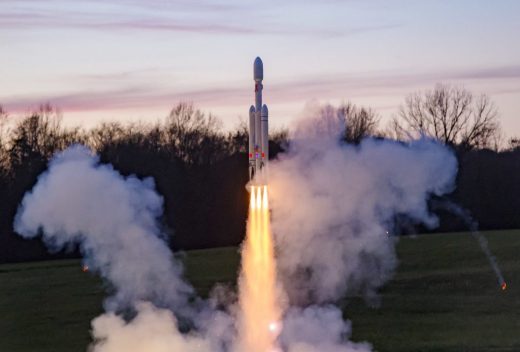
Video: First flight of BPS Space’s Falcon Heavy model rocket

I’ve posted a few times about Joe Barnard‘s scale model rocket projects that seek to emulate realistically the takeoff and landing characteristics of SpaceX rockets. Here is a report on the first flight of the Falcon Heavy model:

Find more about Joe’s projects at BPS.space.

You can also support his efforts at BPS.space is creating Rockets | Patreon.

====

Galaxy Girls: 50 Amazing Stories of Women in Space.


Mars: Insight news conferences + Mars 2020 landing target + Soft landslides

NASA TV will webcast two programs today about the upcoming touch down of the Insight lander on Mars: NASA Live: InSight Mars Landing | NASA 

NASA’s InSight lander is scheduled to touch down on Mars at approximately 3 p.m. EST, Monday, Nov. 26. NASA TV live coverage of the InSight Mars landing will begin at 2 p.m. Eastern (7 p.m. UTC). Upcoming briefings:

Wednesday, Nov. 21, 1 p.m. EST: InSight Mars Lander news conference: Mission engineering overview.
Wednesday, Nov. 21, 2 p.m. EST: InSight Mars Lander news conference: Mission science overview

It will take about 8 minutes for signals from Insight to reach earth during its descent through the atmosphere and the touch down on the surface. Here’s an item about the communications systems that allow for ground controllers to know what happened : How NASA Will Know When InSight Touches Down – NASA JPL


Insight landing sequence: Credits: Emily Lakdawalla for The Planetary Society

===

The Mars 2020 Rover, which is similar in design and capabilities to the Curiosity rover, now knows where it will land: NASA Announces Landing Site for Mars 2020 Rover – NASA JPL

This Mars map depicts the final four locations under consideration for the landing site of Mars 2020. The topographic map of Mars was created by the Mars Orbital Laser Altimeter (MOLA) on board the robot Mars Global Surveyor spacecraft. MOLA measured heights on Mars by precisely determining the time it took for a low power laser beam to bounce off the surface. Image Credit: NASA/MGS/MOLA Science Team. Larger view

Speaking of Curiosity, here is a recent update on its activities: Curiosity on the Move Again | NASA.

===

Bob Zimmerman examines an image taken of the Martian surface and highlights what is similar and different between geologic processes on Mars versus on the Earth: The soft landslides of Mars | Behind The Black

The light gravity of Mars, combined with different materials, a lot of dust, and a geological history different from Earth, produces events that — though reminiscent of similar geological events on Earth — are definitely not the same.

Landslide in Southern Mid-Latitude Crater – HiRISE

====

Telescopes and Binoculars at Amazon

Everyone can participate in space