A sampling of links to recent space policy, politics, and government (US and international) related space news and resource items that I found of interest:
Laura Seward Forczyk (@LauraForczyk) – Twitter – “Amount spent on SLS thus far: $14 billion
Amount spent on Orion thus far: $16 billion
FY2019 SLS/Orion budget: $4,093 up from $4,045 in 2018.
And yet people within NASA are complaining about the lack of money for SLS/Orion.”
** “Watch This Space with NASA Administrator Jim Bridenstine with the latest from the Moon” – NASA update by the administrator –
** “Space Solar: Common Ground from Space” – The National Space Society posts this
9-minute TED talk on space solar power is presented by Paul Jaffe, PhD, of the Naval Research Laboratory Space Engineering Department. Paul does research in space solar and power beaming. The talk was given in October 2018 and published January 28.
Using state of the art robotics and their proprietary polymer, AI SpaceFactory is contending for the final top prize of $500,000 given to the highest scoring team to print a sub-scale habitat in the third and final phase of the construction competition. The 1:3 scale prototype will be printed in front of a live audience at Bradley University in Peoria, Illinois, from April 29 to May 4.
AI SpaceFactory was one of only four teams awarded among six who submitted entries, placing 2nd overall on the basis of 3D-printed samples that were tested for strength, impact resistance, and durability in extreme temperatures. In contrast to other teams, which used concrete as their construction material, AI SpaceFactory formulated their own material – a “Martian polymer” that can be made from matter found or grown on Mars. The polymer was validated by a third-party lab and proven to outperform concrete in every important way: superior tensile and compressive strength, extreme durability in freeze-thaw cycles, and enhanced ductility. The polymer also provides superior cosmic radiation absorption and thermal resistance (insulation) and can be made without water: essential characteristics in the construction of off-world habitats
In five weeks, AI SpaceFactory progressed from basic tests to an autonomously-printed large-area slab validated by NASA in November 2018. Four weeks later the team successfully printed, in only 24 hours, a large cylinder designed to hold twelve-hundred gallons of water complete with prefabricated wall penetrations robotically placed and sealed “on the fly”.
AI SpaceFactory describes MARHSA as a first-principles rethinking of what a Martian habitat could be — not another low-lying dome or confined half-buried structure, but an airy, multi-level environment filled with diffuse light. This innovation challenges the conventional image of “space age” architecture by focusing on the creation of highly habitable spaces tuned to the demands of a Mars mission.
My first reaction was, “Whoa! That tiny pit is at the head of an increasingly growing canyon!” To a caver on Earth, this instantly implies that water has flowed out of that pit and down the canyon, carving it out as it flowed. It also implied that the possible underground passage under the pit’s north rim might conceivably be extensive.
Reinforcing this first impression were the numerous dark streaks flowing down the canyon’s cliff walls to the south. They all seemed to originate at about the same elevation as the pit itself, suggesting they all come from the same contact between two geological layers, a contact where water tends to gather. On Earth, when water seeps downward through water-soluble limestone and then gets blocked at a contact of more resistant material, it then starts to flow horizontally, creating a cave at that contact. The Martian dark streaks and pit in the image to the right suggest a similar process is occurring here.
Bob goes on to discuss the region around the above canyon and what role water may have played in forming the features there.
Nonetheless, the data illustrated by these images makes that tiny pit most enticing. It not only appears to be relatively easy to access its interior, there is visual evidence that suggests the presence of water.
If I was a future settler of Mars, I would give this pit a very high priority for exploration. In fact, I think someone (maybe Elon Musk?) should already be considering a probe to delve its depths.
** Rotating in-space habitats can provide artificial gravity and don’t require that space transports go in and out of deep gravity wells. The Gateway Foundation initiative aims to develop a wheel-shaped station as the first large in-space habitat. This video lays out some of the design features: SpaceX Starship and The Von Braun Rotating Space Station –
https://youtu.be/vTNP01Sg-Ss
Scott Manley gives a brief critique of the Gateway group’s approach: A Realistic Look At The Gateway Foundation & Von Braun Station –
Manley emphasizes that funding is the biggest challenge. I agree and believe that the only viable financial approach to such an orbital facility is one that allows for incremental growth. That is, devise a design that can start small and simple and grows step-by-step, just as happened with most towns on earth. For example, start with two Bigelow habitats connected with a tether and rotating. Prove that this works technically and then show it works commercially by attracting a constant stream of paying visitors. This will then provide the basis to attract more investment to expand to more modules and a more elaborate structure.
A reader who keeps me up-to-date on the project says the system now includes
“improved color images and the addition of IR enhancements showing storm intensity for Band 13 images as well as IR color enhancements for Band 8 images.”
This public tool includes stats on temperature, wind and air pressure recorded by InSight. Sunday’s weather was typical for the lander’s location during late northern winter: a high of 2 degrees Fahrenheit (-17 degrees Celsius) and low of -138 degrees Fahrenheit (-95 degrees Celsius), with a top wind speed of 37.8 mph (16.9 m/s) in a southwest direction. The tool was developed by NASA’s Jet Propulsion Laboratory in Pasadena, California, with partners at Cornell University and Spain’s Centro de Astrobiología. JPL leads the InSight mission.
The white east- and west-facing booms — called Temperature and Wind for InSight, or TWINS — on the deck of NASA’s InSight lander belong to its suite of weather sensors. Credits: NASA/JPL-Caltech. Full image and caption
Through a package of sensors called the Auxiliary Payload Subsystem (APSS), InSight will provide more around-the-clock weather information than any previous mission to the Martian surface. The lander records this data during each second of every sol (a Martian day) and sends it to Earth on a daily basis. The spacecraft is designed to continue that operation for at least the next two Earth years, allowing it to study seasonal changes as well.
The tool will be geeky fun for meteorologists while offering everyone who uses it a chance to be transported to another planet.
** The Mars 2020 rover is coming together at NASA JPL in preparation for launch next year:
Tour the Spacecraft Assembly Facility at NASA’s Jet Propulsion Laboratory and see the Mars 2020 mission under construction. Project System Engineer Jennifer Trosper explains the hardware being built and tested, including the rover, descent stage, cruise stage, back shell and heat shield. This NASA mission is preparing to launch to the Red Planet in 2020 and land in 2012. For more about Mars 2020, visit https://mars.nasa.gov/m2020
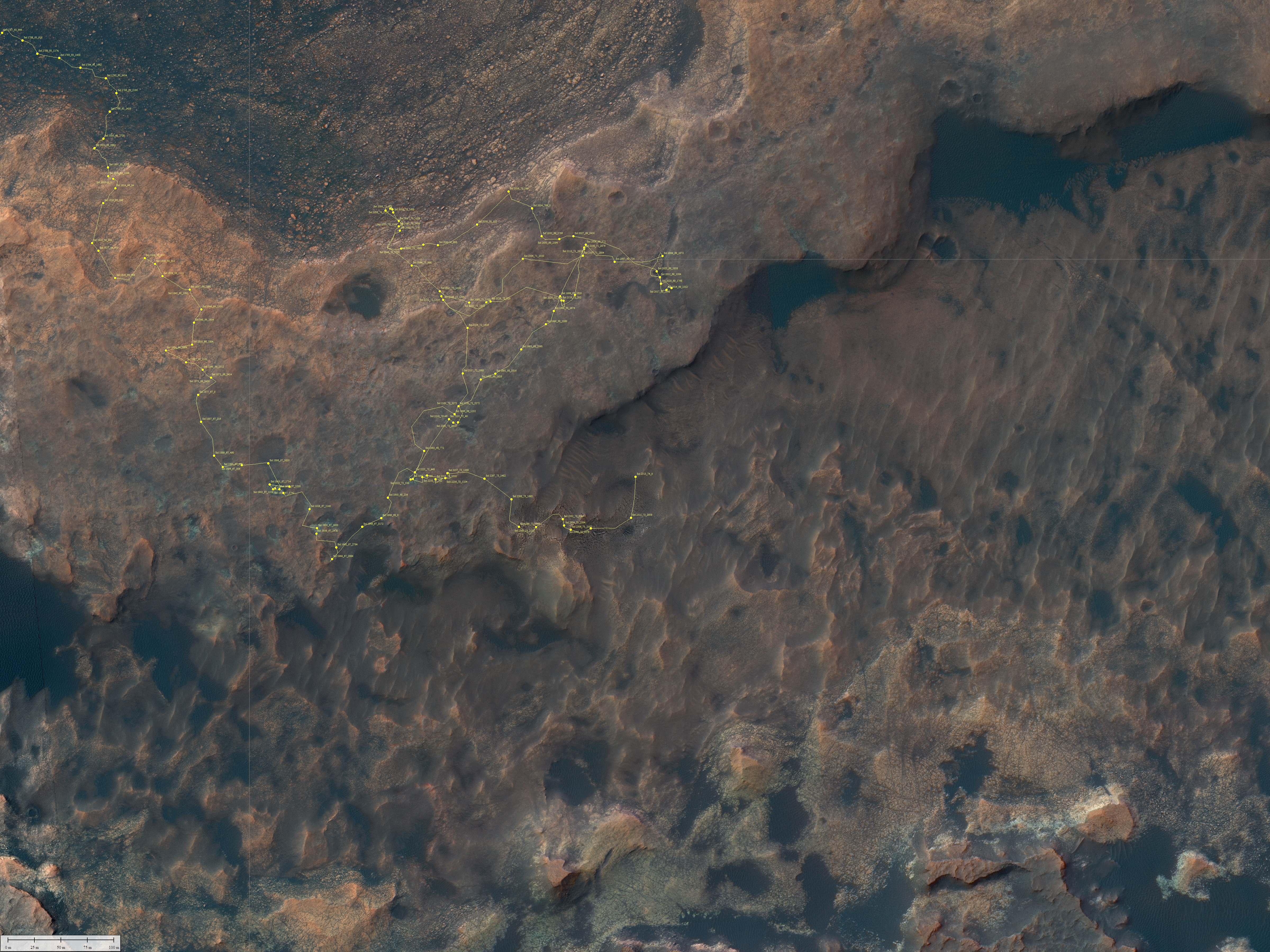
** Rovers on Mars and the Moon: Bob Zimmerman gives an update on Curiosity as it slowly ascends Mt Sharp and on China’s Yutu-2 rover on the lunar surface: Rover update: February 20, 2019 | Behind The Black
The valley that Curiosity is presently traversing is dubbed “the clay unit” or “the clay-bearing unit” by the geologists, based on its make-up determined from orbital data. So far they have found this terrain to be “some of the best driving terrain we’ve encountered in Gale Crater, with just some occasional sandy patches in the lee of small ridges.” Initially they had problems finding any rocks or pebbles large enough for the instruments to use for gathering geological data. For the past week or so, however, they have stopped at “bright exposure of rock” where some bedrock was visible, giving them much better material to work with.
Click to see Curiosity’s track for past couple of years.
**Mars once had rivers flowing on its surface as shown by river beds seen from orbit. But up close images of the river beds show that it has been billions of years since water flowed over them: A river valley floor on Mars | Behind The Black
The floor of a canyon in Reull Vallis.
Here we see that the floor has been significantly eroded by later processes after the water disappeared. Later, wind action, which probably contributed to that erosion, also placed dust and dunes within the depressions here.
A lot of time has passed since that river flowed through Reull Valles. Or to put it another way, Mars has generally been a very dry place for a very long time. It might have considerable water at its poles as well hidden in an underground ice aquifer, but its surface is far drier than any desert on Earth, and has been for eons.
I found it in the February image release from the high resolution camera on Mars Reconnaissance Orbiter. I have merely cropped the full image to focus at full resolution on its primary feature, a region of stippled-like surface surrounding an area of black striping that in turn surrounds a crescent-shaped pit outlined by whiter material.
Why is there a pit here? Why is it crescent-shaped? Why is it surrounded by that whiter material? I could guess and say that the pit is a vent from which water vapor from the lower cap of water sprays out onto the upper cap of frozen carbon dioxide, staining it with white ice, but I am most likely wrong.
Moreover, what causes the black striping, as well as the stippled material surrounding it? The black stripes are probably related to a similar process that forms the spider formations found in the polar regions, except that these are not spiders. Why the parallel straight lines?
**The Chinese Chang’e 4 lander & rover on the far side of the Moon are currently in hibernation during the 2 week long lunar night. The Lunar Reconnaissance Orbiter has posted images of the pair taken during a pass over its location:
On 30 January LROC acquired a spectacular limb shot centered on the Chang’e 4 landing site, looking across the floor of Von Kármán crater. At the time, LRO was more than 200 kilometers from the landing site so Chang’e 4 was only a few pixels across and the rover was not discernable. The following day LRO was closer to the site and again slewed (59° this time) to capture another view. This time the small Yutu-2 rover shows up (two pixels) just north of the lander. Also, shadows cast by the lander and rover are now visible.
“The Chang’e 4 rover is now visible to LROC! Just beyond the tip of the right arrow is the rover and the lander is to the right of the tip of the left arrow. The image appears blocky because it is enlarged 4x to make it easier to see the two vehicles. North is to the upper right, LROC NAC M1303570617LR [NASA/GSFC/Arizona State University].”
Astronomers call it “the moon that shouldn’t be there.”
After several years of analysis, a team of planetary scientists using NASA’s Hubble Space Telescope has at last come up with an explanation for a mysterious moon around Neptune that they discovered with Hubble in 2013.
The tiny moon, named Hippocamp, is unusually close to a much larger Neptunian moon called Proteus. Normally, a moon like Proteus should have gravitationally swept aside or swallowed the smaller moon while clearing out its orbital path.
So why does the tiny moon exist? Hippocamp is likely a chipped-off piece of the larger moon that resulted from a collision with a comet billions of years ago. The diminutive moon, only 20 miles (about 34 kilometers) across, is 1/1000th the mass of Proteus (which is 260 miles [about 418 kilometers] across).
** The Moon receives a constant shower of solar protons, which can interact with oxygen in surface rocks with oxygen-bearing molecules to produce hydroxyl (OH), which needs just one more proton to become water (H2O): NASA Finds Moon Could Be a Chemical Factory for Water | NASA
When a stream of charged particles known as the solar wind careens onto the Moon’s surface at 450 kilometers per second (or nearly 1 million miles per hour), they enrich the Moon’s surface in ingredients that could make water, NASA scientists have found.
Using a computer program, scientists simulated the chemistry that unfolds when the solar wind pelts the Moon’s surface. As the Sun streams protons to the Moon, they found, those particles interact with electrons in the lunar surface, making hydrogen (H) atoms. These atoms then migrate through the surface and latch onto the abundant oxygen (O) atoms bound in the silica (SiO2) and other oxygen-bearing molecules that make up the lunar soil, or regolith. Together, hydrogen and oxygen make the molecule hydroxyl (OH), a component of water, or H2O.
“We think of water as this special, magical compound,” said William M. Farrell, a plasma physicist at NASA’s Goddard Space Flight Center in Greenbelt, Maryland, who helped develop the simulation. “But here’s what’s amazing: every rock has the potential to make water, especially after being irradiated by the solar wind.”
This has implications for lunar settlers:
A key ramification of the result, [NASA Goddard plasma physicist William M. Farrell] said, is that every exposed body of silica in space — from the Moon down to a small dust grain — has the potential to create hydroxyl and thus become a chemical factory for water.
As often reported here, citizen scientists, especially in astronomy, continue to make significant contributions to the sciences. Here is a new article from NASA detailing one such case:
A volunteer working with the NASA-led Backyard Worlds: Planet 9 project has found the oldest and coldest known white dwarf — an Earth-sized remnant of a Sun-like star that has died — ringed by dust and debris. Astronomers suspect this could be the first known white dwarf with multiple dust rings.
In this illustration, an asteroid (bottom left) breaks apart under the powerful gravity of LSPM J0207+3331, the oldest, coldest white dwarf known to be surrounded by a ring of dusty debris. Scientists think the system’s infrared signal is best explained by two distinct rings composed of dust supplied by crumbling asteroids. Credits: NASA’s Goddard Space Flight Center/Scott Wiessinger. Download in high-resolution formats from NASA Goddard’s Scientific Visualization Studio
The star, LSPM J0207+3331 or J0207 for short, is forcing researchers to reconsider models of planetary systems and could help us learn about the distant future of our solar system.
“This white dwarf is so old that whatever process is feeding material into its rings must operate on billion-year timescales,” said John Debes, an astronomer at the Space Telescope Science Institute in Baltimore. “Most of the models scientists have created to explain rings around white dwarfs only work well up to around 100 million years, so this star is really challenging our assumptions of how planetary systems evolve.”
A paper detailing the findings, led by Debes, was published in the Feb. 19 issue of The Astrophysical Journal Letters and is now available online.
J0207 is located around 145 light-years away in the constellation Capricornus. White dwarfs slowly cool as they age, and Debes’ team calculated J0207 is about 3 billion years old based on a temperature just over 10,500 degrees Fahrenheit (5,800 degrees Celsius). A strong infrared signal picked up by NASA’s Wide-field Infrared Survey Explorer (WISE) mission — which mapped the entire sky in infrared light — suggested the presence of dust, making J0207 the oldest and coldest white dwarf with dust yet known. Previously, dust disks and rings had only been observed surrounding white dwarfs about one-third J0207’s age.
When a Sun-like star runs out of fuel, it swells into a red giant, ejects at least half of its mass, and leaves behind a very hot white dwarf. Over the course of the star’s giant phase, planets and asteroids close to the star become engulfed and incinerated. Planets and asteroids farther away survive, but move outward as their orbits expand. That’s because when the star loses mass, its gravitational influence on surrounding objects is greatly reduced.
This scenario describes the future of our solar system. Around 5 billion years from now, Mercury, then Venus and possibly Earth will be swallowed when the Sun grows into a red giant. Over hundreds of thousands to millions of years, the inner solar system will be scrubbed clean, and the remaining planets will drift outward.
Citizen scientists working on Backyard Worlds: Planet 9 scrutinize “flipbooks” of images from NASA’s Wide-field Infrared Survey Explorer. This animation shows a flipbook containing the ring-bearing white dwarf LSPM J0207+3331 (circled). Credit: Backyard Worlds: Planet 9/NASA’s Goddard Space Flight Center
Yet some white dwarfs — between 1 and 4 percent — show infrared emission indicating they’re surrounded by dusty disks or rings. Scientists think the dust may arise from distant asteroids and comets kicked closer to the star by gravitational interactions with displaced planets. As these small bodies approach the white dwarf, the star’s strong gravity tears them apart in a process called tidal disruption. The debris forms a ring of dust that will slowly spiral down onto the surface of the star.
J0207 was found through Backyard Worlds: Planet 9, a project led by Marc Kuchner, a co-author and astrophysicist at NASA’s Goddard Space Flight Center in Greenbelt, Maryland, that asks volunteers to sort through WISE data for new discoveries.
Melina Thévenot, a co-author and citizen scientist in Germany working with the project, initially thought the infrared signal was bad data. She was searching through the ESA’s (European Space Agency’s)Gaia archives for brown dwarfs, objects too large to be planets and too small to be stars, when she noticed J0207. When she looked at the source in the WISE infrared data, it was too bright and too far away to be a brown dwarf. Thévenot passed her findings along to the Backyard Worlds: Planet 9 team. Debes and Kuchner contacted collaborator Adam Burgasser at the University of California, San Diego to obtain follow-up observations with the Keck II telescope at the W. M. Keck Observatory in Hawaii.
“That is a really motivating aspect of the search,” said Thévenot, one of more than 150,000 citizen scientists on the Backyard Worlds project. “The researchers will move their telescopes to look at worlds you have discovered. What I especially enjoy, though, is the interaction with the awesome research team. Everyone is very kind, and they are always trying to make the best out of our discoveries.”
The Keck observations helped confirm J0207’s record-setting properties. Now scientists are left to puzzle how it fits into their models.
Citizen scientists working on Backyard Worlds: Planet 9 scrutinize “flipbooks” of images from NASA’s Wide-field Infrared Survey Explorer. This animation zooms in on the ring-bearing white dwarf LSPM J0207+3331 (highlighted). Credit: Backyard Worlds: Planet 9/NASA’s Goddard Space Flight Center
Debes compared the population of asteroid belt analogs in white dwarf systems to the grains of sand in an hourglass. Initially, there’s a steady stream of material. The planets fling asteroids inward towards the white dwarf to be torn apart, maintaining a dusty disk. But over time, the asteroid belts become depleted, just like grains of sand in the hourglass. Eventually, all the material in the disk falls down onto the surface of the white dwarf, so older white dwarfs like J0207 should be less likely to have disks or rings.
J0207’s ring may even be multiple rings. Debes and his colleagues suggest there could be two distinct components, one thin ring just at the point where the star’s tides break up the asteroids and a wider ring closer to the white dwarf. Follow-up with future missions like NASA’s James Webb Space Telescope may help astronomers tease apart the ring’s constituent parts.
“We built Backyard Worlds: Planet 9 mostly to search for brown dwarfs and new planets in the solar system,” Kuchner said. “But working with citizen scientists always leads to surprises. They are voracious — the project just celebrated its second birthday, and they’ve already discovered more than 1,000 likely brown dwarfs. Now that we’ve rebooted the website with double the amount of WISE data, we’re looking forward to even more exciting discoveries.”
Backyard Worlds: Planet 9 is a collaboration between NASA, the American Museum of Natural History in New York, Arizona State University, National Optical Astronomy Observatory, the Space Telescope Science Institute in Baltimore, the University of California San Diego, Bucknell University, the University of Oklahoma, and Zooniverse, a collaboration of scientists, software developers and educators who collectively develop and manage citizen science projects on the internet.
NASA’s Jet Propulsion Laboratory in Pasadena, California, manages and operates WISE for NASA’s Science Mission Directorate. The WISE mission was selected competitively under NASA’s Explorers Program managed by the agency’s Goddard Space Flight Center. The science instrument was built by the Space Dynamics Laboratory in Logan, Utah. The spacecraft was built by Ball Aerospace & Technologies Corp. in Boulder, Colorado. Placed in hibernation in 2011, the spacecraft was reactivated in 2013 and renamed NEOWISE. Science operations and data processing take place at the Infrared Processing and Analysis Center at Caltech, which manages JPL for NASA.