Here is the latest episode in NASA’s Space to Ground weekly report on activities related to the International Space Station:
** NRCSD#21 Deployments from the International Space Station – Nanoracks
Deployments of three CubeSats from the Nanoracks CubeSat Deployer on the International Space Station. This is Nanoracks’ 21st CubeSat deployment mission from the ISS. The first deployment will contain CAPSat, a 3U from the University of Illinois. The second deployment will contain PR CuNaR2, a 3U from the Inter American University of Puerto Rico (the first ever Puerto Rican Satellite!), and a 3U from the University of Massachusetts Lowell.
** Crew 3 Training Resource Reel UHD – October 12, 2021 – NASA Video
NASA astronauts Raja Chari, Tom Marshburn and Kayla Barron as well as ESA (European Space Agency) astronaut Matthias Maurer train for their six-month stay aboard the International Space Station.
ESA astronaut Thomas Pesquet is on his second mission to the International Space Station called Alpha. In this video Thomas talks about his crew preference food that arrived on @SpaceX CRS-22 supply spacecraft, the video was recorded on 19 June 2021 in the Zvezda module of the Space Station.
Astronauts’ full space menu comprise of a range of food designed to meet nutritional and operational requirements on board. Because of the two hours of exercise they perform every day on the Station and a full schedule of science and operations, astronauts are expected to consume approximately 3000 calories per day in space.
For ESA astronauts such as Thomas, two thirds of this calorie intake come from the basic food supply that is preselected and prepacked by @NASA for the entire space mission. The final third of their calories comes from ‘crew choice meals’ – food that the astronauts choose for themselves, either from the US menu or a range of European, Russian and Japanese options. Before any mission to the Space Station, the astronauts participate in several space food tasting sessions to help determine what dishes will be included in the basic food supply. During a training course they test a range of different food and drink items and rate each of them in a questionnaire.
This information is then provided to NASA’s food lab which determines the final food package. Over 200 experiments are planned during Thomas’ time in space, with 40 European ones and 12 new experiments led by the French space agency @CNES. Follow Thomas: http://bit.ly/ThomasPesquetBlog
** Earth Images from the International Space Station. | Oct. 9, 2021– space googlevesaire
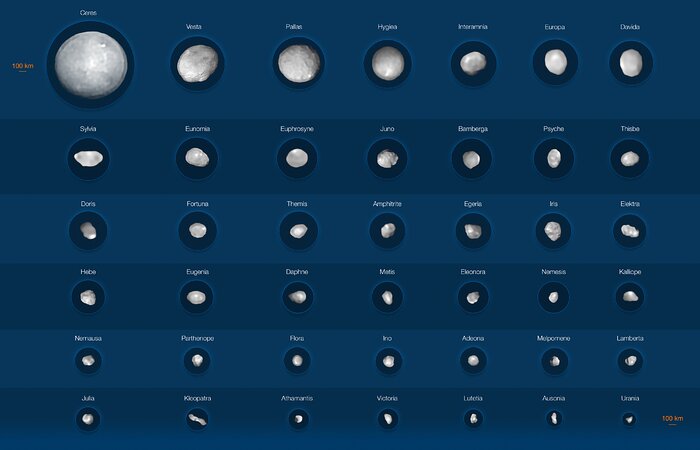
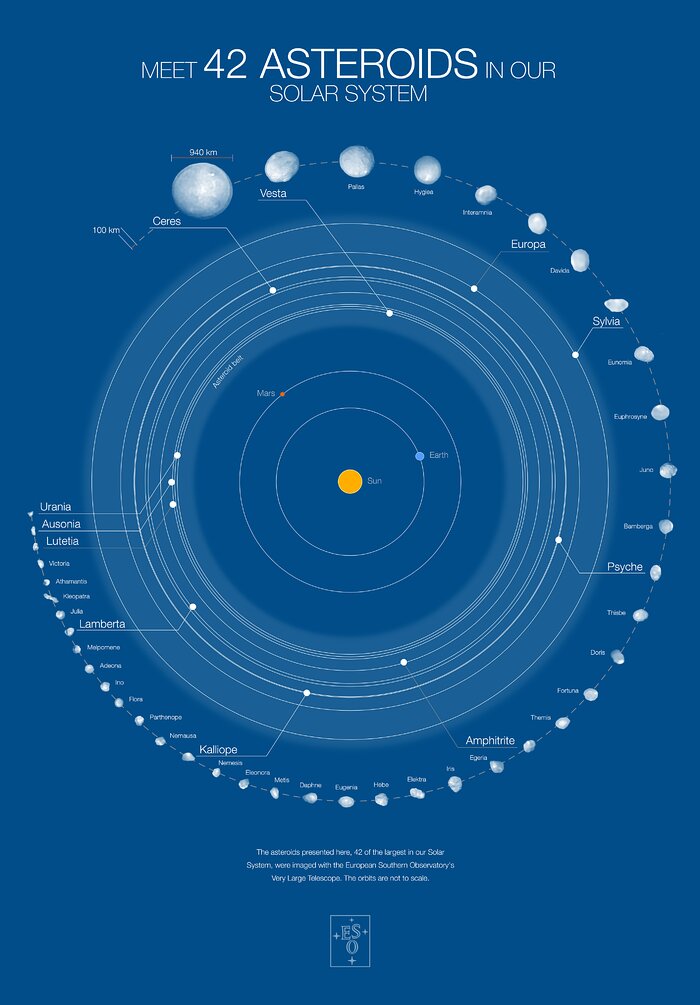
This image depicts 42 of the largest objects in the asteroid belt, located between Mars and Jupiter. Most of them are larger than 100 kilometres, with the two biggest asteroids being Ceres and Vesta, which are around 940 and 520 kilometres in diameter, and the two smallest ones being Urania and Ausonia, each only about 90 kilometres. The images of the asteroids have been captured with the Spectro-Polarimetric High-contrast Exoplanet REsearch (SPHERE) instrument on ESO’s Very Large Telescope.
Using the European Southern Observatory’s Very Large Telescope (ESO’s VLT) in Chile, astronomers have imaged 42 of the largest objects in the asteroid belt, located between Mars and Jupiter. Never before had such a large group of asteroids been imaged so sharply. The observations reveal a wide range of peculiar shapes, from spherical to dog-bone, and are helping astronomers trace the origins of the asteroids in our Solar System.
The detailed images of these 42 objects are a leap forward in exploring asteroids, made possible thanks to ground-based telescopes, and contribute to answering the ultimate question of life, the Universe, and everything [1].
“Only three large main belt asteroids, Ceres, Vesta and Lutetia, have been imaged with a high level of detail so far, as they were visited by the space missions Dawn and Rosetta of NASA and the European Space Agency, respectively,”
explains Pierre Vernazza, from the Laboratoire d’Astrophysique de Marseille in France, who led the asteroid study published today in Astronomy & Astrophysics.
“Our ESO observations have provided sharp images for many more targets, 42 in total.”
The previously small number of detailed observations of asteroids meant that, until now, key characteristics such as their 3D shape or density had remained largely unknown. Between 2017 and 2019, Vernazza and his team set out to fill this gap by conducting a thorough survey of the major bodies in the asteroid belt.
Most of the 42 objects in their sample are larger than 100 km in size; in particular, the team imaged nearly all of the belt asteroids larger than 200 kilometres, 20 out of 23. The two biggest objects the team probed were Ceres and Vesta, which are around 940 and 520 kilometres in diameter, whereas the two smallest asteroids are Urania and Ausonia, each only about 90 kilometres.
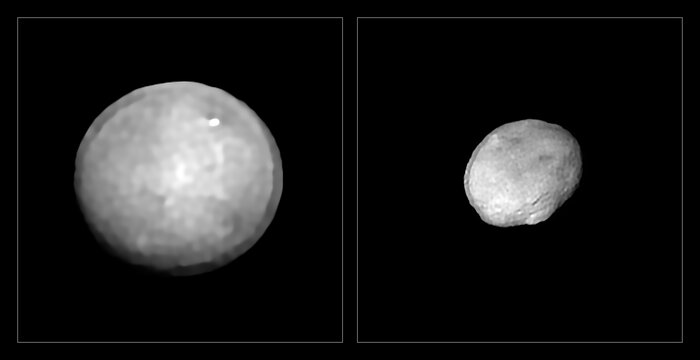
These images have been captured with the Spectro-Polarimetric High-contrast Exoplanet REsearch (SPHERE) instrument on ESO’s Very Large Telescope as part of a programme that surveyed 42 of the largest asteroids in our Solar System. They show Ceres and Vesta, the two largest objects in the asteroid belt between Mars and Jupiter, approximately 940 and 520 kilometres in diameter. These two asteroids are also the two most massive in the sample.
By reconstructing the objects’ shapes, the team realised that the observed asteroids are mainly divided into two families. Some are almost perfectly spherical, such as Hygiea and Ceres, while others have a more peculiar, “elongated” shape, their undisputed queen being the “dog-bone” asteroid Kleopatra.
By combining the asteroids’ shapes with information on their masses, the team found that the densities change significantly across the sample. The four least dense asteroids studied, including Lamberta and Sylvia, have densities of about 1.3 grams per cubic centimetre, approximately the density of coal. The highest, Psyche and Kalliope, have densities of 3.9 and 4.4 grammes per cubic centimetre, respectively, which is higher than the density of diamond (3.5 grammes per cubic centimetre).
This large difference in density suggests the asteroids’ composition varies significantly, giving astronomers important clues about their origin.
“Our observations provide strong support for substantial migration of these bodies since their formation. In short, such tremendous variety in their composition can only be understood if the bodies originated across distinct regions in the Solar System,”
explains Josef Hanuš of the Charles University, Prague, Czech Republic, one of the authors of the study. In particular, the results support the theory that the least dense asteroids formed in the remote regions beyond the orbit of Neptune and migrated to their current location.
These findings were made possible thanks to the sensitivity of the Spectro-Polarimetric High-contrast Exoplanet REsearch (SPHERE) instrument mounted on ESO’s VLT[2].
“With the improved capabilities of SPHERE, along with the fact that little was known regarding the shape of the largest main belt asteroids, we were able to make substantial progress in this field,”
says co-author Laurent Jorda, also of the Laboratoire d’Astrophysique de Marseille.
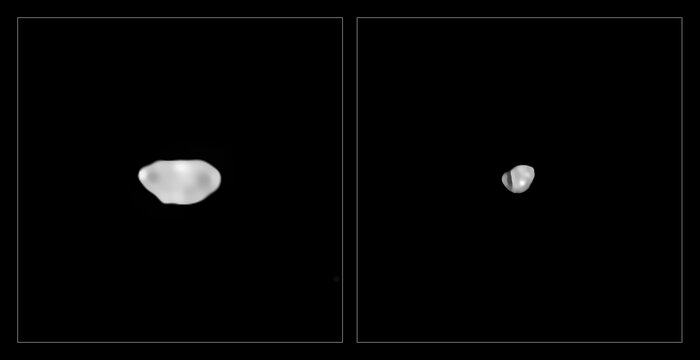
These images have been captured with the Spectro-Polarimetric High-contrast Exoplanet REsearch (SPHERE) instrument on ESO’s Very Large Telescope as part of a programme that surveyed 42 of the largest asteroids in our Solar System. They show two of the least dense asteroids imaged, Sylvia and Lamberta, which have a density of about 1.3 grammes per cubic centimetre, approximately the density of coal.
Astronomers will be able to image even more asteroids in fine detail with ESO’s upcoming Extremely Large Telescope (ELT), currently under construction in Chile and set to start operations later this decade.
“ELT observations of main-belt asteroids will allow us to study objects with diameters down to 35 to 80 kilometres, depending on their location in the belt, and craters down to approximately 10 to 25 kilometres in size,”
says Vernazza.
“Having a SPHERE-like instrument at the ELT would even allow us to image a similar sample of objects in the distant Kuiper Belt. This means we’ll be able to characterise the geological history of a much larger sample of small bodies from the ground.”
This poster shows 42 of the largest objects in the asteroid belt, located between Mars and Jupiter (orbits not to scale). The images in the outermost circle of this infographic have been captured with the Spectro-Polarimetric High-contrast Exoplanet REsearch (SPHERE) instrument on ESO’s Very Large Telescope. The asteroid sample features 39 objects larger than 100 kilometres in diameter, including 20 larger than 200 kilometres. The poster highlights a few of the objects, including Ceres (the largest asteroid in the belt), Urania (the smallest one imaged), Kalliope (the densest imaged) and Lutetia, which was visited by the European Space Agency’s Rosetta mission.
Notes
[1] In The Hitchhiker’s Guide to the Galaxy by Douglas Adams, the number 42 is the answer to the “Ultimate Question of Life, the Universe, and Everything.” Today, 12 October 2021, is the 42nd anniversary of the publication of the book.
[2] All observations were conducted with the Zurich IMaging POLarimeter (ZIMPOL), an imaging polarimeter subsystem of the SPHERE instrument that operates at visible wavelengths.
1. Tuesday, Oct.12, 2021; 7 pm PDT (9 pm CDT, 10 pm EDT): We welcome back Dr. Ajay Kothari on thorium and going back to the Moon. Find his recent thorium Space Review article here.
2. Wednesday, Oct. 13, 2021: Hotel Mars. No show this week.
3. Friday, Oct.15, 2021; 9:30-11 am PDT (11:30 am-1 pm CDT, 12:30-2 pm EDT): Dr. Brian Green on his new book, Space Ethics [Amazon commission link].
4. Sunday, Oct.17.12, 2021; 12-1:30 pm PDT (3-4:30 pm EDT, 2-3:30 pm CDT): OPEN LINES. Everyone call us and share your space thoughts with us.
Some recent shows:
** Sunday, Oct.10.2021 – Emily Carney talked about “her blog series regarding space in the 70’s, blogging for the NSS plus other listener driven phone calls and emails“.
Here is the latest episode in NASA’s Space to Ground weekly report on activities related to the International Space Station:
** Expedition 65 Video File Soyuz MS 19 Launch Docking HatchOpen – October 5, 2021 – NASA Video
Russian actress Yulia Peresild, Russian producer Klim Shipenko and veteran Russian cosmonaut Anton Shkaplerov of Roscosmos launched Oct. 5 on the Soyuz MS-19 spacecraft from the Baikonur Cosmodrome in Kazakhstan on a fast-track, two-orbit journey to the International Space Station. Peresild and Shipenko will be filming scenes for a movie while on board the outpost under a commercial agreement with Roscosmos. They will return to Earth Oct. 17 with station Flight Engineer Oleg Novitskiy while Shkaplerov remains on the complex through March 2022.
** Soyuz with film crew flies around space station in these amazing views – VideoFromSpace
The Soyuz MS-19 spacecraft carrying Russian actress Yulia Peresild, producer Klim Shipenko and cosmonaut Anton Shkaplerov flew around the International Space Station while over Africa and the Mediterranean Sea ahead of docking on Oct. 5, 2021. [Watch the Soyuz launch](https://www.space.com/russian-film-cr…)
** Expedition 65 Inflight with Fox Weather – October 6, 2021 – NASA Video
Aboard the International Space Station, Expedition 65 Flight Engineer Mark Vande Hei discussed living and working in space during an in-flight interview October 6 with the Fox Weather Network. Vande Hei is in the midst of a year-long mission living and working aboard the microgravity laboratory to advance scientific knowledge and demonstrate new technologies for future human and robotic exploration missions as part of NASA’s Moon and Mars exploration approach, including lunar missions through NASA’s Artemis program.
** Watch SpaceX Crew Dragon approach space station in stunning flashback time-lapse – VideoFromSpace
The SpaceX CRS-23 Cargo Dragon spacecraft arrived at the International Space Station on Aug. 30, 2021. The spacecraft departed the orbital outpost today (Sept. 30), see the undocking here: https://www.space.com/spacex-dragon-c…
ESA astronaut Thomas Pesquet is sharing scenes from life on board the International Space Station during his second mission “Alpha”. He shared this video on social media with the caption:
“Space workout anyone? The Advanced Resistive Exercise Device or ARED is called this for a reason, it uses pressurized air in two cylinders and complicated machinery to allow us to weightlift in space: squats, deadlifts, bench press, shoulder press, biceps curl, etc, we can do it all… but we do a lot of squats: these muscles don’t do much work during our normal day. We never skip exercise on the International Space Station. Every. Single. Day. I miss having a shower, and I miss the rain, and I miss fresh food, but secretly I also miss having a day without having to exercise. Don’t tell my flight surgeon!” …
A sampling of links to recent space policy, politics, and government (US and international) related space news and resource items that I found of interest (find previous space policy roundups here):
** A Peek into China’s Future Space Projects at the Zhuhai Airshow, The KZ-1A Rocket Returns to Flight – Dongfang Hour – YouTube
Hello and welcome to another episode of the Dongfang Hour China Space News Roundup! A kind reminder that we cover many more stories every week in our Newsletter (newsletter.dongfanghour.com). This week, we discuss:
00:00 Introduction 01:04 4 Future Space Projects at Zhuhai 08:59 Major Launch Contracts
18:29 Spacecraft and Models Shown in the Exhibition
21:42 The Kuaizhou-1A Rocket Returns to Flight after a year-long absence
In this session of Space Cafè “Moriba’s Vox Populi 06” Dr. Moriba Jah talked about Environmental Protection, Climate Change, and their Correlation Pleiades with Orbital Space with
Prof. Joellen Russell, University Distinguished Professor of Biogeochemical Dynamics, and Thomas R. Brown Distinguished Chair of Integrative Science at the University of Arizona, Dr. Danielle Wood, Assistant Professor of Media Arts and Sciences and Assistant Professor (Joint) of Aeronautics and Astronautics at the Massachusetts Institute of Technology, Dr. Imogen Napper, Expedition Scientist at National Geographic, Dr. Michael Webber, Josey Centennial Professor in Energy Resources at the University of Texas at Austin.
Moriba’s Vox Populi is a disruptor in the current growing ocean of webcasts! In the discussing they try to address …
** How India Developed World Class Rockets From Humble Beginnings. – Scott Manley
A deep dive into the recently released draft Environmental Assessment (EA) for public comment, detailing SpaceX’s future plans for Starbase and its environmental impacts to Boca Chica, and the surrounding area. Once approved, SpaceX can begin launching full stack Starships to orbit. If you’d like to submit your thoughts on the Assessment, comments may be submitted by email to SpaceXBocaChica@icf.com. The full EA draft can be found here: https://www.faa.gov/space/stakeholder…