Bob does frequent postings in which he discusses images of the amazingly diverse Martian surface such as: Terraced mesa inside Martian depression – “[The image] shows a very puzzling terraced mesa inside an enclosed depression or sinkhole (the western half of which can be seen in the full image).”
Here’s an audio narrative/musical tribute to the cosmos created by a
collaboration between the Smithsonian’s National Air and Space Museum and Grammy Award-winning musician and producer Diplo, with words by the museum, music from Diplo’s album MMXX, and narration by Hrishikesh Hirway. As a companion album to MMXX, Under Ancient Skies expands on the theme of our connection with nature to explore our human experience in the cosmos around the globe and throughout history, from the ancient world to contemporary understandings of the universe.
===
“Angelic Soprano” Angèlia Grace renders a beautiful vocal interpretation of a selection of the Hans Zimmer soundtrack to the film, Interstellar [Amazon commission link]:
A sampling of links to recent space policy, politics, and government (US and international) related space news and resource items that I found of interest (find previous space policy roundups here):
Hello and welcome to another episode of the Dongfang Hour China Aero/Space News Roundup! We come to you one day late this week, having spent nearly 2 hours yesterday speaking with our friend and colleague Kevin Xu of Landspace, on topics related to reusable rockets, the differences between SOEs and commercial companies in China, and Kevin’s thoughts on rocket cams. Our interview with Kevin will be available in around 2 weeks. That being said, this week we bring you updates on Galactic Energy, China’s maritime satcom industry and the product offerings therein, and China’s role in the regional EO market.
E2MC founder Raphael Roettgen returns to the Make Space Boring News show to share the news of space financing rounds for the month of October 2020. Web article on spacewatch.global: https://spacewatch.global/2020/11/e2m…
1. Monday, Nov. 9, 2020; 7 pm PDT (9 pm CDT, 10 pm EDT: No special programming.
2. Tuesday, Nov. 10, 2020; 7 pm PDT (9 pm CDT, 10 pm EDT): No show tonight due to Dr. Space non-space appointments.
3. Wednesday, Nov.11, 2020: Hotel Mars TBA pre-recorded. See upcoming show menu on the home page for program details.
4. Thursday, Nov. 12, 2020; 7-8:30 pm PDT (9-10:30 pm CDT, 10-11:30 pm EDT): No program today.
5. Friday, Nov.13, 2020; 9:30-11 am PDT (11:30 am-1 pm CDT, 12:30-2 pm EDT): We welcome Dr. David Carrier to discuss his new book published by Apogee, Apollo Memories[Amazon commission link].
** Thursday, Nov.5.2020 – Robert Zimmerman “discussed a variety of topics, including the recent 2020 election and its potential impact on all things space”.
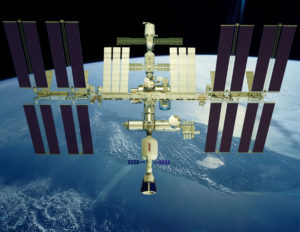
Here is the latest episode in NASA’s Space to Ground weekly report on activities related to the International Space Station:
** Know Your Crew…One! – NASA Johnson
The astronauts who will fly the first operational Crew Dragon spacecraft to the International Space Station are trained up and ready to go. After many months of work together (for some of them, years) they know each other pretty well, so we asked them to prove it. Have a look as four astronauts who are about to spend six months in space together talk about what they’re expecting from life on the space station, and share their advice for the one among them who has never been there before.
** Crew-1 for All – NASA Johnson
The next SpaceX Crew Dragon to fly to the International Space Station will carry four astronauts on a mission known as Crew-1. What does that mean? Who better to explain the first operational mission of a commercial crew space vehicle than the people who will make it happen in space. Join the American and Japanese astronauts for a walk through the mission that opens a new era in human space exploration.
** Expedition 64 ISS 20th Anniversary On Orbit Crew News Conference – October 30, 2020 – NASA Video
Aboard the International Space Station, Expedition 64 Commander Sergey Ryzhikov of Roscosmos and Flight Engineers Kate Rubins of NASA and Sergey Kud-Sverchkov of Roscosmos discussed the upcoming 20th anniversary of a permanent human presence on the orbital laboratory and other elements of life and work in orbit during an in-flight news conference Oct. 30. After arriving on the station Oct. 14 for a six-month mission, the trio is gearing up to mark the anniversary on Nov. 2, the day in 2000 when NASA astronaut and Expedition 1 Commander Bill Shepherd and Russian cosmonauts Yuri Gidzenko and Sergei Krikalev floated into the fledgling ISS to begin the unbroken human occupancy of the complex.
Monday 2 November 2020 marks 20 years of continuous human presence on the International Space Station. Relive a few memorable moments from the unique orbital outpost in this clip covering 20 years of the International Space Station in 60 seconds.Since Crew One took up residence on 2 November, 240 people including 18 ESA astronauts have lived and worked on the orbital outpost, carrying out essential research to benefit life on Earth.The next ESA mission to the International Space Station is set for 2021, when Thomas Pesquet will become the first European to fly on a SpaceX Crew Dragon spacecraft for his Alpha mission.
** Fire, Lightning, and Crystals in Space: 20 Years on the ISS – SciShow Space
2020 marks two decades of people living and working about the ISS, and from fireballs to microgravity grown crystals, they’ve been keeping busy.
** How 20 Years of Life On The ISS Began With Expedition One – Scott Manley
November 2nd 2000 was the day that 3 people arrived on the International Space Station and began living and working there. Since this time, there has always been a human presence in space, and I hope this continues, but it’s important to realise that even before this historic moment there were crews that worked to make the space station a place people could call home.
A sampling of recent articles, videos, and images dealing with space transport (find previous roundups here):
** ULA Atlas V launch of the NROL-101 spysat for the National Reconnaissance Office (NRO) is currently set for Wednesday, Nov. 4 at 5:38 pm EST (2238 GMT) from Cape Canaveral. A roll-out on Monday was aborted and the vehicle moved back into the Vertical Integration Facility. ULA said the vehicle “experienced an upper payload environmental control system flow rate reduction” and they decided to postpone the launch to investigate the issue.
The payloads on ‘In Focus’ included the latest flock of Planet’s Earth-imaging SuperDove small satellites, each integrated with and deployed from Rocket Lab’s Maxwell satellite dispensers. Flock 4e’ bolsters Planet’s constellation of Earth-observation satellites already on orbit providing medium-resolution global coverage and near-daily revisit. Canon Electronic’s mission objective with their CE-SAT-IIB microsatellite is to demonstrate the company’s Earth-imaging capability with a middle-size telescope equipped with an ultra-high sensitivity camera to take night images of the Earth and small size telescopes suitable for CubeSat use.
The ability to change orbital inclinations means more flexibility for our customers, enabling them to position each and every satellite juuuuuust right. It also opens up an even wider range of missions possible from LC-1 and LC-2. pic.twitter.com/96vDbRAJIe
GLONASS is Russia’s global satellite navigation system, analogous to the US Global Positioning System (GPS) and European Galileo constellations; like its counterparts, it is available for both military and civilian use.
…
Sunday’s launch carried a third-generation Uragan-K satellite, Uragan-K No.15L, which is the third Uragan-K to be launched. This class of satellite was originally intended to consist of two prototype satellites for on-orbit testing in an operational environment prior to the entry into service of the operational Uragan-K2 series. Delays to the Uragan-K2 project have led to Russia ordering 11 additional Uragan-K satellites, including No.15L – which will be pressed into service.
China launched a new group of triplet satellites for the Chuangxin-5 (CX-5) constellation on Monday. Launched under the name Yaogan Weixing-30 Group-7, the three satellites were orbited by a Chang Zheng-2C launch vehicle from the LC-3 Launch Complex of the Xichang Satellite Launch Center, with launch taking place at 15:19 UTC.
Like the previous missions on the series, this mission is once again classed as involving new remote sensing birds that will be used to “conduct electromagnetic probes and other experiments.”
As was the case in previous launches of the Yaogan Weixing series, analysts believe this class of satellites is used for military purposes, in particular forming a high-revisit smallsat constellation for signal intelligence missions or imaging activities.
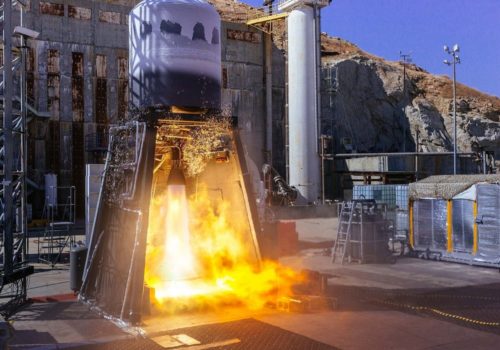
ABL Space Systems has completed integrated stage testing of the RS1 small satellite launch vehicle. Testing was performed on the RS1 second stage with the in-house designed E2 liquid rocket engine at the Area 1-56 test site on Edwards Air Force Base. Critical aspects the campaign included handling of the propellant tanks, operating pressurant management systems, and refining the stage arming and engine startup sequences, all of which were accomplished successfully. This test campaign builds on the successes of eighteen months of extensive component, engine and stage testing.
…
ABL manufactures engines and stages in state-of-the-art facilities in El Segundo, California. By staying highly verticalized and focusing on low-cost, scalable manufacturing processes, ABL delivers industry leading capability and pricing to the small satellite community. RS1 can deliver one metric ton to sun synchronous orbit, 400 kilograms to geosynchronous transfer orbit, and 250kg to lunar injection orbit.
RS1 Integrated Stage Test at Edwards Air Force Base. Credits ABL Space Systems
“Simplicity is key,” said Harry O’Hanley, Founder and CEO of ABL. “Our company is just over three years old. Yet, we’ve moved markedly faster and been more capital efficient than others because we avoid exotic, unproven architectures and manufacturing processes. Unless an innovation adds measurable value to our customer, we do not pursue it.”
ABL supports a variety of customers throughout the defense, civil and commercial sectors, with over $44 million in announced contracts and a deep customer backlog. RS1 is best in class in all dimensions that launch customers value: price – as low as $9,000/kg; capability – the highest lift capacity throughout the cislunar volume; reliability – only proven technologies in the system; and cadence – existing production lines can produce a launch vehicle in under thirty days.
ABL will continue performing stage test operations at Edwards Air Force Base in the coming weeks to accumulate additional run time on the engine and stage. The launch vehicle system will undergo a series of stress tests to demonstrate performance in a variety of different flight conditions. RS1 is scheduled for an initial launch in the first quarter of 2021 from Vandenberg Air Force Base, where ABL has received a Right of Entry for LC-576E from the 30th Space Wing.
** Protolaunch optimizing rocket propulsion systems for small payload transports.
Protolaunch has taken a bottom-up design philosophy to propulsion development, designing specifically for small payloads from the outset. Based on work conducted at the University of Cambridge, Protolaunch has developed a novel thermodynamic cycle that eliminates the need for any turbomachinery while enabling the use of cleaner biofuels, and simplifying propellant handling and storage.
Protolaunch technology leverages thermodynamic optimisations to eliminate the need for complex pumps & turbmachinery and reduce manufacturing complexity.
Our propulsion technology presents a number of strategic advantages over turbomachinery or high-pressure blow-down. Our technology is the key enabler for a dedicated microlauncher and will facilitate a future of dedicated launches for small payloads.
** Stratolaunch receives first Ursa Major rocket engine for Talon-A reusable hypersonic vehicle:
Talon-A is a fully reusable, autonomous, liquid rocket-powered Mach 6-class hypersonic vehicle with a length of 28 feet (8.5 m), wingspan of 11.3 feet (3.4 m), and a launch weight of approximately 6,000 pounds (2,722 Kg). The Talon-A will conduct over 1-minute of hypersonic flight testing, and glide back for an autonomous, horizontal landing on a conventional runway. The vehicle will also be capable of autonomous take-off, under its own power, via a conventional runway.
Space tourism venture Virgin Galactic on Wednesday confirmed to CNBC that it remains on track to conduct its next test spaceflight in the coming weeks.
“We expect our first spaceflight from Spaceport America to occur later this fall and we are pleased to confirm that we are still on track to meet this timeframe,” the company said.
This will be the first of two spaceflights that the space tourism company has planned to complete testing of its SpaceShipTwo spacecraft system.
…Our next spaceflight is set to deliver that first taste of human spaceflight for the state and, having completed two spaceflights, we as a team know how special these historic moments can be.
If all goes to plan, not only will this flight be the first human spaceflight to depart from New Mexico, it will also mark Virgin Galactic Pilot CJ Sturckow’s sixth time in space, and will see him become the first person to have flown to space from three different U.S. States, an extraordinary professional achievement. I too have had a long relationship with space. At NASA I worked numerous Space Shuttle missions and oversaw the launch of 12 flights, and I have managed another two during my time at Virgin Galactic. This mission will mark number 15! One thing is for certain, the feeling you get from witnessing your team run a safe and successful mission, followed by greeting the astronauts on their return to earth, never ceases to thrill me.
…
One thing to note about this flight is that once we are in space, we will be flying slightly differently than how we plan to fly with our Future Astronauts. This is because we’ll have three NASA payloads in the cabin, flown through NASA’s Flight Opportunities Program. Unlike our Future Astronauts, these payloads aren’t on board for the view, so instead of stopping the vehicle pitch in the inverted position for the best views of Earth, we’ll pitch the vehicle 270 degrees following boost to get to the entry attitude as soon as possible. This maneuver will maximize time for the payloads to remain in data-collection mode. Carrying these payloads not only makes this test flight a revenue-generating one, but also demonstrates our commitment to facilitating regular, accessible space-based scientific research.
The payloads will be placed in the spaceship cabin, where we have other test objectives planned. While we have flown passenger seats on previous flights, this will be the first time in flight where we actively recline the seats once in space, which will create extra room when Future Astronauts are floating in zero gravity. For this first test of the seat recline in a space environment, we will have instrumented test mannequins strapped in.
…
Since our last flight to space, we’ve refined and upgraded a few other elements on the spaceship. We’ve extensively tested these changes on the ground and in our previous two flights from Spaceport America, and we are now ready to test them on a rocket-powered flight. We’ve made upgrades to the horizontal stabilizers (known as H-Stabs), which are the flight control surfaces on the outboard of the feather booms. We’ve also made improvements to the flight control system that commands these Hstabs to move in response to pilot inputs. We’ve already flown these improvements on our last two glide flights, and they performed well. Together these mods will enhance the performance of the spaceship and support long-term commercial service.
“VMS Eve has the ability to test pilot proficiency by simulating the glide and approach-to-land phase of flight for SpaceShipTwo pilots. The cockpit structure of Eve is almost identical to that of Unity: the same pilot seats and windows, as well as very similar flight controls and instruments. This, coupled with the fact that with Eve’s landing gear down, and one set of speed brakes out, it descends on the same flight path angle as SpaceShipTwo, means that the crew can practice the identical approach and landing pattern to the one they will fly in Unity – with much of the same information displays, and the same view out the window. This makes Eve a very valuable in-flight simulator for the spaceship’s final approach and landing phases.’’
VMS Eve is airborne and headed to Las Cruces and Truth or Consequences for standard landing approach practice. If you’re in the area you may see the 140ft wingspan in the sky! Pilots for this flight are CJ Sturckow and Dave Mackay with Flight Test Engineer, Brandon Parrish pic.twitter.com/0JJOv9Rt66
Virgin Galactic today announced the appointment of two new pilots into its Pilot Corps, bringing the total number of pilots to eight.
Jameel Janjua and Patrick Moran will be based at Spaceport America, New Mexico, and join the Virgin Galactic team as preparations for commercial service continue.
Both will embark on an extensive training program before flying SpaceShipTwo. In addition to the Spaceship, the pilots will also train to fly the carrier aircraft, VMS Eve. VMS Eve provides a way for the pilots to fly simulated parts of the SpaceShipTwo flight trajectory, gaining valuable hands-on training. Other assignments for the pilots will include flying other company support aircraft, working mission control, flight planning, and support various detailed engineering and project roles across the company.
** Firefly Aerospace raising public profile as it nears first launch: Here are four recent items of interest involving the company:
Firefly Aerospace currently plans for its maiden Alpha rocket launch to happen as early as Dec. 22, co-founder and CEO Tom Markusic told CNBC.
Standing at 95 feet tall, Firefly’s Alpha rocket is designed to launch as much as 1,000 kilograms of payload to low Earth orbit – at a price of $15 million per launch.
“I think it’s very reasonable for us to expect complete success on the first launch,” Markusic said.
Firefly has signed a Launch Services Agreement (LSA) with Spire Global (Spire) for the launch of Lemur spacecraft on the Alpha launch vehicle. The LSA will provide for the launch of Spire spacecraft on multiple Alpha missions over the contract period. Firefly has also executed an LSA with Geometric Space Corporation for the full payload capacity of an Alpha launch vehicle.
…
In addition to the customer agreements, Firefly also provided information on recently achieved Alpha milestones. The Alpha Flight 1 Stage 1 performed a 35 second static fire, including a full suite of thrust vector control maneuvers. Subsequently, a 15 second final trim test was performed, and the stage will now ship to Firefly’s launch complex at Vandenberg Air Force Base (VAFB).
Concurrently, the Alpha Flight 1 payload fairing successfully completed a separation test. The payload fairing separation system was designed and manufactured by Firefly. The system is operationally recyclable, allowing for multiple tests of the flight unit.
Firefly is also nearing completion of its Launch Control Center, Integration Hangar, and launch pad, including assembly of the Transporter Erector Launcher (TEL) at historic Space Launch Complex 2 West (SLC-2W) at VAFB. Firefly’s TEL, built by Firefly’s design and fabrication teams in Texas and California, is being integrated and will soon commence ground system activation.
Firefly’s fairing separation system was designed and manufactured in-house. It is “operationally resettable” so we are able to fully test each fairing prior to launch. Alpha Flight 1 fairing passed the test and is ready to fly! pic.twitter.com/Q8hHTKa8UI
Firefly will install the first of two planned AFP systems in May 2021 at its manufacturing and test facility in Briggs, Texas, where Alpha will be requalified using AFP manufacturing processes. Firefly’s new Florida Space Coast factory and launch site at Cape Canaveral will house the second automated assembly line beginning 2022 and will ultimately be capable of producing an estimated 24 Alpha rockets per year, with the Briggs plant switching to automated developmental builds of the larger Beta launch vehicle.
…
Firefly’s new automated rocket factories will produce a broad range of benefits, including a 30-50% reduction in composite materials waste, increased repeatability, reduced touch labor and build times, and a tailored and optimized structure that further reduces weight and overall costs.
** ULA and Vulcan-Centaur rocket update: Tory Bruno, CEO of ULA, was a guest on The Space Show on Friday,Oct.23.2020 and discussed “many listener email questions and phone calls on a variety of ULA related topics”.
Blue Origin appears to have solved some development issues related to the turbopumps in its powerful BE-4 rocket engine.
United Launch Alliance chief executive Tory Bruno said Friday that the problem was “sorted out,” and that the full-scale, flight-configured BE-4 engine is now accumulating a lot of time on the test stand. Bruno made his comments about one hour into The Space Show with David Livingston.
Bruno also indicated that they are continuing with plans to recover the first stage engine pod in a later model of the Vulcan.
Development of the Centaur V upper stage is apparently going well:
He also expressed excitement about the performance of Vulcan’s new Centaur V upper stage. The current Centaur III vehicle uses a single RL-10, but the new Centaur V will use a pair of uprated RL-10s. The new upper stage should provide more than twice as much energy thanks to its low mass and high performance. “I’m really excited about that,” Bruno said. “It’s a pretty incredible upper stage.”
In the next two weeks, we will build up duration and then replace the heat sink chamber used in this test with the actual world largest 3D printed single piece combustion chamber (with actual flight size nozzle).
Video of the same test. Make sure to have sound 🔊 on to appreciate the power of a 10 ton-force / 22,000 lbf thrust 🚀 engine during a startup transient. https://t.co/eEhPAvc46i
Simon Feast, Future SABRE Studies Lead, will be delivering a symposium keynote lecture on the Development Status of SABRE, as part of the Space Propulsion symposium on Hypersonic Air-breathing and Combined Cycle Propulsion, and Hypersonic Vehicles – In this pre-recorded talk, he discussed the SABRE design and engineering challenges as well as the technical strategy behind the development programme. IAC-20-C4-7-1 The Synergetic Air-Breathing Rocket Engine (SABRE) – Development Status Update
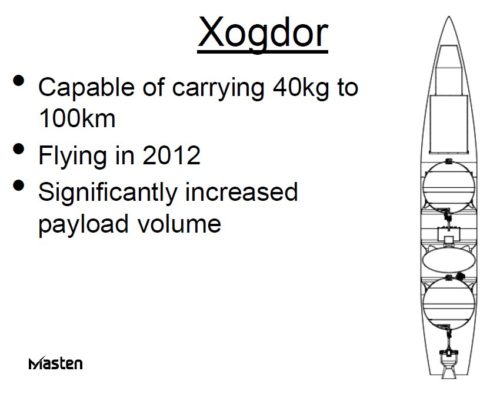
NASA and Masten Space Systems announced that the Space Technology Mission Directorate has chosen Masten for two Tipping Point awards as part of the agency’s Artemis mission to return to the Moon. The first award is for Masten’s Metal Oxidation Warming System (MOWS) which is being developed in partnership with Penn State as a chemical heating solution to help spacecraft survive in sunlight-deprived lunar environments. The second award will drive completion of Masten’s state-of-the-art aerospace testbed, named Xogdor, to provide the industry an updated flight test analog for critical Artemis technologies.
…
Masten will mature its Xogdor flight vehicle to operational service to provide an updated system for testing aerospace technologies in a relevant flight environment. Over this three year project, Masten will complete the development and flight testing of a Xogdor vehicle. The defined effort will support risk reduction of technologies through flight testing in pursuit of NASA’s Moon-to-Mars campaign with a focus on building an EDL (Entry, Descent, Landing) test capability for near-term lunar missions. Xogdor will be the sixth vehicle in Masten’s line of reusable rockets, which have had more than 600 successful VTVL (Vertical Takeoff Vertical Landing) flights over 15 years of heritage.
“Xogdor is poised to become the industry’s state-of-the-art testing analog with performance capabilities far exceeding those of currently available EDL testbeds,” said Masten CTO, Dave Masten. “Through this Masten-NASA partnership, Xogdor will be available to test critical Artemis technologies, including hazard detection instruments, precision landing avionics, innovative flight software, Plume Surface Interaction (PSI) experiments, and other critical EDL experiments as early as 2023.”
Masten Space mentioned Xogdor as far back as 2011 but has not had sufficient funding till now to build it.
In just 5 days, the Skyrora team completed a full static fire test of the Skylark L rocket, on a mobile launch complex built from scratch. The team also managed to carry out tests leading up to the ground rocket test during this time, to ensure maximum safety precautions were applied.
An animation of Skyrora’s Skylark XL launch system:
Ultra Safe Nuclear Technologies (USNC-Tech) has delivered a design concept to NASA as part of a study on nuclear thermal propulsion (NTP) flight demonstration. NTP technology provides unprecedented high-impulse thrust performance for deep space missions such as crewed missions to the moon and Mars. The NASA-sponsored study, managed by Analytical Mechanics Associates (AMA), explored NTP concepts and designs enabling deep space travel.
“We want to lead the effort to open new frontiers in space, and do it quickly and safely,” said Dr. Michael Eades, principal engineer at USNC-Tech. “Our engine maximizes the use of proven technology, eliminates failure modes of previous NTP concepts, and has a specific impulse more than twice that of chemical systems.”
Advancements in nuclear fuel design and passive safety measures pioneered by Ultra Safe Nuclear (USNC, USNC-Tech’s parent company) with Fully Ceramic Micro-encapsulated (FCM™) fuel enabled USNC-Tech to create a novel NTP concept with specialized performance capabilities. The enhanced safety characteristics and design flexibility of the USNC-Tech concept is a critical step forward in achieving extensibility of NTP systems to deep-space missions.
…
The USNC-Tech NTP concept uses a specialized variation of USNC’s FCM™ fuel, featuring high-assay low-enriched Uranium (HALEU) ZrC-encapsulated fuel particles. This variation enables high-temperature operation while maintaining the integrity of the fuel. FCM™ fuel is extremely rugged, enabling a new family of inherently safe space-optimized reactor designs that ensure astronaut safety and environmental protection. Using low quantities of HALEU, this unique NTP concept delivers high thrust and specific impulse previously only achievable through high-enriched uranium. Furthermore, FCM™ fuel leverages pre-existing supply chains and manufacturing facilities used by terrestrial nuclear reactor developers, reducing production risks and enabling sustainable industry involvement.
In an NTP system, exceptionally high levels of thrust are achieved by passing propellant through a specialized reactor core, reducing interplanetary transfer durations. Additionally, NTP systems achieve expanded payload mass capabilities due to their two-fold increase in specific impulse compared with chemical propulsion systems. As a result, NTP offers an entirely new mode of in-space transportation, enabling rapid movement of high-mass spacecraft architectures to deep space destinations (current NTP designs could deliver a crew to Mars in as few as three months) and a new, highly agile degree of cislunar mobility. If designed with commercial sustainability in mind, modern NTP systems can offer these benefits to commercial space entities in addition to government agencies like NASA and the DOD, enabling new business opportunities such as rapid orbital logistics services.
** How Can Soyuz Reach The Space Station In Only 3 Hours? – Scott Manley
This week Soyuz MS17 set a space station record by going from launch to docking with the International Space Station in only 3 hours and 3 minutes, half the time that Soyuz used to take, and much faster than the day long approaches used by US spacecraft. For Soyuz is has much shorter on orbit endurance compared to US spacecraft and is much less spacious than the US equivalents, incentivizing fast rendezvous trajectories.
** Presentations given at the recent Advanced Propulsion Workshop 2020, sponsored by the Space Studies Institute, are now available on video. The presentations included updates from Jim Woodward and Hal Fearn on the Woodward Mach Drive. Their talks focused on the nuts and bolts technicalities of their latest device, which they say is giving much higher thrust than previous versions. They are working with some other teams on replicating the performance of this new design.
Here is a more general talk from Sonny White, previously of NASA and now at the Limitless Space Institute, on advance propulsion concepts:
*** As many as nine Falcon 9 missions could take place over the next two months. The first is the launch of the Air Force’s GPS 3 SV04 satellite set for liftoff from the SLC-40 pad at Cape Canaveral Air Force Station on November 5th during the window 6:24-6:39 pm EST) p.m. EST (2324-2339 GMT). The booster passed a static firing test on the pad on Oct. 31st:
Static fire test complete – targeting Thursday, November 5 for Falcon 9 launch of GPS III-4 from SLC-40
*** Merlin engine problem traced to improper cleaning of coating used during manufacture of a relief valve. GPS launch and Crew missions can now proceed.
** Falcon 9 launch of the NASA Sentinel-6 spacecraft, which will measure the height of the ocean, it was set for November 10th from Vandenberg AFB, on the coast of California but may now slip a few days.
We will have more on Sentinel-6 after the teams complete data review on the West Coast. More to come. (2/2)
A simulation of the Sentinel 6 launch on the Falcon 9:
*** The recent Starlink 14 launch became the 100th successful SpaceX rocket mission:
On Saturday, October 24, 2020, SpaceX completed its 100th successful flight since Falcon 1 first flew to orbit in 2008. Over the course of these flights, SpaceX landed Falcon’s first stage booster 63 times and re-flew boosters 45 times.
*** The Starlink broadband Internet constellation is taking an increasingly important role in SpaceX launch vehicle operations and future development.
The majority of Falcon 9 launches are now devoted to delivering Starlinks to orbit.
Reuse of Falcon 9 boosters is key both to the rapid launch rate of Starlink satellites and the affordability of orbiting so many spacecraft.
The launch of nearly 900 operational satellites in a year has allowed SpaceX already to begin offering a “beta” Internet service to the public to a limited geographic area.
The level of initial customer demand will help indicate whether the service will be a profitable enterprise and fulfill the company’s goal of helping to fund the development of Starships and the establishment of a permanent settlement on Mars.
At the current launch rate, the constellation by the middle of next year could reach the minimum size – 1,440 satellites in 72 orbital planes of 20 satellites each – needed to provide global coverage.
Starships will be needed for affordable orbital installation of the ~30k satellites that the company says is required to provide high performance broadband services globally to a large number of users.
Since the last report, a lot has happened at Boca Chica, as usual:
Oct.20: Successful static firing of three Raptor engines attached to the SN8 prototype Starship. More about this below.
Oct.23: Starship SN8 got a nosecone and finally looked like a real spaceship: The nosecone, with fins attached for air braking on return from high altitude, was moved from the assembly area to the launch site and then a huge crane lifted and set it carefully atop the barrel section. Immediately multiple workers standing in platforms attached to the long high arms of boom lifts (also known as cherry-pickers) attending to the seam. See videos below.
Multiple Starships and the first Super Heavy booster are under construction. Here is a nice display of components seen by observers watching the Boca Chica site:
Stacking of Super Heavy booster SN01 could soon start now that the High Bay hangar is nearly completed. As shown in the above figure, many of the barrel sections for the Super Heavy are already built.
Here is an infographic describing the test flight of the SN8 prototype:
UPDATE: My latest @SpaceX Starship SN8 infographic (I have added a few more stats). After the mission launch I will adjust the visuals if needed & data then repost. Follow me on Twitter & look out for updates. Larger free printable version at https://t.co/arXjhichpBpic.twitter.com/JuqNXFSrCT
— Tony Bela – Infographic news (@InfographicTony) November 1, 2020
Elon in a Tweet responds to a query regarding a webcast of the SN8 flight:
Sure, although it might be quite a short livestream! Lot can go wrong, but we’ll provide video, warts & all. You will see every frame that we do.
**** Elon Musk gave an update on the Starship program during an online interview for the Mars Society convention last week:
lon Musk’s comments with questions relayed from the Mars Society Membership by Dr. Robert Zubrin, James L. Burk, and Carie Fay. Following Elon’s 30 min time, Dr. Zubrin took additional questions. This special event was part of the 2020 Mars Society Virtual Convention from October 14-18, 2020. For more details on this event and The Mars Society, visit http://www.marssociety.org
According to his comments on Twitter, Musk may release a more detailed written update soon.
**** Estimates of launch cost for Starships:
2/ Here are the inputs I’m using.
Know that Raptor cost should come down by 50%, maybe more. Refurb cost should also come down.
Early Tuesday, October 20th, three Raptor engines on the SN8 Starship prototype fired together for the first time: SpaceX Boca Chica – SN8 First Ever 3 Raptor Static Fire – NASASpaceflight – YouTube
SN8 fires up its three Raptor engines for the first time ever in this static fire test. Also included is the preburner test a few hours before. […] SN8 on Pad A Video and Pictures from Mary (@BocaChicaGal). Edited by Jack Beyer (@TheJackBeyer)
***** Oct.23: SpaceX Boca Chica – Starship SN8 nosecone mate – Raptors on the move – NASASpaceflight – YouTube
A long highlight video of Thursday’s historic event of Starship SN8 nosecone stacking and the surprise double Raptor merry-go-round. Video and Pictures from Mary (@BocaChicaGal). Edited by Jack Bayer (@thejackbeyer) and Nic Gautschi (@NGautschi).
***** Oct.26: SpaceX Boca Chica – Starship Factory Drive-Thru – New Flaps Delivered and New Nosecone Moved Outside – NASASpaceflight – YouTube
Mary provides us with one of her classic driving tours of the SpaceX Boca Chica complex, new body flaps were delivered, and a new nosecone was rolled out of the production tent. Video and Pictures from Mary (@BocaChicaGal). Edited by Nic Gautschi (@NGautschi).
**** Oct.30: SpaceX Boca Chica – As Starship SN8 waits, SPMTs convoy arrives, Orbital Pad work – NASASpaceflight – YouTube
While Starship SN8 has to wait a few more days until the second Static Fire test campaign, four additional SPMTs arrived, along with large concrete blocks for the Orbital Launch Pad. The final structural test nosecone met its demise and heck, there’s a lot more….there always is at SpaceX Boca Chica. Video and Pictures from Mary (@BocaChicaGal). Edited by Jack Beyer (@TheJackBeyer)
While Starship SN8 waits for pre-launch testing, SN9 received her aft flaps and SN10 was stacked! That’s three new and stacked Starships for those keeping score. The SPMT squad also rolled out to the launch site. Video and Pictures from Mary (@BocaChicaGal). Edited by Theo Ripper (@TheoRipper).
**** Other Starship and space transport reports:
**** Oct.31: SpaceX Starship – Final preparation for SN8 flight – Space news update – Marcus House
The progress at BocaChica continues with SpaceX Starship SN8 going through some more testing prior to its 15-kilometer flight that we are thinking will be occurring in the upcoming week. These are the final preparation for SN8 flight. We have an overall Space news update with Starlink’s beta looks to have expanded to the public so we will talk about that along with SpaceX’s incredible 100 flight milestone. We’ve got a new Crew 1 launch date set which is exciting. Interesting news with confirmation that there are traces of water on sunlit areas of the moon. We’ll dive into that. And yes, yet another beautiful flight by RocketLabs launching Electron mid-week.
**** Nov.3: SpaceX Starship orbital Starlink flight from ignition to landing! – What about it!?


 [Amazon commission link].