Here is a selection of videos, articles, and news items about space habitats (government and commercial), living in space, and space settlement.
=== International Space Station & NASA
** Crew 11 ended its ISS mission earlier than planned due to a medical issue with an (unnamed) astronaut and returned to Earth on January 15th. This left one US astronaut and two Russian cosmonauts on board the station. Crew 12 with four astronauts could launch to the station as early as Feb.11.
- NASA’s SpaceX Crew-12 Begins Quarantine for Space Station Mission | NASA – Jan.28.2026
- Advanced Tech Research on Station as Crew-12 Announces Launch Opportunities | NASA – Jan.28.2026
- NASA’s SpaceX Crew-11 Mission Returns, Splashes Down off California | NASA – Jan.15.2026
- Prescriptions for space medicine | The Space Review – Jan.12.2026
- Fincke Hands Over Station Command, Crew Preps for Wednesday Departure | NASA – Jan.12.2026
- ISS astronaut evacuation shouldn’t interfere with upcoming Artemis 2 moon mission, NASA chief says | Space.com – Dec,9.2026
- Change of Command of International Space Station to Occur | NASA – Jan.10.2026
- NASA, SpaceX Set Target Date for Crew-11’s Return to Earth | NASA – Jan.9.2026
- Crew-11 to return early due to a medical concern with astronaut | NASASpaceFlight.com – Jan.8.2026
— International Space Station Update: Thursday, Jan. 8, 2026 | NASA on Youtube
Press conference about the early return of the Crew 11 due to a medical concern with one of the astronauts.
** ISS astronauts complete change of command ahead of Crew-11 medical evacuation | VideoFromSpace
Ahead of the early departure of NASA’s SpaceX Crew-11 from the International Space Station, due to a medical issue, a change of command ceremony was conducted on Jan. 12, 2026.
** SpaceX Crew-11 undocking and departure | SciNews
SpaceX’s Crew-11 “Endeavour” Crew Dragon spacecraft, with NASA astronauts Zena Cardman and Mike Fincke, JAXA astronaut Kimiya Yui (油井 亀美也), and Roscosmos cosmonaut Oleg Platonov (Олег Платонов), autonomously undocked from the space-facing port of the International Space Station’s Harmony module, on 14 January 2026, at 22:20 UTC (17:20 EST). Crew-11 is SpaceX’s eleventh operational mission for NASA’s Commercial Crew Program. The “Endeavour” Crew Dragon previously supported NASA’s Crew-3, Crew-5, and Crew-7 missions.
** NASA’s SpaceX Crew-11: Science in Orbit | NASA Johnson
NASA’s SpaceX Crew-11 mission with agency astronauts Zena Cardman and Mike Fincke, JAXA (Japan Aerospace Exploration Agency) astronaut Kimiya Yui, and Roscosmos cosmonaut Oleg Platonov returned to Earth after a long-duration mission aboard the International Space Station. During their stay, Cardman, Fincke, and Yui contributed more than 850 hours of research to help prepare humanity for the return to the Moon and future missions to Mars, while improving life back on Earth..
** NASA Astronaut Discusses Life In Space With Columbia Space Initiative – Friday, January 23, 2026 | NASA Video
Aboard the International Space Station, NASA astronaut Chris Williams discussed life and work aboard the orbital outpost during an in-flight interview Jan. 23 with the Columbia Space Initiative at Columbia University. Williams is in the midst of a long-duration mission aboard the microgravity laboratory to advance scientific knowledge and demonstrate new technologies for future human and robotic exploration flights as part of NASA’s Moon and Mars exploration approach, including lunar missions through NASA’s Artemis program.
Join NASA as we go forward to the Moon and on to Mars — discover the latest on Earth, the Solar System and beyond with a weekly update in your inbox.
=== Commercial space habitats
** Axiom Space
— Axiom reports on progress in development of the thermal control system:
Explore the advancements to our cutting-edge Thermal Control System for #AxiomStation. Members of #TeamAxiom have led the way in developing this critical system, which optimizes heat distribution within the spacecraft while also prioritizing the safety of our future crew members. pic.twitter.com/09V0S6TT5j
— Axiom Space (@Axiom_Space) January 29, 2026
— Update on Axiom station’s network system:
The Axiom Station software team knows how to develop a time sensitive network design, meeting the 2-fault tolerance requirements and relaying data from the ground and the flight computer to the station network, near instantly. From network switches to network experts, #TeamAxiom… pic.twitter.com/kN8CrUIbH6
— Axiom Space (@Axiom_Space) January 14, 2026
— An interview with Peggy Whitson, Axiom’s vice president of human spaceflight: Q&A: Axiom’s Peggy Whitson on space station assembly | Aerospace America – Jan.12.2026
If Axiom Space’s plans hold, the first commercial low-Earth orbit space station will be on orbit in 2028.
The Texas company is one of a handful of developers aiming to establish privately owned stations by the time the International Space Station is decommissioned in 2030. Plans call for the initial Axiom Station to be comprised of two modules, the PPTM — short for Payload Power Thermal Module — and a habitat module. The PPTM, which is to be shipped shortly to Houston for final assembly and integration, is slated to be launched in early 2028, with the second module following just months later. From there, Axiom aims to swiftly begin welcoming crew, Peggy Whitson, the company’s vice president of human spaceflight, told me in an interview.
** Blue Origin
— Blue tests docking system:
Docking? ✅
Our Blue Docking System team successfully completed soft capture system testing at @NASA_Johnson‘s Six-Degree-Of-Freedom Dynamic Test facility. This test completes a key milestone on our Commercial LEO Destinations (CLD) contract.
The fully vertically… pic.twitter.com/PDo0qyjQii
— Blue Origin (@blueorigin) January 27, 2026
** Starlab – Voyager Technologies
— Starlab station aims for capability to replace ISS in scale, volume, and continuous human presence: Starlab: The Scale, Volume and Capability Needed to Truly Replace the ISS | Voyager Technologies – Jan.27.2026
@Starlab_Space is built for what comes next.
With the scale, volume and readiness to truly replace the ISS, it delivers continuous human presence, multi‑market research and industrial‑grade microgravity capability. An all-in-one unified station.
No gap. No compromise. The… pic.twitter.com/JhAWwAjoOE— Voyager Technologies (@voyagertech_) January 27, 2026
— Starlab’s role in development of commercial space economy: Starlab: The Commercial Space Economy’s Essential Infrastructure | Voyager Technologies – Jan.21.2026
… Voyager’s CTO [Paul Tilghman] blog highlighted a critical shift: launch is no longer the bottleneck, but infrastructure and down mass are. Spaceflight is becoming destination and product driven. Without a station, commercial R&D pipelines stall, autonomous systems have nowhere to mature and microgravity manufacturing cannot scale beyond prototypes. The result is what Tilghman describes as the “capability throughput problem.” If industry cannot run missions frequently and reliably, it cannot grow.
Starlab is built to solve this. Designed for continuous human presence, modernized internal volume and simultaneous multi-industry operations, it enables predictable access, repeatable missions and the sustained utilization required for a real orbital marketplace, not episodic experiments.
”Delivered in a single launch, Starlab provides pressurized volume and R&D capacity equivalent to the ISS, ensuring the continuity of ongoing ISS research,” said Dr. Luis Zea, chief scientist, Starlab Space. “Beyond that, it introduces new, first-of-their-kind capabilities that enable exponential growth, unlock entirely new scientific and commercial opportunities, and establish Starlab as the foundational platform on which the next generation of space-based businesses and discoveries will be built.” …
The commercial space economy doesn’t scale without infrastructure. As the ISS retires, @Starlab_Space provides the next destination—enabling continuous human presence, scalable manufacturing, and high-tempo operations. It’s the foundation for the next era of orbital commerce.… pic.twitter.com/RErFpXuo2u
— Voyager Technologies (@voyagertech_) January 21, 2026
— Starlab advocates for “a full-capability ISS-class station” continuously crewed:
We are at a pivotal moment in low Earth orbit. As the ISS retirement approaches, the real risk isn’t a timeline gap—it’s a capability gap as adversarial nations’ stations come online.
A crew-tended outpost cannot replace the ISS. It cannot support the continuous operations,… pic.twitter.com/VVp1In1nCn
— Starlab (@Starlab_Space) January 20, 2026
— Voyager Technologies, the company developing the Starlab station, has earned a patent for optical device manufacturing in a microgravity environment: Voyager Secures Breakthrough Patent for Orbital Optical Communications Manufacturing | Voyager Technologies – Jan.14.2026
Voyager Technologies [NYSE: VOYG] has been awarded a patent for an extraterrestrial manufacturing method that produces larger, purer crystals essential to high-performance optical communications – the backbone of Earth’s data centers and the AI-driven global economy. By harnessing microgravity, the patented process delivers material performance beyond what is possible on Earth.
“Optical networks depend on fibers fabricated from crystal structures that are as perfect as materials science can make them,” said Dylan Taylor, chairman and CEO of Voyager Technologies. “This patent underscores our drive to use microgravity to deliver real benefits on Earth and beyond. Ultra-pure, wavelength-engineered crystals are the foundation for faster, cleaner and more resilient optical communications, whether in data centers on the ground or networks in orbit.”
The patented approach allows Voyager to grow crystals that precisely match a specific optical wavelength, producing only the desired signal band with no interference or unintended spectral artifacts. This breakthrough enables unprecedented performance, where higher crystal quality directly improves signal stability and reduces error rates in high-bandwidth systems that support AI and cloud computing.
The patented process uses long-duration microgravity to grow larger and purer crystals free of defects that typically form when crystals grow in stacked layers on Earth. Voyager’s method keeps all seed material in constant motion during ground handling to prevent premature formation, with growth triggered only after reaching microgravity.
Voyager will fly samples to the International Space Station in spring 2026 to validate the method with a grant through the ISS National Laboratory. Patent partners include experts at the New Jersey Institute of Technology, New York University and Universities Space Research Association.
See also Voyager Details its Plans for In-Space Manufacturing | Payload Space – Jan.16.2026 .
— Mitsubishi reserves Starlab capacity: Mitsubishi Corporation Joins Starlab as Major Space Station Customer | Voyager Technologies – Jan.12.2026
Starlab Space LLC today announced that Mitsubishi Corporation has reserved and pre-purchased capacity on Starlab’s commercial space station, becoming a foundational customer while simultaneously increasing their investment in the company and joining Starlab’s Board of Directors through representative Issei Shinohara.
The expanded partnership includes acquisition of usage rights for designated payload volume and utilization of on orbit laboratory facilities on Starlab, positioning Mitsubishi to accelerate space-based research opportunities for Japanese institutions. This customer commitment is accompanied by an expanded equity partnership that brings additional investment to support Starlab’s development.
— More about Mitsubishi and Starlab:
Mitsubishi Corporation adds proven logistics and utilization capabilities. Their global supply chain reach will support new research, hardware development, and commercial activities in low Earth orbit. Mitsubishi Corporation also expands Starlab’s international connections,… pic.twitter.com/X1A4ooCTQa
— Starlab (@Starlab_Space) January 16, 2026
— Voyager Technologies initiates the VISTA– Voyager Institute for Space, Technology and Advancement – at Ohio State University. VISTA is a
first-of-its-kind U.S. campus dedicated to in-space research, manufacturing and services. Here, the brightest minds in aerospace, robotics, AI and science converge in a dynamic ecosystem built to accelerate discovery, collaboration and commercialization.
Whether you’re an established aerospace company, a fast-moving startup, a leading academic institution, or a government agency, VISTA offers the infrastructure, partnerships and momentum to take your innovations to space.
With access to the International Space Station and future commercial platforms, VISTA tenants can develop the next generation of space-based technologies and services across civil, commercial and national security markets.
As an in-space, platform-agnostic ecosystem, the Science Park will drive advancements across industries and tackle some of the greatest challenges in space-based civil, commercial and national security.
See also:
- VISTA: A Pipeline to the Commercial Space Economy | Voyager Technologies – Jan.16.2026
- Voyager names team to build VISTA space park at Ohio State | Start Midwest – Jan.14.2026
** VAST
— Update on Haven-1 development and launch:
Haven-1 has begun the first phase of clean room integration at Vast HQ. With this milestone, we are updating the schedule for Haven-1 to be ready to launch Q1 2027. https://t.co/4dJvzdMIfo pic.twitter.com/xLgWRTsuaA
— Vast (@vast) January 20, 2026
See also Vast Advances Haven‑1 Into Integration Phase — an update by VAST | VAST – Jan.20.2026
… Haven-1 is an integral part of the company’s hardware-rich development approach that is putting flight-hardware and systems through rigorous ground and in-space testing to accelerate learning, reduce technical and schedule risk, and unlock new commercial and government capabilities in LEO. Haven-1 is designed to expand access to space and provide an affordable platform for microgravity research, manufacturing, and both national and international space infrastructure.
The first phase of Haven-1 integration includes installation of the station’s pressurized fluid systems, including thermal control, life support, and propulsion system tubes, and component trays and tanks. These systems will undergo pressure, leak, and functional testing. The second phase of integration will incorporate avionics, guidance, navigation and control systems, and air revitalization hardware. The third and final phase will complete the vehicle with crew habitation and interior closeouts, exterior micrometeoroid and orbital debris (MMOD) shielding, thermal radiator installation, and solar array integration, bringing Haven-1 to a fully flight-ready configuration. Vast remains focused on completing integration and conducting a suite of system environmental tests at NASA’s Neil Armstrong Test Facility later in 2026.
Based on the current integration timeline, Vast is updating its schedule for Haven-1 to be ready to launch Q1 2027. Haven-1 is contracted to launch on a SpaceX Falcon 9 from Cape Canaveral, Florida. With each milestone, the team gains more data and greater certainty, enabling timelines to become progressively more precise. Haven-1 represents a true zero-to-one development, and as Vast moves on to its second, third, and subsequent stations, schedule precision will continue to improve as systems, processes, and integration maturity increases. Throughout this process, human safety remains the team’s top priority, with development and manufacturing pace carefully balanced to ensure mission integrity. …
— Interview with Vast’s chief of astronaut training: The astronaut training tourists to fly in the world’s first commercial space station | MIT Technology Review – Jan.12.2026
** More commercial space station articles, news, etc:
- Payload Field Guide: Commercial LEO Destination | Payload – Jan.26.2026
- SPARK Microgravity announces plans for Europe’s first commercial cancer lab in space at Frontiers Science House in Davos | EurekAlert – Jan.21.2026
- Key Senate staffer is “begging” NASA to get on with commercial space stations | Ars Technica – Jan.15.2026
- Axiom has delayed the launch of its first space station module to ’28 | Behind The Black/Robert Zimmerman – Jan.14.2026
=== Chinese space habitats
** Shenzhou-21 Crew Continues with Science Experiments, Life in Orbit | CCTV Video News Agency
Shenzhou-21 Crew Continues with Science Experiments, Life in Orbit
** China Registers Smooth Progress in Space Science Research on Space Station in 2025 | CCTV Video News Agency
China registered smooth progress in carrying out space science research, application experiment and technology test projects aboard the country’s space station in orbit, covering multiple fields such as life sciences, microgravity physics, and new space technologies and applications, according to the Technology and Engineering Center for Space Utilization (CSU), the Chinese Academy of Sciences.
=== Russian space habitats
** Update on next-generation Russian space station:
…however, based on the latest experience with the Science and Power Module, NEM, (started around 2012), the construction of another module in this class will probably take much of the 2030s, and even that under favorable economic conditions.
Context: https://t.co/81bSOWHWZb pic.twitter.com/dWdhCPuK6u— Anatoly Zak (@RussianSpaceWeb) January 7, 2026
=== Lunar habitation
** An overview of the The Commercial Lunar Economy Field Guide: A Vision for Industry on the Moon in the Next Decade, a US Air Force publication edited by Michael Nayak: A vision for industry on the Moon | Space Settlement Progress – Jan.16.2026
For decades, lunar exploration has followed a “Flags and Footprints” paradigm—symbolic, government-funded missions that are entirely self-reliant, bringing every gram of power, water, and data storage from Earth. The Field Guide argues that this approach, while scientifically valuable and a display of national pride, is economically unsustainable at the current “million-dollar-per-kilogram” cost of delivery. This is in alignment with the EO which calls for enhancing cost-effectiveness of exploration architectures while establishing initial elements of a permanent lunar outpost by 2030 to ensure a sustained American presence on the Moon, which will lay the groundwork for the exploration of Mars.
** Startup company GRU Space aims to build a hotel on the Moon:
GRU builds off-planet habitats using in-situ resource utilization technology, turning local material into building material. Our first habitat will be a hotel on the Moon for space tourists, aiming to open 2032.
In 2029, our demo mission will turn lunar regolith into bricks and demonstrate our modular pressurized habitat system. A second mission will begin laying the hotel’s foundation in a lunar cave. A third mission will open the first lunar hotel.
We don’t stop at Moon hotels. GRU’s long-term plan:
1. Build the first hotel on the Moon. GRU solves off‑world surface habitation.
2. Build America’s first Moon base: roads, mass drivers, warehouses, and physical infrastructure.
3. Repeat on Mars and build the first cities there.
4. Own property on the Moon and Mars as these economies grow.
5. Reinvest profits into resource utilization systems on the Moon, Mars, asteroids, and beyond—reaching our final form: Galactic Resource Utilization.
GRU Space is backed by investors in SpaceX + Anduril, and is part of Nvidia’s Inception program.
See also:
- You can now reserve a hotel room on the Moon for $250,000 | Ars Technica – Jan.12.2026
- GRU Space – “The First Hotel on the Moon” (GRU = Galactic Resource Utilization)
- Whitepaper: Building America’s First Moonbase and Hotel | GRU Space
- Lunar Hotel Viewed as Key Economic Wedge | Leonard David – Jan.13.2026
Lunar related articles, news, etc:
- Interlune brings in fresh funding to support moon mining mission | GeekWire – Jan.29.2026
- The 2030 Race for a Moon Reactor | Universe Today – Jan.20.2026
- NASA, Department of Energy to Develop Lunar Surface Reactor by 2030 | NASA – Jan.13.2026
- NASA Reaffirms Commitment to Lunar Nuclear Power This Decade | Payload Space – Jan.13.2026
=== Space settlement
Our discussion started with a focus on Melodie’s transition from architectural engineering to space architecture, particularly her work on 3D printing concepts for Mars habitats and her journey through various organizations including NASA and Icon. The discussion covered technical challenges and opportunities in space colonization, including the development of lunar and Martian habitats, autonomous systems, and robotic construction capabilities. The panel explored the broader implications of space exploration, including technological benefits for Earth industries and the importance of long-term projects in advancing space settlement goals.
** Stopping Power! Why Radiation Shielding Is More Than Just Lead Bricks. | Scott Manley
Radiation Shielding is a standard trope in storytelling, and you may well have heard about different radiation types and how materials work differently. However it’s more complicated that you think, sometimes a shield that’s good for one source is bad for others, and this comes down to the physics of radiation interacting with matter. So here’s an overview of how radiation shielding works and what’s going on at the subatomic level.
=== Other space habitat and settlement news and articles:
- Calendar:
- 2026 international Space Development Conference (ISDC 2025) | National Space Society, June 4-7, 2026, McLean, Virginia.
- The Rothblatt Space Settlement in Our Lifetime Prize Submission Deadline: February 15, 2026. Three winning teams will be invited to the NSS International Space Development Conference 2026.
- ISS:
- Expedition 74 Preps CubeSats and Photographs Earth for Research | NASA – Jan.29.2026
- Crew Studies Robotics and Virtual Reality Advancing Space Tech | NASA – Jan.27.2026
- Expedition 74 Continues After Crew-11 Returns to Earth | NASA – Jan.16.2026
- Out of This World Discoveries: Space Station Research in 2025 | NASA – Jan.16.2026
- Resources:
- ISS in Real Time – “Explore 25 years onboard the International Space Station. This multimedia project replays every day of the past 25 years onboard and consists entirely of historical mission material.”
- ISS Archaeology | Boldly Going Where No Archaeologists Have Gone Before
- Amateur Radio on ISS (ARISS)
- China:
- Russia:
- Habitat technologies:
- General settlement topics:
- Resources:
=== Earth views from ISS
** ISS views with Pink Floyd music:
** Earth and Moon views from the International Space Station – Ignis mission timelapses | European Space Agency (ESA) on Youtube
ESA project astronaut Sławosz Uznański-Wiśniewski captured these stunning timelapse videos during his 20-day stay aboard the International Space Station as part of Axiom Mission 4, known as Ignis. Filmed from the Cupola – the Space Station’s iconic seven-windowed observation module – the footage showcases breathtaking views of Earth and the Moon from orbit.
Launched on 25 June 2025 aboard a SpaceX Dragon spacecraft, Sławosz conducted 13 experiments proposed by Polish institutions in collaboration with ESA, plus three ESA-led investigations. These spanned human research, materials science, biology, biotechnology and technology demonstrations.
The Ax-4 mission marks the second commercial human spaceflight for an ESA project astronaut. Ignis was sponsored by the Polish government and supported by ESA, the Polish Ministry of Economic Development and Technology (MRiT) and the Polish Space Agency (POLSA).
Credit: European Space Agency (ESA)
** Lightning in storm over Milan, Italy as seen from ISS 250 miles above | NASA
NASA Image of the Day, Jan.7.2026:
NASA astronaut Nichole Ayers captured this image of lightning while orbiting aboard the International Space Station more than 250 miles above Milan, Italy on July 1, 2025. Storm observations from space station help scientists study Earth’s upper atmosphere, which can improve weather models and protect communication systems and aircraft. Space station crew take photographs of Earth that record how the planet changes over time due to human activity and natural events. This record allows scientists to monitor disasters and direct response on the ground and study phenomena.

** Watching fireworks from the ISS:
New Years fireworks in Baku, Azerbaijan. I was practicing some night time photographs from one of the windows on the @Space_Station at the end of the work day on New Years Eve. I had just finished passing over my targets when I noticed something funny – the city below me was… pic.twitter.com/5FPlBx2oky
— Chris Williams (@Astro_ChrisW) January 7, 2026
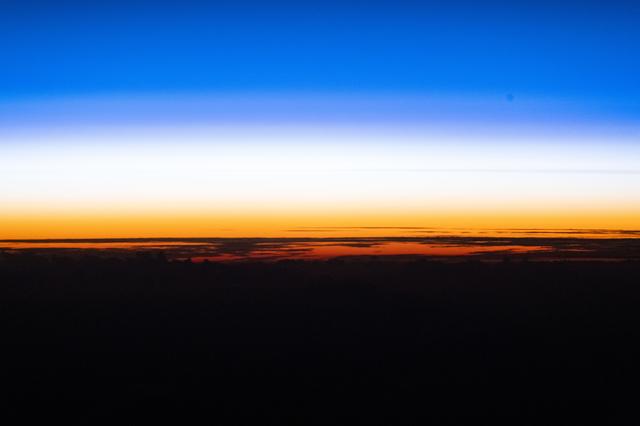
** A sunset from the ISS: Watch the Breathtaking Beauty of a Sunset from the ISS| DailyGalaxy – Jan.28.2026
** Live Video from the International Space Station (Official NASA Stream) | NASA
Watch live video from the International Space Station, including inside views when the crew aboard the space station is on duty. Views of Earth are also streamed from an external camera located outside of the space station. During periods of signal loss due to handover between communications satellites, a blue screen is displayed.
The space station orbits Earth about 250 miles (425 kilometers) above the surface. An international partnership of five space agencies from 15 countries operates the station, and it has been continuously occupied since November 2000. It’s a microgravity laboratory where science, research, and human innovation make way for new technologies and research breakthroughs not possible on Earth. More: https://go.nasa.gov/3CkVtC8
Did you know you can spot the station without a telescope? It looks like a fast-moving star, but you have to know when to look up. Sign up for text messages or email alerts to let you know when (and where) to spot the station and wave to the crew: https://spotthestation.nasa.gov
=====

=== Amazon Associate Ads ===
====