Here is a collection of recent TMRO.tv Space Pod short video reports:
* Galactic Exoplanet Party – Space Pod 08/14/15
TMRO Chief Astronomer Jared Head gives us a basic review of exoplanets and some of the techniques used to find them.
* The Next Generation of Space Access – Space Pod 09/01/15
This week Space Mike discusses several new rockets being developed all over the world, from China, Russia, India, Europe, and the United States.
* Meet the Starliner & New Space Station Crew Members – Space Pod 09/09/15
This week Space Mike discusses Boeing’s new name name for the CST-100, as well as their construction progress at Kennedy Space Center. Also some new astronauts have traveled to the Space Station for a Crew Replacement.
* Possible SLS Payloads Part 1 – SpacePod 09/15/15
This week, Space Mike talks about some of the possible payloads for the Space Launch system. Including Orion, Asteroid Redirect, and the Exploration Augmentation Module.
====
Support TMRO:
TMRO Space Pods are crowd funded shows. If you like this episode consider contributing to help us to continue to improve. Head over to http://www.patreon.com/spacepod for information, goals and reward levels. Don’t forget to check out our weekly live show campaign as well over athttp://www.patreon.com/tmro
The latest images from NASA’s New Horizons spacecraft have scientists stunned – not only for their breathtaking views of Pluto’s majestic icy mountains, streams of frozen nitrogen and haunting low-lying hazes, but also for their strangely familiar, arctic look.
Pluto’s Majestic Mountains, Frozen Plains and Foggy Hazes: Just 15 minutes after its closest approach to Pluto on July 14, 2015, NASA’s New Horizons spacecraft looked back toward the sun and captured this near-sunset view of the rugged, icy mountains and flat ice plains extending to Pluto’s horizon. The smooth expanse of the informally named icy plain Sputnik Planum (right) is flanked to the west (left) by rugged mountains up to 11,000 feet (3,500 meters) high, including the informally named Norgay Montes in the foreground and Hillary Montes on the skyline. To the right, east of Sputnik, rougher terrain is cut by apparent glaciers. The backlighting highlights over a dozen layers of haze in Pluto’s tenuous but distended atmosphere. The image was taken from a distance of 11,000 miles (18,000 kilometers) to Pluto; the scene is 780 miles (1,250 kilometers) wide. Credits: NASA/JHUAPL/SwRIThis new view of Pluto’s crescent — taken by New Horizons’ wide-angle Ralph/Multispectral Visual Imaging Camera (MVIC) on July 14 and downlinked to Earth on Sept. 13 — offers an oblique look across Plutonian landscapes with dramatic backlighting from the sun. It spectacularly highlights Pluto’s varied terrains and extended atmosphere. The scene measures 780 miles (1,250 kilometers) across.
Closer Look: Majestic Mountains and Frozen Plains: Just 15 minutes after its closest approach to Pluto on July 14, 2015, NASA’s New Horizons spacecraft looked back toward the sun and captured this near-sunset view of the rugged, icy mountains and flat ice plains extending to Pluto’s horizon. The smooth expanse of the informally named Sputnik Planum (right) is flanked to the west (left) by rugged mountains up to 11,000 feet (3,500 meters) high, including the informally named Norgay Montes in the foreground and Hillary Montes on the skyline. The backlighting highlights more than a dozen layers of haze in Pluto’s tenuous but distended atmosphere. The image was taken from a distance of 11,000 miles (18,000 kilometers) to Pluto; the scene is 230 miles (380 kilometers) across. Credits: NASA/JHUAPL/SwRI)“This image really makes you feel you are there, at Pluto, surveying the landscape for yourself,” said New Horizons Principal Investigator Alan Stern, of the Southwest Research Institute, Boulder, Colorado. “But this image is also a scientific bonanza, revealing new details about Pluto’s atmosphere, mountains, glaciers and plains.”
Near-Surface Haze or Fog on Pluto: In this small section of the larger crescent image of Pluto, taken by NASA’s New Horizons just 15 minutes after the spacecraft’s closest approach on July 14, 2015, the setting sun illuminates a fog or near-surface haze, which is cut by the parallel shadows of many local hills and small mountains. The image was taken from a distance of 11,000 miles (18,000 kilometers), and the width of the image is 115 miles (185 kilometers). Credits: NASA/JHUAPL/SwRIOwing to its favorable backlighting and high resolution, this MVIC image also reveals new details of hazes throughout Pluto’s tenuous but extended nitrogen atmosphere. The image shows more than a dozen thin haze layers extending from near the ground to at least 60 miles (100 kilometers) above the surface. In addition, the image reveals at least one bank of fog-like, low-lying haze illuminated by the setting sun against Pluto’s dark side, raked by shadows from nearby mountains.
“In addition to being visually stunning, these low-lying hazes hint at the weather changing from day to day on Pluto, just like it does here on Earth,” said Will Grundy, lead of the New Horizons Composition team from Lowell Observatory, Flagstaff, Arizona.
Combined with other recently downloaded pictures, this new image also provides evidence for a remarkably Earth-like “hydrological” cycle on Pluto – but involving soft and exotic ices, including nitrogen, rather than water ice.
Pluto’s ‘Heart’: Sputnik Planum is the informal name of the smooth, light-bulb shaped region on the left of this composite of several New Horizons images of Pluto. The brilliantly white upland region to the right may be coated by nitrogen ice that has been transported through the atmosphere from the surface of Sputnik Planum, and deposited on these uplands. The box shows the location of the glacier detail images below. Credits: NASA/JHUAPL/SwRIBright areas east of the vast icy plain informally named Sputnik Planum appear to have been blanketed by these ices, which may have evaporated from the surface of Sputnik and then been redeposited to the east. The new Ralph imager panorama also reveals glaciers flowing back into Sputnik Planum from this blanketed region; these features are similar to the frozen streams on the margins of ice caps on Greenland and Antarctica.
Valley Glaciers on Pluto: Ice (probably frozen nitrogen) that appears to have accumulated on the uplands on the right side of this 390-mile (630-kilometer) wide image is draining from Pluto’s mountains onto the informally named Sputnik Planum through the 2- to 5-mile (3- to 8- kilometer) wide valleys indicated by the red arrows. The flow front of the ice moving into Sputnik Planum is outlined by the blue arrows. The origin of the ridges and pits on the right side of the image remains uncertain. Credits: NASA/JHUAPL/SwRI“We did not expect to find hints of a nitrogen-based glacial cycle on Pluto operating in the frigid conditions of the outer solar system,” said Alan Howard, a member of the mission’s Geology, Geophysics and Imaging team from the University of Virginia, Charlottesville. “Driven by dim sunlight, this would be directly comparable to the hydrological cycle that feeds ice caps on Earth, where water is evaporated from the oceans, falls as snow, and returns to the seas through glacial flow.”
“Pluto is surprisingly Earth-like in this regard,” added Stern, “and no one predicted it.”
Intricate Valley Glaciers on Pluto: This image covers the same region as the image above, but is re-projected from the oblique, backlit view shown in the new crescent image of Pluto. The backlighting highlights the intricate flow lines on the glaciers. The flow front of the ice moving into the informally named Sputnik Planum is outlined by the blue arrows. The origin of the ridges and pits on the right side of the image remains uncertain. This image is 390 miles (630 kilometers) across. Credits: NASA/JHUAPL/SwRI
When I started HobbySpace in 1999, I was sure that reusable space vehicles would be flying regularly by now and taking lots of space tourists to orbit. I was also sure that collecting space memorabilia would become a popular activity and a lucrative business as Baby Boomers began to grow nostalgic for the Space Age era of their youth. Still waiting on those first two predictions but the third has worked out pretty much as expected : NASA memorabilia fetching high prices among collectors: Do not call it space junk – The Boston Globe.
[Larry] McGlynn, who owns an insurance company in Sudbury, is one of the foremost collectors and appraisers of NASA artifacts, and part of a burgeoning market for items that traveled to the final frontier. Over the past 20 years, the value of these items has exploded, McGlynn said; a star chart from Apollo 11 — the first lunar landing — that went for $500 in 1995 can command upward of $30,000 today.
The RR Auction house mentioned in the article currently has a handful of items in their Space section.
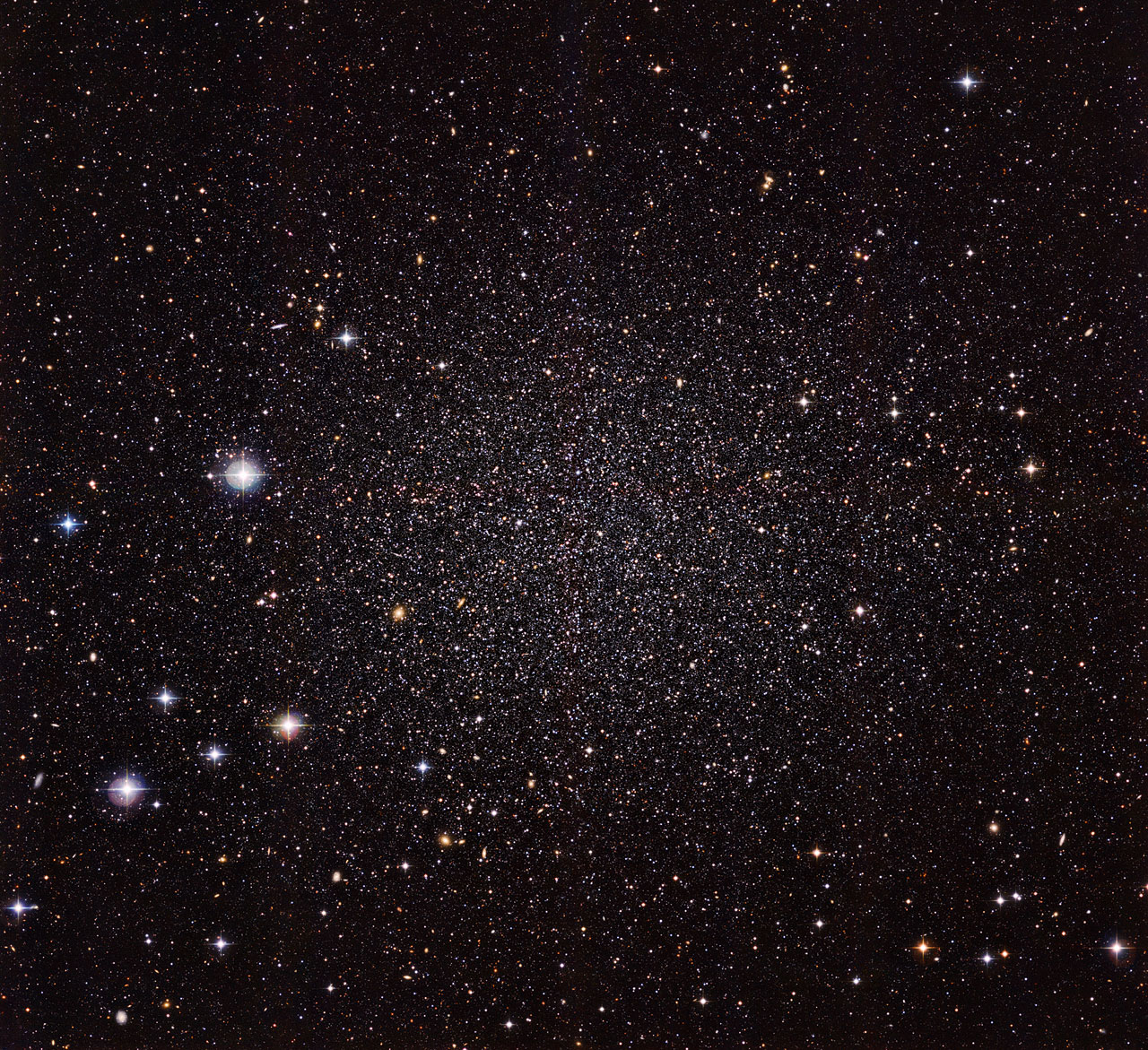
The Sculptor Dwarf Galaxy, pictured in this new image from the Wide Field Imager camera, installed on the 2.2-metre MPG/ESO telescope at ESO’s La Silla Observatory, is a close neighbour of our galaxy, the Milky Way. Despite their close proximity, both galaxies have very distinct histories and characters. This galaxy is much smaller and older than the Milky Way, making it a valuable subject for studying both star and galaxy formation in the early Universe. However, due to its faintness, studying this object is no easy task.
The Sculptor Dwarf Galaxy, pictured in a new image from the Wide Field Imager camera, installed on the 2.2-metre MPG/ESO telescope at ESO’s La Silla Observatory, is a close neighbour of our galaxy, the Milky Way. Despite their proximity, both galaxies have very distinct histories and characters. This galaxy is much smaller, fainter and older than the Milky Way and appears here as a cloud of faint stars filling most of the picture. Many other much more distant galaxies can be seen shining right through the sparse stars of the Sculptor Dwarf.
The Sculptor Dwarf Galaxy — also known as the Sculptor Dwarf Elliptical or the Sculptor Dwarf Spheroidal — is a dwarf spheroidal galaxy, and is one of the fourteen known satellite galaxies orbiting the Milky Way [1]. These galactic hitchhikers are located close by in the Milky Way’s extensive halo, a spherical region extending far beyond our galaxy’s spiral arms. As indicated by its name, this galaxy is located in the southern constellation of Sculptor and lies about 280 000 light-years away from Earth. Despite its proximity, the galaxy was only discovered in 1937, as its stars are faint and spread thinly across the sky.
Although difficult to pick out, the Sculptor Dwarf Galaxy was among the first faint dwarf galaxies found orbiting the Milky Way. The tiny galaxy’s shape intrigued astronomers at the time of its discovery, but nowadays dwarf spheroidal galaxies play a more important role in allowing astronomers to dig deeply into the Universe’s past.
This chart shows the faint southern constellation of Sculptor (The Sculptor). All the stars visible to the naked eye on a clear dark night are shown and the position of the Sculptor Dwarf Galaxy is marked with a red circle. This nearby galaxy is extremely hard to see visually and was only discovered in 1937 on photographs. Credit: ESO/IAU and Sky & TelescopeThe Milky Way, like all large galaxies, is thought to have formed from the build-up of smaller galaxies during the early days of the Universe. If some of these small galaxies still remain today, they should now contain many extremely old stars. The Sculptor Dwarf Galaxy fits the bill as a primordial galaxy, thanks to a large number of ancient stars, visible in this image.
Astronomers can determine the age of stars in the galaxy because their light carries the signatures of only a small quantity of heavy chemical elements. These heavy elements accumulate in galaxies with successive generations of stars. A low level of heavy elements thus indicates that the average age of the stars in the Sculptor Dwarf Galaxy is high.
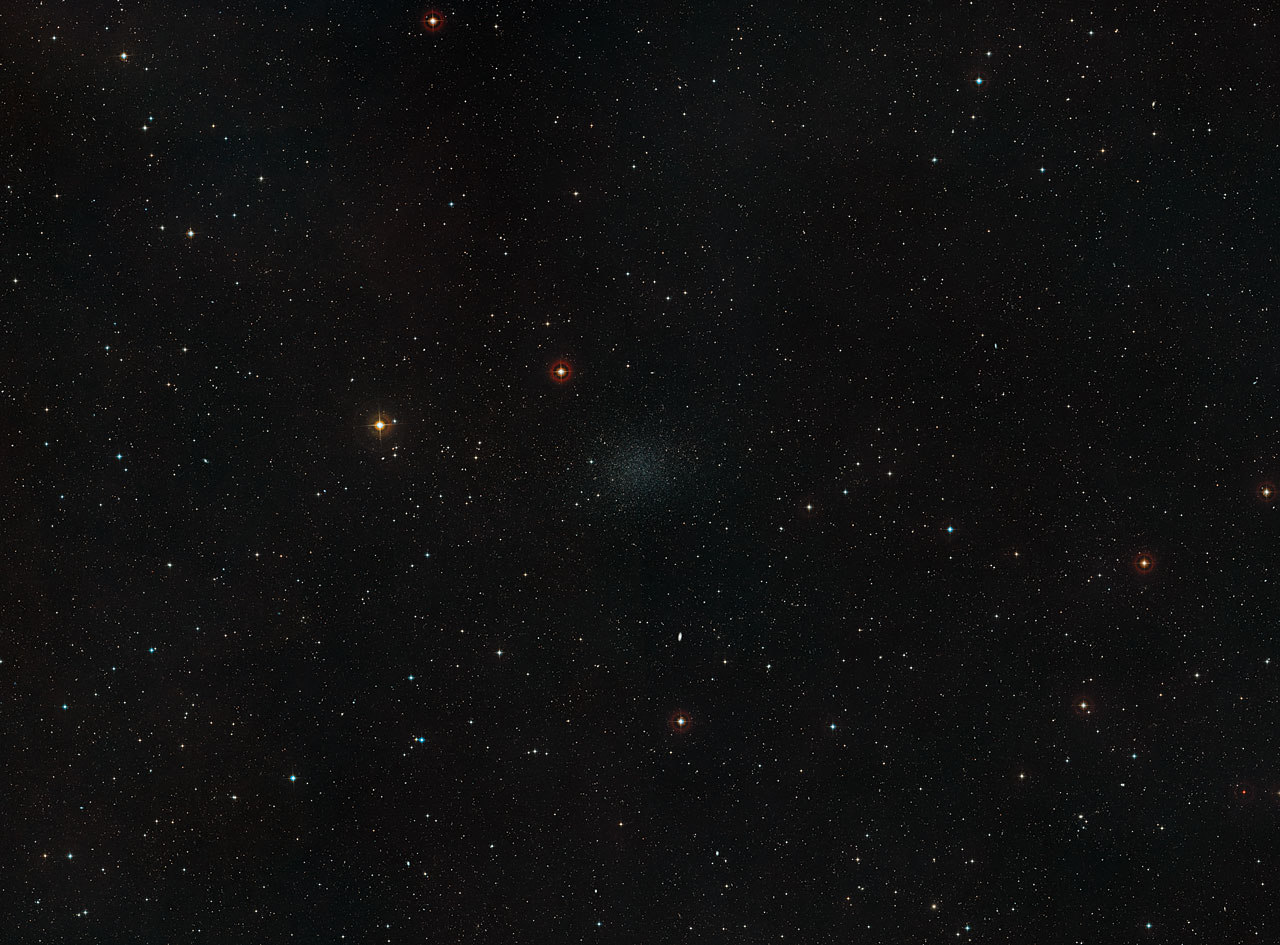
This image of the sky around the Sculptor Dwarf Galaxy was created from pictures from the Digitized Sky Survey 2. The galaxy appears as a small faint cloud close to the centre of the picture.
This quantity of old stars makes the Sculptor Dwarf Galaxy a prime target for studying the earliest periods of star formation. In a recent study, astronomers combined all the data available for the galaxy to create the most accurate star formation history ever determined for a dwarf spheroidal galaxy. This analysis revealed two distinct groups of stars in the galaxy. The first, predominant group is the older population, which is lacking in heavier elements. The second, smaller population, in contrast, is rich with heavy elements. Like young people crowding into city centres, this youthful stellar population is concentrated toward the galaxy’s core.
This video zoom takes a closer look at the Sculptor Dwarf Galaxy, pictured in new image from the Wide Field Imager camera, installed on the 2.2-metre MPG/ESO telescope at ESO’s La Silla Observatory. This elusive galaxy is a close neighbour of our galaxy, the Milky Way. Despite their proximity, both galaxies have very distinct histories and characters. This galaxy is much smaller, fainter and older than the Milky Way. It appears here as a rich cloud of faint stars at the centre of the image at the start, and completely fills the frame later on. Here and there much more distant galaxies can be spotted between the stars of the Sculptor Dwarf.
The stars within dwarf galaxies like the Sculptor Dwarf Galaxy can exhibit complex star formation histories. But as most of these dwarf galaxies’ stars have been isolated from each other and have not interacted for billions of years, each collection of stars has charted its own evolutionary course. Studying the similarities in dwarf galaxies’ histories, and explaining the occasional outliers, will help to explain the development of all galaxies, from the most unassuming dwarf to the grandest spirals. There is indeed much for astronomers to learn from the Milky Way’s shy neighbours.
Notes
[1] This faint galaxy should not be confused with the much brighter Sculptor Galaxy (NGC 253) in the same constellation
The CanSat Competition involves student teams building soda can sized “satellites” that ride suborbital rockets to a high altitude and perform particular tasks such as atmospheric measurements. The program has been going on for several years in the US and is also now in Europe:
15 September 2015: The ESA Education team has the pleasure to announce that preparations for the 2016 edition of the European CanSat competition are underway! The launch campaign will take place at the end of June 2016.
This will be the first time ESA assigns a space theme to the competition, which will be announced in the near future.
Recovered CanSats from the launchesA CanSat is a simulation of a real satellite, integrated within the volume and shape of a soft drink can. The challenge for the students taking part in this competition is to fit all the major subsystems found in a satellite, such as power, sensors and a communication system, into this minimal volume. The CanSat is then launched to an altitude of a few hundred metres by a rocket, or dropped from a platform or captive balloon, where it carries out its scientific experiment and achieves a safe landing.
Before the official European CanSat competition takes place, several national CanSat competitions will be held in various ESA member states*. The winners of the national competitions will be able to participate in the European one. The national organisers are invited to send us the name of their national winning teams before 17 April 2016.
Details about the organisation of the national competitions are available on the CanSat website. Help and advice for the national organisers, the students and teachers, as well as guidelines and timetables will be published soon.
Students tracking their CanSats during the launchThe location of the European CanSat competition finals will be announced in the upcoming months. ESA will sponsor the launch and activities of the European finals as well as the accommodation of the teams who will be participating (maximum 4 students and 1 accompanying teacher per team). Travel expenses will have to be paid by the participants themselves. The student teams are requested to speak English, as all documentation and presentations that the students will have to prepare are in this language.
Several conditions have to be met in order to ensure that your team can be accepted for the European competition. One team must be composed of a maximum of four students. Each team needs to be supervised by a teacher or mentor. One teacher can be responsible for a maximum of one team. All students need to be enrolled in a secondary school located in one of ESA’s Member States*. At least 50% of the students included in a team must be of the nationality of the country of the school where they are enrolled, and be aged between 14 and 20. University students will not be accepted for this competition.
If you want more details about the national and European CanSat competitions, or if you wish to organise the national competition in your own country (if it’s not already organised there), then please contact us at cansat @ esa.int. We wish all participants the best of luck for this engaging challenge. Hope to see you at the next European CanSat competition!
![nh-apluto-wide-9-17-15-final_0[1]](http://www.nasa.gov/sites/default/files/thumbnails/image/nh-apluto-wide-9-17-15-final_0.png)
![nh-apluto-mountains-plains-9-17-15_0[1]](http://www.nasa.gov/sites/default/files/thumbnails/image/nh-apluto-mountains-plains-9-17-15_0.png)
![nh-apluto-low-haze-9-17-15-updated[1]](http://hobbyspace.com/Blog/wp-content/uploads/2015/09/nh-apluto-low-haze-9-17-15-updated1.png)
![nh-1overview_reduced-annotated-9-17-15[1]](http://hobbyspace.com/Blog/wp-content/uploads/2015/09/nh-1overview_reduced-annotated-9-17-151.jpg)
![nh-3flow-detail-annotated-9-17-15[1]](http://hobbyspace.com/Blog/wp-content/uploads/2015/09/nh-3flow-detail-annotated-9-17-151.jpg)
![nh-2flow-detail-hiphase-annotated-9-17-15[1]](http://hobbyspace.com/Blog/wp-content/uploads/2015/09/nh-2flow-detail-hiphase-annotated-9-17-151.jpg)
![eso1536b[1]](http://hobbyspace.com/Blog/wp-content/uploads/2015/09/eso1536b1.jpg)
![CanSats_2015_node_full_image_2[1]](http://hobbyspace.com/Blog/wp-content/uploads/2015/09/CanSats_2015_node_full_image_21.jpg)
![Students_tracking_their_CanSats_during_the_launch_node_full_image_2[1]](http://hobbyspace.com/Blog/wp-content/uploads/2015/09/Students_tracking_their_CanSats_during_the_launch_node_full_image_21.jpg)