Curiosity rover update: Drilling of ‘Mojave” crystal-rich rock

NASA JPL reports on what the Curiosity rover will be up to next:

Crystal-Rich Rock ‘Mojave’ is Next Mars Drill Target

A rock target where NASA’s Curiosity Mars rover is using its sample-collection drill this week may have a salty story to tell.
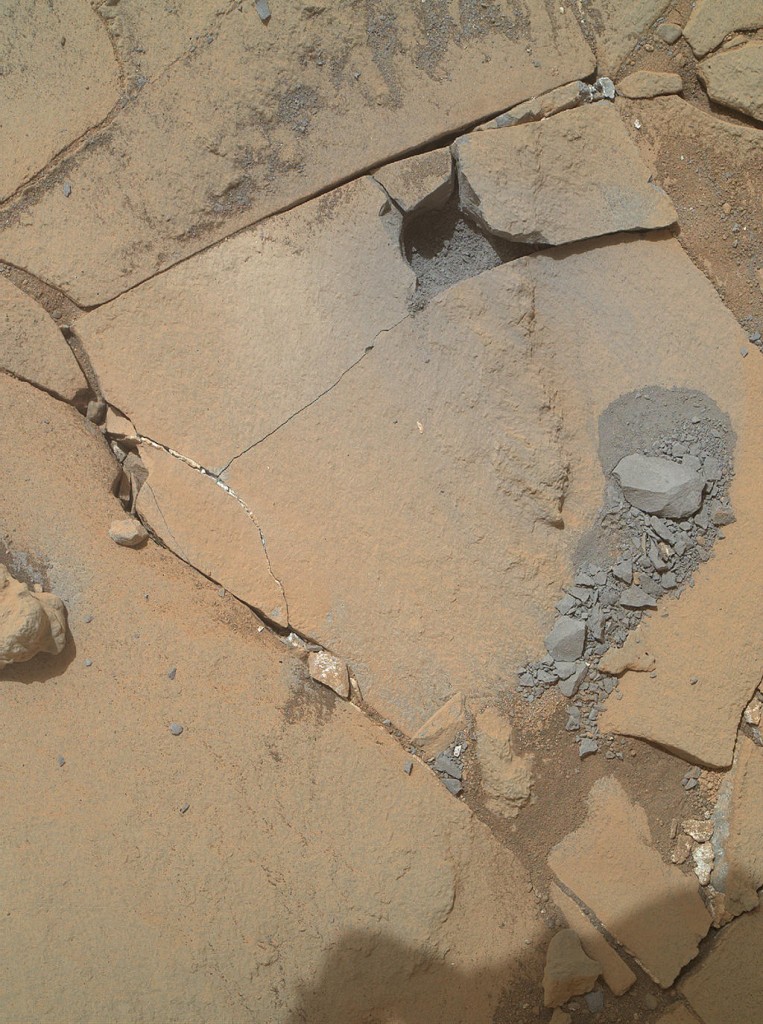
mars-rover-curiosity-drill-rock-cracks-MAHLI-sol867-pia19105-br2

This view from the Mars Hand Lens Imager (MAHLI) camera on the arm of NASA’s Curiosity Mars rover shows some of the outcome from a shallow-depth, mini-drill test to assess whether a rock target called “Mojave” is appropriate for full-depth drilling to collect a sample. It was taken on Jan. 13, 2015, during the 867th Martian day, or sol, of Curiosity’s work on Mars. [Continue…]

This target, called “Mojave,” displays copious slender features, slightly smaller than grains of rice, that appear to be mineral crystals. A chance to learn their composition prompted the Curiosity science team to choose Mojave as the next rock-drilling target for the 29-month-old mission investigating Mars’ Gale Crater. The features might be a salt mineral left behind when lakewater evaporated.

This week, Curiosity is beginning a “mini-drill” test to assess the rock’s suitability for deeper drilling, which collects a sample for onboard laboratory analysis.

A week long pause in science operations to install a new version of rover flight software is scheduled to begin early next week, possibly before completion of the drilling and sample delivery. This is the fourth new version of the onboard software since the rover’s August 2012 landing.
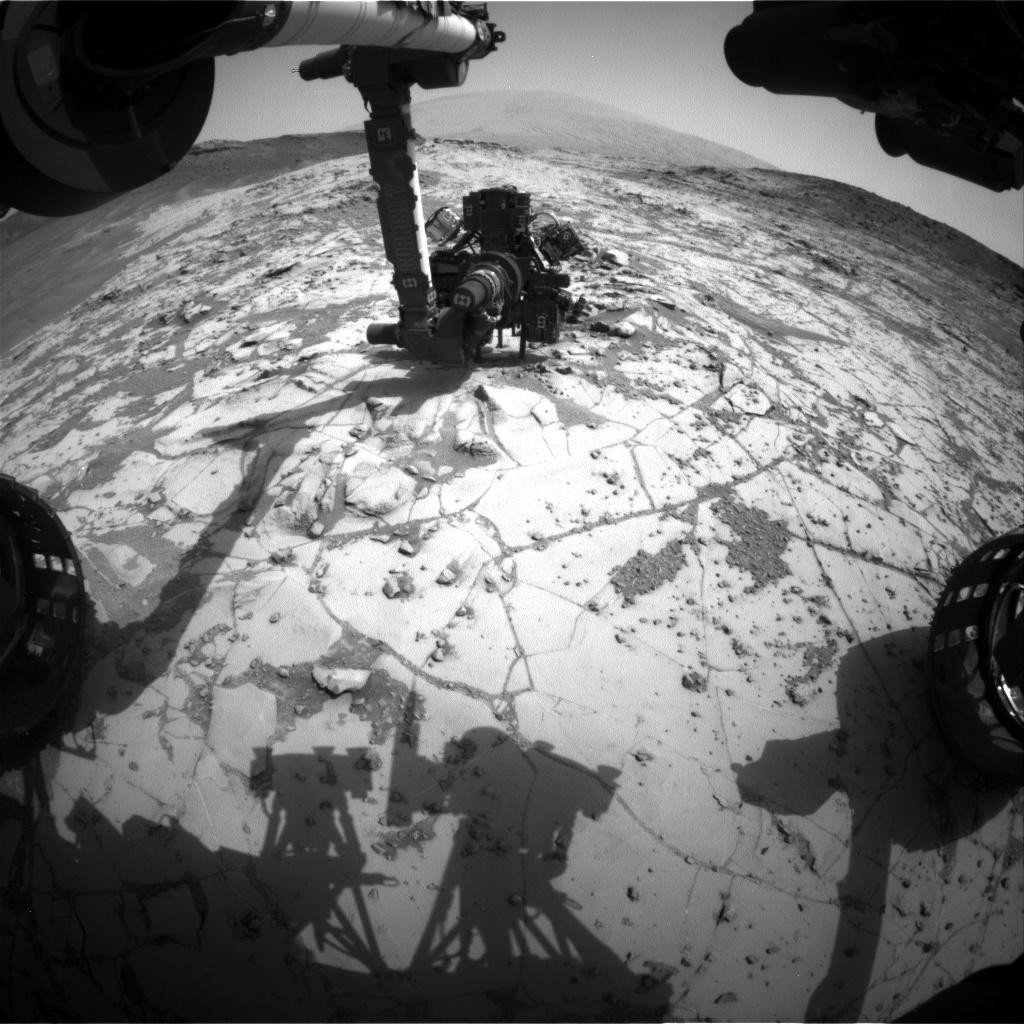
mars-rover-curiosity-arm-sol867-pia19104-br2

This view from the wide-angle Hazard Avoidance Camera (Hazcam) on the front of NASA’s Curiosity Mars Rover shows the rover’s drill in position for a mini-drill test to assess whether a rock target called “Mojave” is appropriate for full-depth drilling to collect a sample. It was taken on Jan. 13, 2015, during the 867th Martian day, or sol, of Curiosity’s work on Mars. [Continue…]

The Mojave drilling begins Curiosity’s third round of investigating the basal layer of Mount Sharp exposed at an area called “Pahrump Hills.” In the first round, the rover drove about 360 feet (110 meters) and scouted sites ranging about 30 feet (9 meters) in elevation. Then it followed a similar path, investigating selected sites in more detail. That second pass included inspection of Mojave in November 2014 with the dust-removal brush, close-up camera and Alpha Particle X-Ray Spectrometer on the rover’s arm. The results put Mojave at the head of the list of targets for the rover’s most intensive inspection, using laboratory instruments that ingest powdered rock collected by the drill.

“The crystal shapes are apparent in the earlier images of Mojave, but we don’t know what they represent,” said Curiosity Project Scientist Ashwin Vasavada at NASA’s Jet Propulsion Laboratory, Pasadena, California. “We’re hoping that mineral identifications we get from the rover’s laboratory will shed more light than we got from just the images and bulk chemistry.”
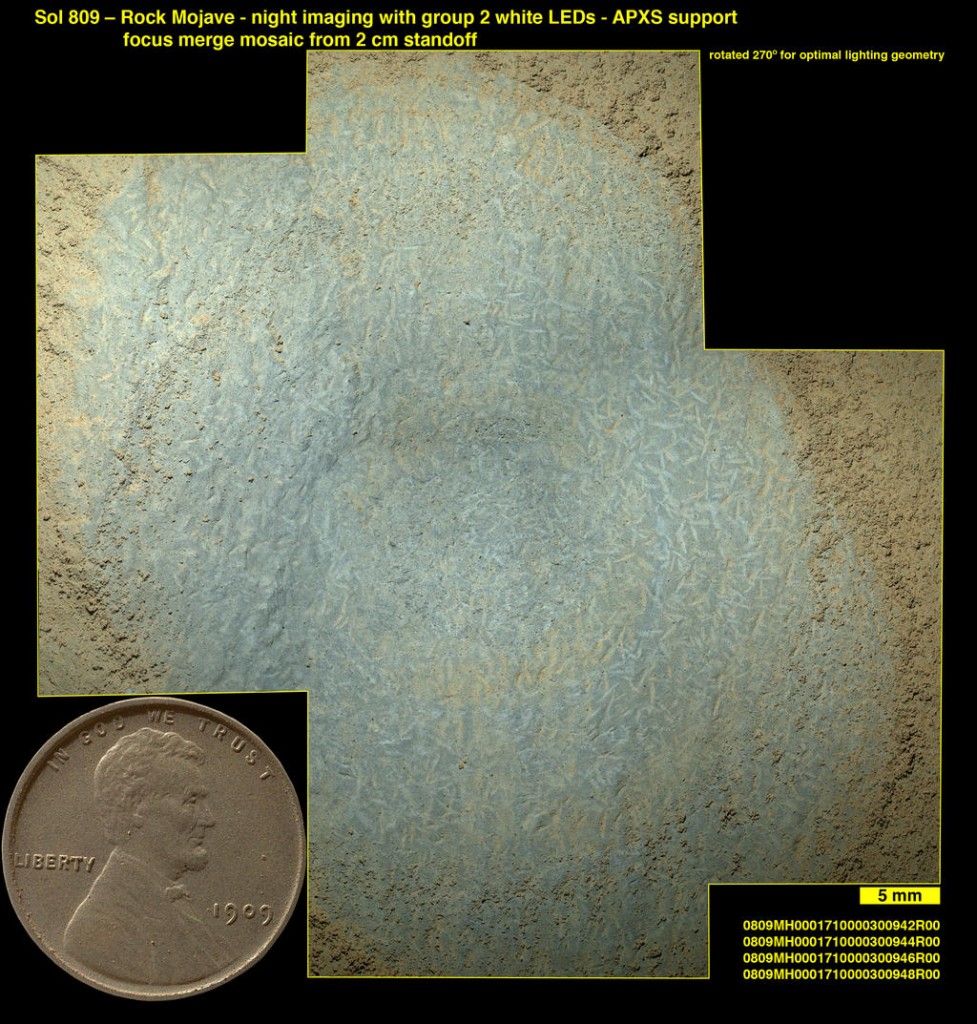
mars-curiosity-mahli-sol-809-mojave-pia19077-br2

Lozenge-shaped crystals are evident in this magnified view of a Martian rock target called “Mojave,” taken on Nov. 15, 2014, by the Mars Hand Lens Imager on the arm of NASA’s Curiosity Mars rover. These features record concentration of dissolved salts, possibly in a drying lake. [Continue…]

Curiosity’s Chemistry and Mineralogy instrument, or CheMin, can identify specific minerals in rock powder from a drilled sample. Analysis of the drill hole and drill tailings may also reveal whether the crystals are only at the surface, like a salty crust, or are also deeper in the rock.

“There could be a fairly involved story here,” Vasavada said. “Are they salt crystals left from a drying lake? Or are they more pervasive through the rock, formed by fluids moving through the rock? In either case, a later fluid may have removed or replaced the original minerals with something else.”

Curiosity’s work at Pahrump Hills may include drilling one or more additional rocks before heading to higher layers of Mount Sharp.

Next week’s planned software revision, like the mission’s earlier ones, adds protections against vulnerabilities identified in rover testbed activities on Earth. It also adds improvements to make planning drives more efficient.

“The files have already been uplinked and are sitting in the rover’s file system to be ready for the installation,” said JPL’s Danny Lam, the deputy engineering operations chief leading the upgrade process.

One change in the new software is to enable use of the rover’s gyroscope-containing “inertial measurement unit” at the same time as the rover’s drill, for better capability to sense slippage of the rover during a drilling operation. Another is a set of improvements to the rover’s ability to autonomously identify and drive in good terrain.

NASA’s Mars Science Laboratory Project is using Curiosity to assess ancient habitable environments and major changes in Martian environmental conditions. JPL, a division of the California Institute of Technology in Pasadena, built the rover and manages the project for NASA’s Science Mission Directorate in Washington.

For more information about Curiosity, visit: www.nasa.gov/msl and mars.jpl.nasa.gov/msl/

You can follow the mission on Facebook and Twitter at: www.facebook.com/marscuriosity and www.twitter.com/marscuriosity

Part 5: Photometry tutorial for amateur and pro astronomers

Rick Boozer on his Astro Maven blog has posted the fifth and final installment of Photometry with AIP4WIN: a Tutorial, which is aimed at astronomers both amateur and professional:

From Part 1:

The science of photometry can be used by both amateur astronomers and professionals for some very advanced scientific work.  You can detect the light changes caused by eclipsing binary stars, plot the changes in luminosity of a variable star and even detect an exoplanet orbiting another star.  This tutorial will be your step-by-step guide on how to employ the powerful Magnitude Measurement Tool that comes with the renowned astronomical imaging software known as AIP4WIN by Richard Berry and Robert Burnell.  Special thanks to Mr. Berry for giving me permission to include screen images and extensive operating details from AIP4WIN.

Video: ‘Space to Ground’ report on ISS – Jan.16.15

The latest Space to Ground video reports on the latest news for the Int. Space Station, including this week’s ammonia leak scare that turned out to be a false alarm:

UK Beagle 2 Mars lander spotted on Mars by orbiter

News comes today from NASA and the UK space authorities that the Beagle 2 Mars Lander, which went silent during its landing attempt in 2003, has been seen from orbit. Below are the NASA and UK announcements and videos:

‘Lost’ 2003 Mars Lander Found by Mars Reconnaissance Orbiter 

The Beagle 2 Mars Lander, built by the United Kingdom, has been thought lost on Mars since 2003, but has now been found in images from NASA’s Mars Reconnaissance Orbiter.

A set of three observations with the orbiter’s High Resolution Imaging Science Experiment (HiRISE) camera shows Beagle 2 partially deployed on the surface of the planet, ending the mystery of what happened to the mission more than a decade ago. They show that the lander survived its Dec. 25, 2003, touchdown enough to at least partially deploy its solar arrays.

Beagle 2 hitched a ride to Mars on the European Space Agency’s long-lived Mars Express mission. It was a collaboration between industry and academia designed to deliver world-class science from the surface of the Red Planet.

“I am delighted that Beagle 2 has finally been found on Mars,” said Mark Sims of the University of Leicester, U.K. He was an integral part of the Beagle 2 project from the start, leading the initial study phase and was Beagle 2 mission manager. “Every Christmas Day since 2003 I have wondered what happened to Beagle 2. My Christmas Day in 2003 alongside many others who worked on Beagle 2 was ruined by the disappointment of not receiving data from the surface of Mars. To be frank I had all but given up hope of ever knowing what happened to Beagle 2. The images show that we came so close to achieving the goal of science on Mars.

pia19106-mro-beagle-wide[1]
This annotated image shows where features seen in an observation by NASA’s Mars Reconnaissance Orbiter have been interpreted as hardware from the Dec. 25, 2003, arrival at Mars of the United Kingdom’s Beagle 2 Lander. The image was taken in 2014 by the orbiter’s HiRISE camera. Image Credit: NASA/JPL-Caltech/Univ. of Arizona/University of Leicester Full image and caption

HiRISE images initially searched by Michael Croon of Trier, Germany, a former member of the European Space Agency’s Mars Express operations team, provide evidence for the lander and key descent components on the surface of Mars within the expected landing area of Isidis Planitia, an impact basin close to the equator.

Subsequent re-imaging and analysis by the Beagle 2 team, the HiRISE team and NASA’s Jet Propulsion Laboratory, Pasadena, California, have confirmed that the targets discovered are of the correct size, shape, color and dispersion to be Beagle 2. JPL planetary geologist Tim Parker, who has assisted in the search and processed some of the images said, “I’ve been looking over the objects in the images carefully, and I’m convinced that these are Beagle 2 hardware.”

Analysis of the images indicates what appears to be a partially deployed configuration, with what is thought to be the rear cover with its pilot/drogue chute (still attached) and main parachute close by. Due to the small size of Beagle 2 (less than 7 feet, or 2 meters across for the deployed lander) it is right at the limit of detection of HiRISE, the highest-resolution camera orbiting Mars. The targets are within the expected landing area at a distance of about three miles (five kilometers) from its center.

“I can imagine the sense of closure that the Beagle 2 team must feel,” said Richard Zurek of JPL, project scientist now for Mars Reconnaissance Orbiter (MRO) and previously for NASA’s still-missing 1998 Mars Polar Lander. “MRO has helped find safe landing sites on Mars for the Curiosity and Phoenix missions and has searched for missing craft to learn what may have gone wrong. It’s an extremely difficult task, as the craft are small and the search areas are vast. It takes the best camera we have in Mars orbit and work by dedicated individuals to be successful at this.”

HiRISE is operated by the University of Arizona, Tucson. The instrument was built by Ball Aerospace & Technologies Corp. of Boulder, Colorado. The Mars Reconnaissance Orbiter Project is managed for NASA’s Science Mission Directorate in Washington, by JPL, a division of the California Institute of Technology, Pasadena.

For more information about HiRISE, visit: hirise.lpl.arizona.edu

Additional information about MRO is online at: www.nasa.gov/mro

====================================

And here is a statement from the UK government:

UK-led Beagle 2 lander found on Mars

Beagle 2 successfully landed on Mars on 25th December 2003.

The UK-led Beagle 2 Mars Lander, thought lost on Mars since 2003, has been found partially deployed on the surface of the planet, ending the mystery of what happened to the mission more than a decade ago. This find shows that the Entry, Descent and Landing (EDL) sequence for Beagle 2 worked and the lander did successfully touchdown on Mars on Christmas Day 2003. Beagle 2 hitched a ride to Mars on ESA’s Mars Express mission and was a collaboration between industry and academia. It would have delivered world-class science from the surface of the Red Planet. Many UK academic groups and industrial companies contributed to Beagle 2.

Images taken by the HiRISE camera on NASA’s Mars Reconnaissance Orbiter (MRO) and initially searched by Michael Croon of Trier, Germany, a former member of ESA’s Mars Express operations team at ESOC, have identified clear evidence for the lander and convincing evidence for key entry and descent components on the surface of Mars within the expected landing area of Isidis Planitia (an impact basin close to the equator).

Since the loss of Beagle 2 following its landing on Christmas Day 2003, Michael has, in parallel with members of the Beagle 2 industrial and scientific teams, been patiently screening images from HiRISE looking for signs of Beagle 2. Subsequent re-imaging and analysis by the Beagle 2 team, HiRISE team and NASA’s Jet Propulsion Laboratory (JPL) has confirmed that the targets discovered, are of the correct size, shape, colour and dispersion (i.e. separation) to be Beagle 2.

Dr David Parker, Chief Executive of the UK Space Agency, said:

The history of space exploration is marked by both success and failure. This finding makes the case that Beagle 2 was more of a success than we previously knew and undoubtedly an important step in Europe’s continuing exploration of Mars.

The images, following analysis by members of the Beagle 2 team and NASA, show the Beagle 2 lander in what appears to be a partially deployed configuration, with what is thought to be the rear cover with its pilot/drogue chute (still attached) and main parachute close by. Due to the small size of Beagle 2 (less than 2m across for the deployed lander) it is right at the limit of detection of imaging systems (cameras) orbiting Mars. The targets are within the expected landing area at a distance of ~5km from its centre. Several interpretations of the image of the lander have been identified, consistent with the lander’s size and shape. The imaging data is however consistent with only a partial deployment following landing. This would explain why no signal or data was received from the lander – as full deployment of all solar panels was needed to expose the RF antenna which would transmit data and receive commands from Earth.

Professor Mark Sims of the University of Leicester who was an integral part of the Beagle 2 project from the start leading the initial study phase and was Beagle 2 Mission Manager and led the Flight Operations team said:

I am delighted that Beagle 2 has finally been found on Mars. Every Christmas Day since 2003 I have wondered what happened to Beagle 2. My Christmas day in 2003 alongside many others who worked on Beagle 2 was ruined by the disappointment of not receiving data from the surface of Mars. To be frank I had all but given up hope of ever knowing what happened to Beagle 2. The images show that we came so close to achieving the goal of science on Mars. The images vindicate the hard work put in by many people and companies both here in the UK and around Europe and the world in building Beagle 2.

The highly complex entry, descent and landing sequence seems to have worked perfectly and only during the final phases of deployment did Beagle 2 unfortunately run into problems. I view it as a great achievement that the team built Beagle 2 in a little over 4 years and successfully landed it on the surface of Mars. It was a great pity we couldn’t have delivered the world class science Beagle 2 may have brought and even sadder that Colin (Pillinger) and other colleagues who died in 2014 didn’t live to see the discovery that Beagle 2 made it to Mars.

Beagle 2 showed the fantastic innovation skills available from UK academia and industry and inspired many people in particular the young. Many opportunities exist for the UK, working with other countries to do inspired space exploration and science (subject of course to available funding).

Unfortunately given the partial deployment (and covering of the RF antenna) it would not be possible to revive Beagle 2 and recover data from it. Professor Colin Pillinger from the Open University who led the Beagle 2 project with inspirational enthusiasm died in May 2014. Others that provided major contributions to Beagle 2 were Professor George Fraser of the University of Leicester and Professor David Barnes of Aberystwyth University who also died in 2014.

Space art led Belbruno to better space travel

Edward Belbruno has become well known for developing new orbital mechanics techniques that allow spacecraft to move about the solar system more efficiently, i.e with less fuel than a conventional approach. See, for example, From chaos, a new order – The Space Review – Mar. 6.200 6 –

This sensitivity to initial conditions may be a challenge to theoreticians, but it provides an opportunity for those who want to leverage it in spaceflight applications. One of the first to explore the potential of chaotic dynamics in spaceflight is Ed Belbruno, a visiting researcher at Princeton University. Working as an orbit analyst at JPL twenty years ago—new to the field of astrodynamics but with a doctorate in mathematics—he looked to alternatives to the traditional method to sending spacecraft to the Moon and planets. That approach, a Hohmann transfer orbit from the Earth and a “capture maneuver” at the destination, works well, but requires a high change in velocity, or delta-v, to perform the capture maneuver. Barring the availability of alternative deceleration techniques, like aerobreaking, this delta-v requirement translates into substantial propellant, and thus a heavier spacecraft.

Belbruno asked if there was a way for a spacecraft to perform a “ballistic capture” maneuver: to arrive at the Moon, for example, on a specific trajectory that would allow it to enter orbit without any delta-v at all. While his JPL colleagues at the time were convinced that it wasn’t possible, Belbruno studied the problem and found there was a way, as he put it, “to slowly creep up” on the Moon, arriving such that all the forces were balanced, allowing the spacecraft to go into orbit rather than escaping from or crashing into the Moon.

Belbruno first proposed taking advantage of “weak stability boundary theory” in 1986 for a proposed small lunar orbiter that could be launched from a Get Away Special canister in the shuttle’s cargo bay. …

Belbruno  is also an artist and he says the act of painting helped him develop ideas like using the weak stability boundary technique : Painting Our Way to the Moon – Space.com.

I  am both a scientist and an artist. The paintings that I create have given rise to interesting scientific discoveries. The paintings don’t just inspire me to pursue a particular avenue of study — they literally have the key within them to help me figure out how to solve complex scientific problems. The process of how this occurs is somewhat mysterious and has happened to me many times, and recently gave rise to a revolutionary new route to the Moon.

Check out some of his art at The Cosmic Art of Edward Belbruno (Gallery) – space.com.