Photos to Space: “Astro Corps – Join the Adventure!”

Photos To Space, a HobbySpace sponsor, introduces their new Astro Corps team:

Astro Corps – Join The Adventure!
Send Your Photo To Space With Our Astro Corps Team.

flight prep_1080_4Countdown To Liftoff!
On September 22, 2013, Photos To Space will launch the first Astro Corps flight to the edge of space. You can be a part of this historic adventure. Just upload your photo using the form below and follow along as we countdown to our first Astro Corps flight.


Who’s Flying On Such A Mission?Group_01_150
Three brave souls have been selected to fly on this historic mission: Gene, the plucky American; Yuri, the hot shot Ukrainian and Riley, a smart scientist from Australia. Each of our explorers has been dreaming of the day when they can go to space. But who are they? They come from different backgrounds but all bring a passion for space. Read More about them on the Astro Corps Bios page.


Learn More About The Flight.Space - The Future
What does it take to get to the edge of space? The team is flying on the ‘Away Mission’ vehicle. Flown by JP Aerospace, this craft is a well know and trusted design having flown numerous times before.

The vehicle should fly to almost 20 miles before the systems return it safely back home. Your photo will be kept safe with our Astro Corps crew during the entire flight.


Sign Up Today!

To get started on your adventure just pick a photo and fill out the flight form. You will receive an email welcoming you to the team.

Certificate of Flight
When the mission is over, we will look through the data and create certificates of participation including all of the details of your Astro Corps mission. We’ll include information such as how high the vehicle went, how fast it traveled and what the cameras saw during the flight.

Sign up today and experience the adventure!
Hurry. This flight closes on September 15th at 11:59pm Eastern Time.

A SpacerGuild Activity
In addition to sending your photo, this flight earns you SpacerGuild points. More info about this wonderful program will be coming soon!

Continue to the flight form…

Surrey Satellite to design exoplanet satellite mission

An announcement from Surrey Satellite Technology Ltd (SSTL):

ESA selects SSTL to design Exoplanet satellite mission

Surrey Satellite Technology Ltd (SSTL) has been selected by the European Space Agency (ESA) for the competitive design phase of CHEOPS science satellite, which will improve mankind’s understanding of exoplanets – planets orbiting distant stars outside our solar system. The contractor selection for the implementation phase is planned by mid-2014 and the launch is scheduled late 2017.

The CHaracterising ExOPlanets Satellite (CHEOPS) will finely characterise known exoplanets and their parent stars with an unprecedented accuracy. The satellite will measure the orbit and radius of those exoplanets, enabling the scientists to assess their potential habitability. The mission will also act as a “scout” performing preliminary observations on targets for the future European Extremely Large Telescope and James Webb Space Telescope that will be capable of more detailed analysis.

CHEOPS was selected from 25 missions proposed in response to ESA Call for Small Missions in 2012, which was targeting innovative small science missions that offer high value at low cost. CHEOPS is jointly developed by ESA and a consortium of Member States led by Switzerland: The Swiss-built instrument using a Ritchey–Chrétien optical telescope will observe the stars and their orbiting planets, while ESA is responsible for the provision of the satellite platform and the launch.

Over the next 10 months SSTL will design the satellite platform, which will host the telescope payload. To provide the mission within a short schedule and at low cost, ESA asked that any solution be based on an existing, flight-proven, satellite platform. SSTL’s solution is based on a variant of the highly successful SSTL-150 platform, which has seen recent service in Canada’s Sapphire space surveillance mission and the 5-satellite RapidEye Earth observation constellation.

In awarding the contract to SSTL, Frederic Safa, Head of Future Missions Office in ESA’s Science and Robotic Exploration Directorate stated: “We chose SSTL for this study for a combination of reasons such as their proven ability to build reliable low-cost missions and their past experience with satellites carrying high-performance optical telescopes.”

SSTL’s Head of Science, Doug Liddle, commented: “We are delighted that ESA selected SSTL to design the CHEOPS mission. We will draw on our experience to design a low cost, but high value solution that will demonstrate that ambitious science missions can be launched both quickly and economically.”

CHEOPS is envisaged as the first in a series of missions in the ESA Science Programme that will utilise small satellites for low cost and rapid development, in order to offer greater flexibility in response to new ideas from the scientific community and complement to the larger missions of ESA’s Science Programme.

About SSTL
Surrey Satellite Technology Limited (SSTL) is the world’s leading small satellite company, delivering operational space missions for a range of applications including Earth observation, science and communications. The Company designs, manufactures and operates high performance satellites and ground systems for a fraction of the price normally associated with space missions, with 580 staff working on turnkey satellite platforms, space-proven satellite subsystems and optical instruments.

Since 1981 SSTL has built and launched 41 satellites – as well as providing training and development programmes, consultancy services, and mission studies for ESA, NASA, international governments and commercial customers, with its innovative approach that is changing the economics of space.

In 2008 the Company set up a US subsidiary, Surrey Satellite Technology US LLC (SST-US) with facilities in Denver, Colorado to address the United States market and its customers for the provision of small satellite solutions, applications and services. www.sst-us.com

Three ISS Expedition 36 crew members back on earth after 166 days in orbit

Three ISS crewmembers returned to earth on Tuesday (US time):

After rentering Earth’s atmosphere, Expedition 36 Commander Pavel Vinogradov and Flight Engineer Alexander Misurkin of the Russian Federal Space Agency and NASA Flight Engineer Chris Cassidy landed safely on the steppe of Kazakhstan on Sept. 11. The trio completed 166 days in space.

Earlier in the day they did there farewells on the Station to Expedition 37 Commander Fyodor Yurchikhin, Flight Engineer Karen Nyberg of NASA and Flight Engineer Luca Parmitano of the European Space Agency.

Curiosity Rover – update on long drive towards Mount Sharp

The latest on Curiosity’s trek towards Mount Sharp:

Mars Science Laboratory: Long Drive Puts NASA Mars Rover Near Planned Waypoint

PASADENA, Calif. — NASA’s Mars rover Curiosity now has a view of a patch of exposed bedrock scientists selected for a few days of close-up study, the first such study since the rover began its long trek to Mount Sharp two months ago.

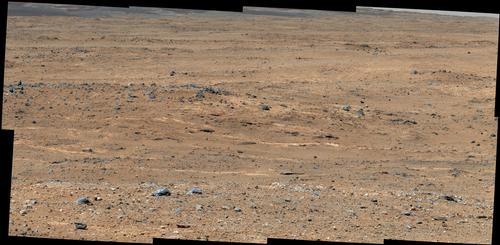
'Darwin' Outcrop at 'Waypoint 1' of Curiosity's trek to Mount Sharp
An outcrop visible as light-toned streaks in the lower center of this image has
been chosen as a place for NASA’s Mars rover Curiosity to study for a few
days in September 2013.

Curiosity reached the crest of a rise informally called “Panorama Point.” From Panorama Point, the rover took photographs of a pale-toned outcrop area that the team chose earlier as “Waypoint 1” on the basis of imagery from NASA’s Mars Reconnaissance Orbiter.

Five selected waypoints dot the mission’s route southwestward from the “Glenelg” area, where Curiosity worked during the first half of 2013, and an entry point to the lower layers of Mount Sharp, the mission’s next major destination. Waypoint 1 lies about one-fifth of the way along the approximately 5.3-mile (8.6-kilometer) route, as plotted from examining orbiter images.

Curiosity advanced 464 feet (141.5 meters) on Sept. 5 in the longest one-day drive so far in the 13-month-old mission. The drive toward the elevated Panorama Point combined two segments. For a long initial segment, engineers chose the path from images examined on Earth ahead of time. That was followed by a 138-foot (42-meter) segment, for which the rover autonomously navigated its own path based on images taken during the day’s drive. That Sept. 5 drive plus the next one — 80 feet (24.3 meters) on Sept. 8 — brought the rover to the top of Panorama Point.

For the Sept. 5 drive, “we had a long and unobstructed view of the hill we needed to climb, which would provide an overlook of the first major waypoint on our trek to Mount Sharp,” said Jeff Biesiadecki, a rover planner on the Curiosity team at NASA’s Jet Propulsion Laboratory, Pasadena, Calif. “We were able to extend the drive well beyond what we could see by enabling the rover’s onboard hazard avoidance system.”

In the Glenelg area, Curiosity accomplished the mission’s major science goal by finding evidence of an ancient environment favorable for microbial life. The evidence came from analysis of rock powder drilled from two outcrops in a shallow depression called “Yellowknife Bay.” When the rover examines multiple rock layers of Mount Sharp, researchers hope to learn more about ancient habitable environments and major changes in environmental conditions.

“We want to know how the rocks at Yellowknife Bay are related to what we’ll see at Mount Sharp,” said the mission’s project scientist, John Grotzinger of the California Institute of Technology, Pasadena. “That’s what we intend to get from the waypoints between them. We’ll use them to stitch together a timeline — which layers are older, which are younger.”

The science team is using images taken from Panorama Point to select precisely where to pause for a few days and use instruments on Curiosity’s arm to examine Waypoint 1. The rock targets being considered are still about 245 feet (75 meters) southwest of Curiosity’s Sept. 9 position.

The trek to Mount Sharp will continue for many months after the planned work at Waypoint 1.

NASA’s Jet Propulsion Laboratory, a division of Caltech in Pasadena, manages the Mars Science Laboratory Project for NASA’s Science Mission Directorate, Washington. JPL designed and built the project’s Curiosity rover.

More information about Curiosity is online at http://www.nasa.gov/msl and http://mars.jpl.nasa.gov/msl/ . You can follow the mission on Facebook at http://www.facebook.com/marscuriosity and on Twitter at http://www.twitter.com/marscuriosity .

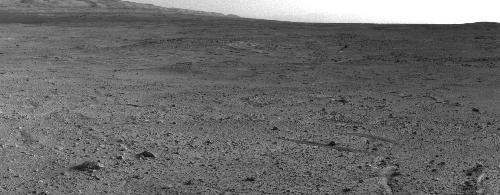
NASA's Mars rover Curiosity captured this view using its Navigation Camera (Navcam) after reaching the top of a rise called "Panorama Point" with a drive during the 388th Martian day, or sol, of the rover's work on Mars (Sept. 8, 2013).Curiosity’s View from ‘Panorama Point’ to ‘Waypoint 1’ and Outcrop ‘Darwin’

NASA’s Mars rover Curiosity captured this view using its Navigation Camera (Navcam) after reaching the top of a rise called “Panorama Point” with a drive during the 388th Martian day, or sol, of the rover’s work on Mars (Sept. 8, 2013). The view is southwestward and spans approximately from south to west, left to right.

In the upper central portion of the image is a patch of ground paler than its surroundings. This pale-toned patch had been mapped from orbit and selected as the first of a few waypoints for the rover to study for a few days during pauses in the mission’s multi-month trek from the “Glenelg” area to the lower layers of Mount Sharp. The outcrop that is exposed at this “Waypoint 1” site has been informally named “Darwin.” It is about 245 feet (75 meters) from the rover’s Sol 388 position on Panorama Point.

Curiosity finished more than six months of investigations in the Glenelg area in early July 2013 and began the drive of about 5.3 miles (8.6 kilometers) from Glenelg to the Mount Sharp entry point. Waypoint 1 is about one fifth of the way along the route plotted from examining orbiter images.

Space policy roundup – Sept.10.13

Some space policy related items today: