** Time-lapse Earth Flyover from NASA astronaut on the ISS:
This time-lapse video taken by NASA astronaut Nick Hague squeezes a 30-minute International Space Station trip over a cloudy Earth into 60 seconds, covering the Pacific to the Atlantic.
** A NASA video promoting the Artemis lunar program with the help of commercial and international partners:
The latest episode of NASA’s Space to Ground weekly report on activities related to the International Space Station:
** Use NASA’s Spot the Station to get updates on when the ISS will fly over your location:
** Expedition 59 – CSA In-Flight Event with Astronaut David Saint-Jacques C2 – Montreal May 24, 2019 –
Aboard the International Space Station, Expedition 59 Flight Engineer David Saint-Jacques of the Canadian Space Agency discussed research and technological breakthroughs aboard the orbital laboratory during an in-flight question and answer session May 24 with innovators and technology devotees gathered at a conference in Montreal, Canada. Saint-Jacques is the final month of six-and-a-half month mission on the complex.
** NASA Administrator Speaks at Florida Institute of Technology Event:
Here is this week’s episode of NASA’s Space to Ground report on activities related to the International Space Station:
** NASA Rocket Ranch podcast discusses the proposed Gateway lunar orbit habitat:
** Expedition 59 Education Event with Mobius Science Center – May 15, 2019
Aboard the International Space Station, Expedition 59 Flight Engineer Anne McClain of NASA, a native of Spokane, Washington, discussed life and research on the complex with students gathered at the Mobius Science Center in Spokane. McClain, who arrived at the orbital laboratory in December, is the fifth month of a planned six-and-a-half- month mission on the orbiting laboratory.
** The Big Bang Juxtaposition: A Live Q&A with JPL and Caltech Scientists and Engineers
Bazinga! Watch this panel featuring real life scientists and engineers from JPL and Caltech the same night as The Big Bang Theory series finale, live from Pasadena, California. Featuring:
• Moderator: Bobak Ferdowsi, JPL systems engineer
• Varoujan Gorjian, JPL scientist and Caltech alum
• Jessie Christiansen, Caltech/IPAC staff scientist
• Vandana Desai, Caltech/IPAC astronomer
A sampling of recent articles, videos, and images related to human settlements in the solar system:
** Jeff Bezos plans to develop technologies that will enable the building of enormous in-space habitats according to his statements in last week’s presentation, which included the unveiling of the Blue Moon lunar lander. The habitats would rotate to provide spin gravity and would ultimately be large enough for cities, rivers, and forests.
An imaginative rendering of a future in-space rotating habitat. Credits: Blue Origin
This club is a way to connect young people who love our home planet, who believe in the power of human ingenuity and the abundance of space, and who are unshakably optimistic about the future. We welcome students, educators, and fans of the future to join a worldwide community of dreamers sponsored by Blue Origin, builders of reusable rockets and roads to space.
O’Neill promoted large in-space habitats as alternatives to settlements on the surface of planets and moons. In 1974, SSI initiated a series of conferences that examined the methods and technologies needed to make such enormous structures a reality. Here is the latest information on registration, speakers, and agenda for the next SSI conference: SSI 50 Conference Update –
SSI 50 marks the kickoff for a new SSI project, the Space Settlement Enterprise. This multi-year project will reexamine the original High Frontier vision created by Professor Gerard O’Neill, bringing his ideas up to date with new technology, new discoveries, and new space ventures. This year’s conference will lay the groundwork that project, helping to determine the questions that need to be addressed. Our panel format is designed to allow for plenty of Q&A and audience interaction. There will be no passive lectures. We need your ideas.
** A recent update on SSI’s proposed G-Lab rotating space station and other Institute projects:
Enabling Permanent Human Settlement On The High Frontier. February 27th 2017 Space Studies Institute President Gary C Hudson spoke at the Silicon Valley Space Center/AIAA Tech Talk meeting in Santa Clara, California about two important SSI programs: G-Lab, the free flying reduced gravity spinner co-orbited with ISS and EPI, supporting fundamental R&D for true “Space Drives.”
We present a number of preliminary policy options and research directions intended to enable construction of the first space settlement starting in two or three decades. Most of the necessary technology development can be driven by either Earthbound applications or the construction and operation of a series of ever more capable space hotels as space hotel requirements are very similar to those of space settlements.
This paper examines policy options for the necessary development that will not be catalyzed by terrestrial needs or space hotels. The options include making space settlement an official goal for the relevant agencies, developing launchers a factor of 20 or more less expensive than today, and debris cleanup.We will also describe an applied research program to better understand the Equatorial Low Earth Orbit (ELEO) radiation environment, space farms, psycho social issues, and unique settlement construction and operation issues.
Globus, an engineer at NASA Ames, has written extensively about starting space settlement with modest-sized rotating habitats in equatorial earth orbit where radiation levels are quite low. See Free Space Settlement for links to several papers on the concept.
In addition, check out The High Frontier: An Easier Way by Globus and Tom Marotta. The book describes the ELEO rotating habitat concept for a general audience.
“So every plan for having a habitat on the moon involves making a trench, creating a structure and covering it with some sort of regolith, which is the soil on the moon.
“Our idea is to actually start underground, using a mechanism we already use on the earth, a tunnel boring machine, to make a continuous opening to create habitats or connect the colonies together,” he added.
Analysis of images of the lunar surface show lava tubes capable of housing large cities underground, said Rostami, director of the Earth Mechanics Institute at the US Colorado School of Mines.
** The Inflatable Lunar/Mars Analog Habitat project at the University of North Dakota recently carried out the seventh simulated space mission. The ILMAH Mission VII began on April 25th and lasted till May 7th with a three-member crew consisting of Space Studies grad students Jared Peick and Peter Henson (Mission Specialists), and Stefan Tomovic (Mission Commander). Reports on the mission can be found at
The three-member Mission-VII crew completed their first Extra Vehicular Activity (EVA-1) on Friday (04/26/19). Saturday (04/27/19) was a science-packed day for the crew members. The team conducted research with an electroencephalogram (EEG) study, practiced emergency responses with simulation software and took care of the plants in the habitat’s Plant Production Module (PPM). The habitat residents conducted EVA1 with Commander Stefan Tomović and Mission Specialist Peter Henson going out on EVA, and Mission Specialist Jared Peick serving as CAPCOM for EVA1. EVA1 lasted an hour and ten minutes with the objectives of inspecting the habitat, collecting water from a resupply drop, and gathering geological samples…
** Space base simulations are also underway in China:
The Resilient ExtraTerrestrial Habitats Institute is working to ensure that the first long-term settlement on other planetary bodies are safe from hazards such as a meteoroid colliding with the moon or violent sandstorms on Mars.
Shirley Dyke, head of Purdue University’s RETH Institute, said she noticed that the habitats on other planets portrayed on TV don’t look realistic. In order to keep occupants alive, a habitat system on another planet would have to be much more sophisticated, even smart.
… SpaceFund Reality (SFR) rating, focused on space habitats. With this rating we begin to move into areas that are more obviously related to the SpaceFund mission of supporting “frontier enabling” technologies. While the launch database showed a field that is over crowded, many other critical sectors of the space economy are not, and some are frankly, wide open.
Our research has showed that this sector, space habitats, is still underdeveloped and represents a potential opportunity for investors and entrepreneurs. If one is to believe what Musk, Bezos and governments such as the US and UAE are saying about their plans to both dramatically lower the cost of space access and enable a permanent human presence in space, within a few years we may see a ‘housing shortage’ on the frontier.
** Japan’s iSpace is building rovers to explore the Moon and has over $90M and engineers like Akane Imamura to do the job: Meet The Engineer Dreaming of a Lunar City
After a decades-long lull, interest in the moon is back — this time led by startups, including Tokyo-based ispace Inc., which is hoping to land two of its miniature rovers on the lunar surface in 2021. Akane Imamura is part of ispace’s team racing to make that deadline, and their ultimate goal is nothing short of making the moon not only habitable, but home to an ecosystem of thriving businesses. Bloomberg Technology’s Aki Ito joins Imamura’s team as they test their most recent prototypes at a lunar simulation facility run by the Japan Aerospace Exploration Agency.
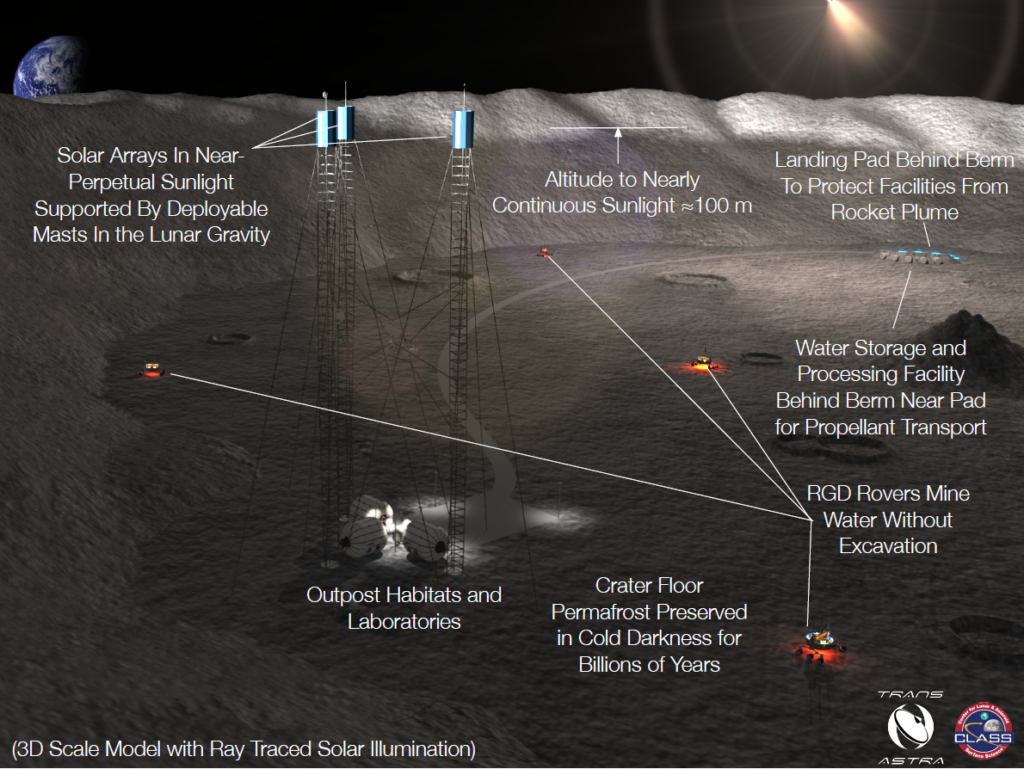
The Lunar Polar Gas-Dynamic Mining Outpost (LGMO) (see quad chart graphic [below]) is a breakthrough mission architecture that promises to greatly reduce the cost of human exploration and industrialization of the Moon. LGMO is based on two new innovations that together solve the problem of affordable lunar polar ice mining for propellant production.
The first innovation is based on a new insight into lunar topography: our analysis suggests that there are large (hundreds of meters) landing areas in small (0.5-1.5 km) nearpolar craters on which the surface is permafrost in perpetual darkness but with perpetual sunlight available at altitudes of only 10s to 100s of meters. In these prospective landing sites, deployable solar arrays held vertically on masts 100 m or so in length (lightweight and feasible in lunar gravity) can provide nearly continuous power. This means that a large lander, such as the Blue Moon vehicle proposed by Blue Origin, a BFR; or a modestly sized lunar ice mining outpost could sit on mineable permafrost with solar arrays in perpetual sunlight on masts providing affordable electric power without the need to separate power supply from the load.
Lunar Polar Gas-Dynamic Mining Outpost
The second enabling innovation for LGMO is Radiant Gas Dynamic (RGD) mining. RGD mining is a new Patent Pending technology invented by TransAstra to solve the problem of economically and reliably prospecting and extracting large quantities (1,000s of tons per year) of volatile materials from lunar regolith using landed packages of just a few tons each. To obviate the problems of mechanical digging and excavation, RGD mining uses a combination of radio frequency, microwave, and infrared radiation to heat permafrost and other types of ice deposits with a depth-controlled heating profile….
Recently, innovators like Elon Musk and Jeff Bezos have taken extraordinary steps toward getting humans to other worlds cheaply and safely. But the challenge remains: How will we sustain ourselves when we get there? Just as important, what are the planetary technologies we need today to ensure our home planet remains healthy long enough for future generations to fully realize our dream of space exploration?
BetaSpace aims to build a tech industry to solve this challenge. It will bring together companies in earth-based industries to explore how to accelerate the technologies and products to sustain human life here and off-planet. Just as SynBioBeta has done for the synthetic biology industry, BetaSpace will be the innovation ecosystem for building a better, sustainable world wherever humans may live.
One hundred miles to the southeast, masses of festival heads were gathering in the desert for Coachella’s first April weekend. But this small crew of space scientists, synthetic biologists, investors, entrepreneurs and one partygoer with flamethrower had higher ambitions.
By jet, bus and more than a few Teslas, they came to this desolate valley for Betaspace: a one-night, invite-only confab for the not-quite-yet-burgeoning space settlement industry.
Through sheer force of festive networking, its organizers hoped to spawn the companies and concepts that could allow humanity to establish bases on Mars (or maybe the moon), or “terraform,” as they say, our nearest neighbors into habitable worlds and spin off technologies for us earthbound humans in the process.
To the brains behind the operation, this was also the first step on a new path for the L.A. tech scene. Once a dominant player, back when tech and aerospace were synonymous, the Southland fell from prominence as silicon, software and start-ups concentrated in the Bay Area. Should space colonization actually become a thing, however, Southern California could capitalize thanks to its long history in rocketry and its lively biotech sector.
** Living above the arctic circle has some similarities to the first space settlements. Here is a story of one man’s pursuit of self-sustaining agriculture in the arctic circle village of Longyearbyen, Norway: Trying to grow food in the Arctic – BBC News
BTW: I would certainly feel safer living in a lunar or Martian colony with today’s technology than in the first arctic settlements with the technology of many centuries ago.
Here is the latest episode of NASA’s Space to Ground report on activities related to the International Space Station:
** NASA Johnson also posts the longer SpaceCast Weekly – May 10, 2019:
SpaceCast Weekly is a NASA Television broadcast from the Johnson Space Center in Houston featuring stories about NASA’s work in human spaceflight, including the International Space Station and its crews and scientific research activities, and the development of Orion and the Space Launch System, the next generation American spacecraft being built to take humans farther into space than they’ve ever gone before.
** Here is the latest episode of This Week @NASA reports on “Supplies, Research and Equipment Delivered to the Space Station”




 ** Underground colonies on the Moon are the opposite approach to the ELEO habitats but might happen sooner: