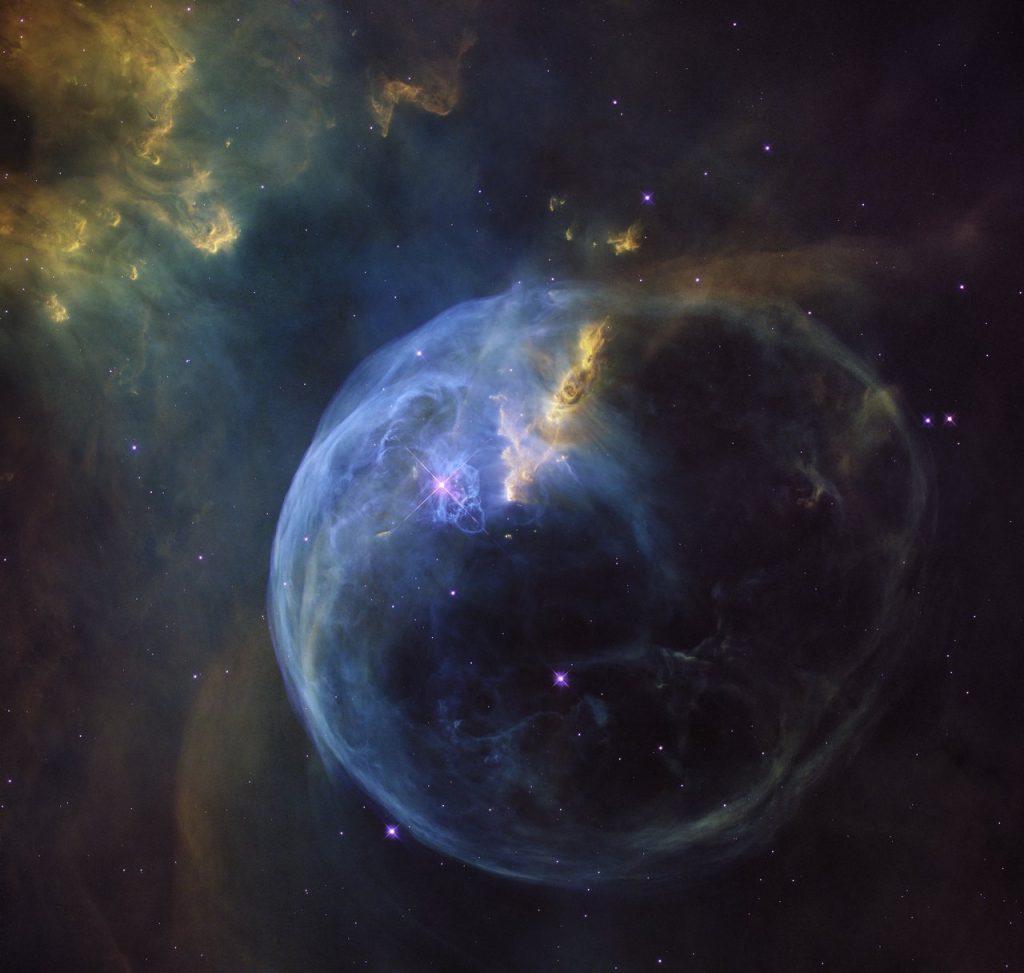
The Bubble Nebula, also known as NGC 7653, is an emission nebula located 8 000 light-years away. This stunning new image was observed by the NASA/ESA Hubble Space Telescope to celebrate its 26th year in space. [Larger images]This new NASA/ESA Hubble Space Telescope image, released to celebrate Hubble’s 26th year in orbit, captures in stunning clarity what looks like a gigantic cosmic soap bubble. The object, known as the Bubble Nebula, is in fact a cloud of gas and dust illuminated by the brilliant star within it. The vivid new portrait of this dramatic scene wins the Bubble Nebula a place in the exclusive Hubble hall of fame, following an impressive lineage of Hubble anniversary images.
Twenty six years ago, on 24 April 1990, the NASA/ESA Hubble Space Telescope was launched into orbit aboard the space shuttleDiscovery as the first space telescope of its kind. Every year, to commemorate this momentous day in space history, Hubble spends a modest portion of its observing time capturing a spectacular view of a specially chosen astronomical object.
HubbleCast 92: 26th anniversary – On 24 April 1990, the NASA/ESA Hubble Space Telescope was sent into orbit aboard the space shuttle Discovery. Now it is celebrating its 26th anniversary. As in the last years Hubble spent a modest portion of its observing time to observe a special chosen object. This year, Hubble re-observed an object, it already captured over 15 years ago: NGC 7635, better known as the Bubble Nebula.
This year’s anniversary object is the Bubble Nebula, also known as NGC 7635, which lies 8 000 light-years away in the constellation Cassiopeia. This object was first discovered by William Herschel in 1787 and this is not the first time it has caught Hubble’s eye. However, due to its very large size on the sky, previous Hubble images have only shown small sections of the nebula, providing a much less spectacular overall effect. Now, a mosaic of four images from Hubble’s Wide Field Camera 3 (WFC3) allows us to see the whole object in one picture for the first time.
This complete view of the Bubble Nebula allows us to fully appreciate the almost perfectly symmetrical shell which gives the nebula its name. This shell is the result of a powerful flow of gas — known as a stellar wind — from the bright star visible just to the left of centre in this image. The star, SAO 20575, is between ten and twenty times the mass of the Sun and the pressure created by its stellar wind forces the surrounding interstellar materialoutwards into this bubble-like form.
The giant molecular cloud that surrounds the star — glowing in the star’s intense ultraviolet radiation — tries to stop the expansion of the bubble. However, although the sphere already measures around ten light-years in diameter, it is still growing, owing to the constant pressure of the stellar wind — currently at more than 100 000 kilometres per hour!
Aside from the symmetry of the bubble itself, one of the more striking features is that the star is not located at the centre. Astronomers are still discussing why this is the case and how the perfectly round bubble is created nonetheless.
The star causing the spectacular colourful bubble is also notable for something less obvious. It is surrounded by a complex system of cometary knots, which can be seen most clearly in this image just to the right of the star. The individual knots, which are generally larger in size than the Solar System and have masses comparable to Earth’s, consist of crescent shaped globules of dust with large trailing tails illuminated and ionised by the star. Observations of these knots, and of the nebula as a whole, help astronomers to better understand the geometry and dynamics of these very complicated systems.
As always, and twenty six years on, Hubble gives us much more than a pretty picture.
The Soundtrack of the Universe’ is an 8-section, 30-minute long, progressive, acoustic-guitar suite from Daniel Voth’s upcoming full-album release ‘Trancendence’.
‘The Soundtrack of the Universe’ features Voth’s darkly melodic playing style and world-class compositional ability. Interwoven throughout are trance-like tapping patterns, piercing harmonics, huge tribal percussive hits, and strumming patterns that build and crescendo at epic heights. The celestial guitar score is supported by lush violin/cello arrangements and powerfully resonant bass lines.
The piece, as a whole, was composed to represent an audial journey through space and time. It asks the listener to envision his/her purpose as part of the seeming infinity we are confronted with when we look up at the stars.
‘The Soundtrack of the Universe’ was engineered, mixed and mastered by Antoine Dufour at his studio in Montreal, Canada. It also features Russian virtuoso Maria Grigoryeva on strings, Nathan Navarro on bass, Luke Notary on percussions and Moto Fukushima also on bass. In addition, gravitational sound waves produced by the LIGO observatory are sampled and layered throughout.
Finally, perhaps the greatest contribution, is a speech orated by the late Carl Sagan, entitled ‘Pale Blue Dot.’ It is a humbling message contained therein about the vastness of space and the insignificance of many of the conflicts endured by humanity on Earth. As a contribution to the legacy left behind by this great man, 10% of the sales of ‘The Soundtrack of the Universe’ are donated to his space foundation.
Solaris Sky Calendar is an astronomy calendar app that shows you upcoming celestial events.
With it, you would never miss the next meteor shower, lunar eclipse, planet conjunction or one of hundreds of other events happening in the night sky right over your head.
It’s a beautiful handcrafted experience with lots of hidden gems that would open a grand and awesome Universe we live in.
The Fornax Galaxy Cluster is one of the closest of such groupings beyond our Local Group of galaxies. This new VLT Survey Telescope image shows the central part of the cluster in great detail. At the lower-right is the elegant barred-spiral galaxy NGC 1365 and to the left the big elliptical NGC 1399. Credit: ESO. Acknowledgement: Aniello Grado and Luca LimatolaThis new image from the VLT Survey Telescope (VST) at ESO’s Paranal Observatory in Chile captures a spectacular concentration of galaxies known as the Fornax Cluster, which can be found in the southern hemisphere constellation of Fornax (The Furnace). The cluster plays host to a menagerie of galaxies of all shapes and sizes, some of which are hiding secrets.
This video sequence takes us deep into the faint southern constellation of Fornax (The Furnace). Here we find a rich concentration of bright galaxies — the Fornax Galaxy Cluster. The final very detailed image is a new image of the cluster from the VLT Survey Telescope. Credit: ESO/Digitized Sky Survey 2/A. Fujii. Acknowledgement: Aniello Grado and Luca Limatola. Music: Johan B. Monell (www.johanmonell.com)
Galaxies, it seems, are sociable animals and they like to gather together in large groups, known as clusters. Actually it’s gravity that holds the galaxies in the cluster close together as a single entity, with the pull of gravity arising from large amounts of dark matter, as well as from the galaxies we can see. Clusters can contain anything between about 100 and 1000 galaxies and can be between about 5 and 30 million light-years across.
The Fornax Galaxy Cluster is one of the closest of such groupings beyond our Local Group of galaxies. This new VLT Survey Telescope image shows the central part of the cluster in great detail. The brightest galaxies are labelled. Credit: ESO. Acknowledgement: Aniello Grado and Luca LimatolaGalaxy clusters do not come in neatly defined shapes so it is difficult to determine exactly where they begin and end. However, astronomers have estimated that the centre of the Fornax Cluster is in the region of 65 million light-years from Earth. What is more accurately known is that it contains nearly sixty large galaxies, and a similar number of smaller dwarf galaxies. Galaxy clusters like this one are commonplace in the Universe and illustrate the powerful influence of gravity over large distances as it draws together the enormous masses of individual galaxies into one region.
The Fornax Galaxy Cluster is one of the closest of such groupings beyond our Local Group of galaxies. This pan sequence, based on a new VLT Survey Telescope image, shows the central part of the cluster in great detail. The field includes the elegant barred-spiral galaxy NGC 1365 and the big elliptical galaxy NGC 1399. Credit: ESO. Acknowledgement: Aniello Grado and Luca Limatola. Music: Johan B. Monell (www.johanmonell.com)
At the centre of this particular cluster, in the middle of the three bright fuzzy blobs on the left side of the image, is what is known as a cD galaxy — a galactic cannibal. cD galaxies like this one, called NGC 1399, look similar to elliptical galaxies but are bigger and have extended, faint envelopes [1]. This is because they have grown by swallowing smaller galaxies drawn by gravity towards the centre of the cluster [2].
Indeed, there is evidence that this process is happening before our eyes — if you look closely enough. Recent work by a team of astronomers led by Enrichetta Iodice (INAF – Osservatorio di Capodimonte, Naples, Italy) [3], using data from ESO’s VST, has revealed a very faint bridge of light between NGC 1399 and the smaller galaxy NGC 1387 to its right. This bridge, which has not been seen before (and is too faint to show up in this picture), is somewhat bluer than either galaxy, indicating that it consists of stars created in gas that was drawn away from NGC 1387 by the gravitational pull of NGC 1399. Despite there being little evidence for ongoing interactions in the Fornax Cluster overall, it seems that NGC 1399 at least is still feeding on its neighbours.
Towards the bottom right of this image is the large barred spiral galaxy NGC 1365. This is a striking example of its type, the prominent bar passing through the central core of the galaxy, and the spiral arms emerging from the ends of the bar. In keeping with the nature of cluster galaxies, there is more to NGC 1365 than meets the eye. It is classified as a Seyfert Galaxy, with a bright active galactic nucleus also containing a supermassive black hole at its centre.
This spectacular image was taken by the VLT Survey Telescope (VST) at ESO’s Paranal Observatory in Chile. At 2.6 metres in diameter, the VST is by no means a large telescope by today’s standards, but it has been designed specifically to conduct large-scale surveys of the sky. What sets it apart is its huge corrected field of view and 256-megapixel camera, called OmegaCAM, which was specially developed for surveying the sky. With this camera the VST can produce deep images of large areas of sky quickly, leaving the really big telescopes — like ESO’s Very Large Telescope (VLT) — to explore the details of individual objects.
This chart shows the naked eye stars in the southern constellation of Fornax (The Furnace). Although the constellation is faint, it is host to the nearby Fornax Galaxy Cluster. The location of the cluster is indicated with a red circle. Many of the galaxies in this cluster are visible in a small telescope as faint smudges on the sky. Credit: ESO, IAU and Sky & TelescopeNotes [1] The image captures only the central regions of the Fornax Cluster; it extends over a larger region of sky.
[2] The central galaxy is often the brightest galaxy in a cluster, but in this case the brightest galaxy, NGC 1316, is situated at the edge of the cluster, just outside the area covered by this image. Also known as Fornax A, it is one of the most powerful sources of radio waves in the sky. The radio waves, which can be seen by specialised telescopes sensitive to this kind of radiation, emanate from two enormous lobes extending far into space either side of the visible galaxy. The energy that powers the radio emission comes from a supermassive black hole lurking at the centre of the galaxy which is emitting two opposing jets of high-energy particles. These jets produce the radio waves when they plough into the rarefied gas which occupies the space between galaxies in the cluster.
[3] “The Fornax Deep Survey with VST. I. The extended and diffuse stellar halo of NGC1399 out to 192 kpc” by E. Iodice, M. Capaccioli , A. Grado , L. Limatola, M. Spavone, N.R. Napolitano, M. Paolillo, R. F. Peletier, M. Cantiello, T. Lisker, C. Wittmann, A. Venhola , M. Hilker , R. D’Abrusco, V. Pota, and P. Schipani has been published in the Astrophysical Journal.
The Fornax Galaxy Cluster is one of the closest such groupings beyond our own Local Group of galaxies. This visible light wide-field image of the cluster was created from photographs taken through red and blue filters and forming part of the Digitized Sky Survey 2. The field of view is approximately three degrees across. Credit: ESO and Digitized Sky Survey 2. Acknowledgment: Davide De Martin
![screen322x572[1]](http://hobbyspace.com/Blog/wp-content/uploads/2016/04/screen322x5721.jpeg)
![screen322x572[1]](http://hobbyspace.com/Blog/wp-content/uploads/2016/04/screen322x5721-1.jpeg)
![eso1612a[1]](http://hobbyspace.com/Blog/wp-content/uploads/2016/04/eso1612a1.jpg)
![eso1612b[1]](http://hobbyspace.com/Blog/wp-content/uploads/2016/04/eso1612b1.jpg)
![eso1612c[1]](http://hobbyspace.com/Blog/wp-content/uploads/2016/04/eso1612c1.jpg)
![eso0949m[1]](http://hobbyspace.com/Blog/wp-content/uploads/2016/04/eso0949m1.jpg)
 , about these mysteries of the universe: