Here are two previews of things to look for in the night sky in January 2017:
** What’s Up for January 2017 – NASA JPL:
** Planets, Constellations and Quadrantid Meteors In Jan. 2017 Skywatching
Here are two previews of things to look for in the night sky in January 2017:
** What’s Up for January 2017 – NASA JPL:
** Planets, Constellations and Quadrantid Meteors In Jan. 2017 Skywatching
A new article from ESO (European Southern Observatory):
First Light for Band 5 at ALMA
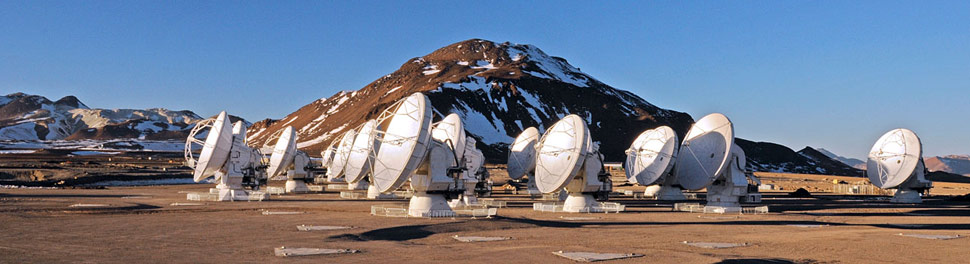
ALMA observes radio waves from the Universe, at the low-energy end of the electromagnetic spectrum. With the newly installed Band 5 receivers, ALMA has now opened its eyes to a whole new section of this radio spectrum, creating exciting new observational possibilities.
The European ALMA Programme Scientist, Leonardo Testi, explains the significance:
“The new receivers will make it much easier to detect water, a prerequisite for life as we know it, in our Solar System and in more distant regions of our galaxy and beyond. They will also allow ALMA to search for ionised carbon in the primordial Universe.”
It is ALMA’s unique location, 5000 metres up on the barren Chajnantor plateau in Chile, that makes such an observation possible in the first place. As water is also present in Earth’s atmosphere, observatories in less elevated and less arid environments have much more difficulty identifying the origin of the emission coming from space. ALMA’s great sensitivity and high angular resolution mean that even faint signals of water in the local Universe can now be imaged at this wavelength [1].
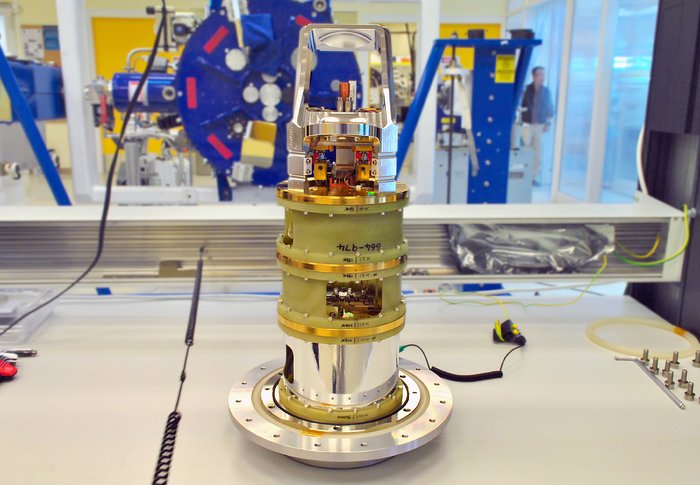
The Band 5 receiver, which was developed by the Group for Advanced Receiver Development (GARD) at Onsala Space Observatory, Chalmers University of Technology, Sweden, has already been tested at the APEX telescope in the SEPIA instrument. These observations were also vital to help select suitable targets for the first receiver tests with ALMA.
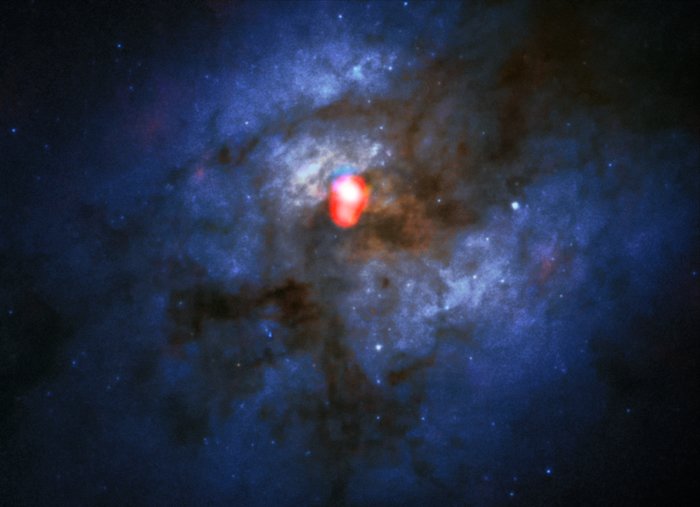
To test the newly installed receivers observations were made of several objects including the colliding galaxies Arp 220, a massive region of star formation close to the centre of the Milky Way, and also a dusty red supergiant star approaching the supernova explosion that will end its life [2].
To process the data and check its quality, astronomers, along with technical specialists from ESO and the European ALMA Regional Centre (ARC) network, gathered at the Onsala Space Observatory in Sweden, for a “Band 5 Busy Week” hosted by the Nordic ARC node [3]. The final results have just been made freely available to the astronomical community worldwide.
Team member Robert Laing at ESO is optimistic about the prospects for ALMA Band 5 observations:
“It’s very exciting to see these first results from ALMA Band 5 using a limited set of antennas. In the future, the high sensitivity and angular resolution of the full ALMA array will allow us to make detailed studies of water in a wide range of objects including forming and evolved stars, the interstellar medium and regions close to supermassive black holes.”
Notes
[1] A key spectral signature of water lies in this expanded range — at a wavelength of 1.64 millimetres.
[2] The observations were performed and made possible by the ALMA Extension of Capabilities team in Chile.
[3] The ESO Band 5 Science Verification team includes: Elizabeth Humphreys, Tony Mroczkowski, Robert Laing, Katharina Immer, Hau-Yu (Baobab) Liu, Andy Biggs, Gianni Marconi and Leonardo Testi. The team working on processing the data included: Tobia Carozzi, Simon Casey, Sabine König, Ana Lopez-Sepulcre, Matthias Maercker, Iván Martí-Vidal, Lydia Moser, Sebastien Muller, Anita Richards, Daniel Tafoya and Wouter Vlemmings.
====
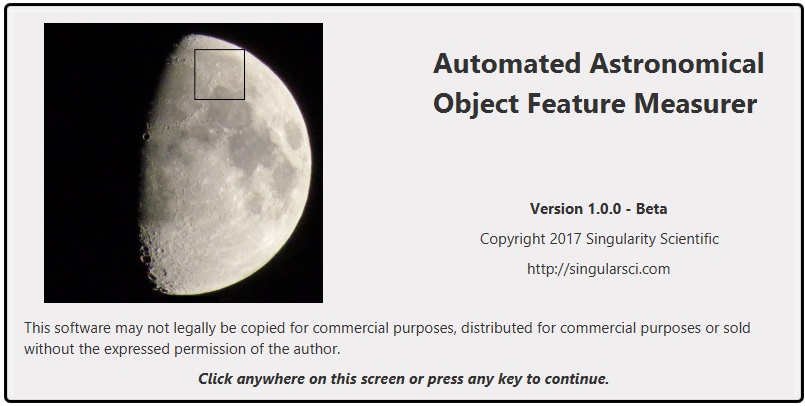
Astro Maven Rick Boozer points me to his new application program: Automated Astronomical Object Feature Measurer –
Want to know the size (in kilometers or miles) of a sunspot, lunar crater, festoon on Jupiter, etc. that you see in a photographic image? My latest software creation called Automated Astronomical Object Feature Measurer (or AAOFM for short) can quickly and accurately tell you the answer. The app is offered free for download.
Click the image below to go to my website and choose the menu option to the left labeled Automated Astronomical Object Feature Measurer to go to the appropriate download area.
Here is a new report from ESO (European Southern Observatory):
Spinning Black Hole Swallowing Star Explains Superluminous Event
ESO telescopes help reinterpret brilliant explosion
An extraordinarily brilliant point of light seen in a distant galaxy, and dubbed ASASSN-15lh, was thought to be the brightest supernova ever seen. But new observations from several observatories, including ESO, have now cast doubt on this classification. Instead, a group of astronomers propose that the source was an even more extreme and very rare event — a rapidly spinning black hole ripping apart a passing star that came too close.
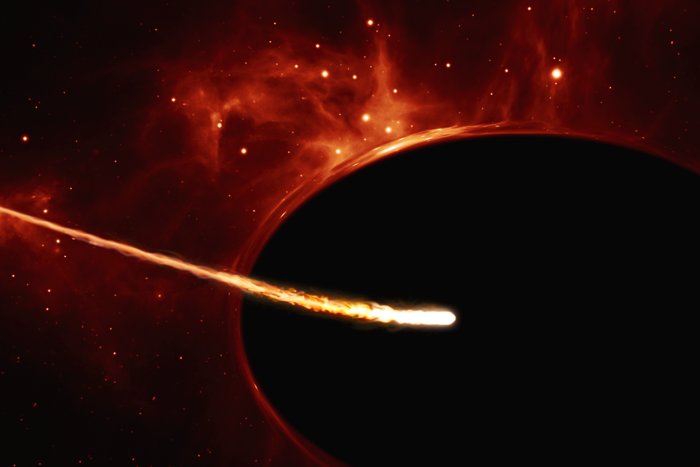
This animation shows how the ASASSN-15lh most likely happened. A Sun-like star gets into the area of influence of a rapidly spinning supermassive black hole in the centre of a distant galaxy. While its orbit gets constantly closer to the black hole the star gets “spaghettified”, creating an accretion disc around the supermassive black hole. When it finally gets ripped apart close to the event horizon it creates a bright flash, that could resemble a superluminous supernova. Credit: ESO, ESA/Hubble, M. Kornmesser
An international team, led by Giorgos Leloudas at the Weizmann Institute of Science, Israel, and the Dark Cosmology Centre, Denmark, has now made additional observations of the distant galaxy, about 4 billion light-years from Earth, where the explosion took place and they have proposed a new explanation for this extraordinary event.
“We observed the source for 10 months following the event and have concluded that the explanation is unlikely to lie with an extraordinarily bright supernova. Our results indicate that the event was probably caused by a rapidly spinning supermassive black hole as it destroyed a low-mass star,”
explains Leloudas.
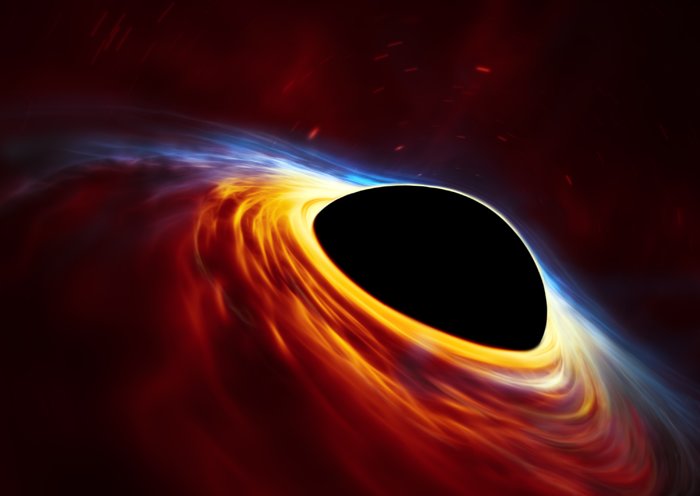
In this scenario, the extreme gravitational forces of a supermassive black hole, located in the centre of the host galaxy, ripped apart a Sun-like star that wandered too close — a so-called tidal disruption event, something so far only observed about 10 times. In the process, the star was “spaghettified” and shocks in the colliding debris as well as heat generated in accretion led to a burst of light. This gave the event the appearance of a very bright supernova explosion, even though the star would not have become a supernova on its own as it did not have enough mass.
“There are several independent aspects to the observations that suggest that this event was indeed a tidal disruption and not a superluminous supernova,”
explains coauthor Morgan Fraser from the University of Cambridge, UK (now at University College Dublin, Ireland).
This simulation shows a star getting torn apart by the gravitational tides of a supermassive black hole. The star gets “spaghettified” and after several orbits creates an accretion disc. Scientists believe that the superluminous ASASSN-15lh event originated in this way. The view on the right is from the side and that at the left face on. Credit: ESO, ESA/Hubble, N. Stone, K. Hayasaki
In particular, the data revealed that the event went through three distinct phases over the 10 months of follow-up observations. These data overall more closely resemble what is expected for a tidal disruption than a superluminous supernova. An observed re-brightening in ultraviolet light as well as a temperature increase further reduce the likelihood of a supernova event. Furthermore, the location of the event — a red, massive and passive galaxy — is not the usual home for a superluminous supernova explosion, which normally occur in blue, star-forming dwarf galaxies.
Although the team say a supernova source is therefore very unlikely, they accept that a classical tidal disruption event would not be an adequate explanation for the event either. Team member Nicholas Stone from Columbia University, USA, elaborates:
“The tidal disruption event we propose cannot be explained with a non-spinning supermassive black hole. We argue that ASASSN-15lh was a tidal disruption event arising from a very particular kind of black hole.”
The mass of the host galaxy implies that the supermassive black hole at its centre has a mass of at least 100 million times that of the Sun. A black hole of this mass would normally be unable to disrupt stars outside of its event horizon — the boundary within which nothing is able to escape its gravitational pull. However, if the black hole is a particular kind that happens to be rapidly spinning — a so-called Kerr black hole — the situation changes and this limit no longer applies.
“Even with all the collected data we cannot say with 100% certainty that the ASASSN-15lh event was a tidal disruption event,” concludes Leloudas. “But it is by far the most likely explanation.”
Notes
[1] As well as the data from ESO’s Very Large Telescope, the New Technology Telescope and the NASA/ESA Hubble Space Telescope the team used observations from NASA’s Swift telescope, the Las Cumbres Observatory Global Telescope (LCOGT), the Australia Telescope Compact Array, ESA’s XMM-Newton, the Wide-Field Spectrograph (WiFeS)and the Magellan Telescope.
The latest report from the ESO (European Southern Observatory):
Dark Matter May be Smoother than Expected
Careful study of large area of sky imaged by VST reveals intriguing result
Analysis of a giant new galaxy survey, made with ESO’s VLT Survey Telescope in Chile, suggests that dark matter may be less dense and more smoothly distributed throughout space than previously thought. An international team used data from the Kilo Degree Survey (KiDS) to study how the light from about 15 million distant galaxies was affected by the gravitational influence of matter on the largest scales in the Universe. The results appear to be in disagreement with earlier results from the Planck satellite.
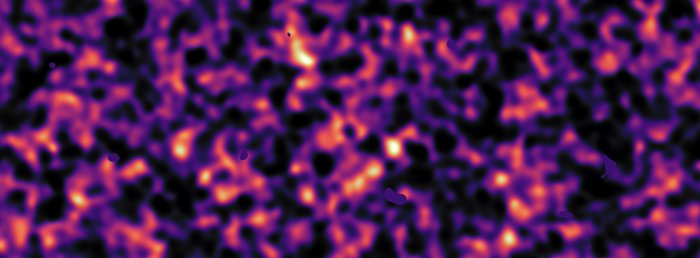
By exploiting the exquisite image quality available to the VST at the Paranal site, and using innovative computer software, the team were able to carry out one of the most precise measurements ever made of an effect known as cosmic shear. This is a subtle variant of weak gravitational lensing, in which the light emitted from distant galaxies is slightly warped by the gravitational effect of large amounts of matter, such as galaxy clusters.
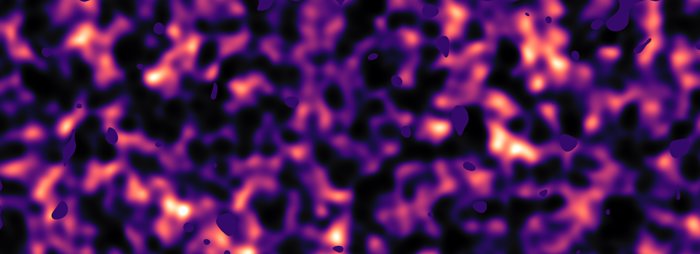
This video shows the location of one of the five KiDS regions that were surveyed by the VLT Survey Telescope at ESO’s Paranal Observatory in Chile. This region (known as G12) covers a large area of sky along the celestial equator in the constellations of Leo (The Lion) and Virgo (The Virgin). The final colour dark matter density image reveals an expansive web of dense (light) and empty (dark) regions. This image reconstruction was made by analysing the light collected from over three million distant galaxies more than 6 billion light-years away. Credit: Kilo-Degree Survey Collaboration/H. Hildebrandt & B. Giblin/ESO/N. Risinger (skysurvey.org). Music: Konstantino Polizois (soundcloud.com/konstantino-polizois).
In cosmic shear, it is not galaxy clusters but large-scale structures in the Universe that warp the light, which produces an even smaller effect. Very wide and deep surveys, such as KiDS, are needed to ensure that the very weak cosmic shear signal is strong enough to be measured and can be used by astronomers to map the distribution of gravitating matter. This study takes in the largest total area of the sky to ever be mapped with this technique so far.
Intriguingly, the results of their analysis appear to be inconsistent with deductions from the results of the European Space Agency’s Planck satellite, the leading space mission probing the fundamental properties of the Universe. In particular, the KiDS team’s measurement of how clumpy matter is throughout the Universe — a key cosmological parameter — is significantly lower than the value derived from the Planck data [3].
“This latest result indicates that dark matter in the cosmic web, which accounts for about one-quarter of the content of the Universe, is less clumpy than we previously believed.”
Dark matter remains elusive to detection, its presence only inferred from its gravitational effects. Studies like these are the best current way to determine the shape, scale and distribution of this invisible material.
The surprise result of this study also has implications for our wider understanding of the Universe, and how it has evolved during its almost 14-billion-year history. Such an apparent disagreement with previously established results from Planck means that astronomers may now have to reformulate their understanding of some fundamental aspects of the development of the Universe.
Hendrik Hildebrandt comments:
“Our findings will help to refine our theoretical models of how the Universe has grown from its inception up to the present day.”
The KiDS analysis of data from the VST is an important step but future telescopes are expected to take even wider and deeper surveys of the sky.
The co-leader of the study, Catherine Heymans of the University of Edinburgh in the UK adds:
“Unravelling what has happened since the Big Bang is a complex challenge, but by continuing to study the distant skies, we can build a picture of how our modern Universe has evolved.”
[Konrad Kuijken (Leiden Observatory, the Netherlands), who is principal investigator of the KiDS survey concludes: ]
“We see an intriguing discrepancy with Planck cosmology at the moment. Future missions such as the Euclid satellite and the Large Synoptic Survey Telescope will allow us to repeat these measurements and better understand what the Universe is really telling us,”
Notes
[1] The international KiDS team of researchers includes scientists from Germany, the Netherlands, the UK, Australia, Italy, Malta and Canada.
[2] This corresponds to about 450 square degrees, or a little more than 1% of the entire sky.
[3] The parameter measured is called S8. Its value is a combination of the size of density fluctuations in, and the average density of, a section of the Universe. Large fluctuations in lower density parts of the Universe have an effect similar to that of smaller amplitude fluctuations in denser regions and the two cannot be distinguished by observations of weak lensing. The 8 refers to a cell size of 8 megaparsecs, which is used by convention in such studies.