Category Archives: Astronomy

Video: 3D journey through the Orion Nebula courtesy Hubble and Spitzer space telescopes

A tour of the Orion Nebula via imagery from the Hubble and Spitzer space telescopes:

NASA Space Telescopes Provide a 3D Journey Through the Orion Nebula

Unprecedented Fly-through Combines the Visible and Infrared Vision of the Hubble and Spitzer Space Telescopes

By combining the visible and infrared capabilities of the Hubble and Spitzer space telescopes, astronomers and visualization specialists from NASA’s Universe of Learning program have created a spectacular, three-dimensional, fly-through movie of the magnificent Orion nebula, a nearby stellar nursery. Using actual scientific data along with Hollywood techniques, a team at the Space Telescope Science Institute in Baltimore, Maryland, and the Caltech/IPAC in Pasadena, California, has produced the best and most detailed multi-wavelength visualization yet of the Orion nebula. The three-minute movie allows viewers to glide through the picturesque star-forming region and experience the universe in an exciting new way.

Astronomers and visualization specialists from NASA’s Universe of Learning program have combined visible and infrared vision of the Hubble and Spitzer space telescopes to create an unprecedented, three-dimensional, fly-through view of the picturesque Orion Nebula, a nearby star-forming region.

Viewers experience this nearby stellar nursery “close up and personally” as the new digital visualization ferries them among newborn stars, glowing clouds heated by intense radiation, and tadpole-shaped gaseous envelopes surrounding protoplanetary disks.

Visible and Infrared Visualization of the Orion Nebula (Artist’s Concept) : This image showcases both the visible-light and the infrared-light visualizations of the Orion Nebula. This view from the movie sequence looks down the “valley” leading to the star cluster at the far end. The left side of the image shows the visible-light visualization, which fades to the infrared visualization on the right. These two contrasting models derive from observations by the Hubble and Spitzer space telescopes.

Using actual scientific imagery and other data, combined with Hollywood techniques, a team at the Space Telescope Science Institute in Baltimore, Maryland, and the Caltech/IPAC in Pasadena, California, has created the best and most detailed multi-wavelength visualization yet of this photogenic nebula. The fly-through enables people to experience and learn about the universe in an exciting new way.

The three-minute movie, which shows the Orion Nebula in both visible and infrared light, was released to the public today. It is available to planetariums and other centers of informal learning worldwide to help audiences explore fundamental questions in science such as, “How did we get here?”

“Being able to fly through the nebula’s tapestry in three dimensions gives people a much better sense of what the universe is really like,” explained the Space Telescope Science Institute’s visualization scientist Frank Summers, who led the team that developed the movie. “By adding depth and structure to the amazing images, this fly-through helps elucidate the universe for the public, both educating and inspiring,”

added Summers.

“Looking at the universe in infrared light gives striking context for the more familiar visible-light views. This movie provides a uniquely immersive chance to see how new features appear as we shift to wavelengths of light normally invisible to our eyes,”

said Robert Hurt, lead visualization scientist at IPAC.

One of the sky’s brightest nebulas, the Orion Nebula is visible to the naked eye. It appears as the middle “star” in the sword of the constellation Orion, the Hunter, and is located about 1,350 light-years away. At only 2 million years old, the nebula is an ideal laboratory for studying young stars and stars that are still forming. It offers a glimpse of what might have happened when the Sun was born 4.6 billion years ago.

The three-dimensional video provides a look at the fantastic topography of the nebula. A torrent of ultraviolet radiation and stellar winds from the massive, central stars of the Trapezium star cluster have carved out a cavernous bowl-like cavity in the wall of a giant cloud of cold molecular hydrogen laced with dust.

Astronomers and visualizers worked together to make a three-dimensional model of the depths of this cavernous region, like plotting mountains and valleys on the ocean floor. Colorful Hubble and Spitzer images were then overlaid on the terrain.

The scientific visualization video takes the viewer on a breathtaking flight through the nebula, following the contours of the gas and dust. By toggling between the Hubble and Spitzer’s views, the movie shows strikingly different details of the Orion Nebula.

Hubble sees objects that glow in visible light, which are typically in the thousands of degrees. Spitzer is sensitive to cooler objects with temperatures of just hundreds of degrees. Spitzer’s infrared vision pierces through obscuring dust to see stars embedded deep into the nebula, as well as fainter and less massive stars, which are brighter in the infrared than in visible light. The new visualization helps people experience how the two telescopes provide a more complex and complete picture of the nebula.

The visualization is one of a new generation of products and experiences being developed by the NASA’s Universe of Learning program. The effort combines a direct connection to the science and scientists of NASA’s Astrophysics missions with attention to audience needs to enable youth, families, and lifelong learners to explore fundamental questions in science, experience how science is done, and discover the universe for themselves.

The three-dimensional interpretation is guided by scientific knowledge and scientific intuition. Starting with the two-dimensional Hubble and Spitzer images, Summers and Hurt worked with experts to analyze the structure inside the nebula. They first created a visible-light surface, and then an underlying structure of the infrared features.

To give the nebula its ethereal feel, Summers wrote a special rendering code for efficiently combining the tens of millions of semi-transparent elements of the gas. The customized code allows Summers to run this and other visualizations on desktop workstations, rather than on a supercomputing cluster.

The other components of the nebula were isolated into image layers and modeled separately. These elements included stars, protoplanetary disks, bow shocks, and the thin gas in front of the nebula called “the veil.” After rendering, these layers and the gaseous nebula are brought back together to create the visualization.

The three-dimensional structures serve as scientifically reasonable approximations for imagining the nebula.

“The main thing is to give the viewer an experiential understanding, so that they have a way to interpret the images from telescopes,” explained Summers. “It’s a really wonderful thing when they can build a mental model in their head to transform the two-dimensional image into a three-dimensional scene.”

This movie demonstrates the power of multi-wavelength astronomy. It helps audiences understand how science is done — how and why astronomers use multiple regions of the electromagnetic spectrum to explore and learn about our universe. It is also whetting astronomers’ appetites for what they will see with NASA’s James Webb Space Telescope, which will show much finer details of the deeper, infrared features.

More visualizations and connections between the science of nebulas and learners can be explored through other products produced by NASA’s Universe of Learning such as ViewSpace. ViewSpace is a video exhibit currently at almost 200 museums and planetariums across the United States. Visitors can go beyond video to explore the images produced by space telescopes with interactive tools now available for museums and planetariums.

NASA’s Universe of Learning materials are based upon work supported by NASA under award number NNX16AC65A to the Space Telescope Science Institute, working in partnership with Caltech/IPAC, Jet Propulsion Laboratory, Smithsonian Astrophysical Observatory, and Sonoma State University.

Related Links:

Video: Night sky highlights for January 2018

A preview of the night sky for January from the Hubble Instittue:

Update: Another preview from NASA JPL

====

Video: The phases of the Moon in 2018

A cool video from NASA showing the phases of the Moon for every hour throughout 2018:

This 4K visualization shows the Moon’s phase and libration at hourly intervals throughout 2018, as viewed from the Northern Hemisphere. Two ‘supermoons’ will ring in the New Year on Jan. 1, 2018 and Jan. 31, 2018.

Each frame represents one hour. In addition, this visualization shows the moon’s orbit position, sub-Earth and subsolar points, distance from the Earth at true scale, and labels of craters near the terminator.

More from the caption:

Southern hemisphere version: https://www.youtube.com/watch?v=zv6zm…

Credit: NASA’s Goddard Space Flight Center/David Ladd (USRA)

Ernie Wright (USRA): Lead Visualizer
John Keller (NASA/GSFC): Scientist
Noah Petro (NASA/GSFC): Scientist

Music Credits: Killer Tracks: “Illuminating” – Kelly McCollough. “Touching Clouds” – Kelly Mccullough.

This video is public domain and along with other supporting visualizations can be downloaded from the Scientific Visualization Studio at: https://svs.gsfc.nasa.gov/4604

Waxing gibbous. Visible to the southeast in early evening, up for most of the night. NASA Scientific Visualization Studio.

====

ESO: VLT observes huge bubble patterns on surface of red giant star

The latest report from ESO (European Southern Observatory):

Giant Bubbles on Red Giant Star’s Surface 

Astronomers using ESO’s Very Large Telescope have directly observed granulation patterns on the surface of a star outside the Solar System — the ageing red giant π1 Gruis. This remarkable new image from the PIONIER instrument reveals the convective cells that make up the surface of this huge star. Each cell covers more than a quarter of the star’s diameter and measures about 120 million kilometres across. [Larger image.]
Astronomers using ESO’s Very Large Telescope have for the first time directly observed granulation patterns on the surface of a star outside the Solar System — the ageing red giant π1 Gruis. This remarkable new image from the PIONIER instrument reveals the convective cells that make up the surface of this huge star, which has 350 times the diameter of the Sun. Each cell covers more than a quarter of the star’s diameter and measures about 120 million kilometres across. These new results are being published this week in the journal Nature.

Located 530 light-years from Earth in the constellation of Grus (The Crane), π1 Gruis is a cool red giant. It has about the same mass as our Sun, but is 350 times larger and several thousand times as bright [1]. Our Sun will swell to become a similar red giant star in about five billion years.

An international team of astronomers led by Claudia Paladini (ESO) used the PIONIER instrument on ESO’s Very Large Telescope to observe π1 Gruis in greater detail than ever before. They found that the surface of this red giant has just a few convective cells, or granules, that are each about 120 million kilometres across — about a quarter of the star’s diameter [2]. Just one of these granules would extend from the Sun to beyond Venus. The surfaces  — known as photospheres —  of many giant stars are obscured by dust, which hinders observations. However, in the case of π1 Gruis, although dust is present far from the star, it does not have a significant effect on the new infrared observations [3].

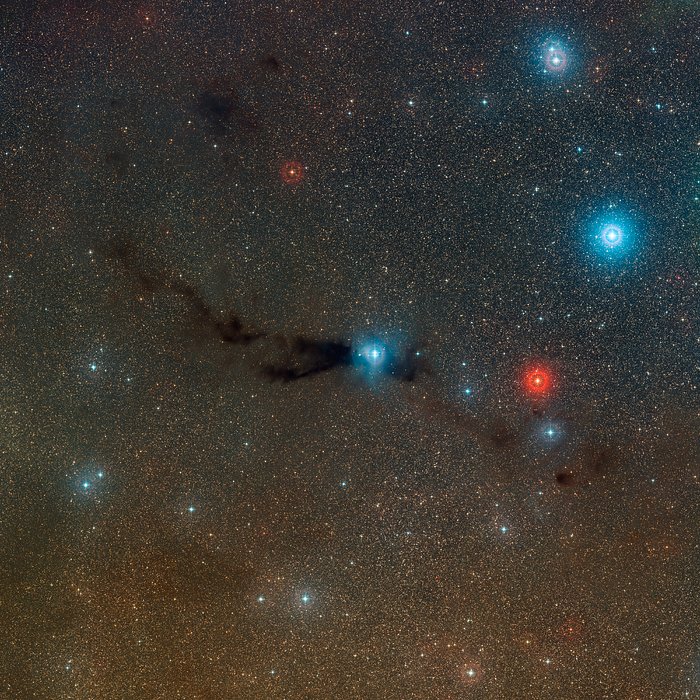
This colourful image shows the sky around the bright pair of stars π1 Gruis (centre-right, very red) and π2 Gruis (centre-left, bluish-white). Just right of centre the bright spiral galaxy IC 5201 is also visible and many other fainter galaxies are scattered across this wide-field image from the Digitized Sky Survey 2. [Larger images]
When π1 Gruis ran out of hydrogen to burn long ago, this ancient star ceased the first stage of its nuclear fusion programme. It shrank as it ran out of energy, causing it to heat up to over 100 million degrees. These extreme temperatures fueled the star’s next phase as it began to fuse helium into heavier atoms such as carbon and oxygen. This intensely hot core then expelled the star’s outer layers, causing it to balloon to hundreds of times larger than its original size. The star we see today is a variable red giant. Until now, the surface of one of these stars has never before been imaged in detail.

By comparison, the Sun’s photosphere contains about two million convective cells, with typical diameters of just 1500 kilometres. The vast size differences in the convective cells of these two stars can be explained in part by their varying surface gravities. π1 Gruis is just 1.5 times the mass of the Sun but much larger, resulting in a much lower surface gravity and just a few, extremely large, granules.

While stars more massive than eight solar masses end their lives in dramatic supernovae explosions, less massive stars like this one gradually expel their outer layers, resulting in beautiful planetary nebulae. Previous studies of π1 Gruis found a shell of material 0.9 light-years away from the central star, thought to have been ejected around 20 000 years ago. This relatively short period in a star’s life lasts just a few tens of thousands of years – compared to the overall lifetime of several billion – and these observations reveal a new method for probing this fleeting red giant phase.

This chart shows the southern constellation of Grus (The Crane) and marks most stars that can be seen with the unaided eye on a clear dark night. The red circle indicates the location of the red giant star π1 Gruis, which forms a colourful pairing with π2 Gruis, visible with a small telescope or binoculars.

Notes
[1] π1 Gruis is named following the Bayer designation system. In 1603 the German astronomer Johann Bayer classified 1564 stars, naming them by a Greek letter followed by the name of their parent constellation. Generally, stars were assigned Greek letters in rough order of how bright they appeared from Earth, with the brightest designated Alpha (α). The brightest star of the Grus constellation is therefore Alpha Gruis.

π1 Gruis is one of an attractive pair of stars of contrasting colours that appear close together in the sky, the other one naturally being named π2 Gruis. They are bright enough to be well seen in a pair of binoculars. Thomas Brisbane realised in the 1830s that π1 Gruis was itself also a much closer binary star system. Annie Jump Cannon, credited with the creation of the Harvard Classification Scheme, was the first to report the unusual spectrum of π1 Gruis in 1895.

[2] Granules are patterns of convection currents in the plasma of a star. As plasma heats up at the centre of the star it expands and rises to the surface, then cools at the outer edges, becoming darker and more dense, and descends back to the centre. This process continues for billions of years and plays a major role in many astrophysical processes including energy transport, pulsation, stellar wind and dust clouds on brown dwarfs.

[3] π1 Gruis is one of the brightest members of the rare S class of stars that was first defined by the American astronomer Paul W. Merrill to group together stars with similarly unusual spectra. π1 Gruis, R Andromedae and R Cygni became prototypes of this type. Their unusual spectra is now known to be the result of the “s-process” or “slow neutron capture process” — responsible for the creation of half the elements heavier than iron.

Video: Google neural network used to discover exoplanet

A NASA / Google collaboration used artificial intelligence (AI) techniques to discover an eighth planet around the star Kepler-90i, which resides just over 2500 light years from earth.

Here is the NASA press release:

Artificial Intelligence, NASA Data Used to Discover Exoplanet | NASA

Our solar system now is tied for most number of planets around a single star, with the recent discovery of an eighth planet circling Kepler-90, a Sun-like star 2,545 light-years from Earth. The planet was discovered in data from NASA’s Kepler Space Telescope.

The newly-discovered Kepler-90i – a sizzling hot, rocky planet that orbits its star once every 14.4 days – was found using machine learning from Google. Machine learning is an approach to artificial intelligence in which computers “learn.” In this case, computers learned to identify planets by finding in Kepler data instances where the telescope recorded signals from planets beyond our solar system, known as exoplanets.

NASA will host a Reddit Ask Me Anything at 3 p.m. EST [Thursday, Dec.14.2017] on this discovery.

“Just as we expected, there are exciting discoveries lurking in our archived Kepler data, waiting for the right tool or technology to unearth them,” said Paul Hertz, director of NASA’s Astrophysics Division in Washington. “This finding shows that our data will be a treasure trove available to innovative researchers for years to come.” 

The discovery came about after researchers Christopher Shallue and Andrew Vanderburg trained a computer to learn how to identify exoplanets in the light readings recorded by Kepler – the minuscule change in brightness captured when a planet passed in front of, or transited, a star. Inspired by the way neurons connect in the human brain, this artificial “neural network” sifted through Kepler data and found weak transit signals from a previously-missed eighth planet orbiting Kepler-90, in the constellation Draco.

While machine learning has previously been used in searches of the Kepler database, this research demonstrates that neural networks are a promising tool in finding some of the weakest signals of distant worlds.

Other planetary systems probably hold more promise for life than Kepler-90. About 30 percent larger than Earth, Kepler-90i is so close to its star that its average surface temperature is believed to exceed 800 degrees Fahrenheit, on par with Mercury. Its outermost planet, Kepler-90h, orbits at a similar distance to its star as Earth does to the Sun.

“The Kepler-90 star system is like a mini version of our solar system. You have small planets inside and big planets outside, but everything is scrunched in much closer,” said Vanderburg, a NASA Sagan Postdoctoral Fellow and astronomer at the University of Texas at Austin.

Shallue, a senior software engineer with Google’s research team Google AI, came up with the idea to apply a neural network to Kepler data. He became interested in exoplanet discovery after learning that astronomy, like other branches of science, is rapidly being inundated with data as the technology for data collection from space advances.

“In my spare time, I started googling for ‘finding exoplanets with large data sets’ and found out about the Kepler mission and the huge data set available,” said Shallue. “Machine learning really shines in situations where there is so much data that humans can’t search it for themselves.”

Kepler’s four-year dataset consists of 35,000 possible planetary signals. Automated tests, and sometimes human eyes, are used to verify the most promising signals in the data. However, the weakest signals often are missed using these methods. Shallue and Vanderburg thought there could be more interesting exoplanet discoveries faintly lurking in the data.

First, they trained the neural network to identify transiting exoplanets using a set of 15,000 previously-vetted signals from the Kepler exoplanet catalogue. In the test set, the neural network correctly identified true planets and false positives 96 percent of the time. Then, with the neural network having “learned” to detect the pattern of a transiting exoplanet, the researchers directed their model to search for weaker signals in 670 star systems that already had multiple known planets. Their assumption was that multiple-planet systems would be the best places to look for more exoplanets.

“We got lots of false positives of planets, but also potentially more real planets,” said Vanderburg. “It’s like sifting through rocks to find jewels. If you have a finer sieve then you will catch more rocks but you might catch more jewels, as well.”

Kepler-90i wasn’t the only jewel this neural network sifted out. In the Kepler-80 system, they found a sixth planet. This one, the Earth-sized Kepler-80g, and four of its neighboring planets form what is called a resonant chain – where planets are locked by their mutual gravity in a rhythmic orbital dance. The result is an extremely stable system, similar to the seven planets in the TRAPPIST-1 system.

Their research paper reporting these findings has been accepted for publication in The Astronomical Journal. Shallue and Vanderburg plan to apply their neural network to Kepler’s full set of more than 150,000 stars.

Kepler has produced an unprecedented data set for exoplanet hunting. After gazing at one patch of space for four years, the spacecraft now is operating on an extended mission and switches its field of view every 80 days.

“These results demonstrate the enduring value of Kepler’s mission,” said Jessie Dotson, Kepler’s project scientist at NASA’s Ames Research Center in California’s Silicon Valley. “New ways of looking at the data – such as this early-stage research to apply machine learning algorithms – promises to continue to yield significant advances in our understanding of planetary systems around other stars. I’m sure there are more firsts in the data waiting for people to find them.”

Ames manages the Kepler and K2 missions for NASA’s Science Mission Directorate in Washington. NASA’s Jet Propulsion Laboratory in Pasadena, California, managed Kepler mission development. Ball Aerospace & Technologies Corporation operates the flight system with support from the Laboratory for Atmospheric and Space Physics at the University of Colorado in Boulder. This work was performed through the Carl Sagan Postdoctoral Fellowship Program executed by the NASA Exoplanet Science Institute.

For more information on this announcement, visit: https://www.nasa.gov/mediaresources

For more information about the Kepler mission, visit: https://www.nasa.gov/kepler