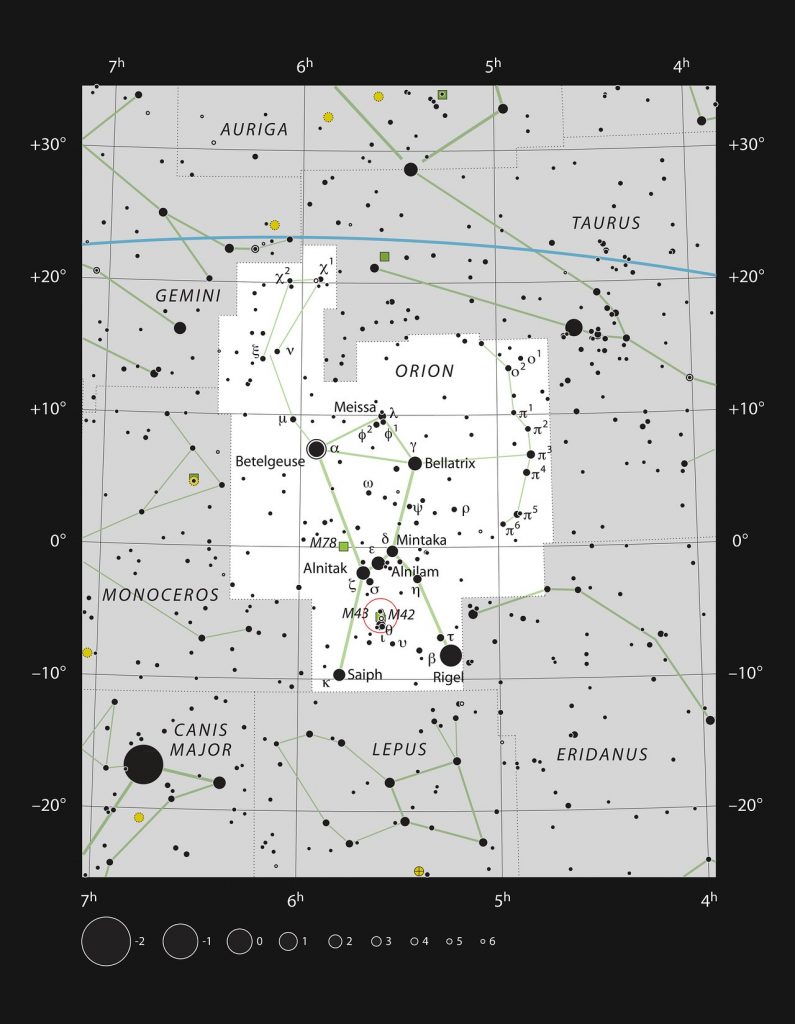
NASA JPL posts this guide to the night sky for April:
A more detailed account of April’s night sky highlights from the Hubble Telescope Institute:
====
NASA JPL posts this guide to the night sky for April:
A more detailed account of April’s night sky highlights from the Hubble Telescope Institute:
====
The latest finding from the Hubble Space Telescope:
Hubble finds first galaxy in the local Universe without dark matter
An international team of researchers using the NASA/ESA Hubble Space Telescope and several other observatories have, for the first time, uncovered a galaxy in our cosmic neighborhood that is missing most — if not all — of its dark matter. This discovery of the galaxy NGC 1052-DF2 challenges currently-accepted theories of and galaxy formation and provides new insights into the nature of dark matter. The results are published in Nature.
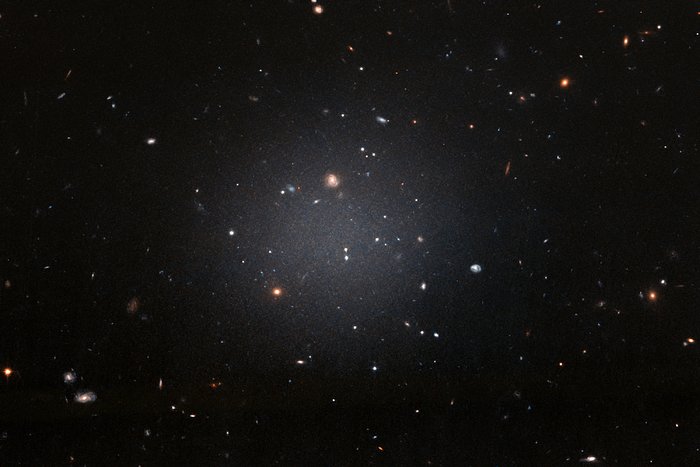
Astronomers using Hubble and several ground-based observatories have found a unique astronomical object: a galaxy that appears to contain almost no dark matter [1]. Hubble helped to accurately confirm the distance of NGC 1052-DF2 to be 65 million light-years and determined its size and brightness. Based on these data the team discovered that NGC 1052-DF2 larger than the Milky Way, but contains about 250 times fewer stars, leading it to be classified as an ultra diffuse galaxy.
“I spent an hour just staring at this image,” lead researcher Pieter van Dokkum of Yale University says as he recalls first seeing the Hubble image of NGC 1052-DF2. “This thing is astonishing: a gigantic blob so sparse that you see the galaxies behind it. It is literally a see-through galaxy.”
Further measurements of the dynamical properties of ten globular clusters orbiting the galaxy allowed the team to infer an independent value of the galaxies mass. This mass is comparable to the mass of the stars in the galaxy, leading to the conclusion that NGC 1052-DF2 contains at least 400 times less dark matter than astronomers predict for a galaxy of its mass, and possibly none at all [2]. This discovery is unpredicted by current theories on the distribution of dark matter and its influence on galaxy formation.
“Dark matter is conventionally believed to be an integral part of all galaxies — the glue that holds them together and the underlying scaffolding upon which they are built,” explains co-author Allison Merritt from Yale University and the Max Planck Institute for Astronomy, Germany. And van Dokkum adds: “This invisible, mysterious substance is by far the most dominant aspect of any galaxy. Finding a galaxy without any is completely unexpected; it challenges standard ideas of how galaxies work.”
Merritt remarks:
“There is no theory that predicts these types of galaxies — how you actually go about forming one of these things is completely unknown.”
Although counterintuitive, the existence of a galaxy without dark matter negates theories that try to explain the Universe without dark matter being a part of it [3]: The discovery of NGC 1052-DF2 demonstrates that dark matter is somehow separable from galaxies. This is only expected if dark matter is bound to ordinary matter through nothing but gravity.
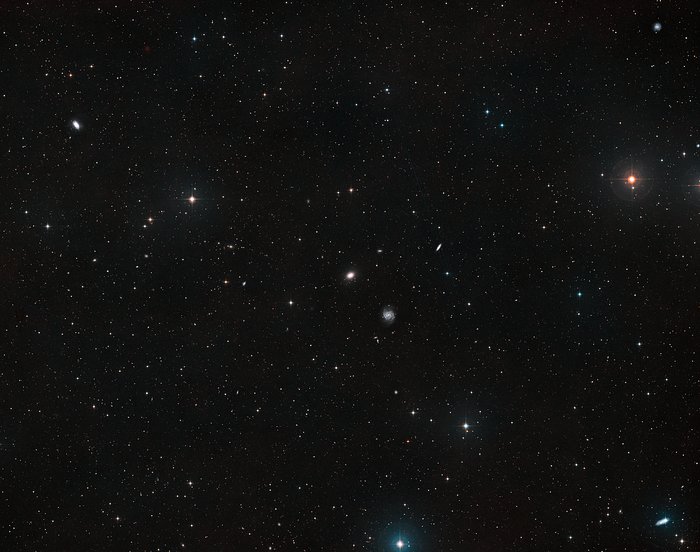
This video zooms in from a view of the night sky, through the constellation of Cetus (the Whale), to end on the NASA/ESA Hubble Space Telescope observations of the ultra diffuse galaxy NGC 1052-DF2. This is the first galaxy to be found to not have dark matter. Credit: ESA/Hubble, Digitized Sky Survey, Nick Risinger (skysurvey.org). Music: Astral Electronic
Meanwhile, the researchers already have some ideas about how to explain the missing dark matter in NGC 1052-DF2. Did a cataclysmic event such as the birth of a multitude of massive stars sweep out all the gas and dark matter? Or did the growth of the nearby massive elliptical galaxy NGC 1052 billions of years ago play a role in NGC 1052-DF2’s dark matter deficiency?
These ideas, however, still do not explain how this galaxy formed. To find an explanation, the team is already hunting for more dark-matter deficient galaxies as they analyse Hubble images of 23 ultra-diffuse galaxies — three of which appear to be similar to NGC 1052-DF2.
Notes
[1] The galaxy was identified with the Dragonfly Telephoto Array (DFA) and also observed by the Sloan Digital Sky Survey (SDSS). As well as the NASA/ESA Hubble Space Telescope, the Gemini Observatory and the Keck Observatory were used to study the object in more detail.
[2] Since 1884 astronomers have invoked dark matter to explain why galaxies do not fly apart, given the speed at which the stars within galaxies move. From Kepler’s Second Law it is expected that the rotation velocities of stars will decrease with distance from the centre of a galaxy. This is not observed.
[3] The MOND theory — Modified Newtonian Dynamics — suggests that the phenomena usually attributed to dark matter can be explained by modifying the laws of gravity. The result of this would be that a signature usually attributed to dark matter should always be detected, and is an unavoidable consequence of the presence of ordinary matter.
Pink Floyd notwithstanding, there is no “Dark side of the Moon” any more than there is a dark side of the earth. The Moon rotates just like earth does, continually changing which half of the sphere is in sunlight and which half in darkness. Our celestial companion keeps one face turned towards us as it orbits around the earth, which means it takes a month rather than 24 hours to make its full 360 degree rotation. Here is a compilation of images from the Lunar Reconnaissance Orbiter (LRO) showing how the Moon would appear if you could sit fixed on a line between the Moon and the sun for a month: APOD: 2018 March 18 – Rotating Moon from LRO
From the caption:
====
A new report from ESA/Hubble:

Galaxies are not static islands of stars — they are dynamic and ever-changing, constantly on the move through the darkness of the Universe. Sometimes, as seen in this spectacular Hubble image of Arp 256, galaxies can collide in a crash of cosmic proportions.
350 million light-years away in the constellation of Cetus (the Sea Monster), a pair of barred spiral galaxies have just begun a magnificent merger. This image suspends them in a single moment, freezing the chaotic spray of gas, dust and stars kicked up by the gravitational forces pulling the two galaxies together.
This video pans over NASA/ESA Hubble Space Telescope observations of the system Arp 256, about 350 million light-years from Earth. The system consists of two spiral galaxies in an early stage of a merger. Though the two galaxies are still separated by a large distance, their shapes are already impressively disrupted by the gravitational forces.
Both galaxies show bright blue patches, which highlight regions of star formation. These regions also contain hot newborn stars. Like their distorted appearance, the bursts in star formation are also triggered by the gravitational interaction between the two galaxies. Credit: ESA/Hubble, NASA Music: Astral Electronic
Though their nuclei are still separated by a large distance, the shapes of the galaxies in Arp 256 are impressively distorted. The galaxy in the upper part of the image contains very pronounced tidal tails — long, extended ribbons of gas, dust and stars.
The galaxies are ablaze with dazzling regions of star formation: the bright blue fireworks are stellar nurseries, churning out hot infant stars. These vigorous bursts of new life are triggered by the massive gravitational interactions, which stir up interstellar gas and dust out of which stars are born.
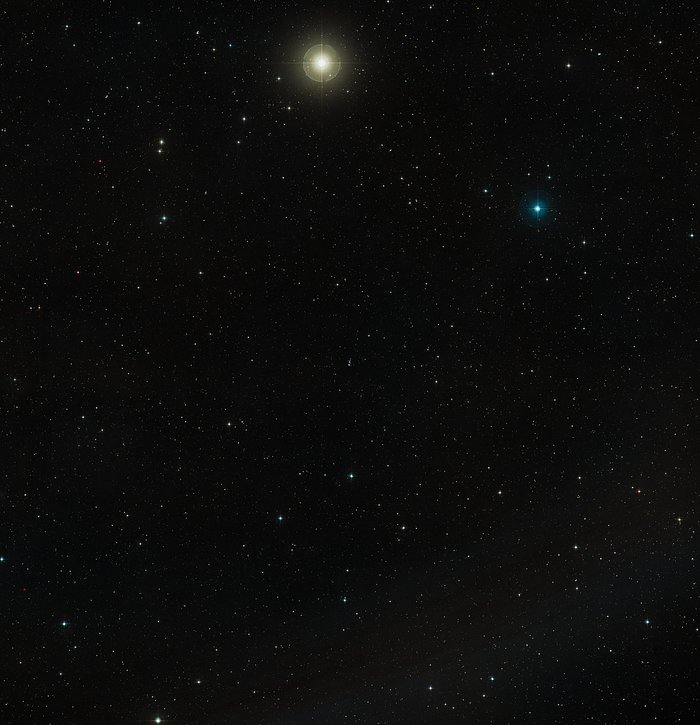
This video zooms in on the two interacting spiral galaxies of the ARP 256 system, about 350 million light-years away. It starts with a view of the night sky, focused on the constellation of Cetus (the Sea Monster), as seen from the ground. It then zooms through observations from the Digitized Sky Survey 2, and ends with a view of Arp 256 obtained with the NASA/ESA Hubble Space Telescope. Credit: ESA/Hubble, NASA, Digitized Sky Survey 2, Risinger. Music: Astral Electronic
Arp 256 was first catalogued by Halton Arp in 1966, as one of 338 galaxies presented in the aptly-named Atlas of Peculiar Galaxies. The goal of the catalogue was to image examples of the weird and wonderful structures found among nearby galaxies, to provide snapshots of different stages of galactic evolution. These peculiar galaxies are like a natural experiment played out on a cosmic scale and by cataloguing them, astronomers can better understand the physical processes that warp spiral and elliptical galaxies into new shapes.
Many galaxies in this catalogue are dwarf galaxies with indistinct structures, or active galaxies generating powerful jets — but a large number of the galaxies are interacting, such as Messier 51, the Antennae Galaxies, and Arp 256. Such interactions often form streamer-like tidal tails as seen in Arp 256, as well as bridges of gas, dust and stars between the galaxies.
Long ago, when our expanding Universe was much smaller, interactions and mergers were more common; in fact, they are thought to drive galactic evolution to this day. The galaxies in the Arp 256 system will continue their gravitational dance over the next millions of years, at first flirtatious, and then intimate, before finally morphing into a single galaxy.
This spectacular image was taken by Hubble’s Advanced Camera for Surveys (ACS) and the Wide Field Camera 3(WFC3). It is a new version of an image already released in 2008 that was part a large collection of 59 images of merging galaxies taken for Hubble’s 18th anniversary.
A new report from ESO (European Southern Observatory):
ALMA Reveals Inner Web of Stellar Nursery
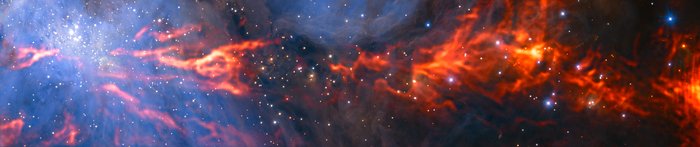
New data from the Atacama Large Millimeter/submillimeter Array (ALMA) and other telescopes have been used to create this stunning image showing a web of filaments in the Orion Nebula. These features appear red-hot and fiery in this dramatic picture, but in reality are so cold that astronomers must use telescopes like ALMA to observe them.
This spectacular and unusual image shows part of the famous Orion Nebula, a star formation region lying about 1350 light-years from Earth. It combines a mosaic of millimetre-wavelength images from the Atacama Large Millimeter/submillimeter Array (ALMA) and the IRAM 30-metre telescope, shown in red, with a more familiar infrared view from the HAWK-Iinstrument on ESO’s Very Large Telescope, shown in blue. The group of bright blue-white stars at the upper-left is the Trapezium Cluster — made up of hot young stars that are only a few million years old.
The wispy, fibre-like structures seen in this large image are long filaments of cold gas, only visible to telescopes working in the millimetre wavelength range. They are invisible at both optical and infrared wavelengths, making ALMA one of the only instruments available for astronomers to study them. This gas gives rise to newborn stars — it gradually collapses under the force of its own gravity until it is sufficiently compressed to form a protostar — the precursor to a star.
The scientists who gathered the data from which this image was created were studying these filaments to learn more about their structure and make-up. They used ALMA to look for signatures of diazenylium gas, which makes up part of these structures. Through doing this study, the team managed to identify a network of 55 filaments.
The Orion Nebula is the nearest region of massive star formation to Earth, and is therefore studied in great detail by astronomers seeking to better understand how stars form and evolve in their first few million years. ESO’s telescopes have observed this interesting region multiple times, and you can learn more about previous discoveries here, here, and here.
This image combines a total of 296 separate individual datasets from the ALMA and IRAM telescopes, making it one of the largest high-resolution mosaics of a star formation region produced so far at millimetre wavelengths [1].
Notes
[1] Earlier mosaics of Orion at millimetre wavelengths had used single-dish telescopes, such as APEX. The new observations from ALMA and IRAM use interferometry to combine the signals from multiple, widely-separated antennas to create images showing much finer detail.