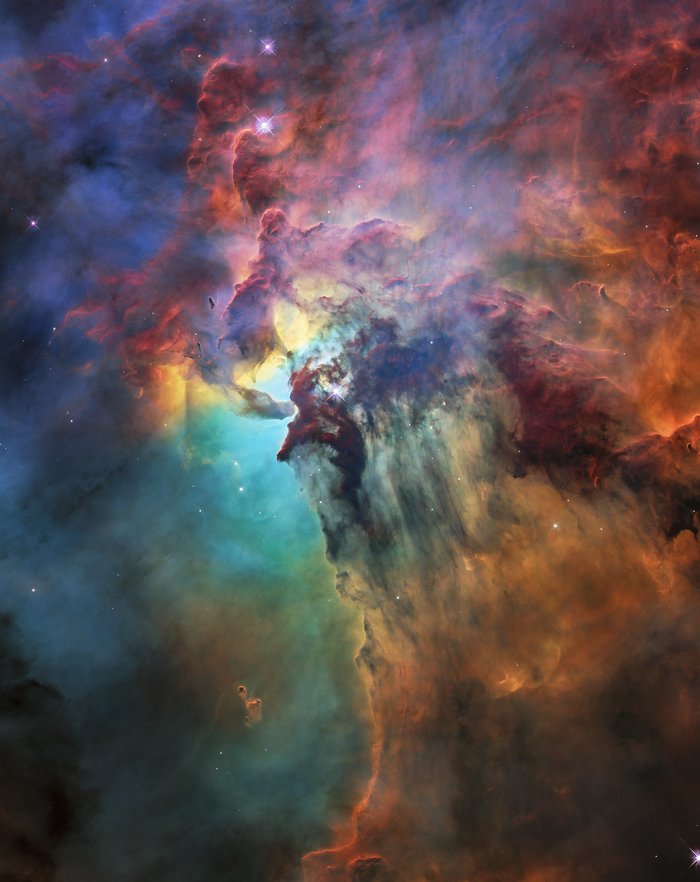
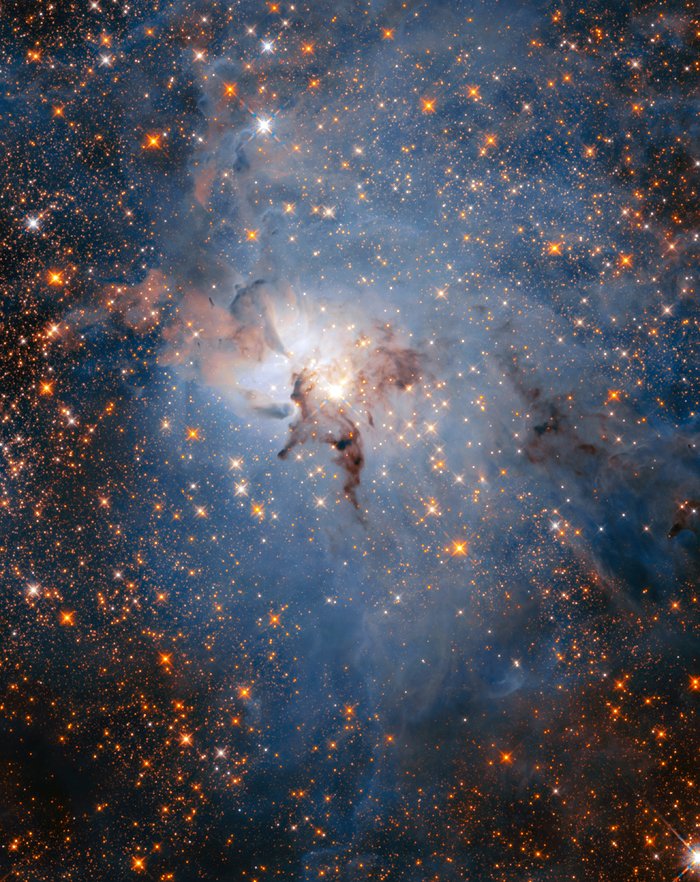
To celebrate its 28th anniversary in space the NASA/ESA Hubble Space Telescope took this amazing and colourful image of the Lagoon Nebula. The whole nebula, about 4000 light-years away, is an incredible 55 light-years wide and 20 light-years tall. This image shows only a small part of this turbulent star-formation region, about four light-years across. This stunning nebula was first catalogued in 1654 by the Italian astronomer Giovanni Battista Hodierna, who sought to record nebulous objects in the night sky so they would not be mistaken for comets. Since Hodierna’s observations, the Lagoon Nebula has been photographed and analysed by many telescopes and astronomers all over the world. The observations were taken by Hubble’s Wide Field Camera 3 between 12 February and 18 February 2018. [Larger versions]
This colourful cloud of glowing interstellar gas is just a tiny part of the Lagoon Nebula, a vast stellar nursery. This nebula is a region full of intense activity, with fierce winds from hot stars, swirling chimneys of gas, and energetic star formation all embedded within a hazy labyrinth of gas and dust. Hubble used both its optical and infrared instruments to study the nebula, which was observed to celebrate Hubble’s 28th anniversary.
Since its launch on 24 April 1990, the NASA/ESA Hubble Space Telescope has revolutionised almost every area of observational astronomy. It has offered a new view of the Universe and has reached and surpassed all expectations for a remarkable 28 years. To celebrate Hubble’s legacy and the long international partnership that makes it possible, each year ESA and NASA celebrate the telescope’s birthday with a spectacular new image. This year’s anniversary image features an object that has already been observed several times in the past: the Lagoon Nebula.
To celebrate its 28th anniversary in space the NASA/ESA Hubble Space Telescope took this amazing and colourful image of the Lagoon Nebula. Using its infrared capabilities, the telescope was able to peer through the thick clouds of dust and gas. The most obvious difference between Hubble’s infrared and visible images of this region is the abundance of stars that fill the field of view in the infrared. Most of them are more distant, background stars located behind the nebula. However, some of them are young stars within the Lagoon Nebula itself. [Larger images]The Lagoon Nebula is a colossal object 55 light-year wide and 20 light-years tall. Even though it is about 4000 light-years away from Earth, it is three times larger in the sky than the full Moon. It is even visible to the naked eye in clear, dark skies. Since it is relatively huge on the night sky, Hubble is only able to capture a small fraction of the total nebula. This image is only about four light-years across, but it shows stunning details.
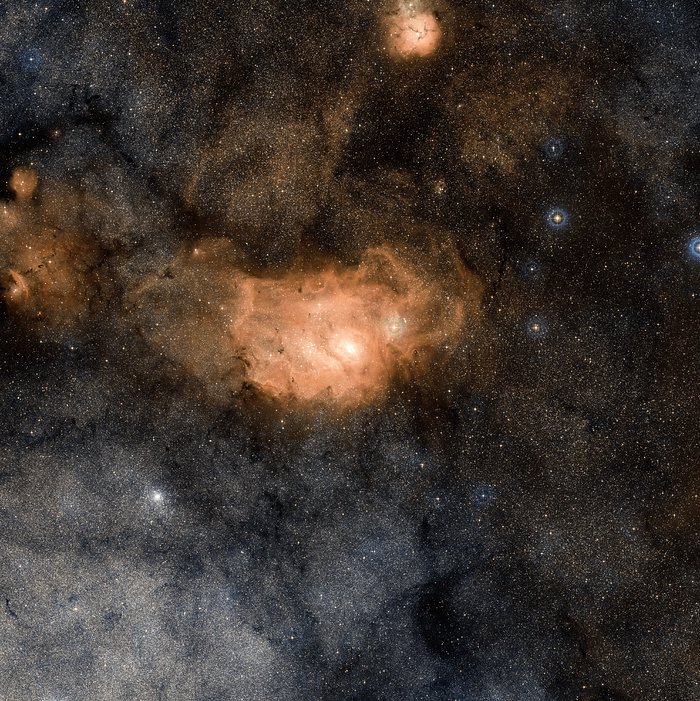
The inspiration for this nebula’s name may not be immediately obvious in this image. It becomes clearer only in a wider field of view, when the broad, lagoon-shaped dust lane that crosses the glowing gas of the nebula can be made out. This new image, however, depicts a scene at the very heart of the nebula.
Like many stellar nurseries, the nebula boasts many large, hot stars. Their ultraviolet radiation ionises the surrounding gas, causing it to shine brightly and sculpting it into ghostly and other-worldly shapes. The bright star embedded in dark clouds at the centre of the image is Herschel 36. Its radiation sculpts the surrounding cloud by blowing some of the gas away, creating dense and less dense regions.
This image from the Digitized Sky Survey shows the area around the Lagoon Nebula, otherwise known as Messier 8. This nebula is filled with intense winds from hot stars, churning funnels of gas, and energetic star formation, all embedded within an intricate haze of gas and pitch-dark dust. [ Larger images ]Among the sculptures created by Herschel 36 are two interstellar twisters — eerie, rope-like structures that each measure half a light-year in length. These features are quite similar to their namesakes on Earth — they are thought to be wrapped into their funnel-like shapes by temperature differences between the hot surfaces and cold interiors of the clouds. At some point in the future, these clouds will collapse under their own weight and give birth to a new generation of stars.
Hubble observed the Lagoon Nebula not only in visible light but also at infrared wavelengths. While the observations in the optical allow astronomers to study the gas in full detail, the infrared light cuts through the obscuring patches of dust and gas, revealing the more intricate structures underneath and the young stars hiding within it. Only by combining optical and infrared data can astronomers paint a complete picture of the ongoing processes in the nebula.
On Wednesday at Cape Canaveral, a SpaceX Falcon 9 rocket successfully put TESS (Transiting Exoplanet Survey Satellite) on the first (big) step to its final operational orbit, which will have an apogee nearly as far out as the Moon and an perigee far beyond that of geostationary satellites. (See the recent post here about TESS.)
NASA’s Transiting Exoplanet Survey Satellite (TESS) launched on the first-of-its-kind mission to find worlds beyond our solar system, including some that could support life.
TESS, which is expected to find thousands of new exoplanets orbiting nearby stars, lifted off at 6:51 p.m. EDT Wednesday on a SpaceX Falcon 9 rocket from Space Launch Complex 40 at Cape Canaveral Air Force Station in Florida. At 7:53 p.m., the twin solar arrays that will power the spacecraft successfully deployed.
“We are thrilled TESS is on its way to help us discover worlds we have yet to imagine, worlds that could possibly be habitable, or harbor life,” said Thomas Zurbuchen, associate administrator of NASA’s Science Mission Directorate in Washington. “With missions like the James Webb Space Telescope to help us study the details of these planets, we are ever the closer to discovering whether we are alone in the universe.”
Over the course of several weeks, TESS will use six thruster burns to travel in a series of progressively elongated orbits to reach the Moon, which will provide a gravitational assist so that TESS can transfer into its 13.7-day final science orbit around Earth. After approximately 60 days of check-out and instrument testing, the spacecraft will begin its work.
“One critical piece for the science return of TESS is the high data rate associated with its orbit,” said George Ricker, TESS principal investigator at the Massachusetts Institute of Technology’s (MIT) Kavli Institute for Astrophysics and Space Research in Cambridge. “Each time the spacecraft passes close to Earth, it will transmit full-frame images taken with the cameras. That’s one of the unique things TESS brings that was not possible before.”
For this two-year survey mission, scientists divided the sky into 26 sectors. TESS will use four unique wide-field cameras to map 13 sectors encompassing the southern sky during its first year of observations and 13 sectors of the northern sky during the second year, altogether covering 85 percent of the sky.
TESS will be watching for phenomena called transits. A transit occurs when a planet passes in front of its star from the observer’s perspective, causing a periodic and regular dip in the star’s brightness. More than 78 percent of the approximately 3,700 confirmed exoplanets have been found using transits.
NASA’s Kepler spacecraft found more than 2,600 exoplanets, most orbiting faint stars between 300 and 3,000 light-years from Earth, using this same method of watching for transits. TESS will focus on stars between 30 and 300 light-years away and 30 to 100 times brighter than Kepler’s targets.
The brightness of these target stars will allow researchers to use spectroscopy, the study of the absorption and emission of light, to determine a planet’s mass, density and atmospheric composition. Water, and other key molecules, in its atmosphere can give us hints about a planets’ capacity to harbor life.
“The targets TESS finds are going to be fantastic subjects for research for decades to come,” said Stephen Rinehart, TESS project scientist at NASA’s Goddard Space Flight Center in Greenbelt, Maryland. “It’s the beginning of a new era of exoplanet research.”
Through the TESS Guest Investigator Program, the worldwide scientific community will be able to conduct research beyond TESS’s core mission in areas ranging from exoplanet characterization to stellar astrophysics, distant galaxies and solar system science.
TESS is a NASA Astrophysics Explorer mission led and operated by MIT and managed by Goddard. George Ricker, of MIT’s Kavli Institute for Astrophysics and Space Research, serves as principal investigator for the mission. TESS’s four wide-field cameras were developed by MIT’s Lincoln Laboratory. Additional partners include Orbital ATK, NASA’s Ames Research Center, the Harvard-Smithsonian Center for Astrophysics, and the Space Telescope Science Institute. More than a dozen universities, research institutes and observatories worldwide are participants in the mission.
Here is a view of the return and landing of the Falcon 9 first stage onto the unmanned droneship “Of Course I Still Love You”. The view is primarily from a camera on the rocket with a brief view from the ship before the shaking caused by the engine plume knocks the transmitter antenna off target:
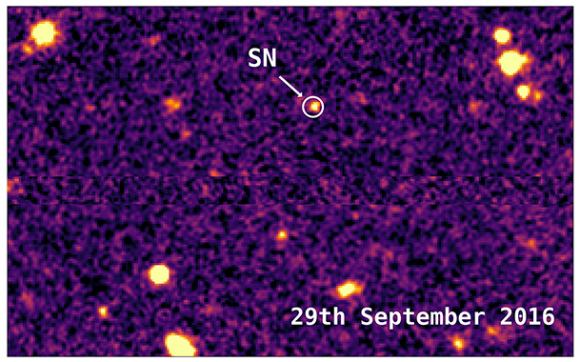
“This image shows the incredibly distant and ancient supernova DES16C2nm. The supernova was discovered by the Dark Energy Survey. Image: Mat Smith and DES collaboration.” – Universe Today
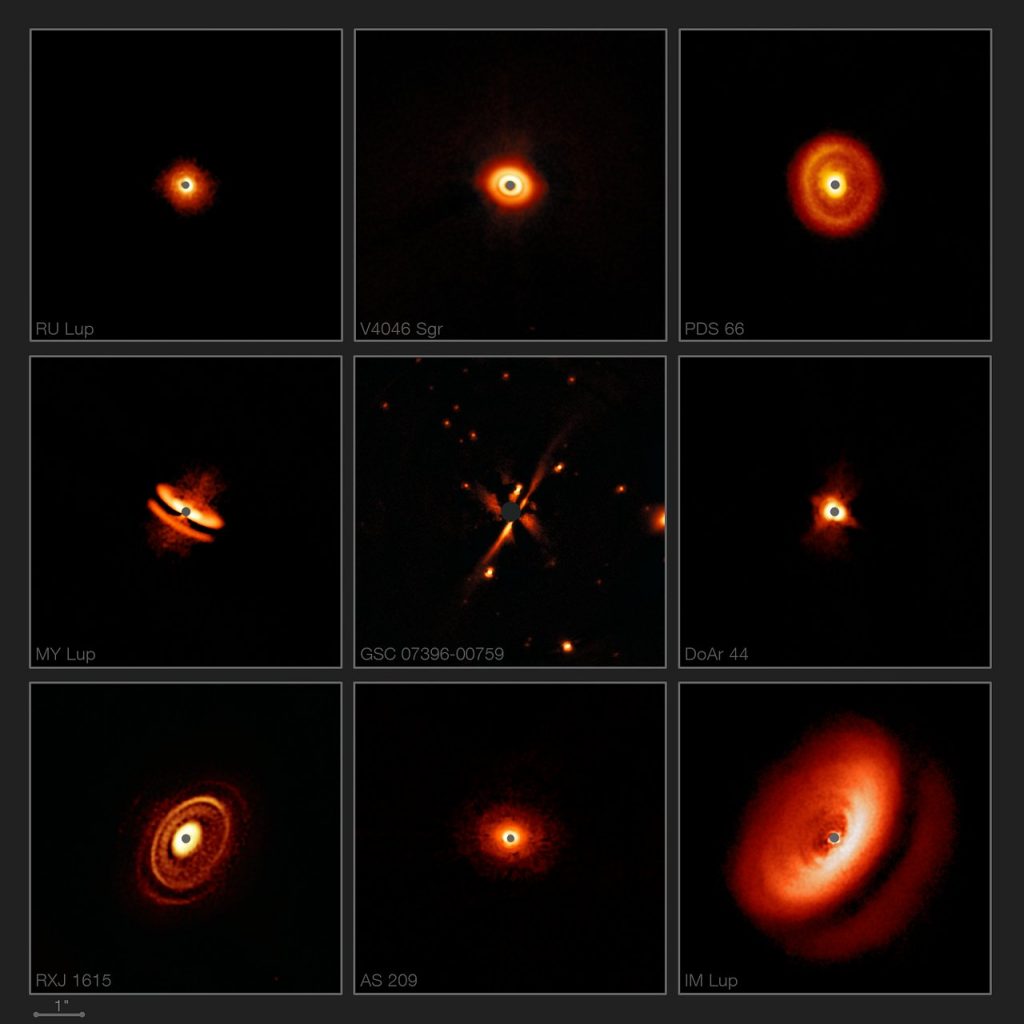
New images from the SPHERE instrument on ESO’s Very Large Telescope are revealing the dusty discs surrounding nearby young stars in greater detail than previously achieved. They show a bizarre variety of shapes, sizes and structures, including the likely effects of planets still in the process of forming. [Larger images]New images from the SPHERE instrument on ESO’s Very Large Telescope are revealing the dusty discs surrounding nearby young stars in greater detail than previously achieved. They show a bizarre variety of shapes, sizes and structures, including the likely effects of planets still in the process of forming.
The SPHERE instrument on ESO’s Very Large Telescope (VLT) in Chile allows astronomers to suppress the brilliant light of nearby stars in order to obtain a better view of the regions surrounding them. This collection of new SPHERE images is just a sample of the wide variety of dusty discs being found around young stars.
These discs are wildly different in size and shape — some contain bright rings, some dark rings, and some even resemble hamburgers. They also differ dramatically in appearance depending on their orientation in the sky — from circular face-on discs to narrow discs seen almost edge-on.
SPHERE’s primary task is to discover and study giant exoplanets orbiting nearby stars using direct imaging. But the instrument is also one of the best tools in existence to obtain images of the discs around young stars — regions where planets may be forming. Studying such discs is critical to investigating the link between disc properties and the formation and presence of planets.
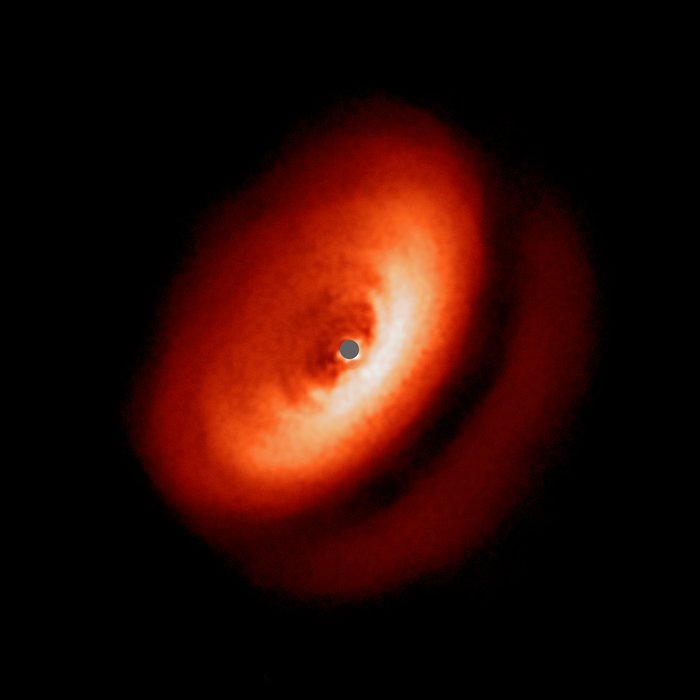
This spectacular image from the SPHERE instrument on ESO’s Very Large Telescope shows the dusty disc around the young star IM Lupi in finer detail than ever before. [Larger versions]Many of the young stars shown here come from a new study of T Tauri stars, a class of stars that are very young (less than 10 million years old) and vary in brightness. The discs around these stars contain gas, dust, and planetesimals — the building blocks of planets and the progenitors of planetary systems.
These images also show what our own Solar System may have looked like in the early stages of its formation, more than four billion years ago.
Most of the images presented were obtained as part of the DARTTS-S (Discs ARound T Tauri Stars with SPHERE) survey. The distances of the targets ranged from 230 to 550 light-years away from Earth. For comparison, the Milky Way is roughly 100 000 light-years across, so these stars are, relatively speaking, very close to Earth. But even at this distance, it is very challenging to obtain good images of the faint reflected light from discs, since they are outshone by the dazzling light of their parent stars.
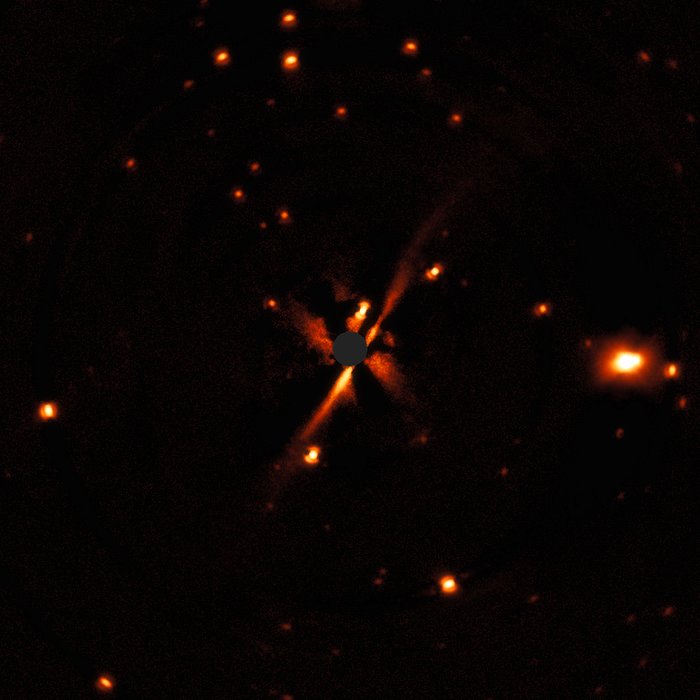
This SPHERE observation is the discovery of an edge-on disc around the star GSC 07396-00759, which is a member of a multiple star system included in the DARTTS-S sample. Oddly, this new disc appears to be more evolved than the gas-rich disc around the T Tauri star in the same system, although they are the same age. The disc extends from the lower-left to the upper-right and the central grey region shows where the star was masked out. [Larger images]Another new SPHERE observation is the discovery of an edge-on disc around the star GSC 07396-00759, found by the SHINE (SpHere INfrared survey for Exoplanets) survey. This red star is a member of a multiple star system also included in the DARTTS-S sample but, oddly, this new disc appears to be more evolved than the gas-rich disc around the T Tauri star in the same system, although they are the same age. This puzzling difference in the evolutionary timescales of discs around two stars of the same age is another reason why astronomers are keen to find out more about discs and their characteristics.
The new results from SPHERE, along with data from other telescopes such as ALMA, are revolutionising astronomers’ understanding of the environments around young stars and the complex mechanisms of planetary formation.
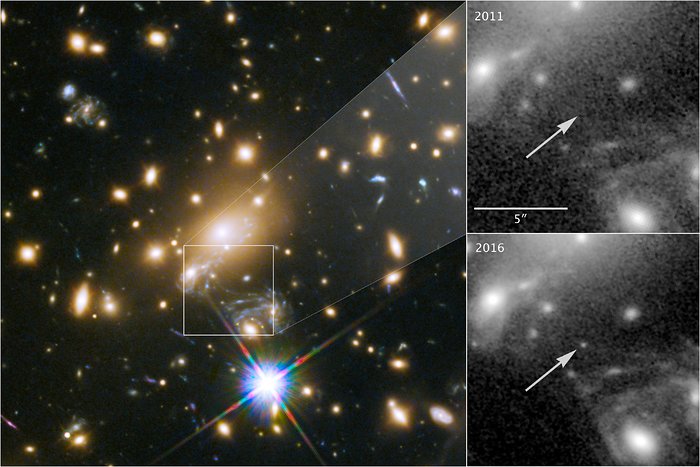
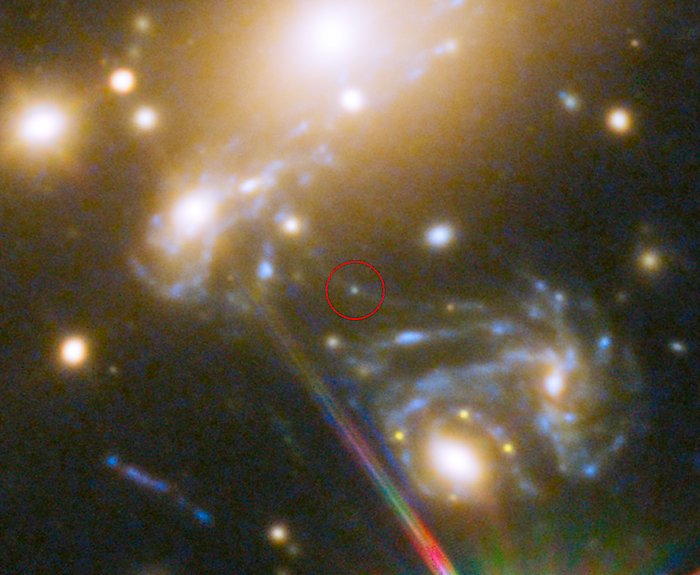
This image composite shows the discovery of the most distant known star using the NASA/ESA Hubble Space Telescope. The image to the left shows a part of the the deep-field observation of the galaxy cluster MACS J1149.5+2223 from the Frontier Fields programme gathered in 2014. The square indicates the position where the star appeared in May 2016 — its image magnified by gravitational microlensing. This part of the image also shows the four images of the Refsdal supernova, arranged in an Einstein cross. The upper right image pinpoints the position of the star, observed in 2011. The lower right image shows where the star was undergoing the microlensing event in late May 2016. [Larger image]Astronomers using the NASA/ESA Hubble Space Telescope have found the most distant star ever discovered. The hot blue star existed only 4.4 billion years after the Big Bang. This discovery provides new insight into the formation and evolution of stars in the early Universe, the constituents of galaxy clusters and also on the nature of dark matter.
The international team, led by Patrick Kelly (University of Minnesota, USA), Jose Diego (Instituto de Física de Cantabria, Spain) and Steven Rodney (University of South Carolina, USA), discovered the distant star in the galaxy cluster MACS J1149-2223 in April 2016.
This animation shows the effect of strong gravitational lensing, which can also be seen in the galaxy MACS J1149-2223. The mass of the galaxy cluster bends and magnifies the light of more distant objects in the background, making them appear brighter and hence allows telescopes to see them; it also leads to multiple images of the same object. This way Hubble detected the most distant star know to date, called LS1.
The observations with Hubble were actually performed in order to detect and follow the latest appearance of the gravitationally lensed supernova explosion nicknamed “Refsdal” (heic1525)[1], when an unexpected point source brightened in the same galaxy that hosted the supernova.
“Like the Refsdal supernova explosion the light of this distant star got magnified, making it visible for Hubble,” says Patrick Kelly. “This star is at least 100 times farther away than the next individual star we can study, except for supernova explosions.”
The observed light from the newly discovered star, called Lensed Star 1 (LS1) was emitted when the Universe was only about 30 percent of its current age — about 4.4 billion years after the Big Bang. The detection of the star through Hubble was only possible because the light from the star was magnified 2000 times.
“The star became bright enough to be visible for Hubble thanks to a process called gravitational lensing,”
explains Jose Diego. The light from LS1 was magnified not only by the huge total mass of the galaxy cluster, but also by another compact object of about three times the mass of the Sun within the galaxy cluster itself; an effect known as gravitational microlensing[2].
“The discovery of LS1 allows us to gather new insights into the constituents of the galaxy cluster. We know that the microlensing was caused by either a star, a neutron star, or a stellar-mass black hole,”
explains Steven Rodney. LS1 therefore allows astronomers to study neutron stars and black holes, which are otherwise invisible and they can estimate how many of these dark objects exist within this galaxy cluster.
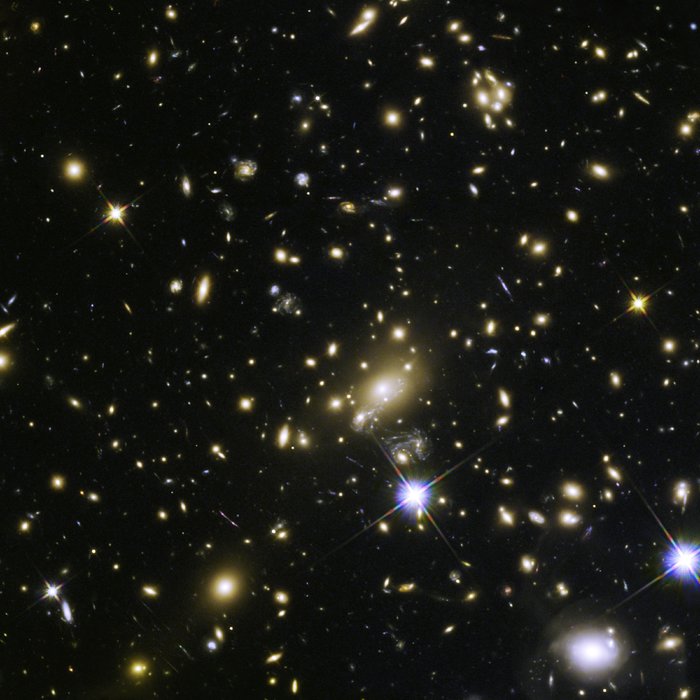
This image shows the the huge galaxy cluster MACS J1149.5+223, whose light has taken over 5 billion years to reach us. Highlighted is the position where the star LS1 appeared — its image magnified by a factor 2000 by gravitational microlensing. The galaxy in which the star is located can be seen three times on the sky — multiplied by strong gravitational lensing. [ Larger image]As galaxy clusters are among the largest and most massive structures in the Universe, learning about their constituents also increases our knowledge about the composition of the Universe overall. This includes additional information about the mysterious dark matter.
“If dark matter is at least partially made up of comparatively low-mass black holes, as it was recently proposed, we should be able to see this in the light curve of LS1. Our observations do not favour the possibility that a high fraction of dark matter is made of these primordial black holes with about 30 times the mass of the Sun”,
highlights Kelly.
This video shows the galaxy cluster MACS J1149.5+223. Thanks to a lucky alignment between the cluster, a dense object within it and a distant star, the image of the distant star was magnified by a factor of 2000, making it visible by the NASA/ESA Hubble Space Telescope. Like the galaxy in which the star is located, the star is actually visible several times. However, the light from the second image of the star was redirected by another massive object in the cluster and only became visible when this object moved out of the line of sight. The video shows the position of the two images of the star within the cluster.
After the discovery the researchers used Hubble again to measure a spectrum of LS1. Based on their analysis, the astronomers think that LS1 is a B-type supergiant star. These stars are extremely luminous and blue in colour, with a surface temperature between 11 000 and 14 000 degrees Celsius; making them more than twice as hot as the Sun.
But this was not the end of the story. Observations made in October 2016 suddenly showed a second image of the star.
“We were actually surprised to not have seen this second image in earlier observations, as also the galaxy the star is located in can be seen twice,” comments Diego. “We assume that the light from the second image has been deflected by another moving massive object for a long time — basically hiding the image from us. And only when the massive object moved out of the line of sight the second image of the star became visible.”
This second image and the blocking object add another piece of the puzzle to reveal the makeup of galaxy clusters.
With more research and the arrival of new, more powerful telescopes like the NASA/ESA/CSA James Webb Space Telescope, the astronomers suggest that with microlensing, it will be possible to study the evolution of the earliest stars in the Universe in greater detail than ever expected.
This image shows the huge galaxy cluster MACS J1149.5+223, whose light took over 5 billion years to reach us. The huge mass of the cluster is bending the light from more distant objects. The light from these objects has been magnified and distorted due to gravitational lensing. The same effect is creating multiple images of the same distant objects. [ Larger image]Notes
[1] Observations of this supernova, nicknamed Refsdal in honour of the Norwegian astronomer Sjur Refsdal, were made as part of Hubble’s Frontier Fields project.
[2] Gravitational lensing magnifies the light from fainter, background objects, allowing Hubble to see objects it would otherwise not be able to detect. The process was first predicted by Albert Einstein and is now used to find some of the most distant objects in the Universe. Usually the lensing object is a galaxy or a galaxy cluster, but in some cases it can also be a star or even a planet. When it involves these smaller objects the process is called microlensing.
This short clip shows an animation of the B-type supergiant star LS1 which was discovered with the help of gravitational lensing. These stars are extremely luminous and blue in colour, with a surface temperature between 11 000 and 14 000 degrees Celsius; making them more than twice as hot as the Sun. Credit: ESA/Hubble, M. Kornmesser