Space transport roundup – May.1.2019

A sampling of recent articles, videos, and images dealing with space transport:

** Blue Origin plans to fly a New Shepard rocket vehicle on Thursday morning at the company’s facilities in West Texas. The website will provide a webcast.

The FAA window for the flight lasts till Sunday: 9/0236 NOTAM Details.

*** A description of nine NASA sponsored payloads on the New Shepard including the Stratospheric and Suborbital Flight Experiments and Equipment for the Teachers in Space program: NASA and Blue Origin Help Classrooms and Researchers Reach Space | NASA

“We are now on the verge of giving students and teachers the ability to build and fly affordable experiments in space. When teachers are this excited about putting experiments in space, their students can’t help but get excited about space, too.”

Elizabeth Kennick, president of Teachers in Space, does not take the opportunity to fly an experiment to space for granted. The nonprofit organization has worked with educators and engineers to design and test standard equipment for classroom-developed experiments, including 3D-printed frames, customizable processors, power adaptors and more. The equipment first flew on high-altitude balloons and more recently on a stratospheric glider. Now, thanks to support from NASA’s Flight Opportunities program, the equipment will fly higher than ever before: to space on the next launch of Blue Origin’s New Shepard rocket.

** The ISS crew has made progress towards fixing the power fault that caused the delay of the launch of the SpaceX Falcon 9 rocket with the CRS-17 Dragon Cargo vehicle. No word yet, though, if the mission will be allowed to take off early (3:11 am EDT) Friday morning.

** Rocket Lab preparing for an Electron launch of three USAF satellites during a two week window that opens this Saturday: Next launch | Rocket Lab

** Virgin Orbit shows off “Cosmic Girl”, the company’s rocket carrier aircraft in this report from Loren Grush: What it takes to fly Virgin Orbit’s huge plane that launches rockets into space – The Verge

Virgin Orbit has developed a small rocket called LauncherOne that can put satellites the size of washing machines into orbit. And its launchpad resides at 35,000 feet. Virgin Orbit owns a Boeing 747 airplane, called Cosmic Girl, which carries LauncherOne up into the sky. From there, the rocket will drop from underneath Cosmic Girl’s left wing and then ignite, climbing the rest of the way to orbit.

** Vector Launch moves towards test flights this year:

** UK startup Skyrora looking for a launch site for the company’s rockets, starting with the suborbital SKYRORA 1 rocket: UK’s Skyrora In Hunt For British Launch Sites For Upcoming Rocket Tests – SpaceWatch.Global

Skyrora will make three test launches over the next 12 months, the first expected to take place over the next few months, as part of its effort to certify its Skyrora XL satellite launch vehicle that will be 10 metres tall and will be able to loft a 100 kilogram payload into low-Earth orbit. The company conducted one of its first tests near Evanton, Scotland, in August 2018 when it launched its SkyLark Nano sounding rocket to an altitude of 6 kilometres, reaching a speed of Mach 1.45.

Among the launch tests planned for the coming year is one aiming to breach the so-called Kármán line, the altitude at which atmospheric flight ends and orbital dynamics begin – 100km.

** The X-37B launched on a Falcon 9 in September 2017 remains in orbit after 600 days: X-37B Military Space Plane’s Latest Mystery Mission Passes 600 Days | Space.com

It’s unclear what exactly the spacecraft is doing up there. X-37B missions are classified, and Air Force officials tend to speak of project goals in general terms, as this excerpt from the X-37B fact sheet shows: “The primary objectives of the X-37B are twofold: reusable spacecraft technologies for America’s future in space and operating experiments which can be returned to, and examined, on Earth.”

Still, the Air Force does divulge some payloads flying on X-37B missions. For example, we know that OTV-5 includes the Advanced Structurally Embedded Thermal Spreader experiment (ASETS-II), which is measuring the performance of electronics and oscillating heat pipes in the space environment.

====

Delta-v

Space transport roundup – Apr.30.2019

A sampling of recent articles, videos, and images dealing with space transport:

** SpaceX Cargo Dragon launch delayed from Wednesday to at least Friday due to power problems on the ISS.

From SFN:

A SpaceX Dragon supply ship packed with nearly three tons of experiments, crew provisions and supplies will remain on the ground until at least Friday morning to allow more time for NASA flight controllers to troubleshoot a problem with an electrical distribution unit on the International Space Station.

Multiple sources said the commercial resupply launch, previously scheduled for Wednesday, will be pushed back at least two days to no earlier than Friday at 3:11 a.m. EDT (0711 GMT).

Find more SpaceX items below.

[ Update: Northrop Grumman has released this video about the first flight of the giant Stratolaunch aircraft:

]

** China launches two Tianhui II-01 satellites remote sensing satellites with little warning: China launches two satellites for scientific experiments – Xinhua | English.news.cn

Long March 4B rocket, with two Tianhui II-01 remote sensing sciencie satellites. Credits: Xinhua

Booster lands on a local village:

*** Update on Chinese launch startup companies who will one can hope will be less likely to drop boosters on communities:

** Interstellar Technologies MOMO 3 suborbital rocket launch was postponed from Tuesday due to a problem with an engine valve. The launch is now set for Thursday:

We are now targeting May 2nd for launch of MOMO third flight. A 75-minute launch window would open at 11:15 JST, 2:15 UTC.

** Firefly tests Alpha upper stage for full launch duration:

From Firefly:

Firefly has achieved a major milestone toward flight qualification of the Alpha second stage, supporting Firefly’s goal of Alpha first launch in 2019. A 300 second hotfire test of the complete upper stage was accomplished on the company’s vertical stage test stand. The length of the test successfully demonstrates the capability of the integrated system (flight avionics, structures, and propulsion systems) to operate for the duration of a flight mission (i.e., a mission duty cycle).

** Blue Origin hints at an announcement from Jeff Bezos on May 9th when he gives a talk at a satellite industry conference: Blue Origin tweets picture from Antarctic voyage, hinting at moon mission – GeekWire

*** Blue Origin facilities in Washington state expand: Construction is well under way for Blue Origin’s expanded HQ – GeekWire

** SpaceX:

*** Latest on Crew Dragon test explosion and status of NASA’s Commercial Crew Program:

*** Everyday Astronaut explains why launch abort towers are being replaced on crew vehicles by integrated liquid fuel engines: Why have SpaceX, Boeing & Blue Origin ditched abort towers? – Everyday Astronaut

There’s a new trend going around in the commercial space industry when it comes to launch abort systems. All three commercial companies who are putting abort systems on their crewed vehicles have ditched the classic launch abort tower we’ve seen dominate abort systems in the past. Previous vehicles like the Mercury capsule, the Apollo capsule and even the Soyuz all used an escape tower that sat on top of the crew module, capable of pulling the vehicle away from a failing rocket in a hurry.

*** Falcon Heavy core booster tested in preparation for the STP-2 Mission set for launch in June:

*** Falcon 9 booster spotted on way to Vandenberg AFB: SpaceX ships Falcon 9 booster west for second California launch of 2019 – Teslarati

Barring a surprise reassignment, the booster Joshuah Murrah caught is Falcon 9 B1051, on its way west some 50 days after successfully supporting Crew Dragon’s March 2nd launch debut. Despite the availability of B1046, B1047, and B1049, B1051 was assigned to the Canadian Space Agency’s (CSA) Radarsat Constellation Mission (RCM) shortly after landing aboard OCISLY, triggering major launch delays. The most logical explanation for customer CSA’s and satellite contractor Maxar Technologies’ curious decision is that they must believe that Falcon 9 Block 5 boosters with more than one launch in their past add more risk than those that do not.

*** Broken Falcon Heavy core prepared for departure from Port Canaveral:

*** FCC grants SpaceX permission to launch StarLink Internet satellites into an orbit lower than in the original plan:

In this Order and Authorization (Order), we grant the application1 of Space Exploration Holdings, LLC (SpaceX) to modify its previously authorized 4,425 non-geostationary orbit (NGSO) satellite constellation using Ku- and Ka-band spectrum.2 Specifically, we authorize SpaceX to slightly reduce the number of satellites in this constellation, to operate a substantial portion of these satellites at a lower orbital altitude than previously authorized, and to include the use of Ku-band gateway earth stations for fewer than 75 of these lower-altitude satellites.3 Grant of this modification will allow SpaceX to make efficient use of valuable spectrum resources more safely, quickly, and cost-effectively as it initiates a new generation of broadband services available to customers worldwide, including those in areas previously underserved or even totally unserved by other broadband solutions.

A statement from SpaceX:

*** The first launch of operational Starlink satellites to this new orbital altitude is expected in May: SpaceX’s first batch of Starlink satellites already in Florida for launch debut – Teslarati

Above all else, SpaceX’s confirmation that the first batch of Starlink satellites are already in Florida drives home the reality that the company’s internet satellite constellation is about to become very real. Said constellation has long been the subject of endless skepticism and criticism, dominated by a general atmosphere of dismissal. There is no doubt that Starlink, as proposed, is an extraordinarily ambitious program that will cost billions of dollars to even begin to realize. SpaceX will have to find ways to affordably manufacture and launch ~11,900 satellites – together weighing something like 500 metric tons (1.1 million lbs) – in as few as nine years, start to finish.

*** Raptor engines tested for Starhopper flights : SpaceX wants to unleash Starhopper but longer Raptor test fires come first – Teslarati

According to SpaceX CEO Elon Musk, the next round of Starhopper activity will focus on removing the spacecraft prototype’s tethers and performing far more substantial hop tests.

Longer tests demand that SpaceX begins expanding the known performance envelope of its full-scale Raptor engine. Towards that end, longer-duration tests would need to be done at the company’s McGregor, TX development facilities to reduce risk, tests that Musk confirmed are already well underway. A recent Raptor static fire reportedly lasted no less than 40 seconds, more than enough time for a single-engine Starhopper to significantly expand both the maximum altitude and velocity of future hop tests. In support of the upcoming Starhopper test campaign, significant construction work is also ongoing at SpaceX’s Boca Chica test and development facilities.

*** Progress on construction of the orbital Starship test vehicle continues at Boca Chica Beach:

*** Elon posts artwork for stainless steel Starships on the Moon and Mars:

====

Moon Rush: The New Space Race

The Space Show this week – April.29.2019

The guests and topics of discussion on The Space Show this week:

1. Monday, April 22, 2019; 2-3:30 pm PDT (4-5:30 pm CDT, 5-6:30 pm EDT): No show this week.

2. Tuesday, April 23, 2019; 7-8:30 pm PDT (9-10:30 pm CDT, 10-11:30 pm EDT): Bruno Mombrinie, founder and lead designer of the electric short takeoff and landing airplane Metro Hop, will talk about “flying cars for real”.

3. Wednesday, April 24, 2019: Hotel Mars. See Upcoming Show Menu and the website newsletter for details. Hotel Mars is pre-recorded by John Batchelor. It is archived on The Space Show site after John posts it on his website.

4. Friday, April 26, 2019; 9:30-11 am PDT; 11:30 am-1 pm CDT, 12:30-2 pm EDT): Marcia S. Smith will discuss NASA budgets and lunar program costs.

5. Sunday, April 28, 2019; 12 pm PDT (3:00 pm EDT, 2:00 pm CDT): Leonard David will talk about his new book, Moon Rush: The New Space Race. The interview will be followed by an Open Lines session.

Some recent shows:

** Sun, 04/28/2019 – 12:00Michael Ciancone talked aboout his spaceflight bibliography, the important 2018 IAC in Bremen, IAC 2019 in Washington, DC, and the Orion Service Module program with ESA.

** Fri, 04/26/2019Umberto Cavallaro talked about his book, The Race to the Moon Chronicled in Stamps, Postcards, and Postmarks: A Story of Puffery vs. the Pragmatic, and about “documenting early space history through stamps, USSR propaganda, US stamp approach and more”.
** Mon, 04/22/2019Daniel Suarez discussed his new science fiction novel, Delta-v, and “deep space mining, space economics, commercial space, policy and regulations, government space activities, risk taking, lunar return, Mars and much much more”.

** Tue, 04/23/2019Jeffrey Smith talked about his two recent booster series articles on The Space Review (Part 1 and Part 2) and “also talked rocket and booster history, returning to the Moon and more”.

See also:
* The Space Show on Vimeo – webinar videos
* The Space Show’s Blog – summaries of interviews.
* The Space Show Classroom Blog – tutorial programs

The Space Show is a project of the One Giant Leap Foundation.

The Space Show - David Livingston
The Space Show – David Livingston


Student and amateur CubeSat news roundup – April.29.2019

A sampling of recent articles, press releases, etc. related to student and amateur CubeSat / SmallSat projects and programs:

** CubeSat built by undergraduate students at Birla Institute of Technology, Pilani in India will include an advance imaging system: BITS Pilani students inch closer to nano-sat launch – AsianAge.com

Mentored by experts from the Indian Space Research Organisation (Isro), undergraduate students at Birla Institute of Technology, Pilani, are inching closer to their dream of designing and launching a nano-satellite or cubesat — of the size of a shoebox – with a special camera that will help study the earth’s surface for response during natural hazards and track carbon dioxide (CO2) emissions.

The country’s first student-run undergraduate research group, which is on a mission to launch a one-of-its-kind nano-satellite with hyperspectral imager, has been christened Team Anant. It has 40 members across all engineering branches and batches at the Rajasthan-based institute.

** Students at Rensselaer Polytechnique Institute (RPI) are building OSCaR (Obsolete Spacecraft Capture and Removal) smallsat to test techniques for de-orbiting space debris

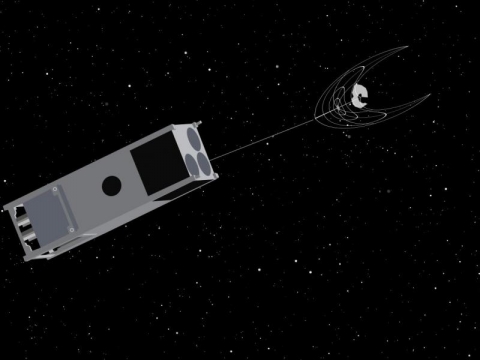
OSCaR (Obsolete Spacecraft Capture and Removal) is a 3U CubeSat in development at Rensselaer Polytechnic Institute that aims to de-orbit space debris.

From the RPI article:

… [Professor Kurt] Anderson and his students are developing OSCaR, a small device that will be able to inexpensively be sent into space aboard larger vehicles and then released to nearly autonomously seek out, capture, and then de-orbit space debris.

OSCaR is a three-unit member of a class of very small satellites known as CubeSats. Each unit is a small and light 10 cm x 10 cm x 10 cm cube.

One of those CubeSat units will house the “brains” of OSCaR including GPS, data storage, and communication, as well as the power and thermal management systems. Another will hold propellant and the system’s propulsion module to drive OSCaR forward. The third unit will contain four gun barrels, nets, and tethers to physically capture debris, one piece at a time. This capture module will also have optical, thermal, and RADAR imaging sensors to help OSCaR locate debris in the vastness of its surrounding space.

After it is done collecting debris, OSCaR will be programmed to deorbit itself within five years, destroying itself and the debris it caught.

** AMSAT news on student and amateur CubeSat/smallsat projects: ANS-118 AMSAT News Service Special Bulletin

  • AMSAT 50th Anniversary Issue of AMSAT Journal Available For All
  • PHL-Microsat Issues Diwata-2 Amateur Radio Unit Service Announcement
  • Coronation Station HS10KING/mm On Geostationary Satellite
  • SatNOGS Satellite Ground Station Article in HackSpace Magazine
  • AMSAT South Africa Developing AfriCUBE SDR-based CubeSat
  • Interview with Peter Gülzow, AMSAT-DL President
  • PSAT2, ISS Sat Gate needed in Central America
  • Upcoming Satellite Operations
  • ARISS News
  • Shorts From All Over

General CubeSat/SmallSat info:

====

Archaeology from Space: How the Future Shapes Our Past

Space policy roundup – April.29.2019

A sampling of links to recent space policy, politics, and government (US and international) related space news and resource items that I found of interest:

Webcasts:

** The Space Show – Fri, 04/26/2019Umberto Cavallaro talked about his book, The Race to the Moon Chronicled in Stamps, Postcards, and Postmarks: A Story of Puffery vs. the Pragmatic, and about “documenting early space history through stamps, USSR propaganda, US stamp approach and more”.

** Lucy in the Sky With Asteroids | The Planetary Society

A rare alignment of planets and other objects will enable the solar-powered Lucy spacecraft to examine seven asteroids, six of which are among the thousands of Trojan asteroids that orbit ahead of and behind Jupiter. The mission team, include Hal Levison, Cathy Olkin and Mike Sekerak, hope to unlock secrets of our solar system’s origin through these ancient artifacts. Planetary Society correspondent Andrew Jones helps us celebrate China’s Space Day with an update on the Chang’e 4 lunar mission. The space trivia contest returns as just one cog in the universe-spanning machine called What’s Up.

** April 25, 2019 Zimmerman/Batchelor podcast | Behind The Black

===


Everyone can participate in space