1. Tuesday, Dec.28, 2021; 7 pm PST (9 pm CST, 10 pm EST): We welcome back Thomas A. Olson for his annual commercial space year in review classic Space Show program. Join us for this final live broadcast program with Tom for 2021.
2. Wednesday, Dec.29, 2021; 1:00 pm PST (3:00 pm CST, 4:00 pm EST) – Hotel Mars: No Hotel Mars this week.
3. Friday, Dec.31, 2021; 9:30-11 am PST (11:30 am-1 pm CST, 12:30-2 pm EST): No show for New Year’s Eve. Happy New Year’s Everyone.
4. Sunday, Jan.2, 2021; 12-1:30 pm PST (2-3:30 pm CST, 3-4:30 pm EST): We welcome in 2022 with our first Open Lines program for the new year. Give us a call. New callers welcome. Call 1-866-687-7223.
Some recent shows:
** Sunday, Dec.26.2021 – Leonard David talked “about leading space news stories during the year and what to look for next year“.
highlighted what we called out as top trends and guests during the year. John went for three trends including commercial activities, the ISS and SpaceX with Starship and Superheavy changing paradigms. I called out the guests we had on talking about what Earth would look like to a being on a distant exoplanet. In addition, I shouted out for Avi Loeb and his ET research regarding fast moving interstellar objects plus work only being tolerated due to his tenure status per his recent book which we discussed on Hotel Mars. Finally, I also shouted out for the commercial fusion industry and our fusion guest, Stephanie Thomas from Princeton Satellite Systems. This Hotel Mars program was one segment timing out at about 10.5 minutes.
Commercial space investing summary for 2021, 2022 investing predictions, China and U.S. space policy, the China space race, Exchange Traded Funds, U.S. Policy, space sector economic concerns, surge in space sector public companies and more.
Here is the latest episode in NASA’s Space to Ground weekly report on activities related to the International Space Station:
** Best Space Station Science Pictures of 2021 – NASA Johnson
It has been a busy year of research aboard the International Space Station. NASA’s SpaceX Crew-1, Crew-2, and Crew-3 missions supported hundreds of science experiments aboard the orbiting laboratory. Multiple Soyuz spacecrafts carried astronauts to and from station. An upgraded cargo Dragon spacecraft returned time sensitive research to scientists on the ground. Astronauts and cosmonauts conducted 13 spacewalks, and their work included installing new solar panels to augment and upgrade the station’s power supply. Chiles and lettuce were harvested as a part of plant research preparing us for deep space missions, and technologies were tested for the upcoming Artemis missions to the Moon. Look at some of the best photos of breakthrough investigations crew members worked on in 2021: https://go.nasa.gov/30Iy8d8
** 2021 International Space Station Year In Review – December 22, 2021 – NASA Johnson
A review of missions, residents, and science on board the International Space Station in 2021.
** NASA Television VideoFile – Soyuz MS-20 Landing – December 20, 2021 – NASA Video
Roscosmos cosmonaut Alexander Misurkin and two Japanese businessmen, Yusaku Maezawa and Yozo Hirano undocked from the International Space Station’s Poisk Module in their Soyuz MS-20 spacecraft December 19, returning to Earth a few hours later for a parachute-assisted landing on the steppe of Kazakhstan Dec. 20. Misurkin, Maezawa, and Hirano, were flying under a contract between Roscosmos and Space Adventures.
The broadcast show begins for NASA’s SpaceX 24th commercial resupply services mission to the International Space Station.
** Expedition 66 SpaceX CRS 24 Docking – December 22, 2022 – NASA Video
Loaded with scientific experiments and supplies, the unpiloted SpaceX CRS-24 cargo ship automatically docked to the International Space Station December 22. The SpaceX spacecraft linked up to the Harmony module after launching December 21 from Florida with several tons of experiments and hardware.
Also on SpaceX CRS-24, Procter & Gamble—one of the leading consumer goods companies in the world—will send Tide Infinity, the first in a series of detergent systems being developed for NASA’s long duration space travel initiatives (through a Space Act Agreement with NASA) to understand the viability of cleaning clothes off planet. The Tide team intends to test the stability of cleaning ingredients under microgravity conditions and radiation exposure in space. In doing so, the company hopes to gain insights that could help in the development of a low-resource-use laundry solution for everyday use while meeting consumer demand for more sustainable products. Results could also further knowledge on the development of laundry detergent solutions to support future long-duration spaceflight missions. Learn more about this exciting investigation!
** NLRA 2022-5: Technology Development and Applied Research on the ISS National Lab – ISS National Lab – YouTube
On December 15, 2021, the ISS National Lab held a webinar to provide further background on NLRA 2022-5 and to answer any questions.
Join ESA astronaut Matthias Maurer inside the seven-windowed cupola, the International Space Station’s “window to the world” and pan around to enjoy the view. The ESA – European Space Agency-built Cupola is the favourite place of many astronauts on the International Space Station. It serves not only as a unique photo spot, but also for observing robotic activities of the Canadian Space Agency’s robotic arm Canadarm2, arriving spacecraft and spacewalks. Just outside the cupola and behind Matthias is a portion of the Soyuz MS-19 crew ship docked to the Rassvet module and the Prichal docking module attached to the Nauka multipurpose laboratory service module. Matthias was launched to the International Space Station on Crew Dragon Endurance as part of Crew-3 at 02:03 GMT/03:03 CET Thursday 11 November. His ESA mission on board is known as Cosmic Kiss and will see him live and work for approximately six months in orbit. Follow Matthias: https://bit.ly/ESACosmicKiss
** Chinese Astronauts Show Process of Height Measurement in Space Station – CCTV Video News Agency
The three Chinese astronauts of the Shenzhou-13 crewed space mission, demonstrated the process of measuring their height in a microgravity environment after traveling over two months aboard China’s space station core module Tianhe.
** How to receive SSTV images from the ISS – K7AGE
I show you how to receive Slow Scan TV (SSTV) images from the International Space Station (ISS). Several times a year SSTV images are sent from the ISS. In December 2021 from the 26th through the 31st SSTV images will be transmitted. A simple two-meter amateur radio, or scanner, is able to receive the signal on 145.800 MHz. You can receive the signal using the antenna on an HT, mobile antenna, or a vertical antenna mounted outside. I show you how to learn when the ISS will be in the range of your station. Heavens-Above is a good website to use and it will generate a list of passes for your station. To decode the SSTV signal you will need software on a computer or portable device. I show MMSSTV on my Windows computer decoding the SSTV signal. I also show decoding SSTV on my iPad …
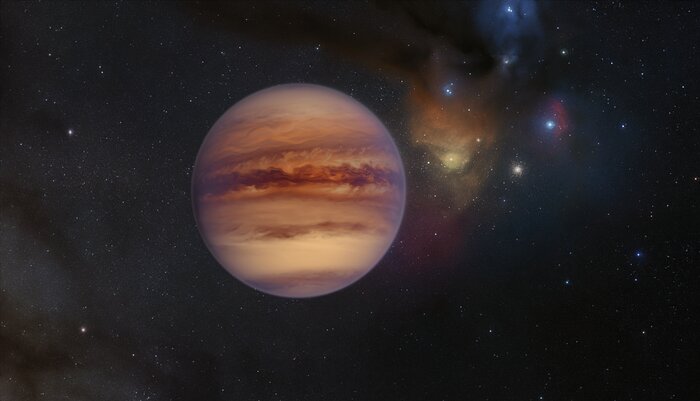
This artist’s impression shows an example of a rogue planet with the Rho Ophiuchi cloud complex visible in the background. Rogue planets have masses comparable to those of the planets in our Solar System but do not orbit a star, instead roaming freely on their own.
Rogue planets are elusive cosmic objects that have masses comparable to those of the planets in our Solar System but do not orbit a star, instead roaming freely on their own. Not many were known until now, but a team of astronomers, using data from several European Southern Observatory (ESO) telescopes and other facilities, have just discovered at least 70 new rogue planets in our galaxy. This is the largest group of rogue planets ever discovered, an important step towards understanding the origins and features of these mysterious galactic nomads.
“We did not know how many to expect and are excited to have found so many,”
says Núria Miret-Roig, an astronomer at the Laboratoire d’Astrophysique de Bordeaux, France and the University of Vienna, Austria, and the first author of the new study published today in Nature Astronomy.
Rogue planets, lurking far away from any star illuminating them, would normally be impossible to image. However, Miret-Roig and her team took advantage of the fact that, in the few million years after their formation, these planets are still hot enough to glow, making them directly detectable by sensitive cameras on large telescopes. They found at least 70 new rogue planets with masses comparable to Jupiter’s in a star-forming region close to our Sun, located within the Scorpius and Ophiuchus constellations [1].
To spot so many rogue planets, the team used data spanning about 20 years from a number of telescopes on the ground and in space.
“We measured the tiny motions, the colours and luminosities of tens of millions of sources in a large area of the sky,” explains Miret-Roig. “These measurements allowed us to securely identify the faintest objects in this region, the rogue planets.”
“The vast majority of our data come from ESO observatories, which were absolutely critical for this study. Their wide field of view and unique sensitivity were keys to our success,” explains Hervé Bouy, an astronomer at the Laboratoire d’Astrophysique de Bordeaux, France, and project leader of the new research. “We used tens of thousands of wide-field images from ESO facilities, corresponding to hundreds of hours of observations, and literally tens of terabytes of data.”
The team also used data from the European Space Agency’s Gaia satellite, marking a huge success for the collaboration of ground- and space-based telescopes in the exploration and understanding of our Universe.
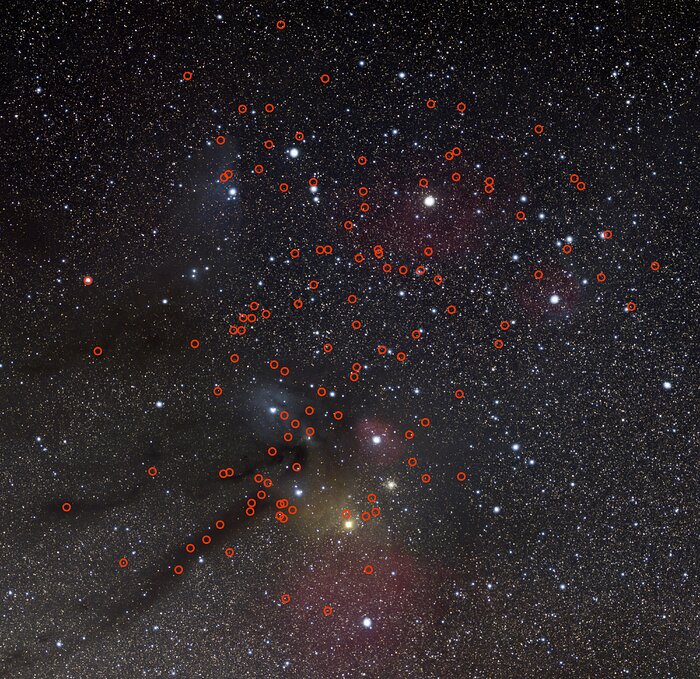
This image shows the locations of 115 potential rogue planets, highlighted with red circles, recently discovered by a team of astronomers in a region of the sky occupied by Upper Scorpius and Ophiucus. Rogue planets have masses comparable to those of the planets in our Solar System, but do not orbit a star and instead roam freely on their own. The exact number of rogue planets found by the team is between 70 and 170, depending on the age assumed for the study region. This image was created assuming an intermediate age, resulting in a number of planet candidates in between the two extremes of the study.
The study suggests there could be many more of these elusive, starless planets that we have yet to discover.
“There could be several billions of these free-floating giant planets roaming freely in the Milky Way without a host star,” Bouy explains.
By studying the newly found rogue planets, astronomers may find clues to how these mysterious objects form. Some scientists believe rogue planets can form from the collapse of a gas cloud that is too small to lead to the formation of a star, or that they could have been kicked out from their parent system. But which mechanism is more likely remains unknown.
Further advances in technology will be key to unlocking the mystery of these nomadic planets. The team hopes to continue to study them in greater detail with ESO’s forthcoming Extremely Large Telescope (ELT), currently under construction in the Chilean Atacama Desert and due to start observations later this decade.
“These objects are extremely faint and little can be done to study them with current facilities,” says Bouy. “The ELT will be absolutely crucial to gathering more information about most of the rogue planets we have found.”
1. Tuesday, Dec. 21, 2021; 7 pm PST (9 pm CST, 10 pm EST): We welcome back Andrew Chanin of the UFO EFT for a summary of space finance 2021 and a look ahead to 2022.
2. Wednesday, Dec. 22, 2021; 1:00 pm PST (3:00 pm CST, 4:00 pm EST) – Hotel Mars: John Batchelor and Dr. David Livingston will review space developments in 2021.
3. Friday, Dec.24, 2021; 9:30-11 am PST (11:30 am-1 pm CST, 12:30-2 pm EST): No show for the Christmas holiday. Merry Christmas everyone.
4. Sunday, Dec.26, 2021; 12-1:30 pm PST (2-3:30 pm CST, 3-4:30 pm EST): We welcome back Leonard David to review special news stories of 2021 and a look ahead to 2022 for space.
Some recent shows:
** Sunday, Dec.19.2021 – Theresa Hitchens “was back with us to discuss national security space policy, main concerns, 2022 be on the look out for issues and more“.
** Friday, Dec.17.2021 – Dr. Lee Cronin from the University of Glasgow, Scotland spoke with David Livingston and co-host Bill Gowan about “his work in molecular complexity leading to his development of the Molecular Assembly index to help search for biomarkers and life on other planets“.
** Tuesday, Dec.14.2021 – Gene Meyers discussed “Space Solar Power Sats, Gene’s unique advocacy for SSP, top policy makers and politicians through his White Paper, infrastructure and more“.
Here is the latest episode in NASA’s Space to Ground weekly report on activities related to the International Space Station:
** The AP Interview: Japanese billionaire in space – Associated Press
Japanese fashion tycoon Yusaku Maezawa has spoken to The Associated Press in his first interview from the International Space Station (Dec. 13).
** 【リアルガチ】無重力で遊んでみた 【FOR REAL】Playing Around in Zero Gravity – Yusaku Maezawa【MZ】
MZ is finally getting used to life in space, And what do you do in space? You play with zero gravity!! Staying still, paddling like a drowning dog, twirling around… See MZ playing around like a little kid. Also see MZ talk about the importance of gravity. For the 12 days in space, MZ and Yozo will attempt to film as many challenges and activities that people from all around the world had requested them to do in the ‘100 Things You Want MZ to Do in Space’.
** 【衝撃の一枚】宇宙から地球撮ってみた【A MIRACLE PIECE】Capturing Earth From Space – Yusaku Maezawa【MZ】
For today’s video, MZ attempts to take photos of the Earth using a camera with telescopic lens. You only have one chance with the button as the ISS moves very fast. MZ seems very proud of what he captured on his camera… For the 12 days in space, MZ and Yozo will attempt to film as many challenges and activities that people from all around the world had requested them to do in the ‘100 Things You Want MZ to Do in Space’. Please stay tuned!
** Expedition 66 PAO Minnesota Public Radio NPR – December 15, 2021 – NASA Video
Aboard the International Space Station, NASA astronauts Mark Vande Hei and Tom Marshburn discussed living and working in space during an in-flight event December 15 with Minnesota Public Radio and NPR’s “Here and Now” program. Vande Hei and Marsburn are in the midst of long duration missions aboard the microgravity laboratory to advance scientific knowledge and demonstrate new technologies for future human and robotic exploration missions as part of NASA’s Moon and Mars exploration approach, including lunar missions through NASA’s Artemis program.
** Expedition 66 PAO KCRG-TV and Kitsap Sun Newspaper – December 13, 2021 – NASA Video
Aboard the International Space Station, NASA astronauts Raja Chari and Kayla Barron discussed living and working in space during an in-flight event December 13 with KCRG-TV in Cedar Rapids, Iowa and the Kitsap Sun newspaper in Bremerton, Washington. Chari and Barron are in the midst of a six month mission aboard the microgravity laboratory to advance scientific knowledge and demonstrate new technologies for future human and robotic exploration missions as part of NASA’s Moon and Mars exploration approach, including lunar missions through NASA’s Artemis program.
SpaceX’s 24th Commercial Resupply Services (CRS) mission to the International Space Station (ISS) is slated for launch no earlier than December 21 at 5:06 a.m. ET from Kennedy Space Center in Florida. The ISS National Laboratory is sponsoring multiple payloads on this mission that will bring value to our nation and drive a sustainable market in low Earth orbit. This video highlights two investigations launching on this mission from private-sector research partners Merck and Procter & Gamble.
The three astronauts on a six-month mission in China’s space station have been working out on a regular basis to prevent potential health hazards that might be caused by the microgravity environment.
** Chinese Astronauts Show Space Station Routine Cleaning Between Duties – CCTV Video News Agency
The three Chinese astronauts, traveling aboard China’s space station core module Tianhe showed routine cleaning between their duties to make their space home clean, tidy and comfortable.