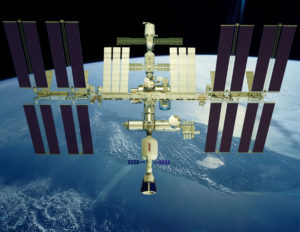
Videos: “Space to Ground” & other space habitat reports – Nov.26.2021

Here is the latest episode in NASA’s Space to Ground weekly report on activities related to the International Space Station:

** Thanksgiving Message from the International Space StationNASA

Aboard the International Space Station, NASA astronauts Mark Vande Hei, Raja Chari, Tom Marshburn and Kayla Barron and ESA (European Space Agency) astronaut Matthias Maurer shared their thoughts about spending Thanksgiving in orbit and the foods they plan to enjoy. Vande Hei is in the midst of a year-long mission, while Chari, Marshburn, Barron and Maurer arrived on the space station Nov. 11 for a planned six-month mission. Together, they’re living and working aboard the microgravity laboratory to advance scientific knowledge and demonstrate new technologies for future human spaceflight missions

** STEMonstrations: Moment of InertiaNASA

NASA Astronauts Megan McArthur and Shane Kimbrough discuss moment of inertia and its effects on rotating objects. Watch as Megan demonstrates what happens to her angular speed as she alters her moment of inertia in microgravity aboard the International Space Station. Be sure to check out https://www.nasa.gov/stemonstrations for more videos like this, along with their corresponding classroom connection lesson plans.

** New Space Station Module Docks to the International ComplexNASA

The Russian “Prichal” Node Module and the attached Progress M-UM docked to the “Nauka” Multipurpose Laboratory (MLM) of the International Space Station November 26 following a launch from the Baikonur Cosmondrome in Kazakhstan on November 24. The node module will serve as a multi-hatch docking port for Russian visiting vehicles to the complex.

** Expedition 66 ESA Education Event – November 24, 2021NASA Video

Aboard the International Space Station, Expedition 66 flight engineer Mattias Maurer of ESA (European Space Agency) discussed living and working in space during an in-flight downlink November 24 with students from Germany, the Czech Republic, and Ireland. Maurer launched in November on the SpaceX Crew Dragon Endurance for a planned six-month science mission to advance scientific knowledge and demonstrate new technologies for future human and robotic exploration missions.

** Expedition 66 – Northrup Grumman Cygnus 16 Release – November 202, 2021NASA Video

More than three months after arriving at the International Space Station to deliver more than three tons of food, supplies and scientific experiments, the unpiloted Northrop Grumman “SS Ellison Onizuka” Cygnus cargo craft departed the complex, headed for destructive entry back into the Earth’s atmosphere in December. Ground controllers at Mission Control, Houston sent commands to release Cygnus from the grasp of the Canadarm 2 robotic arm after it was detached from the Earth-facing port of the station’s Unity module. Cygnus launched on Aug. 10 atop a Northrop Grumman Antares rocket from the Wallops Flight Facility, Virginia.

** Video Shows Beautiful Images of Earth Shot from China’s Tiangong Space StationCCTV Video News Agency

China Manned Space Agency (CMSA) on Tuesday released a video of Earth shot from China’s Tiangong (Heavenly Palace) space station.

** A Glimpse into How Chinese Astronaut Works Out in SpaceCCTV Video News Agency

A footage released by the China Manned Space Agency (CMSA) on Wednesday has given people a glimpse into Chinese astronauts’ life at the country’s space station, showing how the crew member Ye Guangfu works out hard to stay fit for better performing the crew’s tasks in space.

====

=== Amazon Ads ===

LEGO Ideas International Space Station Building Kit,
Adult Set for Display,
Makes a Great Birthday Present
(864 Pieces)

====

Outpost in Orbit:
A Pictorial & Verbal History of the Space Station

Nanoracks to deploy FEES2 picosat from the ISS

Nanoracks and GP Advanced Projects (GPAP) will soon deploy a picosat a third the size of a standard CubeSat from the International Space Station.  GPAP refers to its picosat design as a 1/3U CubeSat (10cm x 10cm x 3cm). The first demo reached orbit in 2020 and was called the Flexible Experimental Embedded Satellite  or FEES.

FEES is a 1/3U Cubesat for in-orbit demonstration and validation of electronic components.

Cubesats systems were born in 1999 as a result of the cooperation between California Polytechnic State University and Stanford University, which defined the standards of this new satellite category. Typical Cubesats have a 10x10x10 cm dimension, 1U volume and are nominally in the nanosat or picosat satellite class.

These attributes being set, Cubesats allow affordable cost launch and different applications, since they lend themselves to educational, scientific and commercial purposes.

More than fifteen years later than the first cubesat prototype, we knew we could go even further. This vision led us to the development a 1/3U Cubesat, miniaturising the Cubesat technology in just 30% of former volume. FEES is the result of our commitment to this project.

Incredible partners like Politecnico di Milano, Brno University of Technology, CESI, LINKIT, Laser and Pandigital joined us in the program, giving birth to a 10x10x3cm satellite with a 300g mass which has been launched into orbit in October 2020.

Here is the announcement of the deployment of second FEES satellite (FEES2) into orbit, this time from the ISS:

Nanoracks to Deploy First-Ever 0.3U CubeSat from Space Station

NOVEMBER 23, 2021 – Torino, Italy – Nanoracks Europe is on track to set a new record as the company prepares to deploy the first-ever 0.3U CubeSat from the International Space Station (ISS). The satellite, named FEES2, was developed by the Italian company GP Advanced Projects and is approximately the thickness of a cherry. It will be one of the smallest trackable objects deployed directly from the Space Station.

FEES2 (Flexible Experimental Embedded Satellite-2) is a platform for demonstrating and validating CubeSat technology in orbit. The mission will test critical satellite components, such as GPS receivers and attitude control systems that have specifically been designed for miniaturized experiments.

GP Advanced Projects (GPAP) selected Nanoracks Europe for the integration services, launch brokerage, and deployment of FEES2 in June 2021 to reach orbit quickly and efficiently. Nanoracks’ proven business model provides flexible opportunities for its customers to demonstrate innovative technologies utilizing the ISS.

Guido Parissenti, CEO and co-founder of GPAP, remarked that

“The ISS has been a sort of booster for our company’s growth. Thanks to this deployment opportunity, which we contracted just five months ago, we will reach a major milestone towards the building of the first Italian nanosatellite constellation for IoT [Internet of Things], which is our long-term goal.”

The miniaturization of space technologies is a trend that allows for broader participation in space research and for CubeSat developers to make progress more rapidly. Companies like GP Advanced Projects that are seeking to deploy small satellites might have had difficulties reaching orbit in the past due to funding or launch accommodations. This mission demonstrates that such deployments are not only possible but that they can also be completed in a very short amount of time.

To approve FEES2 for deployment from the ISS, Nanoracks performed a feasibility study with NASA to verify the satellite’s trackability and quantify its deployment parameters. After careful evaluation, FEES2 was approved for integration into a Nanoracks CubeSat Deployer (NRCSD). The satellite is now integrated into an NRCSD with several other CubeSats and is manifested on the 24th SpaceX Commercial Resupply (SpX CRS-24) mission to the ISS, which is planned to launch in December 2021.

“We were excited that GP Advanced Projects entrusted Nanoracks to get the job done,”

said Adriana Aiello, Systems Engineer for Nanoracks Europe.

“Of course, we were going to make this happen for GP Advanced Projects – this is our specialty. Our customers’ needs challenge us to be innovators and disruptors, and we’re proud to bring a new customer and new technology to the Space Station.”

[Nanoracks Europe’s CEO, Veronica La Regina, said,]

“This is an absolutely exciting opportunity for Nanoracks Europe to make a difference in enabling wider access to space in our community,” […] . “Nanoracks’ passion for opening space access is one of our greatest assets, and this mission proves to be yet another example of the tenacity for making new things happen.”

Nanoracks offers a variety of satellite launch opportunities, including deployments from the International Space Station, the Northrop Grumman Cygnus spacecraft, the SpaceX Rideshare program, and from India’s PSLV. Learn more about Nanoracks’ satellite opportunities here.

About Nanoracks: Nanoracks, a Voyager Space Company, is the world’s leading commercial space services provider. Nanoracks owns and operates private hardware on the International Space Station and has launched over 1,300 research experiments, deployed over 300 small satellites, and owns and operates the Bishop Airlock on the ISS. Today, Nanoracks leverages over a decade of experience to develop new commercial space systems in direct response to customer needs. These space systems include converting commercial launch vehicle upper stages into functional secondary platforms, building new habitable space stations, supplying payload and crew airlock systems and services infrastructure, and more. Follow @Nanoracks on Twitter to learn more.

About GP Advanced Projects: GP Advanced Projects is an innovative SME active in both production and management of space projects. The company is developing PiCo, a picosatellite constellation dedicated to IoT data retrieval anywhere in the world. The first demonstrator satellite has been successfully deployed in March 2021.

In addition, thanks to its experience in project & innovation management, GP Advanced Projects enabled different non-space companies and institutions entering the space sector; the company is also actively engaged in scientific projects for both ESA and NASA.

For more information, visit https://www.gpadvancedprojects.com/

=== Amazon Ads ===

Introduction to CubeSat Technology and Subsystem:
Orbit Design, Debris Impact, and Orbital Decay Prediction

===

Amsats and Hamsats:
Amateur Radio and other Small Satellites

The Space Show this week – Nov.22.2021

The guests and topics of discussion on The Space Show this week:

1. Tuesday, Nov. 23, 2021; 7 pm PST (9 pm CST, 10 pm EST): We welcome Dr. Wendell Mendell is a retired planetary scientist and lunar guy from JSC. We are fortunate to have him return as a Space Show guest.

2. Wednesday, Nov. 24, 2021 – Hotel Mars: No show due to Thanksgiving holiday in the U.S.

3. Friday, Nov.26, 2021; 9:30-11 am PST (11:30 am-1 pm CST, 12:30-2 pm EST): No show due to Thanksgiving holiday in the U.S.

4. Sunday, Nov.28, 2021; 12-1:30 pm PST (2-3:30 pm CST, 3-4:30 pm EST): We welcome Ryan Reynolds who called us on our Open Lines program for those wanting to be a Space Show guest.

Some recent shows:

** Sunday, Nov.21.2021Charles Miller gave an update on Lynk Global, the company he co-founded to provide mobile phone broadband services with a low earth orbit constellation of satellites.

** Friday, Nov.19.2021Kasper Kubica discussed “his idea for $10 million luxury condos in free space as a way to kick off space settlement. His proposed structure which you will hear discussed was very much like a typical condominium structure and project here on Earth other than our guest modeled his condos on high end luxury units being sold in NYC“.

**Wednesday, Nov. 17, 2021 – Hotel Mars: William Harwood talked with John Batchelor and Dr. David Livingston about “the LUCY Mission and the deployment of the solar panels plus Trojan asteroids, the JWST due to launch in a few weeks and the recent Russian ASAT test with its huge corresponding debris field“.

** Tuesday, Nov.16.20201Adlai Salcedo spoke about “his new website launched in September 2021, www.spaceisforyou.com.  This is an educational website with a searchable database to help inform people about the part space plays in our everyday life.

** Wednesday, Nov.10.2021 – Hotel Mars: Dr. Peter Schultz talked with John Batchelor and Dr. David Livingston about a comet that exploded over Atacama Desert in Chile 12,000 years ago.

** See also:
* The Space Show Archives
* The Space Show Newsletter
* The Space Show Shop

The Space Show is a project of the One Giant Leap Foundation.

The Space Show - David Livingston
The Space Show – Dr. David Livingston

=== Amazon Ads ===

Why is America Going Back to the Moon

===

Test Gods:
Virgin Galactic and the Making of a Modern Astronaut

Videos: “Space to Ground” & other space habitat reports – Nov.19.2021

Here is the latest episode in NASA’s Space to Ground weekly report on activities related to the International Space Station:

** Astronauts Show How NASA’s DART Mission Will Change an Asteroid’s Motion in SpaceNASA

NASA’s DART spacecraft will intentionally crash into an asteroid to test if impacting an object is a viable way to deflect an asteroid, should a threat ever be discovered in the future. Watch as NASA astronaut Shane Kimbrough and European Space Agency astronaut Thomas Pesquet demonstrate how DART’s mission will work. Spoiler alert: it’s like a pillow fight in microgravity. DART is a spacecraft designed to impact an asteroid as a test of technology. DART’s target asteroid is NOT a threat to Earth. This asteroid system is a perfect testing ground to see if intentionally crashing a spacecraft into an asteroid is an effective way to change its course, should an Earth-threatening asteroid be discovered in the future.

** Russian Anti-Satellite Weapon Causes Emergency On Space StationScott Manley

Yesterday the Russian military tested a new Anti-Satellite missile on an old, dead Soviet satellite. The test was a success and now there are thousands of pieces of debris crossing the orbit of the Space Station. Space is big, and the chances of an impacts are low, but this particular satellite was relatively close to the altitude of the ISS, rather than low down like recent US and Indian tests meaning the debris will remain in orbit longer and have a long term cost for operations in Low Earth Orbit.

** How To Deorbit The International Space Station SafelyScott Manley

The International Space Station may one day be forced to return to Earth, so that it safely burns up over the ocean, and this is actually a surprisingly complicated task given the huge mass of the station and the limited propulsion available. The plans aren’t final by any means, but this discusses the problems and one particular option using multiple progress spacecraft to augment the propulsion and propellent available for deorbiting this historic orbital facility….

** Why Commercial Space Stations Are The Future NASA WantsScott Manley

In the last month or so we’ve seen a couple of major private space station plans revealed to the world – Orbital Reef lead by Blue Origin and Starlab Lead by Nanoracks. These are likely just the tip of the iceberg as NASA is currently reviewing proposals for the Commercial Low Earth Orbit Destinations project.

** Announcing Orbital Reef – Your Address in OrbitBlue Origin

Blue Origin and Sierra Space have announced plans for Orbital Reef, a commercially developed, owned, and operated space station to be built in low Earth orbit. The station will open the next chapter of human space exploration and development by facilitating the growth of a vibrant ecosystem and business model for the future. Orbital Reef is backed by space industry leaders and teammates including Boeing, Redwire Space, Genesis Engineering Solutions, and Arizona State University. Designed to open multiple new markets in space, Orbital Reef will provide anyone with the opportunity to establish their own address on orbit. This unique destination will offer research, industrial, international, and commercial customers the cost competitive end-to-end services they need including space transportation and logistics, space habitation, equipment accommodation, and operations including onboard crew. The station will start operating in the second half of this decade. Learn more at OrbitalReef.com

** First spacewalk by a Chinese female astronaut during Shenzhou 13 crew space station mission – South China Morning Post

The crew of China’s Shenzhou 13 mission completed their first spacewalk of their mission on board the Tiangong space station on November 7, 2021. One of the crew members venturing outside was Wang Yaping who became China’s first female astronaut to complete a spacewalk. She joined Zhai Zhigang for what was the first planned activity of China’s longest space flight yet, a six-month mission during which the crew will focus on station expansion. Related story: China’s astronauts complete spacewalk at new Tiangong space station https://sc.mp/dhg5

See also:

====

=== Amazon Ads ===

LEGO Ideas International Space Station Building Kit,
Adult Set for Display,
Makes a Great Birthday Present
(864 Pieces)

====

Outpost in Orbit:
A Pictorial & Verbal History of the Space Station
Astroscale and Virgin Orbit partnering on satellite servicing initiatives

This sort of announcement seems particularly  following this week’s news of a Russian anti-satellite demonstration creating thousands of new space debris objects in low earth orbit:

Responsive satellite servicing and sustainable space launches
get a boost through Astroscale, Virgin Orbit Partnership

ASCEND Conference, Las Vegas, Nevada, Nov. 17, 2021 Astroscale Holdings Inc. (“Astroscale”), the market leader in satellite servicing and long-term orbital sustainability across all orbits, today announced it has signed a Memorandum of Understanding (“MOU”) with Virgin Orbit, the responsive launch and space solutions company that has announced a planned business combination with NextGen Acquisition Corp. II (“NextGen”) (NASDAQ: NGCA). The MOU establishes a new partnership in which the two companies will seek opportunities to cooperate on a series of space initiatives that will drive the future of space sustainability and on-orbit servicing ecosystem. Astroscale is planning dozens of missions over the next decade and is in discussions with Virgin Orbit to launch as many as 10 of those on Virgin Orbit’s LauncherOne. The two companies are also working toward a future joint mission concept focused on satellite servicing.

LauncherOne rocket released from carrier aircraft. Credits: Virgin Orbit

Astroscale and Virgin Orbit share a vision of creating a sustainable space environment and will explore areas of cooperation on policy and regulatory efforts in the fields of space sustainability, space debris removal, government partnerships, launch and on-orbit servicing spectrum allocation. The MOU also includes a partnership to study the business potential of a joint Global Responsive Satellite Servicing capability, pre-encapsulating Astroscale payloads and storing them at LauncherOne spaceports, as well as promoting U.S.-Japan and U.S.-UK bilateral cooperation with a responsive launch capability from Virgin Orbit’s launch sites in Oita, Japan, and Spaceport Cornwall, UK. The two companies are also discussing a future mission concept wherein Astroscale would utilize its robotic arms payload and/or docking plate on the LauncherOne system.

“The space industry is on the cusp of a new era, with flexible and responsive launch and satellite servicing an emerging reality,” said Nobu Okada, Founder & CEO of Astroscale. “This partnership with Virgin Orbit will bring value to these rapidly developing sectors, not just for technology development, but for business and regulatory innovations as well. Virgin Orbit is a like-minded company that is revolutionizing the way we launch and access space while maintaining a commitment to space sustainability.”

[Virgin Orbit CEO Dan Hart said, ]

“We at Virgin Orbit are excited to partner with Astroscale to foster the development and promotion of the responsible, sustainable use of space,” […] “Our LauncherOne System already has key features that minimize the impact of space launch on Earth. We’re committed to finding ways to protect the space and Earth environments, and we’re highly motivated to drive forward technologies that will enable orbital debris clean-up.”

In addition to pursuing joint activities, Virgin Orbit recently joined The Consortium for Execution of Rendezvous and Servicing Operations (CONFERS), an international industry group representing the on-orbit servicing ecosystem. Astroscale is already an active member of CONFERS, which is advancing the on-orbit servicing industry by leveraging best practices from government and industry to research, develop, and publish technical and operational standards for OOS and Rendezvous and Proximity Operations.

Artist view of the Astroscale ELSA-d spacecraft to demonstrate in-space rendezvous and capture of debris objects and derelict spacecraft.

About Astroscale: Astroscale is the first private company with a vision to secure the safe and sustainable development of space for the benefit of future generations, and the only company dedicated to on-orbit servicing across all orbits.

Founded in 2013, Astroscale is developing innovative and scalable solutions across the spectrum of on-orbit servicing, including life extension, in situ space situational awareness, end-of-life, and active debris removal, to create sustainable space systems and mitigate the growing and hazardous buildup of debris in space. Astroscale is also defining business cases and working with government and commercial stakeholders to develop norms, regulations, and incentives for the responsible use of space.

Headquartered in Japan, Astroscale has an international presence with subsidiaries in the United Kingdom, the United States, Israel, and Singapore. Astroscale is a rapidly expanding venture company, working to advance safe and sustainable growth in space and solve a growing environmental concern.

Find out more about Astroscale at www.astroscale.com.

About Virgin Orbit: Virgin Orbit builds and operates the most flexible and responsive satellite launcher ever invented: LauncherOne, a dedicated launch service for commercial and government-built small satellites. LauncherOne rockets are designed and manufactured in Long Beach, California, and are air-launched from our modified 747-400 carrier aircraft — allowing us to operate from locations all over the world in order to best serve each customer’s needs. To learn more or to apply to join Virgin Orbit’s talented and growing team, visit virginorbit.com.

About NextGen: NextGen Acquisition Corp. II is a blank check company whose business purpose is to effect a merger, share exchange, asset acquisition, share purchase, reorganization or similar business combination with one or more businesses. NextGen is led by George Mattson, a former Partner at Goldman, Sachs & Co., and Gregory Summe, former Chairman and CEO of Perkin Elmer and Vice Chairman of the Carlyle Group. NextGen is listed on Nasdaq under the ticker symbol “NGCA.” For more information, please visit www.nextgenacq.com.

=== Amazon Ad ===

Asteroids: How Love, Fear, and Greed
Will Determine Our Future in Space

Everyone can participate in space