1. Tuesday, Apr. 26, 2022; 7 pm PST (9 pm CST, 10 pm EST): We welcome back Aggie Kobrin and Rod Pyle to talk about the upcoming ISDC 2022 (Int.Space Development Conference, Living in Space, May 27-29, 2022, Hyatt Regency Crystal City, Arlington, VA) , NSS (National Space Society), and lots more.
2. Hotel Mars – Wednesday, Apr. 27, 2022; 1:00 pm PST (3:00 pm CST, 4:00 pm EST): No Hotel Mars due to Move to Nevada.
3. Friday, Apr.29, 2022; 9:30-11 am PST (11:30 am-1 pm CST, 12:30-2 pm EST): No program today due to move to Nevada.
4. Sunday, May.1, 2022; 12-1:30 pm PST (2-3:30 pm CST, 3-4:30 pm EST): No program today due to move to Nevada.
** Friday, Apr.22.2022 – Dr. John Horack “from Ohio State was with us today regarding the LEO super charged economy. We fielded multiple economically oriented questions, we talked about different segment of the commercial and NewSpace sectors, plus we talked national security space and the private sector“.
** Tuesday, Apr.9.2022 – Dr. Anita Sengupta discussed er “new company, Hydroplane.us, hydrogen propulsion for aviation, fuel cells, storage issues, hydrogen economics, hydrogen safety facts, hydrogen propulsion, creating a hydrogen infrastructure and more“.
Here is the latest episode in NASA’s Space to Ground weekly report on activities related to the International Space Station:
** Expedition 67 – Axiom Mission 1 International Space Station Farewell Remarks – April 19, 2022 – NASA Video
The Expedition 67 crew and astronauts of the Axiom Mission 1 (Ax-1) shared reflections on the first private astronaut mission to the International Space Station prior to the mission’s planned departure. NASA astronauts Marshburn, Raja Chari, and Kayla Barron, ESA (European Space Agency) astronaut Matthias Maurer, and Roscosmos cosmonauts Oleg Artemyev, Sergey Korsokov, and Denis Matveev joined Ax-1 Commander Michael López-Alegría, Pilot Larry Connor, and Mission Specialists Eytan Stibbe and Mark Pathy for the farewell remarks. The Ax-1 crew will return to Earth aboard the SpaceX Dragon Endeavour and splashdown off the coast of Florida to complete their mission.
** Russian Cosmonauts Conduct Spacewalk To Activate New Station Robotic Arm – NASA Johnson
Expedition 67 cosmonauts Oleg Artemyev and Denis Matveev conducted the first in a series of spacewalks April 18 outside the International Space Station to install a control panel for a new European robotic arm attached to the Nauka Multipurpose Laboratory Module and activate the arm. The European robotic arm launched on Nauka, and will be used to move payloads and spacewalkers around the Russian segment of the complex.
ESA astronaut Samantha Cristoforetti will return to the International Space Station in April 2022. Her second space mission is known as Minerva. Inspired by Roman mythology, Samantha says the Minerva mission name and patch pay homage to the competence and sophisticated craftmanship of all those who make human spaceflight possible. Samantha will travel to the Station alongside @NASA astronauts Kjell Lindgren, Bob “Farmer” Hines and Jessica Watkins. Collectively known as Crew-4, the astronauts will be launched from @NASA’s Kennedy Space Center in Florida, USA, on a @SpaceX Crew Dragon spacecraft. When Samantha arrives at the Station, her Minerva mission officially begins. This will see her live and work aboard the orbital outpost for approximately five months. During this time, she will support over 35 European and many more international experiments in orbit. Samantha will also hold the role of US Orbital Segment (USOS) lead, responsible for operations within the US, European, Japanese and Canadian modules and components of the Space Station. As her launch draws closer, Samantha continues her training with International Space Station partners. Learn more about Mission Minerva: https://bit.ly/MissionMinerva
** Touchdown! Shenzhou 13 crew lands in China’s Inner Mongolia region – VideoFromSpace
The Shenzhou 13 astronauts Zhai Zhigang (commander), Wang Yaping and Ye Guangfu are returned to Earth after over 170 days in space on April 15, 2022 (April 16 – BJT). They touched down at the Dongfeng landing site in north China’s Inner Mongolia Autonomous Region. Credit: China Central Television (CCTV)
** NLRA 2022-7: Leveraging the ISS National Lab to Enable Digital Engagement For K-12/Higher Education – ISS National Lab – YouTube
An informational webinar regarding NLRA 2022-7 was held on March 29, 2022.
** Veteran Astronaut Rex Walheim on Ax-1 and this new era of human spaceflight – Axiom Space
Axiom Space is guided by the vision of a thriving home in space that benefits every human, everywhere. The leader in providing space infrastructure as a service, Axiom offers end-to-end missions to the International Space Station today while privately developing its successor – a permanent commercial destination in Earth’s orbit that will sustain human growth off the planet and bring untold benefits back home. More information about Axiom can be found at www.axiomspace.com.
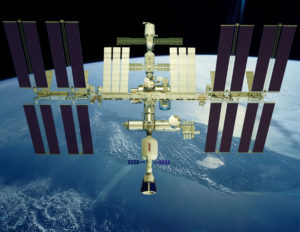
Currently, live views from the ISS are streaming from an external camera mounted on the ISS module called Node 2. Node 2 is located on the forward part of the ISS. The camera is looking forward at an angle so that the International Docking Adapter 2 (IDA2) is visible. If the Node 2 camera is not available due to operational considerations for a longer period of time, a continuous loop of recorded HDEV imagery will be displayed. The loop will have “Previously Recorded” on the image to distinguish it from the live stream from the Node 2 camera. After HDEV stopped sending any data on July 18, 2019, it was declared, on August 22, 2019, to have reached its end of life. Thank You to all who shared in experiencing and using the HDEV views of Earth from the ISS to make HDEV so much more than a Technology Demonstration Payload!
Here is the latest episode in NASA’s Space to Ground weekly report on activities related to the International Space Station:
** Ax-1 Astronauts speak with Houston-area students at Space Center Houston – Axiom Space
Axiom Space is guided by the vision of a thriving home in space that benefits every human, everywhere. The leader in providing space infrastructure as a service, Axiom offers end-to-end missions to the International Space Station today while privately developing its successor – a permanent commercial destination in Earth’s orbit that will sustain human growth off the planet and bring untold benefits back home. More information about Axiom can be found at www.axiomspace.com.
** Ax-1 Mission Update – Flight Day Seven – Axiom Space
** Expedition 67 – NASA’s SpaceX Crew-3 Talks to Media Before Departing Station – April 15, 2022 – NASA Video
Aboard the International Space Station, Expedition 67 Flight Engineers Raja Chari, Tom Marshburn, and Kayla Barron of NASA and ESA (European Space Agency) astronaut Matthias Maurer reflected back and discussed their six-month mission aboard the orbital outpost during a crew news conference April 15. The Crew-3 astronauts are nearing the end of a long duration mission living and working aboard the microgravity laboratory to advance scientific knowledge and demonstrate new technologies for future human and robotic exploration missions as part of NASA’s Moon and Mars exploration approach, including lunar missions through NASA’s Artemis program.
** Space Tango: Expanding Capabilities and Partnerships for Stem Cell Discovery and Manufacturing – ISS National Lab – YouTube
During the stem cell session of the 2020 Tissue Engineering and Regenerative Medicine Onboard the ISS workshop, Jana Stoudemire, commercial innovation officer at Space Tango, discusses how Space Tango is supporting space-based stem cell research and talks about the company’s mission to manufacture health and technology products in space that lead to valuable and transformational solutions.
During the biomanufacturing session of the 2020 Tissue Engineering and Regenerative Medicine Onboard the ISS workshop, Orchid Garcia, research fellow and lead for 3D bioprinting and tissue regen technologies at Johnson & Johnson, discusses the company’s approach to gaining a deeper understanding of tissue regeneration and bioprinting technologies to develop new ways to diagnose and treat patients on Earth.
Astronauts Megan McArthur and Aki Hoshide discuss how engineers designed the U.S. Destiny module so that every cubic inch of volume is used efficiently. Astronauts give a tour of the orbiting module aboard the International Space Station and discuss how engineers use area and volume calculations to strategically design how the space is used in microgravity. Be sure to check out https://www.nasa.gov/stemonstrations for more videos like this, along with their corresponding Classroom Connection lesson plans.
On 23 March 2022, ESA astronaut Matthias Maurer successfully performed his first extravehicular activity (EVA) alongside fellow @NASA astronaut Raja Chari. The spacewalk, dubbed “US EVA 80”, was carried out in support of assembly, refurbishment and maintenance work on the International Space Station. In this video, Matthias Maurer answers questions and reports on his experiences, feelings and the challenges he faced during his almost seven-hour-long spacewalk. …
** Chinese astronauts packing for return trip & jump rope in space! – VideoFromSpace
Chinese astronauts Wang Yaping, Ye Guangfu, and Zhai Zhigang are preparing for the return to Earth and even find time for some jump rope. Credit: Space.com | footage courtesy: China Central Television (CCTV) | edited by [Steve Spaleta]
The Shenzhou-13 crewed spacecraft, which has completed all its scheduled tasks, will separate from the space station core module Tianhe at an appropriate time and land at the Dongfeng landing site in north China’s Inner Mongolia Autonomous Region, said the China Manned Space Agency (CMSA) on Thursday. …
Currently, live views from the ISS are streaming from an external camera mounted on the ISS module called Node 2. Node 2 is located on the forward part of the ISS. The camera is looking forward at an angle so that the International Docking Adapter 2 (IDA2) is visible. If the Node 2 camera is not available due to operational considerations for a longer period of time, a continuous loop of recorded HDEV imagery will be displayed. The loop will have “Previously Recorded” on the image to distinguish it from the live stream from the Node 2 camera. After HDEV stopped sending any data on July 18, 2019, it was declared, on August 22, 2019, to have reached its end of life. Thank You to all who shared in experiencing and using the HDEV views of Earth from the ISS to make HDEV so much more than a Technology Demonstration Payload!
1. Tuesday, Apr. 12, 2022; 7 pm PST (9 pm CST, 10 pm EST): No new shows this week. See archive program suggestions with links to the first four interviews with Dr. Gilbert Levin. From David Livingston:
Gil was a first class and favorite Space Show guest dating back to his first time on the program, June 23, 2013. Unfortunately I was unable to attend Gil’s celebration but because I am away this week preparing for The Space Show move to Summerlin, NV, I thought I would play all the archived programs from Gil being on The Space Show.
2. Hotel Mars – Wednesday, Apr. 13, 2022; 1:00 pm PST (3:00 pm CST, 4:00 pm EST): TBD. Check the Upcoming Show Menu at www.thespaceshow.com for updates on scheduling.
3. Friday, Apr.15, 2022; 9:30-11 am PST (11:30 am-1 pm CST, 12:30-2 pm EST): No new show this week. See archive program suggestions with links to the first four interviews with Dr. Gilbert Levin.
4. Sunday, Apr.17, 2022; 12-1:30 pm PST (2-3:30 pm CST, 3-4:30 pm EST): No program on Easter Sunday. See archive program suggestions with links to the first four interviews with Dr. Gilbert Levin.
This composite shows thermal images of Neptune taken between 2006 and 2020. The first three images (2006, 2009, 2018) were taken with the VISIR instrument on ESO’s Very Large Telescope while the 2020 image was captured by the COMICS instrument on the Subaru Telescope (VISIR wasn’t in operation in mid-late 2020 because of the pandemic). After the planet’s gradual cooling, the south pole appears to have become dramatically warmer in the past few years, as shown by a bright spot at the bottom of Neptune in the images from 2018 and 2020.
An international team of astronomers have used ground-based telescopes, including the European Southern Observatory’s Very Large Telescope (ESO’s VLT), to track Neptune’s atmospheric temperatures over a 17-year period. They found a surprising drop in Neptune’s global temperatures followed by a dramatic warming at its south pole.
“This change was unexpected,” says Michael Roman, a postdoctoral research associate at the University of Leicester, UK, and lead author of the study published today in The Planetary Science Journal. “Since we have been observing Neptune during its early southern summer, we expected temperatures to be slowly growing warmer, not colder.”
Like Earth, Neptune experiences seasons as it orbits the Sun. However, a Neptune season lasts around 40 years, with one Neptune year lasting 165 Earth years. It has been summertime in Neptune’s southern hemisphere since 2005, and the astronomers were eager to see how temperatures were changing following the southern summer solstice.
Astronomers looked at nearly 100 thermal-infrared images of Neptune, captured over a 17-year period, to piece together overall trends in the planet’s temperature in greater detail than ever before.
These data showed that, despite the onset of southern summer, most of the planet had gradually cooled over the last two decades. The globally averaged temperature of Neptune dropped by 8 °C between 2003 and 2018.
The astronomers were then surprised to discover a dramatic warming of Neptune’s south pole during the last two years of their observations, when temperatures rapidly rose 11 °C between 2018 and 2020. Although Neptune’s warm polar vortex has been known for many years, such rapid polar warming has never been previously observed on the planet.
“Our data cover less than half of a Neptune season, so no one was expecting to see large and rapid changes,”
says co-author Glenn Orton, senior research scientist at Caltech’s Jet Propulsion Laboratory (JPL) in the US.
The astronomers measured Neptune’s temperature using thermal cameras that work by measuring the infrared light emitted from astronomical objects. For their analysis the team combined all existing images of Neptune gathered over the last two decades by ground-based telescopes. They investigated infrared light emitted from a layer of Neptune’s atmosphere called the stratosphere. This allowed the team to build up a picture of Neptune’s temperature and its variations during part of its southern summer.
Because Neptune is roughly 4.5 billion kilometres away and is very cold, the planet’s average temperature reaching around –220°C, measuring its temperature from Earth is no easy task.
“This type of study is only possible with sensitive infrared images from large telescopes like the VLT that can observe Neptune clearly, and these have only been available for the past 20 years or so,”
says co-author Leigh Fletcher, a professor at the University of Leicester.
The image of the planet Neptune on the left was obtained during the testing of the Narrow-Field adaptive optics mode of the MUSE instrument on ESO’s Very Large Telescope. The image on the right is a comparable image from the NASA/ESA Hubble Space Telescope. Note that the two images were not taken at the same time so do not show identical surface features.
Around one third of all the images taken came from the VLT Imager and Spectrometer for mid-InfraRed (VISIR) instrument on ESO’s VLT in Chile’s Atacama Desert. Because of the telescope’s mirror size and altitude, it has a very high resolution and data quality, offering the clearest images of Neptune. The team also used data from NASA’s Spitzer Space Telescope and images taken with the Gemini South telescope in Chile, as well as with the Subaru Telescope, the Keck Telescope, and the Gemini North telescope, all in Hawai‘i.
Because Neptune’s temperature variations were so unexpected, the astronomers do not know yet what could have caused them. They could be due to changes in Neptune’s stratospheric chemistry, or random weather patterns, or even the solar cycle. More observations will be needed over the coming years to explore the reasons for these fluctuations. Future ground-based telescopes like ESO’s Extremely Large Telescope (ELT) could observe temperature changes like these in greater detail, while the NASA/ESA/CSA James Webb Space Telescope will provide unprecedented new maps of the chemistry and temperature in Neptune’s atmosphere.
“I think Neptune is itself very intriguing to many of us because we still know so little about it,” says Roman. “This all points towards a more complicated picture of Neptune’s atmosphere and how it changes with time.”