Here’s an interesting overview of radiation exposure issues encounter by space travelers: Surviving Radiation in Space – Astrowright.
Another review of The Art of Citizen Space Exploration
Here’s another review of the exhibition Free Enterprise: The Art of Citizen Space Exploration in Southern California: Space As A Creative Muse – Co.Design – Feb.12.13.
ArduSat Academy Summer Program 2013
An announcement from Nanosatisfi:
ArduSat Academy Launches 4 Week Space Experience
NanoSatisfi, LLC is pleased to announce that registration is now open for ArduSat Academy Summer Program 2013. Ardusat Academy is an opportunity for students, hackers, makers, DIY space enthusiasts, and anyone interested in space, science, or programming to learn how to devise and prepare their own satellite-based experiment. Building on the ArduSat initiative to make space accessible to all, ArduSat Academy gives participants the tools they need to best make use of that opportunity.
“In just four weeks, anyone can design and program their own space-based experiment or experience,” says ArduSat Academy Program Director Merryl Azriel. “This isn’t just a project to keep you busy through yet another summer: this is the real deal, with a real satellite.”
Participants will discover the nuts and bolts of satellite operations, explore the capabilities of ArduSat’s sensor suite, learn to program and assemble Arduinos, and design and test a program to execute their experiments in orbit. This summer, participants will also be able to witness the July launch of ArduSat-1 and meet with the engineers that made it all happen.
The four week program will run June 24 through July 19, with morning, afternoon, and weekend sessions available. $2000 will get you in the program, which will be held in the San Francisco metropolitan area. No prior experience is necessary. All ages 13 years and above are welcome.
For more details about ArduSat Academy Summer Program 2013 and to register, visit us at ardusatacademy.org.
About NanoSatisfi, LLC
San Francisco-based NanoSatisfi formed in the summer of 2012, with a mission of providing convenient, affordable, on-demand access to satellites. NanoSatisfi’s founders together combine experience at 9 universities, in 8 companies, in 7 languages, and on 3 continents. NanoSatisfi prides itself on being free from the old mindset of “space costs millions and take years,” and is devoted to making space accessible and affordable for everyone. The company’s first two satellites were crowdfunded via a Kickstarter campaign. The results of that campaign – a space-based application platform comprised of an AVR/Arduino based computer in a CubeSat standard with a freely programmable micro-processor and 25 sensors – will launch with NanoRacks in the summer of 2013. Learn more at www.nanosatisfi.com.
New Mexico space museum volunteers restoring DC-X for exhibit
The New Mexico Museum of Space History in Alamogordo has a project to build an exhibit about the Delta Clipper eXperimental (DC-X) reusable rocket project of the early 1990s:
Restoration Center Open House Highlights
DC-X Volunteers
Alamogordo, NM: It’s not exactly the Taos hum, but there’s a growing buzz in Alamogordo, New Mexico, that’s coming from across the tracks. Specifically, from the New Mexico Museum of Space History’s Restoration Center which is located, coincidentally, across the railroad tracks off of Tenth Street. You’ll mostly hear it on Wednesday and Saturday mornings, when volunteers converge on the building to continue what has become a serious mission for them. The target of the volunteer team’s work is the Delta Clipper Experimental (DC-X), an operations and technology demonstrator for a single stage to orbit reusable launch vehicle that had been flight tested at White Sands Missile Range in the early ‘90’s.
A remarkable vehicle, the DC-X was touted at the time as bringing America to the “threshold of a new era in space”, making space available to the general public for business or pleasure. It demonstrated that a single stage to orbit vertical launch, vertical landing craft which could deliver a payload to low earth orbit, could be routinely and safely operated like an airplane and at one tenth the cost of conventional expendable launch vehicles or the Space Shuttle. With famed Apollo astronaut and space visionary Pete Conrad as the Flight Commander, a small dedicated group of government and industry engineers and program managers, sustained by avid supporters, were about to make aerospace history.
The first flight of the DC-X from the “Clipper-Site” was on August 18, 1993, at Northrup Strip, now known as White Sands Space Harbor, on White Sands Missile Range, New Mexico. The team actually built a mini-spaceport along the edge of the Northrop Strip. It incorporated all the functions of an operational spaceport.
It was a breathtaking vertical launch that left the spectators in attendance in awe. “The DC-X launched vertically, hovered in mid-air at 150 feet, and began to move sideways at a dogtrot. After traveling 350 feet, the onboard global-positioning satellite unit indicated that the DC-X was directly over its landing point. The spacecraft stopped mid-air again and, as the engines throttled back, began its successful vertical landing. Just like Buck Rogers,” said an article from the Ada Joint Program Office of the U.S. Government.
Behind the scenes though, before the launch, all was not perfect.
An article in the Space Review written by Jeff Foust said: “A key incident that many people recalled was the storm that hit White Sands the night before the scheduled first flight, damaging equipment and flooding the launch site. “Arriving at the pad at around 4:30 in the morning and seeing the damage was appalling,” recalled Joaquin Castro, who was on the DC-X propulsion team. “A pall of failure hung over the team as we surveyed the damage… there was no way we were going to fly that day.”
Conrad, though, was undaunted, Castro recalled. “He looked at all of us, got us in a huddle, and said, ‘We have the opportunity to make history here today. We have a whole bunch of people coming to see us fly this afternoon. It will not be easy, but if anybody can do it, it’s us. Let’s not give up without trying.’” Conrad then picked up a shovel, Castro said, and started cleaning out one of the trenches at the site that has been filled with sand and water by the storm. “The rest is history.”
The Delta Clipper flew a total of 12 flights, eight under the McDonnell Douglas test program and four under the auspices of NASA as the DC-X/A. According to the NASA website, “during flight 4 (as the DC-X/A) on July 31, 1997, landing strut 2 failed to extend, causing the unbalanced vehicle to tip over on its landing pad.” The LOX tank fractured, feeding fires that erupted on the landing pad. The LH2 tank finally failed as its internal pressure exceeded the ultimate design strength of the composite tank walls. The ensuing fire damaged large sections of the DC-XA. An investigation board was convened to determine the cause of the accident, which was later determined to be an unconnected helium pressurant line that supplied pressure to release the landing strut.
The conclusion of the program was summed up well by the Reusable Launch Vehicle program director, Gary Payton. He stated, “The way the budget is now, we cannot afford to rebuild the Clipper Graham and will not be able to continue with that takeoff and landing technique, so we will declare victory with the DC-XA. Like any good experimental vehicle, the DC-XA flew until it was destroyed. We will always be impressed by the lessons this little rocket taught us about the right way to travel to the heavens…”
After the explosion, and following investigation, various pieces and parts of the DC-X/XA, were gathered up and stored at Marshall Space Flight Center. The aeroshell had been completely destroyed along with most of the LOX tank. A major component, the thrust structure, was actually destined for the recycler but every time it got close to going to the junk yard it was mysteriously moved to a safer location. Eventually, members of the original DC-X team were able to get the thrust structure, the original LOX tank, the oxygen tank, the landing struts and a couple of huge crates of miscellaneous parts loaned to the NM Museum of Space History.
Another thing DC-X did, said U.S. Air Force Major Jess Sponable, a Government Program Manager on the project, was jumpstart the development of commercial vehicles. There was an initial generation of vehicles and ventures that “captured the vision of DC-X in different ways” in the 1990s. More recently, a second generation inspired by DC-X has emerged, focused primarily, although not exclusively, on suborbital spaceflight. (From an article by Jeff Foust on Monday, August 25, 2008, published in The Space Review.)
One of the new commercial space companies that drew inspiration from the DC-X program is Burt Rutan’s Scaled Composites, the company that won the $10 million Ansari X PRIZE in 2004 with SpaceShipOne. Rutan’s design fueled Richard Branson’s imagination and he consequently founded Virgin Galactic, which will be flying SpaceShipTwo from Spaceport America in New Mexico.
The Delta Clipper Experimental started a hum in the aerospace industry that is now being heard around the world, and today, as in 1993, that hum is emanating from the Tularosa Basin. A cast of volunteers, from retired engineers to middle school students spend two days a week on what has become a labor of love for them – the restoration of the original Delta Clipper. The burned thrust structure, seriously damaged in the fire that marked the end of the program, is now nearly ready for display at the New Mexico Museum of Space History in Alamogordo, New Mexico. Two quadrants have been polished and shined. Flashy new insulating tape adorns the hydraulic lines and the signs of the damage have all but been removed. The remaining two quadrants have been left in their original condition, the blackened metal a bleak reminder of that last flight. The landing struts, boxed for nearly twenty years, are now nearly as pristine as they were on the morning of the first flight.
Several of the original engineers, spearheaded by Mike Johnson and Nino Polizzi, and program managers for the DC-X program have been working with Museum staff for the past several years on an exhibit design concept. In the last year, the restoration project began in earnest led by Museum Assistant Curator Jim Mayberry and lead volunteer Larry Strain. Their goal is to have as much as possible done by August 2013 when an estimated 200 DC-X/XA team members and supporters are expected in Alamogordo to celebrate the DC-X first flight 20th Anniversary.
The volunteers meet each Wednesday and Saturday morning at 9:00 am to continue their restoration project. Wednesday’s group is a bit smaller than Saturday’s, usually numbering about five or six local retirees. Saturday mornings, things liven up when high school and middle school students join the mix. Although the focus is on the DC-X, new projects are always in the works. The middle school students have started repairing a group of robots used by the museum’s education department while another group of volunteers have been piecing the parts of a large GPS exhibit back together. Restoring an Apollo Lunar Landing Module model is next on their list.
To highlight the hard work this dedicated group of volunteers, young and old, have done, the Museum of Space History is hosting a community open house at the Restoration Center on Saturday January 19th from 9:00 am until 1:00 pm. Not only will the public be able to see the DC-X restoration project but they’ll also have an opportunity for a behind the scenes tour of the Museum’s support center, at 1402 Eddy Drive (near the old sawmill). From missiles to mock-ups of the lunar lander, the Museum is the caretaker of a significant collection of artifacts many of which are stored at the restoration center. The Museum expresses a special thank you to Tularosa Basin Telephone for sponsoring wireless internet service at the Restoration Center. For more information, contact Cathy Harper at the Museum at 575-437-2840 ext. 41153 or email at cathy.harper@state.nm.us.
The New Mexico Museum of Space History is a division of the NM Department of Cultural Affairs. For more information, call 575-437-2840 or toll free 1-877-333-6589 or visit the website at www.nmspacemuseum.org.
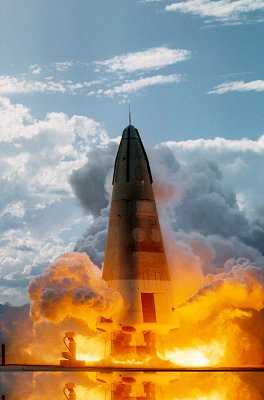
Clipper DCX rocket: The Delta Clipper flew a total of 12 flights, eight under the original Strategic Defense Initiative Office (SDIO) sponsored test program and four under the auspices of NASA as the DC-X/A. According to the NASA website, “during flight 4 (as the DC-X/A) on July 31, 1997, landing strut 2 failed to extend, causing the unbalanced vehicle to tip over on its landing pad.” The LOX tank fractured, feeding fires that erupted on the landing pad. The LH2 tank finally failed as its internal pressure exceeded the ultimate design strength of the composite tank walls. The ensuing fire damaged large sections of the DC-XA.
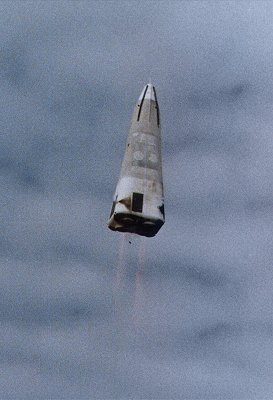
DCX flying: “It was amazing to see the DC-X hanging in mid-air, while the preprogramed flight controls switched over to a horizontal flight direction while the vehicle remained in its vertical takeoff orientation. There was a spontaneous gasp and then cheers from the small crowd that was fortunate enough to see this historic flight take place. The DC-X flew steadily across to its next “way-point” 350 feet from the flight stand, puffing out little clouds of vapor as the pressure relief valves maintained the operating tank pressures. It then hovered there while its flight control set up for the vertical landing on the concrete pad. The DC-X throttled back its four engines, extended the four landing gear, and settled down nearly in the center of the landing pad and then shut off its engines,” said Program Manager William Gaubatz.
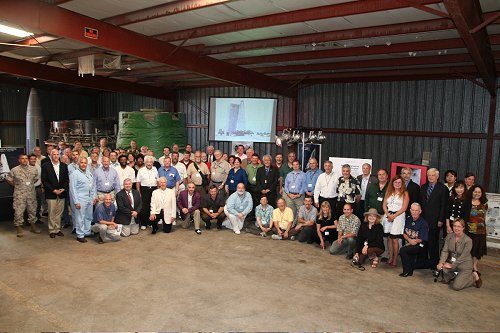
15th Anniversary Group Shot MSC: On August 17, 18 & 19, 2008, 145 engineers, entrepreneurs, scientists, writers and supporters of the DC-X converged on Alamogordo, New Mexico, to celebrate the 15th Anniversary of the first flight. Along with the reunion, a space conference was held focusing on “Spaceflight for the 21st Century”. Speakers included former NASA Director Michael Griffin, Dr. S. Pete Worden, Director of the NASA Ames Research Center, Mr. Gary Payton, Deputy Under Secretary of the Air Force for Space Programs, and many other dignitaries. This group poses in front of the DC-X artifacts housed at the Museum of Space History’s restoration center.
On August 16, 17 and 18, 2013, the Museum will host the DC-X First Flight + Twenty Anniversary and space conference entitled “Securing the Past/Inspiring the Future”. The first day of the event will be held at Spaceport America, followed by two days at the New Mexico Museum of Space History in Alamogordo, New Mexico.
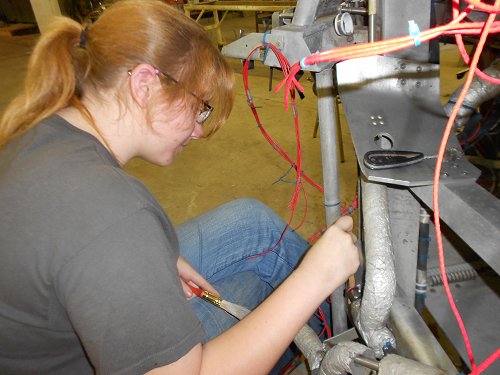
Shiloh Langwell: Shiloh Langwell, works carefully to remove debris from the hydraulic lines attached to the thrust structure of the DC-X. Shiloh, a student at Alamogordo High School, began volunteering at the New Mexico Museum of Space History as a guide and has been awarded the Museum’s Volunteer of the Quarter award. An aspiring engineer, Shiloh spends most Saturday mornings at the Museum’s restoration center working on the DC-X.
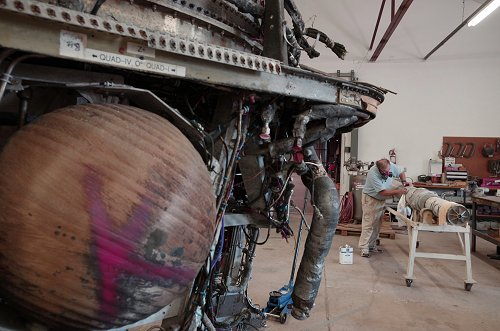
Larry Strain: Volunteer Larry Strain gently removes corrosion from one of the DC-X landing struts. Strain, a federal retiree, volunteers five to six days each week at the NM Museum of Space History. Strain has taken the lead on the DC-X restoration and has been instrumental in reviving the student volunteer program, bringing half a dozen Chaparral Middle School students to help with the DC-X project and other activities. Volunteers meet each Wednesday and Saturday mornings at 9:00 am at the Museum’s restoration center.
Carnival of Space #288 – Dear Astronomer
The Dear Astronomer blog hosts the latest Carnival of Space.