NextBigFuture.com hosts the latest Carnival of Space.

====
NextBigFuture.com hosts the latest Carnival of Space.
====
The latest report from ESO (European Southern Observatory)
Supersharp Images from New VLT Adaptive Optics
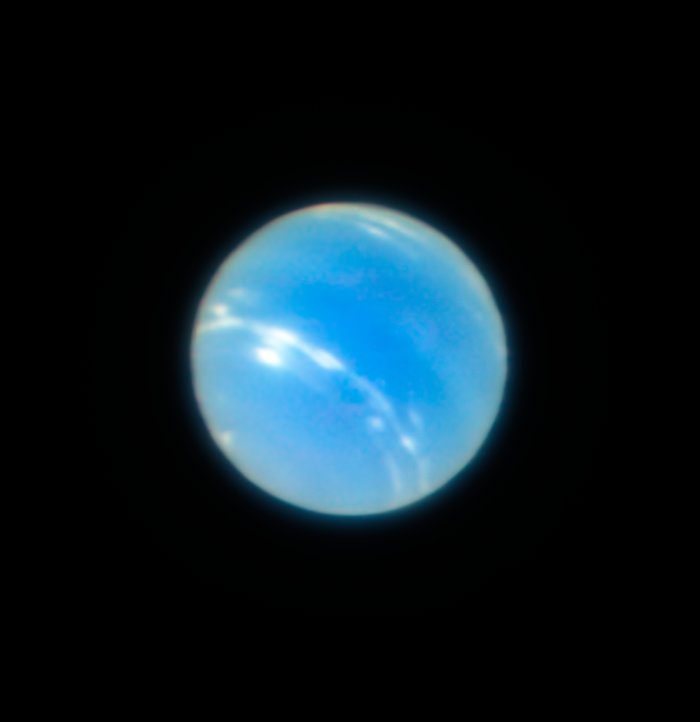
The MUSE (Multi Unit Spectroscopic Explorer) instrument on ESO’s Very Large Telescope (VLT) works with an adaptive optics unit called GALACSI. This makes use of the Laser Guide Star Facility, 4LGSF, a subsystem of the Adaptive Optics Facility (AOF). The AOF provides adaptive optics for instruments on the VLTs Unit Telescope 4 (UT4). MUSE was the first instrument to benefit from this new facility and it now has two adaptive optics modes — the Wide Field Mode and the Narrow Field Mode [1].
The MUSE Wide Field Mode coupled to GALACSI in ground-layer mode corrects for the effects of atmospheric turbulence up to one kilometre above the telescope over a comparatively wide field of view. But the new Narrow Field Mode using laser tomography corrects for almost all of the atmospheric turbulence above the telescope to create much sharper images, but over a smaller region of the sky [2].
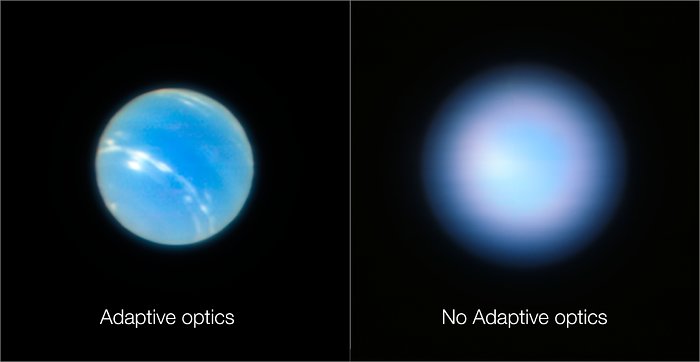
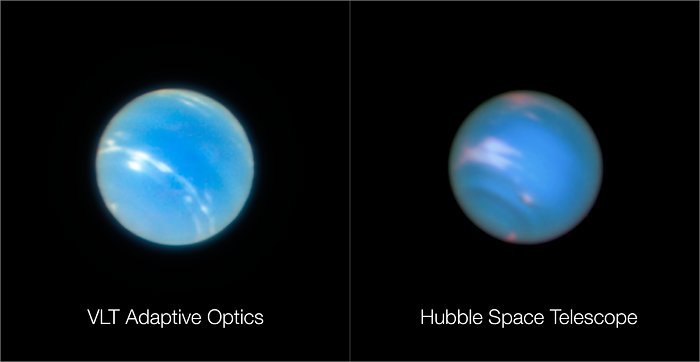
To achieve this four brilliant lasers are fixed to UT4 that project columns of intense orange light 30 centimetres in diameter into the sky, stimulating sodium atoms high in the atmosphere and creating artificial Laser Guide Stars. Adaptive optics systems use the light from these “stars” to determine the turbulence in the atmosphere and calculate corrections one thousand times per second, commanding the thin, deformable secondary mirror of UT4 to constantly alter its shape, correcting for the distorted light.
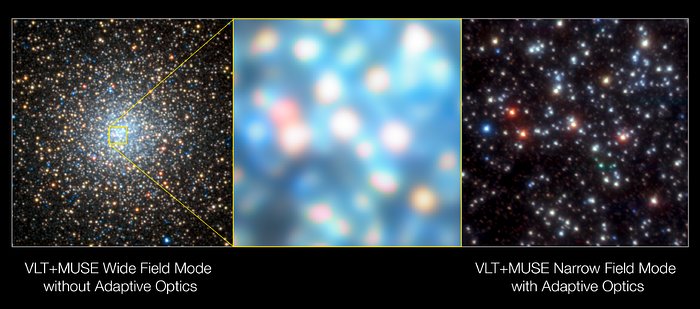
This new mode also constitutes a major step forward for the ESO’s Extremely Large Telescope, which will need Laser Tomography to reach its science goals. These results on UT4 with the AOF will help to bring ELT’s engineers and scientists closer to implementing similar adaptive optics technology on the 39-metre giant.
Notes
[1] MUSE and GALACSI in Wide-Field Mode already provides a correction over a 1.0-arcminute-wide field of view, with pixels 0.2 by 0.2 arcseconds in size. This new Narrow-Field Mode from GALACSI covers a much smaller 7.5-arcsecond field of view, but with much smaller pixels just 0.025 by 0.025 arcseconds to fully exploit the exquisite resolution.
[2] Atmospheric turbulence varies with altitude; some layers cause more degradation to the light beam from stars than others. The complex adaptive optics technique of Laser Tomography aims to correct mainly the turbulence of these atmospheric layers. A set of pre-defined layers are selected for the MUSE/GALACSI Narrow Field Mode at 0 km (ground layer; always an important contributor), 3, 9 and 14 km altitude. The correction algorithm is then optimised for these layers to enable astronomers to reach an image quality almost as good as with a natural guide star and matching the theoretical limit of the telescope.
Here is the latest TMRO.tv Space program: What’s missing to get humans to Mars? – Orbit 11.28 – TMRO
We have our scheduled roundtable this week, voted on by the Citizens of TMRO. Jared hosts and asks, “What are the missing pieces needed to get humans to Mars?” This turned in to a really lively discussion and we would love your comments below or on our new forums at https://community.tmro.tv
And a recent TMRO.tv Science program: Wearable Tech – Discovery 01.07 – TMRO
Alex Moss of Canaria joins us to talk about their wearable tech and how it can help save lives. By wearing a small device behind the ear, Canaria can track your fatigue levels to help anyone working in dangerous environments. Has amazing applications in medical, space and construction as well.
====
The BlackFly vertical takeoff and landing (VTOL) craft is not a concept but has actually flown over “1,000+ flights and 10,000+ miles”:
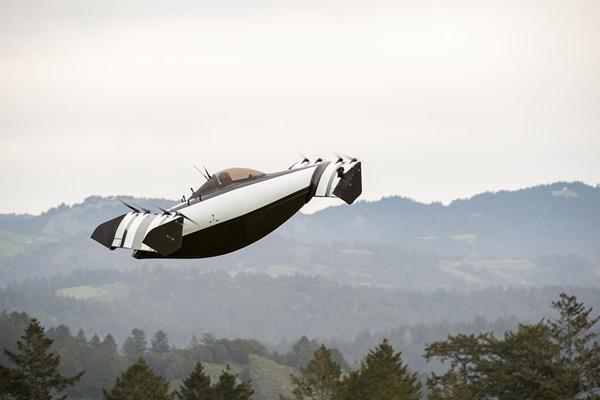
The Silicon Valley based company Opener has been developing the vehicle since 2011.
BlackFly is simple to master and requires no formal licensing (in USA) or special skills to operate safely. Though BlackFly has full amphibious capabilities, it is primarily designed to easily operate from small grassy areas and travel distances of up to 25 miles at a speed of 62 mph (USA restriction).
OPENER is re-energizing the art of flight with a safe and affordable flying vehicle that can free its operators from the everyday restrictions of ground transportation,” said Marcus Leng, CEO. “We will offer competitive pricing in an endeavor to democratize three-dimensional personal transportation. Safety has been our primary driving goal in the development of this new technology. OPENER will be introducing this innovation in a controlled and responsible manner. Even though not required by FAA regulations, BlackFly operators will be required to successfully complete the FAA Private Pilot written examination and also complete company-mandated vehicle familiarization and operator training.”
The OPENER team has spent the last nine years in stealth mode, designing, developing, and testing new innovative technologies which have now evolved into the zero-emission BlackFly vehicles. Fault-tolerant design and triple modular redundancy reside at the core of these vehicles. Eight propulsion systems, spread across two wings, provide for multiple-failure security. Years of continuous testing, combined with 1,000+ flights and 10,000+ miles flown, form the bedrock of OPENER’s development program.
OPENER’s long-term vision is to integrate these highly-efficient vehicles into a rural/urban commuting network. These networks would be powered by renewable energy sources requiring only a fraction of the transportation energy used currently.
More at
===
Google co-founder Larry Page is an investor in Opener – Larry Page invests in another flying car startup – KEYT – and also has his own personal VTOL vehicle company called Kitty Hawk. The Kitty Hawk Flyer is intended for different purposes than the BlackFly. Rather than commuting over land, the Flyer is a recreational vehicle for flying over water. In fact, it is limited to flying no higher than 3 meters/10 feet and 20 mph. It can fly for 12-20 minutes.
More about the Flyer at
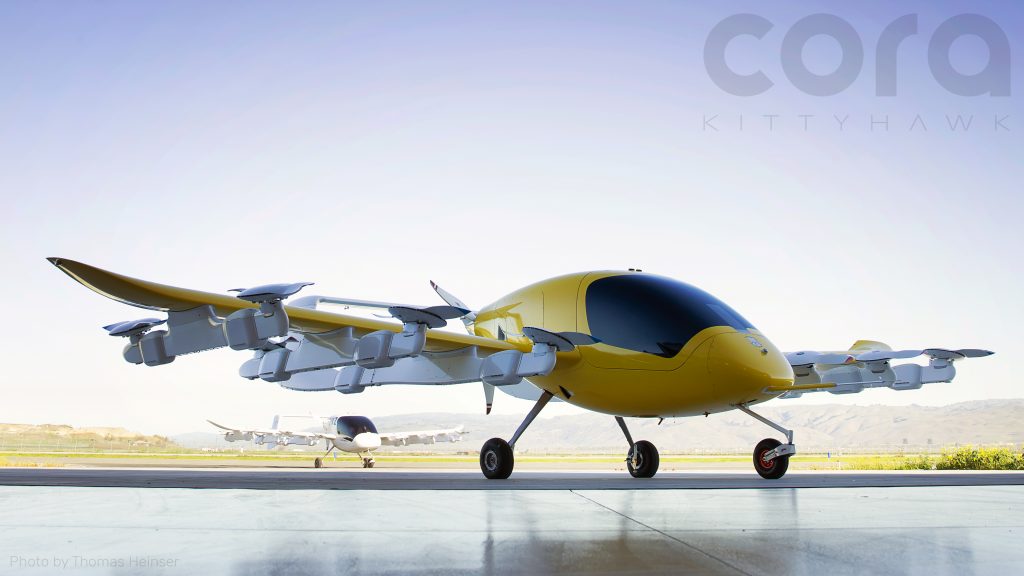
The Cora is Kitty Hawk’s entry in the VTOL air taxi market. The two passenger vehicle will initially travel up to “62 miles / about 100 kilometres” and at “about 110 miles per hour / about 180 kilometres per hour”. Flights of the Cora, under development in New Zealand, have not yet been demonstrated in public.

===
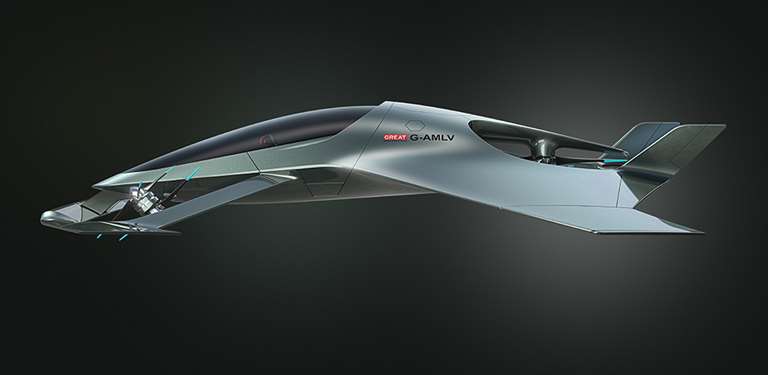
This VTOL single-seater isn’t flying yet but it will sure be one of the coolest looking ones if it ever does: The Aston Martin Volante Vision Concept | Aston Martin
====
The guests and topics of discussion on The Space Show this week:
1. Monday, July 16, 2018; 2-3:30 pm PDT (4-5:30 pm CDT, 5-6:30 pm EDT): We welcome back Dr. Jason Kalirai to discuss WFIRST, HUBBLE & JWST.
2. Tuesday, July 17, 2018: 7-8:30 pm PDT; 9-10:30 pm CDT; 10-11:30 pm EDT: We welcome back Bob Zimmerman (BehindTheBlack.com) for news and updates.
3. Wednesday, July 18, 2018: Hotel Mars. See Upcoming Show Menu and the website newsletter for details. Hotel Mars is pre-recorded by John Batchelor. It is archived on The Space Show site after John posts it on his website.
4. Friday, July 20, 2018; 9:30 am -11 am PDT, (12:30 -2 pm EDT; 11:30 am -1 pm CDT): We welcome back Bruce Pittman with Dr. Bruce Cahan to talke about the Space Commodities Futures Trading Exhange.
5. Sunday, July 22, 2018: 12-1:30 pm PDT; 2-3:30 pm CDT; 3-4:30 pm EDT. We welcome back Rand Simberg and Bill Simon for EVOLOTERRA 2018!
See also:
* The Space Show on Vimeo – webinar videos
* The Space Show’s Blog – summaries of interviews.
* The Space Show Classroom Blog – tutorial programs
The Space Show is a project of the One Giant Leap Foundation.