I’ve posted several times about Elon Musk’s Hyperloop fast mass transit concept. Today he posted a couple of brief statements about plans to build a test track:
Update: Here is a transcript (courtesy Trent Waddington) of Elon’s remarks in Texas in which he briefly mentions the Hyperloop test track before switching to comments about Tesla.
If Musk does in fact build a test track, in Texas or elsewhere, it would be a huge help to the company that’s made more progress than anyone toward making the Hyperloop happen. The track isn’t the part of this endeavor that’s hard to engineer. “It’s a couple of tubes and a vacuum pump,” says Dirk Ahlborn, CEO of JumpStartFund, an El Segunda, California-based startup that is taking Musk up on his challenge to develop and build the Hyperloop. But, like most chunks of infrastructure, even in prototype sizes, it’s expensive.
Ten years ago, an explorer from Earth parachuted into the haze of an alien moon toward an uncertain fate. After a gentle descent lasting more than two hours, it landed with a thud on a frigid floodplain, surrounded by icy cobblestones. With this feat, the Huygens probe accomplished humanity’s first landing on a moon in the outer solar system. Huygens was safely on Titan, the largest moon of Saturn.
The hardy probe not only survived the descent and landing, but continued to transmit data for more than an hour on the frigid surface of Titan, until its batteries were drained.
Since that historic moment, scientists from around the world have pored over volumes of data about Titan, sent to Earth by Huygens — a project of the European Space Agency — and its mothership, NASA’s Cassini spacecraft. In the past 10 years, data from the dynamic spacecraft duo have revealed many details of a surprisingly Earth-like world.
In addition to the technical wizardry needed to pull off this tour de force, international partnerships were critical to successfully delivering the two spacecraft to Saturn and Titan.
“A mission of this ambitious scale represents a triumph in international collaboration,” said Earl Maize, Cassini Project manager at NASA’s Jet Propulsion Laboratory in Pasadena, California.
“From the mission’s formal beginning in 1982, to Huygens’ spectacular landing 23 years later, to the present day, Cassini-Huygens owes much of its success to the tremendous synergy and cooperation between more than a dozen countries. This teamwork is still a major strength of the project as the Cassini orbiter continues to explore the Saturn system,” Maize said.
A gallery of some of the best images related to Huygens is available at:
A decade ago, Titan was known as a hidden, hazy world. Findings made by NASA’s Cassini mission and the European Space Agency’s Huygens probe have unveiled Titan as an “alien Earth,” providing scientists with a unique world to explore.
A sampling of the top discoveries at Titan includes:
Lakes and Seas
Titan is a world with lakes and seas, made up of liquid methane and ethane. It is believed that these bodies of hydrocarbons are replenished by methane and ethane rainfall from clouds in the moon’s atmosphere. Titan is the only other place in the solar system known to have an Earth-like cycle of liquids flowing across its surface.
Active Meteorology and Surface Processes
Liquid methane drizzles onto Titan’s surface. Just like clouds on Earth, clouds on Titan form through a cycle of evaporation and condensation, with methane vapor rising from the surface, forming clouds and falling back down as precipitation. Huygens data suggest the presence of layered methane clouds in Titan’s troposphere, at altitudes between about 5 and 20 miles (8 and 30 kilometers). Titan’s “hydrological” cycle causes visible changes on the moon’s surface.
Organic Sand Seas
Seas of sand dunes, like those in Earth’s Arabian desert, are observed in the dark equatorial regions of Titan. Scientists believe the sand is not made of silicates as on Earth, but of solid water ice coated with hydrocarbons that fall from the atmosphere. Images show Titan’s dunes are gigantic, reaching, on average, 0.6 to 1.2 miles (1 to 2 kilometers) wide, hundreds of miles (kilometers) long and around 300 feet (100 meters) high.
The location of the Huygens probe’s resting place, a soft, sandy riverbed, was only confirmed after some time by the detection of two dark, longitudinal sand dunes, about 20 miles (30 kilometers) north of the landing site. The elusive landforms were visible in images from both Cassini radar and the probe.
First Determination of Depth for an Extraterrestrial Sea
Ligeia Mare, Titan’s second-largest sea, was revealed to be about 560 feet (170 meters) deep. This represents the first time scientists have been able to determine the depth of a body of open liquid on the surface of another world. This was possible, in part, because the liquid turned out to be mostly clear methane, allowing the radar signal to pass through it easily.
River Channels and Ice Cobbles
Images taken during the Huygens probe’s descent revealed river channels and flood plains. The probe’s cameras unveiled a plateau with a large number of dark channels cut into it, forming drainage networks that bore many similarities to those on Earth. The narrow channels converged into broad rivers, which drained into a broad, dark, lowland region. Earth-like river rocks, composed of water ice, were also observed at the Huygens probe landing site. Radar evidence from Cassini suggests that flash flooding has sculpted streambeds on Titan with these rounded cobbles of water ice, which likely originated in water-ice bedrock in higher terrain.
The Collapse of the Detached Haze
The massive atmosphere of Titan is shrouded in thick layers of photochemical smog. One of the “detached” layers has fallen in altitude from over 310 miles to only 240 miles (about 500 kilometers to only 380 kilometers) between 2006 and 2010. The changing altitudes indicate that Titan’s smog layers are coupled to a seasonal climate cycle.
Rich Chemistry in the Atmosphere, including Propylene
The Huygens probe made the first direct measurements of Titan’s lower atmosphere. Data returned by the probe included altitude profiles of the gaseous constituents, isotopic ratios and trace gases (including organic compounds). Huygens also directly sampled aerosols in the atmosphere and confirmed that carbon and nitrogen are their major constituents. Cassini detected propylene, a chemical used to make household plastic, in Titan’s atmosphere. This is the first definitive detection of the plastic ingredients on any moon or planet, other than Earth. Other chemicals observed indicate a rich and complex chemistry originating from methane and nitrogen and evolving into complex molecules, eventually forming the smog that surrounds the icy moon.
Argon-40 Isotope in the Atmosphere
Huygens’ detection of Argon-40, an isotope or type of the element argon, in Titan’s atmosphere indicates that the interior of Titan is still active. This is unusual in a moon and one of the first clues of subsurface liquid water on Titan. The presence of the Huygens probe on Titan’s surface was essential in detecting this substance, as it is mostly concentrated toward the bottom of the atmosphere (due to its relatively heavier weight compared to the lighter molecules comprising the atmosphere).
Liquid Water Subsurface Ocean
Cassini’s numerous gravity measurements of Titan revealed that this moon is hiding an internal, liquid water/ammonia ocean underneath its surface. Huygens also detected radio signals during its descent that strongly suggested the presence of an ocean 35 to 50 miles (55 to 80 kilometers) below the moon’s surface. The discovery of a global ocean of liquid water adds Titan to the handful of worlds in our solar system that could potentially contain habitable environments.
————————————————-
The Cassini-Huygens mission is a cooperative project of NASA, the European Space Agency and the Italian Space Agency. NASA’s Jet Propulsion Laboratory, a division of the California Institute of Technology in Pasadena, manages the mission for NASA’s Science Mission Directorate, Washington. JPL designed, developed and assembled the Cassini orbiter. NASA supplied two instruments on the Huygens probe, the Descent Imager/Spectral Radiometer and the Gas Chromatograph Mass Spectrometer.
More information about Cassini is available at the following sites:
The National Space Society (NSS) is looking for student artists to create ORIGINAL illustrations for the NSS Roadmap to Space Settlement. Submitted artwork should REALISTICALLY illustrate this year’s themes: People Living and Working in Space Settlements.
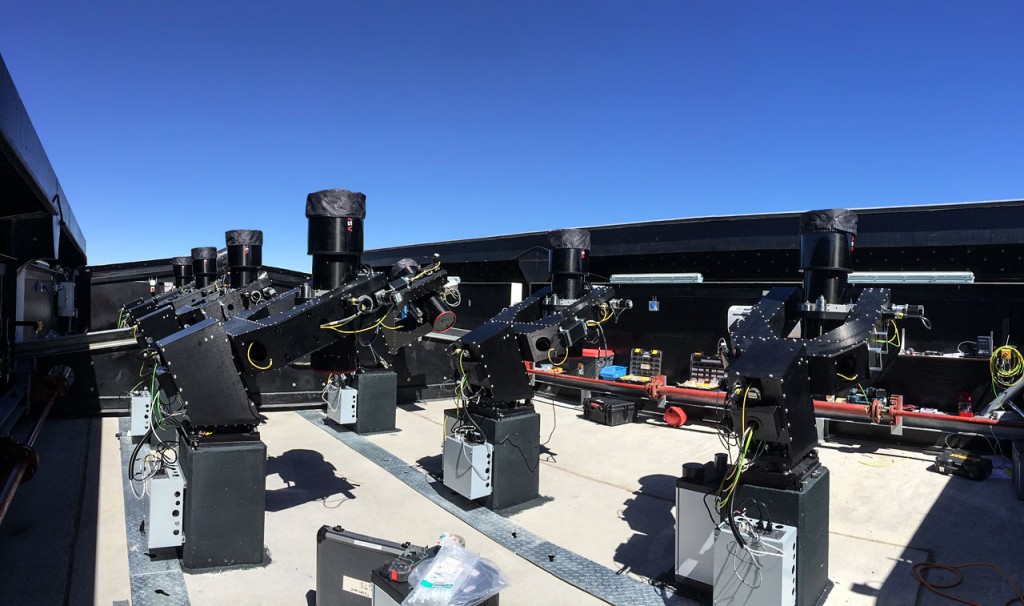
The Next-Generation Transit Survey (NGTS) has achieved first light at ESO’s Paranal Observatory in northern Chile. This project will search for transiting exoplanets — planets that pass in front of their parent star and hence produce a slight dimming of the star’s light that can be detected by sensitive instruments. The telescopes will focus on discovering Neptune-sized and smaller planets, with diameters between two and eight times that of Earth.
The Next-Generation Transit Survey (NGTS) is located at ESO’s Paranal Observatory in northern Chile. This project will search for transiting exoplanets — planets that pass in front of their parent star and hence produce a slight dimming of the star’s light that can be detected by sensitive instruments. The telescopes will focus on discovering Neptune-sized and smaller planets, with diameters between two and eight times that of Earth.
Most of the 20-centimetre telescopes that form the survey system are shown in this picture taken during testing. Credit: ESO/R. West
The Next-Generation Transit Survey (NGTS) is a wide-field observing system made up of an array of twelve telescopes, each with an aperture of 20 centimetres [1]. This new facility, built by a UK, Swiss and German consortium, is located at ESO’s Paranal Observatory in northern Chile and benefits from the superb observing conditions and excellent support facilities available at this site.
“We needed a site where there were many clear nights and the air was clear and dry so that we could make very accurate measurements as often as possible — Paranal was the best choice by far,” says Don Pollacco of the University of Warwick in the UK and one of the NGTS project leads.
NGTS is designed to operate in a robotic mode and it will continuously monitor the brightness of hundreds of thousands of comparatively bright stars in the southern skies. It is searching for transiting exoplanets and will reach a level of accuracy in measuring the brightness of stars — one part in a thousand — that has never before been attained with a ground-based wide-field survey instrument [2].
This great accuracy of brightness measurement, across a wide field, is technically demanding, but all the key technologies needed for NGTS were demonstrated using a smaller prototype system, which operated on La Palma in the Canary Islands during 2009 and 2010. NGTS also builds on the success of the SuperWASP experiment, which up to now leads in the detection of large gaseous planets.
The discoveries of NGTS will be studied further using other larger telescopes, including the ESO Very Large Telescope. One goal is to find small planets that are bright enough for the planetary mass to be measured. This will allow planetary densities to be deduced, which in turn provides clues about the composition of the planets. It may also be possible to probe the atmospheres of the exoplanets whilst they are in transit. During the transit some of the star’s light passes through the planet’s atmosphere, if it has one, and leaves a tiny, but detectable, signature. So far only a few such very delicate observations have been made, but NGTS should provide many more potential targets.
This is the first telescope project hosted, but not operated, by ESO on Paranal. Several telescope projects operating under similar arrangements are already at work at the older La Silla Observatory. The NGTS data will flow into the ESO archivesystem and will be available to astronomers worldwide for decades to come.
Peter Wheatley, one of the NGTS project leads from the University of Warwick, concludes: “We are excited to begin our search for small planets around nearby stars. The NGTS discoveries, and follow-up observations by telescopes on the ground and in space, will be important steps in our quest to study the atmospheres and composition of small planets such as the Earth.”
The NGTS Consortium is composed of the University of Warwick, UK; the Queen’s University of Belfast, UK; the University of Leicester, UK; the University of Cambridge, UK; Geneva University, Switzerland and DLR Berlin, Germany.
In August of 2012, we raised $100k here on Kickstarter. With that funding, we interviewed dozens of professionals in the space industry and completed filming and research for this film. Now in 2015 we have nearly completed the edit on the film and need your help to get it out to the masses as soon as possible.
FIGHT FOR SPACE is a feature length documentary film that explores the economic and cultural benefits of human space exploration, and examines the historical and political events that have led to the decline of NASA’s budget and its struggle to return to the Moon and send humans to Mars. FIGHT FOR SPACE presents viewpoints from Astronauts, politicians and staff, scientists, former NASA officials, commercial space entrepreneurs, and many other individuals in the space community…
FIGHT FOR SPACE advocates for the advancement of space exploration by showing the benefits of space exploration at a governmental, cultural, and commercial level.
![marte-650[1]](http://hobbyspace.com/Blog/wp-content/uploads/2015/01/marte-6501.jpg) Mars from a young perspective
Mars from a young perspective