Mars One says over 200,000 responded to call for Mars settler applications

The Mars One project released the following statement today:

Over 200,000 apply to first ever recruitment for Mars settlement
Amersfoort, 9th Sep 2013: The first round of the Mars One Astronaut Selection Program has now closed for applications. In the 5 month application period, Mars One received interest from 202,586 people from around the world, wanting to be amongst the first human settlers on Mars.

Mars One applicants come from over 140 countries; the largest numbers are from the United States (24%), India (10%), China (6%), Brazil (5%), Great Britain (4%), Canada (4%), Russia (4%), Mexico (4%), Philippines (2%), Spain (2%), Colombia (2%), Argentina (2%), Australia (1%), France (1%), Turkey (1%), Chile (1%), Ukraine (1%), Peru (1%), Germany (1%), Italy (1%) and Poland (1%).

Settlement_MedRes_500x281

From this applicant pool, the Mars One Selection Committee will select prospective Martian settlers in three additional rounds spread across two years. By 2015, six-ten teams of four individuals will be selected for seven years of full-time training. In 2023, one of these teams will become the first humans ever to land on Mars and live there for the rest of their lives.

Each Round 1 applicant is now being screened by the Selection Committee, which is expected to take several months. Candidates selected to pass to the next round will be notified by the end of 2013. The second round of selection will start in early 2014, where the candidates will be interviewed in person by the Mars One Selection Committee.

Aspiring martians who have missed Round 1 or could not meet the age restriction can join subsequent Astronaut Selection Programs. Mars One will commence regular recruitment programs as the search for follow-up crews continues.


About Mars One: Mars One is a not-for-profit foundation that will establish a permanent human settlement on Mars in 2023. Human settlement on Mars is possible today with existing technologies. Mars One mission plan integrates components that are well tested and readily available from industry leaders worldwide. The first footprint on Mars and lives of the crew thereon will captivate and inspire generations; it is this public interest that will help finance this human mission to Mars. Mars One will select and train the human crew for permanent settlement. The search for Astronauts began in April 2013.  www.mars-one.com

The Space Show this week

Here’s a list of the programs on The Space Show this week:

1. Monday, Sept. 9, 2013, 2-3:30 PM PDT (5-6:30 PM EDT, 4-5:30 PM CDT): No show today as I am at the AIAA SPACE 2013 Conference in San Diego.

2. Tuesday, Sept. 10, 2013, 7-8:30 PM PDT (10-11:30 PM EDT, 9-10:30 PM CDT): No show today as I am at the AIAA Space 2013 Conference in San Diego.

3. Friday, Sept. 13, 2013, 9:30-11 AM PDT (11:30- 1 PM CDT, 12:30PM-2:00 PM EDT): Taped interviews from AIAA Space 2013. When you see the program on the archives for the website and blog, the program is ready for your play and enjoyment.

4. Sunday, Sept. 15, 2013, 12-1:30 PM PDT (3-4:30 PM EDT, 2-3:30 PM CDT). Brian Weeden of the Secure World Foundation is with us regarding his recent Space Review article re the Space Fence. See www.thespacereview.com/article/2357/1.

See also:
/– The Space Show on Vimeo – webinar videos
/– The Space Show’s Blog – summaries of interviews.
/– The Space Show Classroom Blog – tutorial programs

The Space Show is a project of the One Giant Leap Foundation.

Space on the John Batchelor Show

Bob Zimmerman recently reported on space news on the John Batchelor radio program:

  • Wed 9/4/13 Hr 3 JBS:
    • Indian GSLV development problems
    • Re-nationalization of the Russian space industry
    • Hurricane shortage this summer
  • Fri 9/6/13 Hr 4 JBS:
    • Losing contact with Deep Impact probe
    • ATK’s five segment booster for SLS has fuel debonding problem
    • Spacesuit problems on ISS
    • Launches coming up for Orbital Sciences and SpaceX
    • Virgin Galactic SpaceShipTwo

On the latest episode of the Batchelor show’s weekly Hotel Mars segment with David Livingson, they talked with Pablo de Leon about the water leak problem with the  NASA spacesuit on the ISS:  The John Batchelor Show Hotel Mars, Wednesday, 9-4-13 – Thespaceshow’s Blog


FISO: Small Bodies Assessment Group’s low assessment of the asteroid retrieval mission

The latest presentation to the Future In-Space Operations (FISO) study group is now posted in the FISO Working Group Presentations Archive. Both slides (pdf) and audio (mp3) are available for the talk, “SBAG Findings on ARM – Is There a Role for NEOs in Human Exploration?”, Mark Sykes, Planetary Science Institute – Sept.4.13

Mark V. Sykes of the Planetary Science Institute reports on the negative review of NASA’s proposed Asteroid Retrieval/Redirect Mission (ARM) by the  Small Bodies Assessment Group (SBAG).

A sampling of his slides: Sykes_Summary_500x364

Sykes_Summary_ARM_HSF_500x296

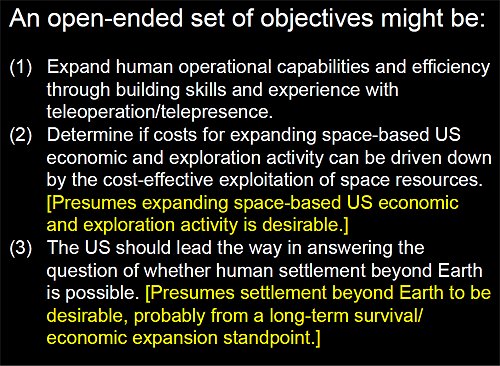
Sykes_Summary_Objectives_500x366

Architects design underground Mars settlement

Dmitry Zhuikov, Arina Ageeva, and Krassimir Krastev of the Russian ZA Architects group lay out an interesting plan for a Mars Colony that starts with robots digging large chambers in basalt bedrock.

[]

Their guidelines:

Purpose of the project – is in research of the possibility to build permanent settlements on Mars, using robotics and local materials to reduce the price and risks.

resources available on mars

1.The surface of Mars is primarily composed of basalt
2. The Phoenix lander directly sampled water ice in Martian soil
[3.] Some martian soil appropriate for groving certain agricultures e.g. Asparagus
Basalt is good material to make a protectional cave on, to produce insulation, and basalt roving, which is stronger than steel.
Possibility of food production will make Martian settlements independent of expensive deliveries from the Earth.


[Colonization] stages

1. Rocket with digging robots are sent to the Mars
2. Robots drop-off on the surface
3. Robots analyze basalt columns on strength value, then each chooses a weakest pillar that equidistant from the others – it is a start position
4. Robots drill basalt, moving down and increasing diameter of withdrawn rock with each step, until it reaches strong pillars that remain
as columns
5. Chaff set aside to form network of the rampants, in order to protect skylight holes from the wind and dust
6. After caves are ready human [expedition] rush to the Mars
7. Astronauts finish the construction and arrange technical facilities as water, oxygen, basalt processing line, etc.
8. Using generated basalt roving, robots weave spatial spider-like web, that will be used as spaces and construction to hold domestic and technical facilities

They include more info and images…