
AMSAT Fox cubesats for student expts + Online software-defined radios

The latest episode of the HAMRADIONOW.tv program discussed the Fox Project at AMSAT-NA, which aims to build a “family of CubeSats with amateur radio transponders that can support advanced science experiments” for students : HamRadioNow – Episode 85: AMSAT Fox-1

Getting a launch date for a new satellite – even a date more than a year out – is exciting at AMSAT. In this episode, we talk to a pair of AMSAT VP’s. Tony Montiero AA2TX handles Engineering, and Mark Hammond N8MH does Education. We talk about what Fox-1 will do (an FM crossband repeater that will also relay data from onboard science experiments). And we learn how AMSAT must transition from a bunch of hams who put up satellites that we can talk through, to a provider of the physical platform and communications for educational experiments for school grades K thru Post-Grad…. that also has transponders and repeaters that hams can use.

===

The site websdr.org provides a long list of online SDR (Software-Defined Radio) sites:

A WebSDR is a Software-Defined Radio receiver connected to the internet, allowing many listeners to listen and tune it simultaneously. SDR technology makes it possible that all listeners tune independently, and thus listen to different signals; this is in contrast to the many classical receivers that are already available via the internet.

For example, the following site tracks several satellites and the ISS and has a “sat” setting for tuning them in: VHF/UHF WebSDR on University of Technology Eindhoven – Maxwell Foundation (Note the site requests permission to run a Java program in your browser.)
 

Space weather cataclysms + Solar cycle letdown + Your space weather update

The Washington Post had an extended article today about the potential havoc that would be  unleashed upon our electronic civilization if the earth is hit by a severe solar storm: When space weather attacks! – WashingtonPost.com

The auroras of 1859, known as the “Carrington Event,” came after the sun unleashed a large coronal mass ejection, a burst of charged plasma aimed directly at the Earth. When the particles hit our magnetosphere, they triggered an especially fierce geomagnetic storm that lit up the sky and frazzled communication wires around the world. Telegraphs in Philadelphia were spitting out “fantastical and unreadable messages,” one paper reported, with some systems unusable for hours.

Today, electric utilities and the insurance industry are grappling with a scary possibility. A solar storm on the scale of that in 1859 would wreak havoc on power grids, pipelines and satellites. In the worst case, it could leave 20 million to 40 million people in the Northeast without power — possibly for years — as utilities struggled to replace thousands of fried transformers stretching from Washington to Boston. Chaos and riots might ensue.

===

So far, though, the current solar cycle max is anticlimax : 2013’s solar maximum could be weakest since the dawn of the space age – io9.

===

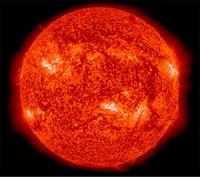
Take a daily glance of the latest images and data of the sun and space weather at the HobbySpace Sun & Space Weather page

SOHO sun image

StarTalk Radio Show with Neil deGrasse Tyson: Cosmic Queries

The latest episode of StarTalk Radio Show by Neil deGrasse Tyson is titled: Cosmic Queries: Planet Earth

StarTalk Radio comes down to Earth as astrophysicist Neil deGrasse Tyson and comic co-host Chuck Nice answer fan questions about our home planet. How was Earth formed? What is the earliest limit of the fossil and tectonic record? How does the high proportion of landmass in the Northern Hemisphere affect Earth’s rotation? Which will happen first – the Sun’s expansion into a red giant or the death of the dynamo inside Earth? Could a shift in magnetic poles happen in the near future, and what would that mean? In terms of natural disasters, where is the safest place to live? Does the full Moon affect tides? What would carbon-based life be like if Earth had double the gravity? Were there red sunsets in prehistoric times, before human pollution? All this, plus Neil’s classic answer to the question, “If the moon is getting further away from the Earth each year, how can we have a Super Moon?”

Co-Host:
Chuck Nice, comedian

Amateur astronomer spots comet during star party in Ukraine

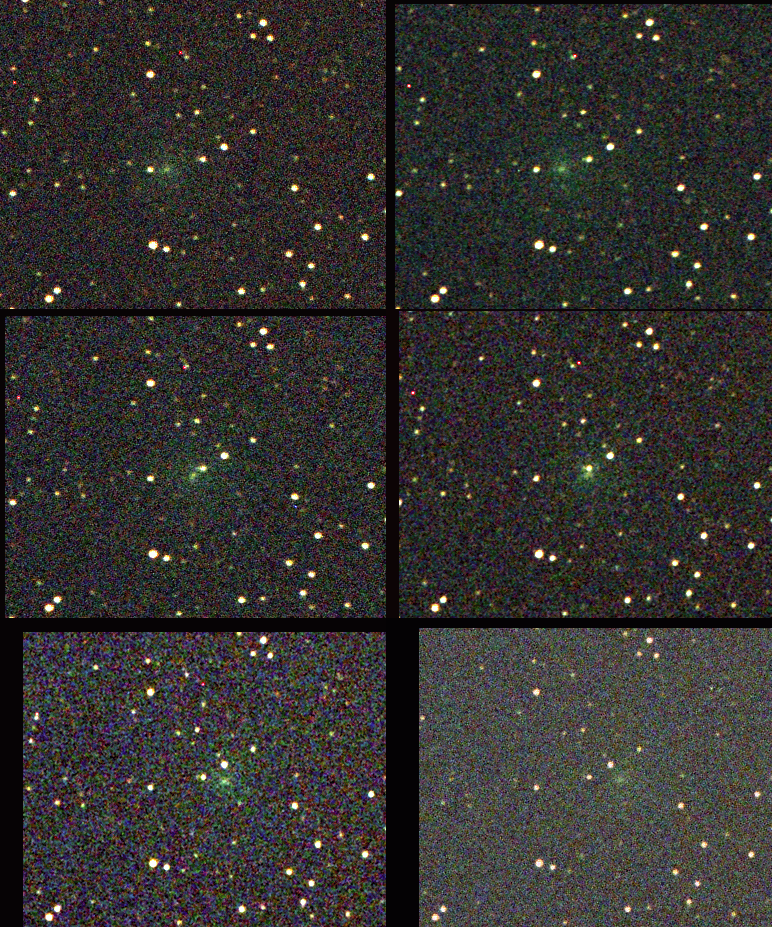
Ukrainian amateur astronomer Gennady Borisov discovered a comet while participating in a star party: Amateur Astronomer Discovers Comet C/2013 N4 (Borisov) During a Star Party – universetoday.com.

Animation of Comet Borisov compiled from multiple images. Credit: http://astronomamator.narod.ru/cometes/comet_anim.gif

Animation of Comet Borisov compiled from multiple images.
Credit: astronomamator.narod.ru/cometes/comet_anim.gif

More info and images at Leonid Elenin’s Photos | Facebook.

AMSAT and ISS amateur radio news

Go to AMSAT News for the latest headlines about developments in amateur and student satellites and for updates about amateur radio on the ISS.

ANS 195 Weekly AMSAT Bulletin – July 13, 2013:
* 2013 AMSAT-NA Board of Directors Ballot Mailing This Week
* 2013 AMSAT-UK International Space Colloquium This Week
* 2013 Central States VHF Society Conference 26-28 July
* The Whale’s HTs Don’t Have PL
* Scotland Portable Satellite Operation in August
* ARISS News
* This Week in Space History