Category Archives: Amateur/Student Satellite

Student and amateur CubeSat news roundup – Sept.9.2019

A sampling of recent articles, press releases, etc. related to student and amateur CubeSat / SmallSat projects and programs (find previous smallsat roundups here):

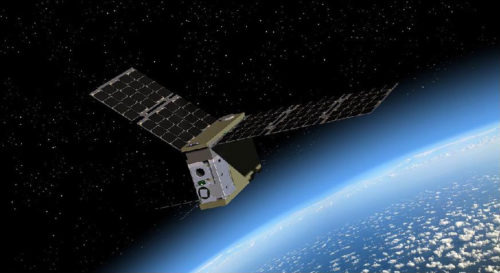
** HARP cubesat developed by Utah State and Univ. Maryland at Baltimore County teams will measure  aerosol and cloud properties of the atmosphere: Space Dynamics Lab Delivers Small Satellite in Preparation for Launch to ISS

Utah State University’s Space Dynamics Laboratory announced today that it has delivered a small satellite designed for NASA to measure the microphysical properties of cloud water and ice particles.

The HARP CubeSat satellite was built by SDL to carry the HyperAngular Rainbow Polarimeter payload built by the University of Maryland, Baltimore County under the direction of principal investigator J. Vanderlei Martins. HARP is currently being prepared for launch by International Space Station small satellite launch service provider NanoRacks, LLC. HARP is scheduled to launch to the ISS in October aboard Northrop Grumman’s robotic resupply space freighter Cygnus at the Mid-Atlantic Regional Spaceport. HARP will be ejected into space following its placement on the ISS.

HARP Cubesat

** More about the Arizona State Univ. Phoenix cubesat project: ASU students create miniature space satellite that can track climate change – msn.com

** AMSAT news on student and amateur CubeSat/smallsat projects: ANS-251 AMSAT News Service Special Bulletin

  • AMSAT Board of Directors Election Ballots Due September 15
  • 2019 AMSAT Space Symposium Preliminary Schedule Now Available
  • 2019 AMSAT Symposium Early-Bird Registration Ends September 15
  • DM02 Satellite Expedition Sunday, September 22 – N6O/MM
  • VUCC Awards & Endorsements for August 2019
  • How to Support AMSAT
  • Upcoming Satellite Operations
  • Satellite Shorts from All Over

General CubeSat/SmallSat info:

SmallSat [Conference] was last week which meant a flurry of announcements. This year was launch heavy, so I break down some announcements from SpaceX, Arianespace, and Rocket Lab.

====

Introduction to CubeSat Technology and Subsystem:
Orbit Design, Debris Impact, and Orbital Decay Prediction

Student and amateur CubeSat news roundup – Sept.3.2019

A sampling of recent articles, press releases, etc. related to student and amateur CubeSat / SmallSat projects and programs (find previous smallsat roundups here):

** Oman university student team builds CubeSat:  SQU team develops sultanate’s first CubeSat – Oman – Muscat Daily

Oman’s first non-commercial CubeSat is a reality now. A team comprising faculty members and students from the Department of Electrical and Computer Engineering of the College of Engineering at Sultan Qaboos University (SQU) has executed the project.

It is a type of miniaturised satellite for space research. The project was proposed and supervised by Dr Amir Mohamed Abdulghani and Sayyid Dr Samir al Busaidi. The students who worked to design the satellite’s payload comprised Abdulaziz Mohammed al Qamshaoui, Luay Khalifa al Yaqoubi and Ali Abdulhamied al Shamali.

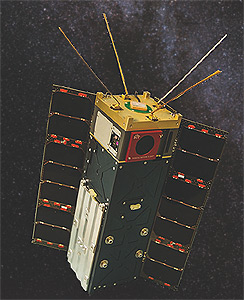
** Arizona State University team building Phoenix CubeSat for study of “the Urban Heat Island (UHI) Effect: a phenomenon in which the structure of the city causes a rise in surface temperature”: Mini-spacecraft built by ASU students will study urban heat island effect – ASU Now

If all goes as planned, one day this October a spacecraft the size of jumbo loaf of bread will leave from Wallops, Virginia, packed aboard a cargo rocket bound for the International Space Station.

The spacecraft is a cubesat named Phoenix, and it is the creation of more than 100 science and engineering students, faculty and researchers at Arizona State University.

On Aug. 18, the Phoenix spacecraft was hand-delivered by the student team to Nanoracks, a launch integrator, at their facility in Houston. There it underwent final tests and preparations for its launch to the Space Station, planned for Oct. 21, 2019. After it arrives at the Space Station, Phoenix will be sent into low-Earth orbit sometime early next year.

The Phoenix spacecraft is designed for a two-year mission to take thermal images of several American cities (including its namesake, Phoenix) by day and by night.

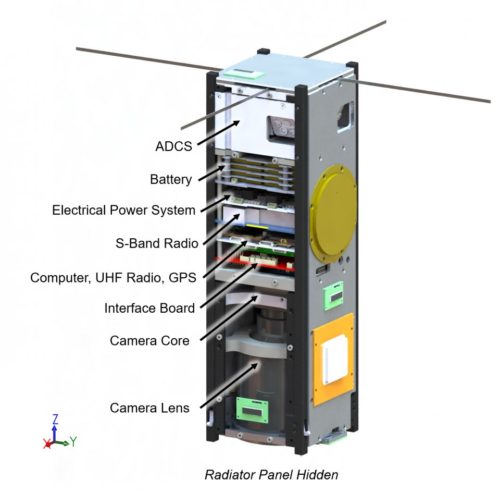
ASU Phoenix Cubesat Diagram
Components of the ASU Phoenix Cubesat.

** AMSAT news on student and amateur CubeSat/smallsat projects: ANS-244 AMSAT News Service Special Bulletin

  • 2019 37th AMSAT Space Symposium and Annual General Meeting
  • 2019 AMSAT Symposium Early-Bird Registration Rate Until September 15
  • Second Call for AMSAT 2019 Symposium Papers
  • Mark Johns, KØJM, Appointed Editor-in-Chief AMSAT News Service
  • Emergency Traffic Relayed over AO-92 Satellite
  • University of Tsukuba YUI Satellite Project D-ATV User Survey
  • ARISS Activities
  • AMSAT SA Dual Band Yagi Now Available for Export
  • Upcoming Satellite Operations
  • German CEPT Response States Sharing of 144-146 MHz Not Realistic
  • Talks by Radio Amateurs at UKHAS Conference London Sept 7
  • CAMSAT Applies for IARU Coordination for Four V/U Transponder Satellites
  • Satellite Shorts From All Over

General CubeSat/SmallSat info:

====

Introduction to CubeSat Technology and Subsystem:
Orbit Design, Debris Impact, and Orbital Decay Prediction

Student and amateur CubeSat news roundup – Aug.25.2019

A sampling of recent articles, press releases, etc. related to student and amateur CubeSat / SmallSat projects and programs (find previous smallsat roundups here):

** Communications with the Virginia CubeSat Constellation spacecraft built by several Virginia universities and deployed from the ISS into orbit in July have not been established yet: Aerospace team awaits communication with CubeSat after successful deployment into space | The Cavalier Daily

In order to contact Libertas, a “wake-up command” was sent up by U.Va. An acknowledgement packet — a unit of data that must be decoded — was sent back, responding to the ground station signal. Due to technical difficulties with the University’s ground station caused by a series of lightning storms, the Virginia Tech ground station was able to listen in and receive the response signal. By achieving this one-way communication, Libertas is currently the only CubeSat which has responded to a signal, showing that it is alive and working. 

“Initially from deployment, we don’t know if the satellite is on, or whether something broke,” [Uni. Virginia student Connor Segal] said. “You don’t know if maybe the antenna didn’t deploy or the board was hit with a cosmic ray, so the initial step is establishing contact and seeing whether the satellite is alive or not.”

Though the team has not made two-way communication with the satellite, meaning they have not received data, Segal is happy with where the team is at.

See previous entries about the Virginia CubeSat program here, here, here, and here. This video shows the deployment of the three CubeSat Constellation spacecraft

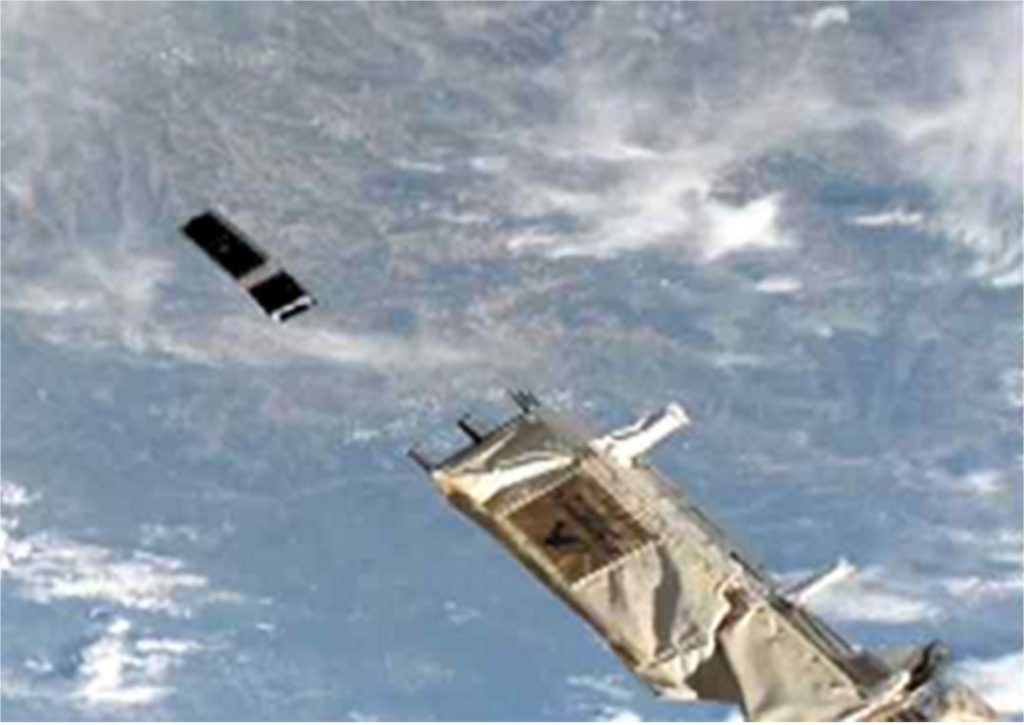
Virginia CubeSat ConstellationDeployment
Three Virginia CubeSat Constellation spacecraft deployed from the ISS on July 9, 2019.

Continue reading Student and amateur CubeSat news roundup – Aug.25.2019

Student and amateur CubeSat news roundup – Aug.18.2019

A sampling of recent articles, press releases, etc. related to student and amateur #CubeSat / #SmallSat projects and programs:

** Northwest Nazarene University’s student-built RFTSat was launched into orbit from a Northrop-Grumman Cygnus spacecraft using the SlingShot deployer, developed by the SEOPS division of Hypergiant.

NNU RFTSat (Radio Frequency Tag Satellite) CubeSat
Northwest Nazarene University RFTSat (Radio Frequency Tag Satellite) CubeSat.

RFTSat was deployed into orbit on August 7, 2019!

The NNU RFTSat (Radio Frequency Tag Satellite) CubeSat team is designing and building a 3U CubeSat to demonstrate the application of radio frequency (RF) energy harvesting and backscatter communication to the problem of distributed sensing in space. A small RF tag will be mounted on the side of the satellite and contain a temperature sensor. The tag will not contain a battery, but will be powered by energy emitted from an RF reader inside the satellite. The tag’s sensor data will be wirelessly sent back to the reader via backscatter communication, and then to the Earth via a Globalstar satellite constellation link. RF tags equipped with sensors could be added to a spacecraft, like the ISS, without additional wires or power supplies and provide a means to monitor structural integrity, space weather, or make sensitive electric/magnetic field measurements.

See also:

An animation of how the Slingshot works:

** Student and volunteer Fossa Systems project in Space is building a PocketQube picosat: Spain’s First Open Source Satellite | Hackaday

[Fossa Systems], a non-profit youth association based out of Madrid, is developing an open-source satellite set to launch in October 2019. The FossaSat-1 is sized at 5x5x5 cm, weighs 250g, and will provide free IoT connectivity by communicating LoRa RTTY signals through low-power RF-based LoRa modules. The satellite is powered by 28% efficient gallium arsenide TrisolX triple junction solar cells.

A video from Fossa Systems co-founder Julian Fernandez:

Fossa Systems is a non-profit association based in Spain and dedicated to the development of picosatellite technologies. Our mission is to democratize access to space telecommunications and in-orbit hardware by launching satellites that can fit in your pocket and creating educational and development kits. Our first satellite FossaSat-1 is set to launch in Q3 of 2019 and will create the worlds first free and open source IoT network.

** AMSAT news on student and amateur CubeSat/smallsat projects: ANS-230 AMSAT News Service Special Bulletin

  • AMSAT Space Symposium Call for Papers
  • 2019 AMSAT Board of Directors Election Reminder
  • FCC Dismisses ARRL, AMSAT Requests in Small Satellite Proceeding
  • Changes to AMSAT-NA TLE Distribution
  • 50th Anniversary AMSAT Space Symposium Banquet Speakers Announced
  • Upcoming Satellite Operations
  • PSAT2 Downlink for DTMF Grids and Messages
  • Microwave Update Call for Submissions
  • Upcoming ARISS Contact Schedule
  • Chinese Satellite Profiles RF Spectrum as Seen from Lunar Orbit
  • Satellite Shorts From All Over

General CubeSat/SmallSat info:

** Amateur satcom: Pirates On US Navy Satellites – UHF SatCom | Southgate Amateur Radio News

==

Previous Smallsat postings here.

====

Introduction to CubeSat Technology and Subsystem:
Orbit Design, Debris Impact, and Orbital Decay Prediction

Student and amateur CubeSat news roundup – Aug.12.2019

A sampling of recent articles, press releases, etc. related to student and amateur CubeSat / SmallSat projects and programs:

** Virginia Tech awarded NASA contract to launch and operate the LAICE CubeSat (Lower Atmosphere/Ionosphere Coupling Experiment) as a part of the agency’s CubeSat Launch Initiative program. Lower Atmosphere/Ionsphere Coupling Experiment CubeSat – Gov Mik

The spacecraft will study to

…what extent do Gravity Waves influence the coupling of the Earth’s upper atmosphere and the lower ionosphere/mesosphere/thermosphere. 

The Virgin Tech team led the LAICE CubeSat project but they were

unable to attain an FCC license and therefore LAICE has been shelved indefinitely. The 2013 National Academy Solar and Space Physics Decadal Survey Key Science Goal 2 has made this an attractive opportunity as launch and operation of the LAICE CubeSat will address key aspects of the goal. 

LAICE diagram
Diagram of the Lower Atmosphere/Ionosphere Coupling Experiment (LAICE) CubeSat. Credits: LAICE Overview presentation

** University Würzburg Experimental Satellite 4 (UWE-4) demonstrates Morpheus Space miniature electric thrusters: Electric thrusters changed attitude of University Würzburg cubesat – SpaceNews.com

The University Würzburg Experimental Satellite 4 has four 160-gram Morpheus Nano Field Effect Electric Propulsion (NanoFEEP) thrusters integrated in its rails, facing the same direction. In May, mission controllers fired the thrusters, which combine a liquid gallium propellant with a chip-based neutralizer, for slightly more than six minutes.

While the thrusters fired, the satellite’s rotation increased from approximately 1.7 degrees per second to more than four degrees per second, according to “Hybrid attitude control on-board UWE-4 using magnetorquers and the electric propulsion system NanoFEEP,” by Alexander Kramer, Philip Bangert and Klaus Schilling of University Würzburg.

University Würzburg Experimental Satellite 4 (UWE-4)
“UWE‑4 with Thrusters, Neutralizer and a new kind of sun sensors on each panel.” – University Würzburg

** AMSAT news on student and amateur CubeSat/smallsat projects: ANS-223 AMSAT News Service Special Bulletin

  • 50th Anniversary AMSAT Space Symposium Banquet Speakers Announced – Tickets Now Available
  • FUNcube-1/AO-73 Entering Continuous Sunlight
  • ARRL/TAPR 2019 Digital Communications Conference Call for Papers
  • BRICSAT2 and PSAT2 Get OSCAR Designations
  • 19th Global Symposium for Regulators
  • SSA Defends 23cm Band Against Galileo Threat
  • Upcoming Satellite Operations
  • ARISS News
  • Satellite Shorts from All Over

General CubeSat/SmallSat info:

====

The Race to the Moon Chronicled in Stamps, Postcards, and Postmarks:
A Story of Puffery vs. the Pragmatic (Springer Praxis Books)