Here’s a very beautifully made time-lapse video composition of ISS imagery by Bruce W. Berry Jr of Bruce Wayne Photography.
(Item via UniverseToday.com,)
Here’s a very beautifully made time-lapse video composition of ISS imagery by Bruce W. Berry Jr of Bruce Wayne Photography.
(Item via UniverseToday.com,)
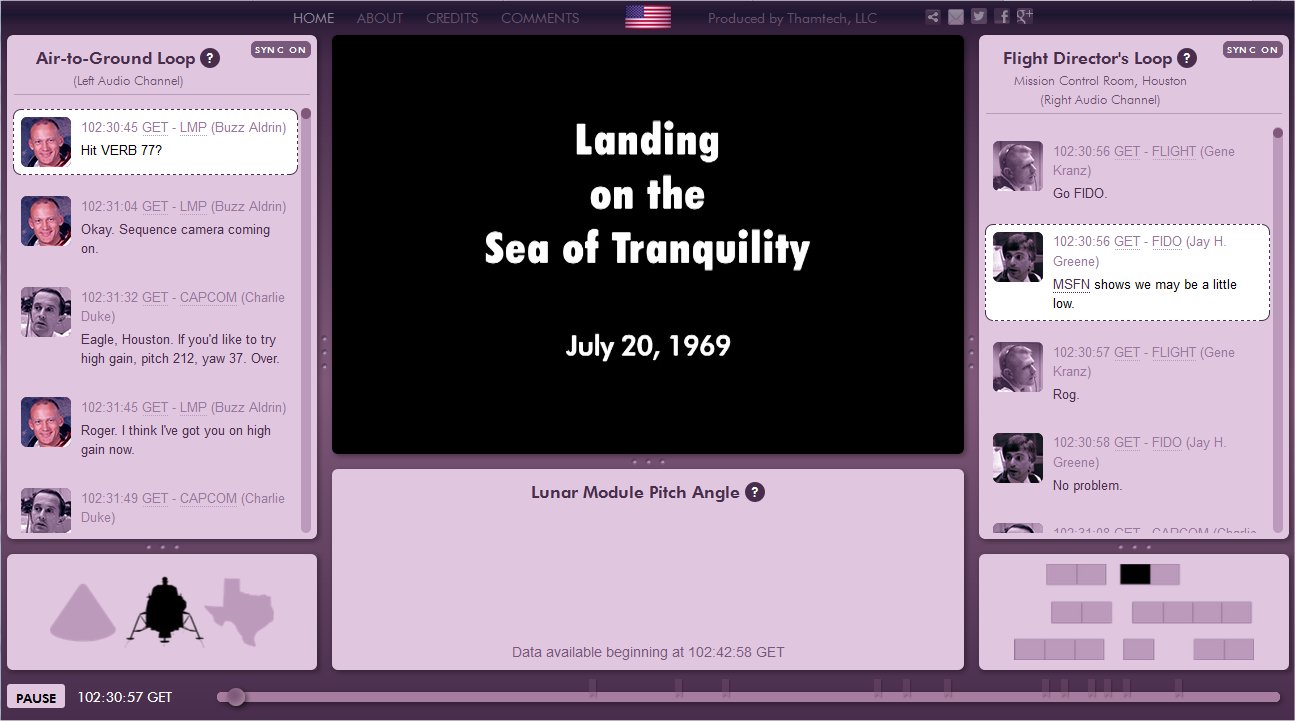
The website The First Men on the Moon: The Apollo 11 Lunar Landing provides
an online interactive featuring the Eagle lunar landing. The presentation includes original Apollo 11 spaceflight video footage, communication audio, mission control room conversations, text transcripts, and telemetry data, all synchronized into an integrated audio-visual experience.
Until today, it has been impossible to comprehensively experience mankind’s shining exploratory accomplishment in a singular experience. We have compiled hours of content available from public domain sources and various NASA websites. Thamtech staff and volunteers generously devoted their time to transcribe hours of speech to text. By using simultaneous space and land based audio and video, transcripts, images, spacecraft telemetry, and biomedical data—this synchronized presentation reveals the Moon Shot as experienced by the astronauts and flight controllers.
The latest discovery by Cassini:
NASA Probe Observes Meteors Colliding With Saturn’s Rings
PASADENA, Calif. — NASA’s Cassini spacecraft has provided the first direct evidence of small meteoroids breaking into streams of rubble and crashing into Saturn’s rings.
These observations make Saturn’s rings the only location besides Earth, the moon and Jupiter where scientists and amateur astronomers have been able to observe impacts as they occur. Studying the impact rate of meteoroids from outside the Saturnian system helps scientists understand how different planet systems in our solar system formed.
The solar system is full of small, speeding objects. These objects frequently pummel planetary bodies. The meteoroids at Saturn are estimated to range from about one-half inch to several yards (1 centimeter to several meters) in size. It took scientists years to distinguish tracks left by nine meteoroids in 2005, 2009 and 2012.
Details of the observations appear in a paper in the Thursday, April 25 edition of Science.
Results from Cassini have already shown Saturn’s rings act as very effective detectors of many kinds of surrounding phenomena, including the interior structure of the planet and the orbits of its moons. For example, a subtle but extensive corrugation that ripples 12,000 miles (19,000 kilometers) across the innermost rings tells of a very large meteoroid impact in 1983.
“These new results imply the current-day impact rates for small particles at Saturn are about the same as those at Earth — two very different neighborhoods in our solar system — and this is exciting to see,” said Linda Spilker, Cassini project scientist at NASA’s Jet Propulsion Laboratory in Pasadena, Calif. “It took Saturn’s rings acting like a giant meteoroid detector — 100 times the surface area of the Earth — and Cassini’s long-term tour of the Saturn system to address this question.”
The Saturnian equinox in summer 2009 was an especially good time to see the debris left by meteoroid impacts. The very shallow sun angle on the rings caused the clouds of debris to look bright against the darkened rings in pictures from Cassini’s imaging science subsystem.
“We knew these little impacts were constantly occurring, but we didn’t know how big or how frequent they might be, and we didn’t necessarily expect them to take the form of spectacular shearing clouds,” said Matt Tiscareno, lead author of the paper and a Cassini participating scientist at Cornell University in Ithaca, N.Y. “The sunlight shining edge-on to the rings at the Saturnian equinox acted like an anti-cloaking device, so these usually invisible features became plain to see.”
Tiscareno and his colleagues now think meteoroids of this size probably break up on a first encounter with the rings, creating smaller, slower pieces that then enter into orbit around Saturn. The impact into the rings of these secondary meteoroid bits kicks up the clouds. The tiny particles forming these clouds have a range of orbital speeds around Saturn. The clouds they form soon are pulled into diagonal, extended bright streaks.
“Saturn’s rings are unusually bright and clean, leading some to suggest that the rings are actually much younger than Saturn,” said Jeff Cuzzi, a co-author of the paper and a Cassini interdisciplinary scientist specializing in planetary rings and dust at NASA’s Ames Research Center in Moffett Field, Calif. “To assess this dramatic claim, we must know more about the rate at which outside material is bombarding the rings. This latest analysis helps fill in that story with detection of impactors of a size that we weren’t previously able to detect directly.”
The Cassini-Huygens mission is a cooperative project of NASA, the European Space Agency and the Italian Space Agency. NASA’s Jet Propulsion Laboratory, Pasadena, Calif., a division of the California Institute of Technology, Pasadena, manages the Cassini-Huygens mission for NASA’s Science Mission Directorate in Washington. JPL designed, developed and assembled the Cassini orbiter and its two onboard cameras. The imaging team consists of scientists from the United States, England, France and Germany. The imaging operations center is based at the Space Science Institute in Boulder, Colo.
For images of the impacts and information about Cassini, visit: http://www.nasa.gov/cassini and http://saturn.jpl.nasa.gov .

Five images of Saturn’s rings, taken by NASA’s Cassini spacecraft between 2009 and 2012, show clouds of material ejected from impacts of small objects into the rings. Clockwise from top left are two views of one cloud in the A ring, taken 24.5 hours apart, a cloud in the C ring, one in the B ring, and another in the C ring. Arrows in the annotated version point to the cloud structures, which spread out at visibly different angles than the surrounding ring features.
The clouds of ejected material were visible because of the angle sunlight was hitting the Saturn system and the position of the spacecraft. The first four images were taken near the time of Saturn equinox, when sunlight strikes the rings at very shallow angles, nearly directly edge-on. During Saturn equinox, which occurs only every 14.5 Earth years, the ejecta clouds were caught in sunlight because they were elevated out of the ring plane. The last image was taken in 2012 at a very high-phase angle, which is the sun-Saturn-spacecraft angle. This geometry enabled Cassini to see the clouds of dust-sized particles in the same way that dust on a surface is easier to see when the viewer is looking toward a light source.
The angle that the clouds are canted gives the time elapsed since the cloud was formed (see PIA14941). The A ring cloud formed 24 hours before its first apparition in the top left box; it formed 48.5 hours before the top middle image. The other three clouds were approximately 13 hours, four hours, and one hour old (respectively) at the times they were seen. See PIA11674 for more information on ring impacts.
The Cassini-Huygens mission is a cooperative project of NASA, the European Space Agency and the Italian Space Agency. The Jet Propulsion Laboratory, a division of the California Institute of Technology in Pasadena, manages the mission for NASA’s Science Mission Directorate, Washington, D.C. The Cassini orbiter and its two onboard cameras were designed, developed and assembled at JPL. The imaging operations center is based at the Space Science Institute in Boulder, Colo.
For more information about the Cassini-Huygens mission visit http://www.nasa.gov/cassini and http://saturn.jpl.nasa.gov.
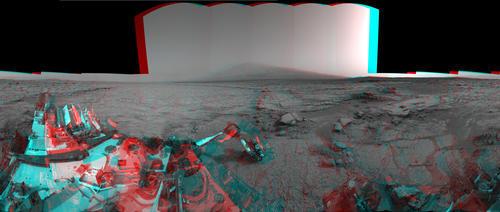
Mars Stereo View from ‘John Klein’ to Mount Sharp
Left and right eyes of the Navigation Camera (Navcam) in NASA’s Curiosity Mars rover took the dozens of images combined into this stereo scene of the rover and its surroundings. The component images were taken during the 166th, 168th and 169th Martian days, or sols, of Curiosity’s work on Mars (Jan. 23, 25 and 26, 2013). The scene appears three dimensional when viewed through red-blue glasses with the red lens on the left. It spans 360 degrees, with Mount Sharp on the southern horizon.
In the center foreground, the rover’s arm holds the tool turret above a target called “Wernecke” on the “John Klein” patch of pale-veined mudstone. On Sol 169, Curiosity used its dust-removing brush and Mars Hand Lens Imager (MAHLI) on Wernecke (see http://photojournal.jpl.nasa.gov/catalog/PIA16790 ). About two weeks later, Curiosity used its drill at a point about 1 foot (30 centimeters) to the right of Wernecke to collect the first drilled sample from the interior of a rock on Mars. This anaglyph was made with the images as captured by the Curiosity. Another version with the seams in the sky eliminated and cropped for optimal 3-D viewing can be seen at PIA16925.
The separate left-eye and right-eye mosaics are combined into the stereo view.
NASA’s Jet Propulsion Laboratory, a division of the California Institute of Technology, Pasadena, manages the Mars Science Laboratory Project for NASA’s Science Mission Directorate, Washington. JPL designed and built the project’s Curiosity rover and the rover’s Navcam.
NASA releases a video showing a time lapse sequence of solar images taken over three years by the Solar Dynamics Observatory (SDO). There are 2 images per day:
SDO’s Atmospheric Imaging Assembly captures a shot of the sun every 12 seconds in 10 different wavelengths. The images shown here are based on a wavelength of 171 angstroms, which is in the extreme ultraviolet range and shows solar material at around 600,000 kelvins (about 1.08 million F). In this wavelength it is easy to see the sun’s 25-day rotation as well as how solar activity has increased over three years.
During the course of the video, the sun subtly increases and decreases in apparent size. This is because the distance between the SDO spacecraft and the sun varies over time. The image is, however, remarkably consistent and stable despite the fact that SDO orbits Earth at 6,876 mph and Earth orbits the sun at 67,062 mph.
