Here is the latest episode of NASA’s weekly Space to Ground reports on activities related to the International Space Station:
Other NASA videos released this week focus on building upon lessons learned in LEO to go beyond earth orbit:
** NASA wants to build a human-tended station around the Moon called the Gateway:
** Agency chief Jim Bridenstine talked about lunar goals:
In an address from Kennedy Space Center on March 11, 2019, NASA Administrator Jim Bridenstine shares the work underway to return astronauts to the Moon and onward to Mars.
** Technologies for lunar exploration and a human base:
A sampling of recent items related to traveling to and through space:
[ Update: The Soyuz launch and docking with the ISS were successful:
]
** A Russian Soyuz is set to launch today with three new crew members to the ISS. Astronaut Christina Koch, on her first mission to space, joins cosmonaut Alexey Ovchinin and NASA flight engineer Tyler “Nick” Hague, who were both on the Soyuz MS-10 that suffered an in-flight abort last October. The Soyuz with the threesome will reach the station after a quick 6 hour flight.
** United Launch Alliance (ULA) is set to launch a Delta IV rocket on Friday from Cape Canaveral with the 10th Wideband Global SATCOM spacecraft (Wideband Gapfiller Satellite), built by Boeing for the U.S. military. Delta IV WGS-10 – United Launch Alliance (ULA) Rocket Launch
The webcast starts at 6:56 p.m. EDT and the launch window extends to 9:05 p.m. EDT:
** China launched a Long March 3B on March 9th from the Xichang Satellite Launch Center. The rocket carried the Zhongxing-6C (ChinaSat-6C) communication satellite.
I am very pleased to say that the OS-M launch vehicle has completed assembly rehearsal and is currently in the Jiuquan Satellite Launch Center for final preparations. Thanks to all who’ve worked so hard on it!👏👏
Check out “OS-M assembly rehearsal” video!!😍 pic.twitter.com/AvE6uUGpaz
** China’s LinkSpace tests vertical takeoff and landing rocket, similar to the type flown by Masten Space for many years. The LinkSpace goal is a reusable first stage for a rocket that will launch small satellites to low earth orbit:
Granted, LinkSpace’s first planned orbital rocket New Line 1 is only expected to lift about 200kg into SSO (vs Falcon 9’s 10,000 kg to Polar). But they’re getting there: pic.twitter.com/a0ROK2RTtM
Another stage test done. Getting ready for the next flight after DARPA R3D2. The team are really streamlining things now. Build, test, launch – repeat! pic.twitter.com/r0NZO0f1Tp
Following a delay to payload arrival, the R3D2 spacecraft is now at LC-1 & integration is underway! The launch window has been adjusted to the second half of March to provide the prime contractor with additional time to complete payload and spacecraft validation & verification. https://t.co/WeFJWk8hA3
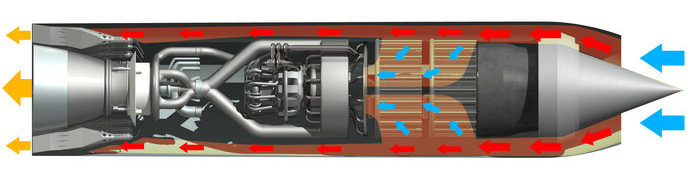
** Reaction Engines will start building a prototype Sabre rocket engine after an ESA review gives the design a thumbs-up. While powering a vehicle in the atmosphere, the Sabre’s pre-cooler would gather air, cool it, and feed it into the combustion chamber of the rocket along with hydrogen fuel. Once outside the atmosphere, oxygen from on-board tanks would feed the Sabre (Synergetic Air-Breathing Rocket Engine):
“The Synergistic Air-Breathing Rocket Engine is uniquely designed to scoop up atmospheric air during the early part of its flight to orbit. This slashes the need for the vehicle to carry bulky onboard oxygen for this part of the ascent, before switching to rocket mode drawing on internal propellants for its final climb to space. To allow SABRE to use the superfast onrushing airstream as oxidiser, the air must be cooled from 1000°C to –150°C within just a hundredth of second, at the same time avoiding the formation of dangerous ice.” – Engine Airflow/ESA
The air-cooler technology has been proven in a standalone test. The demo engine will include only the rocket
Reaction Engines launched a significant new element of its development programme in October 2016 to design, build and demonstrate a SABRE engine core. The test item consists of an engine core, which is a major module of the complete SABRE engine, but without the pre-cooler and rocket nozzle in place. This core design and development activity is a major undertaking and upon completion of the tests, major elements of the world’s first air-breathing engine capable of accelerating from zero to Mach 5 will have been demonstrated.
The SABRE engine core tests are part of a range of development activities currently underway at Reaction Engines. The company will shortly begin its HTX ‘hot’ heat exchanger testing in a unique test facility it has constructed in Colorado, United States. The HTX test programme is a manufacturing and performance ground-level demonstration of the SABRE engine ‘Pre-Cooler’ heat exchanger in a high temperature environment, similar to that expected to be seen by the SABRE engine during its air-breathing flight regime – up to 1000°C air inlet temperature.
The goal is an propulsion system efficient enough to power a single-stage-to-orbit vehicle like the Skylon.
[HyperSciences founder and CEO Mark] Russell and his team have developed a low-cost, multi-purpose projectile called the HyperDrone that can accelerate to velocities over five times the speed of sound and pulverize hard rock via their HyperDrill. This will enable tunneling speeds that are 5-10 times quicker than conventional methods, and more importantly, it opens up significant market viability in other industries that could benefit, namely when that acceleration is pointed skyward. NASA has already recognized this potential and is a current investor and major partner of HyperSciences.
With a nuclear rocket like the ones researched in project NERVA, a trip to Mars could be done in four months. (Interestingly, the astronauts would actually be exposed to less radiation with a nuclear ship, because shortening the trip reduces their exposure to cosmic rays in space.) And with higher thrust and higher efficiency, nuclear rockets would open up much of the solar system. They could even be designed to rendezvous with comets and use cometary ice as fuel for the return trip.
…
Now NASA is getting interested in nuclear rockets again. In 2017, it awarded a nearly $19 million contract for development. And this year’s NASA budget contains $100 million for nuclear thermal research, leading to a demonstration in 2024.
Last Friday, SpaceX Spokesman James Gleeson said in an email that the Starship prototype was moved in preparation for non-public testing.
“SpaceX will conduct checkouts of the newly installed ground systems and perform a short static fire test in the days ahead,” Gleeson said. “Although the prototype is designed to perform sub-orbital flights, or hops, powered by the SpaceX Raptor engine, the vehicle will be tethered during initial testing and hops will not be visible from offsite. SpaceX will establish a safety zone perimeter in coordination with local enforcement and signage will be in place to alert the community prior to the testing.”
**** The latest view of the StarHopper from a drone flying above the SpaceX facilities:
****Scott Manley gives his review of the Crew Dragon mission to the ISS:
Yesterday SpaceX’s crew capable Dragon 2 spacecraft completed its visit to the ISS, demonstrating the technology was sound and clearing one more hurdle on its way to becoming a commercial crew transportation provider.
**** Videos of the Crew Dragon and the Falcon 9 booster following the mission (via www.USLaunchReport.com):
The latest Space to Ground weekly report from NASA on activities related to the International Space Station:
A profile of astronaut Christina Kcoh
It may not look like mountain climbing has much to do with being an astronaut, even though both involve great heights and special equipment. But NASA’s Christina Koch says the concentration and control she learned in climbing helped her prepare to be an astronaut and to make the climb to space for her first mission to the International Space Station.
Here is the latest episode of NASA’s weekly Space to Ground report on activities related to the International Space Station:
** A recent interview with ISS crew member Anne McClain:
Aboard the International Space Station, Expedition 58 Flight Engineer Anne McClain of NASA discussed life and research on the outpost and her thoughts on the Apollo program fifty years after humankind’s first landing on the moon during a pair of in-flight interviews Feb. 15 with CNN and National Public Radio’s “Weekend Edition”. McClain is in the third month of a planned six-and-a-half month mission on the complex.
Using state of the art robotics and their proprietary polymer, AI SpaceFactory is contending for the final top prize of $500,000 given to the highest scoring team to print a sub-scale habitat in the third and final phase of the construction competition. The 1:3 scale prototype will be printed in front of a live audience at Bradley University in Peoria, Illinois, from April 29 to May 4.
AI SpaceFactory was one of only four teams awarded among six who submitted entries, placing 2nd overall on the basis of 3D-printed samples that were tested for strength, impact resistance, and durability in extreme temperatures. In contrast to other teams, which used concrete as their construction material, AI SpaceFactory formulated their own material – a “Martian polymer” that can be made from matter found or grown on Mars. The polymer was validated by a third-party lab and proven to outperform concrete in every important way: superior tensile and compressive strength, extreme durability in freeze-thaw cycles, and enhanced ductility. The polymer also provides superior cosmic radiation absorption and thermal resistance (insulation) and can be made without water: essential characteristics in the construction of off-world habitats
In five weeks, AI SpaceFactory progressed from basic tests to an autonomously-printed large-area slab validated by NASA in November 2018. Four weeks later the team successfully printed, in only 24 hours, a large cylinder designed to hold twelve-hundred gallons of water complete with prefabricated wall penetrations robotically placed and sealed “on the fly”.
AI SpaceFactory describes MARHSA as a first-principles rethinking of what a Martian habitat could be — not another low-lying dome or confined half-buried structure, but an airy, multi-level environment filled with diffuse light. This innovation challenges the conventional image of “space age” architecture by focusing on the creation of highly habitable spaces tuned to the demands of a Mars mission.
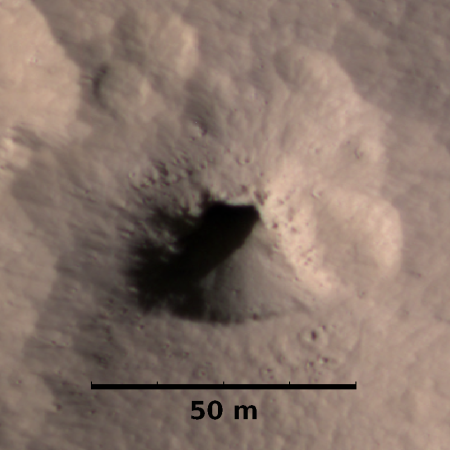
My first reaction was, “Whoa! That tiny pit is at the head of an increasingly growing canyon!” To a caver on Earth, this instantly implies that water has flowed out of that pit and down the canyon, carving it out as it flowed. It also implied that the possible underground passage under the pit’s north rim might conceivably be extensive.
Reinforcing this first impression were the numerous dark streaks flowing down the canyon’s cliff walls to the south. They all seemed to originate at about the same elevation as the pit itself, suggesting they all come from the same contact between two geological layers, a contact where water tends to gather. On Earth, when water seeps downward through water-soluble limestone and then gets blocked at a contact of more resistant material, it then starts to flow horizontally, creating a cave at that contact. The Martian dark streaks and pit in the image to the right suggest a similar process is occurring here.
Bob goes on to discuss the region around the above canyon and what role water may have played in forming the features there.
Nonetheless, the data illustrated by these images makes that tiny pit most enticing. It not only appears to be relatively easy to access its interior, there is visual evidence that suggests the presence of water.
If I was a future settler of Mars, I would give this pit a very high priority for exploration. In fact, I think someone (maybe Elon Musk?) should already be considering a probe to delve its depths.
** Rotating in-space habitats can provide artificial gravity and don’t require that space transports go in and out of deep gravity wells. The Gateway Foundation initiative aims to develop a wheel-shaped station as the first large in-space habitat. This video lays out some of the design features: SpaceX Starship and The Von Braun Rotating Space Station –
Scott Manley gives a brief critique of the Gateway group’s approach: A Realistic Look At The Gateway Foundation & Von Braun Station –
Manley emphasizes that funding is the biggest challenge. I agree and believe that the only viable financial approach to such an orbital facility is one that allows for incremental growth. That is, devise a design that can start small and simple and grows step-by-step, just as happened with most towns on earth. For example, start with two Bigelow habitats connected with a tether and rotating. Prove that this works technically and then show it works commercially by attracting a constant stream of paying visitors. This will then provide the basis to attract more investment to expand to more modules and a more elaborate structure.