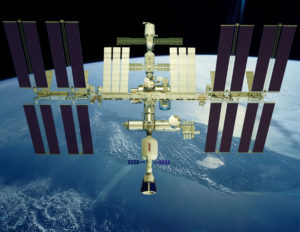
Here is the latest episode in NASA’s Space to Ground weekly report on activities related to the International Space Station:
** Expedition 67 Education inflight with JPL and Caltech – NASA Video
Aboard the International Space Station, NASA Expedition 67 Flight Engineer Jessica Watkins answered pre-recorded questions about life and work on the orbital laboratory during an in-flight event August 9 with students, faculty, and staff at Caltech in Pasadena, California. Watkins is an alum of Caltech and is in the midst of a science mission living and working aboard the microgravity laboratory to advance scientific knowledge and demonstrate new technologies for future human and robotic exploration missions as part of NASA’s Moon and Mars exploration approach, including lunar missions through NASA’s Artemis program. Join NASA as we go forward to the Moon and on to Mars — discover the latest on Earth, the Solar System and beyond with a weekly update in your inbox.
** Chinese astronauts set up new lab module, test robotic arm on space station – VideoFromSpace
The Shenzhou-14 crew has been keeping busy with “daily care of the core module, setting up the status of the Wentian lab module, and assembling and testing the regenerative life support system,” according to China Central Television (CCTV). See footage of the crew and views outside the Tiangong space station in these highlights
** Earth from Space in 4K – Expedition 65 Edition – NASA Johnson
The people who get to see the Earth from space marvel at its beauty, the colors, the fragility they feel about the planet 250 miles below them. Now it’s your turn: this ultra-high definition video, captured during the International Space Station’s Expedition 65, allows you an extended, appreciative gawk at the home planet in all its glory. Hit play, and go into orbit mode.
This footage was shot from the International Space Station between April 17, 2021 – Oct. 17, 2021.
Currently, live views from the ISS are streaming from an external camera mounted on the ISS module called Node 2. Node 2 is located on the forward part of the ISS. The camera is looking forward at an angle so that the International Docking Adapter 2 (IDA2) is visible. If the Node 2 camera is not available due to operational considerations for a longer period of time, a continuous loop of recorded HDEV imagery will be displayed. The loop will have “Previously Recorded” on the image to distinguish it from the live stream from the Node 2 camera. After HDEV stopped sending any data on July 18, 2019, it was declared, on August 22, 2019, to have reached its end of life. Thank You to all who shared in experiencing and using the HDEV views of Earth from the ISS to make HDEV so much more than a Technology Demonstration Payload!
Here is the latest episode in NASA’s Space to Ground weekly report on activities related to the International Space Station:
** Station Astronauts Discuss Life in Space with the Lollipop Theater Network – NASA Video
Aboard the International Space Station, Expedition 67 Flight Engineers Bob Hines of NASA and Samantha Cristoforetti of ESA (European Space Agency) discussed life and work aboard the orbital outpost during an in-flight event Aug. 2 with Children’s Hospitals for the “Lollipop Theater Network.” Hines and Cristoforetti are in the midst of a science mission living and working aboard the microgravity laboratory. The goal of their mission is to advance scientific knowledge and demonstrate new technologies for future human and robotic exploration missions as part of NASA’s Moon and Mars exploration approach, including lunar missions through NASA’s Artemis program.
** Cold Atom Lab: Celebrating Four Years of Quantum Science in Space (Live Public Talk) – NASA Jet Propulsion Laboratory
The Cold Atom Lab, NASA’s first quantum science laboratory in space, will mark four years onboard the International Space Station on Aug. 4, 2022. It has already achieved its main science goals by cooling atoms down to ultra-cold temperatures to study their basic physical properties in ways that would not be possible on Earth. Join us for this exciting event and learn from some of the world’s experts – from astronauts to Nobel Laureates – on the details of getting the unique Cold Atom Lab up and running, as well as the progress toward using microgravity to illuminate new features of the quantum world.
Speakers:
Christina Koch, astronaut, NASA Johnson Space Center Eric Cornell, Nobel Laureate in physics, Joint Institute for Laboratory Astrophysics Kamal Oudrhiri, project manager for the Cold Atom Lab, NASA JPL Jason Williams, project scientist for the Cold Atom Lab, NASA JPL
** Space Station robot ‘dances’ with new dust collector in epic installation time-lapse – VideoFromSpace
The International Space Station’s Special Purpose Dexterous Manipulator (Dextre) was employed to install the Earth Surface Mineral Dust Source Investigation instrument outside the International Space Station. The choreographed maneuver is set to a waltz in this time-lapse video.
** Chinese space station’s robotic arm tested on-orbit in these amazing views – VideoFromSpace
China’s Wentian lab module’s robotic arm was tested on Aug. 3, 2022. It will ”support the astronauts’ extravehicular activities, delivering goods, and maintaining andrepairing the exterior of the space station,” according to China Central Television (CCTV). The Wentian lab docked with the Tiangong space station’s Tianhe core module on July 25: https://www.space.com/china-space-sta…
Currently, live views from the ISS are streaming from an external camera mounted on the ISS module called Node 2. Node 2 is located on the forward part of the ISS. The camera is looking forward at an angle so that the International Docking Adapter 2 (IDA2) is visible. If the Node 2 camera is not available due to operational considerations for a longer period of time, a continuous loop of recorded HDEV imagery will be displayed. The loop will have “Previously Recorded” on the image to distinguish it from the live stream from the Node 2 camera. After HDEV stopped sending any data on July 18, 2019, it was declared, on August 22, 2019, to have reached its end of life. Thank You to all who shared in experiencing and using the HDEV views of Earth from the ISS to make HDEV so much more than a Technology Demonstration Payload!
Here is the latest episode in NASA’s Space to Ground weekly report on activities related to the International Space Station:
** Station Astronauts Discuss Life In Space During ISS Conference – NASA Video
Aboard the International Space Station, Expedition 67 Flight Engineers Kjell Lindgren and Jessica Watkins of NASA discussed life and work aboard the orbital outpost during an in-flight event July 26 with the International Space Station Research and Development conference attendees in Washington, D.C. Lindgren and Watkins are in the midst of a science mission living and working aboard the microgravity laboratory. The goal of their mission is to advance scientific knowledge and demonstrate new technologies for future human and robotic exploration missions as part of NASA’s Moon and Mars exploration approach, including lunar missions through NASA’s Artemis program.
The Next Decade of Results: A Conversation with NASA and the ISS National Lab Leadership Panelists: • Ray Lugo, CEO, ISS National Laboratory • Joel Montalbano, ISS Program Manager, NASA • Robyn Gatens, Director of the International Space Station (ISS) in the Space Operations Mission Directorate at NASA Headquarters
Space Policy Panel: Moderator Paul Stimers, Partner, K&L Gates Panelists: • Pam Whitney, Staff Director, House Committee on Space, Science, and Technology • Joel Graham, Professional Staff Member, Senate Committee on Commerce, Science & Transportation • Mary Guenther, Director of Space Policy, Commercial Spaceflight Federation (CSF) • Michael Gold, Executive Vice President for Civil Space and External Affairs at Redwire Space
The Next Decade of Results—A Conversation with the Chief Scientists of the ISS National Lab and NASA’s ISS Program: Moderator: Katherine Calvin, Ph.D., Chief Scientist and Senior Climate Advisor, NASA Panelists • Kirt Costello, Ph.D., ISS Chief Scientist, NASA • Dr. Mike Roberts, Ph.D., Chief Scientist, ISS National Lab
** ISSRDC 2022: Advancing Fundamental Science in Space in Collaboration with the NSF – ISS National Lab – YouTube
The microgravity environment of the ISS provides a unique window to explore fundamental phenomena in the absence of gravity-dependent physics and introduces new biological stressors to cells and tissues. The ISS National Lab has partnered with the NSF Chemical, Bioengineering, Environmental, and Transport Systems (CBET) Division on two long-standing solicitations to explore these phenomena: The solicitation on transport phenomena is going on its seventh year, and the solicitation on tissue engineering and mechanobiology is going on its fifth year. Research funded through these solicitations enables scientific discoveries not possible on Earth. Join us to hear more about this exciting research and the impact that fundamental science in space can have on life on Earth.
Moderator Stephanie George, Tissue Engineering Program Director, NSF Panelists • Tammy Chang, Ph.D., Associate Professor, University of California, San Francisco • Ngan Huang, Ph.D., Associate Professor, Stanford University and Principal Investigator, Veterans Affairs Palo Alto Health Care System • Ya-Ting T. Liao, Ph.D., Assistant Professor, Case Western Reserve University • Eric M. Furst, Ph.D., Professor and Department Chair of Chemical and Biomolecular Engineering, University of Delaware
** Chinese astronauts enter Tiangong space station’s new lab module after dock – VideoFromSpace
Chinese astronauts Chen Dong, Liu Yang, and Cai Xuzhe made their way into the Wentian lab module shortly after it docked with the Tiangong space station on July 25, 2022.
** Building Gateway! 1st space station in lunar orbit – Animation – VideoFromSpace
Gateway will support NASA missions to the moon as the space station in lunar orbit. See its components come together in this animation. Learn more about Gateway: https://www.space.com/43018-lunar-orb…
Currently, live views from the ISS are streaming from an external camera mounted on the ISS module called Node 2. Node 2 is located on the forward part of the ISS. The camera is looking forward at an angle so that the International Docking Adapter 2 (IDA2) is visible. If the Node 2 camera is not available due to operational considerations for a longer period of time, a continuous loop of recorded HDEV imagery will be displayed. The loop will have “Previously Recorded” on the image to distinguish it from the live stream from the Node 2 camera. After HDEV stopped sending any data on July 18, 2019, it was declared, on August 22, 2019, to have reached its end of life. Thank You to all who shared in experiencing and using the HDEV views of Earth from the ISS to make HDEV so much more than a Technology Demonstration Payload!
Here is the latest episode in NASA’s Space to Ground weekly report on activities related to the International Space Station:
** Astronaut Discusses Life Aboard Space Station During Farnborough Air Show – NASA Video
Aboard the International Space Station, Expedition 67 Flight Engineer Samantha Cristoforetti of ESA (European Space Agency) discussed living and working in space during an in-flight interview for the Farnborough Air Show in England July 22. Cristoforetti launched in April on the SpaceX Dragon spacecraft, named Freedom, for a science mission to advance scientific knowledge and demonstrate new technologies for future human and robotic exploration missions.
** Russian, European Space Agency Spacewalk Animation – NASA Video
Jul 20, 2022Expedition 67 Commander Oleg Artemyev of Roscosmos and Flight Engineer Samantha Cristoforetti of European Space Agency, clad in Russian Orlan spacesuits, will conduct a spacewalk on Thursday, July 21, 2022. The primary objective is to install platforms and workstation adapter hardware near the 37-foot-long manipulator system mounted to the Nauka module. The spacewalkers also will relocate the arm’s external control panel, replace a protective window on the arm’s camera unit, and extend a Strela telescoping boom from Zarya to Poisk to facilitate future spacewalks. The European robotic arm will be used to move payloads and equipment outside the Russian segment of the station, joining the Canadian-built Canadarm2 robotic arm and the Japanese arm already supporting station maintenance, operations, and research. One of the first tasks will see Artemyev and Cristoforetti deploy 10 nanosatellites designed to collect radio electronics data during the spacewalk, which will be the 251st in support of station assembly, maintenance, and upgrades. Artemyev will wear a Russian spacesuit with red stripes, while Cristoforetti will wear a Russian suit with blue stripes. This will be the sixth spacewalk for Artemyev and the first for Cristoforetti, who will become the fourth European astronaut to conduct a spacewalk in a Russian spacesuit.
** Spacewalker tosses cubesats away from space station in this amazing view – VideoFromSpace
Watch Russian cosmonaut Oleg Artemyev deployed 4 of 10 cubesats during a spacewalk outside the International Space Station on July 21, 2022.
** Cubesat hits space station solar array ‘mildly’ after spacewalker deploys it – VideoFromSpace
A cubesat made ‘mild’ contact with a space station solar array after it was deployed by Russian cosmonaut Oleg Artemyev during a spacewalk outside the International Space Station on July 21, 2022. “I think it is okay because the first contact was very mild and the second contact was at the frame,” said Artemyev following the hit, which was out of view in the video.
** Expedition 67 SpaceX Dragon CRS-25 Cargo Ship Docks to International Space Station – July 16, 2022 – NASA Video
Jul 18, 2022Loaded with scientific experiments and supplies, the unpiloted SpaceX CRS-25 cargo ship automatically docked to the International Space Station July 16. The SpaceX spacecraft linked up to the Harmony module after launching July 14 from Florida with several tons of experiments and hardware.
** 15 Benefits of Space Station Research – NASA Johnson
The first decade of the International Space Station was the decade of construction. The second decade moved from initial studies to fully using the capabilities of the orbiting laboratory. We have now entered the decade of results. With more than 20 years of experiments conducted on station, more breakthroughs are materializing than ever before. Explore 15 of the ways the space station is benefiting humanity: https://go.nasa.gov/3ASkrrD
** International Space Station Benefits for Humanity 2022 – NASA Johnson
The 2022 edition of the International Space Station Benefits for Humanity publication is now available. This updated edition is packed with numerous benefits of the microgravity laboratory highlighting the groundbreaking discoveries helping society, technologies tested for future space exploration, new scientific breakthroughs, and contributions to the growing low-Earth orbit (LEO) economy. View the full Benefits for Humanity 2022 publication here: https://www.nasa.gov/stationbenefits
** How China will Complete its Space Station in 2022 (a Step-by-Step Recap) – Dongfang Hour
Welcome to another episode of the Dongfang Hour! In this video, we describe step-by-step how the Chinese Space Station will be fully assembled in 2022 and adopt its final T-shape configuration. At the end, we also speculate on what the Space Station could look like in the future if extended If you like what you see, please consider supporting us at patreon.com/dongfanghour !
00:00 Introduction to the Chinese Space Station 01:26 Wentian lab module (July 2022) 03:16 Mengtian lab module (October 2022) 03:54 Final cargo and crewed missions (Nov/Dec 2022) 04:35 Possible future extension? 07:04 Conclusion (and 100th episode!)
** Tianzhou-3 Cargo Craft Undocks from Space Station After Completing Missions – CCTV Video News Agency
Jul 17, 2022China’s cargo spacecraft Tianzhou-3 undocked from the combination of the under-construction space station at 10:59 Beijing time Sunday, after completing all its missions, according to the China Manned Space Agency (CMSA).
** Shenzhou-14 Astronauts Preparing for Arrival of Wentian Lab Module – CCTV Video News Agency
Three Chinese astronauts Chen Dong, Liu Yang and Cai Xuzhe stationed in space are preparing for the arrival of Wentian laboratory module, which is set to be launched at the end of July.
Currently, live views from the ISS are streaming from an external camera mounted on the ISS module called Node 2. Node 2 is located on the forward part of the ISS. The camera is looking forward at an angle so that the International Docking Adapter 2 (IDA2) is visible. If the Node 2 camera is not available due to operational considerations for a longer period of time, a continuous loop of recorded HDEV imagery will be displayed. The loop will have “Previously Recorded” on the image to distinguish it from the live stream from the Node 2 camera. After HDEV stopped sending any data on July 18, 2019, it was declared, on August 22, 2019, to have reached its end of life. Thank You to all who shared in experiencing and using the HDEV views of Earth from the ISS to make HDEV so much more than a Technology Demonstration Payload!
Here is the latest episode in NASA’s Space to Ground weekly report on activities related to the International Space Station:
** Science Launching on the Next SpaceX Cargo Resupply Mission to the Space Station – NASA
The 25th SpaceX cargo resupply services mission (SpaceX CRS-25) carrying scientific research and technology demonstrations to the International Space Station is scheduled for launch July 14from NASA’s Kennedy Space Center in Florida. Experiments aboard the Dragon capsule include studies of the immune system, Earth’s oceans, soil communities, and cell-free biomarkers, along with mapping the composition of Earth’s dust and testing an alternative to concrete. More: https://go.nasa.gov/3PENKTO
A student researcher intends to launch a genetic experiment to the International Space Station through the Genes in Space education program. This investigation seeks to evaluate water pathogens in space and validate “biobits”, a technology created by miniPCR (co-founders of the Genes in Space program with Boeing) for future inquiries. Learn more about this investigation and educational program here!
** Expedition 67 Astronaut Bob Hines Talks with WHP-TV in Harrisburg, Pennsylvania – July 13, 2022 – NASA Video
Aboard the International Space Station, Expedition 67 Flight Engineers Bob Hines and Samantha Cristoforetti of ESA (European Space Agency) discussed life and work aboard the orbital outpost during an in-flight event July 13 with WHP-TV in Harrisburg, Pennsylvania. Hines and Cristoforetti are in the midst of a science mission living and working aboard the microgravity laboratory. The goal of their mission is to advance scientific knowledge and demonstrate new technologies for future human and robotic exploration missions as part of NASA’s Moon and Mars exploration approach, including lunar missions through NASA’s Artemis program.
** SpaceX CRS-25 Cargo Dragon docks with space station – VideoFromSpace
See the approach and soft capture callout for the SpaceX CRS-25 cargo mission to the International Space Station. The capsule arrived at the orbital outpost on July 16, 2022. See the launch: https://www.space.com/spacex-crs-25-c…
** Shenzhou-14 Astronauts Preparing for Arrival of Wentian Lab Module – CCTV Video News Agency
Three Chinese astronauts Chen Dong, Liu Yang and Cai Xuzhe stationed in space are preparing for the arrival of Wentian laboratory module, which is set to be launched at the end of July.
Currently, live views from the ISS are streaming from an external camera mounted on the ISS module called Node 2. Node 2 is located on the forward part of the ISS. The camera is looking forward at an angle so that the International Docking Adapter 2 (IDA2) is visible. If the Node 2 camera is not available due to operational considerations for a longer period of time, a continuous loop of recorded HDEV imagery will be displayed. The loop will have “Previously Recorded” on the image to distinguish it from the live stream from the Node 2 camera. After HDEV stopped sending any data on July 18, 2019, it was declared, on August 22, 2019, to have reached its end of life. Thank You to all who shared in experiencing and using the HDEV views of Earth from the ISS to make HDEV so much more than a Technology Demonstration Payload!