Category Archives: Astronomy

Beyond the solar system: More on Breakthrough Initiative + Smallsat exoplanet finder + Fast radio burst mystery

Some misc. items on SETI and exoplanets:

The Planetary Society‘s Planetary Radio program recently webcast two programs about the  Breakthrough Initiative (see earlier post), which plans to spend $10M per year for the next ten years on a search for intelligent life beyond earth.

Ann Druyan and the Breakthrough SETI Initiatives

The Breakthrough Initiatives will pump $100 million into the Search for Extraterrestrial Intelligence in the next 10 years, vastly expanding humanity’s quest to learn if it has company in the universe. Among the leaders of this brave new project is Cosmos creator Ann Druyan. Join us for a special, extended conversation with Ann.

A New Era For SETI Research: More on the Breakthrough Initiatives

We follow last week’s conversation with Ann Druyan about the $100 million funding of the Search for Extraterrestrial Intelligence by visiting with two of the scientists who will do the work: Dan Werthimer of UC Berkeley and Karen O’Neil of the Green Bank Telescope.

Here’s an interesting article about the possibility of observing an earth sized planet in the Alpha Centauri system with a small telescope in space: Planet Hunters Bet Big on a Small Telescope to See Alien Earths – Lee Billings/Scientific American Blog Network –

According to Ruslan Belikov and Eduardo Bendek, two research scientists at NASA’s Ames Research Center in California, a 45-kilogram space telescope with a 30-to-45-centimeter mirror would be sufficient to deliver images of rocky planets in the habitable zones of either Alpha Centauri A or B. That’s smaller than some of the telescopes you can buy on Amazon.com, though you can’t purchase a planet-imaging space observatory off-the-shelf quite yet. Belikov, Bendek, and their collaborators call the concept ACESat – the Alpha Centauri Exoplanet Satellite – and have submitted it to NASA in response to the agency’s October 2014 call for proposals for Small Explorer missions, which have budgets capped at $175 million. If selected, the mission would be ready to launch no later than the end of 2020.

More about those odd fast radio bursts (FRBs) : Are aliens trying to contact us? Mathematical radio waves from deep space baffle scientists: Strange bursts of radio waves have a pattern that can’t be explained by known phenomenon – Mother Nature Network

The brevity of the bursts is particularly unusual because it means their source has to be extremely small, hundreds of kilometers across at most. And because they exhibit such a high pulse dispersion — a measure of the distance between the arrival of higher frequency waves within the signal compared to lower frequency waves — scientists believe they come from very far away, possibly another galaxy entirely.

All 10 of the bursts detected so far have dispersion measures that are multiples of a single number: 187.5. That’s the mathematical regularity that is hard to shake off. The breakdown of the pattern implies five sources for the bursts all at regularly spaced distances from Earth, billions of light-years away. Scientists have calculated this to be a five in 10,000 probability of a coincidence. In other words, not likely.

“If the pattern is real, it is very, very hard to explain,” said John Learned, a scientist at the University of Hawaii in Manoa who analyzed the FRBs.

Update: A comment about exoplanet naming: To Play or Not to Play the Exoplanet Name Game? – Lee Billings/Scientific American Blog Network

ESO: Astronomers measure dying energy output of the universe

Here’s a new report from ESO (European Southern Observatory):

Charting the Slow Death of the Universe

An international team of astronomers studying more than 200 000 galaxies has measured the energy generated within a large portion of space more precisely than ever before. This represents the most comprehensive assessment of the energy output of the nearby Universe. They confirm that the energy produced in a section of the Universe today is only about half what it was two billion years ago and find that this fading is occurring across all wavelengths from the ultraviolet to the far infrared. The Universe is slowly dying.

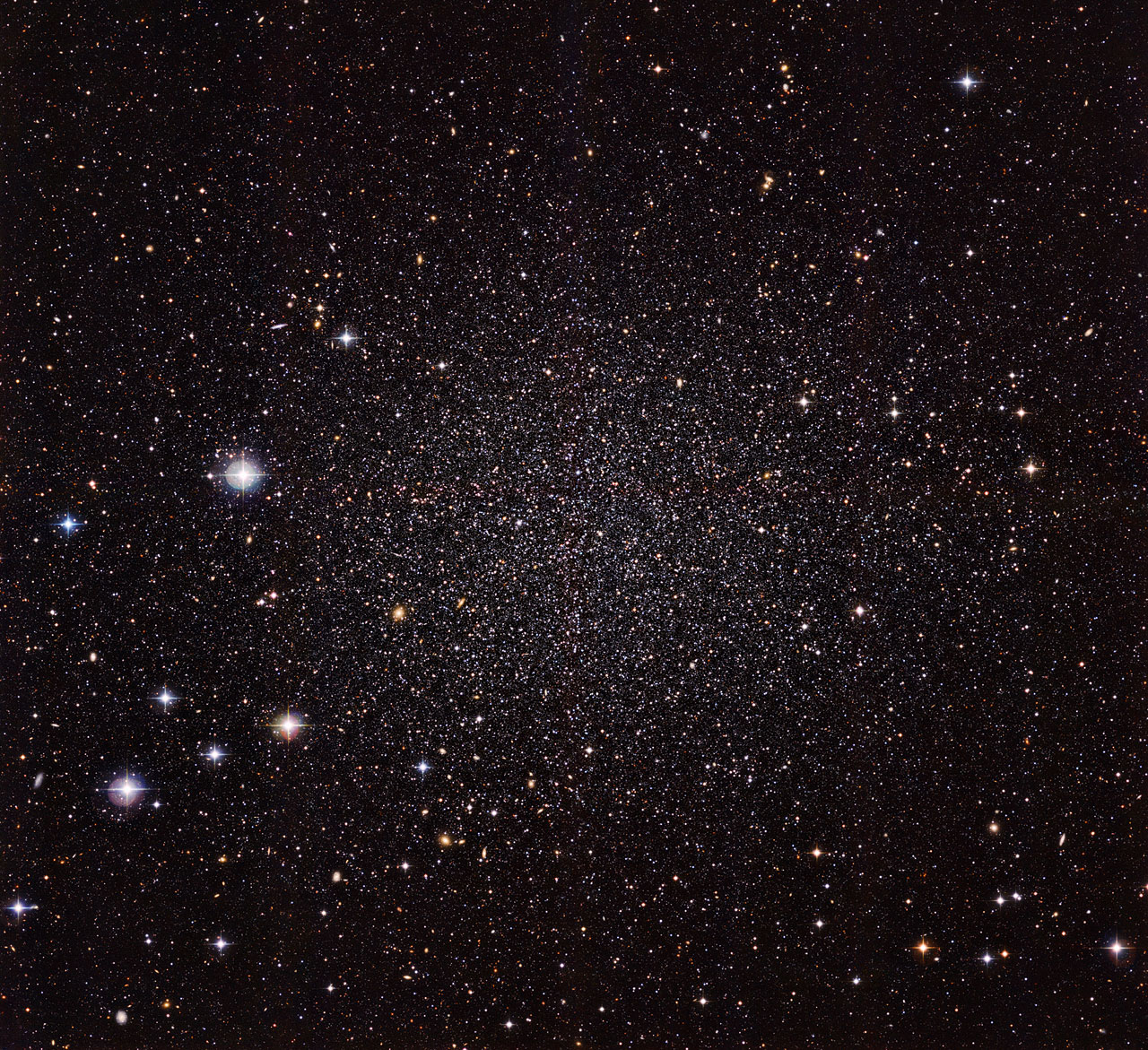
This composite picture shows how a typical galaxy appears at different wavelengths in the GAMA survey. This huge project has measured the energy output of more than 200 000 galaxies and represents the most comprehensive assessment of the energy output of the nearby Universe. The results confirm that the energy produced in a section of the Universe today is only about half what it was two billion years ago and find that this fading is occurring across all wavelengths from the ultraviolet to the far infrared.

Click for larger image.

The study involves many of the world’s most powerful telescopes, including ESO’s VISTA and VST survey telescopes at the Paranal Observatory in Chile. Supporting observations were made by two orbiting space telescopes operated by NASA (GALEX and WISE) and another belonging to the European Space Agency (Herschel) .

The research is part of the Galaxy And Mass Assembly (GAMA) project, the largest multi-wavelength survey ever put together.

“We used as many space and ground-based telescopes as we could get our hands on to measure the energy output of over 200 000 galaxies across as broad a wavelength range as possible,” says Simon Driver (ICRAR, The University of Western Australia), who heads the large GAMA team.

The survey data, released to astronomers around the world today, includes measurements of the energy output of each galaxy at 21 wavelengths, from the ultraviolet to the far infrared. This dataset will help scientists to better understand how different types of galaxies form and evolve.

All the energy in the Universe was created in the Big Bang, with some portion locked up as mass. Stars shine by converting mass back into energy, as described by Einstein’s famous equation E=mc2 [2]. The GAMA study sets out to map and model all of the energy generated within a large volume of space today and at different times in the past.

“While most of the energy sloshing around in the Universe arose in the aftermath of the Big Bang, additional energy is constantly being generated by stars as they fuse elements like hydrogen and helium together,” Simon Driver says. “This new energy is either absorbed by dust as it travels through the host galaxy, or escapes into intergalactic space and travels until it hits something, such as another star, a planet, or, very occasionally, a telescope mirror.”

The fact that the Universe is slowly fading has been known since the late 1990s, but this work shows that it is happening across all wavelengths from the ultraviolet to the infrared, representing the most comprehensive assessment of the energy output of the nearby Universe.

“The Universe will decline from here on in, sliding gently into old age. The Universe has basically sat down on the sofa, pulled up a blanket and is about to nod off for an eternal doze,” concludes Simon Driver.

The team of researchers hope to expand the work to map energy production over the entire history of the Universe, using a swathe of new facilities, including the world’s largest radio telescope, the Square Kilometre Array, which is due to be built in Australia and South Africa over the next decade.

The team will present this work at the International Astronomical Union XXIX General Assembly in Honolulu, Hawaii, on Monday 10 August 2015.

Notes

[1] The telescopes and survey data used, in order of increasing wavelength, were: GALEX, SDSS, VST (KiDS survey), AAT,VISTA (VIKING survey)/UKIRT, WISE, Herschel (PACS/SPIRE).

[2] Much of the Universe’s energy output comes from nuclear fusion in stars, when mass is slowly converted into energy. Another major source is the very hot discs around black holes at the centres of galaxies, where gravitational energy is converted to electromagnetic radiation in quasars and other active galactic nuclei. Much longer wavelength radiation comes from huge dust clouds that are re-radiating the energy from stars within them.

ESO: VLT captures beautiful view of a planetary nebula

The latest ESO report:

The Ghost of a Dying Star

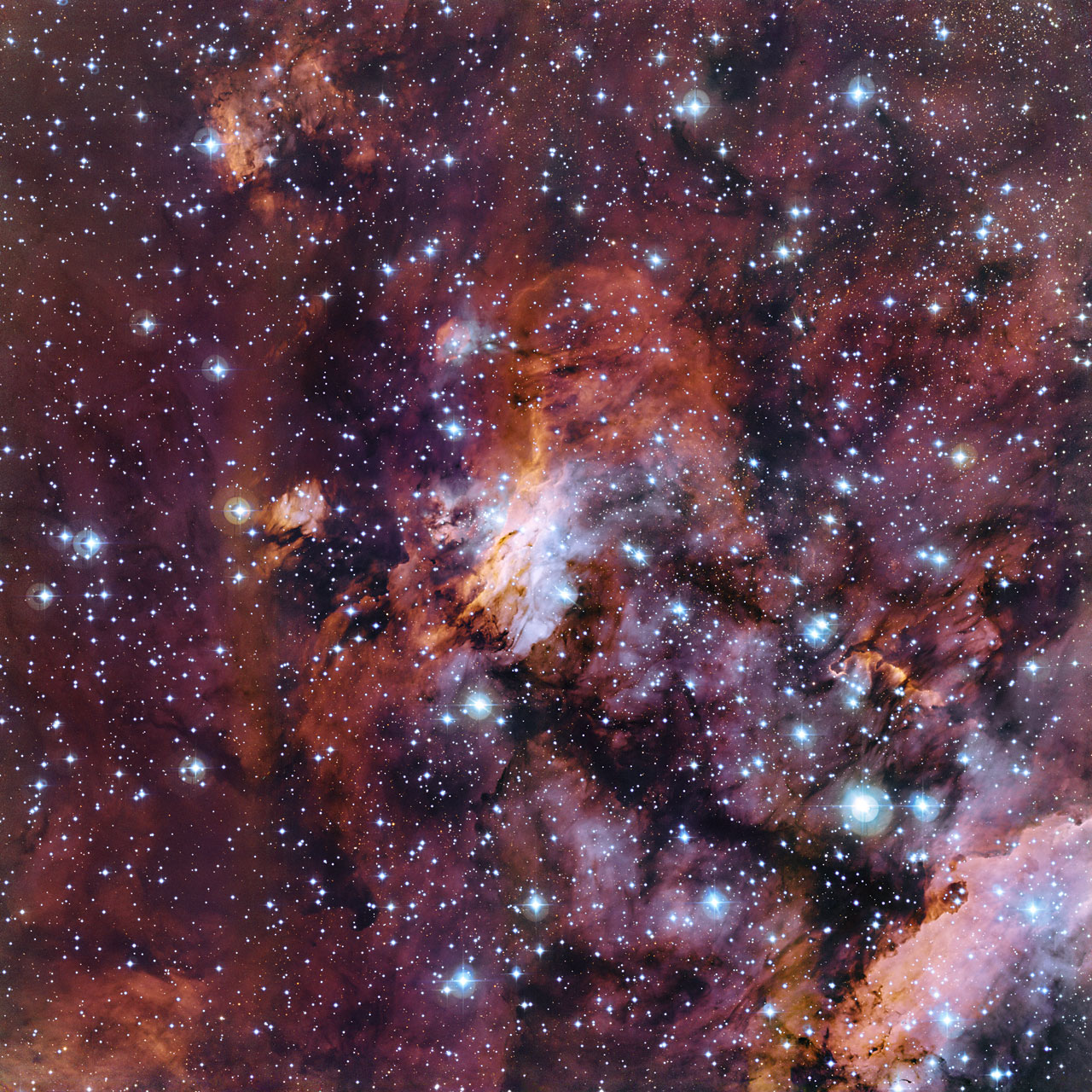
This extraordinary bubble, glowing like the ghost of a star in the haunting darkness of space, may appear supernatural and mysterious, but it is a familiar astronomical object: a planetary nebula, the remnants of a dying star. This is the best view of the little-known object ESO 378-1 yet obtained and was captured by ESO’s Very Large Telescope in northern Chile.

This extraordinary bubble, glowing like the ghost of a star in the haunting darkness of space, may appear supernatural and mysterious, but it is a familiar astronomical object: a planetary nebula, the remnants of a dying star. This is the best view of the little-known object ESO 378-1 yet obtained and was captured by ESO’s Very Large Telescope in northern Chile.

Nicknamed the Southern Owl Nebula, this shimmering orb is a planetary nebula with a diameter of almost four light-years. Its informal name relates to its visual cousin in the northern hemisphere, the Owl Nebula. ESO 378-1 [1], which is also catalogued as PN K 1-22 and PN G283.6+25.3, is located in the constellation of Hydra (The Female Water Snake).

Like all planetary nebulae, ESO 378-1 is a relatively short-lived phenomenon, lasting only a few tens of thousands of years, compared to a typical stellar lifetime of several billion years [2].

Planetary nebulae are created by the ejected and expanding gas of dying stars. Although they are brilliant and intriguing objects in the initial stages of formation, these bubbles fade away as their constituent gas moves away and the central stars grow dimmer.

For a planetary nebula to form, the aging star must have a mass less than about eight times that of the Sun. Stars that are heavier than this limit will end their lives in dramatic fashion as supernova explosions.

As these less massive stars grow old they start to lose their outer layers of gas to stellar winds. After most of these outer layers have dissipated, the remaining hot stellar core starts to emit ultraviolet radiation which then ionises the surrounding gas. This ionisation causes the expanding shell of ghostly gas to begin to glow in bright colours.

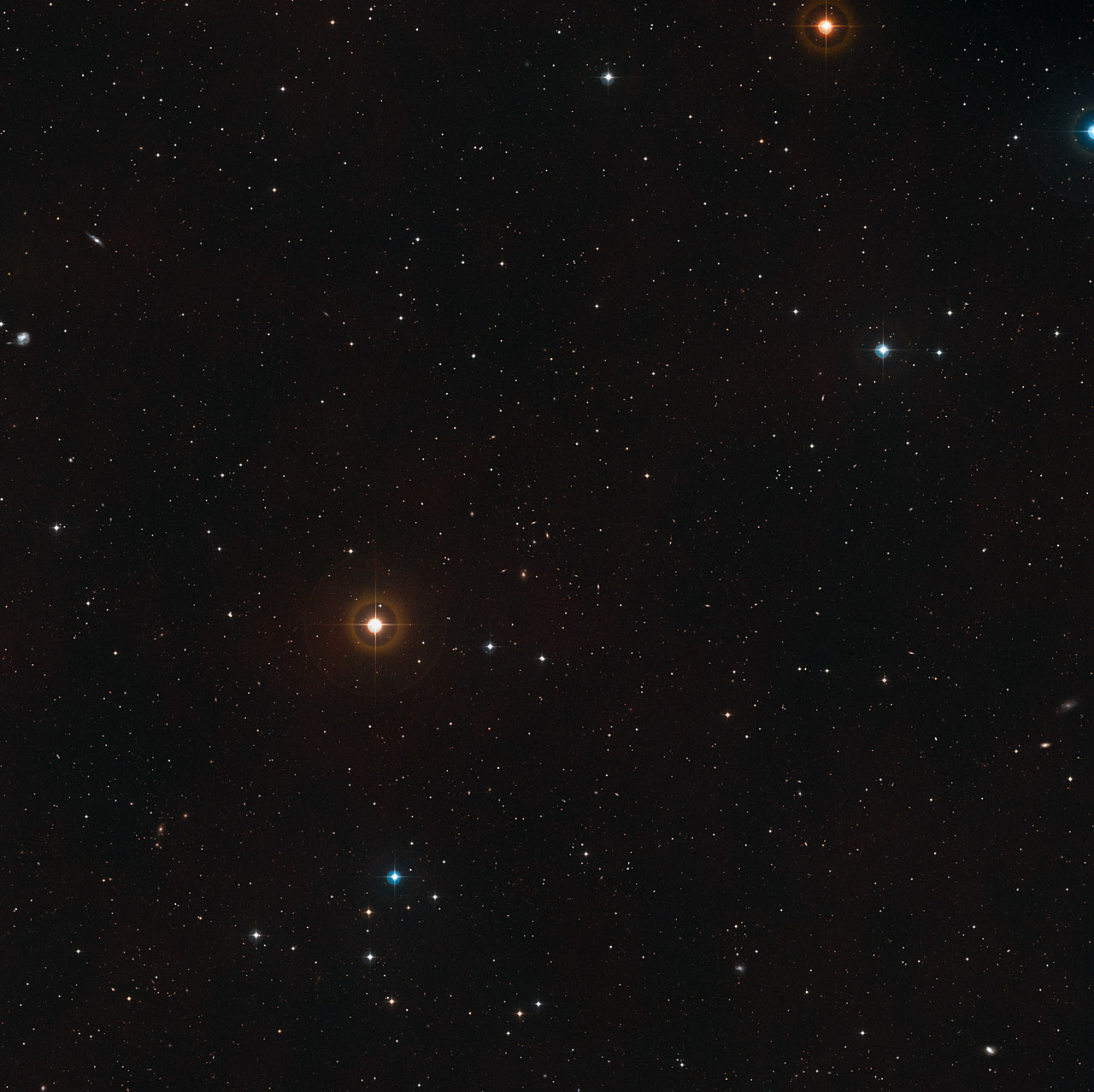
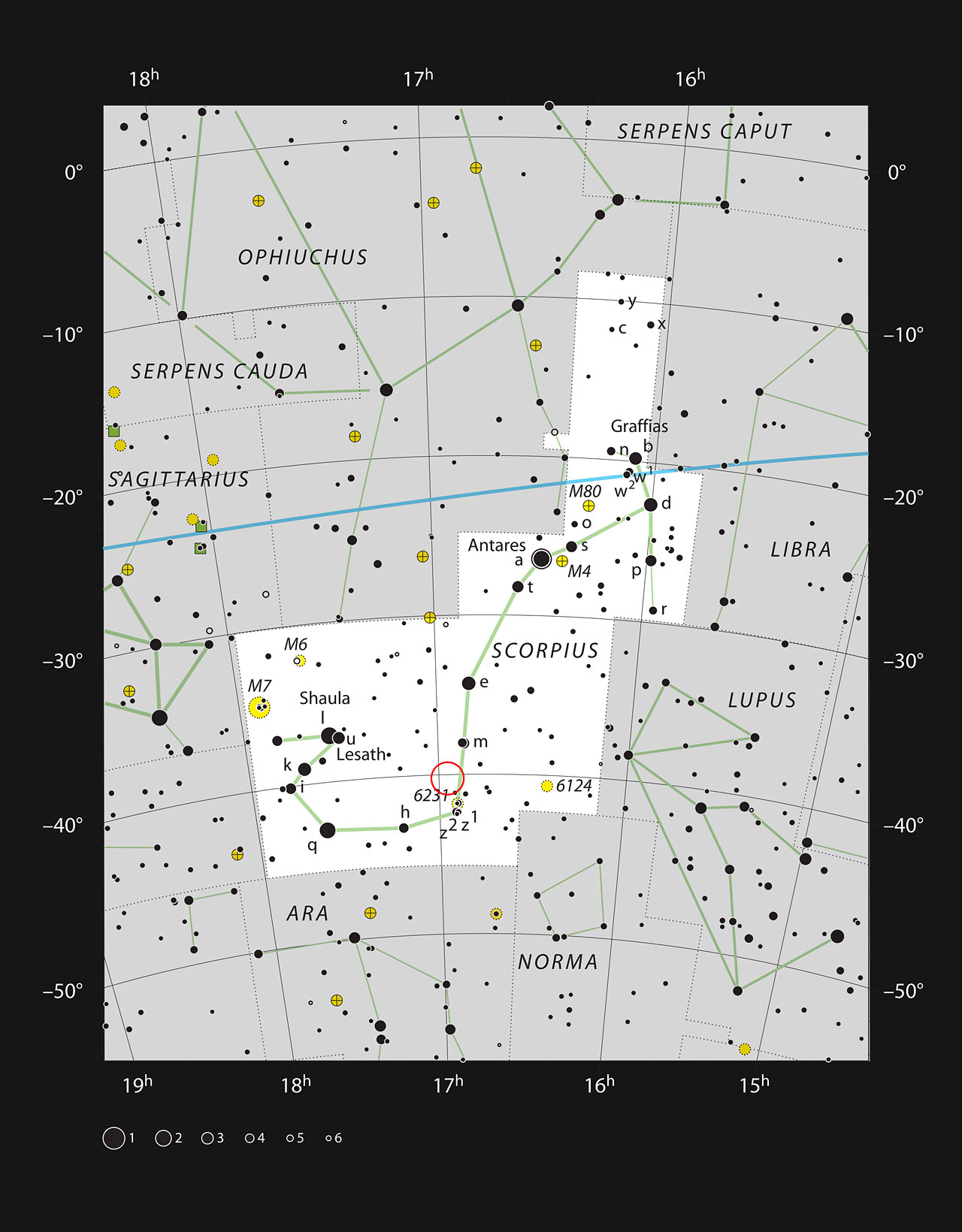
This chart shows the location of ESO 378-1 in the constellation of Hydra (The Female Water Snake). All the stars easily seen with the naked eye on a dark clear night are shown. This object can be seen faintly as a small glowing disc of light with moderate-sized telescopes.

After the planetary nebula has faded away, the leftover stellar remnant will burn for another billion years before consuming all its remaining fuel. It will then become a tiny — but hot and very dense — white dwarf that will slowly cool over billions of years. The Sun will produce a planetary nebula several billion years in the future and will afterwards also spend its twilight years as a white dwarf.

Planetary nebulae play a crucial role in the chemical enrichment and evolution of the Universe. Elements such as carbon and nitrogen, as well as some other heavier elements, are created in these stars and returned to the interstellar medium. Out of this material new stars, planets and eventually life can form. Hence astronomer Carl Sagan’s famous phrase: “We are made of star stuff.”

This video sequence starts from a wide field of the Milky Way and closes in on a rather empty patch of sky in the huge constellation of Hydra. A strange blue disc becomes visible — the planetary nebula ESO 378-1. The final very detailed view comes from ESO’s Very Large Telescope at the Paranal Observatory in Chile. Credit: ESO/Digitized Sky Survey 2/N. Risinger (skysurvey.org). Music: Johan B. Monell

This picture comes from the ESO Cosmic Gems programme, an outreach initiative to produce images of interesting, intriguing or visually attractive objects using ESO telescopes for the purposes of education and public outreach. The programme makes use of telescope time that cannot be used for science observations. All data collected may also be suitable for scientific purposes, and are made available to astronomers through ESO’s science archive.
Notes

[1] The ESO in the name of this object refers to a catalogue of objects compiled in the 1970s and 80s from careful inspection of new photographs taken with the ESO 1-metre Schmidt telescope at La Silla.

[2] The lifetime of a planetary nebula as a fraction of a star’s life is about the same as the life of a soap bubble compared to the age of the child who blows it.

NASA Spitzer confirms closest rocky exoplanet

NASA’s Spitzer Space Telescope uses the transit method to confirm the presence of a small rocky planet orbiting a start 21 light-years away from earth:

NASA’s Spitzer Confirms Closest Rocky Exoplanet

Using NASA’s Spitzer Space Telescope, astronomers have confirmed the discovery of the nearest rocky planet outside our solar system, larger than Earth and a potential gold mine of science data.

Dubbed HD 219134b, this exoplanet, which orbits too close to its star to sustain life, is a mere 21 light-years away. While the planet itself can’t be seen directly, even by telescopes, the star it orbits is visible to the naked eye in dark skies in the Cassiopeia constellation, near the North Star.

15-160[1]
This artist’s concept shows the silhouette of a rocky planet, dubbed HD 219134b. At 21 light-years away, the planet is the closest outside of our solar system that can be seen crossing, or transiting, its star. Credits: NASA/JPL-Caltech
HD 219134b is also the closest exoplanet to Earth to be detected transiting, or crossing in front of, its star and, therefore, perfect for extensive research.

“Transiting exoplanets are worth their weight in gold because they can be extensively characterized,” said Michael Werner, the project scientist for the Spitzer mission at NASA’s Jet Propulsion Laboratory (JPL) in Pasadena, California. “This exoplanet will be one of the most studied for decades to come.”

pia19832[1]
This sky map shows the location of the star HD 219134 (circle), host to the nearest confirmed rocky planet found to date outside of our solar system. The star lies just off the “W” shape of the constellation Cassiopeia and can be seen with the naked eye in dark skies. It actually has multiple planets, none of which are habitable. Credits: NASA/JPL-Caltech/DSS
The planet, initially discovered using HARPS-North instrument on the Italian 3.6-meter Galileo National Telescope in the Canary Islands, is the subject of a study accepted for publication in the journal Astronomy & Astrophysics.

Study lead author Ati Motalebi of the Geneva Observatory in Switzerland said she believes the planet is the ideal target for NASA’s James Webb Space Telescope in 2018.

“Webb and future large, ground-based observatories are sure to point at it and examine it in detail,” Motalebi said.

Only a small fraction of exoplanets can be detected transiting their stars due to their relative orientation to Earth. When the orientation is just right, the planet’s orbit places it between its star and Earth, dimming the detectable light of its star. It’s this dimming of the star that is actually captured by observatories such as Spitzer, and can reveal not only the size of the planet but also clues about its composition.

“Most of the known planets are hundreds of light-years away. This one is practically a next-door neighbor,” said astronomer and study co-author Lars A. Buchhave of the Harvard-Smithsonian Center for Astrophysics in Cambridge, Massachusetts. For reference, the closest known planet is GJ674b at 14.8 light-years away; its composition is unknown.

pia19833[1]
This artist’s rendition shows one possible appearance for the planet HD 219134b, the nearest confirmed rocky exoplanet found to date outside our solar system. The planet is 1.6 times the size of Earth, and whips around its star in just three days. Scientists predict that the scorching-hot planet — known to be rocky through measurements of its mass and size — would have a rocky, partially molten surface with geological activity, including possibly volcanoes. Credits: NASA/JPL-Caltech
HD 219134b was first sighted by the HARPS-North instrument and a method called the radial velocity technique, in which a planet’s mass and orbit can be measured by the tug it exerts on its host star. The planet was determined to have a mass 4.5 times that of Earth, and a speedy three-day orbit around its star.

Spitzer followed up on the finding, discovering the planet transits its star. Infrared measurements from Spitzer revealed the planet’s size, about 1.6 times that of Earth. Combining the size and mass gives it a density of 3.5 ounces per cubic inch (six grams per cubic centimeter) — confirming HD 219134b is a rocky planet.

Now that astronomers know HD 219134b transits its star, scientists will be scrambling to observe it from the ground and space. The goal is to tease chemical information out of the dimming starlight as the planet passes before it. If the planet has an atmosphere, chemicals in it can imprint patterns in the observed starlight.

Rocky planets such as this one, with bigger-than-Earth proportions, belong to a growing class of planets termed super-Earths.

“Thanks to NASA’s Kepler mission, we know super-Earths are ubiquitous in our galaxy, but we still know very little about them,” said co-author Michael Gillon of the University of Liege in Belgium, lead scientist for the Spitzer detection of the transit. “Now we have a local specimen to study in greater detail. It can be considered a kind of Rosetta Stone for the study of super-Earths.”

Further observations with HARPS-North also revealed three more planets in the same star system, farther than HD 219134b. Two are relatively small and not too far from the star. Small, tightly packed multi-planet systems are completely different from our own solar system, but, like super-Earths, are being found in increasing numbers.

JPL manages the Spitzer mission for NASA’s Science Mission Directorate in Washington. Science operations are conducted at the Spitzer Science Center at the California Institute of Technology (Caltech) in Pasadena. Spacecraft operations are based at Lockheed Martin Space Systems Company in Littleton, Colorado. Data are archived at the Infrared Science Archive, housed at Caltech’s Infrared Processing and Analysis Center.

For more information about NASA’s Spitzer Space Telescope, visit: www.nasa.gov/spitzer

Videos: August night sky previews

Two videos about sights to see in the night sky during this August:

* What’s Up! August 2015 – Space Pod 07/31/15

TMRO Chief Astronomer Jared Head takes a look at what to expect from the sky for viewing in the month of August.

What’s Up – August 2015 – NASA JPL