Category Archives: Astronomy

ESO: The dark Coalsack Nebula waits for new stars to light it up

ESO releases its latest astronomical findings:

A Cosmic Sackful of Black Coal

Dark smudges almost block out a rich star field in this new image captured by the Wide Field Imager camera, installed on the MPG/ESO 2.2-metre telescope at ESO’s La Silla Observatory in Chile. The inky areas are small parts of a huge dark nebula known as the Coalsack, one of the most prominent objects of its kind visible to the unaided eye. Millions of years from now, chunks of the Coalsack will ignite, rather like its fossil fuel namesake, with the glow of many young stars.
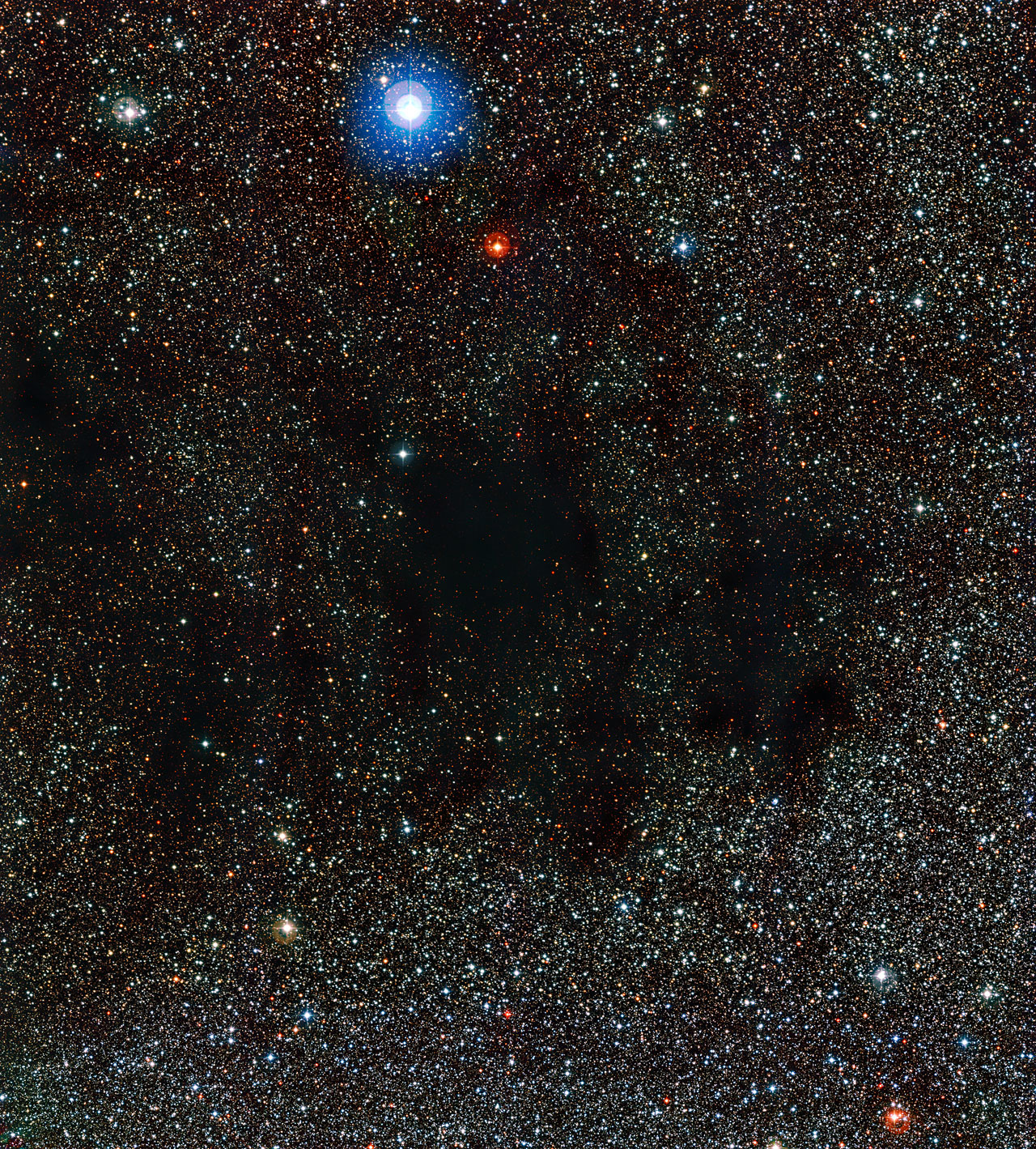
This image from the Wide Field Imager on the MPG/ESO 2.2-metre telescope shows part of the huge cloud of dust and gas known as the Coalsack Nebula. The dust in this nebula absorbs and scatters the light from background stars.
This image from the Wide Field Imager on the MPG/ESO 2.2-metre telescope shows part of the huge cloud of dust and gas known as the Coalsack Nebula. The dust in this nebula absorbs and scatters the light from background stars. Larger image.

The Coalsack Nebula is located about 600 light-years away in the constellation of Crux (The Southern Cross). This huge, dusky object forms a conspicuous silhouette against the bright, starry band of the Milky Way and for this reason the nebula has been known to people in the southern hemisphere for as long as our species has existed.

The Spanish explorer Vicente Yáñez Pinzón first reported the existence of the Coalsack Nebula to Europe in 1499. The Coalsack later garnered the nickname of the Black Magellanic Cloud, a play on its dark appearance compared to the bright glow of the two Magellanic Clouds, which are in fact satellite galaxies of the Milky Way. These two bright galaxies are clearly visible in the southern sky and came to the attention of Europeans during Ferdinand Magellan’s explorations in the 16th century. However, the Coalsack is not a galaxy. Like other dark nebulae, it is actually an interstellar cloud of dust so thick that it prevents most of the background starlight from reaching observers.

This zoom video starts with a broad view of the Milky Way. We then zoom in towards the famous small constellation of Crux, the Southern Cross, and to its left, the huge dark area called the Coalsack. The final sequence takes a very close look at some of the darkest parts of this cloud and also reveals many faint stars whose light has been reddened by scattering from the dust. Credit: ESO, N. Risinger (skysurvey.org), Digitized Sky Survey 2. Music: Johan Monell (www.johanmonell.com)

A significant number of the dust particles in dark nebulae have coats of frozen water, nitrogen, carbon monoxide and other simple organic molecules. The resulting grains largely prevent visible light from passing through the cosmic cloud. To get a sense of how truly dark the Coalsack is, back in 1970, the Finnish astronomer Kalevi Mattila published a study estimating that the Coalsack has only about 10 percent of the brightness of the encompassing Milky Way. A little bit of background starlight, however, still manages to get through the Coalsack, as is evident in the new ESO image and in other observations made by modern telescopes.

This video takes a close-up look at a new image from the Wide Field Imager on the MPG/ESO 2.2-metre telescope. It shows part of the huge cloud of dust and gas known as the Coalsack Nebula, close to the Southern Cross in the southern Milky Way. The dust in this nebula absorbs and scatters the light from background stars, making many of them appear fainter and redder. Credit: ESO. Music: Johan Monell (www.johanmonell.com)

The little light that does make it through the nebula does not come out the other side unchanged. The light we see in this image looks redder than it ordinarily would. This is because the dust in dark nebulae absorbs and scatters blue light from stars more than red light, tinting the stars several shades more crimson than they would otherwise be.

Millions of years in the future the Coalsack’s dark days will come to an end. Thick interstellar clouds like the Coalsack contain lots of dust and gas — the fuel for new stars. As the stray material in the Coalsack coalesces under the mutual attraction of gravity, stars will eventually light up, and the coal “nuggets” in the Coalsack will “combust”, almost as if touched by a flame.
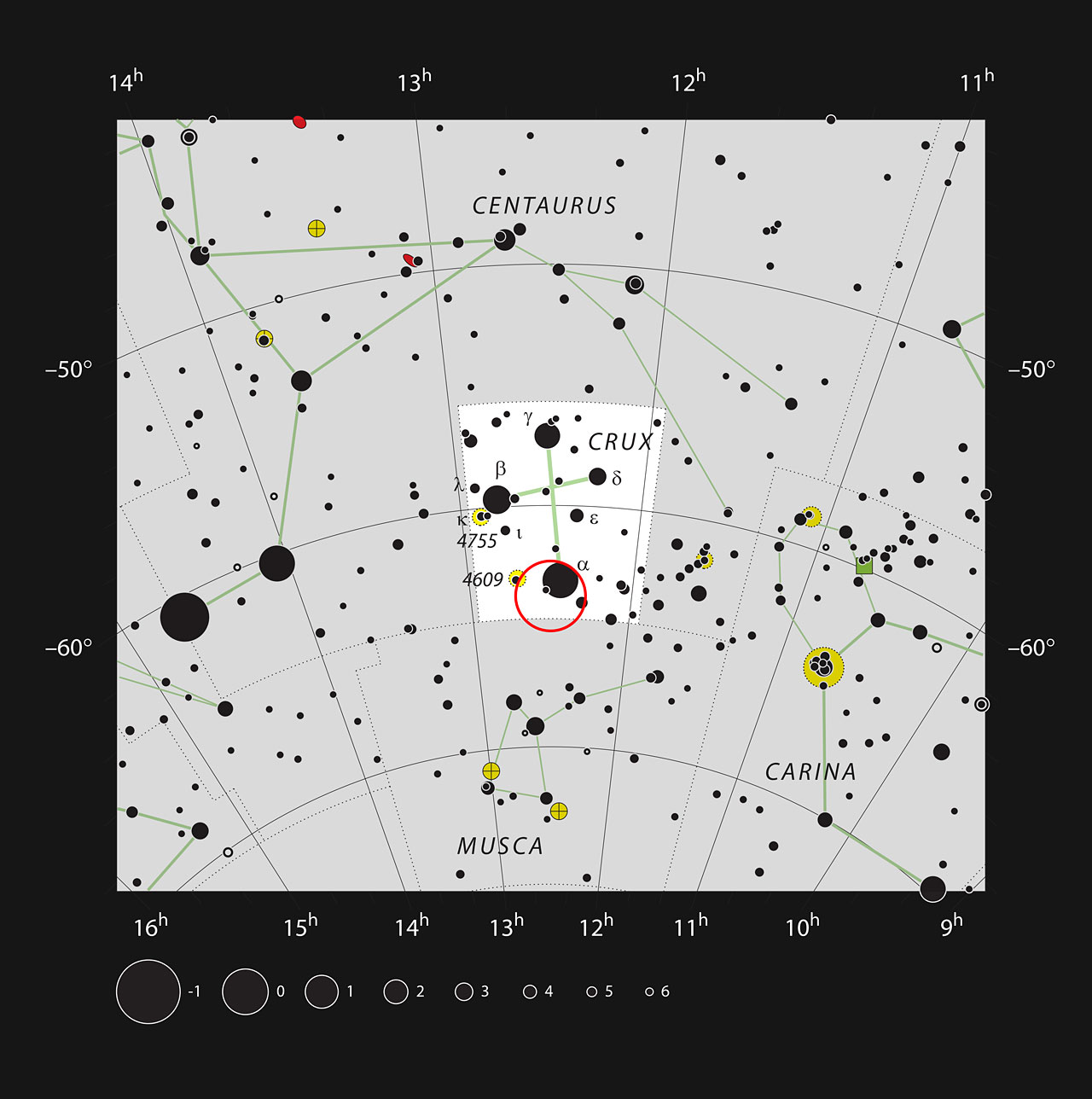
This chart of the famous small constellation of Crux (The Southern Cross) shows all the stars that can be seen with the naked eye on a clear dark night. This constellation and its neighbours are also home to the huge dark nebula called the Coalsack, which can be easily seen without a telescope as a dark area superposed on the glow of the Milky Way. The location of a particularly dark part of this cloud, which has been imaged in detail using the Wide Field Imager on the MPG/ESO 2.2-metre telescope, is marked with a red circle.
This chart of the famous small constellation of Crux (The Southern Cross) shows all the stars that can be seen with the naked eye on a clear dark night. This constellation and its neighbours are also home to the huge dark nebula called the Coalsack, which can be easily seen without a telescope as a dark area superposed on the glow of the Milky Way. The location of a particularly dark part of this cloud, which has been imaged in detail using the Wide Field Imager on the MPG/ESO 2.2-metre telescope, is marked with a red circle. Larger image.

More information

ESO is the foremost intergovernmental astronomy organisation in Europe and the world’s most productive ground-based astronomical observatory by far. It is supported by 16 countries: Austria, Belgium, Brazil, the Czech Republic, Denmark, France, Finland, Germany, Italy, the Netherlands, Poland, Portugal, Spain, Sweden, Switzerland and the United Kingdom, along with the host state of Chile. ESO carries out an ambitious programme focused on the design, construction and operation of powerful ground-based observing facilities enabling astronomers to make important scientific discoveries. ESO also plays a leading role in promoting and organising cooperation in astronomical research. ESO operates three unique world-class observing sites in Chile: La Silla, Paranal and Chajnantor. At Paranal, ESO operates the Very Large Telescope, the world’s most advanced visible-light astronomical observatory and two survey telescopes. VISTA works in the infrared and is the world’s largest survey telescope and the VLT Survey Telescope is the largest telescope designed to exclusively survey the skies in visible light. ESO is a major partner in ALMA, the largest astronomical project in existence. And on Cerro Armazones, close to Paranal, ESO is building the 39-metre European Extremely Large Telescope, the E-ELT, which will become “the world’s biggest eye on the sky”.
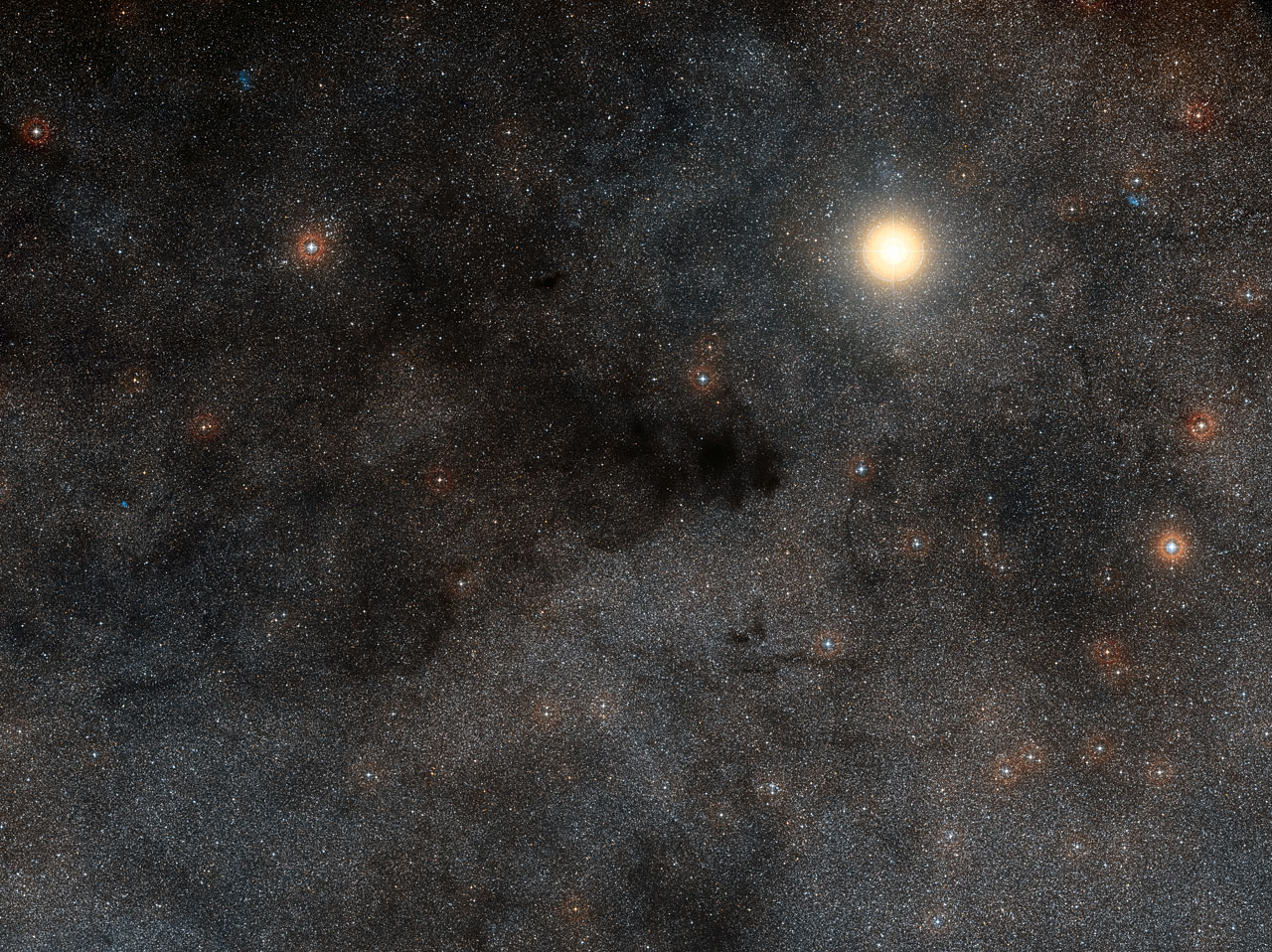
This rich landscape is part of the small constellation of Crux (The Southern Cross). The very bright star is Alpha Crucis, also know as Acrux, one of the four stars that make up the famous cross shape. Most of the upper left part of this image is filled with dark dusty clouds that form part of the huge dark nebula called the Coalsack.
This rich landscape is part of the small constellation of Crux (The Southern Cross). The very bright star is Alpha Crucis, also know as Acrux, one of the four stars that make up the famous cross shape. Most of the upper left part of this image is filled with dark dusty clouds that form part of the huge dark nebula called the Coalsack. Larger image.

Hubble telescope spots mysterious ripples racing through planet-forming disc

The NASA/ESA Hubble telescope team releases this new finding:

Mysterious Ripples Found Racing Through Planet-forming Disc

Using images from the NASA/ESA Hubble Space Telescope and ESO’s Very Large Telescope, astronomers have discovered never-before-seen structures within a dusty disc surrounding a nearby star. The fast-moving wave-like features in the disc of the star AU Microscopii are unlike anything ever observed, or even predicted, before now. The origin and nature of these features present a new mystery for astronomers to explore. The results are published in the journal Nature on 8 October 2015.

Using images from the NASA/ESA Hubble Space Telescope and ESO’s Very Large Telescope, astronomers have discovered fast-moving wave-like features in the dusty disc around the nearby star AU Microscopii. These odd structures are unlike anything ever observed, or even predicted, before now. The top row shows a Hubble image of the AU Mic disc from 2010, the middle row Hubble from 2011 and the bottom row is an image taken with the SPHERE instrument, mounted on the Very Large Telescope, from 2014. The black central circles show where the brilliant light of the central star has been blocked off to reveal the much fainter disc, and the position of the star is indicated schematically.

AU Microscopii, or AU Mic for short, is a young, nearby star surrounded by a large disc of dust [1]. Studies of such debris discs can provide valuable clues about how planets, which form from these discs, are created.

Video: Using images from the NASA/ESA Hubble Space Telescope and ESO’s Very Large Telescope, astronomers have discovered unique and totally unexpected structures within the dusty disc around the star AU Microscopii. Credits.

Astronomers have been searching AU Mic’s disc for any signs of clumpy or warped features, as such signs might give away the location of possible planets. And in 2014 they used the  powerful high-contrast imaging capabilities of ESO’s newly installed SPHERE instrument, mounted on the Very Large Telescope for their search — and discovered something very unusual.

“Our observations have shown something unexpected,” explains Anthony Boccaletti of the Observatoire de Paris, France, lead author on the paper. “The images from SPHERE show a set of unexplained features in the disc which have an arch-like, or wave-like, structure, unlike anything that has ever been observed before.”

This image shows the sky around the nearby young star AU Microscopii. It was created from images forming part of the Digitized Sky Survey 2. AU Mic appears just below the centre of the image as an orangish star of moderate brightness. Because the photographs through different coloured filters that were used to make this picture were taken many years apart, AU Mic appears double, as the star’s own proper motion has moved it a small distance across the sky in the intervening time.

Five wave-like arches at different distances from the star show up in the new images, reminiscent of ripples in water. After spotting the features in the SPHERE data the team turned to earlier images of the disc taken by the NASA/ESA Hubble Space Telescope in 2010 and 2011 to see whether the features were also visible in these [2]. They were not only able to identify the features on the earlier Hubble images — but they also discovered that they had changed over time. It turns out that these ripples are moving — and very fast!

“We reprocessed images from the Hubble data and ended up with enough information to track the movement of these strange features over a four-year period,” explains team member Christian Thalmann (ETH Zürich, Switzerland). “By doing this, we found that the arches are racing away from the star at speeds of up to about 40 000 kilometres/hour!”

The features further away from the star seem to be moving faster than those closer to it. At least three of the features are moving so fast that they could well be escaping from the gravitational attraction of the star. Such high speeds rule out the possibility that these are conventional disc features caused by objects — like planets — disturbing material in the disc while orbiting the star. There must have been something else involved to speed up the ripples and make them move so quickly, meaning that they are a sign of something truly unusual [3].

“Everything about this find was pretty surprising!” comments co-author Carol Grady of Eureka Scientific, USA. “And because nothing like this has been observed or predicted in theory we can only hypothesise when it comes to what we are seeing and how it came about.”

The team cannot say for sure what caused these mysterious ripples around the star. But they have considered and ruled out a series of phenomena as explanations, including the collision of two massive and rare asteroid-like objects releasing large quantities of dust, and spiral waves triggered by instabilities in the system’s gravity.

Video: This short timelapse sequence shows images of the debris disc around the nearby star AU Microscopii in 2010, 2011 and 2014. The two earlier images were from the NASA/ESA Hubble Space Telescope and the final one from the new SPHERE instrument on ESO’s Very Large Telescope. Credit: ESO, ESA & NASA

But other ideas that they have considered look more promising.

“One explanation for the strange structure links them to the star’s flares. AU Mic is a star with high flaring activity — it often lets off huge and sudden bursts of energy from on or near its surface,” explains co-author Glenn Schneider of Steward Observatory, USA. “One of these flares could perhaps have triggered something on one of the planets — if there are planets — like a violent stripping of material which could now be propagating through the disc, propelled by the flare’s force.”

“It is very satisfying that SPHERE has proved to be very capable at studying discs like this in its first year of operation,”adds Jean-Luc Beuzit, who is both a co-author of the new study and also led the development of SPHERE itself.

The team plans to continue to observe the AU Mic system with SPHERE and other facilities, including ALMA, to try to understand what is happening. But, for now, these curious features remain an unsolved mystery.

This video clip takes the viewer from a broad view of the entire southern Milky Way into a closeup of the nearby star AU Microscopii, about 32 light-years from Earth. This star is young and surrounded by a dusty disc that features odd wave-like, rapidly moving features that are imperfectly understood. Credit: ESO/Digitized Sky Survey 2/N. Risinger (skysurvey.org) . Music: Johan Monell

Notes

[1] AU Microscopii lies just 32 light-years away from Earth. The disc essentially comprises asteroids that have collided with such vigour that they have been ground to dust.

[2] The data were gathered by Hubble’s Space Telescope Imaging Spectrograph (STIS).

[3] The edge-on view of the disc complicates the interpretation of its three-dimensional structure.

Videos: October night sky + Blood Moon

Here is the NASA JPL preview of the night sky for October:


[ Update: Here’s another October night sky preview from TMRO.tv:

TMRO’s Chief Astronomer Jared Head takes a look at a few far off objects in the sky for October 2015.

TMRO Space Pods are crowd funded shows. If you like this episode consider contributing to help us to continue to improve. Head over tohttp://www.patreon.com/spacepod for information, goals and reward levels. Don’t forget to check out our weekly live show campaign as well over at http://www.patreon.com/tmro

]

Johannes Jönsson pointed me to his video of the lunar eclipse earlier this week:

Supermoon eclipse tonight

There will be a lunar eclipse tonight that will particularly unusual. The Moon will be at the closest approach (perigee) of its orbit to earth when it can be as much as 14% bigger and 30% brighter than when the Moon is at its farthest distance (apogee) from earth. NASA TV to Provide Live Feed of Sunday’s Supermoon Eclipse – NASA

This video gives a brief description of this eclipse of a Supermoon:

Viewing info:

Sunday’s supermoon eclipse will last 1 hour and 11 minutes, and will be visible to North and South America, Europe, Africa, and parts of West Asia and the eastern Pacific. Weather permitting, you can see the supermoon after nightfall, and the eclipse will cast it into shadow beginning at 8:11 p.m. EDT. The total eclipse starts at 10:11 p.m. EDT, peaking at 10:47 p.m. EDT.

More on times and visibility at September 27 / September 28, 2015 — Total Lunar Eclipse – Where and when to see.

If you cannot go outside and see the eclipse directly, views of it will be available online:

Here’s a tutorial on lunar eclipses:

Video: Detecting exoplanet systems with microlensing

Here is a SETI Institute seminar on a lesser known way to detect and measure exoplanets: Detecting Exoplanetary Systems with Micolensing – Scott Gaudi (SETI Talks)

From the caption:

Measurements of the demographics of exoplanets over a range of planet and host star properties provide fundamental empirical constraints on theories of planet formation and evolution. Because of its unique sensitivity to low-mass, long-period, and free-floating planets, microlensing is an essential complement to our arsenal of planet detection methods.

Dr. Gaudi will review the microlensing method, and discuss results to date from ground-based microlensing surveys. Also, Dr. Gaudi will motivate a space-based microlensing survey with WFIRST-AFTA, which when combined with the results from Kepler, will yield a nearly complete picture of the demographics of planetary systems throughout the Galaxy.