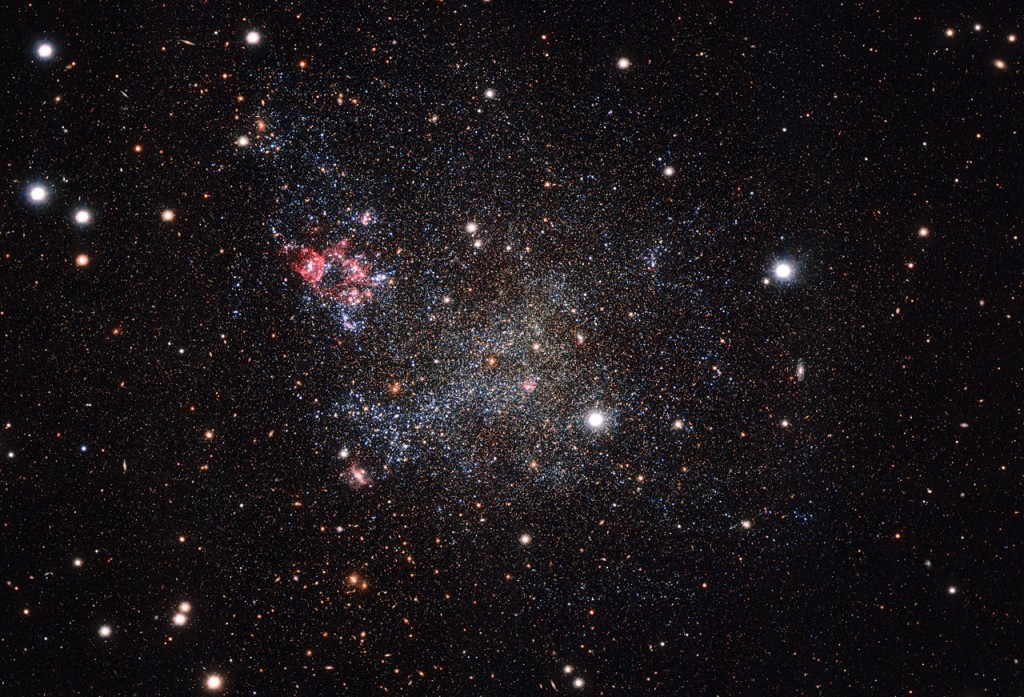
This image, captured with the OmegaCAM camera on ESO’s VLT Survey Telescope in Chile, shows an unusually clean small galaxy. IC 1613 contains very little cosmic dust, allowing astronomers to explore its contents with great clarity.
Many galaxies are chock-full of dust, while others have occasional dark streaks of opaque cosmic soot swirling in amongst their gas and stars. However, the subject of this new image, snapped with the OmegaCAM camera on ESO’s VLT Survey Telescope in Chile, is unusual — the small galaxy, named IC 1613, is a veritable clean freak! IC 1613 contains very little cosmic dust, allowing astronomers to explore its contents with great clarity. This is not just a matter of appearances; the galaxy’s cleanliness is vital to our understanding of the Universe around us.
IC 1613 is a dwarf galaxy in the constellation of Cetus (The Sea Monster). This VST image [1] shows the galaxy’s unconventional beauty, all scattered stars and bright pink gas, in great detail.
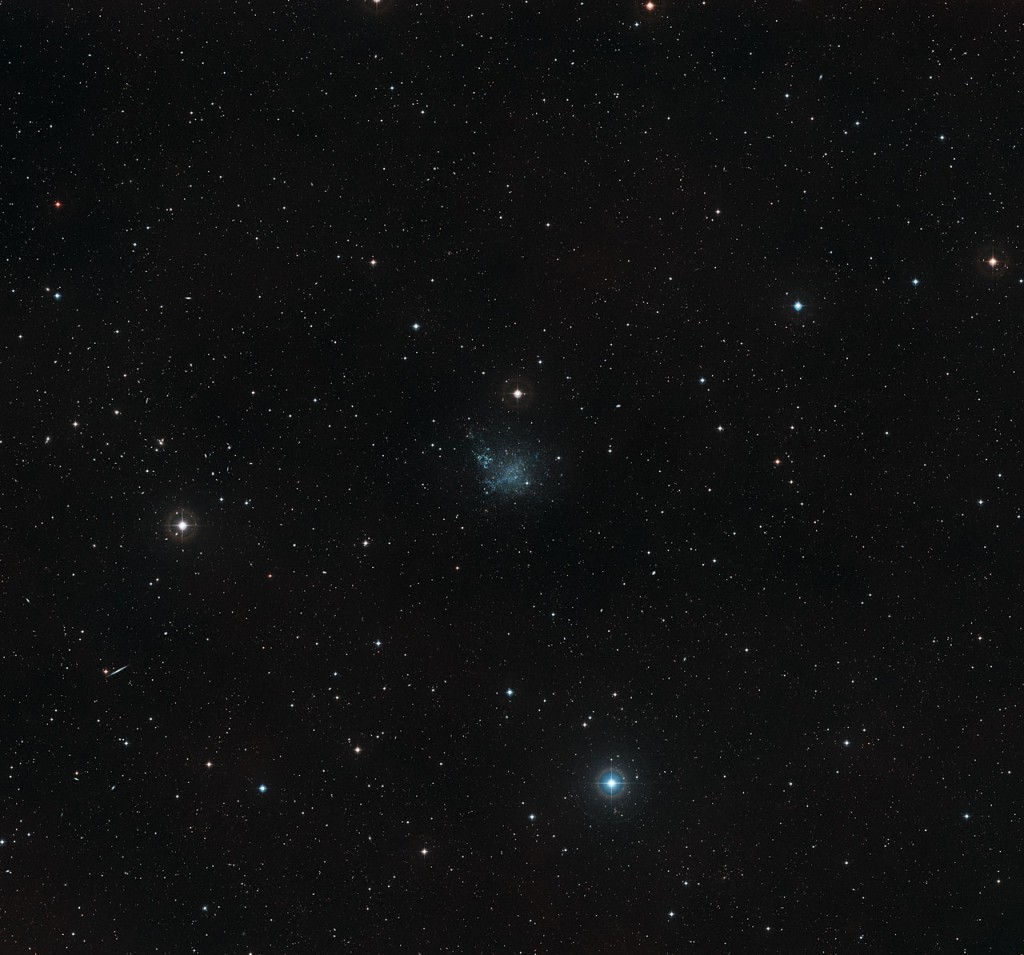
This chart shows the position of the nearby, but very faint, galaxy IC 1613 in the constellation of Cetus (The Sea Monster). Most of the stars visible to the naked eye on a clear and dark night are shown. The galaxy itself has a very low surface brightness and is very hard to spot visually. Credit: ESO/IAU and Sky & TelescopeGerman astronomer Max Wolf discovered IC 1613’s faint glow in 1906. In 1928, his compatriot Walter Baade used the more powerful 2.5-metre telescope at the Mount Wilson Observatory in California to successfully make out its individual stars. From these observations, astronomers figured out that the galaxy must be quite close to the Milky Way, as it is only possible to resolve single pinprick-like stars in the very nearest galaxies to us.
Astronomers have since confirmed that IC 1613 is indeed a member of the Local Group, a collection of more than 50 galaxies that includes our home galaxy, the Milky Way. IC 1613 itself lies just over 2.3 million light-years away from us. It is relatively well-studied due to its proximity; astronomers have found it to be an irregular dwarf that lacks many of the features, such as a starry disc, found in some other diminutive galaxies.
This sequence starts with a broad view of the rather faint constellation of Cetus (The Sea Monster). As we zoom, we close in on a faint, but nearby galaxy, IC 1613. The final detailed image, captured with the OmegaCAM camera on ESO’s VLT Survey Telescope in Chile, shows an unusually clean small galaxy. IC 1613 contains very little cosmic dust, allowing astronomers to explore its contents with great clarity. Credit: ESO/A. Fujii/Digitised Sky Survey 2. Music: Johan B. Monell (www.johanmonell.com)
However, what IC 1613 lacks in form, it makes up for in tidiness. We know IC 1613’s distance to a remarkably high precision, partly due to the unusually low levels of dust lying both within the galaxy and along the line of sight from the Milky Way — something that enables much clearer observations [2].
The second reason we know the distance to IC 1613 so precisely is that the galaxy hosts a number of notable stars of two types: Cepheid variables and RR Lyrae variables[3]. Both types of star rhythmically pulsate, growing characteristically bigger and brighter at fixed intervals (eso1311).
As we know from our daily lives on Earth, shining objects such as light bulbs or candle flames appear dimmer the further they are away from us. Astronomers can use this simple piece of logic to figure out exactly how far away things are in the Universe— so long as they know how bright they really are, referred to as their intrinsic brightness.
This wide-field view shows the sky around the dwarf galaxy IC 1613 in the constellation of Cetus (The Sea Monster). This picture was created from images forming part of the Digitized Sky Survey 2. The galaxy appears at the centre of the picture as an irregularly shaped clump of faint stars.
Cepheid and RR Lyrae variables have the special property that their period of brightening and dimming is linked directly to their intrinsic brightness. So, by measuring how quickly they fluctuate astronomers can work out their intrinsic brightness. They can then compare these values to their apparent measured brightness and work out how far away they must be to appear as dim as they do.
Stars of known intrinsic brightness can act like standard candles, as astronomers say, much like how a candle with a specific brightness would act as a good gauge of distance intervals based on the observed brightness of its flame’s flicker.
Using standard candles — such as the variable stars within IC 1613 and the less-common Type Iasupernova explosions, which can seen across far greater cosmic distances — astronomers have pieced together a cosmic distance ladder, reaching deeper and deeper into space.
Decades ago, IC 1613 helped astronomers work out how to utilise variable stars to chart the Universe’s grand expanse. Not bad for a little, shapeless galaxy.
This video sequence takes a close look at a new image, captured with the OmegaCAM camera on ESO’s VLT Survey Telescope in Chile, showing an unusually clean small galaxy. IC 1613 contains very little cosmic dust, allowing astronomers to explore its contents with great clarity. Credit: ESO. Music: Johan B. Monell (www.johanmonell.com)
Notes
[1] OmegaCAM is a 32-CCD, 256-million-pixel camera mounted on the 2.6-metre VLT Survey Telescope at Paranal Observatory in Chile. Click here to view more images taken by OmegaCAM.
[2] Cosmic dust is made of various heavier elements, such as carbon and iron, as well as larger, grainier molecules. Not only does dust block out light, making dust-shrouded objects harder to see, it also preferentially scatters bluer light. As a result, cosmic dust makes objects appear redder when seen through our telescopes than they are in reality. Astronomers can factor out this reddening when studying objects. Still, the less reddening, the more precise an observation is likely to be.
[3] Other than the two Magellanic Clouds, IC 1613 is the only irregular dwarf galaxy in the Local Group in which RR Lyrae type variable stars have been identified.
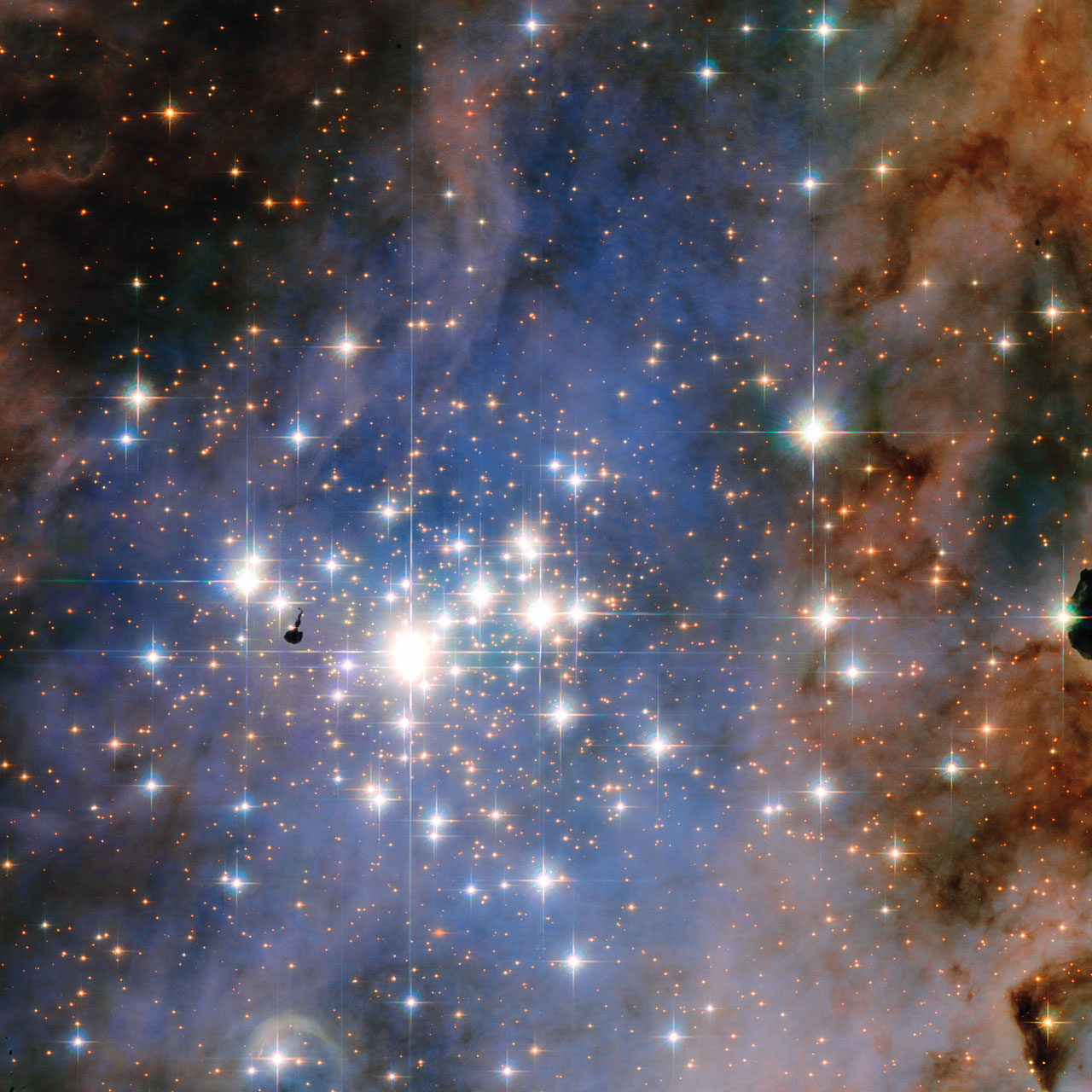
This NASA/ESA Hubble Space Telescope image features the star cluster Trumpler 14. One of the largest gatherings of hot, massive and bright stars in the Milky Way, this cluster houses some of the most luminous stars in our entire galaxy.
Single stars are often overlooked in favour of their larger cosmic cousins — but when they join forces, they create truly breathtaking scenes to rival even the most glowing of nebulae or swirling of galaxies. This NASA/ESA Hubble Space Telescope image features the star cluster Trumpler 14. One of the largest gatherings of hot, massive and bright stars in the Milky Way, this cluster houses some of the most luminous stars in our entire galaxy.
Around 1100 open clusters have so far been discovered within the Milky Way, although many more are thought to exist. Trumpler 14 is one of these, located some 8000 light-years away towards the centre of the well-known Carina Nebula.
This short sequence zooms in on the open young cluster of stars, Trumpler 14. One of the largest gatherings of hot, massive and bright stars in the Milky Way, this cluster houses some of the most luminous stars in our entire galaxy. Credit: ESO, DSS, ESA/Hubble, Risinger (skysurvey.org) Music: Johan B. Monell
At a mere 500 000 years old — a small fraction of the Pleiades open cluster’s age of 115 million years — Trumpler 14 is not only one of the most populous clusters within the Carina Nebula, but also the youngest. However, it is fast making up for lost time, forming stars at an incredible rate and putting on a stunning visual display.
This region of space houses one of the highest concentrations of massive, luminous stars in the entire Milky Way — a spectacular family of young, bright, white-blue stars. These stars are rapidly working their way through their vast supplies of hydrogen, and have only a few million years of life left before they meet a dramatic demise and explode as supernovae. In the meantime, despite their youth, these stars are making a huge impact on their environment. They are literally making waves!
As the stars fling out high-speed particles from their surfaces, strong winds surge out into space. These winds collide with the surrounding material, causing shock waves that heat the gas to millions of degrees and trigger intense bursts of X-rays. These strong stellar winds also carve out cavities in nearby clouds of gas and dust, and kickstart the formation of new stars.
This colour-composite image of the Carina Nebula, made by the MPG/ESO 2.2-metre telescope at La Silla, Chile, reveals exquisite details in the stars and dust of the region. The open star cluster Trumpler 14, a collection of very bright, young stars within the Carina Nebula, is marked with a red circle. Several more well known astronomical objects can be seen in this wide field image: to the bottom left of the image is one of the most impressive binary stars in the Universe, Eta Carinae, with the famous Keyhole Nebula just adjacent to the star. A second open star cluster, Collinder 228 is also seen in the image, just below Eta Carinae.
The peculiar arc-shaped cloud visible at the very bottom of this image is suspected to be the result of such a wind. This feature is thought to be a bow shock created by the wind flowing from the nearby star Trumpler 14 MJ 218. Astronomers have observed this star to be moving through space at some 350 000 kilometres per hour, sculpting the surrounding clumps of gas and dust as it does so.
Astronomers estimate that around 2000 stars reside within Trumpler 14, ranging in size from less than one tenth to up to several tens of times the mass of the Sun. The most prominent star in Trumpler 14, and the brightest star in this image, is the supergiant HD 93129Aa [1]. It is one of the most brilliant and hottest stars in our entire galaxy.
Notes
[1] HD 93129Aa is part of the binary star system HD 93129AaAb consisting of HD 93129Aa and HD 93129Ab. HD 93129Aa is an O-type star that is approximately two and a half million times brighter than the Sun, and has a mass 80 times greater. It forms a close binary with another massive star within the open cluster, meaning that the two orbit around a shared centre of mass. With a surface temperature of over 50 000 degrees, HD 93129Aa is one of the hottest O-type stars in the entire Milky Way.
Caltech researchers have found evidence of a giant planet tracing a bizarre, highly elongated orbit in the outer solar system. The object, which the researchers have nicknamed Planet Nine, has a mass about 10 times that of Earth and orbits about 20 times farther from the sun on average than does Neptune (which orbits the sun at an average distance of 2.8 billion miles). In fact, it would take this new planet between 10,000 and 20,000 years to make just one full orbit around the sun.
This artistic rendering shows the distant view from Planet Nine back towards the sun. The planet is thought to be gaseous, similar to Uranus and Neptune. Hypothetical lightning lights up the night side. Credit: Caltech/R. Hurt (IPAC)The researchers, Konstantin Batygin and Mike Brown, discovered the planet’s existence through mathematical modeling and computer simulations but have not yet observed the object directly.
“This would be a real ninth planet,” says Brown, the Richard and Barbara Rosenberg Professor of Planetary Astronomy. “There have only been two true planets discovered since ancient times, and this would be a third. It’s a pretty substantial chunk of our solar system that’s still out there to be found, which is pretty exciting.”
The six most distant known objects in the solar system with orbits exclusively beyond Neptune (magenta) all mysteriously line up in a single direction. Also, when viewed in three dimensions, they tilt nearly identically away from the plane of the solar system. Batygin and Brown show that a planet with 10 times the mass of the earth in a distant eccentric orbit anti-aligned with the other six objects (orange) is required to maintain this configuration. Credit: Caltech/R. Hurt (IPAC); [Diagram created using WorldWide Telescope.]Brown notes that the putative ninth planet—at 5,000 times the mass of Pluto—is sufficiently large that there should be no debate about whether it is a true planet. Unlike the class of smaller objects now known as dwarf planets, Planet Nine gravitationally dominates its neighborhood of the solar system. In fact, it dominates a region larger than any of the other known planets—a fact that Brown says makes it “the most planet-y of the planets in the whole solar system.”
Batygin and Brown describe their work in the current issue of the Astronomical Journal and show how Planet Nine helps explain a number of mysterious features of the field of icy objects and debris beyond Neptune known as the Kuiper Belt.
“Although we were initially quite skeptical that this planet could exist, as we continued to investigate its orbit and what it would mean for the outer solar system, we become increasingly convinced that it is out there,” says Batygin, an assistant professor of planetary science. “For the first time in over 150 years, there is solid evidence that the solar system’s planetary census is incomplete.”
Caltech professor Mike Brown and assistant professor Konstanin Batygin have been working together to investigate distant objects in our solar system for more than a year and a half. The two bring very different perspectives to the work: Brown is an observer, used to looking at the sky to try and anchor everything in the reality of what can be seen; Batygin is a theorist who considers how things might work from a physics standpoint. Credit: Credit: Lance Hayashida/CaltechThe road to the theoretical discovery was not straightforward. In 2014, a former postdoc of Brown’s, Chad Trujillo, and his colleague Scott Sheppard published a paper noting that 13 of the most distant objects in the Kuiper Belt are similar with respect to an obscure orbital feature. To explain that similarity, they suggested the possible presence of a small planet. Brown thought the planet solution was unlikely, but his interest was piqued.
He took the problem down the hall to Batygin, and the two started what became a year-and-a-half-long collaboration to investigate the distant objects. As an observer and a theorist, respectively, the researchers approached the work from very different perspectives—Brown as someone who looks at the sky and tries to anchor everything in the context of what can be seen, and Batygin as someone who puts himself within the context of dynamics, considering how things might work from a physics standpoint. Those differences allowed the researchers to challenge each other’s ideas and to consider new possibilities. “I would bring in some of these observational aspects; he would come back with arguments from theory, and we would push each other. I don’t think the discovery would have happened without that back and forth,” says Brown. ” It was perhaps the most fun year of working on a problem in the solar system that I’ve ever had.”
Fairly quickly Batygin and Brown realized that the six most distant objects from Trujillo and Shepherd’s original collection all follow elliptical orbits that point in the same direction in physical space. That is particularly surprising because the outermost points of their orbits move around the solar system, and they travel at different rates.
“It’s almost like having six hands on a clock all moving at different rates, and when you happen to look up, they’re all in exactly the same place,” says Brown. The odds of having that happen are something like 1 in 100, he says. But on top of that, the orbits of the six objects are also all tilted in the same way—pointing about 30 degrees downward in the same direction relative to the plane of the eight known planets. The probability of that happening is about 0.007 percent. “Basically it shouldn’t happen randomly,” Brown says. “So we thought something else must be shaping these orbits.”
The first possibility they investigated was that perhaps there are enough distant Kuiper Belt objects—some of which have not yet been discovered—to exert the gravity needed to keep that subpopulation clustered together. The researchers quickly ruled this out when it turned out that such a scenario would require the Kuiper Belt to have about 100 times the mass it has today.
That left them with the idea of a planet. Their first instinct was to run simulations involving a planet in a distant orbit that encircled the orbits of the six Kuiper Belt objects, acting like a giant lasso to wrangle them into their alignment. Batygin says that almost works but does not provide the observed eccentricities precisely. “Close, but no cigar,” he says.
Then, effectively by accident, Batygin and Brown noticed that if they ran their simulations with a massive planet in an anti-aligned orbit—an orbit in which the planet’s closest approach to the sun, or perihelion, is 180 degrees across from the perihelion of all the other objects and known planets—the distant Kuiper Belt objects in the simulation assumed the alignment that is actually observed.
“Your natural response is ‘This orbital geometry can’t be right. This can’t be stable over the long term because, after all, this would cause the planet and these objects to meet and eventually collide,'” says Batygin. But through a mechanism known as mean-motion resonance, the anti-aligned orbit of the ninth planet actually prevents the Kuiper Belt objects from colliding with it and keeps them aligned. As orbiting objects approach each other they exchange energy. So, for example, for every four orbits Planet Nine makes, a distant Kuiper Belt object might complete nine orbits. They never collide. Instead, like a parent maintaining the arc of a child on a swing with periodic pushes, Planet Nine nudges the orbits of distant Kuiper Belt objects such that their configuration with relation to the planet is preserved.
“Still, I was very skeptical,” says Batygin. “I had never seen anything like this in celestial mechanics.”
But little by little, as the researchers investigated additional features and consequences of the model, they became persuaded. “A good theory should not only explain things that you set out to explain. It should hopefully explain things that you didn’t set out to explain and make predictions that are testable,” says Batygin.
And indeed Planet Nine’s existence helps explain more than just the alignment of the distant Kuiper Belt objects. It also provides an explanation for the mysterious orbits that two of them trace. The first of those objects, dubbed Sedna, was discovered by Brown in 2003. Unlike standard-variety Kuiper Belt objects, which get gravitationally “kicked out” by Neptune and then return back to it, Sedna never gets very close to Neptune. A second object like Sedna, known as 2012 VP113, was announced by Trujillo and Shepherd in 2014. Batygin and Brown found that the presence of Planet Nine in its proposed orbit naturally produces Sedna-like objects by taking a standard Kuiper Belt object and slowly pulling it away into an orbit less connected to Neptune.
But the real kicker for the researchers was the fact that their simulations also predicted that there would be objects in the Kuiper Belt on orbits inclined perpendicularly to the plane of the planets. Batygin kept finding evidence for these in his simulations and took them to Brown. “Suddenly I realized there are objects like that,” recalls Brown. In the last three years, observers have identified four objects tracing orbits roughly along one perpendicular line from Neptune and one object along another. “We plotted up the positions of those objects and their orbits, and they matched the simulations exactly,” says Brown. “When we found that, my jaw sort of hit the floor.”
“When the simulation aligned the distant Kuiper Belt objects and created objects like Sedna, we thought this is kind of awesome—you kill two birds with one stone,” says Batygin. “But with the existence of the planet also explaining these perpendicular orbits, not only do you kill two birds, you also take down a bird that you didn’t realize was sitting in a nearby tree.”
Where did Planet Nine come from and how did it end up in the outer solar system? Scientists have long believed that the early solar system began with four planetary cores that went on to grab all of the gas around them, forming the four gas planets—Jupiter, Saturn, Uranus, and Neptune. Over time, collisions and ejections shaped them and moved them out to their present locations. “But there is no reason that there could not have been five cores, rather than four,” says Brown. Planet Nine could represent that fifth core, and if it got too close to Jupiter or Saturn, it could have been ejected into its distant, eccentric orbit.
Batygin and Brown continue to refine their simulations and learn more about the planet’s orbit and its influence on the distant solar system. Meanwhile, Brown and other colleagues have begun searching the skies for Planet Nine. Only the planet’s rough orbit is known, not the precise location of the planet on that elliptical path. If the planet happens to be close to its perihelion, Brown says, astronomers should be able to spot it in images captured by previous surveys. If it is in the most distant part of its orbit, the world’s largest telescopes—such as the twin 10-meter telescopes at the W. M. Keck Observatory and the Subaru Telescope, all on Mauna Kea in Hawaii—will be needed to see it. If, however, Planet Nine is now located anywhere in between, many telescopes have a shot at finding it.
“I would love to find it,” says Brown. “But I’d also be perfectly happy if someone else found it. That is why we’re publishing this paper. We hope that other people are going to get inspired and start searching.”
In terms of understanding more about the solar system’s context in the rest of the universe, Batygin says that in a couple of ways, this ninth planet that seems like such an oddball to us would actually make our solar system more similar to the other planetary systems that astronomers are finding around other stars. First, most of the planets around other sunlike stars have no single orbital range—that is, some orbit extremely close to their host stars while others follow exceptionally distant orbits. Second, the most common planets around other stars range between 1 and 10 Earth-masses.
“One of the most startling discoveries about other planetary systems has been that the most common type of planet out there has a mass between that of Earth and that of Neptune,” says Batygin. “Until now, we’ve thought that the solar system was lacking in this most common type of planet. Maybe we’re more normal after all.”
Brown, well known for the significant role he played in the demotion of Pluto from a planet to a dwarf planet adds, “All those people who are mad that Pluto is no longer a planet can be thrilled to know that there is a real planet out there still to be found,” he says. “Now we can go and find this planet and make the solar system have nine planets once again.”
The paper is titled “Evidence for a Distant Giant Planet in the Solar System.”
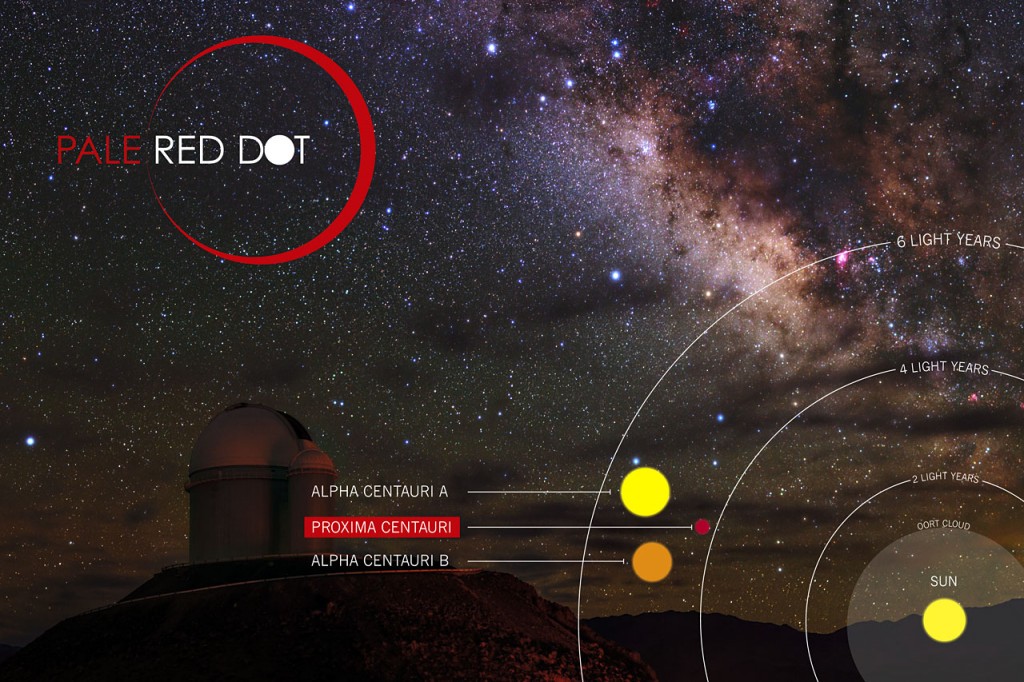
ESO opens a new outreach program that allows the general public to follow closely the hunt for an earth-like exoplanet around the nearest star Proxima Centauri:
A unique outreach campaign has been launched that will allow the general public to follow scientists from around the globe as they search for an Earth-like exoplanet around the closest star to us, Proxima Centauri. The observing campaign will run from January to April 2016 and will be accompanied by blog posts and social media updates. No one knows what the outcome will be. In the months following the observations, the scientists will analyse the data and submit the results to a peer-reviewed journal.
Pale Red Dot is an international search for an Earth-like exoplanet around the closest star to us, Proxima Centauri. It will use HARPS, attached to ESO’s 3.6-metre telescope at La Silla Observatory, as well as the Las Cumbres Observatory Global Telescope Network (LCOGT) and the Burst Optical Observer and Transient Exploring System (BOOTES). It will be one of the few outreach campaigns allowing the general public to witness the scientific process of data acquisition in modern observatories. The public will see how teams of astronomers with different specialities work together to collect, analyse and interpret data, which may or may not be able to confirm the presence of an Earth-like planet orbiting our nearest neighbour . The outreach campaign consists of blog posts and social media updates on the Pale Red Dot Twitter account and using the hashtag #PaleRedDot. For more information visit the Pale Red Dot website: http://www.palereddot.org
At a distance of just 4.2 light-years from the Sun, and located in the constellation of Centaurus, Proxima Centauri is the closest known star to the Sun. Previous observations have provided tantalising, but weak hints of a small companion orbiting this red dwarf star, but this new campaign will make a more sensitive search for the telltale wobbles in the dwarf star’s orbital motion that might reveal the presence of an Earth-like orbiting planet.
Observations will be made with the High Accuracy Radial velocity Planet Searcher (HARPS), attached to ESO’s 3.6-metre telescope at La Silla Observatory. The HARPS data will be complemented by images from an assortment of robotic telescopes located across the world [1].
The telescopes that comprise the Burst Optical Observer and Transient Exploring System (BOOTES) and the Las Cumbres Observatory Global Telescope Network (LCOGT) will support the search by measuring the brightness of Proxima Centauri every night during the two and a half month long project. These observations will help astronomers determine whether any detected wobbles in the star’s motion are caused by features on its turbulent surface or by an orbiting planet.
Once the data have been collected by the various telescopes, astronomers can start their analysis. In the following months, their research methods and conclusions will be described in a paper submitted to a peer-reviewed scientific journal. When the scientific community has validated the research, the results will be published, concluding a long and substantial programme of scientific research.
Apart from following the scientific observations as they arrive, the Pale Red Dot outreach campaign [2] gives the public the opportunity to see how science is done in modern observatories, and how teams of astronomers with different specialities work together to collect, analyse and interpret data, which may or may not be able to confirm the presence of an Earth-like planet orbiting our nearest neighbour.
“We are taking a risk to involve the public before we even know what the observations will be telling us — we cannot analyse the data and draw conclusions in real time. Once we publish the paper summarising the findings it’s entirely possible that we will have to say that we have not been able to find evidence for the presence of an Earth-like exoplanet around Proxima Centauri. But the fact that we can search for such small objects with such extreme precision is simply mind-boggling,” said Guillem Anglada-Escude, the Project Coordinator.
“We want to share the excitement of the search with people and show them how science works behind the scenes, the trial and error process and the continued efforts that are necessary for the discoveries that people normally hear about in the news. By doing so, we hope to encourage more people towards STEM [3] subjects and science in general,” adds Guillem.
The Pale Red Dot outreach campaign will illuminate the often unseen side of planet hunting with background articles and through social media. A bustling array of blog posts on many topics — including planet-hunting techniques, ESO’s European Extremely Large Telescope (E-ELT), and the lives of stars — are planned, written by the astronomers, scientists and engineers from the observatories involved, as well as science writers, observers and other experts in the field.
There will be daily social media updates, briefing the public on how the observations are going and any events taking place at the three observatories involved. To receive updates, people are invited to follow the Pale Red Dot Twitter accountand the hashtag #PaleRedDot.
The name of the campaign was inspired by the famous “pale blue dot” image of the Earth, taken in 1990 by Voyager 1 on its way to interstellar space. The phrase was later used by Carl Sagan for his essay, Pale Blue Dot: A Vision of the Human Future in Space. As Proxima Centauri is a red dwarf star, astronomers expect that an exoplanet orbiting it will appear reddish. At the same time, just as Voyager’s image of Earth was a remarkable achievement for humanity, finding an Earth-like exoplanet around the closest star to us would be a another step towards answering humanity’s biggest question: Are we alone?
The Pale Red Dot campaign will begin in earnest on 15 January 2016 with observations commencing just three days later from ESO’s La Silla Observatory, situated at the edge of the Chilean Atacama Desert, and continuing until the first week of April. All of the scientific data obtained as part of the project are expected to become publicly available for all to exploit in late 2016.
Notes
[1] The team of astronomers leading the observations and outreach campaign are: Guillem Anglada-Escude, Gavin Coleman, John Strachan (Queen Mary University of London, UK), James Jenkins (Universidad de Chile, Chile), Cristina Rodriguez-Lopez, Zaira M. Berdinas, Pedro J. Amado (Instituto de Astrofisica de Andalucia/CSIC), Julien Morin (Universite de Montpellier, France), Mikko Tuomi (Centre for Astrophysics Research/University of Hertfordshire, UK), Yiannis Tsapras (Heidelberg/LCOGT, Astronomisches Rechen-Institut – Heidelberg & LCOGT) and Christopher J. Marvin (University of Goettingen).
[2] The outreach campaign is coordinated by the project team with support from the outreach departments of ESO, Queen Mary University of London, Instituto de Astrofisica de Andalucia/CSIC, Universite de Montpellier, University of Goettingen, Universidad de Chile and Las Cumbres Observatory Global Telescope Network.
[3] STEM, Science, Technology, Engineering and Mathematics.
The most luminous galaxy known in the Universe — the quasar W2246-0526, seen when the Universe was less than 10% of its current age — is so turbulent that it is in the process of ejecting its entire supply of star-forming gas, according to new observations with the Atacama Large Millimeter/submillimeter Array (ALMA).
Artist impression of W2246-0526, a single galaxy glowing in infrared light as intensely as 350 trillion suns. It is so violently turbulent that it may eventually jettison its entire supply of star-forming gas, according to new observations with ALMA.
Quasars are distant galaxies with very active supermassive black holes at their centres that spew out powerful jets of particles and radiation. Most quasars shine brightly, but a tiny fraction [1] of these energetic objects are of an unusual type known as Hot DOGs, or Hot, Dust-Obscured Galaxies, including the galaxy WISE J224607.57-052635.0 [2], the most luminous known galaxy in the Universe.
For the first time, a team of researchers led by Tanio Díaz-Santos of the Universidad Diego Portales in Santiago, Chile, has used the unique capabilities of ALMA[3] to peer inside W2246-0526 and trace the motion of ionised carbon atoms between the galaxy’s stars.
“Large amounts of this interstellar material were found in an extremely turbulent and dynamic state, careening throughout the galaxy at around two million kilometres per hour,” explains lead author Tanio Díaz-Santos.
The astronomers believe that this turbulent behaviour could be linked to the galaxy’s extreme luminosity. W2246-0526 blasts out as much light as roughly 350 trillion Suns. This startling brightness is powered by a disc of gas that is superheated as it spirals in on the supermassive black hole at the galaxy’s core. The light from the blazingly bright accretion disc in the centre of this Hot DOG does not escape directly, it is absorbed by a surrounding thick blanket of dust, which re-emits the energy as infrared light [4].
This powerful infrared radiation has a direct and violent impact on the entire galaxy. The region around the black hole is at least 100 times more luminous than the rest of the galaxy combined, thus releasing intense yet localised radiation in W2246-0526 that is exerting tremendous pressure on the entire galaxy [5].
“We suspected that this galaxy was in a transformative stage of its life because of the enormous amount of infrared energy,” said co-author Peter Eisenhardt, Project Scientist for WISE at NASA’s Jet Propulsion Laboratory in Pasadena, California.
“ALMA has now shown us that the raging furnace in this galaxy is making the pot boil over,” adds Roberto Assef, also from Universidad Diego Portales and leader of the ALMA observations.
If these turbulent conditions continue, the intense infrared radiation would boil away all of the galaxy’s interstellar gas. Models of galaxy evolution based on the new ALMA data indicate that the interstellar gas is already being ejected from the galaxy in all directions.
“If this pattern continues, it is possible that W2246 will eventually mature into a more traditional quasar,” concludes Manuel Aravena, also from the Universidad Diego Portales. “Only ALMA, with its unparalleled resolution, can allow us to see this object in high definition and fathom such an important episode in the life of this galaxy.”
Notes
[1] Only one of every 3000 quasars observed are classified as Hot DOGs.
[2] The full name of this remarkable object is WISE J224607.57-052635.0, it was found by NASA’s Wide-field Infrared Survey Explorer (WISE) spacecraft and the rest of the name gives the precise location of the quasar on the sky.
[3] ALMA is uniquely capable of detecting the faint, millimetre-wavelength light naturally emitted by atomic carbon.
[4] Because of the expansion of the Universe the infrared radiation from W2246-0526 is redshifted to longer millimetre wavelengths — where ALMA is very sensitive — when it is observed from Earth.
[5] In most other quasars this ratio is much more modest. This process of mutual interaction between the central black hole of a galaxy and the rest of its material is known to astronomers as feedback.
More information
This research was presented in a paper “The Strikingly Uniform, Highly Turbulent Interstellar Medium of The Most Luminous Galaxy in the Universe”, by T. Díaz-Santos et al., and will be published in the journal Astrophysical Journal Letters.
The team is composed of T. Díaz-Santos (Universidad Diego Portales, Santiago, Chile), R. J. Assef (Universidad Diego Portales, Santiago, Chile), A. W. Blain (University of Leicester, UK) , C.-W. Tsai (Jet Propulsion Laboratory, California Institute of Technology, Pasadena, California, USA) , M. Aravena (Universidad Diego Portales, Santiago, Chile), P. Eisenhardt (Jet Propulsion Laboratory, California Institute of Technology, Pasadena, California, USA), J. Wu (University of California Los Angeles, California, USA), D. Stern (Jet Propulsion Laboratory, California Institute of Technology, Pasadena, California, USA) and C. Bridge (Jet Propulsion Laboratory, California Institute of Technology, Pasadena, California, USA).
![eso1603b[1]](http://hobbyspace.com/Blog/wp-content/uploads/2016/01/eso1603b1.jpg)

![Planet-9-Art-NEWS-WEB[1]](http://hobbyspace.com/Blog/wp-content/uploads/2016/01/Planet-9-Art-NEWS-WEB1.jpg)
![P9_KBO_orbits_labeled-NEWS-WEB[1]](http://hobbyspace.com/Blog/wp-content/uploads/2016/01/P9_KBO_orbits_labeled-NEWS-WEB1.png)
![kbatygin-mbrown-0049_1000[1]](http://hobbyspace.com/Blog/wp-content/uploads/2016/01/kbatygin-mbrown-0049_10001.jpg)