Last summer billionaire Yuri Milner announced he would fund a $100M initiative for the search for extraterrestrial intelligent life. The organization formed to implement the program is called Breakthrough Initiatives and its chairman is Pete Worden, former director of NASA Ames Research Center. Below is a video of an interesting and entertaining SETI Institute talk given by Worden in which he discusses the history of SETI, exoplanets, the possibility of earth-like planets around nearby star systems, the feasibility of interstellar travel, and other topics.
On July 20, 2015, the 46th anniversary of the Apollo 11 moon landing, the Breakthrough Prize Foundation announced in London, UK a new initiative to study life in the universe. The announcement was made by Silicon Valley billionaire Yuri Milner and physicist Steven Hawking. The Breakthrough Initiatives currently consist of two primary elements, Breakthrough Listen which is a $100M renewed search for intelligent extraterrestrial signals, and Breakthrough Message, a global competition with a $1M prize to create, but not send a message representing humanity. S. Pete Worden, the former Center Director of the NASA Ames Research Center, is the Chairman of the Breakthrough Prize Foundation. He will talk about these initiatives in the broader context of our search for life in the universe.
A newly formed star lights up the surrounding cosmic clouds in this new image from ESO’s La Silla Observatory in Chile. Dust particles in the vast clouds that surround the star HD 97300 diffuse its light, like a car headlight in enveloping fog, and create the reflection nebula IC 2631. Although HD 97300 is in the spotlight for now, the very dust that makes it so hard to miss heralds the birth of additional, potentially scene-stealing, future stars.
A newly formed star lights up the surrounding cosmic clouds in this image from ESO’s La Silla Observatory in Chile. Dust particles in the vast clouds that surround the star HD 97300 diffuse its light, like a car headlight in enveloping fog, and create the reflection nebula IC 2631. Although HD 97300 is in the spotlight for now, the very dust that makes it so hard to miss heralds the birth of additional, potentially scene-stealing, future stars.
The glowing region in this new image from the MPG/ESO 2.2-metre telescope is a reflection nebula known as IC 2631. These objects are clouds of cosmic dust that reflect light from a nearby star into space, creating a stunning light show like the one captured here. IC 2631 is the brightest nebula in the Chamaeleon Complex, a large region of gas and dust clouds that harbours numerous newborn and still-forming stars. The complex lies about 500 light-years away in the southern constellation of Chamaeleon.
This video journey starts with a view of the spectacular southern Milky Way and then closes in on the inconspicuous southern constellation of Chameleon (The Chameleon). The final image shows a detailed view of the blue reflection nebula IC 2631 around the young star HD 97300.
IC 2631 is illuminated by the star HD 97300, one of the youngest — as well as most massive and brightest — stars in its neighbourhood. This region is full of star-making material, which is made evident by the presence of dark nebulae noticeable above and below IC 2631 in this picture. Dark nebulae are so dense with gas and dust that they prevent the passage of background starlight.
Despite its dominating presence, the heft of HD 97300 should be kept in perspective. It is a T Tauri star, the youngest visible stage for relatively small stars. As these stars mature and reach adulthood they will lose mass and shrink. But during the T Tauri phase these stars have not yet contracted to the more modest size that they will maintain for billions of years as main sequence stars.
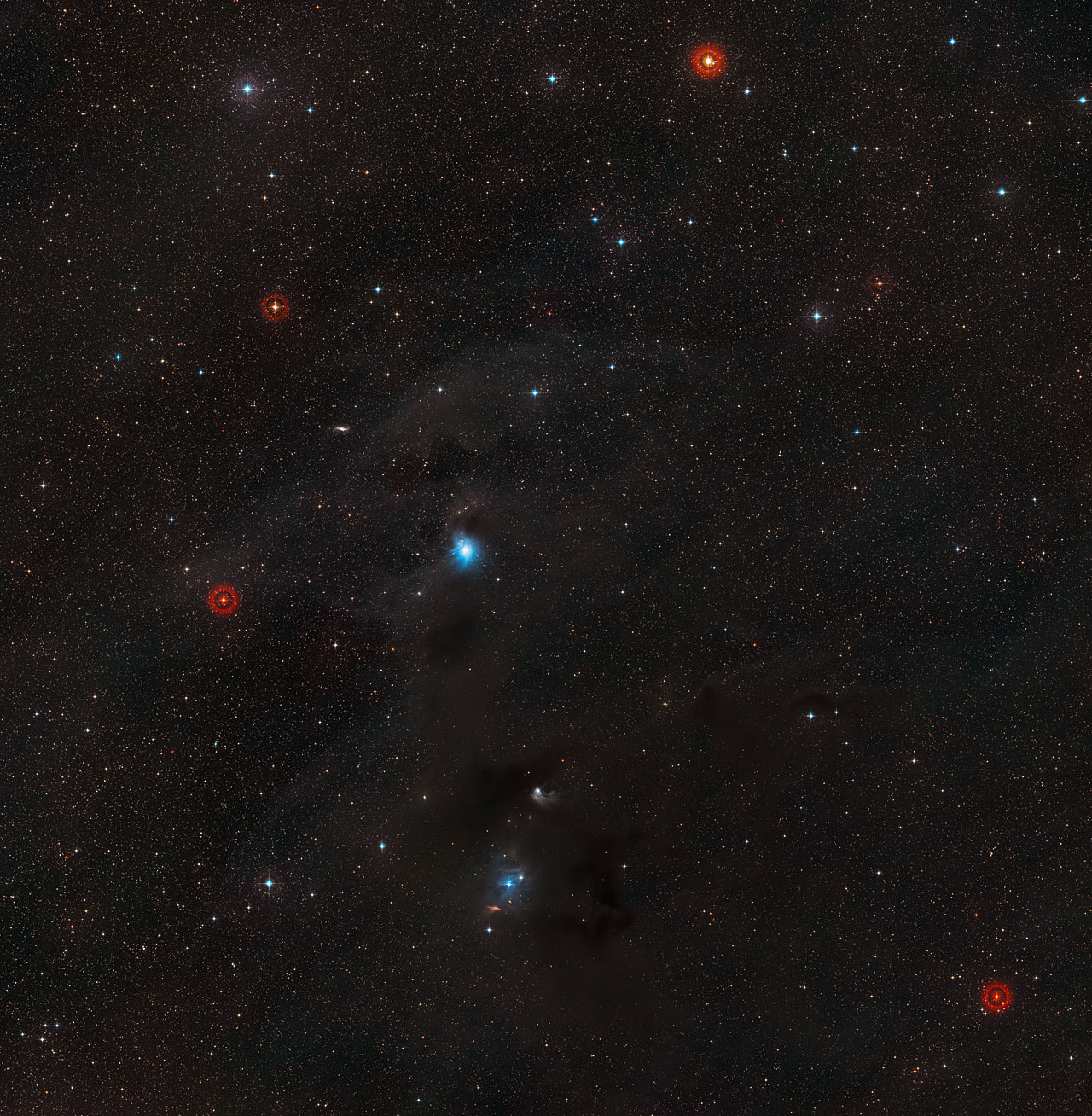
A newly formed star lights up the surrounding cosmic clouds to create the blue reflection nebula IC 2631 at the centre of this striking panorama of gas and dust clouds in the southern constellation of Chameleon. This picture was created from images forming part of the Digitized Sky Survey 2.
These fledging stars already have surface temperatures similar to their main sequence phase and accordingly, because T Tauri-phase objects are essentially jumbo versions of their later selves, they look brighter in their oversized youth than in maturity. They have not yet started to fuse hydrogen into helium in their cores, like normal main sequence stars, but are just starting to flex their thermal muscles by generating heat from contraction.
Reflection nebula, like the one spawned by HD 97300, merely scatter starlight back out into space. Starlight that is more energetic, such as the ultraviolet radiation pouring forth from very hot new stars, can ionise nearby gas, making it emit light of its own. These emission nebulae indicate the presence of hotter and more powerful stars, which in their maturity can be observed across thousands of light-years. HD 97300 is not so powerful, and its moment in the spotlight is destined not to last.
A newly formed star lights up the surrounding cosmic clouds in this close up look at an image from ESO’s La Silla Observatory in Chile. Dust particles in the vast clouds that surround the star HD 97300 diffuse its light, like a car headlight in enveloping fog, and create the blue reflection nebula IC 2631. Although HD 97300 is in the spotlight for now, the very dust that makes it so hard to miss heralds the birth of additional, potentially scene-stealing, future stars.
ESO is the foremost intergovernmental astronomy organisation in Europe and the world’s most productive ground-based astronomical observatory by far. It is supported by 16 countries: Austria, Belgium, Brazil, the Czech Republic, Denmark, France, Finland, Germany, Italy, the Netherlands, Poland, Portugal, Spain, Sweden, Switzerland and the United Kingdom, along with the host state of Chile. ESO carries out an ambitious programme focused on the design, construction and operation of powerful ground-based observing facilities enabling astronomers to make important scientific discoveries. ESO also plays a leading role in promoting and organising cooperation in astronomical research. ESO operates three unique world-class observing sites in Chile: La Silla, Paranal and Chajnantor. At Paranal, ESO operates the Very Large Telescope, the world’s most advanced visible-light astronomical observatory and two survey telescopes. VISTA works in the infrared and is the world’s largest survey telescope and the VLT Survey Telescope is the largest telescope designed to exclusively survey the skies in visible light. ESO is a major partner in ALMA, the largest astronomical project in existence. And on Cerro Armazones, close to Paranal, ESO is building the 39-metre European Extremely Large Telescope, the E-ELT, which will become “the world’s biggest eye on the sky”.
This chart of the faint southern constellation of Chameleon (The Chameleon) shows most stars visible on a clear and dark night. The location of the reflection nebula IC 2631 around the young star HD 97300 is marked. Although the star can be seen in a small telescope, the surrounding nebula is too faint to be easily perceived, and shows itself best in photographs. Credit: ESO/IAU and Sky & TelescopeLinks
Astronomers have used the ALMA and IRAM telescopes to make the first direct measurement of the temperature of the large dust grains in the outer parts of a planet-forming disc around a young star. By applying a novel technique to observations of an object nicknamed the Flying Saucer they find that the grains are much colder than expected: −266 degrees Celsius. This surprising result suggests that models of these discs may need to be revised.
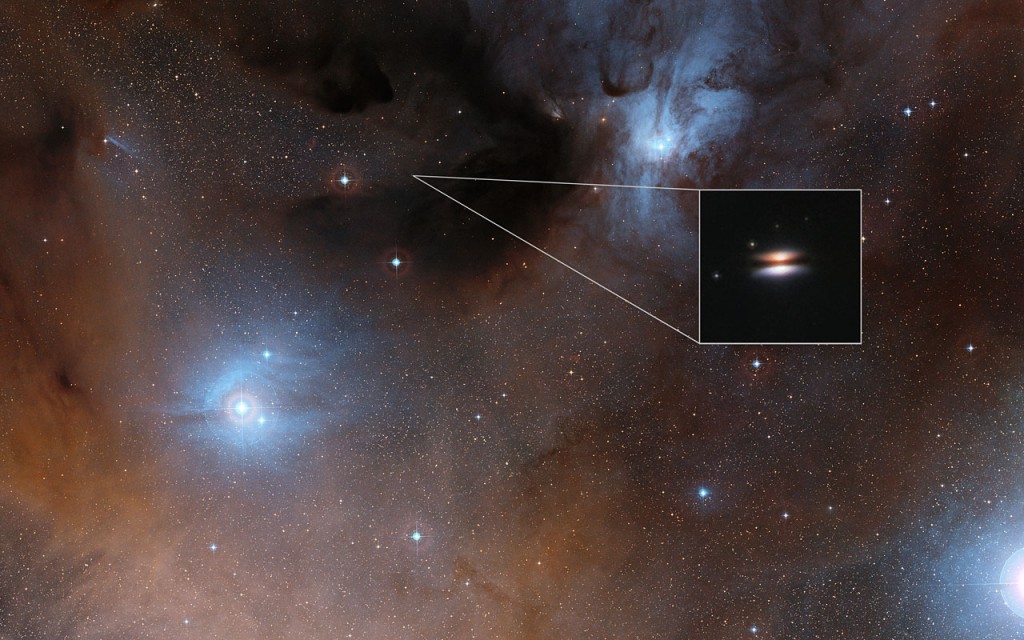
The young star 2MASS J16281370-2431391 lies in the spectacular Rho Ophiuchi star formation region, about 400 light-years from Earth. It is surrounded by a disc of gas and dust — such discs are called protoplanetary discs as they are the early stages in the creation of planetary systems. This particular disc is seen nearly edge-on, and its appearance in visible light pictures has led to its being nicknamed the Flying Saucer. The main image shows part of the Rho Ophiuchi region and a much enlarged close-up infrared view of the Flying Saucer from the NASA/ESA Hubble Space Telescope is shown as an insert.
The international team, led by Stephane Guilloteau at the Laboratoire d’Astrophysique de Bordeaux, France, measured the temperature of large dust grains around the young star 2MASS J16281370-2431391 in the spectacular Rho Ophiuchi star formation region, about 400 light-years from Earth.
This star is surrounded by a disc of gas and dust — such discs are called protoplanetary discs as they are the early stages in the creation of planetary systems. This particular disc is seen nearly edge-on, and its appearance in visible light pictures has led to its being nicknamed the Flying Saucer.
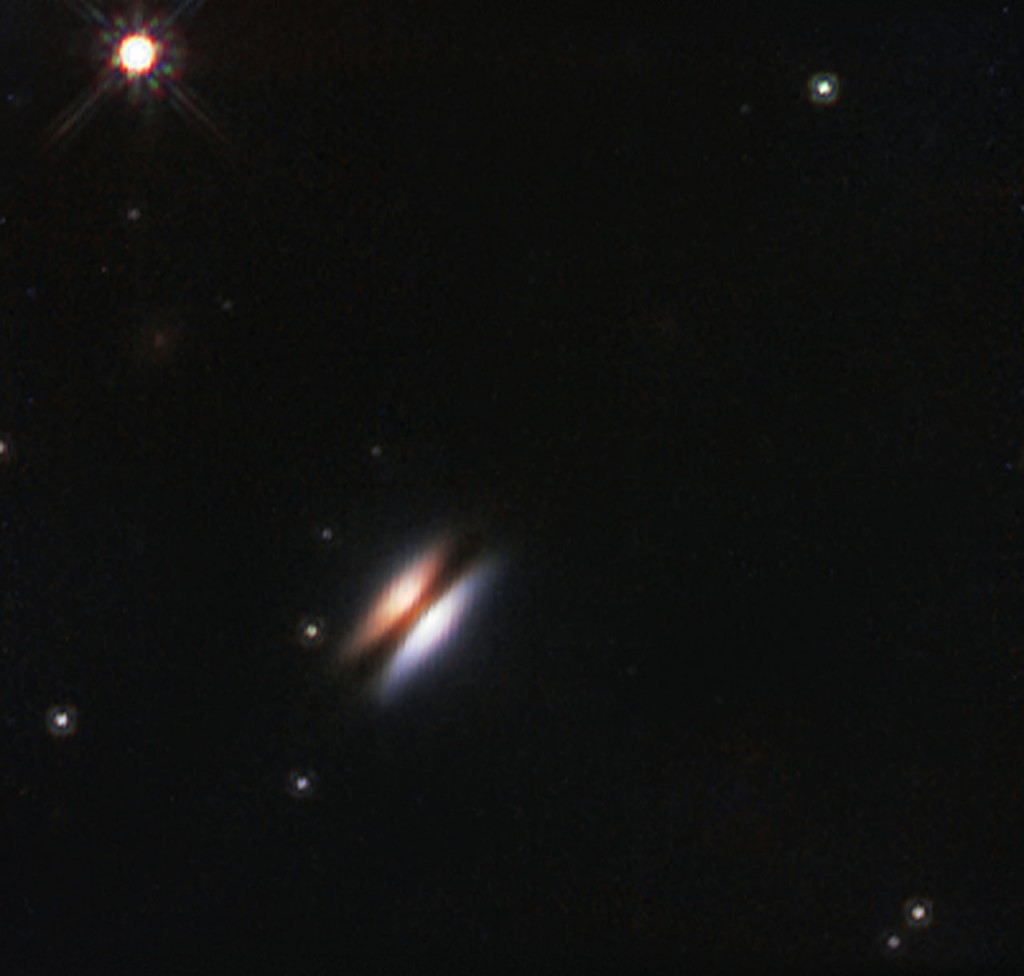
The young star 2MASS J16281370-2431391 lies in the spectacular Rho Ophiuchi star formation region, about 400 light-years from Earth. It is surrounded by a disc of gas and dust — such discs are called protoplanetary discs as they are the early stages in the creation of planetary systems. This particular disc is seen nearly edge-on, and its appearance in visible light pictures has led to its being nicknamed the Flying Saucer. This close-up infrared view of the Flying Saucer comes from the NASA/ESA Hubble Space Telescope.
The astronomers used the Atacama Large Millimeter/submillimeter Array (ALMA) to observe the glow coming from carbon monoxide molecules in the 2MASS J16281370-2431391 disc. They were able to create very sharp images and found something strange — in some cases they saw a negative signal! Normally a negative signal is physically impossible, but in this case there is an explanation, which leads to a surprising conclusion.
This video takes us on a journey to the young star 2MASS J16281370-2431391 in the spectacular Rho Ophiuchi star formation region, about 400 light-years from Earth. This star is surrounded by a disc of gas and dust — a protoplanetary disc, the early stage in the creation of a planetary system. This particular disc is seen nearly edge-on, and its appearance in visible light pictures has led to its being nicknamed the Flying Saucer.
The final close-up infrared view of the Flying Saucer comes from the NASA/ESA Hubble Space Telescope.
Lead author Stephane Guilloteau takes up the story:
“This disc is not observed against a black and empty night sky. Instead it’s seen in silhouette in front of the glow of the Rho Ophiuchi Nebula. This diffuse glow is too extended to be detected by ALMA, but the disc absorbs it. The resulting negative signal means that parts of the disc are colder than the background. The Earth is quite literally in the shadow of the Flying Saucer!”
The team combined the ALMA measurements of the disc with observations of the background glow made with the IRAM 30-metre telescope in Spain [1]. They derived a disc dust grain temperature of only −266 degrees Celsius (only 7 degrees above absolute zero, or 7 Kelvin) at a distance of about 15 billion kilometres from the central star [2]. This is the first direct measurement of the temperature of large grains (with sizes of about one millimetre) in such objects.
This temperature is much lower than the −258 to −253 degrees Celsius (15 to 20 Kelvin) that most current models predict. To resolve the discrepancy, the large dust grains must have different properties than those currently assumed, to allow them to cool down to such low temperatures.
“To work out the impact of this discovery on disc structure, we have to find what plausible dust properties can result in such low temperatures. We have a few ideas — for example the temperature may depend on grain size, with the bigger grains cooler than the smaller ones. But it is too early to be sure,” adds co-author Emmanuel di Folco (Laboratoire d’Astrophysique de Bordeaux).
If these low dust temperatures are found to be a normal feature of protoplanetary discs this may have many consequences for understanding how they form and evolve.
For example, different dust properties will affect what happens when these particles collide, and thus their role in providing the seeds for planet formation. Whether the required change in dust properties is significant or not in this respect cannot yet be assessed.
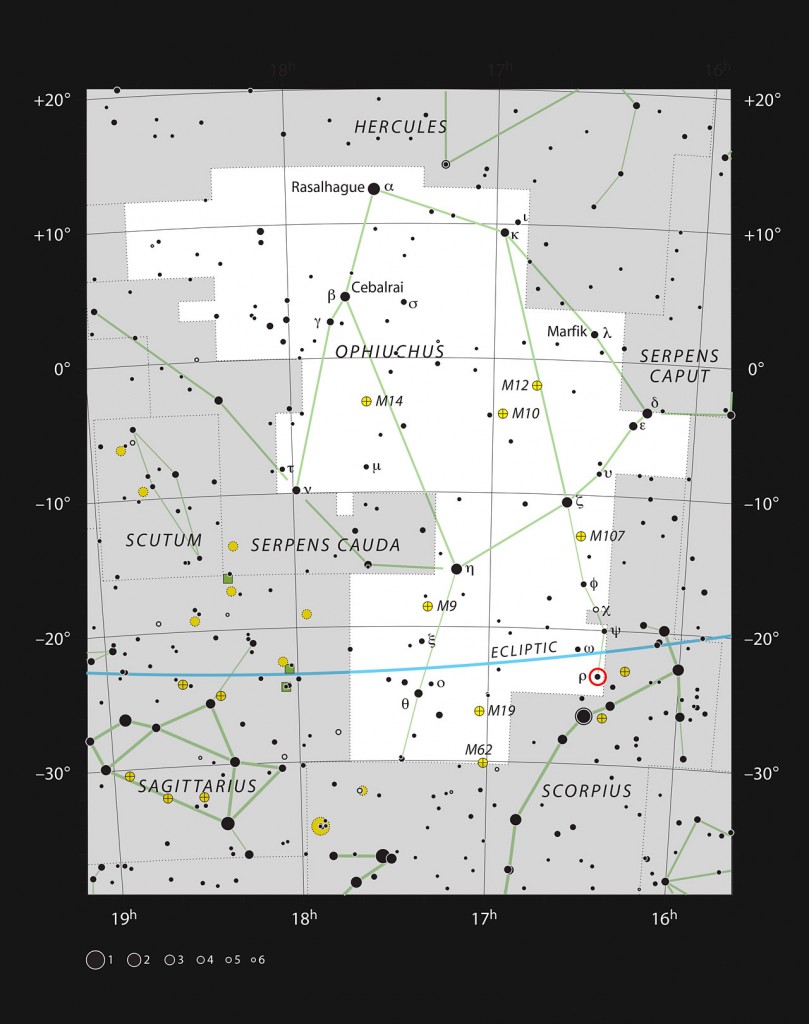
This chart shows the large constellation of Ophiuchus (The Serpent Bearer). In the southern part of this constellation there is a spectacular region of dark and bright clouds, forming part of a region of star formation. This chart, which shows all the stars easily seen with the naked eye on a dark and clear night, shows the location of Rho Ophiuchi, the brightest star in the region.
Low dust temperatures can also have a major impact for the smaller dusty discs that are known to exist. If these discs are composed of mostly larger, but cooler, grains than is currently supposed, this would mean that these compact discs can be arbitrarily massive, so could still form giant planets comparatively close to the central star.
Further observations are needed, but it seems that the cooler dust found by ALMA may have significant consequences for the understanding of protoplanetary discs.
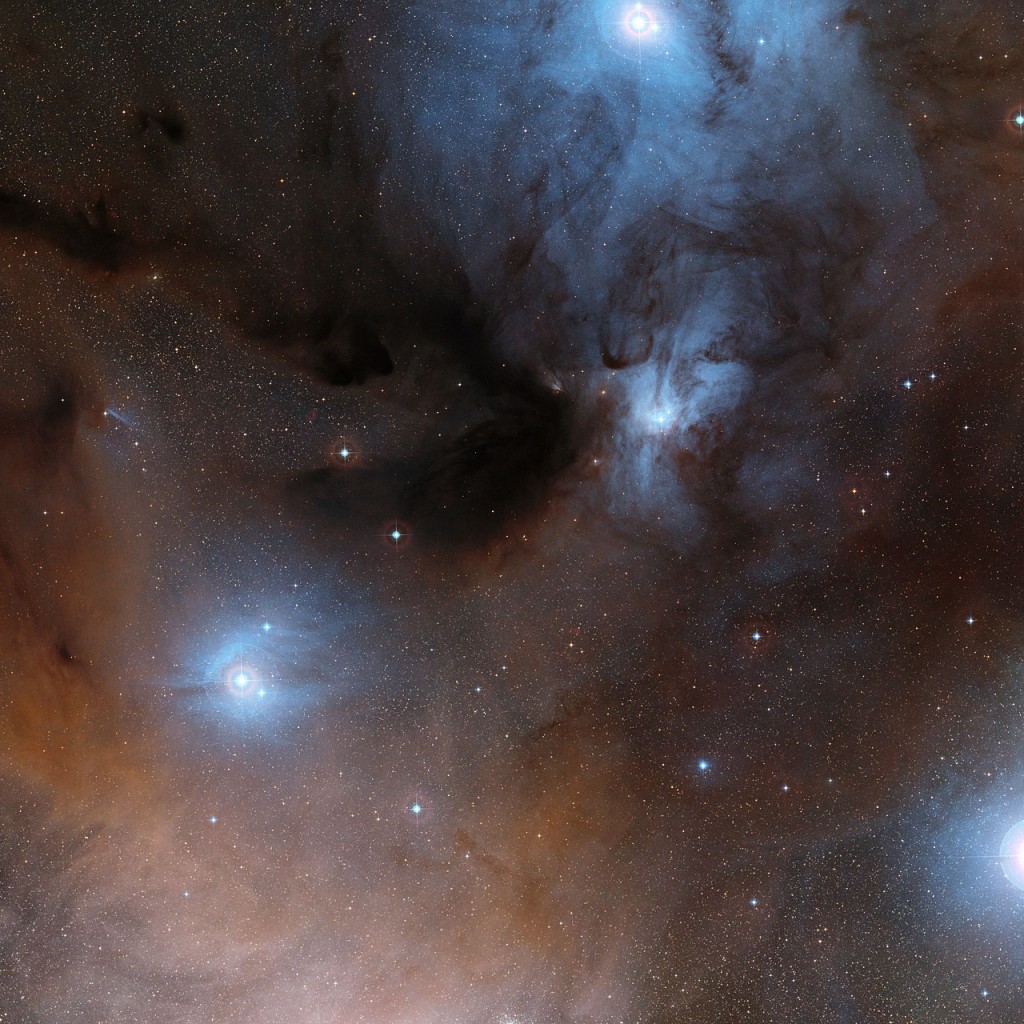
This wide-field view shows a spectacular region of dark and bright clouds, forming part of a region of star formation in the constellation of Ophiuchus (The Serpent Bearer). This picture was created from images in the Digitized Sky Survey 2.
Notes
[1] The IRAM measurements were needed as ALMA itself was not sensitive to the extended signal from the background.
[2] This corresponds to one hundred times the distance from the Earth to the Sun. This region is now occupied by the Kuiper Belt within the Solar System.
This NASA JPL video points to highlights in the night sky for February:
Set your alarm! Five planets will be visible in the early morning sky until Feb. 20. Plus, learn what other celestial objects will be visible this month.

![eso1605b[1]](http://hobbyspace.com/Blog/wp-content/uploads/2016/02/eso1605b1.jpg)