overview of the Breakthrough Listen Initiative, 100-million-dollar, 10-year search for extraterrestrial intelligence. Dr. Siemion will also discuss other SETI efforts ongoing at the BSRC, including the successful citizen science project SETI@Home, as well as a concerted effort to undertake panchromatic observations of the mysterious Kepler star KIC 8462852
In this huge new image clouds of crimson gas are illuminated by rare, massive stars that have only recently ignited and are still buried deep in thick dust clouds. These scorching-hot, very young stars are only fleeting characters on the cosmic stage and their origins remain mysterious. The vast nebula where these giants were born, along with its rich and fascinating surroundings, are captured here in fine detail by ESO’s VLT Survey Telescope (VST) at the Paranal Observatory in Chile.
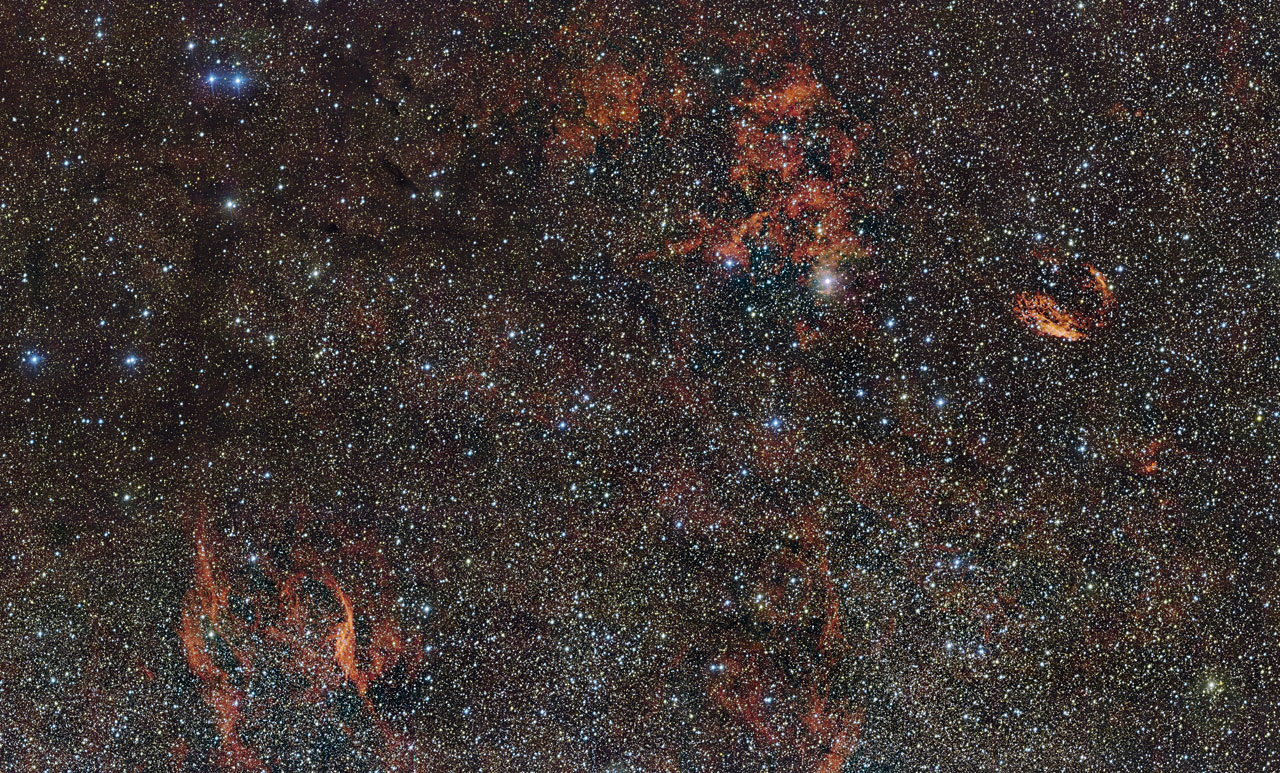
In this huge image of part of the southern constellation of Norma (The Carpenter’s Square) wisps of crimson gas are illuminated by rare, massive stars that have only recently ignited and are still buried deep in thick dust clouds. These scorching-hot, very young stars are only fleeting characters on the cosmic stage and their origins remain mysterious. The vast nebula where these giants were born, known as RCW 106, is captured here in fine detail by ESO’s VLT Survey Telescope (VST), at the Paranal Observatory in Chile. The brightest part appears just above the centre of the image. Many other interesting objects are also captured in this wide-field image. For example the filaments to the right of the image are the remnants of an ancient supernova (SNR G332.4-00.4, also known as RCW 103), and the glowing red filaments at the lower left surround an unusual and very hot star (RCW 104, surrounding the Wolf–Rayet star WR 75). Patches of dark obscuring dust are also visible across the entire cosmic landscape.
RCW 106 is a sprawling cloud of gas and dust located about 12 000 light-years away in the southern constellation of Norma (The Carpenter’s Square). The region gets its name from being the 106th entry in a catalogue of H II regions in the southern Milky Way [1]. H II regions like RCW 106 are clouds of hydrogen gas that are being ionised by the intense starlight of scorching-hot, young stars, causing them to glow and display weird and wonderful shapes.
RCW 106 itself is the red cloud above centre in this new image, although much of this huge H II region is hidden by dust and it is much more extensive than the visible part. Many other unrelated objects are also visible in this wide-field VST image. For example, the filaments to the right of the image are the remnants of an ancient supernova, and the glowing red filaments at the lower left surround an unusual and very hot star [2]. Patches of dark obscuring dust are also visible across the entire cosmic landscape.
Astronomers have been studying RCW 106 for some time, although it is not the crimson clouds that draw their attention, but rather the mysterious origin of the massive and powerful stars buried within. Although they are very bright, these stars cannot be seen in visible-light images such as this one as the surrounding dust is too thick, but they make their presence clear in images of the region at longer wavelengths.
This video takes a close-up look at a huge image of part of the southern constellation of Norma (The Carpenter’s Square) where wisps of crimson gas are illuminated by rare, massive stars that have only recently ignited and are still buried deep in thick dust clouds. These scorching-hot, very young stars are only fleeting characters on the cosmic stage and their origins remain mysterious. The vast nebula where these giants were born, known as RCW 106, is captured here in fine detail by ESO’s VLT Survey Telescope (VST), at the Paranal Observatory in Chile.
The sequence starts with a view of RCW 104, filaments glowing in the intense radiation from a Wolf-Rayet star, passes over the supernova remnant RCW 103, and finally settles on RCW 106 itself.
For less massive stars like the Sun the process that brings them into existence is quite well understood — as clouds of gas are pulled together under gravity, density and temperature increase, and nuclear fusion begins — but for the most massive stars buried in regions like RCW 106 this explanation does not seem to be fully adequate. These stars — known to astronomers as O-type stars — may have masses many dozens of times the mass of the Sun and it is not clear how they manage to gather, and keep together, enough gas to form.
O-type stars likely form from the densest parts of the nebular clouds like RCW 106 and they are notoriously difficult to study. Apart from obscuration by dust, another challenge is the brevity of an O-type star’s life. They burn through their nuclear fuel in mere tens of millions of years, while the lightest stars have lifetimes that span many tens of billions of years. The difficulty of forming a star of this mass, and the shortness of their lifetimes, means that they are very rare — only one in every three million stars in our cosmic neighbourhood is an O-type star. None of those that do exist are close enough for detailed investigation and so the formation of these fleeting stellar giants remains mysterious, although their outsized influence is unmistakeable in glowing H II regions like this one.
This chart shows the small and inconspicuous southern constellation of Norma (The Carpenter’s Square). Most of the stars visible to the naked eye on a clear dark night are shown. This region is in the plane of the Milky Way and hosts the huge star formation region RCW 106 (marked with a red circle), which is mostly hidden behind thick dust clouds and not visible in a small telescope. Credit: ESO/IAU and Sky & TelescopeNotes
[1] The catalogue was compiled in 1960 by three astronomers from the Mount Stromlo Observatory in Australia whose surnames were Rodgers, Campbell and Whiteoak, hence the prefix RCW.
[2] The supernova remnant is SNR G332.4-00.4, also known as RCW 103. It is about 2000 years old. The lower filaments are RCW 104, surrounding the Wolf–Rayet starWR 75. Although these objects bear RCW numbers, detailed later investigations revealed that neither of them were HII regions.
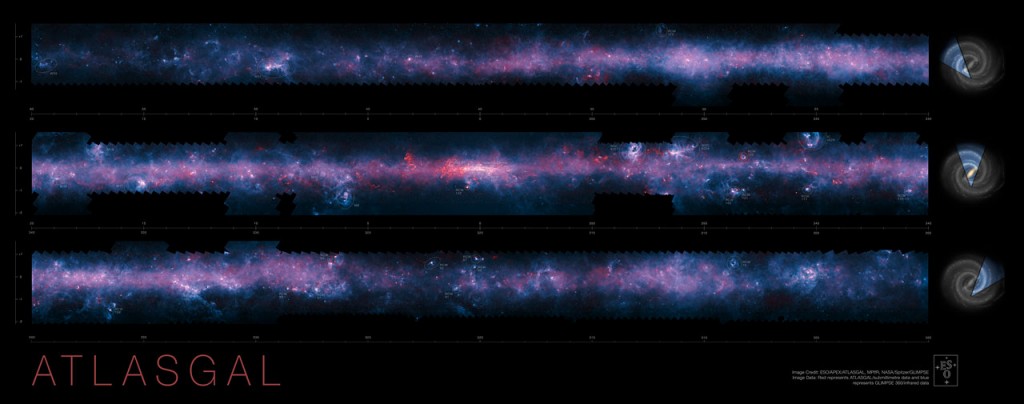
A spectacular new image of the Milky Way has been released to mark the completion of the APEX Telescope Large Area Survey of the Galaxy (ATLASGAL). The APEX telescope in Chile has mapped the full area of the Galactic Plane visible from the southern hemisphere for the first time at submillimetre wavelengths — between infrared light and radio waves — and in finer detail than recent space-based surveys. The pioneering 12-metre APEX telescope allows astronomers to study the cold Universe: gas and dust only a few tens of degrees above absolute zero.
This image of the Milky Way has been released to mark the completion of the APEX Telescope Large Area Survey of the Galaxy (ATLASGAL). The APEX telescope in Chile has mapped the full area of the Galactic Plane visible from the southern hemisphere for the first time at submillimetre wavelengths — between infrared light and radio waves — and in finer detail than recent space-based surveys. The APEX data, at a wavelength of 0.87 millimetres, shows up in red and the background blue image was imaged at shorter infrared wavelengths by the NASA Spitzer Space Telescope as part of the GLIMPSE survey. The fainter extended red structures come from complementary observations made by ESA’s Planck satellite. Many of the most prominent objects are named and the parts of the galaxy that are shown in the three slices are indicated at the right.
APEX, the Atacama Pathfinder EXperiment telescope, is located at 5100 metres above sea level on the Chajnantor Plateau in Chile’s Atacama region. The ATLASGAL survey took advantage of the unique characteristics of the telescope to provide a detailed view of the distribution of cold dense gas along the plane of the Milky Way galaxy [1]. The new image includes most of the regions of star formation in the southern Milky Way [2].
The new ATLASGAL maps cover an area of sky 140 degrees long and 3 degrees wide, more than four times larger than the first ATLASGAL release[3]. The new maps are also of higher quality, as some areas were re-observed to obtain a more uniform data quality over the whole survey area.
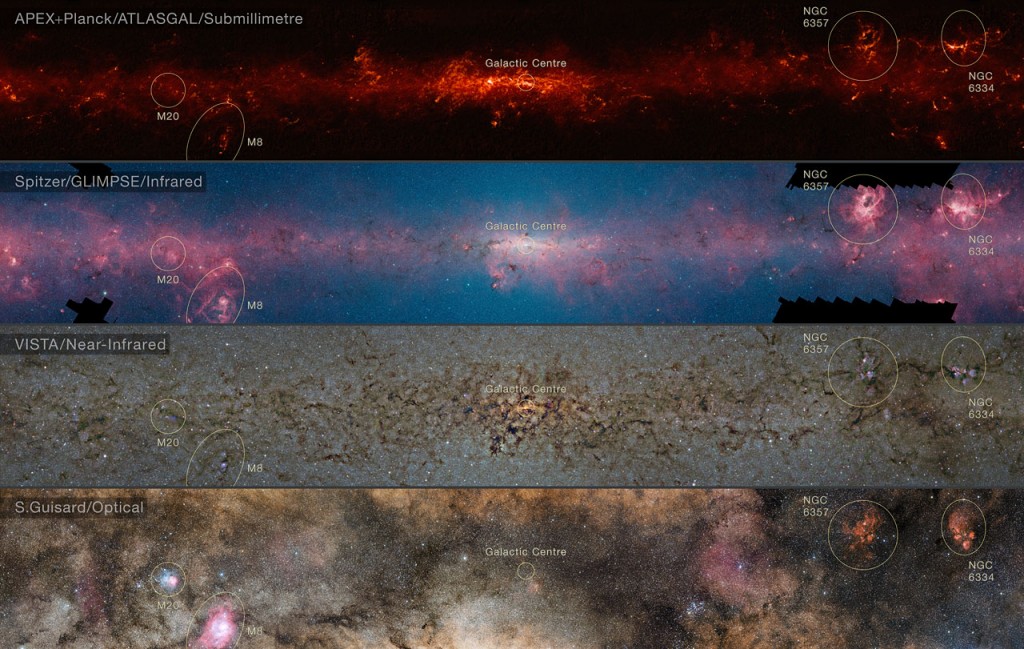
This comparison shows the central regions of the Milky Way observed at different wavelengths. The top panel shows compact sources of submillimetre radiation detected by APEX as part of the ATLASGAL survey, combined with complementary data from ESA’s Planck satellite, to capture more extended features. The second panel shows the same region as seen in shorter, infrared, wavelengths by the NASA Spitzer Space Telescope. The third panel shows the same part of sky again at even shorter wavelengths, the near-infrared, as seen by ESO’s VISTA infrared survey telescope at the Paranal Observatory in Chile. Regions appearing as dark dust tendrils here show up brightly in the ATLASGAL view. Finally the bottom picture shows the more familiar view in visible light, where most of the more distant structures are hidden from view. The significance of the colours varies from image to image and they cannot be directly compared.
The ATLASGAL survey is the single most successful APEX large programme with nearly 70 associated science papers already published, and its legacy will expand much further with all the reduced data products now available to the full astronomical community [4].
At the heart of APEX are its sensitive instruments. One of these, LABOCA (the LArge BOlometer Camera) was used for the ATLASGAL survey. LABOCA measures incoming radiation by registering the tiny rise in temperature it causes on its detectors and can detect emission from the cold dark dust bands obscuring the stellar light.
This video takes a close look at a new image of the Milky Way released to mark the completion of the APEX Telescope Large Area Survey of the Galaxy (ATLASGAL). The APEX telescope in Chile has mapped the full area of the Galactic Plane visible from the southern hemisphere for the first time at submillimetre wavelengths — between infrared light and radio waves — and in finer detail than recent space-based surveys.
The APEX data, at a wavelength of 0.87 millimetres, shows up in red and the background blue image was imaged at shorter infrared wavelengths by the NASA Spitzer Space Telescope as part of the GLIMPSE survey. The fainter extended red structures come from complementary observations made by ESA’s Planck satellite.
Credit: ESO/APEX/ATLASGAL consortium/NASA/GLIMPSE consortium/ESA/Planck. Music: Johan B. Monell (www.johanmonell.com)
The new release of ATLASGAL complements observations from ESA’s Planck satellite [5]. The combination of the Planck and APEX data allowed astronomers to detect emission spread over a larger area of sky and to estimate from it the fraction of dense gas in the inner Galaxy. The ATLASGAL data were also used to create a complete census of cold and massive clouds where new generations of stars are forming.
“ATLASGAL provides exciting insights into where the next generation of high-mass stars and clusters form. By combining these with observations from Planck, we can now obtain a link to the large-scale structures of giant molecular clouds,” remarks Timea Csengeri from the Max Planck Institute for Radio Astronomy (MPIfR), Bonn, Germany, who led the work of combining the APEX and Planck data.
The APEX telescope recently celebrated ten years of successful research on the cold Universe. It plays an important role not only as pathfinder, but also as a complementary facility to ALMA, the Atacama Large Millimeter/submillimeter Array, which is also located on the Chajnantor Plateau. APEX is based on a prototype antenna constructed for the ALMA project, and it has found many targets that ALMA can study in great detail.
Leonardo Testi from ESO, who is a member of the ATLASGAL team and the European Project Scientist for the ALMA project, concludes:
“ATLASGAL has allowed us to have a new and transformational look at the dense interstellar medium of our own galaxy, the Milky Way. The new release of the full survey opens up the possibility to mine this marvellous dataset for new discoveries. Many teams of scientists are already using the ATLASGAL data to plan for detailed ALMA follow-up.”
This video comparison shows the central regions of the Milky Way observed in four different wavelength ranges.
The first view shows compact sources of submillimetre radiation detected by APEX as part of the ATLASGAL survey, combined with complementary data from ESA’s Planck satellite, to capture more extended features.
The second view shows the same region as seen in shorter, infrared, wavelengths by NASA’s Spitzer Space Telescope as part of the GLIMPSE survey.
The third view shows the same part of sky again at even shorter wavelengths, the near-infrared, as seen by ESO’s VISTA infrared survey telescope at the Paranal Observatory in Chile. Regions appearing as dark dust tendrils here show up brightly in the ATLASGAL view.
Finally the more familiar view in visible light, when most of the more distant structures are hidden from view, is also included.
The significance of the colours varies from image to image and they cannot be directly compared.
Credit: ESO/APEX/ATLASGAL consortium/NASA/GLIMPSE consortium/ESA/Planck/VVV Survey/D. Minniti/S. Guisard. Acknowledgement: Ignacio Toledo, Martin Kornmesser. Music: Johan B. Monell (www.johanmonell.com)
Notes
[1] The map was constructed from individual APEX observations of radiation with a wavelength of 870 µm (0.87 millimetres).
[2] The northern part of the Milky Way had already been mapped by the James Clerk Maxwell Telescope (JCMT) and other telescopes, but the southern sky is particularly important as it includes the Galactic Centre, and because it is accessible for detailed follow-up observations with ALMA.
[3] The first data release covered an area of approximately 95 square degrees, a very long and narrow strip along the Galactic Plane two degrees wide and over 40 degrees long. The final maps now cover 420 square degrees, more than four times larger.
[5] The Planck data cover the full sky, but with poor spatial resolution. ATLASGAL covers only the Galactic plane, but with high angular resolution. Combining both provides excellent spatial dynamic range.
More information
ATLASGAL is a collaboration between the Max Planck Institute for Radio Astronomy (MPIfR), the Max Planck Institute for Astronomy (MPIA), ESO, and the University of Chile.
APEX is a collaboration between the Max Planck Institute for Radio Astronomy (MPIfR), the Onsala Space Observatory (OSO) and ESO. Operation of APEX at Chajnantor is carried out by ESO.
ALMA is a partnership of the ESO, the U.S. National Science Foundation (NSF) and the National Institutes of Natural Sciences (NINS) of Japan in cooperation with the Republic of Chile. ALMA is funded by ESO on behalf of its Member States, by NSF in cooperation with the National Research Council of Canada (NRC) and the National Science Council of Taiwan (NSC) and by NINS in cooperation with the Academia Sinica (AS) in Taiwan and the Korea Astronomy and Space Science Institute (KASI).
ESO is the foremost intergovernmental astronomy organisation in Europe and the world’s most productive ground-based astronomical observatory by far. It is supported by 16 countries: Austria, Belgium, Brazil, the Czech Republic, Denmark, France, Finland, Germany, Italy, the Netherlands, Poland, Portugal, Spain, Sweden, Switzerland and the United Kingdom, along with the host state of Chile. ESO carries out an ambitious programme focused on the design, construction and operation of powerful ground-based observing facilities enabling astronomers to make important scientific discoveries. ESO also plays a leading role in promoting and organising cooperation in astronomical research. ESO operates three unique world-class observing sites in Chile: La Silla, Paranal and Chajnantor. At Paranal, ESO operates the Very Large Telescope, the world’s most advanced visible-light astronomical observatory and two survey telescopes. VISTA works in the infrared and is the world’s largest survey telescope and the VLT Survey Telescope is the largest telescope designed to exclusively survey the skies in visible light. ESO is a major partner in ALMA, the largest astronomical project in existence. And on Cerro Armazones, close to Paranal, ESO is building the 39-metre European Extremely Large Telescope, the E-ELT, which will become “the world’s biggest eye on the sky”.
I can remember attending a colloquium talk in the 1970s by Joseph Weber on his pioneering attempts to measure gravitational waves. I also recall a talk later in the 1980s on the concept of a giant Laser Interferometer Gravitational-Wave Observatory (LIGO) for detecting such waves. It’s sure has been a long search, but two LIGO detectors in Livingston, Louisiana, and Hanford, Washington have now observed for the first time the gravitational waves signal created by two black holes rotating around each other and then colliding and merging into one big black hole.
This clip illustrates how the waves are detected by monitoring the interference pattern of two laser beams that have traveled to the ends and back of 4 km (2.5 mile) long tunnels at 90 degrees to each other. A gravitational wave will alter the length of those tunnels slightly, which in turn will alter the interference of the two beams :
Here is a video of the entire briefing held today:
![eso1607d[1]](http://hobbyspace.com/Blog/wp-content/uploads/2016/03/eso1607d1.jpg)