NASA JPL posts its latest report on highlights in the night sky for the coming month:
Where to look in the night sky this month for Jupiter, Mars, the Lyrid meteor shower and 2016’s best views of Mercury.
NASA JPL posts its latest report on highlights in the night sky for the coming month:
Where to look in the night sky this month for Jupiter, Mars, the Lyrid meteor shower and 2016’s best views of Mercury.
A new report from ESO (European Southern Observatory):
ALMA’s Most Detailed Image of a Protoplanetary Disc
This new image from the Atacama Large Millimeter/submillimeter Array (ALMA) shows the finest detail ever seen in the planet-forming disc around the nearby Sun-like star TW Hydrae. It reveals a tantalising gap at the same distance from the star as the Earth is from the Sun, which may mean that an infant version of our home planet, or possibly a more massive super-Earth, is beginning to form there.
![eso1611a[1]](http://hobbyspace.com/Blog/wp-content/uploads/2016/04/eso1611a1.jpg)
The star TW Hydrae is a popular target of study for astronomers because of its proximity to Earth (only about 175 light-years away) and its status as an infant star (about 10 million years old). It also has a face-on orientation as seen from Earth. This gives astronomers a rare, undistorted view of the complete protoplanetary disc around the star.
“Previous studies with optical and radio telescopes confirm that TW Hydrae hosts a prominent disc with features that strongly suggest planets are beginning to coalesce,” said Sean Andrews with the Harvard-Smithsonian Center for Astrophysics in Cambridge, Massachusetts, USA and lead author on a paper published today in the Astrophysical Journal Letters. “The new ALMA images show the disc in unprecedented detail, revealing a series of concentric dusty bright rings and dark gaps, including intriguing features that may indicate that a planet with an Earth-like orbit is forming there.”
![eso1611b[1]](http://hobbyspace.com/Blog/wp-content/uploads/2016/04/eso1611b1.jpg)
Other pronounced gaps that show up in the new images are located three billion and six billion kilometres from the central star, similar to the average distances from the Sun to Uranus and Pluto in the Solar System. They too are likely to be the results of particles that came together to form planets, which then swept their orbits clear of dust and gas and shepherded the remaining material into well-defined bands.
For the new TW Hydrae observations, astronomers imaged the faint radio emission from millimetre-sized dust grains in the disc, revealing details on the order of the distance between the Earth and the Sun (about 150 million kilometres). These detailed observations were made possible with ALMA’s high-resolution, long-baseline configuration. When ALMA’s dishes are at their maximum separation, up to 15 kilometres apart, the telescope is able to resolve finer details. “This is the highest spatial resolution image ever of a protoplanetary disc from ALMA, and that won’t be easily beaten in the future!” said Andrews [1].
![eso1611c[1]](http://hobbyspace.com/Blog/wp-content/uploads/2016/04/eso1611c1.jpg)
“TW Hydrae is quite special. It is the nearest known protoplanetary disc to Earth and it may closely resemble the Solar System when it was only 10 million years old,” adds co-author David Wilner, also with the Harvard-Smithsonian Center for Astrophysics.
Earlier ALMA observations of another system, HL Tauri, show that even younger protoplanetary discs — a mere 1 million years old — can display similar signatures of planet formation. By studying the older TW Hydrae disc, astronomers hope to better understand the evolution of our own planet and the prospects for similar systems throughout the Milky Way.
The astronomers now want to find out how common these kinds of features are in discs around other young stars and how they might change with time or environment.
This video shows ALMA’s best image of a protoplanetary disc to date. The picture of the nearby young star TW Hydrae reveals the classic rings and gaps that signify planets are in formation in this system.
Notes
[1] The angular resolution of the images of HL Tauri was similar to these new observations, but as TW Hydrae is much closer to Earth, finer details can be seen.
The latest report from the European Southern Observatory (ESO)
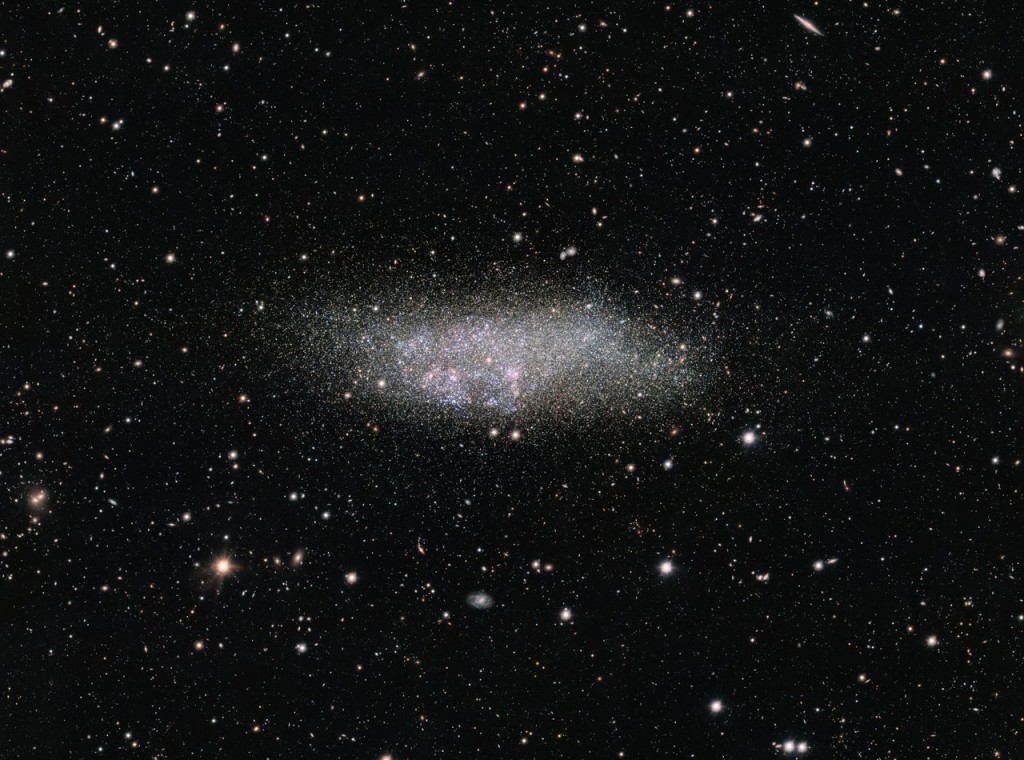
This scene, captured by ESO’s OmegaCAM on the VLT Survey Telescope, shows a lonely galaxy known as Wolf-Lundmark-Melotte, or WLM for short. Although considered part of our Local Group of dozens of galaxies, WLM stands alone at the group’s outer edges as one of its most remote members. In fact, the galaxy is so small and secluded that it may never have interacted with any other Local Group galaxy — or perhaps even any other galaxy in the history of the Universe.
Rather like an uncontacted tribe living deep in the Amazon rainforest or on an island in Oceania, WLM offers a rare insight into the primordial nature of galaxies that have been little disturbed by their environment.
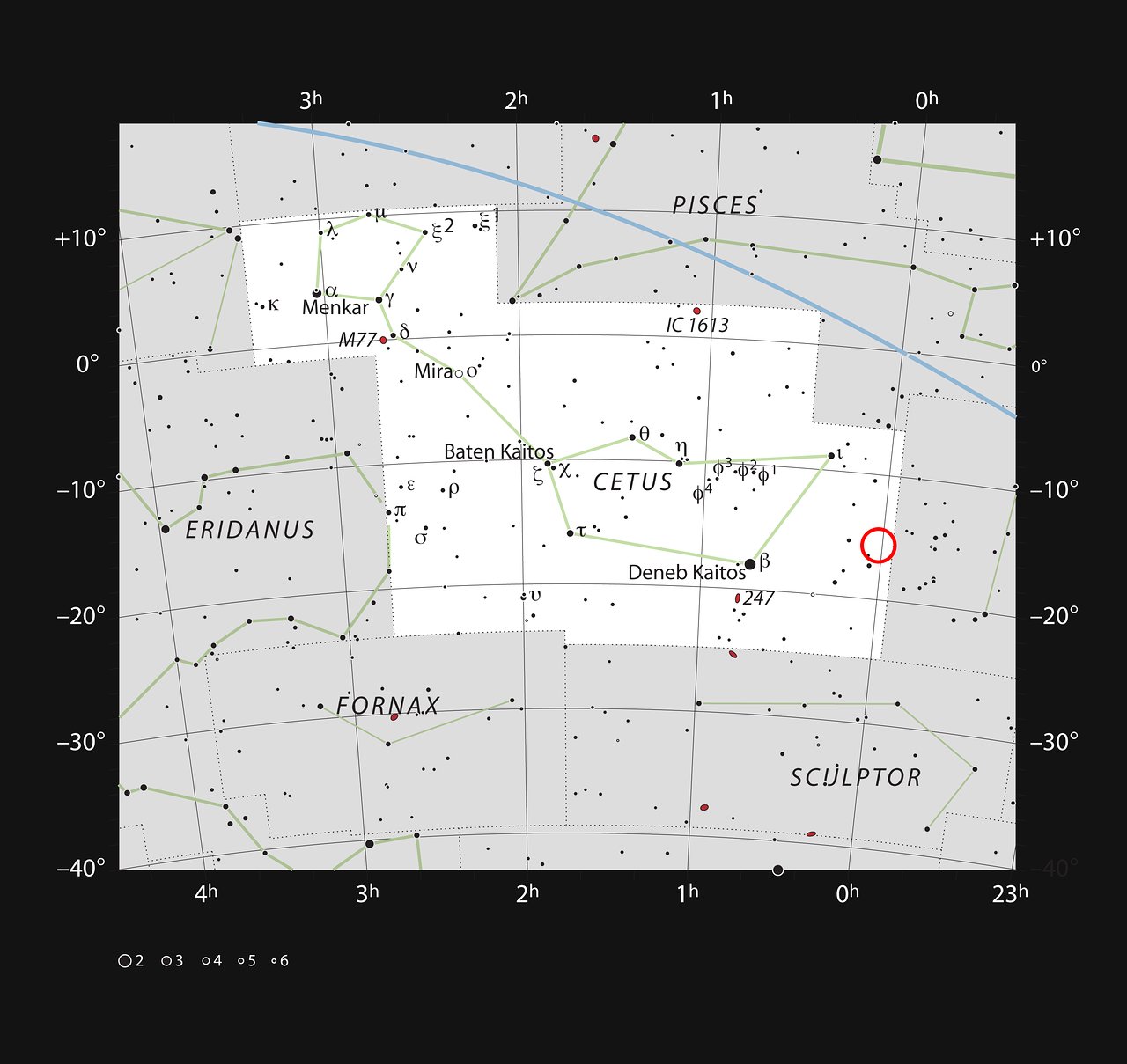
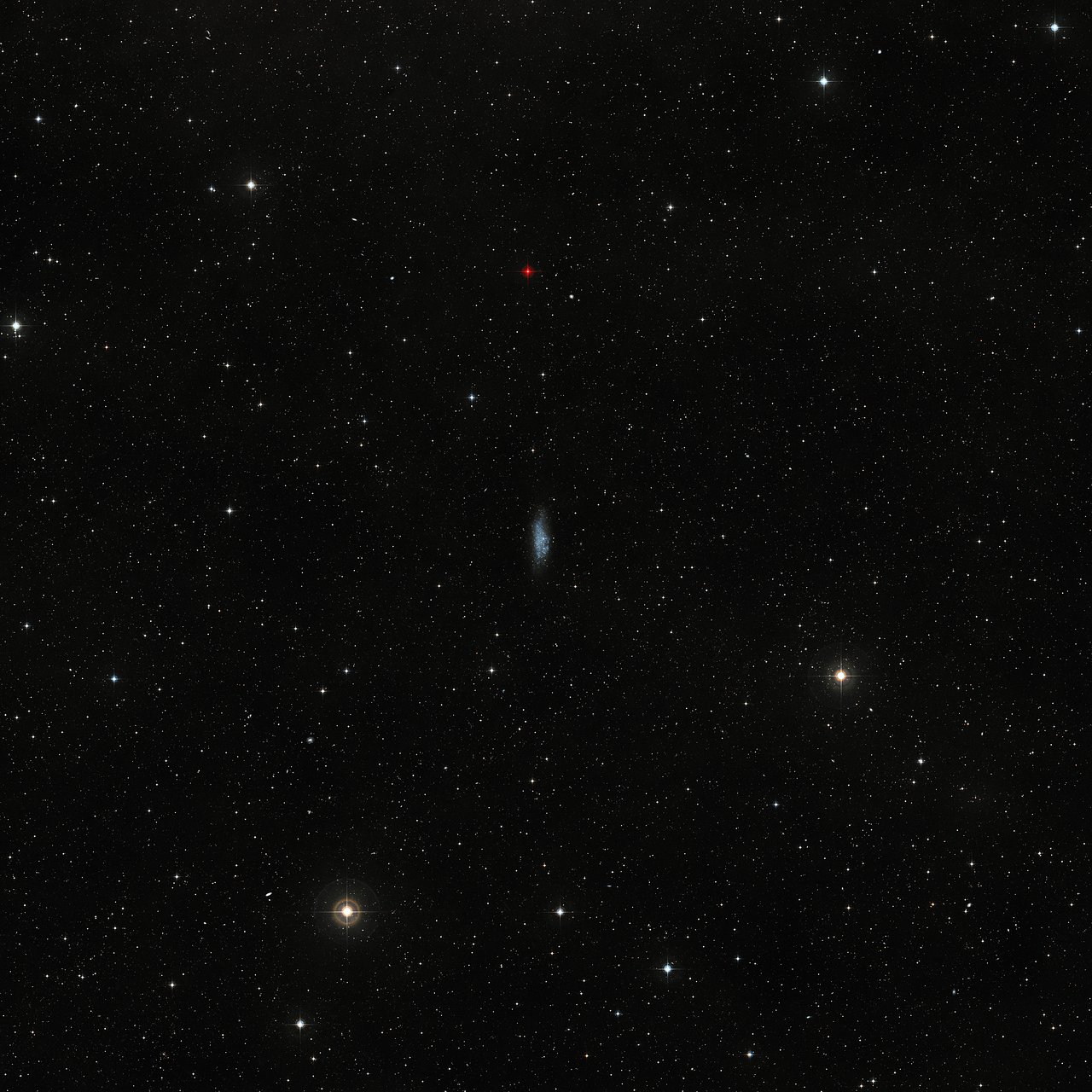
This sequence starts with a broad view of the rather faint constellation of Cetus (The Sea Monster). As we zoom, we close in on a faint galaxy, known as WLM. The final detailed image, captured with the OmegaCAM camera on ESO’s VLT Survey Telescope in Chile, shows the galaxy in great detail, including many of its component stars and some glowing clouds of hydrogen. Credit: ESO/A. Fujii/Digitized Sky Survey 2. Music: Johan B. Monell (www.johanmonell.com). Acknowledgement: VST/Omegacam Local Group Survey
WLM was discovered in 1909 by German astronomer Max Wolf, and identified as a galaxy some fifteen years later by astronomers Knut Lundmark and Philibert Jacques Melotte — explaining the galaxy’s unusual moniker. The dim galaxy is located in the constellation of Cetus (The Sea Monster) about three million light-years away from the Milky Way, which is one of the three dominant spiral galaxies in the Local Group.
WLM is quite small and lacks structure, hence its classification as a dwarf irregular galaxy. WLM spans about 8000 light-years at its greatest extent, a measurement that includes a halo of extremely old stars discovered in 1996 (eso9633).
Astronomers think that comparatively small primeval galaxies gravitationally interacted with each other and in many cases merged, building up into larger composite galaxies. Over billions of years, this merging process assembled the large spiral and elliptical galaxies that now appear to be common in the modern Universe. Galaxies congregating in this manner is similar to the way in which human populations have shifted over thousands of years and intermixed into larger settlements, eventually giving rise to today’s megacities.
WLM has instead developed on its own, away from the influence of other galaxies and their stellar populations. Accordingly, like a hidden human population with limited contact with outsiders, WLM represents a relatively unperturbed “state of nature”, where any changes occurring over its lifetime have taken place largely independent of activity elsewhere.
This small galaxy features an extended halo of very dim red stars, which stretches out into the inky blackness of the surrounding space. This reddish hue is indicative of advanced stellar age. It is likely that the halo dates back to the original formation of the galaxy itself, helpfully offering clues about the mechanisms that spawned the very first galaxies.
This close-up video pan sequence, captured by ESO’s OmegaCAM on the VLT Survey Telescope, shows a lonely galaxy known as Wolf-Lundmark-Melotte, or WLM for short. Although considered part of our Local Group of dozens of galaxies, WLM stands alone at the group’s outer edges as one of its most remote members. In fact, the galaxy is so small and secluded that it may never have interacted with any other Local Group galaxy — or perhaps even any other galaxy in the history of the Universe. Credit: ESO. Music: Johan B. Monell (www.johanmonell.com). Acknowledgement: VST/Omegacam Local Group Survey
The stars at the centre of WLM, meanwhile, appear younger and bluer in colour. In this image, pinkish clouds highlight areas where the intense light from young stars has ionised ambient hydrogen gas, making it glow in a characteristic shade of red.
This detailed image was captured by the OmegaCAM wide-field imager, a huge camera mounted on ESO’s VLT Survey Telescope (VST) in Chile — a 2.6-metre telescope exclusively designed to survey the night sky in visible light. OmegaCAM’s 32 CCD detectors create 256-megapixel images, offering a very detailed wide-field view of the cosmos.
The latest report from ESO (European Southern Observatory):
Unexpected Changes of Bright Spots on Ceres Discovered
Observations made using the HARPS spectrograph at ESO’s La Silla Observatory in Chile have revealed unexpected changes in the bright spots on the dwarf planet Ceres. Although Ceres appears as little more than a point of light from the Earth, very careful study of its light shows not only the changes expected as Ceres rotates, but also that the spots brighten during the day and also show other variations. These observations suggest that the material of the spots is volatile and evaporates in the warm glow of sunlight.
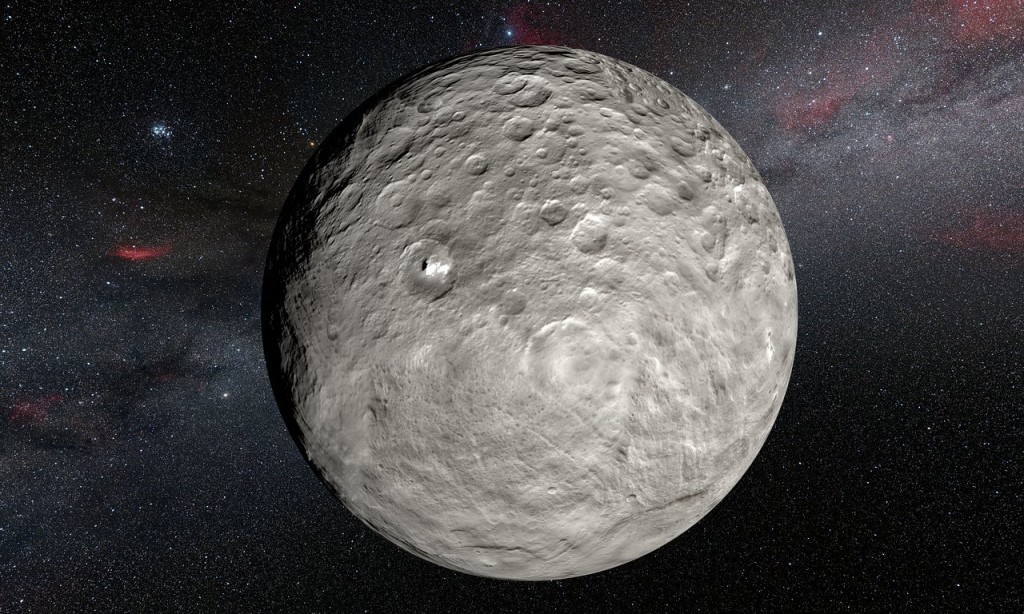
Ceres is the largest body in the asteroid belt between Mars and Jupiter and the only such object classed as a dwarf planet. NASA’s Dawn spacecraft has been in orbit around Ceres for more than a year and has mapped its surface in great detail. One of the biggest surprises has been the discovery of very bright spots, which reflect far more light than their much darker surroundings [1]. The most prominent of these spots lie inside the crater Occator and suggest that Ceres may be a much more active world than most of its asteroid neighbours.
This artist’s impression video [click here for higher resolution versions] is based on a detailed map of the surface compiled from images taken from NASA’s Dawn spacecraft in orbit around the dwarf planet Ceres. It shows the very bright patches of material in the crater Occator and elsewhere. New observations using the HARPS spectrograph on the ESO 3.6-metre telescope at La Silla in Chile have revealed unexpected daily changes on these spots, suggesting that they change under the influence of sunlight as Ceres rotates.
This illustration shows how the features in the spectrum of the light reflected from the bright spots is alternately red and blue shifted slightly compared to the average light of Ceres as it rotates. This very subtle effect has been measured from the ground using the HARPS spectrograph on the ESO 3.6-metre telescope at La Silla in Chile. The effect has been greatly exaggerated to make it visible and excludes the much brighter light coming from the rest of the disc of Ceres. Credit: ESO/L.Calçada/NASA/JPL-Caltech/UCLA/MPS/DLR/IDA/Steve Albers
New and very precise observations using the HARPS spectrograph at the ESO 3.6-metre telescope at La Silla, Chile, have now not only detected the motion of the spots due to the rotation of Ceres about its axis, but also found unexpected additional variations suggesting that the material of the spots is volatile and evaporates in sunlight.
![eso1609b[1]](http://hobbyspace.com/Blog/wp-content/uploads/2016/03/eso1609b1-1024x1024.jpg)
“As soon as the Dawn spacecraft revealed the mysterious bright spots on the surface of Ceres, I immediately thought of the possible measurable effects from Earth. As Ceres rotates the spots approach the Earth and then recede again, which affects the spectrum of the reflected sunlight arriving at Earth.”
Ceres spins every nine hours and calculations showed that the effects due to the motion of the spots towards and away from the Earth caused by this rotation would be very small, of order 20 kilometres per hour. But this motion is big enough to be measurable via the Doppler effect with high-precision instruments such as HARPS.
This artist’s impression video is based on a detailed map of the surface compiled from images taken from NASA’s Dawn spacecraft in orbit around the dwarf planet Ceres. It shows the very bright patches of material in the crater Occator and elsewhere. New observations using the HARPS spectrograph on the ESO 3.6-metre telescope at La Silla in Chile have revealed unexpected daily changes on these spots, suggesting that they change under the influence of sunlight as Ceres rotates. Credit: ESO/L.Calçada/NASA/JPL-Caltech/UCLA/MPS/DLR/IDA/Steve Albers
The team observed Ceres with HARPS for a little over two nights in July and August 2015. “The result was a surprise,”adds Antonino Lanza, at the INAF–Catania Astrophysical Observatory and co-author of the study.
“We did find the expected changes to the spectrum from the rotation of Ceres, but with considerable other variations from night to night.”
The team concluded that the observed changes could be due to the presence of volatile substances that evaporate under the action of solar radiation [2]. When the spots inside the Occator crater are on the side illuminated by the Sun they form plumes that reflect sunlight very effectively. These plumes then evaporate quickly, lose reflectivity and produce the observed changes. This effect, however, changes from night to night, giving rise to additional random patterns, on both short and longer timescales.
If this interpretation is confirmed Ceres would seem to be very different from Vesta and the other main belt asteroids. Despite being relatively isolated, it seems to be internally active [3]. Ceres is known to be rich in water, but it is unclear whether this is related to the bright spots. The energy source that drives this continual leakage of material from the surface is also unknown.
Dawn is continuing to study Ceres and the behaviour of its mysterious spots. Observations from the ground with HARPS and other facilities will be able to continue even after the end of the space mission.
Notes
[1] Bright spots were also seen, with much less clarity, in earlier images of Ceres from the NASA/ESA Hubble Space Telescope taken in 2003 and 2004.
[2] It has been suggested that the highly reflective material in the spots on Ceres might be freshly exposed water ice or hydrated magnesium sulphates.
[3] Many of the most internally active bodies in the Solar System, such as the large satellites of Jupiter and Saturn, are subjected to strong tidal effects due to their proximity to the massive planets.
The latest European Southern Observatory (ESO) report:
Sharpest View Ever of Dusty Disc Around Aging Star
VLTI finds discs around aging stars similar to those around young ones
The Very Large Telescope Interferometer at ESO’s Paranal Observatory in Chile has obtained the sharpest view ever of the dusty disc around an aging star. For the first time such features can be compared to those around young stars — and they look surprisingly similar. It is even possible that a disc appearing at the end of a star’s life might also create a second generation of planets.
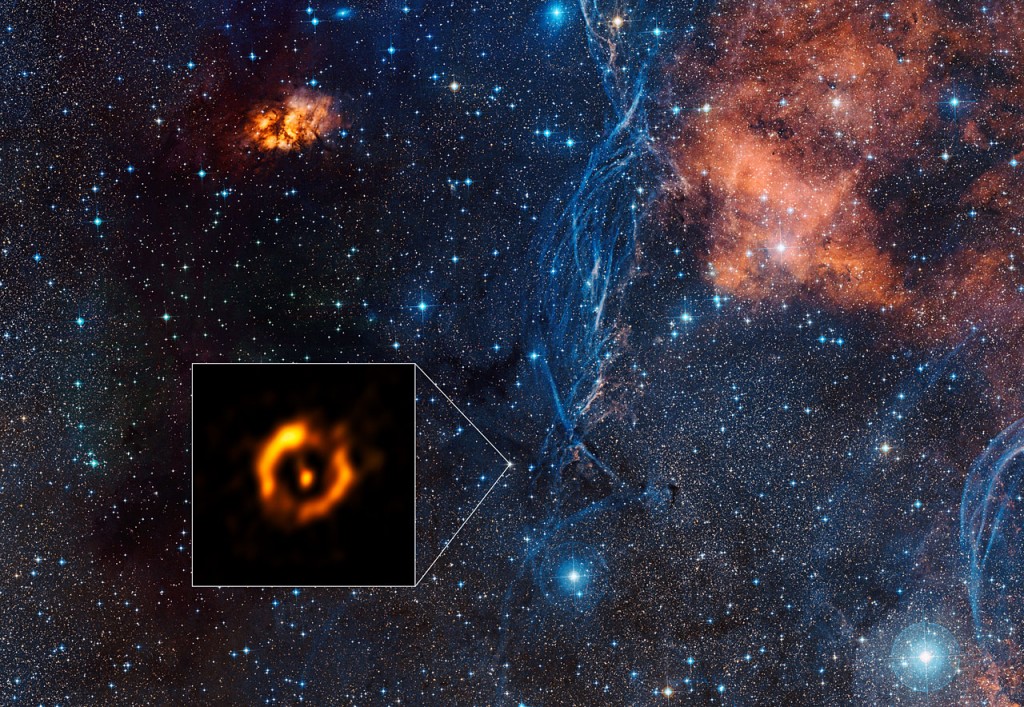
As they approach the ends of their lives many stars develop stable discs of gas and dust around them. This material was ejected by stellar winds, whilst the star was passing through the red giant stage of its evolution. These discs resemble those that form planets around young stars. But up to now astronomers have not been able to compare the two types, formed at the beginning and the end of the stellar life cycle.
Although there are many discs associated with young stars that are sufficiently near to us to be studied in depth, there are no corresponding old stars with discs that are close enough for us to obtain detailed images.
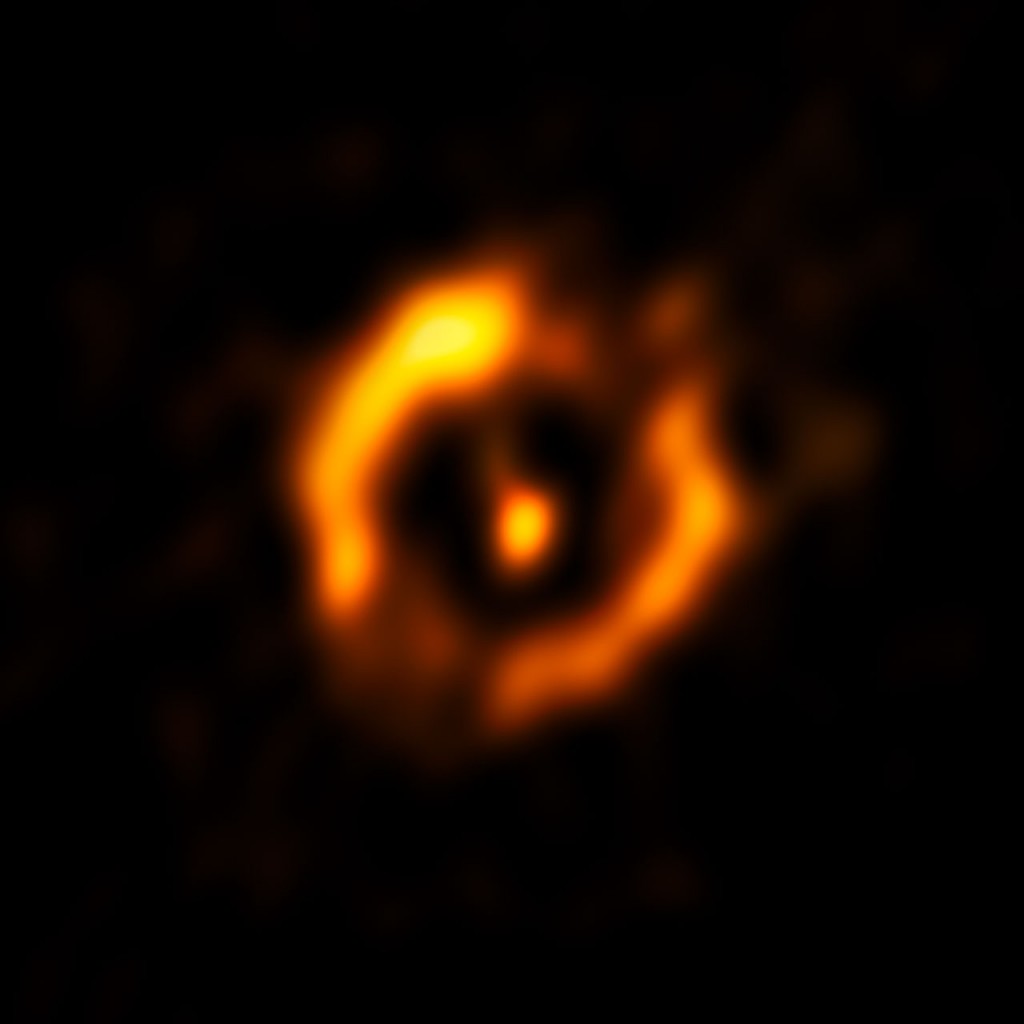
But this has now changed. A team of astronomers led by Michel Hillen and Hans Van Winckel from the Instituut voor Sterrenkunde in Leuven, Belgium, has used the full power of the Very Large Telescope Interferometer (VLTI) at ESO’s Paranal Observatory in Chile, armed with the PIONIER instrument, and the newly upgraded RAPID detector.
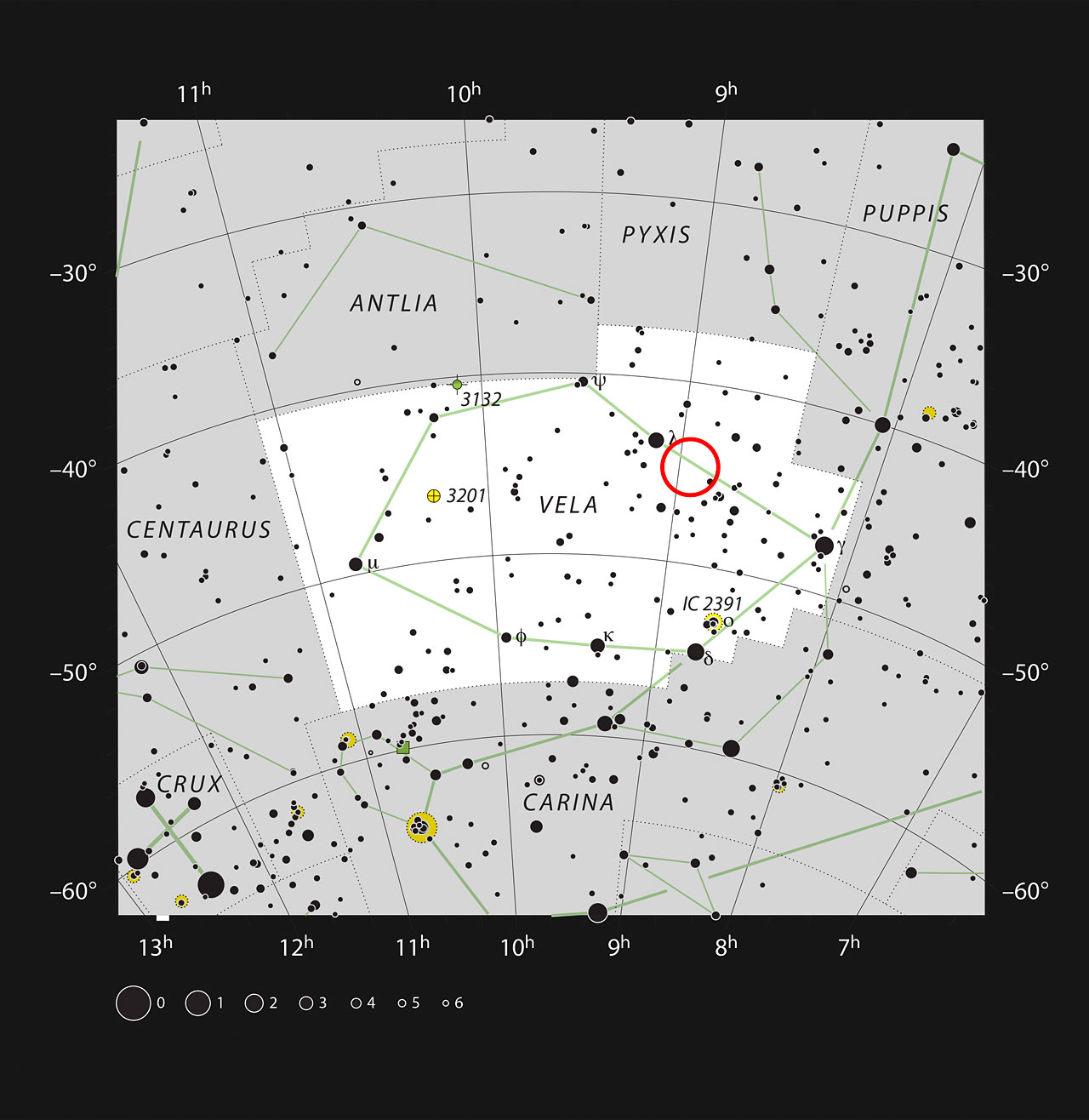
Their target was the old double star IRAS 08544-4431 [1], lying about 4000 light-years from Earth in the southern constellation of Vela (The Sails). This double star consists of a red giant star, which expelled the material in the surrounding dusty disc, and a less-evolved more normal star orbiting close to it.
Jacques Kluska, team member from Exeter University, United Kingdom, explains:
“By combining light from several telescopes of the Very Large Telescope Interferometer, we obtained an image of stunning sharpness — equivalent to what a telescope with a diameter of 150 metres would see. The resolution is so high that, for comparison, we could determine the size and shape of a one euro coin seen from a distance of two thousand kilometres.”
Thanks to the unprecedented sharpness of the images [2] from the Very Large Telescope Interferometer, and a new imaging technique that can remove the central stars from the image to reveal what lies around them, the team could dissect all the building blocks of the IRAS 08544-4431 system for the first time.
This video takes the viewer deep into a spectacular region of the southern Milky Way in the constellation of Vela (The Sails). We pass many interesting objects, including star formation regions and the blue filaments of a supernova remnant, before closing in on the faint star IRAS 08544-4431. This aging object is surrounded by a dusty disc that has been clearly resolved for the first time by the Very Large Telescope Interferometer at ESO’s Paranal Observatory in Chile. Credit: ESO/Digitized Sky Survey 2/N. Risinger (skysurvey.org). Acknowledgement: Davide De Martin. Music: Johan B. Monell (www.johanmonell.com)
The most prominent feature of the image is the clearly resolved ring. The inner edge of the dust ring, seen for the first time in these observations, corresponds very well with the expected start of the dusty disc: closer to the stars, the dust would evaporate in the fierce radiation from the stars.
“We were also surprised to find a fainter glow that is probably coming from a small accretion disc around the companion star. We knew the star was double, but weren’t expecting to see the companion directly. It is really thanks to the jump in performance now provided by the new detector in PIONIER, that we are able to view the very inner regions of this distant system,”
adds lead author Michel Hillen.
The team finds that discs around old stars are indeed very similar to the planet-forming ones around young stars. Whether a second crop of planets can really form around these old stars is yet to be determined, but it is an intriguing possibility.
“Our observations and modelling open a new window to study the physics of these discs, as well as stellar evolution in double stars. For the first time the complex interactions between close binary systems and their dusty environments can now be resolved in space and time,”
concludes Hans Van Winckel.
Notes
[1] The name of the object indicates that it is a source of infrared radiation that was detected and catalogued by the IRAS satellite observatory in the 1980s.
[2] The resolution of the VLTI, used with the four Auxiliary Telescopes, was about one milliarcsecond (1/1000th of 1/3600th of a degree).