On 9 May Mercury passed in front of the Sun as seen from Earth. These transits of Mercury occur only around 13 times every century, so astronomers all over Earth were eager to capture the event.
For astrophotographer Thierry Legault, capturing Mercury and the Sun alone was not enough, however – he wanted the International Space Station in the frame as well.
To catch the Station passing across the Sun, you need to set up your equipment within a ground track less than 3 km wide. For Thierry, this meant flying to the USA from his home near Paris, France.
On 9 May there were three possible areas to capture the Station and Mercury at the same time against the solar disc: Quebec, Canada, the Great Lakes and Florida, USA.
Choosing the right spot took considerable effort, says Thierry:
“Canada had bad weather predicted and around Florida I couldn’t find a suitably quiet but public place, so I went to the suburbs of Philadelphia.”
With 45 kg of equipment, Thierry flew to New York and drove two hours to Philadelphia to scout the best spot. Even then, all the preparations and intercontinental travel could have been for nothing because the Station crosses the Sun in less than a second and any clouds could have ruined the shot.
“I was very lucky: 10 minutes after I took the photos, clouds covered the sky,” says a relieved Thierry.
“Adrenaline flows in the moments before the Station flies by – it is a one-shot chance. I cannot ask the space agencies to turn around so I can try again. Anything can happen.”
The hard work and luck paid off. The image here includes frames superimposed on each other to show the Station’s path. Mercury appears as a black dot at bottom-centre of the Sun.
For Thierry, the preparation and the hunt for the perfect shot is the best part.
“Astrophotography is my hobby that I spend many hours on, but even without a camera I encourage everybody to look up at the night sky. The International Space Station can be seen quite often and there are many more things to see. It is just a case of looking up at the right time.”
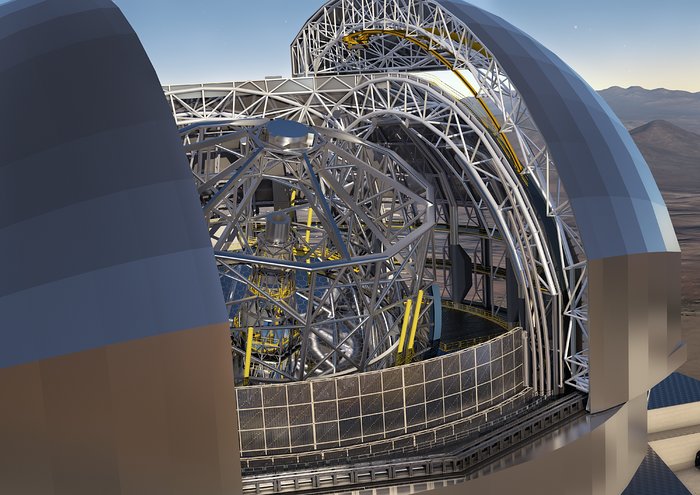
At a ceremony in Garching bei München, Germany on 25 May 2016, ESO signed the contract with the ACe Consortium, consisting of Astaldi, Cimolai and the nominated sub-contractor EIE Group, for the construction of the dome and telescope structure of the European Extremely Large Telescope (E-ELT). This is the largest contract ever awarded by ESO and also the largest contract ever in ground-based astronomy. This occasion saw the unveiling of the construction design of the E-ELT. Construction of the dome and telescope structure will now commence.
This artist’s rendering of the E-ELT is based on the detailed construction design for the telescope. Credit: ESO/L. Calçada/ACe ConsortiumThe European Extremely Large Telescope (E-ELT), with a main mirror 39 metres in diameter, will be the largest optical/near-infrared telescope in the world: truly the world’s biggest eye on the sky. It will be constructed in northern Chile, on a site that has already been prepared.
The contract to build the telescope’s dome and structure was signed by ESO’s Director General, Tim de Zeeuw, the Chairman of Astaldi, Paolo Astaldi, and the President of Cimolai, Luigi Cimolai. ESO was delighted to welcome Italy’s Minister of Education, Universities and Research, H.E. Stefania Giannini, to the ceremony, which was also attended by the Italian Consul General in Munich, Renato Cianfarani, the ESO Council President, Patrick Roche, and the Italian ESO Council Delegates, Nicolò D’Amico (who is also President of INAF) and Matteo Pardo, Scientific Attaché at the Italian Embassy in Berlin. The President of EIE, Gianpietro Marchiori, and other guests and representatives of the consortium were also present.
This artist’s rendering of the E-ELT is based on the detailed construction design for the telescope. Credit: ESO/L. Calçada/ACe Consortium
The contract covers the design, manufacture, transport, construction, on-site assembly and verification of the dome and telescope structure. With an approximate value of 400 million euros, it is the largest contract ever awarded by ESO and the largest contract ever in ground-based astronomy.
A video describing the E-ELT project.
The E-ELT dome and telescope structure will take telescope engineering into new territory. The contract includes not only the enormous 85-metre-diameter rotating dome, with a total mass of around 5000 tonnes, but also the telescope mounting and tube structure, with a total moving mass of more than 3000 tonnes. Both of these structures are by far the largest ever built for an optical/infrared telescope and dwarf all existing ones. The dome is almost 80 metres high and its footprint is comparable in area to a football pitch.
This artist’s impression compares the E-ELT to the Colosseum in Rome, Italy. Credit: ESOThe E-ELT is being built on Cerro Armazones, a 3000-metre peak about 20 kilometres from ESO’s Paranal Observatory. The access road and leveling of the summit have already been completed and work on the dome is expected to start on site in 2017.
Tim de Zeeuw, ESO’s Director General said:
“The E-ELT will produce discoveries that we simply cannot imagine today, and it will inspire people around the world to think about science, technology and our place in the Universe. Today’s signature is a key step towards delivering the E-ELT in 2024.”
Paolo Astaldi, Chairman of Astaldi added:
“This project is truly visionary, both in what it represents for the field of astronomy and for construction and engineering. Astaldi and our project partners, Cimolai and EIE Group, are extremely proud to have been selected by ESO through their call for tender to help make their vision a reality. Astaldi is renowned for delivering its best-in-class technical skills, quality construction and strong execution, and we will put the full force of our core strengths behind this project. It is with great excitement that I sign a contract of such astronomical ambition.”
Luigi Cimolai, President of Cimolai, said:
“We are honoured and grateful that our company has been given the opportunity to take part in this technically advanced astronomical challenge. The European Extremely Large Telescope will demand a high degree of quality in engineering and construction and I believe this will definitely contribute to further increase our ability to develop projects of greater and greater complexity.”
Many other aspects of the construction of the E-ELT are also moving forward rapidly. ESO has already signed agreements for the construction of the first-light instruments MICADO, HARMONI and METIS, as well as the MAORY adaptive optics system for the E-ELT. Contracts for the telescope’s huge secondary mirror will be signed in the near future.
The light-collecting area of the E-ELT will be bigger than all existing optical research telescopes combined and its adaptive optics system will provide images about 15 times sharper than those from the NASA/ESA Hubble Space Telescope at the same wavelength. It offers numerous possibilities for technology and engineering spin-offs, technology transfer and technology contracting. The new contract demonstrates that the E-ELT has the potential to be a powerhouse for economic development, offering contractors in ESO’s Member States an opportunity to lead major projects at an international level.
An infographic [Larger version] that compares the size of the European Extremely Large Telescope (E-ELT) main mirror with that of other major ground-based telescopes, either in operation or planned. The E-ELT, with a main mirror 39 metres in diameter, will be the largest optical/near-infrared telescope in the world. It was inspired by infographic made by Wikipedia Author Cmglee. Credit: ESO
A group of astronomers last year proposed a 11.7 meter diameter multi-mirror space telescope that could image planets around other stars: From Cosmic Birth to Living Earths (See also the detailed study in the AURA report (pdf))
The High Definition Space Telescope (HDST) would be sensitive to light at UV through near-infrared wavelengths, viewing the universe from the second Earth-Sun Lagrange point (L2), one million miles from the Earth. Its segmented mirror would be folded into either a current or future heavy-lift rocket, before being launched and deployed at its final home.
In its mission to discover and study Earth-like planets orbiting Sun-like stars, HDST will directly image exoplanets — including planets that may be as much as 10 billion times fainter than their host star — by carefully suppressing the star’s light. HDST’s exquisite image quality at visible wavelengths (with more than 25 times the resolving power of the Hubble Space Telescope) and high sensitivity all the way into the ultraviolet part of the spectrum (100 times more sensitive than Hubble), combined with a versatile set of imaging and spectroscopic instruments, will trigger profound breakthroughs in astrophysics.
Like Hubble and JWST, HDST would operate as a general observatory, supporting a broad range of investigations beyond its core exoplanet mission.
The HDST mirror array in comparison to the Hubble space telescope mirror and the James Webb Space Telescope
HDST‘s primary goal is to find and characterize dozens of Earth-like exoplanets. A sample of dozens of exoEarths opens up the opportunity to identify truly Earth-like worlds with rocky surfaces and oceans, amidst a complex zoo of other varieties of terrestrial planets.
With this large sample, observing telltale signs of life in the planets’ atmospheres becomes possible. If life is rare, HDST will take us from our current complete ignorance of the occurrence rate of inhabited worlds to a first constraint, potentially showing how remarkable our own existence is.
If life is common, a large sample of terrestrial worlds with highly unusual atmospheric chemistry will secure our belief that life of some kind exists beyond the Earth, regardless of possible false positives. Whatever the outcome, HDST will change how we see our place in the Universe.
A view of the telescope folded up inside the fairing of a Delta IV Heavy rocket:
A folded 11 m primary mirror, constructed with 54 1.3 m segments, is shown inside a Delta 4-H shroud.
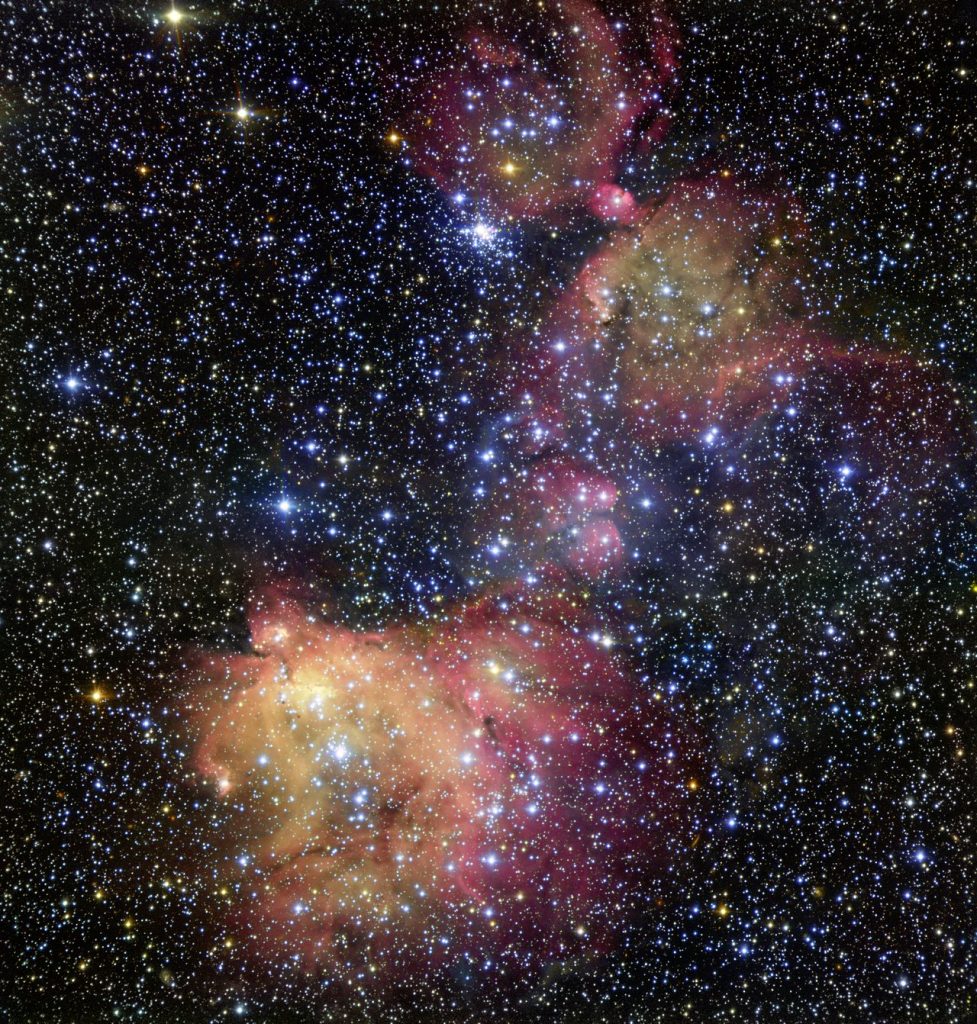
In this image from ESO’s Very Large Telescope (VLT), light from blazing blue stars energises the gas left over from the stars’ recent formation. The result is a strikingly colourful emission nebula, called LHA 120-N55, in which the stars are adorned with a mantle of glowing gas. Astronomers study these beautiful displays to learn about the conditions in places where new stars develop.
In this image from ESO’s Very Large Telescope (VLT), light from blazing blue stars energises the gas left over from the stars’ recent formation. The result is a strikingly colourful emission nebula, called LHA 120-N55, in which the stars are adorned with a mantle of glowing gas. Astronomers study these beautiful displays to learn about the conditions in places where new stars develop.
LHA 120-N55, or N55 as it is usually known, is a glowing gas cloud in the Large Magellanic Cloud (LMC), a satellite galaxy of the Milky Way located about 163 000 light-years away. N55 is situated inside a supergiant shell, or superbubble called LMC 4. Superbubbles, often hundreds of light-years across, are formed when the fierce winds from newly formed stars and shockwaves from supernova explosions work in tandem to blow away most of the gas and dust that originally surrounded them and create huge bubble-shaped cavities.
The material that became N55, however, managed to survive as a small remnant pocket of gas and dust. It is now a standalone nebula inside the superbubble and a grouping of brilliant blue and white stars — known as LH 72 — also managed to form hundreds of millions of years after the events that originally blew up the superbubble. The LH 72 stars are only a few million years old, so they did not play a role in emptying the space around N55. The stars instead represent a second round of stellar birth in the region.
This zoom sequence takes us on a journey of 160 000 light-years to one of our neighbouring galaxies, the Large Magellanic Cloud. In the final image, taken with ESO’s Very Large Telescope (VLT), light from blazing blue stars energises the gas left over from the stars’ recent formation to create a strikingly colourful emission nebula, called LHA 120-N55, in which the stars are adorned with a mantle of glowing gas. Astronomers study these beautiful displays to learn about the conditions in places where new stars develop. Credit: ESO/ Nick Risinger (skysurvey.org)/Robert Gendler (http://www.robgendlerastropics.com/). Music: Johan monell
The recent rise of a new population of stars also explains the evocative colours surrounding the stars in this image. The intense light from the powerful, blue–white stars is stripping nearby hydrogen atoms in N55 of their electrons, causing the gas to glow in a characteristic pinkish colour in visible light. Astronomers recognise this telltale signature of glowing hydrogen gas throughout galaxies as a hallmark of fresh star birth.
While things seem quiet in the star-forming region of N55 for now, major changes lie ahead. Several million years hence, some of the massive and brilliant stars in the LH 72 association will themselves go supernova, scattering N55’s contents. In effect, a bubble will be blown within a superbubble, and the cycle of starry ends and beginnings will carry on in this close neighbour of our home galaxy.
This pan video gives a close-up look at a new image of the strikingly colourful emission nebula, called LHA 120-N55 from ESO’s Very Large Telescope (VLT). Light from blazing blue stars energises the gas left over from the stars’ recent formation to create a mantle of glowing gas. Astronomers study these beautiful displays to learn about the conditions in places where new stars develop. Credit: ESO. Music: Johan Monell
This new image was acquired using the FOcal Reducer and low dispersion Spectrograph (FORS2) instrument attached to ESO’s VLT. It was taken as part of the ESO Cosmic Gems programme, an outreach initiative to produce images of interesting, intriguing or visually attractive objects using ESO telescopes for the purposes of education and public outreach. The programme makes use of telescope time that cannot be used for science observations. All data collected may also be suitable for scientific purposes, and are made available to astronomers through ESO’s science archive.
This chart shows all the naked eye stars in the far-southern constellation of Dorado (The Dolphin Fish) and also indicates the outline of the Large Magellanic Cloud, a small nearby galaxy. The position of the star formation region LHA 120-N55 is marked. This gas cloud is very faint to be seen visually, but the hot young stars with which it is associated are easier to spot. Credit: ESO/IAU and Sky & Telescope
On Monday the planet Mercury will transit across the face of the Sun as seen from earth between about 7:12 am and 2:42 pm EDT : Mercury Enters Spotlight on May 9 – NASA.
This video shows the path that it will take:
Don’t ever look directly at the sun. There are various safe ways to observe the transit such as using a solar filter over a telescope aperature or to project the image onto a white board with a pinhole. The transit will also be webcast from various sites.
Here are some sites with information on webcasts and tips on viewing the transit directly:
![eso1617e[1]](http://hobbyspace.com/Blog/wp-content/uploads/2016/05/eso1617e1.jpg)
![eso1617q[1]](http://hobbyspace.com/Blog/wp-content/uploads/2016/05/eso1617q1.jpg)
![eso1617z[1]](http://hobbyspace.com/Blog/wp-content/uploads/2016/05/eso1617z1.jpg)
![fig_5-1[1]](http://hobbyspace.com/Blog/wp-content/uploads/2016/05/fig_5-11.jpg)
![fig_5-2[1]](http://hobbyspace.com/Blog/wp-content/uploads/2016/05/fig_5-21.jpg)
![eso1616b[1]](http://hobbyspace.com/Blog/wp-content/uploads/2016/05/eso1616b1.jpg)