Category Archives: Astronomy

Light pollution hides the Milky Way from a third of humanity

A veil of light is blanking out the night sky for more and more of the world’s population: Milky Way Can No Longer Be Seen By One-Third of Humanity Because of Light Pollution – Nature World News

The atlas shows that more than 80 percent of the world and more than 99 percent of the U.S. and European populations live under light-polluted skies. Light pollution is most evident in developed countries, where the ubiquitous presence of artificial lights has created a luminous fog that blots out the stars and constellations once visible during the night.

“We’ve got whole generations of people in the United States who have never seen the Milky Way,” Chris Elvidge of the U.S. National Oceanic and Atmospheric Administration (NOAA) and co-author of the study said in a report published in Science Daily.

“It’s a big part of our connection to the cosmos – and it’s been lost,” he added.

Here are maps of light pollution:  The new world atlas of artificial night sky brightness – Science Advances

Here are some places with the best dark skys: Space Tourism on Earth: The 7 Dark Sky Reserves to Visit Right Now – Inverse.

ESO: Methyl Alcohol detected for first time in a protoplanetary disck

ESO (European Southern Observatory) highlights a new finding:

First Detection of Methyl Alcohol in a Planet-forming Disc

The organic molecule methyl alcohol (methanol) has been found by the Atacama Large Millimeter/Submillimeter Array (ALMA) in the TW Hydrae protoplanetary disc. This is the first such detection of the compound in a young planet-forming disc. Methanol is the only complex organic molecule as yet detected in discs that unambiguously derives from an icy form. Its detection helps astronomers understand the chemical processes that occur during the formation of planetary systems and that ultimately lead to the creation of the ingredients for life.

eso1619a[1]
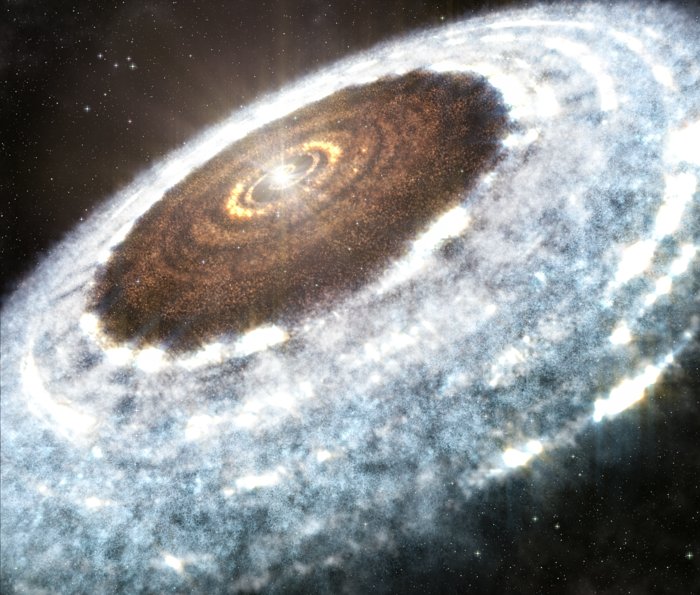
This artist’s impression shows the closest known protoplanetary disc, around the star TW Hydrae in the huge constellation of Hydra (The Female Watersnake). The organic molecule methyl alcohol (methanol) has been found by the Atacama Large Millimeter/Submillimeter Array (ALMA) in this disc. This is the first such detection of the compound in a young planet-forming disc. Credit: ESO/M. Kornmesser
The protoplanetary disc around the young star TW Hydrae is the closest known example to Earth, at a distance of only about 170 light-years. As such it is an ideal target for astronomers to study discs. This system closely resembles what astronomers think the Solar System looked like during its formation more than four billion years ago.

The Atacama Large Millimeter/Submillimeter Array (ALMA) is the most powerful observatory in existence for mapping the chemical composition and the distribution of cold gas in nearby discs. These unique capabilities have now been exploited by a group of astronomers led by Catherine Walsh (Leiden Observatory, the Netherlands) to investigate the chemistry of the TW Hydrae protoplanetary disc.

This artist’s impression video shows the molecule methanol, or methyl alcohol (CH3OH). This organic compound has been found by the Atacama Large Millimeter/Submillimeter Array (ALMA) in the closest known protoplanetary disc, around the star TW Hydrae in the huge constellation of Hydra (The Female Watersnake). This is the first such detection of the compound in a young planet-forming disc. Its detection helps astronomers understand the chemical processes that occur during the formation of planetary systems and that ultimately lead to the creation of the ingredients for life. Credit: ESO/M. Kornmesser

The ALMA observations have revealed the fingerprint of gaseous methyl alcohol, or methanol (CH3OH), in a protoplanetary disc for the first time. Methanol, a derivative of methane, is one of the largest complex organic molecules detected in discs to date. Identifying its presence in pre-planetary objects represents a milestone for understanding how organic molecules are incorporated into nascent planets.

Furthermore, methanol is itself a building block for more complex species of fundamental prebiotic importance, like amino acid compounds. As a result, methanol plays a vital role in the creation of the rich organic chemistry needed for life.

Catherine Walsh, lead author of the study, explains:

“Finding methanol in a protoplanetary disc shows the unique capability of ALMA to probe the complex organic ice reservoir in discs and so, for the first time, allows us to look back in time to the origin of chemical complexity in a planet nursery around a young Sun-like star.”

Gaseous methanol in a protoplanetary disc has a unique importance in astrochemistry. While other species detected in space are formed by gas-phase chemistry alone, or by a combination of both gas and solid-phase generation, methanol is a complex organic compound, which is formed solely in the ice phase via surface reactions on dust grains.

This artist’s impression video shows the closest known protoplanetary disc, around the star TW Hydrae in the huge constellation of Hydra (The Female Watersnake). The organic molecule methyl alcohol (methanol) has been found by the Atacama Large Millimeter/Submillimeter Array (ALMA) in this disc. This is the first such detection of the compound in a young planet-forming disc. Credit: ESO/M. Kornmesser

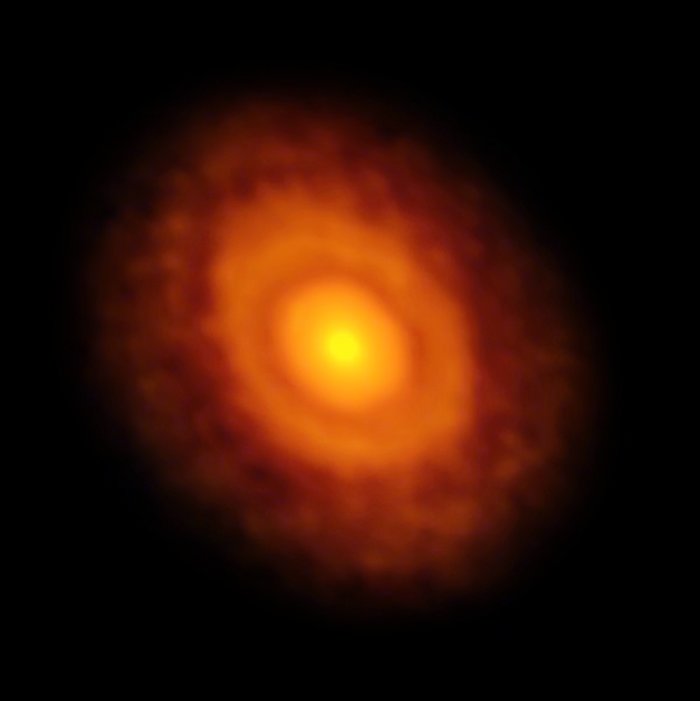
The sharp vision of ALMA has also allowed astronomers to map the gaseous methanol across the TW Hydrae disc. They discovered a ring-like pattern in addition to significant emission from close to the central star [1].

The observation of methanol in the gas phase, combined with information about its distribution, implies that methanol formed on the disc’s icy grains, and was subsequently released in gaseous form. This first observation helps to clarify the puzzle of the methanol ice–gas transition [2], and more generally the chemical processes in astrophysical environments [3].

Ryan A. Loomis, a co-author of the study, adds:

“Methanol in gaseous form in the disc is an unambiguous indicator of rich organic chemical processes at an early stage of star and planet formation. This result has an impact on our understanding of how organic matter accumulates in very young planetary systems.”

This successful first detection of cold gas-phase methanol in a protoplanetary disc means that the production of ice chemistry can now be explored in discs, paving the way to future studies of complex organic chemistry in planetary birthplaces. In the hunt for life-sustaining exoplanets, astronomers now have access to a powerful new tool.

Notes

[1] A ring of methanol between 30 and 100 astronomical units (au) reproduces the pattern of the observed methanol data from ALMA. The identified structure supports the hypothesis that the bulk of the disc ice reservoir is hosted primarily on the larger (up to millimetre-sized) dust grains, residing in the inner 50 au, which have become decoupled from the gas, and drifted radially inwards towards the star.

[2] In this study, rather than thermal desorption (with methanol released at temperatures higher than its sublimation temperature), other mechanisms are supported and discussed by the team, including photodesorption by ultraviolet photons and reactive desorption. More detailed ALMA observations would help to definitely favour one scenario among the others.

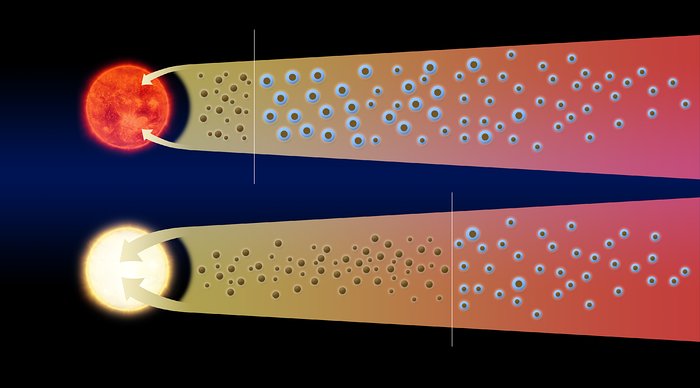
[3] Radial variation of chemical species in the disc midplane composition, and specifically the locations of snowlines, are crucial for understanding the chemistry of nascent planets.The snowlines mark the boundary beyond which a particular volatile chemical species is frozen out onto dust grains. The detection of methanol also in the colder outer regions of the disc shows that it is able to escape off the grains at temperatures much lower than its sublimation temperature, necessary to trigger thermal desorption.

ESO: Intergalactic gas clouds pulled towards supermassive black hole

The latest report from ESO (European Southern Observatory:

Black Hole Fed by Cold Intergalactic Deluge

The cosmic weather report, as illustrated in this artist’s concept, calls for condensing clouds of cold molecular gas around the Abell 2597 Brightest Cluster Galaxy. The clouds condense out of the hot, ionised gas that suffuses the space between the galaxies in this cluster. New ALMA data show that these clouds are raining in on the galaxy, plunging toward the supermassive black hole at its centre.

An international team of astronomers using the Atacama Large Millimeter/submillimeter Array (ALMA) has witnessed a cosmic weather event that has never been seen before — a cluster of towering intergalactic gas clouds raining in on the supermassive black hole at the centre of a huge galaxy one billion light-years from Earth. The results will appear in the journal Nature on 9 June 2016.

The new ALMA observation is the first direct evidence that cold dense clouds can coalesce out of hot intergalactic gas and plunge into the heart of a galaxy to feed its central supermassive black hole. It also reshapes astronomers’ views on how supermassive black holes feed, in a process known as accretion.

eso1618c[1]
The background image (blue) is from the NASA/ESA Hubble Space Telescope. The foreground (red) is ALMA data showing the distribution of carbon monoxide gas in and around the galaxy. The pull-out box shows the ALMA data of the “shadow” (black) produced by absorption of the millimetre-wavelength light emitted by electrons whizzing around powerful magnetic fields generated by the galaxy’s supermassive black hole. The shadow indicates that cold clouds of molecular gas are raining in on the black hole. Credit: B. Saxton (NRAO/AUI/NSF)/G. Tremblay et al./NASA/ESA Hubble/ALMA (ESO/NAOJ/NRAO)

Previously, astronomers believed that, in the largest galaxies, supermassive black holes fed on a slow and steady diet of hot ionised gas from the galaxy’s halo. The new ALMA observations show that, when the intergalactic weather conditions are right, black holes can also gorge on a clumpy, chaotic downpour of giant clouds of very cold molecular gas.

Although it has been a major theoretical prediction in recent years, this is one of the first unambiguous pieces of observational evidence for a chaotic, cold rain feeding a supermassive black hole,” said Grant Tremblay, an astronomer with Yale University in New Haven, Connecticut, USA, former ESO Fellow, and lead author on the new paper. “It’s exciting to think we might actually be observing this galaxy-spanning rainstorm feeding a black hole whose mass is about 300 million times that of the Sun.

Tremblay and his team used ALMA to peer into an unusually bright cluster of about 50 galaxies, collectively known as Abell 2597. At its core is a massive elliptical galaxy, descriptively named the Abell 2597 Brightest Cluster Galaxy. Suffusing the space between these galaxies is a diffuse atmosphere of hot ionised gas, which was previously observed with NASA’s Chandra X-ray Observatory.

This very, very hot gas can quickly cool, condense, and precipitate in much the same way that warm, humid air in Earth’s atmosphere can spawn rain clouds and precipitation,” Tremblay said. “The newly condensed clouds then rain in on the galaxy, fueling star formation and feeding its supermassive black hole.

Near the centre of this galaxy the researchers discovered just this scenario: three massive clumps of cold gas are careening toward the supermassive black hole in the galaxy’s core at about a million kilometres per hour. Each cloud contains as much material as a million Suns and is tens of light-years across.

The cosmic weather report, as illustrated in this artist’s concept video, calls for condensing clouds of cold molecular gas around the Abell 2597 Brightest Cluster Galaxy. The clouds condense out of the hot, ionised gas that suffuses the space between the galaxies in this cluster. New ALMA data show that these clouds are raining in on the galaxy, plunging toward the supermassive black hole at its centre. Credit: NRAO/AUI/NSF; Dana Berry/SkyWorks; ALMA (ESO/NAOJ/NRAO). Music: Johan B. Monell

Normally, objects on that scale would be difficult to distinguish at these cosmic distances, even with ALMA’s amazing resolution. They were revealed, however, by the billion-light-year-long “shadows” they cast toward Earth [1].

Additional data from the National Science Foundation’s Very Long Baseline Array indicate that the gas clouds observed by ALMA are only about 300 light-years from the central black hole, essentially teetering on the edge of being devoured, in astronomical terms.

While ALMA was only able to detect three clouds of cold gas near the black hole, the astronomers speculate that there may be thousands like them in the vicinity, setting up the black hole for a continuing downpour that could fuel its activity for a long time.

The astronomers now plan to use ALMA to search for these “rainstorms” in other galaxies in order to determine whether such cosmic weather is as common as current theory suggests it might be.

Notes

[1] The shadows are formed when the in-falling opaque gas clouds block out a portion of the bright background millimetre-wavelength light emitted by electrons spiraIling around magnetic fields very near the central supermassive black hole.

Videos: “Sailing Amongst the Stars” – a new space documentary series

Below are the initial entries in a space documentary series of videos on Youtube:

Dr. Kaii is proud to present a new series where he finally gets to give over all the wonderful ideas, facts and knowledge about the galaxy that are just waiting to blow your minds.

Using the photo-real sandbox tool Space Engine, this is a whole new type of documentary, with the potential for hundreds of effortless episodes, with the ability to demonstrate the size and awe of the universe in ways never seen before.

Subscribe and follow, I can’t imagine any scenario where you’d regret it 😉 

The series is viewer supported:

To keep these videos going, donations would be most gratefully received here: http://bit.ly/SASDonate
To keep Space Engine free and continually developed, donate here: http://en.spaceengine.org/i…

Download Space Engine and follow along here: http://en.spaceengine.org/l…

Video: “What’s Up for June” – night sky highlights this month

A look at highlights in the night sky for June: