The annual Insight Astronomy Photographer of the Year Competition, which is run by the Royal Museums Greenwich, had over 4500 entries this year from amateur and professional astrophotographers from around the world. The RMG just announced this week that they have shortlisted the entries from which the final winners will be announced on September 15th:
The Solar System furnishes the most familiar planetary architecture: many planets, orbiting nearly coplanar to one another. We can examine the composition and atmospheres of the Solar System planets in detail, even occasionally in situ. Studies of planets orbiting other stars (exoplanets), in contrast, only begin to approach the precision of humanity’s knowledge of Earth five hundred years ago. I will describe a two-pronged approach to the study of exoplanets.
One approach involves time-intensive investigations of individual planets to eke out bulk density or single molecules in the planetary atmosphere.
Another involves studies of the ensemble properties of planetary systems, and addresses the question of a “typical” planetary system in the Milky Way. In an era with thousands of exoplanet discoveries in hand and thousands more to follow in short order, a judicious combination of these approaches is emerging.
I’ll showcase some of my own detailed findings of other worlds (placing Earth in context), in addition to wider-field studies of typical planet occurrence and formation.
I’ll close with an opportunity, using an existing data set, to make inroads into the singular question driving much of exoplanetary science: the detectability of signatures of life.
Astronomers using ESO’s Very Large Telescope, along with other telescopes on the ground and in space, have discovered a new type of exotic binary star. In the system AR Scorpii a rapidly spinning white dwarf star powers electrons up to almost the speed of light. These high energy particles release blasts of radiation that lash the companion red dwarf star, and cause the entire system to pulse dramatically every 1.97 minutes with radiation ranging from the ultraviolet to radio. The research will be published in the journal Nature on 28 July 2016.
This artist’s impression shows the strange object AR Scorpii. In this unique double star a rapidly spinning white dwarf star (right) powers electrons up to almost the speed of light. These high energy particles release blasts of radiation that lash the companion red dwarf star (left) and cause the entire system to pulse dramatically every 1.97 minutes with radiation ranging from the ultraviolet to radio. Larger image
In May 2015, a group of amateur astronomers from Germany, Belgium and the UK came across a star system that was exhibiting behaviour unlike anything they had ever encountered. Follow-up observations led by the University of Warwick and using a multitude of telescopes on the ground and in space [1], have now revealed the true nature of this previously misidentified system.
The star system AR Scorpii, or AR Sco for short, lies in the constellation of Scorpius, 380 light-years from Earth. It comprises a rapidly spinning white dwarf[2], the size of Earth but containing 200 000 times more mass, and a cool red dwarf companion one third the mass of the Sun [3], orbiting one another every 3.6 hours in a cosmic dance as regular as clockwork.
This artist’s impression video shows the strange object AR Scorpii. In this unique double star a rapidly spinning white dwarf star powers electrons up to almost the speed of light. These high energy particles release blasts of radiation that lash the companion red dwarf star and cause the entire system to pulse dramatically every 1.97 minutes with radiation ranging from the ultraviolet to radio. Credit: ESO/L. Calçada/University of Warwick
In a unique twist, this binary star system is exhibiting some brutal behaviour. Highly magnetic and spinning rapidly, AR Sco’s white dwarf accelerates electrons up to almost the speed of light. As these high energy particles whip through space, they release radiation in a lighthouse-like beam which lashes across the face of the cool red dwarf star, causing the entire system to brighten and fade dramatically every 1.97 minutes. These powerful pulses include radiation at radio frequencies, which has never been detected before from a white dwarf system.
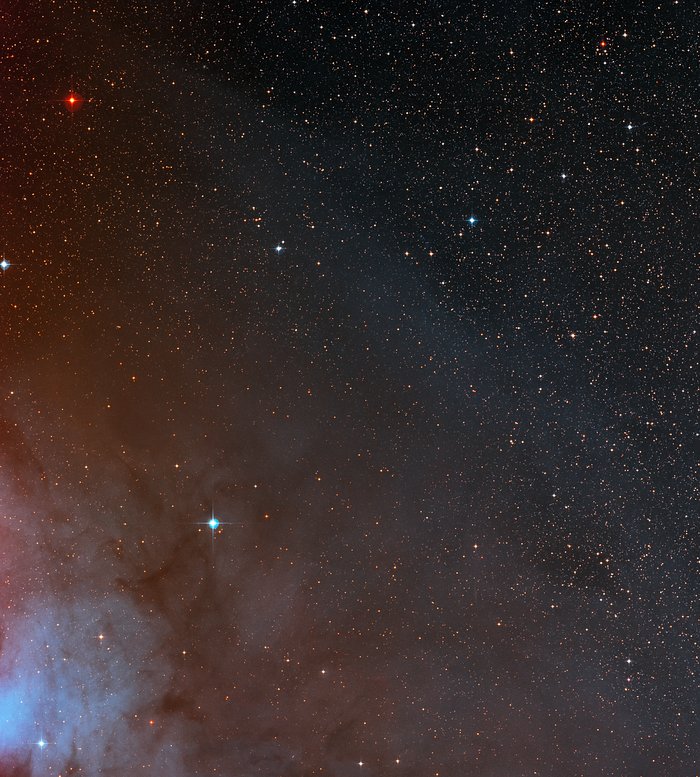
This wide-field image from the Digitized Sky Survey 2 shows the rich starfields surrounding the exotic binary star system AR Scorpii.
Lead researcher Tom Marsh of the University of Warwick’s Astrophysics Group commented:
“AR Scorpii was discovered over 40 years ago, but its true nature was not suspected until we started observing it in 2015. We realised we were seeing something extraordinary within minutes of starting the observations.”
The observed properties of AR Sco are unique. They are also mysterious. The radiation across a broad range of frequencies is indicative of emission from electrons accelerated in magnetic fields, which can be explained by AR Sco’s spinning white dwarf. The source of the electrons themselves, however, is a major mystery — it is not clear whether it is associated with the white dwarf itself, or its cooler companion.
AR Scorpii was first observed in the early 1970s and regular fluctuations in brightness every 3.6 hours led it to be incorrectly classified as a lone variable star[4]. The true source of AR Scorpii’s varying luminosity was revealed thanks to the combined efforts of amateur and professional astronomers. Similar pulsing behaviour has been observed before, but from neutron stars — some of the densest celestial objects known in the Universe — rather than white dwarfs.
Boris Gänsicke, co-author of the new study, also at the University of Warwick, concludes:
“We’ve known pulsing neutron stars for nearly fifty years, and some theories predicted white dwarfs could show similar behaviour. It’s very exciting that we have discovered such a system, and it has been a fantastic example of amateur astronomers and academics working together.“
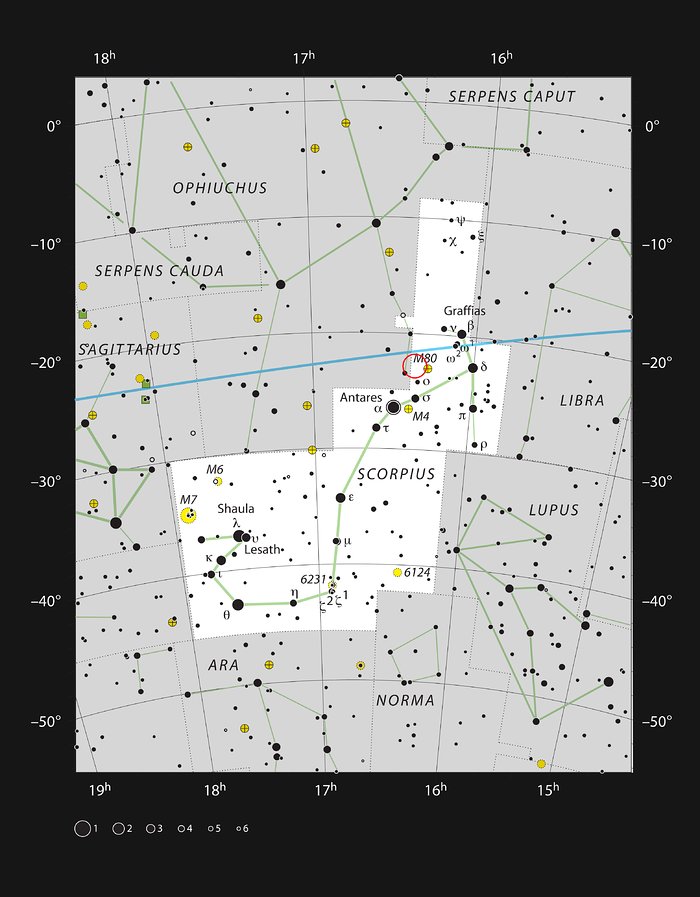
This chart shows the location of the exotic binary star AR Scorpii in the bright constellation of Scorpius (The Scorpion). The stars visible with the naked eye on a dark clear night are shown and the location of AR Scorpii marked with a red circle.
[2] White dwarfs form late in the life cycles of stars with masses up to about eight times that of our Sun. After hydrogen fusion in a star’s core is exhausted, the internal changes are reflected in a dramatic expansion into a red giant, followed by a contraction accompanied by the star’s outer layers being blown off in great clouds of dust and gas. Left behind is a white dwarf, Earth-sized but 200 000 times more dense. A single spoonful of the matter making up a white dwarf would weigh about as much as an elephant here on Earth.
[3] This red dwarf is an M type star. M type stars are the most common class in the Harvard classification system, which uses single letters to group stars according their spectral characteristics. The famously awkward to remember sequence of classes runs: OBAFGKM, and is often remembered using the mnemonic Oh Be A Fine Girl/Guy, Kiss Me.
[4] A variable star is one whose brightness fluctuates as seen from Earth. The fluctuations may be due to the intrinsic properties of the star itself changing. For instance some stars noticeably expand and contract. It could also be due to another object regularly eclipsing the star. AR Scorpii was mistaken for a single variable star as the orbiting of two stars also results in regular fluctuations in observed brightness.
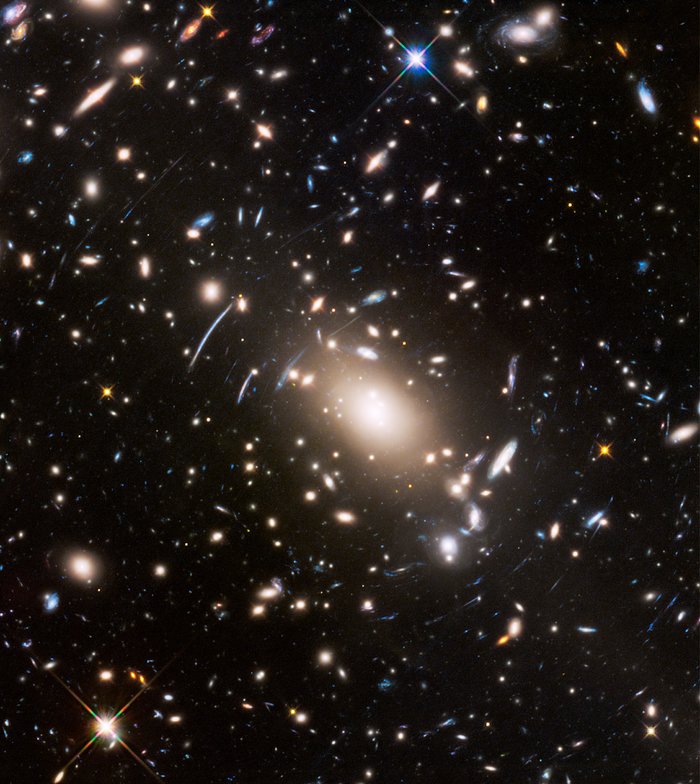
Abell S1063, a galaxy cluster, was observed by the NASA/ESA Hubble Space Telescope as part of the Frontier Fields programme. The huge mass of the cluster acts as a cosmic magnifying glass and enlarges even more distant galaxies, so they become bright enough for Hubble to see.
Fifty years ago Captain Kirk and the crew of the starship Enterprise began their journey into space — the final frontier. Now, as the newest Star Trek film hits cinemas, the NASA/ESA Hubble space telescope is also exploring new frontiers, observing distant galaxies in the galaxy cluster Abell S1063 as part of the Frontier Fields programme.
Space… the final frontier. These are the stories of the Hubble Space Telescope. Its continuing mission, to explore strange new worlds and to boldly look where no telescope has looked before.
The newest target of Hubble’s mission is the distant galaxy cluster Abell S1063, potentially home to billions of strange new worlds.
This video begins with a view of the night sky from the ground, before zooming in on the distant galaxy cluster Abell S1063 as the NASA/ESA Hubble Space Telescope sees it. The cluster was observed as part of the Frontier Fields programme. Credit: Fuji/DSS/Hubble. Music: Johan B. Monell (www.johanmonell.com)
This view of the cluster, which can be seen in the centre of the image, shows it as it was four billion years ago. But Abell S1063 allows us to explore a time even earlier than this, where no telescope has really looked before. The huge mass of the cluster distorts and magnifies the light from galaxies that lie behind it due to an effect called gravitational lensing. This allows Hubble to see galaxies that would otherwise be too faint to observe and makes it possible to search for, and study, the very first generation of galaxies in the Universe. “Fascinating”, as a famous Vulcan might say.
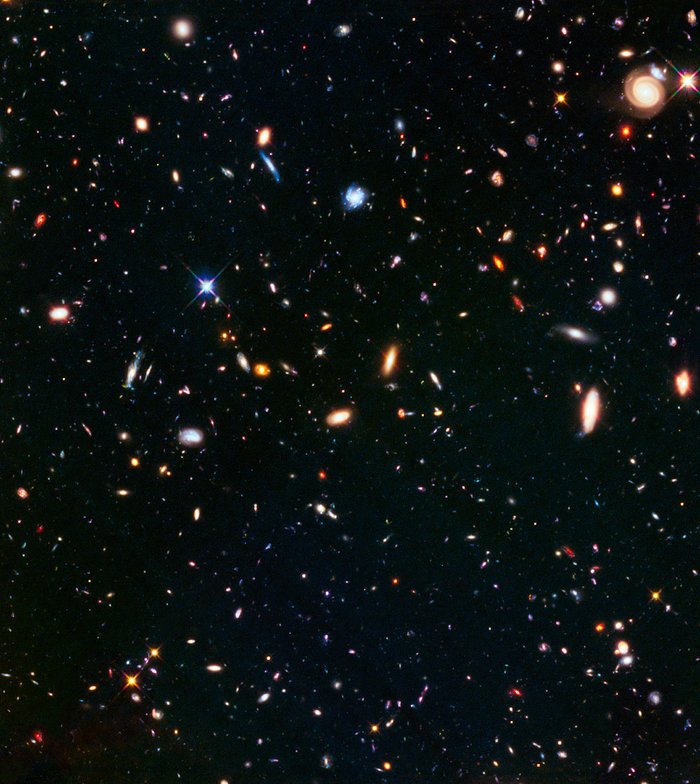
This part of the sky was observed in parallel with the galaxy cluster Abell S1063 and is also part of the Frontier Fields programme. While one of Hubble’s cameras observed the galaxy cluster itself, another simultaneously captured the spectacular scene pictured above, of an “unremarkable” patch of space. While not having the advantage of strong gravitational lensing this parallel field observation is still nearly as deep as the Hubble Ultra-Deep Field. Combined with other deep fields it helps astronomers understand how similar the Universe looks in different directions.
The first results from the data on Abell S1063 promise some remarkable new discoveries. Already, a galaxy has been found that is observed as it was just a billion years after the Big Bang.
Astronomers have also identified sixteen background galaxies whose light has been distorted by the cluster, causing multiple images of them to appear on the sky. This will help astronomers to improve their models of the distribution of both ordinary and dark matter in the galaxy cluster, as it is the gravity from these that causes the distorting effects. These models are key to understanding the mysterious nature of dark matter.
This video pans over NASA/ESA Hubble Space Telescope observations of the galaxy cluster Abell S1063, which were made as part of the Frontier Fields programme. The many galaxies within the cluster become clearly visible, as well as the background galaxies, enlarged by gravitational lensing. Credit: ESA/Hubble. Music: Johan B. Monell (www.johanmonell.com)
Abell S1063 is not alone in its ability to bend light from background galaxies, nor is it the only one of these huge cosmic lenses to be studied using Hubble. Three other clusters have already been observed as part of the Frontier Fields programme, and two more will be observed over the next few years, giving astronomers a remarkable picture of how they work and what lies both within and beyond them [1].
Data gathered from the previous galaxy clusters were studied by teams all over the world, enabling them to make important discoveries, among them galaxies that existed only hundreds of million years after the Big Bang (heic1523) and the first predicted appearance of a gravitationally lensed supernova (heic1525).
Such an extensive international collaboration would have made Gene Roddenberry, the father of Star Trek, proud. In the fictional world Roddenberry created, a diverse crew work together to peacefully explore the Universe. This dream is partially achieved by the Hubble programme in which the European Space Agency (ESA), supported by 22 member states, and NASA collaborate to operate one of the most sophisticated scientific instruments in the world. Not to mention the scores of other international science teams that cross state, country and continental borders to achieve their scientific aims.
Notes
[1] The Hubble Frontier Fields is a three-year, 840-orbit programme which will yield the deepest views of the Universe to date, combining the power of Hubble with the gravitational amplification of light around six different galaxy clusters to explore more distant regions of space than could otherwise be seen.
An international team of astronomers has discovered and confirmed a treasure trove of new worlds using NASA’s Kepler spacecraft on its K2 mission. Among the findings tallying 197 initial planet candidates, scientists have confirmed 104 planets outside our solar system. Among the confirmed is a planetary system comprising four promising planets that could be rocky.
Artist concept. A crop of more than 100 planets, discovered by NASA’s Kepler Space Telescope, includes four in Earth’s size-range orbiting a single dwarf star. Two of these planets are too hot to support life as we know it, but two are in the star’s “habitable” zone, where liquid water could exist on the surface. These small, rocky worlds are far closer to their star than Mercury is to our sun. But because the star is smaller and cooler than ours, its habitable zone is much closer. One of the two planets in the habitable zone, K2-72c, has a “year” about 15 Earth-days long—the time it takes to complete one orbit. This closer planet is likely about 10% warmer than Earth. On the second, K2-72e, a year lasts 24 Earth days, this slightly more distant planet would be about 6% colder than Earth. Credits: NASA/JPLThe planets, all between 20 and 50 percent larger than Earth by diameter, are orbiting the M dwarf star K2-72, found 181 light years away in the direction of the Aquarius constellation. The host star is less than half the size of the sun and less bright. The planets’ orbital periods range from five and a half to 24 days, and two of them may experience irradiation levels from their star comparable to those on Earth. Despite their tight orbits — closer than Mercury’s orbit around the sun — the possibility that life could arise on a planet around such a star cannot be ruled out, according to lead author Crossfield, a Sagan Fellow at the University of Arizona’s Lunar and Planetary Laboratory.
The researchers achieved this extraordinary “roundup” of exoplanets by combining data with follow-up observations by earth-based telescopes including the North Gemini telescope and the W. M. Keck Observatory in Hawaii, the Automated Planet Finder of the University of California Observatories, and the Large Binocular Telescope operated by the University of Arizona. The discoveries are published online in the Astrophysical Journal Supplement Series.
Both Kepler and its K2 mission discover new planets by measuring the subtle dip in a star’s brightness caused by a planet passing in front of its star. In its initial mission, Kepler surveyed just one patch of sky in the northern hemisphere, determining the frequency of planets whose size and temperature might be similar to Earth orbiting stars similar to our sun. In the spacecraft’s extended mission in 2013, it lost its ability to precisely stare at its original target area, but a brilliant fix created a second life for the telescope that is proving scientifically fruitful.
After the fix, Kepler started its K2 mission, which has provided an ecliptic field of view with greater opportunities for Earth-based observatories in both the northern and southern hemispheres. Additionally, the K2 mission is entirely community-driven with all targets proposed by the scientific community.
Because it covers more of the sky, the K2 mission is capable of observing a larger fraction of cooler, smaller, red-dwarf type stars, and because such stars are much more common in the Milky Way than sun-like stars, nearby stars will predominantly be red dwarfs.
“An analogy would be to say that Kepler performed a demographic study, while the K2 mission focuses on the bright and nearby stars with different types of planets,” said Ian Crossfield. “The K2 mission allows us to increase the number of small, red stars by a factor of 20, significantly increasing the number of astronomical ‘movie stars’ that make the best systems for further study.”
To validate candidate planets identified by K2, the researchers obtained high-resolution images of the planet-hosting stars as well as high-resolution optical spectroscopy. By dispersing the starlight as through a prism, the spectrographs allowed the researchers to infer the physical properties of a star — such as mass, radius and temperature — from which the properties of any planets orbiting it can be inferred.
“This bountiful list of validated exoplanets from the K2 mission highlights the fact that the targeted examination of bright stars and nearby stars along the ecliptic is providing many interesting new planets,” said Steve Howell, project scientist for the K2 mission at NASA’s Ames Research Center in Moffett Field, California. “These targets allow the astronomical community ease of follow-up and characterization, providing a few gems for first study by the James Webb Space Telescope, which could perhaps tell us about the planets’ atmospheres.”
This work was performed in part under contract with the Jet Propulsion Laboratory (JPL) funded by NASA through the Sagan Fellowship Program executed by the NASA Exoplanet Science Institute.
NASA Ames manages the Kepler and K2 missions for NASA’s Science Mission Directorate. NASA’s Jet Propulsion Laboratory in Pasadena, California, managed Kepler mission development. Ball Aerospace & Technologies Corporation operates the flight system with support from the Laboratory for Atmospheric and Space Physics at the University of Colorado at Boulder.
For more information on the Kepler and the K2 mission, visit: www.nasa.gov/kepler
![CPLNI8yWUAAA2Q8[1]](http://hobbyspace.com/Blog/wp-content/uploads/2016/07/CPLNI8yWUAAA2Q81.jpg)

![k2_100planet_header[1]](http://hobbyspace.com/Blog/wp-content/uploads/2016/07/k2_100planet_header1.png)