Dr. Anglada will discuss the new paper he is first author in reporting the presence of a 1.3 Earth mass exoplanet in a temperate orbit around Proxima Centauri. This finding was reported in Nature on Thursday 25 Aug 2016. http://www.nature.com/nature/journal/… Dr. Anglada will particpate remotely, and Dr. Franck Marchis of the SETI Institute will host a local panel to discuss the implications of the finding. “Our little world will never seem the same again”.
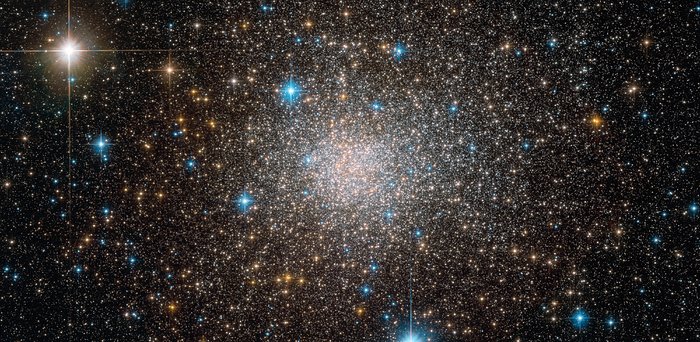
Peering through the thick dust clouds of the galactic bulge an international team of astronomers has revealed the unusual mix of stars in the stellar cluster known as Terzan 5. The new results indicate that Terzan 5 is in fact one of the bulge’s primordial building blocks, most likely the relic of the very early days of the Milky Way. Observations were made with the Wide Field Camera 3 (WFC3) on board the Hubble, the Multi-conjugate Adaptive Optics Demonstrator (MAD) instrument on ESO’s Very Large Telescope and the second generation Near Infrared Camera at the Keck Telescope.
A fossilised remnant of the early Milky Way harbouring stars of hugely different ages has been revealed by an international team of astronomers. This stellar system resembles a globular cluster, but is like no other cluster known. It contains stars remarkably similar to the most ancient stars in the Milky Way and bridges the gap in understanding between our galaxy’s past and its present.
Terzan 5, 19 000 light-years from Earth, has been classified as a globular cluster for the forty-odd years since its detection. Now, an Italian-led team of astronomers have discovered that Terzan 5 is like no other globular cluster known.
The team scoured data from the Advanced Camera for Surveys and the Wide Field Camera 3 on board Hubble, as well as from a suite of other ground-based telescopes [1]. They found compelling evidence that there are two distinct kinds of stars in Terzan 5 which not only differ in the elements they contain, but have an age-gap of roughly 7 billion years [2].
This sequence takes the viewer from a wide view of the Milky Way to the central regions, where many bright star forming regions and star clusters can be seen. The final view is a close-up of the sky around the star cluster Terzan 5 taken with Hubble, the Very Large Telescope at ESO’s Paranal Observatory and the Keck Telescope. Credit: Nick Risinger (skysurvey.org)/DSS/Hubble. Music: Johan B. Monell
The ages of the two populations indicate that the star formation process in Terzan 5 was not continuous, but was dominated by two distinct bursts of star formation.
“This requires the Terzan 5 ancestor to have large amounts of gas for a second generation of stars and to be quite massive. At least 100 million times the mass of the Sun,” explains Davide Massari, co-author of the study, from INAF, Italy, and the University of Gröningen, Netherlands.
Its unusual properties make Terzan 5 the ideal candidate for a living fossil from the early days of the Milky Way. Current theories on galaxy formation assume that vast clumps of gas and stars interacted to form the primordial bulge of the Milky Way, merging and dissolving in the process.
“We think that some remnants of these gaseous clumps could remain relatively undisrupted and keep existing embedded within the galaxy,” explains Francesco Ferraro from the University of Bologna, Italy, and lead author of the study. “Such galactic fossils allow astronomers to reconstruct an important piece of the history of our Milky Way.”
While the properties of Terzan 5 are uncommon for a globular cluster, they are very similar to the stellar population which can be found in the galactic bulge, the tightly packed central region of the Milky Way. These similarities could make Terzan 5 a fossilised relic of galaxy formation, representing one of the earliest building blocks of the Milky Way.
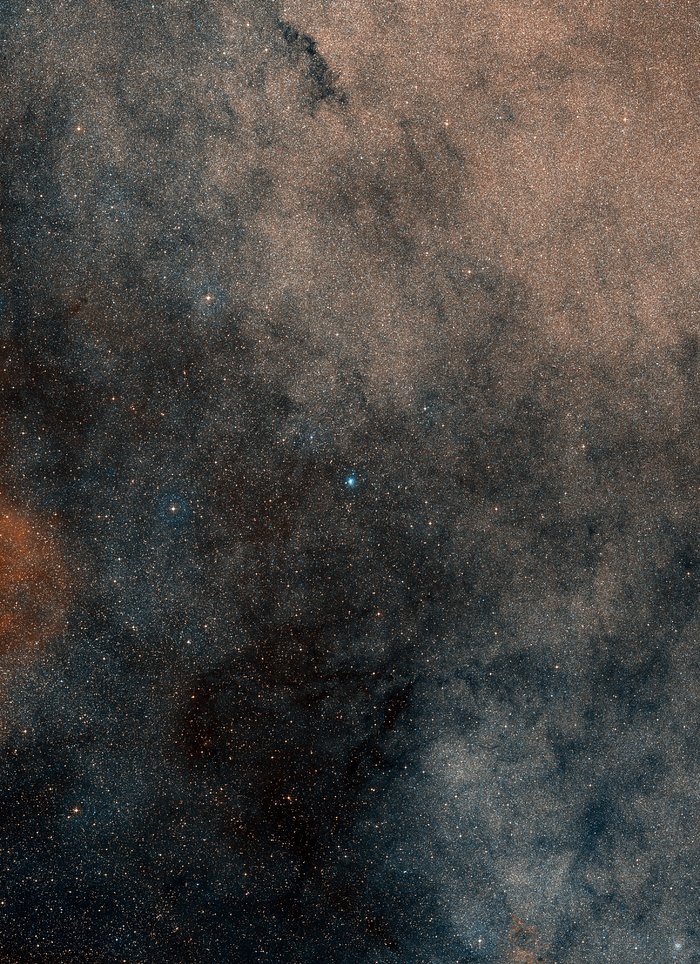
This wide-field image, based on data from Digitized Sky Survey 2, shows the whole region around the stellar grouping Terzan 5.
This assumption is strengthened by the original mass of Terzan 5 necessary to create two stellar populations: a mass similar to the huge clumps which are assumed to have formed the bulge during galaxy assembly around 12 billion years ago. Somehow Terzan 5 has managed to survive being disrupted for billions of years, and has been preserved as a remnant of the distant past of the Milky Way.
“Some characteristics of Terzan 5 resemble those detected in the giant clumps we see in star-forming galaxies at high-redshift, suggesting that similar assembling processes occurred in the local and in the distant Universe at the epoch of galaxy formation,“ continues Ferraro.
Hence, this discovery paves the way for a better and more complete understanding of galaxy assembly.
“Terzan 5 could represent an intriguing link between the local and the distant Universe, a surviving witness of the Galactic bulge assembly process,” explains Ferraro while commenting on the importance of the discovery.
The research presents a possible route for astronomers to unravel the mysteries of galaxy formation, and offers an unrivaled view into the complicated history of the Milky Way.
Notes
[1] The researchers also used data from the Multi-conjugate Adaptive Optics Demonstrator at ESO’s Very Large Telescope and the Near Infrared Camera 2 at the W. M. Keck Observatory.
[2] The two detected stellar populations have ages of 12 billion years and 4.5 billion years respectively.
MPL3D Solar System is a visual tool to arouse interest for astronomy and to divulge science in an entertaining way.
MPL3D Solar System maps out the majority of the close known universe. Stretching beyond our own Solar System, it reaches out to include another 120 extrasolar planets amongst over 10,000 mapped objects in this interactive simulation. Based on scientific data, every planet has been carefully reproduced as a visual representation, alongside the technical details. You can explore our own planets, exoplanets, nebulae, star clusters, several galaxies and even Sagittarius A*, the black hole that exists at the centre of our own galaxy.
“MPL3D Solar System (Touch) v1.5” includes now touch enabled capabilities and a customizable spaceship mode, allowing the user to fly all around the galaxy with Newtonian physics for the space flight.
This is the 5th version of the MPL3D saga, that keeps on with a continuous improvement of the original idea: An astronomy tool for the whole family.
Better textures for celestial bodies and improved graphic effects, including 7 combinations of HDR/Bloom, heat haze for stars and spaceship engines, and revised effects for nebulae, star clusters and galaxies.
Touch control adds a new feeling of intuitive, natural handling, bringing a new experience to the final user.
Spaceship mode enhances the entertainment side of the simulation, and even a fabulous 3d asteroids mini-game has been included. Spaceship control mode has all the common options in this type of simulations, which also include joystick and touch control, to allow a better control of the spaceship.
On the spaceship graphics side, seven configurable cameras, dozens of effects and up to eight light sources. The cockpit includes all kind of gauges for the three crew members, like gyroscope, g forces indicator, mission time, and even a 3d radar of the solar system.
Here is the NASA JPL update on night sky highlights for the month ahead:
What’s up in the sky this month? An eclipse in Africa, two minor meteor showers, and planet and moon pair-ups. Plus: Get information now to help plan for the August 2017 total solar eclipse, which will span the United States from Oregon to South Carolina.
This ESO (European Southern Observatory) report has had probably the most violated embargo of any ESO news. Great to see the full report finally made available to everyone:
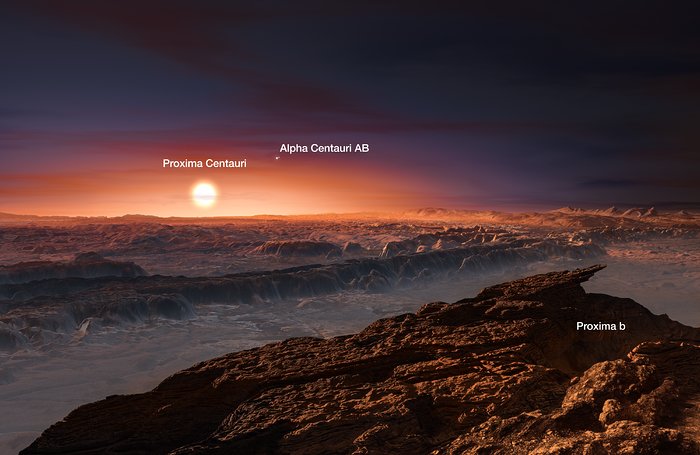
This artist’s impression shows a view of the surface of the planet Proxima b orbiting the red dwarf star Proxima Centauri, the closest star to the Solar System. The double star Alpha Centauri AB also appears in the image. Proxima b is a little more massive than the Earth and orbits in the habitable zone around Proxima Centauri, where the temperature is suitable for liquid water to exist on its surface.
Astronomers using ESO telescopes and other facilities have found clear evidence of a planet orbiting the closest star to Earth, Proxima Centauri. The long-sought world, designated Proxima b, orbits its cool red parent star every 11 days and has a temperature suitable for liquid water to exist on its surface. This rocky world is a little more massive than the Earth and is the closest exoplanet to us — and it may also be the closest possible abode for life outside the Solar System. A paper describing this milestone finding will be published in the journal Nature on 25 August 2016.
Just over four light-years from the Solar System lies a red dwarf star that has been named Proxima Centauri as it is the closest star to Earth apart from the Sun. This cool star in the constellation of Centaurus is too faint to be seen with the unaided eye and lies near to the much brighter pair of stars known as Alpha Centauri AB.
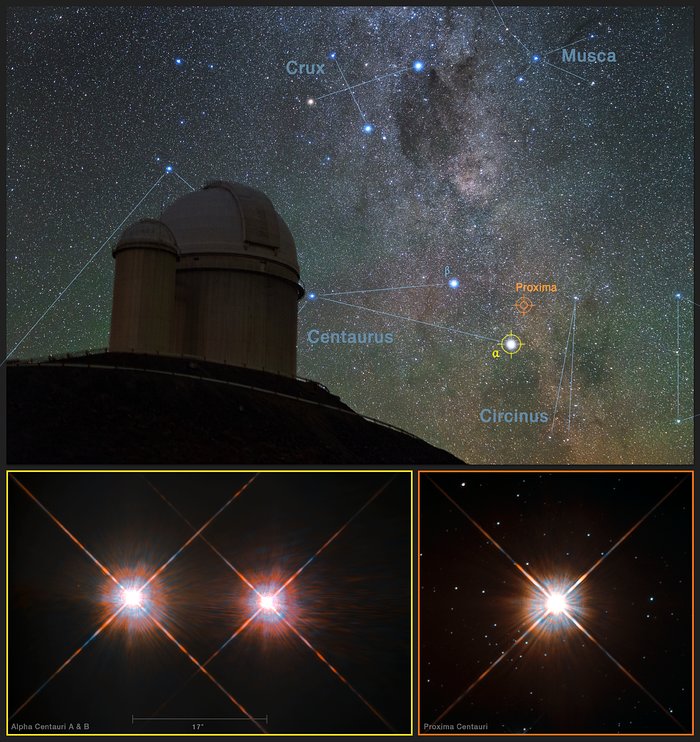
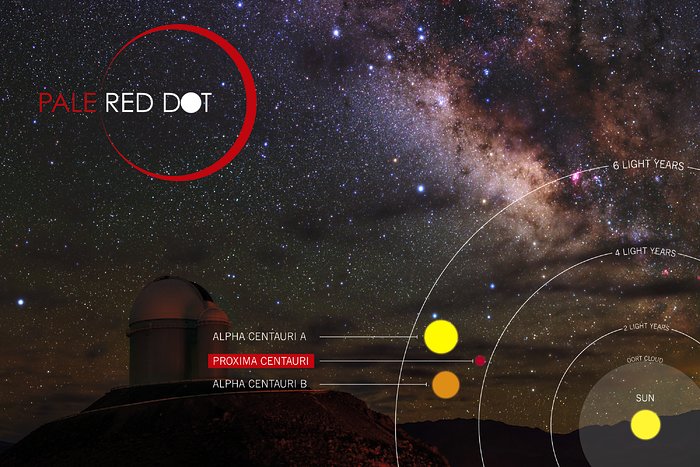
This picture combines a view of the southern skies over the ESO 3.6-metre telescope at the La Silla Observatory in Chile with images of the stars Proxima Centauri (lower-right) and the double star Alpha Centauri AB (lower-left) from the NASA/ESA Hubble Space Telescope. Proxima Centauri is the closest star to the Solar System and is orbited by the planet Proxima b, which was discovered using the HARPS instrument on the ESO 3.6-metre telescope.
During the first half of 2016 Proxima Centauri was regularly observed with the HARPS spectrograph on the ESO 3.6-metre telescope at La Silla in Chile and simultaneously monitored by other telescopes around the world [1]. This was the Pale Red Dot campaign, in which a team of astronomers led by Guillem Anglada-Escudé, from Queen Mary University of London, was looking for the tiny back and forth wobble of the star that would be caused by the gravitational pull of a possible orbiting planet [2].
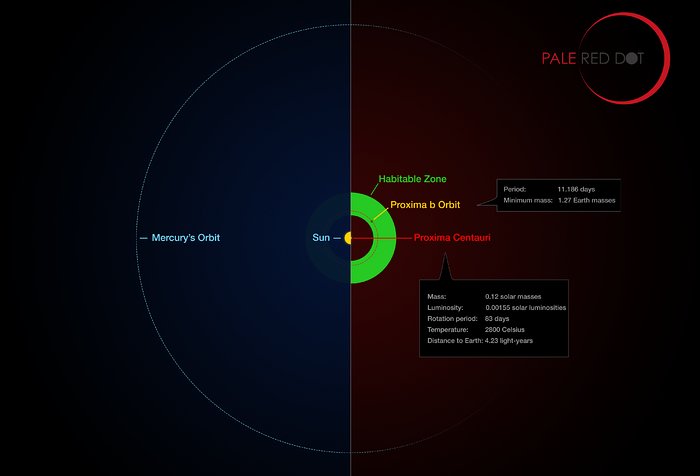
This infographic compares the orbit of the planet around Proxima Centauri (Proxima b) with the same region of the Solar System. Proxima Centauri is smaller and cooler than the Sun and the planet orbits much closer to its star than Mercury. As a result it lies well within the habitable zone, where liquid water can exist on the planet’s surface.
As this was a topic with very wide public interest, the progress of the campaign between mid-January and April 2016 was shared publicly as it happened on the Pale Red Dot website and via social media. The reports were accompanied by numerous outreach articles written by specialists around the world.
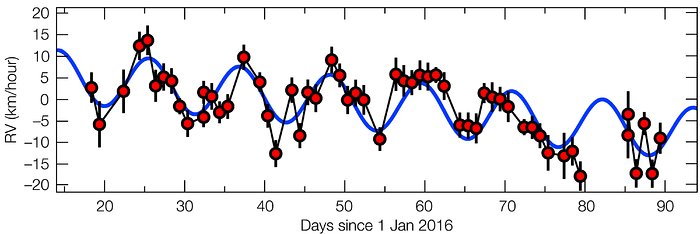
This plot shows how the motion of Proxima Centauri towards and away from Earth is changing with time over the first half of 2016. Sometimes Proxima Centauri is approaching Earth at about 5 kilometres per hour — normal human walking pace — and at times receding at the same speed. This regular pattern of changing radial velocities repeats with a period of 11.2 days. Careful analysis of the resulting tiny Doppler shifts showed that they indicated the presence of a planet with a mass at least 1.3 times that of the Earth, orbiting about 7 million kilometres from Proxima Centauri — only 5% of the Earth-Sun distance.
Guillem Anglada-Escudé explains the background to this unique search:
“The first hints of a possible planet were spotted back in 2013, but the detection was not convincing. Since then we have worked hard to get further observations off the ground with help from ESO and others. The recent Pale Red Dot campaign has been about two years in the planning.”
The Pale Red Dot data, when combined with earlier observations made at ESO observatories and elsewhere, revealed the clear signal of a truly exciting result. At times Proxima Centauri is approaching Earth at about 5 kilometres per hour — normal human walking pace — and at times receding at the same speed. This regular pattern of changing radial velocities repeats with a period of 11.2 days. Careful analysis of the resulting tiny Doppler shifts showed that they indicated the presence of a planet with a mass at least 1.3 times that of the Earth, orbiting about 7 million kilometres from Proxima Centauri — only 5% of the Earth-Sun distance [3].
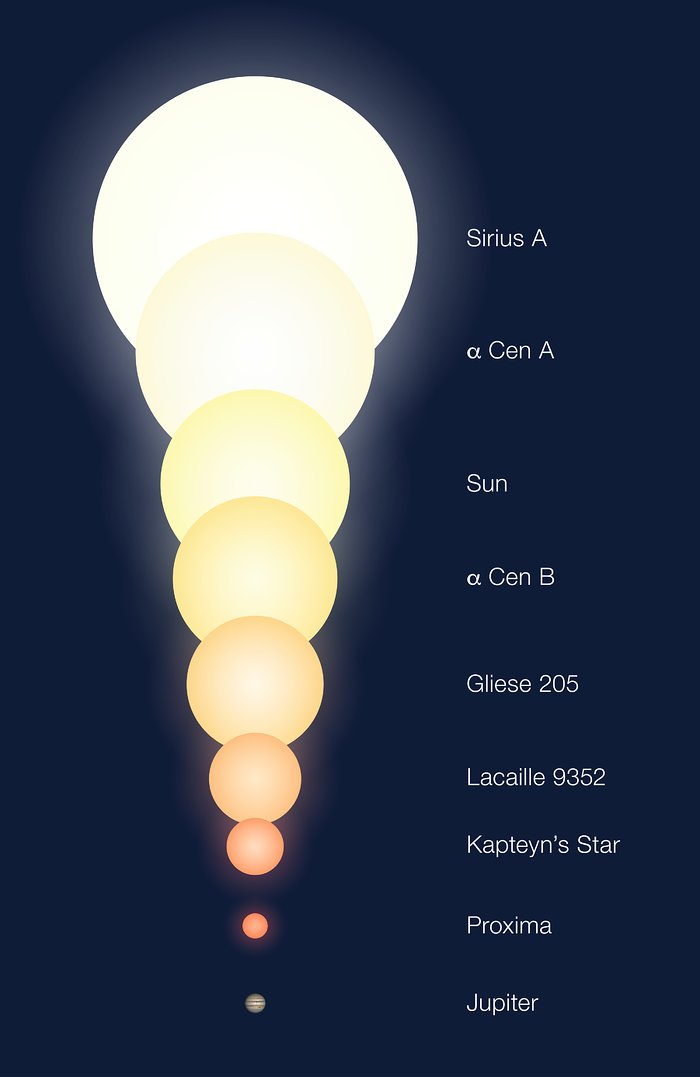
The relative sizes of a number of objects, including the three (known) members of Alpha Centauri triple system and some other stars for which the angular sizes have also been measured with the Very Large Telescope Interferometer (VLTI) at the ESO Paranal Observatory. The Sun and planet Jupiter are also shown for comparison.
Guillem Anglada-Escudé comments on the excitement of the last few months:
“I kept checking the consistency of the signal every single day during the 60 nights of the Pale Red Dot campaign. The first 10 were promising, the first 20 were consistent with expectations, and at 30 days the result was pretty much definitive, so we started drafting the paper!”
Red dwarfs like Proxima Centauri are active stars and can vary in ways that would mimic the presence of a planet. To exclude this possibility the team also monitored the changing brightness of the star very carefully during the campaign using the ASH2 telescope at the San Pedro de Atacama Celestial Explorations Observatory in Chile and the Las Cumbres Observatory telescope network. Radial velocity data taken when the star was flaring were excluded from the final analysis.
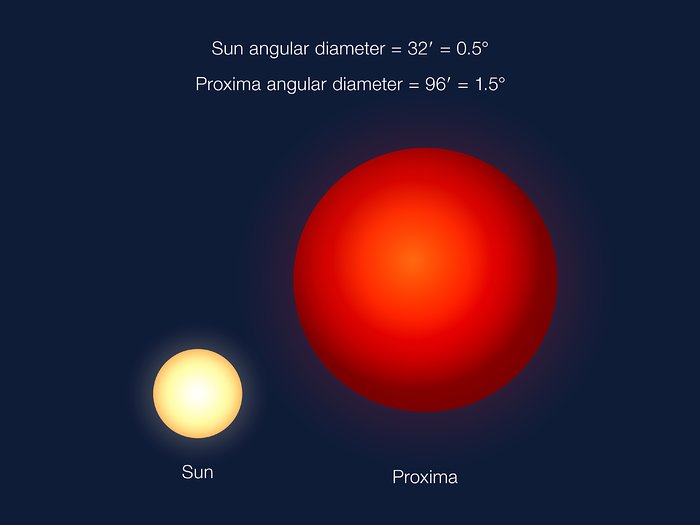
An angular size comparison of how Proxima will appear in the sky seen from Proxima b, compared to how the Sun appears in our sky on Earth. Proxima is much smaller than the Sun, but Proxima b lies very close to its star.
Although Proxima b orbits much closer to its star than Mercury does to the Sun in the Solar System, the star itself is far fainter than the Sun. As a result Proxima b lies well within the habitable zone around the star and has an estimated surface temperature that would allow the presence of liquid water. Despite the temperate orbit of Proxima b, the conditions on the surface may be strongly affected by the ultraviolet and X-ray flares from the star — far more intense than the Earth experiences from the Sun [4].
Pale Red Dot was an international search for an Earth-like exoplanet around the closest star to us, Proxima Centauri. It used HARPS, attached to ESO’s 3.6-metre telescope at La Silla Observatory, as well as other telescopes around the world. It was one of the few outreach campaigns allowing the general public to witness the scientific process of data acquisition in modern observatories. The public could see how teams of astronomers with different specialities work together to collect, analyse and interpret data, which ultimately confirmed the presence of an Earth-like planet orbiting our nearest neighbour. The outreach campaign consisted of blog posts and social media updates on the Pale Red Dot Twitter account and using the hashtag #PaleRedDot. For more information visit the Pale Red Dot website: http://www.palereddot.org
Two separate papers discuss the habitability of Proxima b and its climate. They find that the existence of liquid water on the planet today cannot be ruled out and, in such case, it may be present over the surface of the planet only in the sunniest regions, either in an area in the hemisphere of the planet facing the star (synchronous rotation) or in a tropical belt (3:2 resonance rotation). Proxima b’s rotation, the strong radiation from its star and the formation history of the planet makes its climate quite different from that of the Earth, and it is unlikely that Proxima b has seasons.
This video takes the viewer from Earth to the closest star, Proxima Centauri. Here we can see the planet Proxima b, which orbits its red dwarf star every 11.2 days. This planet orbits within the habitable zone, shown in green, which means that liquid water could exist on its surface. Credit: PHL @ UPR Arecibo, ESO. Music by Lyford Rome
This discovery will be the beginning of extensive further observations, both with current instruments [5] and with the next generation of giant telescopes such as the European Extremely Large Telescope (E-ELT). Proxima b will be a prime target for the hunt for evidence of life elsewhere in the Universe. Indeed, the Alpha Centauri system is also the target of humankind’s first attempt to travel to another star system, the StarShot project.
A numerical simulation of possible surface temperatures on Proxima b performed with the Laboratoire de Météorologie Dynamique’s Planetary Global Climate Model. Here it is hypothesised that the planet possesses an Earth-like atmosphere and that it is covered by an ocean (the dashed line is the frontier between the liquid and icy oceanic surface). Two models exist for the planet’s rotation. Here the planet is in synchronous rotation (like the Moon around the Earth), and is seen as a distant observer would do during one full orbit. Another model is that it is trapped in a so-called 3:2 resonance (a natural frequency for the orbit).
Two additional papers about Proxima b’s possibility for habitability are described at proximacentauri.info. Credit: M. Turbet/I. Ribas/ESO
Guillem Anglada-Escudé concludes:
“Many exoplanets have been found and many more will be found, but searching for the closest potential Earth-analogue and succeeding has been the experience of a lifetime for all of us. Many people’s stories and efforts have converged on this discovery. The result is also a tribute to all of them. The search for life on Proxima b comes next…”
Notes
[1] Besides data from the recent Pale Red Dot campaign, the paper incorporates contributions from scientists who have been observing Proxima Centauri for many years. These include members of the original UVES/ESO M-dwarf programme (Martin Kürster and Michael Endl), and exoplanet search pioneers such as R. Paul Butler. Public observations from the HARPS/Geneva team obtained over many years were also included.
[2] The name Pale Red Dot reflects Carl Sagan’s famous reference to the Earth as a pale blue dot. As Proxima Centauri is a red dwarf star it will bathe its orbiting planet in a pale red glow.
[3] The detection reported today has been technically possible for the last 10 years. In fact, signals with smaller amplitudes have been detected previously. However, stars are not smooth balls of gas and Proxima Centauri is an active star. The robust detection of Proxima b has only been possible after reaching a detailed understanding of how the star changes on timescales from minutes to a decade, and monitoring its brightness with photometric telescopes.
[4] The actual suitability of this kind of planet to support water and Earth-like life is a matter of intense but mostly theoretical debate. Major concerns that count against the presence of life are related to the closeness of the star. For example gravitational forces probably lock the same side of the planet in perpetual daylight, while the other side is in perpetual night. The planet’s atmosphere might also slowly be evaporating or have more complex chemistry than Earth’s due to stronger ultraviolet and X-ray radiation, especially during the first billion years of the star’s life. However, none of the arguments has been proven conclusively and they are unlikely to be settled without direct observational evidence and characterisation of the planet’s atmosphere. Similar factors apply to the planets recently found around TRAPPIST-1.
[5] Some methods to study a planet’s atmosphere depend on it passing in front of its star and the starlight passing through the atmosphere on its way to Earth. Currently there is no evidence that Proxima b transits across the disc of its parent star, and the chances of this happening seem small, but further observations to check this possibility are in progress.