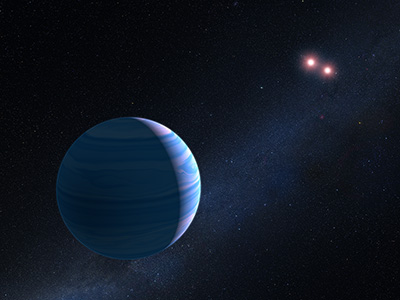
The new finding from a group using the Hubble Space Telescope. (Someone living on a moon orbiting this gas giant would have quite a skyscape to enjoy.)
Two’s company, but three might not always be a crowd — at least in space.
This artist’s illustration shows a gas giant planet circling a pair of red dwarf stars. [Larger images]Astronomers using NASA’s Hubble Space Telescope, and a trick of nature, have confirmed the existence of a planet orbiting two stars in the system OGLE-2007-BLG-349, located 8,000 light-years away towards the center of our galaxy.
The planet orbits roughly 300 million miles from the stellar duo, about the distance from the asteroid belt to our sun. It completes an orbit around both stars roughly every seven years. The two red dwarf stars are a mere 7 million miles apart, or 14 times the diameter of the moon’s orbit around Earth.
The Hubble observations represent the first time such a three-body system has been confirmed using the gravitational microlensing technique. Gravitational microlensing occurs when the gravity of a foreground star bends and amplifies the light of a background star that momentarily aligns with it. The particular character of the light magnification can reveal clues to the nature of the foreground star and any associated planets.
The three objects were discovered in 2007 by an international collaboration of five different groups: Microlensing Observations in Astrophysics (MOA), the Optical Gravitational Lensing Experiment (OGLE), the Microlensing Follow-up Network (MicroFUN), the Probing Lensing Anomalies Network (PLANET), and the Robonet Collaboration. These ground-based observations uncovered a star and a planet, but a detailed analysis also revealed a third body that astronomers could not definitively identify.
“The ground-based observations suggested two possible scenarios for the three-body system: a Saturn-mass planet orbiting a close binary star pair or a Saturn-mass and an Earth-mass planet orbiting a single star,” explained David Bennett of the NASA Goddard Space Flight Center in Greenbelt, Maryland, the paper’s first author.
The sharpness of the Hubble images allowed the research team to separate the background source star and the lensing star from their neighbors in the very crowded star field. The Hubble observations revealed that the starlight from the foreground lens system was too faint to be a single star, but it had the brightness expected for two closely orbiting red dwarf stars, which are fainter and less massive than our sun.
“So, the model with two stars and one planet is the only one consistent with the Hubble data,” Bennett said.
Bennett’s team conducted the follow-up observations with Hubble’s Wide Field Planetary Camera 2.
“We were helped in the analysis by the almost perfect alignment of the foreground binary stars with the background star, which greatly magnified the light and allowed us to see the signal of the two stars,” Bennett explained.
Kepler has discovered 10 other planets orbiting tight binary stars, but these are all much closer to their stars than the one studied by Hubble.
Now that the team has shown that microlensing can successfully detect planets orbiting double-star systems, Hubble could provide an essential role in this new realm in the continued search for exoplanets.
The team’s results have been accepted for publication in The Astronomical Journal.
International teams of astronomers have used the Atacama Large Millimeter/submillimeter Array (ALMA) to explore the distant corner of the Universe first revealed in the iconic images of the Hubble Ultra Deep Field (HUDF). These new ALMA observations are significantly deeper and sharper than previous surveys at millimetre wavelengths. They clearly show how the rate of star formation in young galaxies is closely related to their total mass in stars. They also trace the previously unknown abundance of star-forming gas at different points in time, providing new insights into the “Golden Age” of galaxy formation approximately 10 billion years ago.
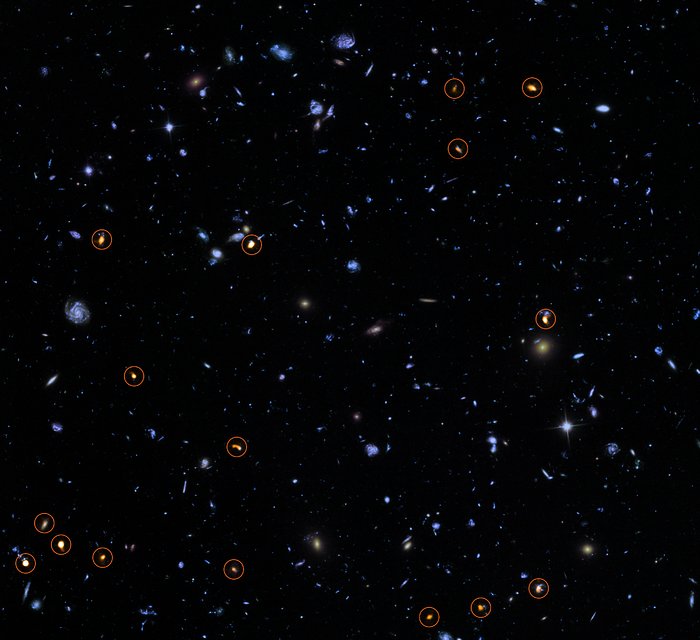
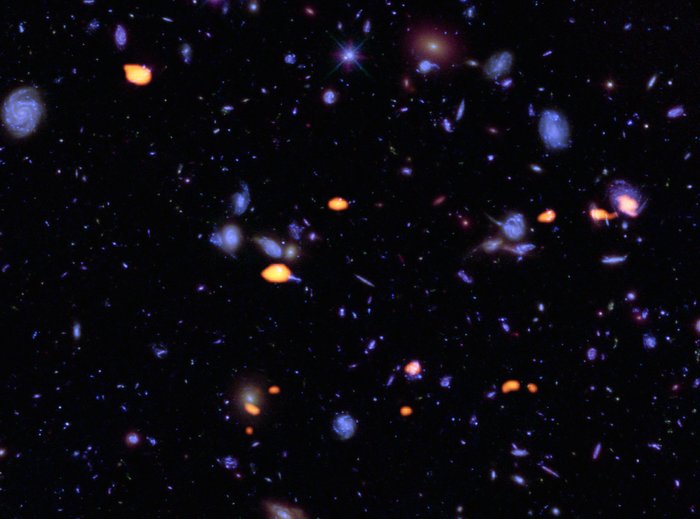
This image combines a background picture taken by the NASA/ESA Hubble Space Telescope (blue/green) with a new very deep ALMA view of this field (orange, marked with circles). All the objects that ALMA sees appear to be massive star-forming galaxies. This image is based on the ALMA survey by J. Dunlop and colleagues, covering the full HUDF area. [Larger images]The new ALMA results will be published in a series of papers appearing in the Astrophysical Journal and Monthly Notices of the Royal Astronomical Society. These results are also among those being presented this week at the Half a Decade of ALMA conference in Palm Springs, California, USA.
In 2004 the Hubble Ultra Deep Field images — pioneering deep-field observations with the NASA/ESA Hubble Space Telescope — were published. These spectacular pictures probed more deeply than ever before and revealed a menagerie of galaxies stretching back to less than a billion years after the Big Bang. The area was observed several times by Hubble and many other telescopes, resulting in the deepest view of the Universe to date.
This video sequence combines a background picture taken by the NASA/ESA Hubble Space Telescope (blue/green) with a new very deep ALMA view of this field (orange, marked with circles). All the objects that ALMA sees appear to be massive star-forming galaxies. This image is based on the ALMA survey by J. Dunlop and colleagues, covering the full HUDF area. Credit: NASA/ESA/ESO/J. Dunlop
Astronomers using ALMA have now surveyed this seemingly unremarkable, but heavily studied, window into the distant Universe for the first time both deeply and sharply in the millimetre range of wavelengths [1]. This allows them to see the faint glow from gas clouds and also the emission from warm dust in galaxies in the early Universe.
ALMA has observed the HUDF for a total of around 50 hours up to now. This is the largest amount of ALMA observing time spent on one area of the sky so far.
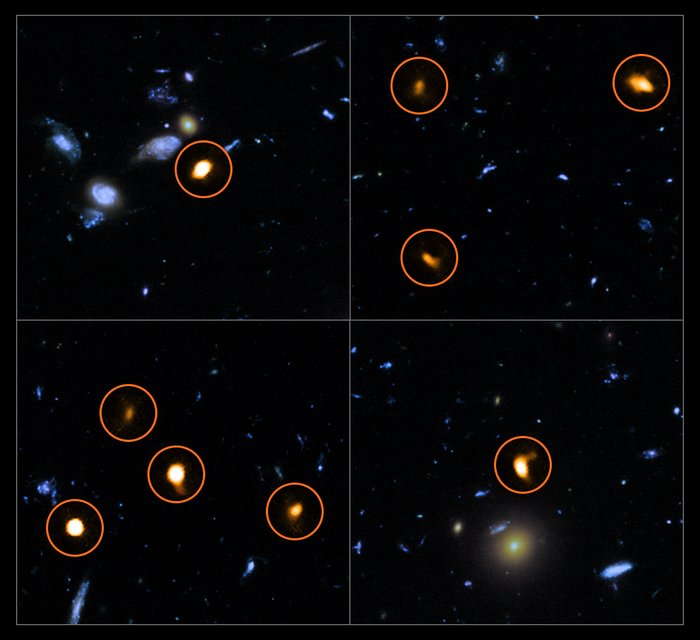
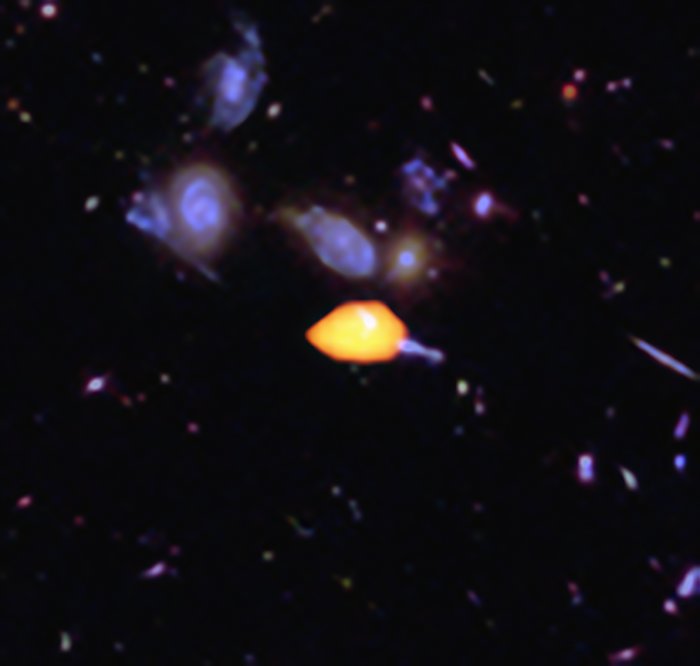
These cutout images are from a combination of a background picture taken by the NASA/ESA Hubble Space Telescope (blue/green) with a new very deep ALMA view of the field (orange, marked with circles). All the objects that ALMA sees appear to be massive star-forming galaxies. This image is based on the ALMA survey by J. Dunlop and colleagues, covering the full HUDF area. [Larger images.]One team led by Jim Dunlop (University of Edinburgh, United Kingdom) used ALMA to obtain the first deep, homogeneous ALMA image of a region as large as the HUDF. This data allowed them to clearly match up the galaxies that they detected with objects already seen with Hubble and other facilities.
This study showed clearly for the first time that the stellar mass of a galaxy is the best predictor of star formation rate in the high redshift Universe. They detected essentially all of the high-mass galaxies [2] and virtually nothing else.
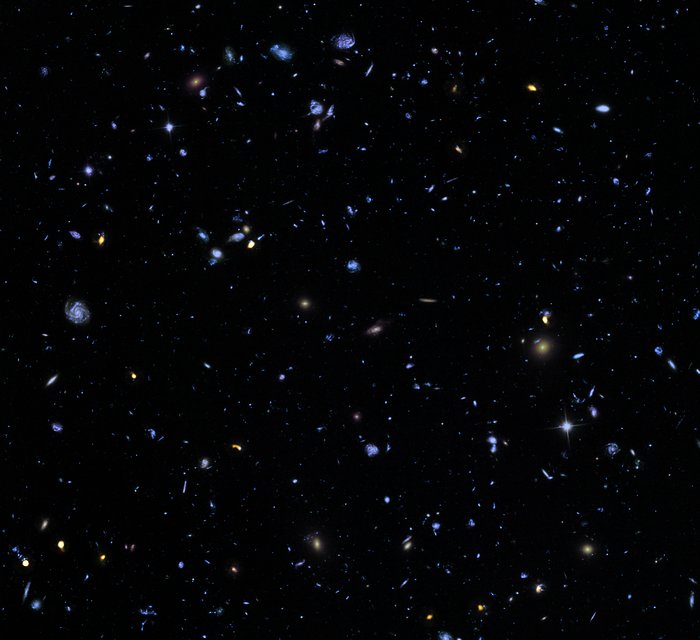
This image, called the Hubble eXtreme Deep Field (XDF), combines Hubble observations taken over the past decade of a small patch of sky in the constellation of Fornax. With a total of over two million seconds of exposure time, it is the deepest image of the Universe ever made, combining data from previous images including the Hubble Ultra Deep Field (taken in 2003 and 2004) and Hubble Ultra Deep Field Infrared (2009). The image covers a region less than a tenth of the width of the full Moon across, making it just a 30 millionth of the whole sky. Yet even in this tiny fraction of the sky, the long exposure reveals about 5500 galaxies, some of them so distant that we see them when the Universe was less than 5% of its current age. The Hubble eXtreme Deep Field image contains several of the most distant objects ever identified. [Larger images.]Jim Dunlop, lead author on the deep imaging paper sums up its importance:
“This is a breakthrough result. For the first time we are properly connecting the visible and ultraviolet light view of the distant Universe from Hubble and far-infrared/millimetre views of the Universe from ALMA.”
The second team, led by Manuel Aravena of the Núcleo de Astronomía, Universidad Diego Portales, Santiago, Chile, and Fabian Walter of the Max Planck Institute for Astronomy in Heidelberg, Germany, conducted a deeper search across about one sixth of the total HUDF [3].
ALMA surveyed the Hubble Ultra Deep Field, uncovering new details of the star-forming history of the Universe. This close-up image reveals one such galaxy (orange), rich in carbon monoxide, showing it is primed for star formation. The blue features are galaxies imaged by Hubble. This image is based on the very deep ALMA survey by Manuel Aravena, Fabian Walter and colleagues, covering about one sixth of the full HUDF area. [Larger images.]
“We conducted the first fully blind, three-dimensional search for cool gas in the early Universe,” said Chris Carilli, an astronomer with the National Radio Astronomy Observatory (NRAO) in Socorro, New Mexico, USA and member of the research team. “Through this, we discovered a population of galaxies that is not clearly evident in any other deep surveys of the sky.” [4]
Some of the new ALMA observations were specifically tailored to detect galaxies that are rich in carbon monoxide, indicating regions primed for star formation. Even though these molecular gas reservoirs give rise to the star formation activity in galaxies, they are often very hard to see with Hubble. ALMA can therefore reveal the “missing half” of the galaxy formation and evolution process.
A trove of galaxies, rich in carbon monoxide (indicating star-forming potential) were imaged by ALMA (orange) in the Hubble Ultra Deep Field. The blue features are galaxies imaged by Hubble.This image is based on the very deep ALMA survey by Manuel Aravena, Fabian Walter and colleagues, covering about one sixth of the full HUDF area. [Larger images]
“The new ALMA results imply a rapidly rising gas content in galaxies as we look back further in time,” adds lead author of two of the papers, Manuel Aravena (Núcleo de Astronomía, Universidad Diego Portales, Santiago, Chile). “This increasing gas content is likely the root cause for the remarkable increase in star formation rates during the peak epoch of galaxy formation, some 10 billion years ago.”
The results presented today are just the start of a series of future observations to probe the distant Universe with ALMA. For example, a planned 150-hour observing campaign of the HUDF will further illuminate the star-forming potential history of the Universe.
“By supplementing our understanding of this missing star-forming material, the forthcoming ALMA Large Program will complete our view of the galaxies in the iconic Hubble Ultra Deep Field,” concludes Fabian Walter.
Notes
[1] Astronomers specifically selected the area of study in the HUDF, a region of space in the faint southern constellation of Fornax (The Furnace), so ground-based telescopes in the southern hemisphere, like ALMA, could probe the region, expanding our knowledge about the very distant Universe.
Probing the deep, but optically invisible, Universe was one of the primary science goals for ALMA.
[2] In this context “high mass” means galaxies with stellar masses greater than 20 billion times that of the Sun ( 2 × 10¹⁰solar masses). For comparison, the Milky Way is a large galaxy and has a mass of around 100 billion solar masses.
[3] This region of sky is about seven hundred times smaller than the area of the disc of the full Moon as seen from Earth. One of the most startling aspects of the HUDF was the vast number of galaxies found in such a tiny fraction of the sky.
[4] ALMA’s ability to see a completely different portion of the electromagnetic spectrum from Hubble allows astronomers to study a different class of astronomical objects, such as massive star-forming clouds, as well as objects that are otherwise too faint to observe in visible light, but visible at millimetre wavelengths.
The search is referred to as “blind” as it was not focussed on any particular object.
The new ALMA observations of the HUDF include two distinct, yet complementary types of data: continuum observations, which reveal dust emission and star formation, and a spectral emission line survey, which looks at the cold molecular gas fueling star formation. The second survey is particularly valuable because it includes information about the degree to which light from distant objects has been redshifted by the expansion of the Universe. Greater redshift means that an object is further away and seen farther back in time. This allows astronomers to create a three-dimensional map of star-forming gas as it evolves over cosmic time.
An international team using ALMA, along with ESO’s Very Large Telescope and other telescopes, has discovered the true nature of a rare object in the distant Universe called a Lyman-alpha Blob. Up to now astronomers did not understand what made these huge clouds of gas shine so brightly, but ALMA has now seen two galaxies at the heart of one of these objects and they are undergoing a frenzy of star formation that is lighting up their surroundings. These large galaxies are in turn at the centre of a swarm of smaller ones in what appears to be an early phase in the formation of a massive cluster of galaxies. The two ALMA sources are expected to evolve into a single giant elliptical galaxy.
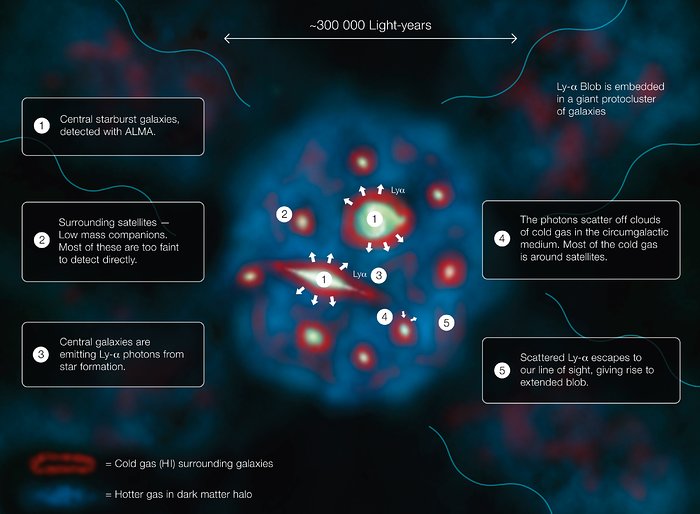
This rendering [see larger images] shows a snapshot from a cosmological simulation of a Lyman-alpha Blob similar to LAB-1. This simulation tracks the evolution of gas and dark matter using one of the latest models for galaxy formation running on the NASA Pleiades supercomputer. This view shows the distribution of gas within the dark matter halo, colour coded so that cold gas (mainly neutral hydrogen) appears red and hot gas appears white. Embedded at the centre of this system are two strongly star-forming galaxies, but these are surrounded by hot gas and many smaller satellite galaxies that appear as small red clumps of gas here. Lyman-alpha photons escape from the central galaxies and scatter off the cold gas associated with these satellites to give rise to an extended Lyman-alpha Blob.Lyman-alpha Blobs (LABs) are gigantic clouds of hydrogen gas that can span hundreds of thousands of light-years and are found at very large cosmic distances. The name reflects the characteristic wavelength of ultraviolet light that they emit, known as Lyman-alpha radiation[1]. Since their discovery, the processes that give rise to LABs have been an astronomical puzzle. But new observations with ALMA may now have now cleared up the mystery.
One of the largest Lyman-alpha Blobs known, and the most thoroughly studied, is SSA22-Lyman-alpha blob 1, or LAB-1. Embedded in the core of a huge cluster of galaxies in the early stages of formation, it was the very first such object to be discovered — in 2000 — and is located so far away that its light has taken about 11.5 billion years to reach us.
This diagram explains how a Lyman-alpha Blob, one of the largest and brightest objects in the Universe, shines. [Larger version.]A team of astronomers, led by Jim Geach, from the Centre for Astrophysics Research of the University of Hertfordshire, UK, has now used the Atacama Large Millimeter/Submillimeter Array’s (ALMA) unparallelled ability to observe light from cool dust clouds in distant galaxies to peer deeply into LAB-1. This allowed them to pinpoint and resolve several sources of submillimetre emission [2].
They then combined the ALMA images with observations from the Multi Unit Spectroscopic Explorer (MUSE) instrument mounted on ESO’s Very Large Telescope (VLT), which map the Lyman-alpha light. This showed that the ALMA sources are located in the very heart of the Lyman-alpha Blob, where they are forming stars at a rate over 100 times that of the Milky Way.
This video zoom sequence starts with a wide-field view of the dim constellation of Aquarius (The Water Carrier) and slowly closes in on one of the largest known single objects in the Universe, the Lyman-alpha blob LAB1. Observations with the ESO VLT show, for the first time, that the giant “blob” must be powered by galaxies embedded within the cloud. Credit: ESO/A. Fujii/Digitized Sky Survey 2/M. Hayes. Music: John Dyson (from the album Moonwind)
Deep imaging with the NASA/ESA Hubble Space Telescope and spectroscopy at the W. M. Keck Observatory[3] showed in addition that the ALMA sources are surrounded by numerous faint companion galaxies that could be bombarding the central ALMA sources with material, helping to drive their high star formation rates.
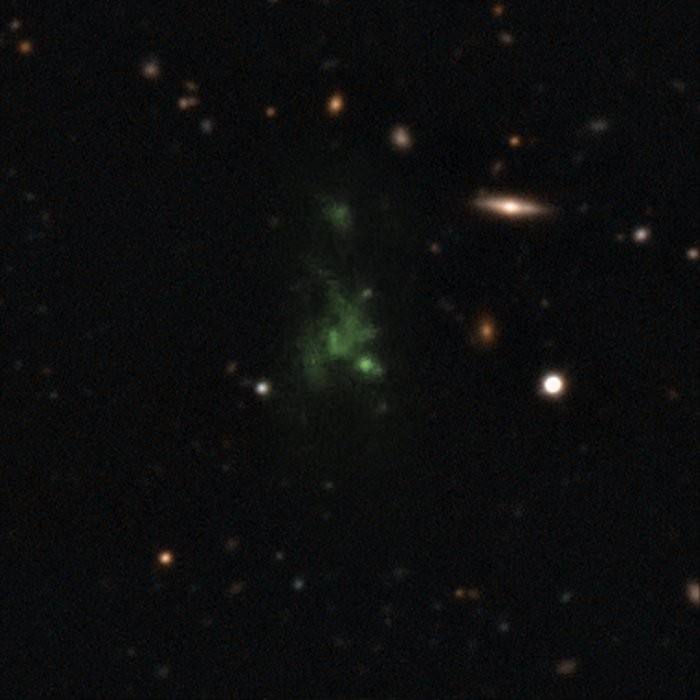
This image shows one of the largest known single objects in the Universe, the Lyman-alpha blob LAB-1. This picture is a composite of two different images taken with the FORS instrument on the Very Large Telescope (VLT) — a wider image showing the surrounding galaxies and a much deeper observation of the blob itself at the centre made to detect its polarisation. The intense Lyman-alpha ultraviolet radiation from the blob appears green after it has been stretched by the expansion of the Universe during its long journey to Earth. These new observations show for the first time that the light from this object is polarised. This means that the giant “blob” must be powered by galaxies embedded within the cloud. [Larger versions.]The team then turned to a sophisticated simulation of galaxy formation to demonstrate that the giant glowing cloud of Lyman-alpha emission can be explained if ultraviolet light produced by star formation in the ALMA sources scatters off the surrounding hydrogen gas. This would give rise to the Lyman-alpha Blob we see.
Jim Geach, lead author of the new study, explains:
“Think of a streetlight on a foggy night — you see the diffuse glow because light is scattering off the tiny water droplets. A similar thing is happening here, except the streetlight is an intensely star-forming galaxy and the fog is a huge cloud of intergalactic gas. The galaxies are illuminating their surroundings.”
Understanding how galaxies form and evolve is a massive challenge. Astronomers think Lyman-alpha Blobs are important because they seem to be the places where the most massive galaxies in the Universe form. In particular, the extended Lyman-alpha glow provides information on what is happening in the primordial gas clouds surrounding young galaxies, a region that is very difficult to study, but critical to understand.
Jim Geach concludes,
“What’s exciting about these blobs is that we are getting a rare glimpse of what’s happening around these young, growing galaxies. For a long time the origin of the extended Lyman-alpha light has been controversial. But with the combination of new observations and cutting-edge simulations, we think we have solved a 15-year-old mystery: Lyman-alpha Blob-1 is the site of formation of a massive elliptical galaxy that will one day be the heart of a giant cluster. We are seeing a snapshot of the assembly of that galaxy 11.5 billion years ago.”
This visible-light wide-field image of the region around the giant Lyman-alpha blob LAB1 was created from photographs taken through blue and red filters and forming part of the Digitized Sky Survey 2. The blob itself lies at the centre of the image but, despite being huge and very luminous, it is so distant that it is too faint to be seen clearly on this picture. The field of view is approximately 2.9 degrees across. [Larger versions.]Notes
[1] The negatively charged electrons that orbit the positively charged nucleus in an atom have quantised energy levels. That is, they can only exist in specific energy states, and they can only transition between them by gaining or losing precise amounts of energy. Lyman-alpha radiation is produced when electrons in hydrogen atoms drop from the second-lowest to the lowest energy level. The precise amount of energy lost is released as light with a particular wavelength, in the ultraviolet part of the spectrum, which astronomers can detect with space telescopes or on Earth in the case of redshifted objects. For LAB-1, at redshift of z~3, the Lyman-alpha light is seen as visible light.
[2] Resolution is the ability to see that objects are separated. At low resolution, several bright sources at a distance would seem like a single glowing spot, and only at closer quarters would each source be distinguishable. ALMA’s high resolution has resolved what previously appeared to be a single blob into two separate sources.
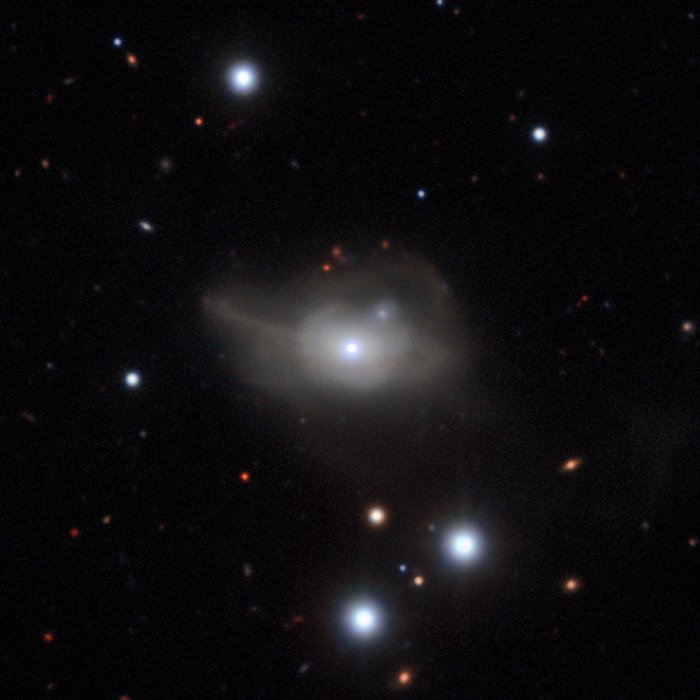
This image from the MUSE instrument on ESO’s Very Large Telescope shows the active galaxy Markarian 1018, which has a supermassive black hole at its core. The faint loops of light around the galaxy are a result of its interaction and merger with another galaxy in the recent past. [Larger image]The mystery of a rare change in the behaviour of a supermassive black hole at the centre of a distant galaxy has been solved by an international team of astronomers using ESO’s Very Large Telescope along with the NASA/ESA Hubble Space Telescope and NASA’s Chandra X-ray Observatory. It seems that the black hole has fallen on hard times and is no longer being fed enough fuel to make its surroundings shine.
Many galaxies are found to have an extremely bright core powered by a supermassive black hole. These cores make “active galaxies” some of the brightest objects in the Universe. They are thought to shine so brightly because hot material is glowing fiercely as it falls into the black hole, a process known as accretion. This brilliant light can vary hugely between different active galaxies, so astronomers classify them into several types based on the properties of the light they emit [1].
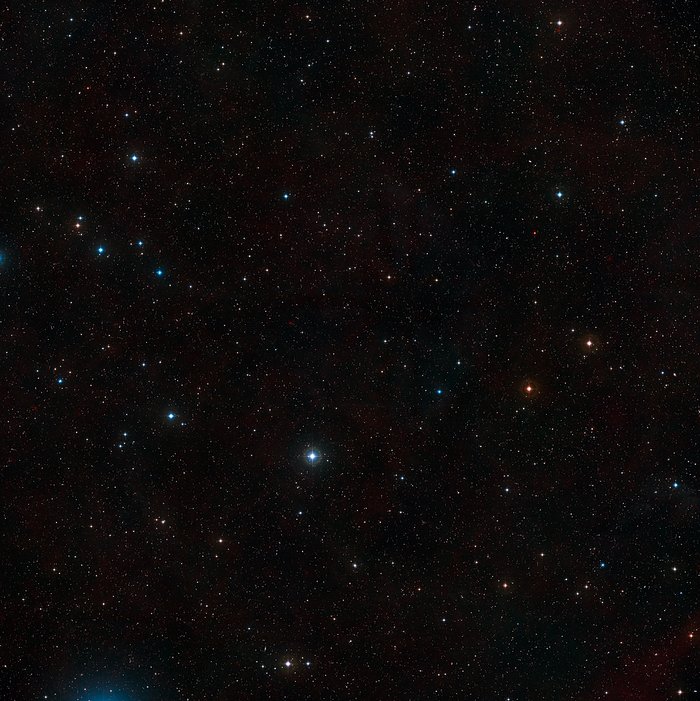
This sequence takes the viewer deep into the rather faint constellation of Cetus (The Sea Monster). In the final stages the faint active galaxy Markarian 1018 is seen, in a recent image from the MUSE instrument on ESO’s Very Large Telescope. Credit: ESO/A. Fujii/Digitized Sky Survey 2/CARS survey
Some of these galaxies have been observed to change dramatically over the course of only 10 years; a blink of an eye in astronomical terms. However, the active galaxy in this new study, Markarian 1018 stands out by having changed type a second time, reverting back to its initial classification within the last five years. A handful of galaxies have been observed to make this full-cycle change, but never before has one been studied in such detail.
The discovery of Markarian 1018’s fickle nature was a chance by-product of the Close AGN Reference Survey (CARS), a collaborative project between ESO and other organisations to gather information on 40 nearby galaxies with active cores. Routine observations of Markarian 1018 with the Multi-Unit Spectroscopic Explorer (MUSE) installed on ESO’s Very Large Telescope revealed the surprising change in the light output of the galaxy.
“We were stunned to see such a rare and dramatic change in Markarian 1018”,
The chance observation of the galaxy so soon after it began to fade was an unexpected opportunity to learn what makes these galaxies tick, as Bernd Husemann, CARS project leader and lead author of one of two papers associated with the discovery, explained:
“We were lucky that we detected the event just 3-4 years after the decline started so we could begin monitoring campaigns to study details of the accretion physics of active galaxies that cannot be studied otherwise.”
The research team made the most of this opportunity, making it their first priority to pinpoint the process causing Markarian 1018’s brightness to change so wildly. This could have been caused by any one of a number of astrophysical events, but they could rule out the black hole pulling in and consuming a single star [2] and cast doubt on the possibility of obscuration by intervening gas [3]. But the true mechanism responsible for Markarian 1018’s surprising variation remained a mystery after the first round of observations.
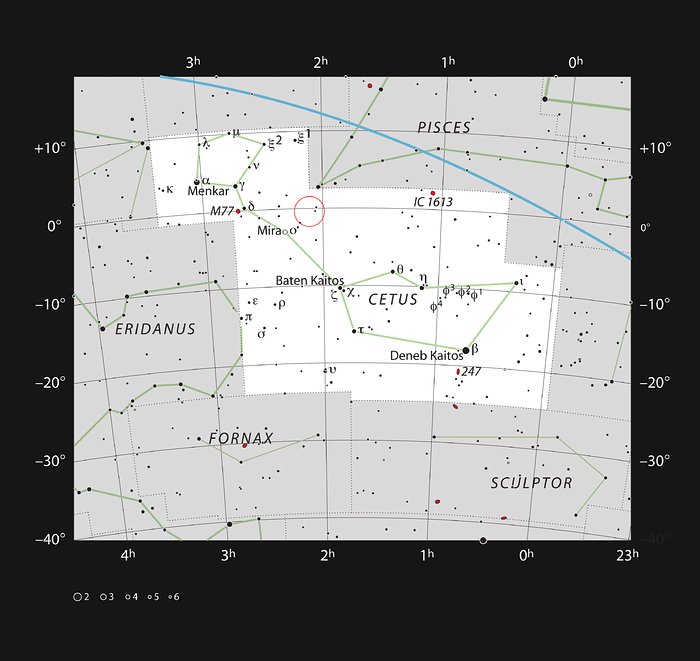
This chart shows the large but faint constellation of Cetus (The Whale). Most of the stars visible with the naked eye are shown and the position of the faint active galaxy Markarian 1018 is marked with a red circle. This object is too faint to be seen easily with small telescopes. [Larger images]However, the team were able to gather extra data after they were awarded observing time to use the NASA/ESA Hubble Space Telescope, and NASA’s Chandra X-ray Observatory. With the new data from this suite of instruments they were able to solve the mystery — the black hole was slowly fading because it was being starved of accretion material.
“It’s possible that this starvation is because the inflow of fuel is being disrupted”, said Rebecca McElroy. “An intriguing possibility is that this could be due to interactions with a second supermassive black hole”.
Such a black hole binary system is a distinct possibility in Markarian 1018, as the galaxy is the product of a major merger of two galaxies — each of which likely contained a supermassive black hole in its centre.
Research continues into the mechanisms at work in active galaxies such as Markarian 1018 that change their appearance.
“The team had to work fast to determine what was causing Markarian 1018’s return to the shadows,” comments Bernd Husemann. “Ongoing monitoring campaigns with ESO telescopes and other facilities will allow us to explore the exciting world of starving black holes and changing active galaxies in more detail.”
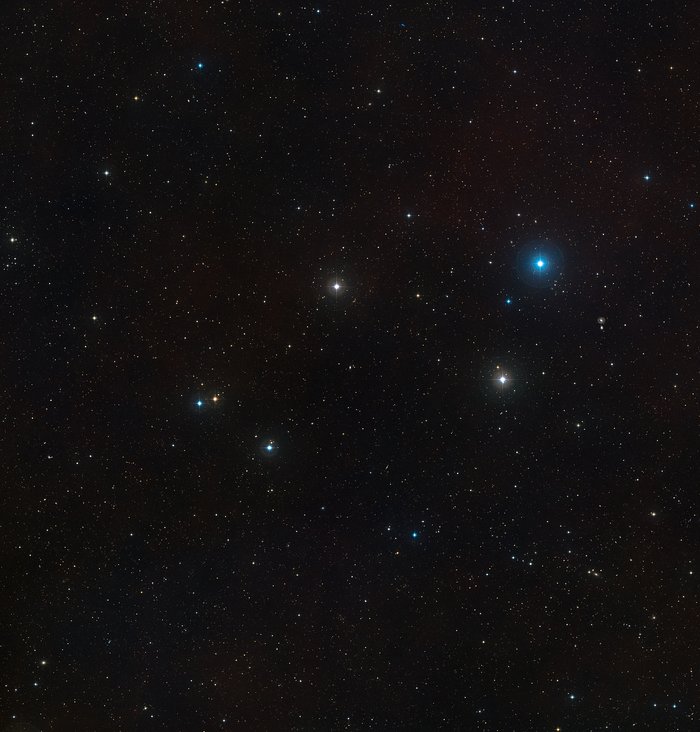
This wide-field image shows the sky around the faint active galaxy Markarian 1018. The picture was assembled from images forming part of the Digitized Sky Survey 2. The galaxy itself is at the centre of the picture and faint evidence of its recent merger can be seen in the form of tails and loops. [Larger images]Notes [1] The brightest of the active galaxies are quasars, where the brilliant nucleus outshines the rest of the galaxy. Another, less extreme, class are known as Seyfert galaxies. Originally a method was developed that used brightness and the emission spectrum — the plot of the strength of radiation emitted at different wavelength — to distinguish between just two types of Seyfert galaxies, Type 1 and Type 2, but extra classifications such as Type 1.9 Seyferts have since been introduced.
[2] Such a tidal disruption event occurs when a star strays too close to a supermassive black hole and is torn apart by the extreme gravitational tidal force. This results in a sharp rise in the brightness of the central region that slowly declines over a period of years. The observed brightness variations of Markarian 1018 were found not to match the profile of such an event.
[3] Gas obscuration can affect the classification of an active galaxy by blocking the line of sight, drifting in front of the galaxy’s bright core like fog in front of a car’s headlights, and dimming the light passing through. This also affects the spectrum of galaxy, perhaps changing its classification.
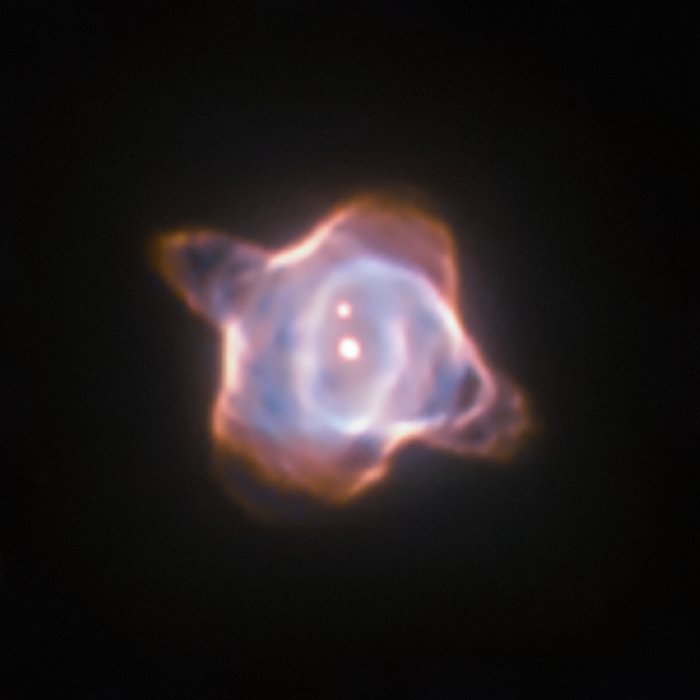
This image of the Stingray nebula, a planetary nebula 2700 light-years from Earth, was taken with the Wide Field and Planetary Camera 2 (WFPC2) in 1998. In the centre of the nebula the fast evolving star SAO 244567 is located. Observations made within the last 45 years showed that the surface temperature of the star increased by almost 40 000 degree Celsius. Now new observations of the spectra of the star have revealed that SAO 244567 has started to cool again.
Over a period of 30 years dramatic increases in the temperature of the star SAO 244567 have been observed. Now the star is cooling again, having been reborn into an earlier phase of stellar evolution. This makes it the first reborn star to have been observed during both the heating and cooling stages of rebirth.
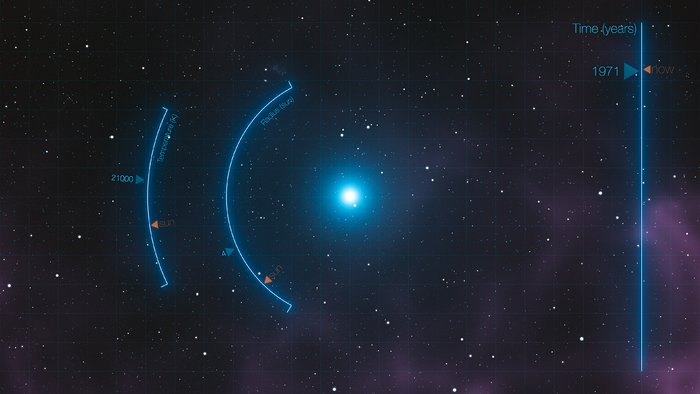
This animation shows the fast evolution of SAO 244567. The animation starts 10 300 BC, with the star having a radius 152 times the size of the Sun and a surface temperature of about 3500 degree Celsius, giving it its orange colour. At this point of its life the star had already lost half of its initial mass.
After 10 000 years the star slowly shrinks to only 40 times the size of the Sun; at the same time its temperature rises to 6800 degree Celsius, causing its colour to change to white-yellow. As the star heats up to about 20 000 degree Celsius Helium fusion inside the star suddenly gets re-ignited — the late thermal pulse.
After the flash the star heats quickly and becomes a blue-white star with a temperature of 21 000 degree Celsius, only 4 times larger than the Sun. SAO 244567 shrinks further till it only a third the size of the Sun and a temperature of 60 000 degree Celsius; this status was reached in the year 2002. Now new observations show that the star is still blue and hot — with about 50 000 degree Celsius — but started to expand again: its size is about two third of our Sun.
Within the next few hundreds of years SAO 244567 will expand back to its giant dimensions and also change its colour to orange — as shown at the end of the animation. Credit: ESA/Hubble, L. Calçada
Even though the Universe is constantly changing, most processes are too slow to be observed within a human lifespan. But now an international team of astronomers have observed an exception to this rule.
“SAO 244567 is one of the rare examples of a star that allows us to witness stellar evolution in real time”, explains Nicole Reindl from the University of Leicester, UK, lead author of the study. “Over only twenty years the star has doubled its temperature and it was possible to watch the star ionising its previously ejected envelope, which is now known as the Stingray Nebula.”
SAO 244567, 2700 light-years from Earth, is the central star of the Stingray Nebula and has been visibly evolving between observations made over the last 45 years. Between 1971 and 2002 the surface temperature of the star skyrocketed by almost 40 000 degrees Celsius. Now new observations made with the Cosmic Origins Spectrograph (COS) on the NASA/ESA Hubble Space Telescope have revealed that SAO 244567 has started to cool and expand.
This is unusual, though not unheard-of [1], and the rapid heating could easily be explained if one assumed that SAO 244567 had an initial mass of 3 to 4 times the mass of the Sun. However, the data show that SAO 244567 must have had an original mass similar to that of our Sun. Such low-mass stars usually evolve on much longer timescales, so the rapid heating has been a mystery for decades.
Back in 2014 Reindl and her team proposed a theory that resolved the issue of both SAO 244567’s rapid increase in temperature as well as the low mass of the star. They suggested that the heating was due to what is known as a helium-shell flash event: a brief ignition of helium outside the stellar core [2].
This artist’s impression shows a still from the video showing the evolution of SAO 244567’s rapid evolution.
This theory has very clear implications for SAO 244567’s future: if it has indeed experienced such a flash, then this would force the central star to begin to expand and cool again — it would return back to the previous phase of its evolution. This is exactly what the new observations confirmed. As Reindl explains:
“The release of nuclear energy by the flash forces the already very compact star to expand back to giant dimensions — the born-again scenario.”
It is not the only example of such a star, but it is the first time ever that a star has been observed during both the heating and cooling stages of such a transformation.
Yet no current stellar evolutionary models can fully explain SAO 244567’s behaviour. As Reindl elaborates:
“We need refined calculations to explain some still mysterious details in the behaviour of SAO 244567. These could not only help us to better understand the star itself but could also provide a deeper insight in the evolution of central stars of planetary nebulae.”
Until astronomers develop more refined models for the life cycles of stars, aspects of SAO 244567’s evolution will remain a mystery.
Notes
[1] The other star thought to have experienced the same type of helium flash event (see[2]) is FG Sagittae, located in the constellation Sagitta, making SAO 244567 the second of its kind. However, other objects undergoing similar “born-again” scenarios are known, including Sakurai’s Object, located in Sagittarius.
[2] Helium flash events, also known as late thermal pulses, occur late in the evolution of about 25% of low- to medium-mass stars. After evolving off the main sequence, these stars enter the red giant phase, where the star expands dramatically. Various changes occur in the star’s chemical and physical composition during this phase, until it has burnt most of the helium available in its core, which is by then composed of carbon and oxygen. Helium fusion continues in a thin shell around the core, but then turns off as the helium becomes depleted. This allows hydrogen fusion to start in a layer above the helium layer. After enough additional helium accumulates, helium fusion is reignited, leading to a thermal pulse which eventually causes the star to expand, cool and brighten temporarily.