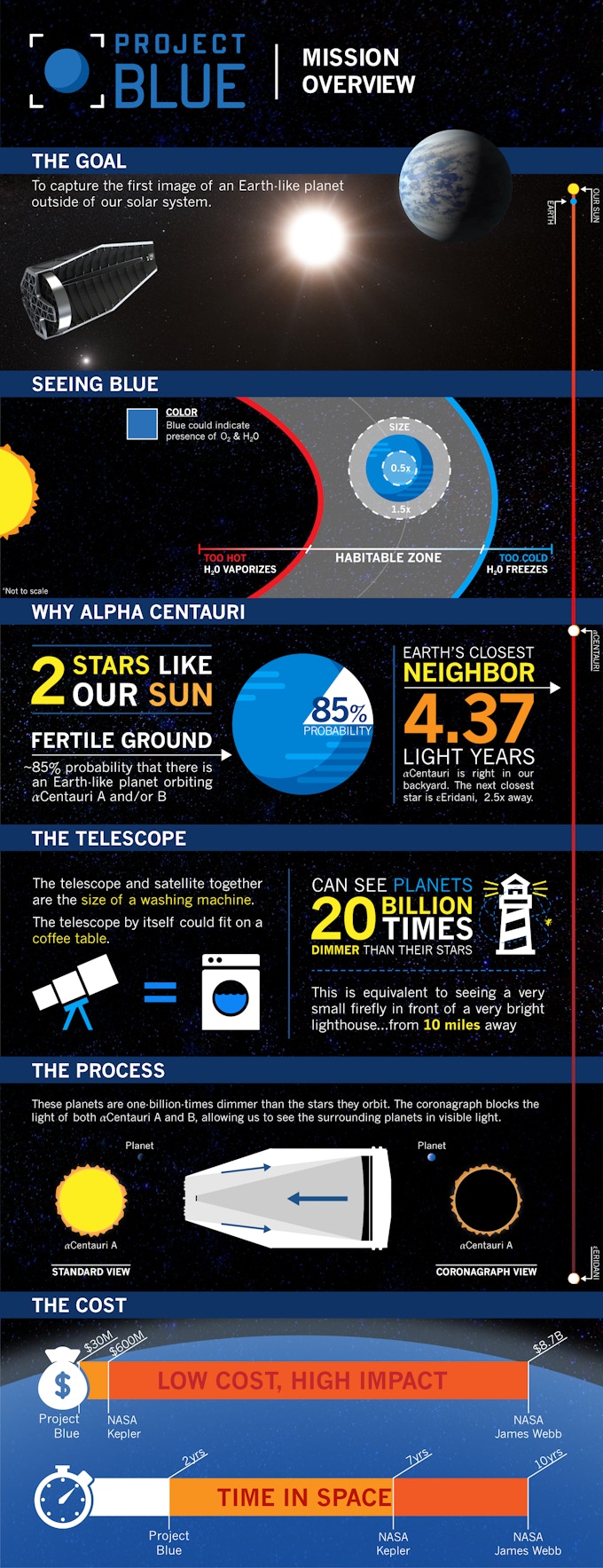
Project Blue intends to develop a small, low cost space telescope that looks continually at our nearest neighboring star system, Alpha Centauri, and try to directly image any planets orbiting it. A coronagraph will be used to block the otherwise blinding glare of the stars.
The project has opened a Kickstarter campaign to raise $1M to fund the initial design study for the system, which is expected eventually to cost around $30M.
… we need your help. This isn’t a traditional space mission. Within astrophysics, NASA has traditionally funded projects with a much broader scope, like Kepler and Hubble, rather than a project like ours that is focused on a single target. So we started this campaign with the belief that together, people all over the world could push the boundaries of discovery in space, and possibly achieve one of the greatest milestones of human exploration.
With the formation of Project Blue, we brought together the technical experts who can build and launch this telescope: scientists from organizations like BoldlyGo Institute, Mission Centaur, the SETI Institute, and the University of Massachusetts Lowell. And now we’re asking for your support to get involved, and make Project Blue a reality.
Here is a video about the project:
From the website:
Project Blue is a new science initiative to capture the first photograph of a potential Earth-like planet orbiting another Sun-like star. The mission aims to launch a lightweight space telescope to directly image exoplanets around Earth’s nearest star system, Alpha Centauri A and B. With a budget the fraction of the cost of a mid-size astrophysics mission, and a planned launch by the end of the decade, this venture represents an ambitious leap forward in low-cost, high-impact space exploration. Through active collaboration between research institutions, universities, private industry and citizens, Project Blue seeks to make space exploration a participatory, collective endeavor and inspire millions worldwide to engage in scientific inquiry.
The plan is to build a telescope to stare at those two closely paired stars over the course of two years. Because they’re so close to us in astronomical terms — a mere 4.37 light-years, or 26 trillion miles — it would be possible to get a direct image of any potentially habitable planets using a telescope that has a 20-inch-wide (0.5-meter-wide) mirror, Morse said.
What’s more, the telescope would be able to analyze the light reflected by those planets. That could tell scientists what their atmospheres are made of. If the planet shines with the right shade of blue, that would suggest it’s an alien Earth.
A Free, Professionally-edited, Non-profit Introductory Astronomy Textbook
A new introductory textbook called Astronomy has just been published by OpenStax, a national, non-profit project to develop high-quality, introductory textbooks that are free to students. The publisher is located at Rice University and supported by several major foundations (including the Gates and Hewlett Foundations.) They have already done over 20 free textbooks in other fields, used by hundreds of thousands of students around the country.
Figure 1.1. Distant Galaxies. These two interacting islands of stars (galaxies) are so far away that their light takes hundreds of millions of years to reach us on Earth (photographed with the Hubble Space Telescope). (credit: modification of work by NASA, ESA, the Hubble Heritage (STScl/ AURA)-ESA/Hubble Collaboration, and K. Noll (STScl))
Senior authors for the new non-technical astronomy text are Andrew Fraknoi (Foothill College), David Morrison (NASA Ames Research Ctr.), and Sidney Wolff (National Optical Astronomy Observatory), who have had many years of experience writing texts and educational materials. The project had the help of over 75 astronomers and astronomy educators, to make sure that the text is up-to-date, authoritative, and educationally sound. None of the authors receive one penny of royalties.
The book is free to students in the electronic version, and can be custom printed on demand – at cost. Even more interesting, the book is open source, which means professors can use it as is, or develop their own electronic version of it, selecting only the sections they teach and adding course-specific curriculum materials.
Featuring such current topics as the results from the New Horizons exploration of Pluto, the classification of exoplanets from Kepler and other projects, and the discovery of gravitational waves, the book is current and easily updated electronically. At the same time, it is written in everyday language specifically for non-science majors, with many analogies drawn from students’ lives, clear diagrams, the latest color images, and occasional touches of humor.
Math boxes throughout the chapters put topics on a quantitative footing for those who want to use math in their courses. Each chapter has math problems at the end. However, if a course doesn’t use math, these boxes and problems can easily be skipped. Chapters also include suggested collaborative group activities (especially useful for discussion sections), links to web resources, biographies of astronomers, interdisciplinary connections, and much more.
Ancillary materials are also being developed and the book will be compatible with several class management software systems.
At a time when both students and professors have so often thrown up their hands in despair over the growing cost of astronomy textbooks, OpenStax Astronomy makes a professionally-edited, high-quality text available world-wide without charge.
This week’s ESO (European Southern Observatory) report:
Sculpting Solar Systems ESO’s SPHERE instrument reveals protoplanetary discs being shaped by newborn planets
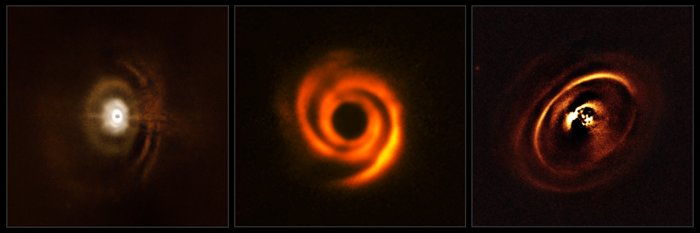
Sharp new observations have revealed striking features in planet-forming discs around young stars. The SPHERE instrument, mounted on ESO’s Very Large Telescope, has made it possible to observe the complex dynamics of young solar systems — including one seen developing in real-time. The recently published results from three teams of astronomers showcase SPHERE’s impressive capability to capture the way planets sculpt the discs that form them — exposing the complexities of the environment in which new worlds are formed.
These three planetary discs have been observed with the SPHERE instrument, mounted on ESO’s Very Large Telescope. The observations were made in order to shed light on the enigmatic evolution of fledgling planetary systems. [Larger images]Three teams of astronomers have made use of SPHERE, an advanced exoplanet-hunting instrument on the Very Large Telescope (VLT) at ESO’s Paranal Observatory, in order to shed light on the enigmatic evolution of fledgling planetary systems. The explosion in the number of known exoplanets in recent years has made the study of them one of the most dynamic fields in modern astronomy.
Today it is known that planets form from vast discs of gas and dust encircling newborn stars, known as protoplanetary discs. These can extend for thousands of millions of kilometres. Over time, the particles in these protoplanetary discs collide, combine and eventually build up into planet-sized bodies. However, the finer details of the evolution of these planet-forming discs remain mysterious.
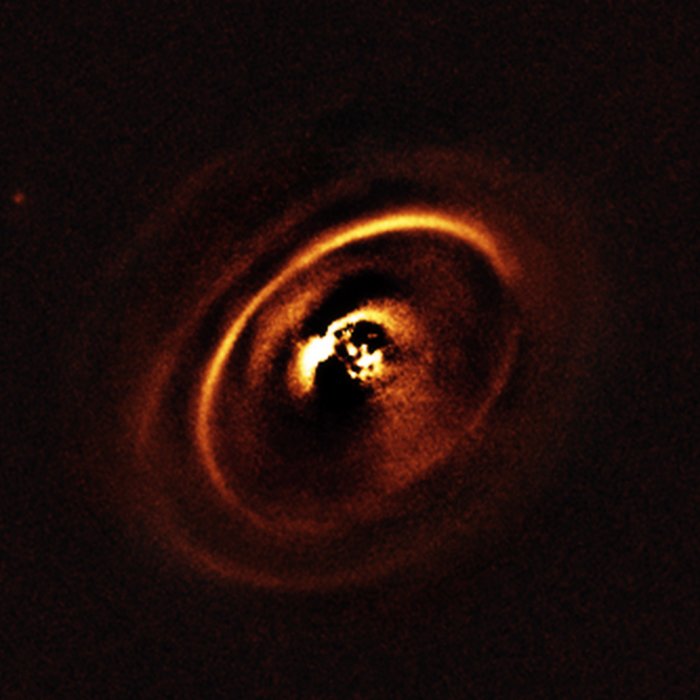
Using the ESO’s SPHERE instrument at the Very Large Telescope, a team of astronomer observed the planetary disc surrounding the star RXJ1615 which lies in the constellation of Scorpius, 600 light-years from Earth. The observations show a complex system of concentric rings surrounding the young star, forming a shape resembling a titanic version of the rings that encircle Saturn. Such an intricate sculpting of rings in a protoplanetary disc has only been imaged a handful of times before. The central parts of the image appears dark because SPHERE blocks out the light from the brilliant central star to reveal the much fainter structures surrounding it. [Larger images]SPHERE is a recent addition to the VLT’s array of instruments and with its combination of novel technologies, it provides a powerful method to directly image the fine details of protoplanetary discs [1]. The interaction between protoplanetary discs and growing planets can shape the discs into various forms: vast rings, spiral arms or shadowed voids. These are of special interest as an unambiguous link between these structures and the sculpting planets is yet to be found; a mystery astronomers are keen to solve. Fortunately, SPHERE’s specialised capabilities make it possible for research teams to observe these striking features of protoplanetary discs directly.
For example, RX J1615 is a young star, which lies in the constellation of Scorpius, 600 light-years from Earth. A team led by the Jos de Boer, of Leiden Observatory in the Netherlands, found a complex system of concentric rings surrounding the young star, forming a shape resembling a titanic version of the rings that encircle Saturn. Such an intricate sculpting of rings in a protoplanetary disc has only been imaged a handful of times before, and even more excitingly, the entire system seems to be only 1.8 million years old. The disc shows hints of being shaped by planets still in the process of formation.
The age of the newly detected protoplanetary disc makes RX J1615 an outstanding system, as most other examples of protoplanetary discs detected so far are relatively old or evolved. De Boer’s unexpected result was quickly echoed by the findings of a team led by Christian Ginski, also of Leiden Observatory. They observed the young star HD 97048, located in the constellation of Chamaeleon, about 500 light-years from Earth. Through painstaking analysis, they found that the juvenile disc around this star has also formed into concentric rings. The symmetry of these two systems is a surprising result, as most protoplanetary systems contain a multitude of asymmetrical spiral arms, voids and vortexes. These discoveries significantly raise the number of known systems with multiple highly symmetrical rings.
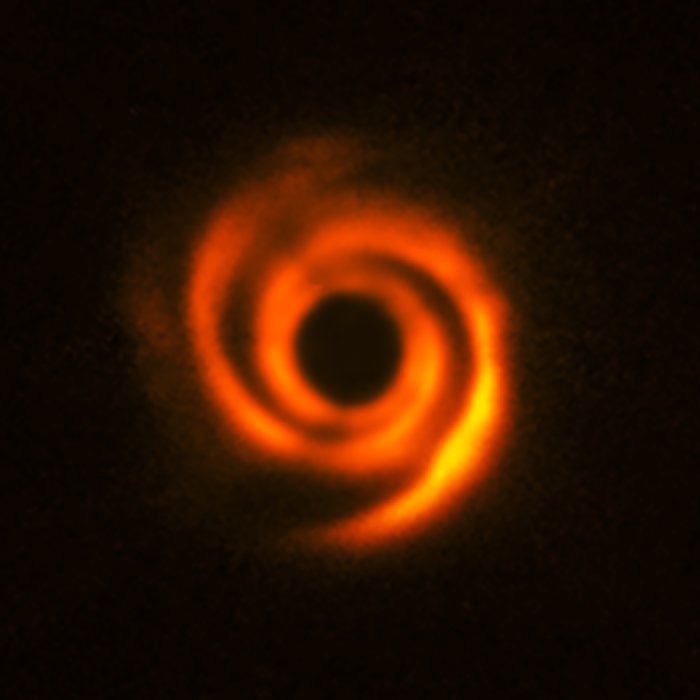
A particularly spectacular example of the more common asymmetric disc was captured by a group of astronomers led by Tomas Stolker of the Anton Pannekoek Institute for Astronomy, the Netherlands. This disc surrounds the star HD 135344B, about 450 light-years away. Although this star has been well-studied in the past, SPHERE allowed the team to see the star’s protoplanetary disc in more detail than ever before. The large central cavity and two prominent spiral arm-like structures are thought to have been created by one or multiple massive protoplanets, destined to become Jupiter-like worlds.
Using the ESO’s SPHERE instrument at the Very Large Telescope, a team of astronomer observed the planetary disc surrounding the star HD135344B, about 450 light-years away. The disc shows prominent spiral arm-like structures. These are thought to have been created by one or multiple massive protoplanets, destined to become Jupiter-like worlds. [Larger images]In addition, four dark streaks, apparently shadows thrown by the movement of material within HD 135344B’s disc, were observed. Remarkably, one of the streaks noticeably changed in the months between observing periods: a rare example of observing planetary evolution occur in real time, hinting at changes occurring in the inner disc regions that can not be directly detected by SPHERE. As well as producing beautiful images, these flickering shadows provide a unique way of probing the dynamics of innermost disc regions.
As with the concentric rings found by de Boer and Ginski, these observations by Stolker’s team prove that the complex and changing environment of the discs surrounding young stars are still capable of producing surprising new discoveries. By building an impressive body of knowledge about these protoplanetary discs, these teams are stepping closer to understanding how planets shape the discs that form them — and therefore understanding planet formation itself.
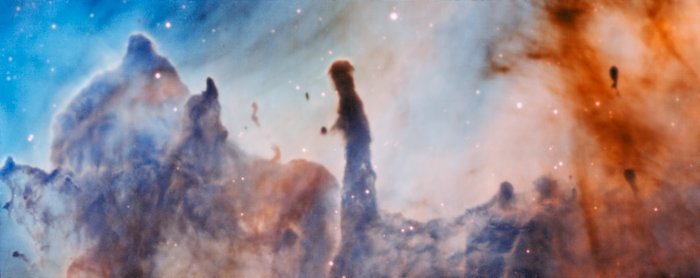
This image was taken by the MUSE instrument, mounted on ESO’s Very Large Telescope and shows the region R44 within the Carina Nebula, 7500 light-years away. The massive stars within the star formation region slowly destroy the pillars of dust and gas from which they are born. [Larger versions]Spectacular new observations of vast pillar-like structures within the Carina Nebula have been made using the MUSE instrument on ESO’s Very Large Telescope. The different pillars analysed by an international team seem to be pillars of destruction — in contrast to the name of the iconic Pillars of Creation in the Eagle Nebula, which are of similar nature.
3D animation of the Carina Nebula. Credit: ESO/M. Kornmesser
The spires and pillars in the new images of the Carina Nebula are vast clouds of dust and gas within a hub of star formation about 7500 light-years away. The pillars in the nebula were observed by a team led by Anna McLeod, a PhD student at ESO, using the MUSE instrument on ESO’s Very Large Telescope.
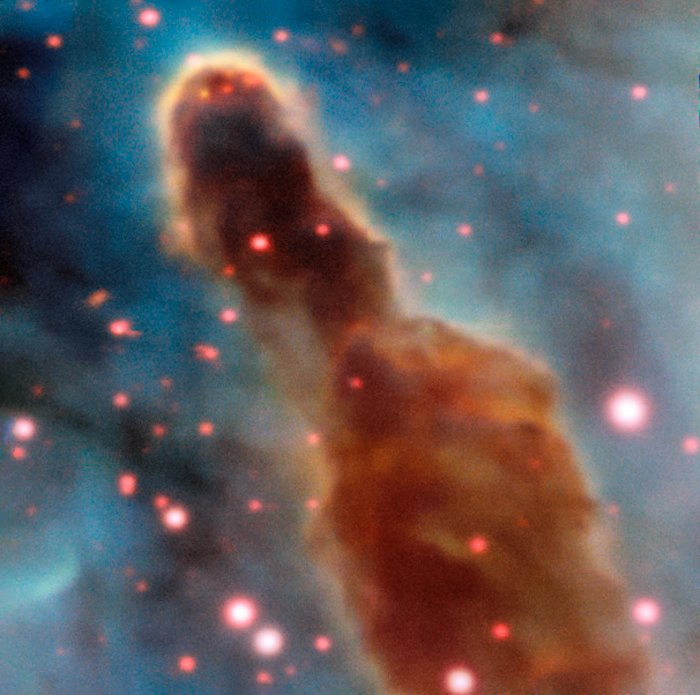
This image was taken by the MUSE instrument, mounted on ESO’s Very Large Telescope and shows the region R18 within the Carina Nebula, 7500 light-years away. The massive stars within the star formation region slowly destroy the pillars of dust and gas from which they are born. [Larger images]The great power of MUSE is that it creates thousands of images of the nebula at the same time, each at a different wavelength of light. This allows astronomers to map out the chemical and physical properties of the material at different points in the nebula.
Images of similar structures, the famous Pillars of Creation[1] in the Eagle Nebula and formations in NGC 3603, were combined with the ones displayed here. In total ten pillars have been observed, and in so doing a clear link was observed between the radiation emitted by nearby massive stars and the features of the pillars themselves.
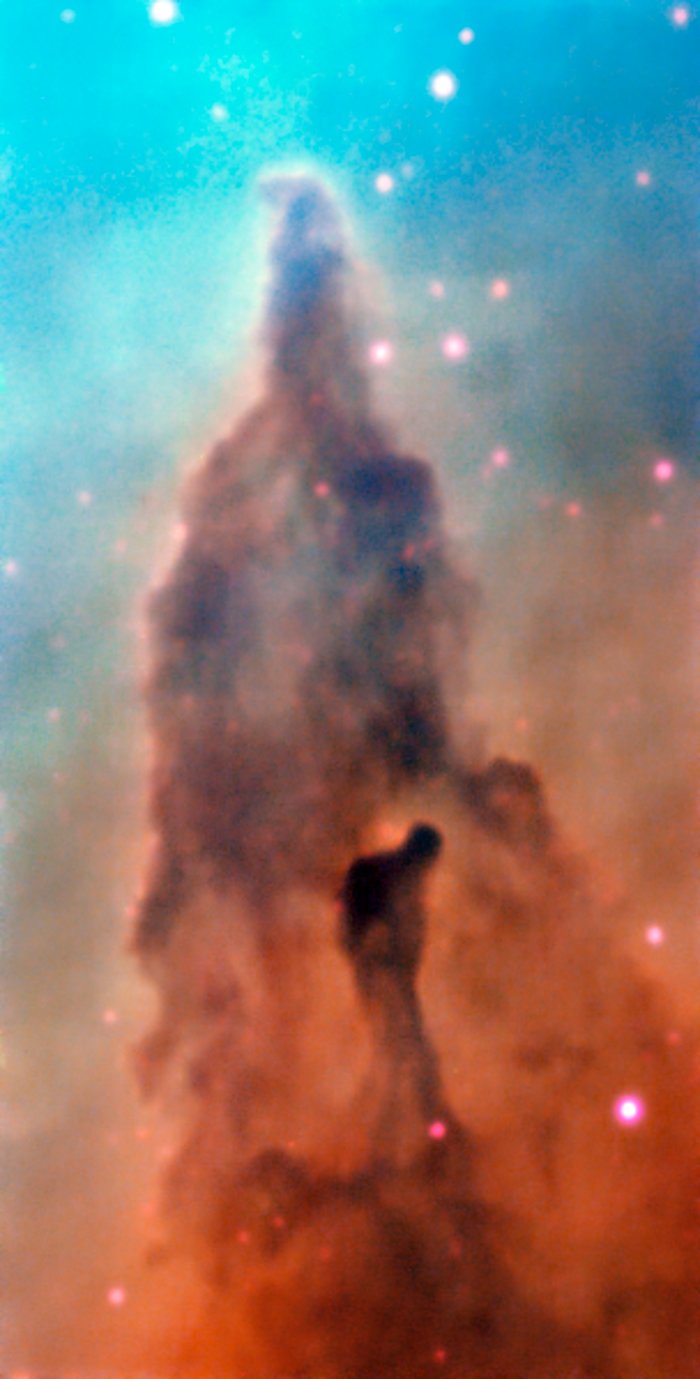
This image was taken by the MUSE instrument, mounted on ESO’s Very Large Telescope and shows the region R45 within the Carina Nebula, 7500 light-years away. The massive stars within the star formation region slowly destroy the pillars of dust and gas from which they are born. [Larger images]In an ironic twist, one of the first consequences of the formation of a massive star is that it starts to destroy the cloud from which it was born. The idea that massive stars will have a considerable effect on their surroundings is not new: such stars are known to blast out vast quantities of powerful, ionising radiation — emission with enough energy to strip atoms of their orbiting electrons. However, it is very difficult to obtain observational evidence of the interplay between such stars and their surroundings.
The team analysed the effect of this energetic radiation on the pillars: a process known as photoevaporation, when gas is ionised and then disperses away. By observing the results of photoevaporation — which included the loss of mass from the pillars — they were able to deduce the culprits. There was a clear correlation between the amount of ionising radiation being emitted by nearby stars, and the dissipation of the pillars.
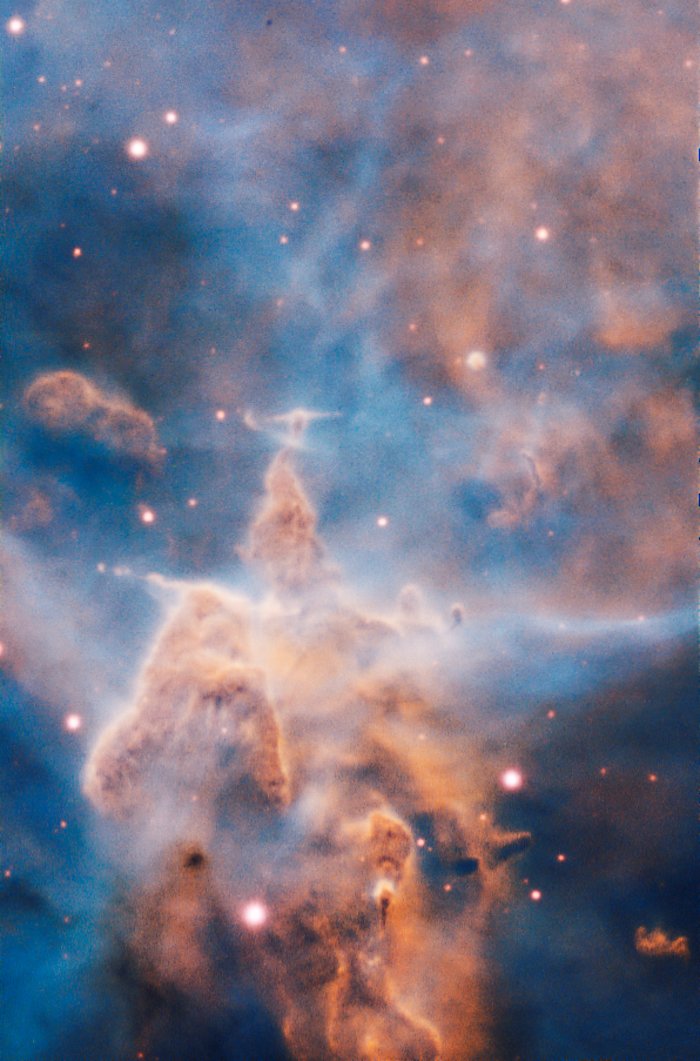
This craggy fantasy mountaintop enshrouded by wispy clouds looks like a bizarre landscape. But it is indeed a pillar of gas and dust, three light-years tall, which is being eaten away by the brilliant light from nearby bright stars. The pillar is also being assaulted from within, as infant stars buried inside it fire off jets of gas that can be seen streaming from towering peaks. [Larger images]This might seem like a cosmic calamity, with massive stars turning on their own creators. However the complexities of the feedback mechanisms between the stars and the pillars are poorly understood. These pillars might look dense, but the clouds of dust and gas which make up nebulae are actually very diffuse. It is possible that the radiation and stellar winds from massive stars actually help create denser spots within the pillars, which can then form stars.
These breathtaking celestial structures have more to tell us, and MUSE is an ideal instrument to probe them with.
This zoom sequence starts with a broad view of the Milky Way and closes in on the Carina Nebula, an active stellar nursery about 7500 light-years from Earth. In the final sequence we see a new image taken with the VLT Survey Telescope at ESO’s Paranal Observatory. This picture was taken with the help of Sebastián Piñera, President of Chile, during his visit to the observatory on 5 June 2012 and released on the occasion of the telescope’s inauguration in Naples on 6 December 2012.
Credit: ESO/Nick Risinger (skysurvey.org)/Digitized Sky Survey 2 . Music: John Dyson (from the album Moonwind). Acknowledgement: VPHAS+ Consortium/Cambridge Astronomical Survey Unit
Notes
[1] The Pillars of Creation are an iconic image, taken with the NASA/ESA Hubble Space Telescope, making them the most famous of these structures. Also known as elephant trunks, they can be several light-years in length.