NASA JPL’s What’s Up for December 2016 describes the most interesting sights to see in the night sky for the coming month:
See Mercury, Venus and Mars all month long and a New Year’s Eve comet. With some luck, you may catch some Geminid and Ursid meteors, too. Catch up on all of NASA’s missions at http://www.nasa.gov
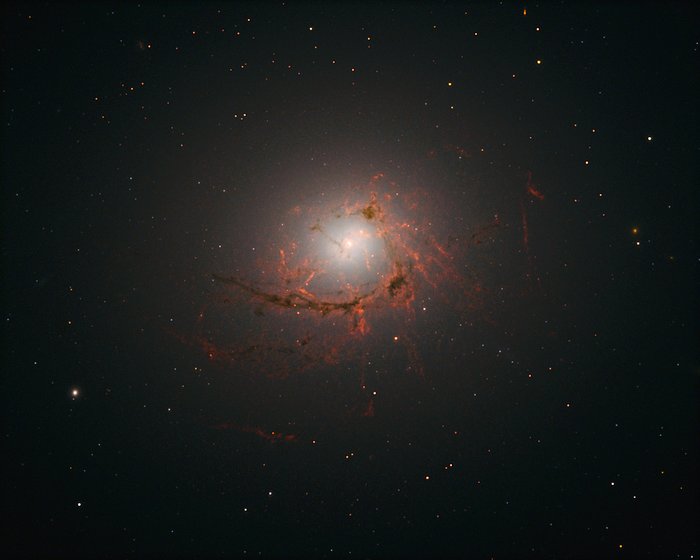
New observations from the NASA/ESA Hubble Space Telescope have revealed the intricate structure of the galaxy NGC 4696 in greater detail than ever before. The elliptical galaxy is a beautiful cosmic oddity with a bright core wrapped in system of dark, swirling, thread-like filaments.
This picture, taken by Hubble’s Wide Field Camera 3 (WFC3), shows NGC 4696, the largest galaxy in the Centaurus Cluster. The new images taken with Hubble show the dusty filaments surrounding the centre of this huge galaxy in greater detail than ever before. These filaments loop and curl inwards in an intriguing spiral shape, swirling around the supermassive black hole at such a distance that they are dragged into and eventually consumed by the black hole itself. [Larger images]NGC 4696 is a member of the Centaurus galaxy cluster, a swarm of hundreds of galaxies all sitting together, bound together by gravity, about 150 million light-years from Earth and located in the constellation of Centaurus.
Despite the cluster’s size, NGC 4696 still manages to stand out from its companions — it is the cluster’s brightest member, known for obvious reasons as the Brightest Cluster Galaxy . This puts it in the same category as some of the biggest and brightest galaxies known in the Universe.
This video zooms on NGC 4696, the largest galaxy in the Centaurus Cluster (galaxy cluster Abell 3526) as seen with the NASA/ESA Hubble Space Telescope. Credit: ESA/Hubble, NASA, ESO/Digitized Sky Survey 2 and S. Brunier. Music: John Dyson (from the album “Moonwind”). Acknowledgment: Davide De Martin
Even if NGC 4696 keeps impressive company, it has a further distinction: the galaxy’s unique structure. Previous observations have revealed curling filaments that stretch out from its main body and carve out a cosmic question mark in the sky (heic1013), the dark tendrils encircling a brightly glowing centre.
An international team of scientists, led by astronomers from the University of Cambridge, UK, have now used new observations from the NASA/ESA Hubble Space Telescope to explore this thread-like structure in more detail. They found that each of the dusty filaments has a width of about 200 light-years, and a density some 10 times greater than the surrounding gas. These filaments knit together and spiral inwards towards the centre of NGC 4696, connecting the galaxy’s constituent gas to its core.
This video pans over NASA/ESA Hubble Space Telescope observations of the massive galaxy NGC 4696, which lies about 150 million light-years from Earth. Credit: ESO/L. Calçada, Music Credit: Konstantino Polizois
In fact, it seems that the galaxy’s core is actually responsible for the shape and positioning of the filaments themselves. At the centre of NGC 4696 lurks an active supermassive black hole. This floods the galaxy’s inner regions with energy, heating the gas there and sending streams of heated material outwards.
It appears that these hot streams of gas bubble outwards, dragging the filamentary material with them as they go. The galaxy’s magnetic field is also swept out with this bubbling motion, constraining and sculpting the material within the filaments.
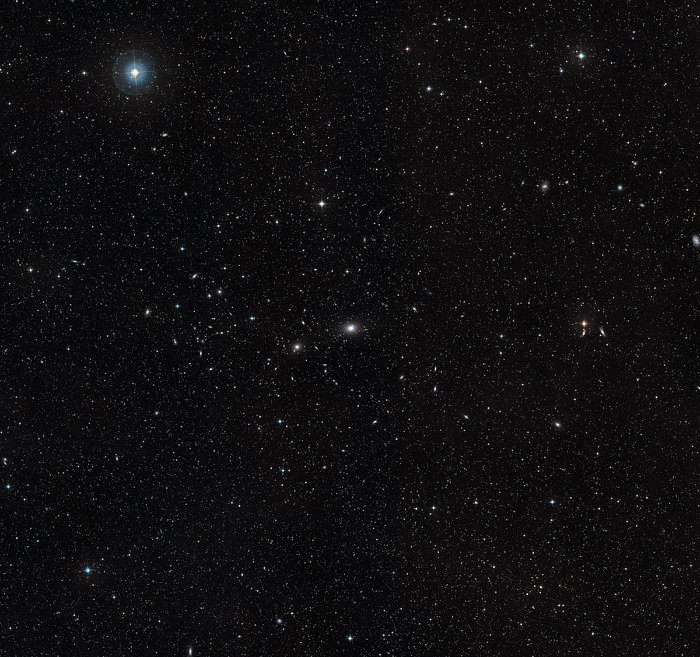
This ground-based image shows the galaxy NGC 4696 and its surroundings. [Larger images]At the very centre of the galaxy, the filaments loop and curl inwards in an intriguing spiral shape, swirling around the supermassive black hole at such a distance that they are dragged into and eventually consumed by the black hole itself.
Understanding more about filamentary galaxies such as NGC 4696 may help us to better understand why so many massive galaxies near to us in the Universe appear to be dead; rather than forming newborn stars from their vast reserves of gas and dust, they instead sit quietly, and are mostly populated with old and aging stars. This is the case with NGC 4696. It may be that the magnetic structure flowing throughout the galaxy stops the gas from creating new stars.
By studying the light emitted from an extraordinarily dense and strongly magnetised neutron star using ESO’s Very Large Telescope, astronomers may have found the first observational indications of a strange quantum effect, first predicted in the 1930s. The polarisation of the observed light suggests that the empty space around the neutron star is subject to a quantum effect known as vacuum birefringence.
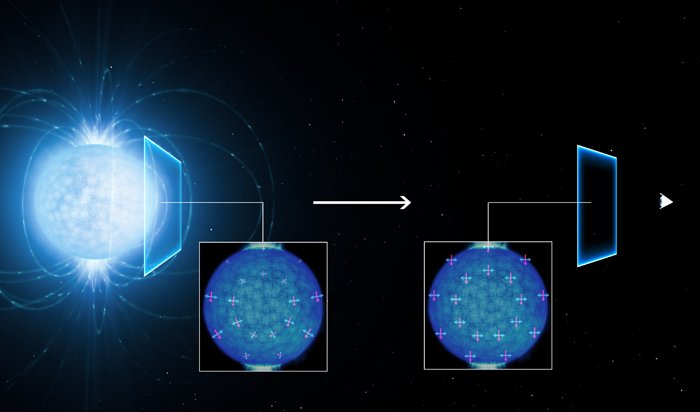
This artist’s view shows how the light coming from the surface of a strongly magnetic neutron star (left) becomes linearly polarised as it travels through the vacuum of space close to the star on its way to the observer on Earth (right). The polarisation of the observed light in the extremely strong magnetic field suggests that the empty space around the neutron star is subject to a quantum effect known as vacuum birefringence, a prediction of quantum electrodynamics (QED). This effect was predicted in the 1930s but has not been observed before. The magnetic and electric field directions of the light rays are shown by the red and blue lines. Model simulations by Roberto Taverna (University of Padua, Italy) and Denis Gonzalez Caniulef (UCL/MSSL, UK) show how these align along a preferred direction as the light passes through the region around the neutron star. As they become aligned the light becomes polarised, and this polarisation can be detected by sensitive instruments on Earth. [Larger images]A team led by Roberto Mignani from INAF Milan (Italy) and from the University of Zielona Gora (Poland), used ESO’s Very Large Telescope (VLT) at the Paranal Observatory in Chile to observe the neutron star RX J1856.5-3754, about 400 light-years from Earth [1].
Despite being amongst the closest neutron stars, its extreme dimness meant the astronomers could only observe the star with visible light using the FORS2 instrument on the VLT, at the limits of current telescope technology.
This artist’s view shows how the light coming from the surface of a strongly magnetic neutron star (left) becomes linearly polarised as it travels through the vacuum of space close to the star on its way to the observer on Earth (right). The polarisation of the observed light in the extremely strong magnetic field suggests that the empty space around the neutron star is subject to a quantum effect known as vacuum birefringence, a prediction of quantum electrodynamics (QED). This effect was predicted in the 1930s but has not been observed before.
The magnetic and electric field directions of the light rays are shown by the red and blue lines. Model simulations by Roberto Taverna (University of Padua, Italy) and Denis Gonzalez Caniulef (UCL/MSSL, UK) show how these align along a preferred direction as the light passes through the region around the neutron star. As they become aligned the light becomes polarised, and this polarisation can be detected by sensitive instruments on Earth. Credit: ESO/L. Calçada
Neutron stars are the very dense remnant cores of massive stars — at least 10 times more massive than our Sun — that have exploded as supernovae at the ends of their lives. They also have extreme magnetic fields, billions of times stronger than that of the Sun, that permeate their outer surface and surroundings.
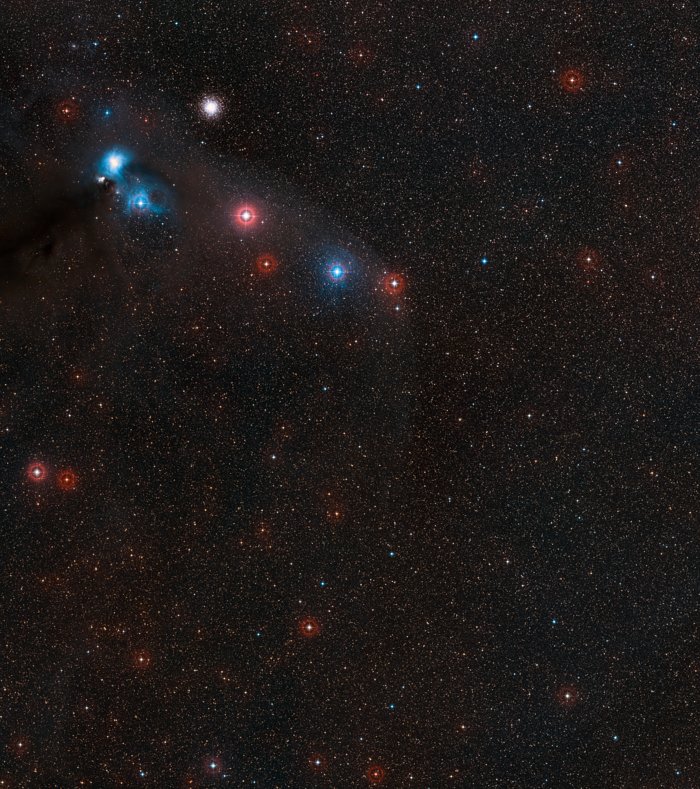
This wide field image shows the sky around the very faint neutron star RX J1856.5-3754 in the southern constellation of Corona Australis. This part of the sky also contains interesting regions of dark and bright nebulosity surrounding the variable star R Coronae Australis (upper left), as well as the globular star cluster NGC 6723. The neutron star itself is too faint to be seen here, but lies very close to the centre of the image. [Larger images]These fields are so strong that they even affect the properties of the empty space around the star. Normally a vacuum is thought of as completely empty, and light can travel through it without being changed. But in quantum electrodynamics (QED), the quantum theory describing the interaction between photons and charged particles such as electrons, space is full of virtual particles that appear and vanish all the time. Very strong magnetic fields can modify this space so that it affects the polarisation of light passing through it.
Mignani explains:
“According to QED, a highly magnetised vacuum behaves as a prism for the propagation of light, an effect known as vacuum birefringence.”
“This effect can be detected only in the presence of enormously strong magnetic fields, such as those around neutron stars. This shows, once more, that neutron stars are invaluable laboratories in which to study the fundamental laws of nature.”
says Roberto Turolla (University of Padua, Italy).
Colour composite photo of the sky field with the lonely neutron star RX J1856.5-3754 and the related cone-shaped nebula. It is based on a series of exposures obtained with the multi-mode FORS2 instrument at VLT KUEYEN through three different optical filters. The trail of an asteroid is seen in the field with intermittent blue, green and red colours. Credit: ESO [Larger images]After careful analysis of the VLT data, Mignani and his team detected linear polarisation — at a significant degree of around 16% — that they say is likely due to the boosting effect of vacuum birefringence occurring in the area of empty space surrounding RX J1856.5-3754 [2].
“This is the faintest object for which polarisation has ever been measured. It required one of the largest and most efficient telescopes in the world, the VLT, and accurate data analysis techniques to enhance the signal from such a faint star.”
[- Vincenzo Testa (INAF, Rome, Italy) comments.]
“The high linear polarisation that we measured with the VLT can’t be easily explained by our models unless the vacuum birefringence effects predicted by QED are included,”
adds Mignani.
“This VLT study is the very first observational support for predictions of these kinds of QED effects arising in extremely strong magnetic fields,”
remarks Silvia Zane (UCL/MSSL, UK).
Mignani is excited about further improvements to this area of study that could come about with more advanced telescopes:
“Polarisation measurements with the next generation of telescopes, such as ESO’s European Extremely Large Telescope, could play a crucial role in testing QED predictions of vacuum birefringence effects around many more neutron stars.”
[Adds Kinwah Wu (UCL/MSSL, UK): ]
“This measurement, made for the first time now in visible light, also paves the way to similar measurements to be carried out at X-ray wavelengths,”
This video sequence takes us from a broad view of the spectacular central regions of the Milky Way deep into the small constellation of Corona Australis. Here, as well as seeing clouds of glowing gas and dark regions of dust, we find the very faint neutron star RX J1856.5-3754. This extremely dense and magnetic object is the first place that indications of a strange quantum effect called vacuum birefringence may have been detected in new observations made using ESO’s Very Large Telescope. Credit: ESO/N. Risinger (skysurvey.org)/Digitized Sky Survey 2
Notes
[1] This object is part of the group of neutron stars known as the Magnificent Seven. They are known as isolated neutron stars (INS), which have no stellar companions, do not emit radio waves (like pulsars), and are not surrounded by progenitor supernova material.
[2] There are other processes that can polarise starlight as it travels through space. The team carefully reviewed other possibilities — for example polarisation created by scattering off dust grains — but consider it unlikely that they produced the polarisation signal observed.
Halloran created paintings of Messier’s objects with blue ink on semi-transparent drafting film. These were then contact-printed onto photographic paper and cut into circles evocative of the view through a telescope. Prints of each of the 110 Messier objects are displayed on the geometrically skewed lobby walls and stairwells of the Cahill building, which was designed by architect Thom Mayne. Several of the original blue-ink paintings are displayed on the stairway landings.
… historical imagery and narratives to trace contributions of women in astronomy since antiquity. The of series of large scale cyanotype prints will interpret a fragmented history and represent a female-centric astronomical catalog of craters, comets, galaxies and nebula drawing from narrative, imagery and historical accounts of Hypatia of Alexandria, Caroline Herschel, Helen Sawyer Hogg, and a group of women at Harvard in the late 1800’s known as Pickering’s Harem or the Harvard Computers.
Cyanotypes are printed from painted negatives that are based on the objects and narratives that were connected to these early astronomers. This process mimics early astronomical glass plates moving between transparent surfaces to a photograph without the use of a camera.
[] From the collection “Your Body is a Space that Sees” – Lia Halloran
Check out Halloran’s other space inspired works in her online gallery.
Laniakea, that is the name of the supercluster of galaxies we are part of. This tremendous structure can now be yours.
I made this 3,1″ glass-sphere with 600.000 tiny dots, each representing an entire galaxy. I decided to make a Kickstarter campaign, where I try to collect a large amount of people who want to buy such a sphere to make the production affordable. Now I write you to ask, if you are interested in reselling these spheres? They will cost 30€ each, if you buy ten of them and 40€ for a single one. The campaign only runs until the 27th November and if there are enough buyers, the spheres will be produced. The campaign is already funded to 40% and I got a lot of positive feedback.