ESO has signed an agreement with the Breakthrough Initiatives to adapt the Very Large Telescope instrumentation in Chile to conduct a search for planets in the nearby star system Alpha Centauri. Such planets could be the targets for an eventual launch of miniature space probes by the Breakthrough Starshot initiative.
The foreground of this image shows ESO’s Very Large Telescope (VLT) at the Paranal Observatory in Chile. The rich stellar backdrop to the picture includes the bright star Alpha Centauri, the closest stellar system to Earth. In late 2016 ESO signed an agreement with the Breakthrough Initiatives to adapt the VLT instrumentation to conduct a search for planets in the Alpha Centauri system. Such planets could be the targets for an eventual launch of miniature space probes by the Breakthrough Starshot Initiative. [Larger images.]ESO, represented by the Director General, Tim de Zeeuw, has signed an agreement with the Breakthrough Initiatives, represented by Pete Worden, Chairman of the Breakthrough Prize Foundation and Executive Director of the Breakthrough Initiatives. The agreement provides funds for the VISIR (VLT Imager and Spectrometer for mid-Infrared) instrument, mounted at ESO’s Very Large Telescope (VLT) to be modified in order to greatly enhance its ability to search for potentially habitable planets around Alpha Centauri, the closest stellar system to the Earth. The agreement also provides for telescope time to allow a careful search programme to be conducted in 2019.
ESO has signed an agreement with the Breakthrough Initiatives to adapt the Very Large Telescope instrumentation in Chile to conduct a search for planets in the nearby star system Alpha Centauri. Such planets could be the targets for an eventual launch of miniature space probes by the Breakthrough Starshot Initiative. The video is available in 4K UHD. This ESOcast Light takes a quick look at the main facts and why this is an important step for the future.
The discovery in 2016 of a planet, Proxima b, around Proxima Centauri, the third and faintest star of the Alpha Centauri system, adds even further impetus to this search.
Knowing where the nearest exoplanets are is of paramount interest for Breakthrough Starshot, the research and engineering programme launched in April 2016, which aims to demonstrate proof of concept for ultra-fast light-driven “nanocraft”, laying the foundation for the first launch to Alpha Centauri within a generation.
This image shows the closest stellar system to the Sun, the bright double star Alpha Centauri AB and its distant and faint companion Proxima Centauri. In late 2016 ESO signed an agreement with the Breakthrough Initiatives to adapt the VLT instrumentation to conduct a search for planets in the Alpha Centauri system. Such planets could be the targets for an eventual launch of miniature space probes by the Breakthrough Starshot Initiative. [Larger images.]Detecting a habitable planet is an enormous challenge due to the brightness of the planetary system’s host star, which tends to overwhelm the relatively dim planets. One way to make this easier is to observe in the mid-infrared wavelength range, where the thermal glow from an orbiting planet greatly reduces the brightness gap between it and its host star. But even in the mid-infrared, the star remains millions of times brighter than the planets to be detected, which calls for a dedicated technique to reduce the blinding stellar light.
The existing mid-infrared instrument VISIR on the VLT will provide such performance if it were enhanced to greatly improve the image quality using adaptive optics, and adapted to employ a technique called coronagraphy to reduce the stellar light and thereby reveal the possible signal of potential terrestrial planets. Breakthrough Initiatives will pay for a large fraction of the necessary technologies and development costs for such an experiment, and ESO will provide the required observing capabilities and time.
The new hardware includes an instrument module contracted to Kampf Telescope Optics (KTO), Munich, which will host the wavefront sensor, and a novel detector calibration device. In addition, there are plans for a new coronagraph to be developed jointly by University of Liège (Belgium) and Uppsala University (Sweden).
Detecting and studying potentially habitable planets orbiting other stars will be one of the main scientific goals of the upcoming European Extremely Large Telescope (E-ELT). Although the increased size of the E-ELT will be essential to obtaining an image of a planet at larger distances in the Milky Way, the light collecting power of the VLT is just sufficient to image a planet around the nearest star, Alpha Centauri.
The developments for VISIR will also be beneficial for the future METIS instrument, to be mounted on the E-ELT, as the knowledge gained and proof of concept will be directly transferable. The huge size of the E-ELT should allow METIS to detect and study exoplanets the size of Mars orbiting Alpha Centauri, if they exist, as well as other potentially habitable planets around other nearby stars.
This image from the VISTA infrared survey telescope at ESO’s Paranal Observatory in northern Chile is part of the largest infrared high-resolution mosaic of Orion ever created. It covers the Orion A molecular cloud, the nearest known massive star factory, lying about 1350 light-years from Earth, and reveals many young stars and other objects normally buried deep inside the dusty clouds. [Larger images.]
This spectacular new image is one of the largest near-infrared high-resolution mosaics of the Orion A molecular cloud, the nearest known massive star factory, lying about 1350 light-years from Earth. It was taken using the VISTA infrared survey telescope at ESO’s Paranal Observatory in northern Chile and reveals many young stars and other objects normally buried deep inside the dusty clouds.
This video takes a quick look at a new image of one of the coolest bits of the night sky — the Orion Nebula. By observing in infrared light the VISTA survey telescope at ESO’s Paranal Observatory in Chile can see through the dust and this allowed astronomers to catalogue nearly 800 000 objects in this region, young stars, strange outflows and very distant galaxies.
The new image from the VISION survey (VIenna Survey In Orion) is a montage of images taken in the near-infrared part of the spectrum [1] by the VISTA survey telescope at ESO’s Paranal Observatory in Chile. It covers the whole of the Orion A molecular cloud, one of the two giant molecular clouds in the Orion molecular cloud complex (OMC). Orion A extends for approximately eight degrees to the south of the familiar part of Orion known as the sword [2].
This close-up video sequence gives a detailed look at a new image from the VISTA infrared survey telescope at ESO’s Paranal Observatory in northern Chile. The image is compared with a visible light view of the region from the Digitized Sky Survey 2 (DSS).
This new infrared VISTA image is part of the largest infrared high-resolution mosaic of Orion ever created and covers the Orion A molecular cloud, the nearest known massive star factory, lying about 1350 light-years from Earth. The new infrared images reveal many young stars and other objects normally buried deep in the dusty clouds.
VISTA is the world’s largest dedicated survey telescope, and has a large field of view imaged with very sensitive infrared detectors, characteristics that made it ideal for obtaining the deep, high-quality infrared images required by this ambitious survey.
The VISION survey has resulted in a catalogue containing almost 800 000 individually identified stars, young stellar objects and distant galaxies, This represents better depth and coverage than any other survey of this region to date [3].
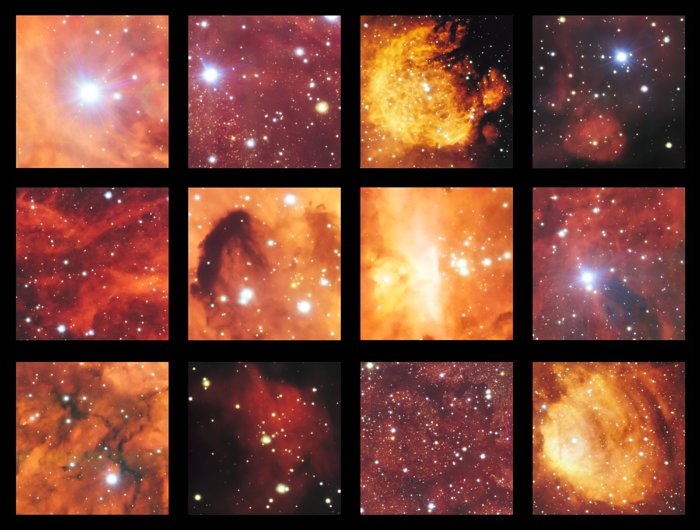
This collection of highlights is taken from a new infrared image of the Orion A molecular cloud from the VISTA telescope. Many curious structures are clearly seen, including the red jets from very young stars, dark clouds of dust and even tiny images of very distant galaxies. [Larger images]VISTA can see light that the human eye cannot, allowing astronomers to identify many otherwise hidden objects in the stellar nursery. Very young stars that cannot be seen in visible-light images are revealed when observed at longer infrared wavelengths, where the dust that shrouds them is more transparent.
The new image represents a step towards a complete picture of the star formation processes in Orion A, for both low and high mass stars. The most spectacular object is the glorious Orion Nebula, also called Messier 42[4] seen towards the left of the image. This region forms part of the sword of the famous bright constellation of Orion (The Hunter). The VISTA catalogue covers both familiar objects and new discoveries. These include five new young stellar object candidates and ten candidate galaxy clusters.
This zoom sequence takes the viewer from a wide view of the Milky Way deep into a fascinating part of the famous constellation of Orion. By observing in near-infrared light the new picture from VISTA, a survey telescope at ESO’s Paranal Observatory, reveals huge numbers of objects that are normally obscured by dust in visible light pictures of the region.
Elsewhere in the image, we can look into Orion A’s dark molecular clouds and spot many hidden treasures, including discs of material that could give birth to new stars (pre-stellar discs), nebulosity associated with newly-born stars (Herbig-Haro objects), smaller star clusters and even galaxy clusters lying far beyond the Milky Way. The VISION survey allows the earliest evolutionary phases of young stars within nearby molecular clouds to be systematically studied.
This impressively detailed image of Orion A establishes a new observational foundation for further studies of star and cluster formation and once again highlights the power of the VISTA telescope to image wide areas of sky quickly and deeply in the near-infrared part of the spectrum [5].
This sequence compares a new infrared image from the VISTA survey telescope at ESO’s Paranal Observatory in northern Chile with a visible light view of the region from the Digitized Sky Survey 2 (DSS).
This new infrared VISTA image is part of the largest infrared high-resolution mosaic of Orion ever created and covers the Orion A molecular cloud, the nearest known massive star factory, lying about 1350 light-years from Earth. The new infrared images reveal many young stars and other objects normally buried deep inside the dusty clouds.
Notes
[1] The VISION survey covers approximately 18.3 square degrees at a scale of about one-third of an arcsecond per pixel.
[2] The other giant molecular cloud in the Orion Molecular Cloud is Orion B, which lies east of Orion’s Belt.
[3] The complete VISION survey includes an even larger region than is shown in this picture, which covers 39 578 x 23 069 pixels.
[4] The Orion nebula was first described in the early seventeenth century although the identity of the discoverer is uncertain. The French comet-hunter Messier made an accurate sketch of its main features in the mid-eighteenth century and gave it the number 42 in his famous catalogue. He also allocated the number 43 to the smaller detached region just north of the main part of the nebula. Later William Herschel speculated that the nebula might be “the chaotic material of future suns”and astronomers have since discovered that the mist is indeed gas glowing in the fierce ultraviolet light from young hot stars that have recently formed there.
[5] The successful VISION survey of Orion will be followed by a new, bigger public survey of other star-forming regions with VISTA, called VISIONS, which will start in April 2017.
The compound view shows a new ALMA Band 5 view of the colliding galaxy system Arp 220 (in red) on top of an image from the NASA/ESA Hubble Space Telescope (blue/green). With the newly installed Band 5 receivers, ALMA has now opened its eyes to a whole new section of this radio spectrum, creating exciting new observational possibilities and improving the telescope’s ability to search for water in the Universe. This image is one of the first taken using Band 5 and was intended to verify the scientific capability of the new receivers. The ALMA image includes data recording emission from water, CS and HCN in the galaxies. [Larger images.]The Atacama Large Millimeter/submillimeter Array (ALMA) in Chile has begun observing in a new range of the electromagnetic spectrum. This has been made possible thanks to new receivers installed at the telescope’s antennas, which can detect radio waves with wavelengths from 1.4 to 1.8 millimetres — a range previously untapped by ALMA. This upgrade allows astronomers to detect faint signals of water in the nearby Universe.
ALMA observes radio waves from the Universe, at the low-energy end of the electromagnetic spectrum. With the newly installed Band 5 receivers, ALMA has now opened its eyes to a whole new section of this radio spectrum, creating exciting new observational possibilities.
The European ALMA Programme Scientist, Leonardo Testi, explains the significance:
“The new receivers will make it much easier to detect water, a prerequisite for life as we know it, in our Solar System and in more distant regions of our galaxy and beyond. They will also allow ALMA to search for ionised carbon in the primordial Universe.”
It is ALMA’s unique location, 5000 metres up on the barren Chajnantor plateau in Chile, that makes such an observation possible in the first place. As water is also present in Earth’s atmosphere, observatories in less elevated and less arid environments have much more difficulty identifying the origin of the emission coming from space. ALMA’s great sensitivity and high angular resolution mean that even faint signals of water in the local Universe can now be imaged at this wavelength [1].
Band 5 receiver integrated with receivers for all the other current ALMA Bands (3 to 10). [Larger image.]The first production receivers were built and delivered to ALMA in the first half of 2015 by a consortium consisting of the Netherlands Research School for Astronomy (NOVA) and GARD in partnership with the National Radio Astronomy Observatory (NRAO), which contributed the local oscillator to the project. The receivers are now installed and being prepared for use by the community of astronomers.
To test the newly installed receivers observations were made of several objects including the colliding galaxies Arp 220, a massive region of star formation close to the centre of the Milky Way, and also a dusty red supergiant star approaching the supernova explosion that will end its life [2].
To process the data and check its quality, astronomers, along with technical specialists from ESO and the European ALMA Regional Centre (ARC) network, gathered at the Onsala Space Observatory in Sweden, for a “Band 5 Busy Week” hosted by the Nordic ARC node[3]. The final results have just been made freely available to the astronomical community worldwide.
Team member Robert Laing at ESO is optimistic about the prospects for ALMA Band 5 observations:
“It’s very exciting to see these first results from ALMA Band 5 using a limited set of antennas. In the future, the high sensitivity and angular resolution of the full ALMA array will allow us to make detailed studies of water in a wide range of objects including forming and evolved stars, the interstellar medium and regions close to supermassive black holes.”
Notes [1] A key spectral signature of water lies in this expanded range — at a wavelength of 1.64 millimetres.
[2] The observations were performed and made possible by the ALMA Extension of Capabilities team in Chile.
[3] The ESO Band 5 Science Verification team includes: Elizabeth Humphreys, Tony Mroczkowski, Robert Laing, Katharina Immer, Hau-Yu (Baobab) Liu, Andy Biggs, Gianni Marconi and Leonardo Testi. The team working on processing the data included: Tobia Carozzi, Simon Casey, Sabine König, Ana Lopez-Sepulcre, Matthias Maercker, Iván Martí-Vidal, Lydia Moser, Sebastien Muller, Anita Richards, Daniel Tafoya and Wouter Vlemmings.
Want to know the size (in kilometers or miles) of a sunspot, lunar crater, festoon on Jupiter, etc. that you see in a photographic image? My latest software creation called Automated Astronomical Object Feature Measurer (or AAOFM for short) can quickly and accurately tell you the answer. The app is offered free for download.
Designed to run on Windows, Linux and Mac computers. Note: This is a beta version and I need feedback concerning any bugs that may exist in the app. I have installed and run the software successfully on Windows and Linux computers; therefore, input from Mac users would be appreciated.
Click the image below to go to my website and choose the menu option to the left labeled Automated Astronomical Object Feature Measurer to go to the appropriate download area.