NASA JPL describes what to look for in the night sky in the coming month:
This month the moon hides red Aldebaran, Venus and Mercury show their phases. Find more astronomy information and events in your area by visiting https://nightsky.jpl.nasa.gov/
The Hubble Space Telescope offers its own night sky highlights report:
Backyard stargazers get a monthly guide to the northern hemisphere’s skywatching events with “Tonight’s Sky.” The March equinox still grants plenty of dark nighttime skies for planet-hunting.
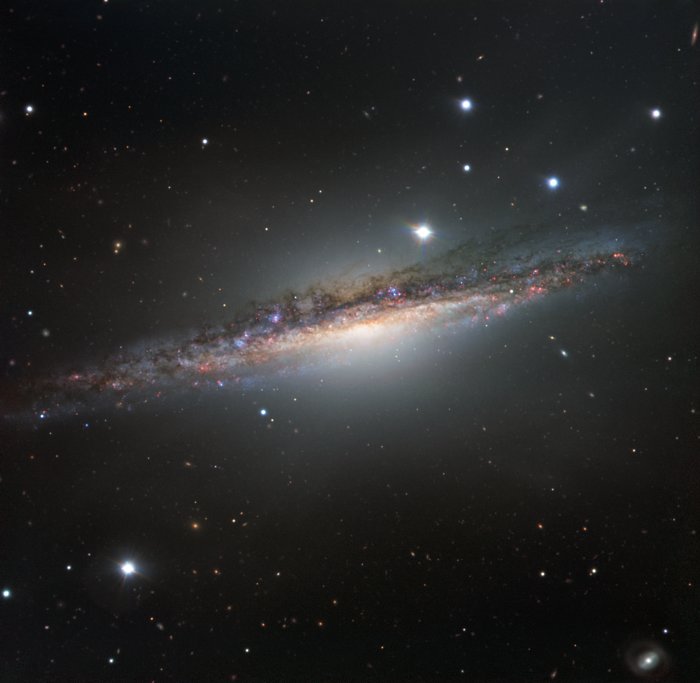
This colourful stripe of stars, gas, and dust is actually a spiral galaxy named NGC 1055. Captured here by ESO’s Very Large Telescope (VLT), this big galaxy is thought to be up to 15 percent larger in diameter than the Milky Way. NGC 1055 appears to lack the whirling arms characteristic of a spiral, as it is seen edge-on. However, it displays odd twists in its structure that were probably caused by an interaction with a large neighbouring galaxy.
This colourful image from ESO’s Very Large Telescope shows NGC 1055 in the constellation of Cetus (The Sea Monster). This large galaxy is thought to be up to 15 percent larger in diameter than the Milky Way. NGC 1055 appears to lack the whirling arms characteristic of a spiral, as it is seen edge-on. However, it displays odd twists in its structure that were probably caused by an interaction with a large neighbouring galaxy. [Larger image.]Spiral galaxies throughout the Universe take on all manner of orientations with respect to Earth. We see some from above (as it were) or “face-on” — a good example of this being the whirlpool-shaped galaxy NGC 1232. Such orientations reveal a galaxy’s flowing arms and bright core in beautiful detail, but make it difficult to get any sense of a three-dimensional shape.
A new image from ESO’s Very Large Telescope gives a very detailed view of the edge-on galaxy NGC 1055. This ESOcast Light takes a quick look at this image and explains what it shows.
We see other galaxies, such as NGC 3521, at angles. While these tilted objects begin to reveal the three-dimensional structure within their spiral arms, fully understanding the overall shape of a spiral galaxy requires an edge-on view — such as this one of NGC 1055.
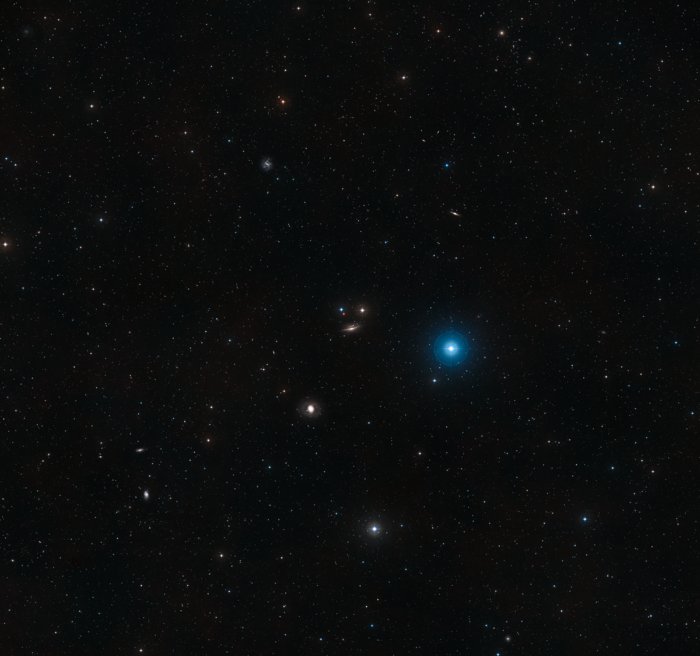
This rich wide-field view captures not only the edge-on galaxy NGC 1055 at the centre but also the bright galaxy NGC 1068 (also known as Messier 77, it is an active galaxy with a huge black hole at its centre) to its lower-left, the fainter galaxy NGC 1032 to the upper right and the barred spiral galaxy NGC 1073 to the upper left. In addition, much closer to home, the bright naked-eye blue star Delta Ceti appears at the right of centre. This picture was created from images in the Digitized Sky Survey 2. [Larger images.]When seen edge-on, it is possible to get an overall view of how stars — both new patches of starbirth and older populations — are distributed throughout a galaxy, and the “heights” of the relatively flat disc and the star-loaded core become easier to measure. Material stretches away from the blinding brightness of the galactic plane itself, becoming more clearly observable against the darker background of the cosmos.
Such a perspective also allows astronomers to study the overall shape of a galaxy’s extended disc, and to study its properties. One example of this is warping, which is something we see in NGC 1055. The galaxy has regions of peculiar twisting and disarray in its disc, likely caused by interactions with the nearby galaxy Messier 77 (eso0319) [1]. This warping is visible here; NGC 1055’s disc is slightly bent and appears to wave across the core.
This video sequence takes the viewer deep into the faint constellation of Cetus (The Sea Monster) and finishes on a new and very detailed view of the edge-on galaxy NGC 1055 from ESO’s Very Large Telescope in northern Chile. Credit: ESO/Digitized Sky Survey 2/A. Fujii. Music: Astral Electronic
NGC 1055 is located approximately 55 million light-years away in the constellation of Cetus (The Sea Monster). This image was obtained using the FOcal Reducer and low dispersion Spectrograph 2 (FORS2) instrument mounted on Unit Telescope 1 (Antu) of the VLT, located at ESO’s Paranal Observatory in Chile. It hails from ESO’s Cosmic Gems programme, an outreach initiative that produces images of interesting, intriguing or visually attractive objects using ESO telescopes for the purposes of education and outreach.
Notes [1] Messier 77, also known as NGC 1068, has a very brilliant central region powered by a supermassive black hole. It is one of the nearest examples of what astronomers call active galaxies.
Three decades ago, a massive stellar explosion sent shockwaves not only through space but also through the astronomical community. SN 1987A was the closest observed supernova to Earth since the invention of the telescope and has become by far the best studied of all time, revolutionising our understanding of the explosive death of massive stars.
This new image of the supernova remnant SN 1987A was taken by the NASA/ESA Hubble Space Telescope in January 2017 using its Wide Field Camera 3 (WFC3). Since its launch in 1990 Hubble has observed the expanding dust cloud of SN 1987A several times and this way helped astronomers to create a better understanding of these cosmic explosions. Supernova 1987A is located in the centre of the image amidst a backdrop of stars. The bright ring around the central region of the exploded star is composed of material ejected by the star about 20 000 years before the actual explosion took place. The supernova is surrounded by gaseous clouds. The clouds’ red colour represents the glow of hydrogen gas. The colours of the foreground and background stars were added from observations taken by Hubble’s Wide Field Planetary Camera 2 (WFPC2). [Larger image.]Located in the Large Magellanic Cloud, a satellite galaxy of the Milky Way, Supernova 1987A is the nearest supernova explosion observed in hundreds of years. It marked the end of the life of a massive star and sent out a shockwave of ejected material and bright light into space. The light finally reached Earth on 23 February 1987 — like a cosmic blast from the past.
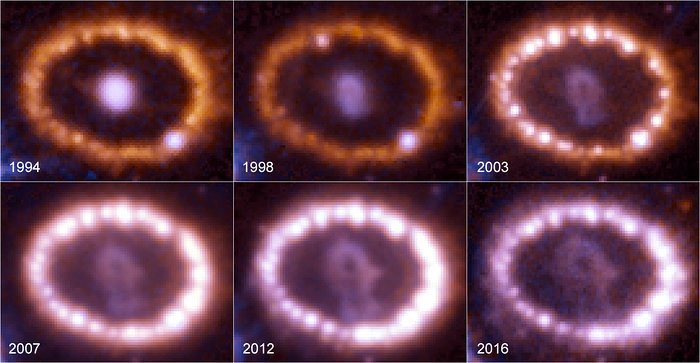
This time-lapse video sequence, created of images taken with the NASA/ESA Hubble Space Telescope, reveals the dramatic changes in the ring of material around the supernova 1987A. The images, taken between 1994 to 2016, show the movement of debris from the supernova within the ring. The ring, about one light-year across, also begins to brighten as the shock wave of material hits it.
The NASA/ESA Hubble Space Telescope has been on the front line of observations of SN 1987A since 1990 and has taken a look at it many times over the past 27 years. To celebrate the 30th anniversary of the supernova and to check how its remnant has developed, Hubble took another image of the distant explosion in January 2017, adding to the existing collection.
This montage shows the evolution of the supernova SN 1987A between 1994 and 2016, as seen by the NASA/ESA Hubble Space Telescope. The supernova explosion was first spotted in 1987 and is among the brightest supernova within the last 400 years. Hubble began observing the aftermath of the explosion shortly after it was launched in 1990. The growing number of bright spots on the ring was produced by an onslaught of material unleashed by the explosion. The shock wave of material hit the ring’s innermost regions, heating them up, and causing them to glow. The ring, about one light-year across, was probably shed by the star about 20,000 years before the star exploded. [Larger image.]Because of its early detection and relative proximity to Earth, SN 1987A has become the best studied supernova ever. Prior to SN 1987A, our knowledge of supernovae was simplistic and idealised. But by studying the evolution of SN 1987A from supernova to supernova remnant in superb detail, using telescopes in space and on the ground, astronomers have gained revolutionary insights into the deaths of massive stars.
Using computer simulations astronomers can visualise the development of the supernova 1987A, from its initial blast observed three decades ago to the luminous ring of material seen today: The sequence begins with the star before it exploded. A ring of material was expelled about 20 000 years before the actual supernova happened. A flash of light indicates the actual stellar explosion which sends a shock wave outwards. As this wave slams into the ring, knots of dense material become intensely heated and glow brightly, while was with lower density is blown outward. Credit: NASA, ESA, and F. Summers and G. Bacon (STScI)
Back in 1990, Hubble was the first to see the event in high resolution, clearly imaging the main ring that blazes around the exploded star. It also discovered the two fainter outer rings, which extend like mirror images in a hourglass-shaped structure. Even today, the origin of these structures is not yet fully understood.
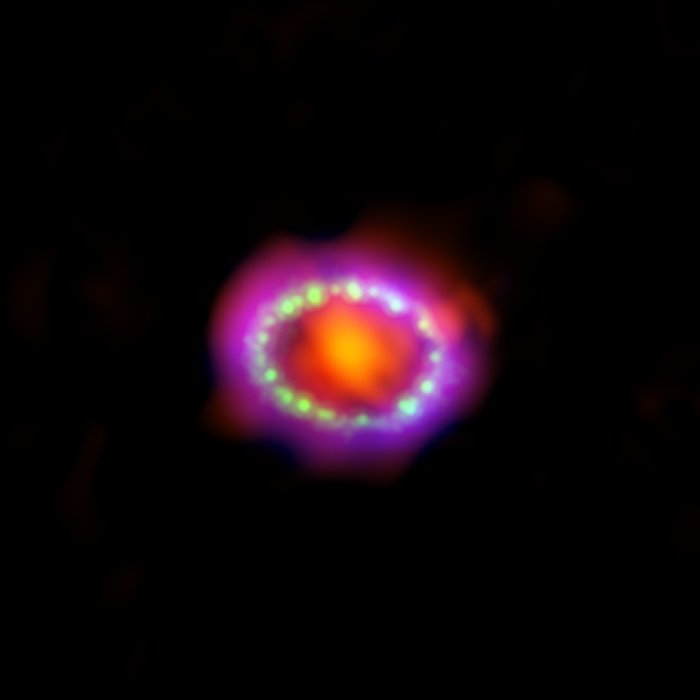
Astronomers combined observations from three different observatoriesto produce this multiwavelength image of the remnants of supernova SN 1987A. The red colour shows newly formed dust in the centre of the supernova remnant, taken at submillimeter wavelengths by the Atacama Large Millimeter/submillimeter Array (ALMA) telescope in Chile. The green represents the glow of visible light, captured by the NASA/ESA Hubble Space Telescope. The blue color reveals the hottest gas and is based on data from NASA’s Chandra X-Ray observatory. The green and blue hues reveal where the expanding shock wave from the explosion is colliding with a ring of material around the supernova. This ring was initially illuminated by the ultraviolet flash from the explosion, but over the past few years the ring material has brightened considerably as it collides with the expanding shock wave. [Larger image.]However, by observing the expanding remnant material over the years, Hubble helped to show that the material within this structure was ejected 20 000 years before the actual explosion took place. Its shape at first surprised astronomers, who expected the dying star to eject material in a spherical shape — but faster stellar winds likely caused the slower material to pile up into ring-like structures.
The initial burst of light from the supernova illuminated the rings. They slowly faded over the first decade after the explosion, until the shock wave of the supernova slammed into the inner ring in 2001, heating the gas to searing temperatures and generating strong X-ray emission. Hubble’s observations of this process shed light on how supernovae can affect the dynamics and chemistry of their surrounding environment, and thus shape galactic evolution.
This video starts with a view of the night sky as seen from the ground and zooms in onto the Large Magellanic Cloud, a satellite galaxy of the Milky Way. A further zoom shows the remnants of the supernova explosion 1987A, nestled between red-coloured gas, as they are seen by Hubble. The site of the supernova is surrounded by a ring of material that is illuminated by a wave of energy from the outburst. Two faint outer rings are also visible. All three of these rings existed before the explosion.Credit: NASA, ESA, and G. Bacon (STScI)
Here is a video of the NASA panel discussion of the findings by an international team of the TRAPPIST-1 star system with 7 earth sized exoplanets (see earlier posting here).
The briefing participants included:
Thomas Zurbuchen, associate administrator of the Science Mission Directorate at NASA Headquarters in Washington
Michael Gillon, astronomer at the University of Liege in Belgium
Sean Carey, manager of NASA’s Spitzer Science Center at Caltech/IPAC, Pasadena, California
Nikole Lewis, astronomer at the Space Telescope Science Institute in Baltimore
Sara Seager, professor of planetary science and physics at Massachusetts Institute of Technology, Cambridge
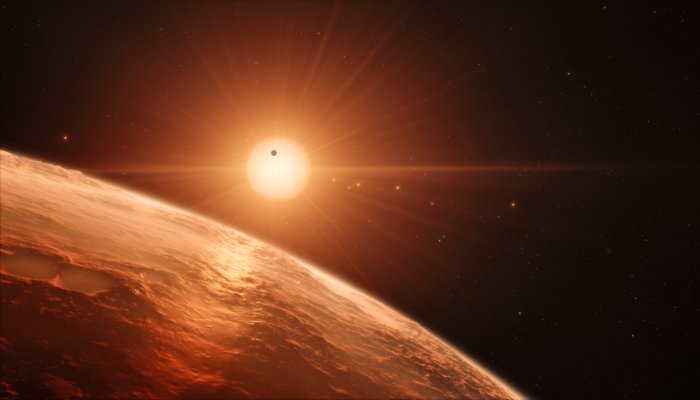
This artist’s impression shows the view from the surface of one of the planets in the TRAPPIST-1 system. At least seven planets orbit this ultra cool dwarf star 40 light-years from Earth and they are all roughly the same size as the Earth. They are at the right distances from their star for liquid water to exist on the surfaces of several of them. This artist’s impression is based on the known physical parameters for the planets and stars seen, and uses a vast database of objects in the Universe. [Full size image]Astronomers have found a system of seven Earth-sized planets just 40 light-years away. Using ground and space telescopes, including ESO’s Very Large Telescope, the planets were all detected as they passed in front of their parent star, the ultracool dwarf star known as TRAPPIST-1. According to the paper appearing today in the journal Nature, three of the planets lie in the habitable zone and could harbour oceans of water on their surfaces, increasing the possibility that the star system could play host to life. This system has both the largest number of Earth-sized planets yet found and the largest number of worlds that could support liquid water on their surfaces.
Astronomers using the TRAPPIST–South telescope at ESO’s La Silla Observatory, the Very Large Telescope (VLT) at Paranal and the NASA Spitzer Space Telescope, as well as other telescopes around the world [1], have now confirmed the existence of at least seven small planets orbiting the cool red dwarf star TRAPPIST-1[2]. All the planets, labelled TRAPPIST-1b, c, d, e, f, g and h in order of increasing distance from their parent star, have sizes similar to Earth [3].
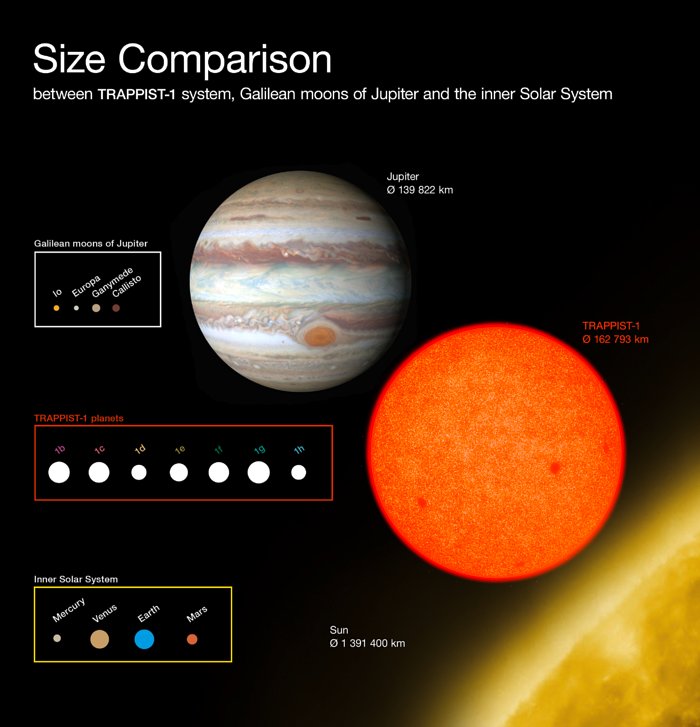
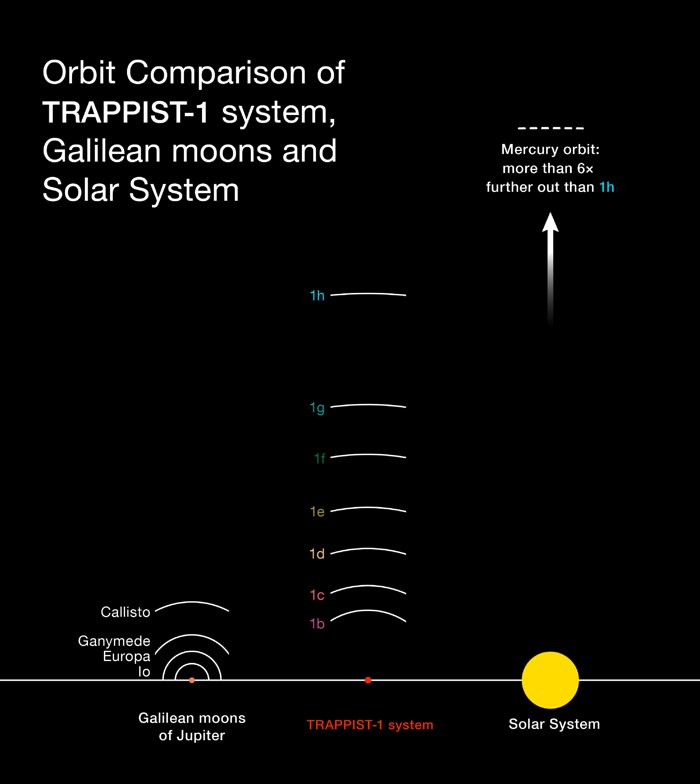
This diagram compares the sizes of the newly-discovered planets around the faint red star TRAPPIST-1 with the Galilean moons of Jupiter and the inner Solar System. All the planets found around TRAPPIST-1 are of similar size to the Earth. [Full size image.]Dips in the star’s light output caused by each of the seven planets passing in front of it — events known as transits — allowed the astronomers to infer information about their sizes, compositions and orbits [4]. They found that at least the inner six planets are comparable in both size and temperature to the Earth.
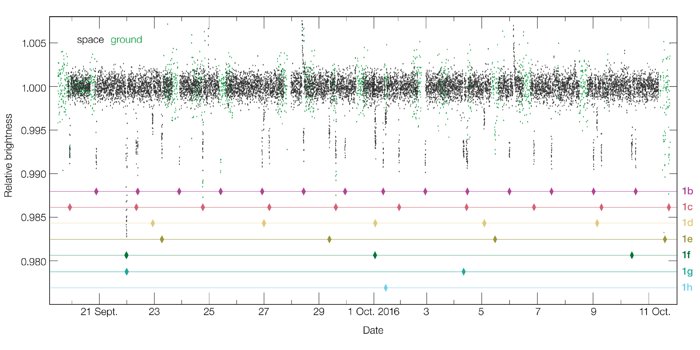
This diagram shows the changing brightness of the ultra cool dwarf star TRAPPIST-1 over a period of 20 days in September and October 2016 as measured by NASA’s Spitzer Space Telescope and many other telescopes on the ground. On many occasions the brightness of the star drops for a short period and then returns to normal. These events, called transits, are due to one or more of the star’s seven planets passing in front of the star and blocking some of its light. The lower part of the diagram shows which of the system’s planets are responsible for the transits. [Full size image]
Lead author Michaël Gillon of the STAR Institute at the University of Liège in Belgium is delighted by the findings:
“This is an amazing planetary system — not only because we have found so many planets, but because they are all surprisingly similar in size to the Earth!”
With just 8% the mass of the Sun, TRAPPIST-1 is very small in stellar terms — only marginally bigger than the planet Jupiter — and though nearby in the constellation Aquarius (The Water Carrier), it appears very dim. Astronomers expected that such dwarf stars might host many Earth-sized planets in tight orbits, making them promising targets in the hunt for extraterrestrial life, but TRAPPIST-1 is the first such system to be found.
Co-author Amaury Triaud expands:
“The energy output from dwarf stars like TRAPPIST-1 is much weaker than that of our Sun. Planets would need to be in far closer orbits than we see in the Solar System if there is to be surface water. Fortunately, it seems that this kind of compact configuration is just what we see around TRAPPIST-1!”
The team determined that all the planets in the system are similar in size to Earth and Venus in the Solar System, or slightly smaller. The density measurements suggest that at least the innermost six are probably rocky in composition.
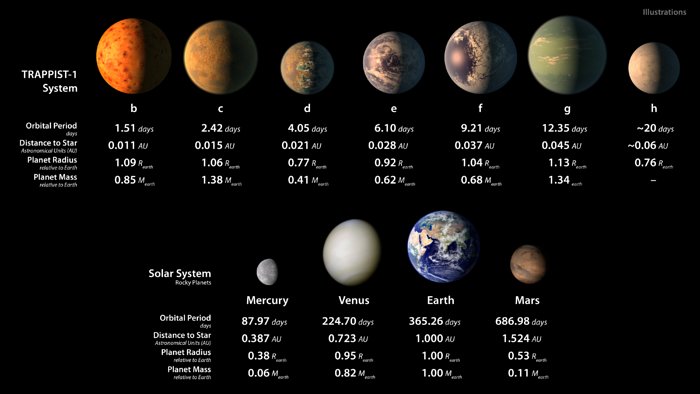
This infographic displays some artist’s illustrations of how the seven planets orbiting TRAPPIST-1 might appear — including the possible presence of water oceans — alongside some images of the rocky planets in our Solar System. Information about the size and orbital periods of all the planets is also provided for comparison; the TRAPPIST-1 planets are all approximately Earth-sized. [Full sized image]The planetary orbits are not much larger than that of Jupiter’s Galilean moon system, and much smaller than the orbit of Mercury in the Solar System. However, TRAPPIST-1’s small size and low temperature mean that the energy input to its planets is similar to that received by the inner planets in our Solar System; TRAPPIST-1c, d and f receive similar amounts of energy to Venus, Earth and Mars, respectively.
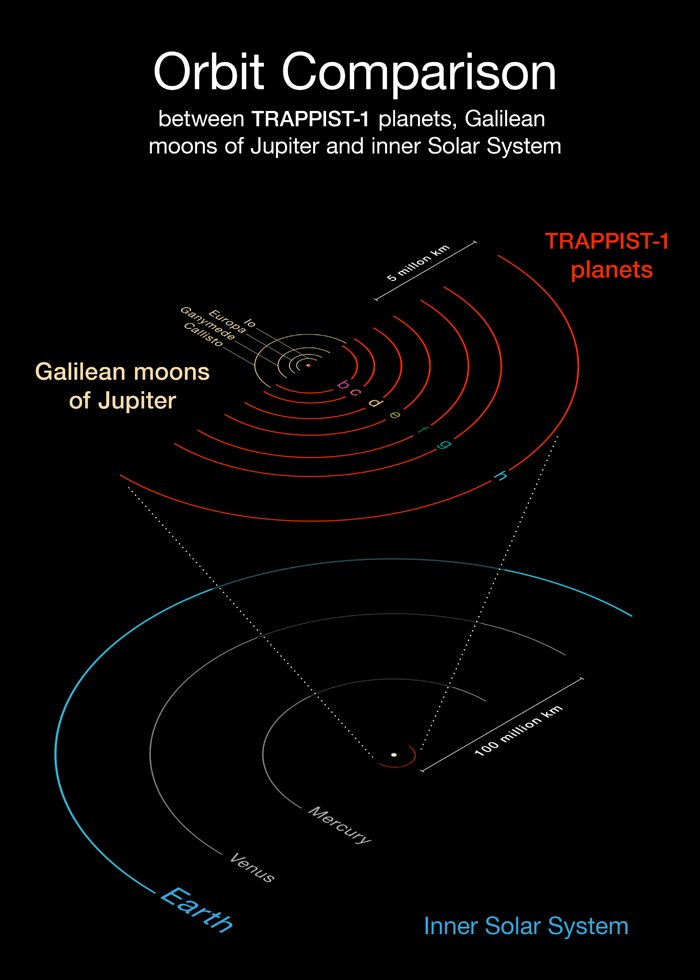
This diagram compares the orbits of the newly-discovered planets around the faint red star TRAPPIST-1 with the Galilean moons of Jupiter and the inner Solar System. All the planets found around TRAPPIST-1 orbit much closer to their star than Mercury is to the Sun, but as their star is far fainter, they are exposed to similar levels of irradiation as Venus, Earth and Mars in the Solar System. [Full size image ]All seven planets discovered in the system could potentially have liquid water on their surfaces, though their orbital distances make some of them more likely candidates than others. Climate models suggest the innermost planets, TRAPPIST-1b, c and d, are probably too hot to support liquid water, except maybe on a small fraction of their surfaces. The orbital distance of the system’s outermost planet, TRAPPIST-1h, is unconfirmed, though it is likely to be too distant and cold to harbour liquid water — assuming no alternative heating processes are occurring [5]. TRAPPIST-1e, f, and g, however, represent the holy grail for planet-hunting astronomers, as they orbit in the star’s habitable zone and could host oceans of surface water [6].
This diagram compares the orbits of the newly-discovered planets around the faint red star TRAPPIST-1 with the Galilean moons of Jupiter and the inner Solar System. All the planets found around TRAPPIST-1 orbit much closer to their star than Mercury is to the Sun, but as their star is far fainter, they are exposed to similar levels of irradiation as Venus, Earth and Mars in the Solar System. [Full size image]These new discoveries make the TRAPPIST-1 system a very important target for future study. The NASA/ESA Hubble Space Telescope is already being used to search for atmospheres around the planets and team member Emmanuël Jehin is excited about the future possibilities:
This video takes the viewer on a quick trip from Earth, past the Moon and far beyond. We finally arrive at the faint red ultracool dwarf star TRAPPIST-1, which has a remarkable seven planets orbiting it, all having sizes similar to the Earth.
The stars in the animation are accurately positioned as in reality. The tiny ultracool dwarf TRAPPIST-1 is so dim that it would remain invisible to the naked eye until the imaginary traveller gets very close, when its seven orbiting planets can also be seen.
The artist’s impression in this video is based on the known physical parameters for the planets and stars seen, and uses a vast database of objects in the Universe. Credit: ESO/L. Calçada/spaceengine.org
[2] TRAPPIST–South (the TRAnsiting Planets and PlanetesImals Small Telescope–South) is a Belgian 0.6-metre robotic telescope operated from the University of Liège and based at ESO’s La Silla Observatory in Chile. It spends much of its time monitoring the light from around 60 of the nearest ultracool dwarf stars and brown dwarfs (“stars” which are not quite massive enough to initiate sustained nuclear fusion in their cores), looking for evidence of planetary transits. TRAPPIST–South, along with its twin TRAPPIST–North, are the forerunners to the SPECULOOS system, which is currently being installed at ESO’s Paranal Observatory.
[3] In early 2016, a team of astronomers, also led by Michaël Gillon announced the discovery of three planets orbiting TRAPPIST-1. They intensified their follow-up observations of the system mainly because of a remarkable triple transit that they observed with the HAWK-I instrument on the VLT. This transit showed clearly that at least one other unknown planet was orbiting the star. And that historic light curve shows for the first time three temperate Earth-sized planets, two of them in the habitable zone, passing in front of their star at the same time!
[4] This is one of the main methods that astronomers use to identify the presence of a planet around a star. They look at the light coming from the star to see if some of the light is blocked as the planet passes in front of its host star on the line of sight to Earth — it transits the star, as astronomers say. As the planet orbits around its star, we expect to see regular small dips in the light coming from the star as the planet moves in front of it.
[5] Such processes could include tidal heating, whereby the gravitational pull of TRAPPIST-1 causes the planet to repeatedly deform, leading to inner frictional forces and the generation of heat. This process drives the active volcanism on Jupiter’s moon Io. If TRAPPIST-1h has also retained a primordial hydrogen-rich atmosphere, the rate of heat loss could be very low.
[6] This discovery also represents the largest known chain of exoplanets orbiting in near-resonance with each other. The astronomers carefully measured how long it takes for each planet in the system to complete one orbit around TRAPPIST-1 — known as the revolution period — and then calculated the ratio of each planet’s period and that of its next more distant neighbour. The innermost six TRAPPIST-1 planets have period ratios with their neighbours that are very close to simple ratios, such as 5:3 or 3:2. This means that the planets most likely formed together further from their star, and have since moved inwards into their current configuration. If so, they could be low-density and volatile-rich worlds, suggesting an icy surface and/or an atmosphere.