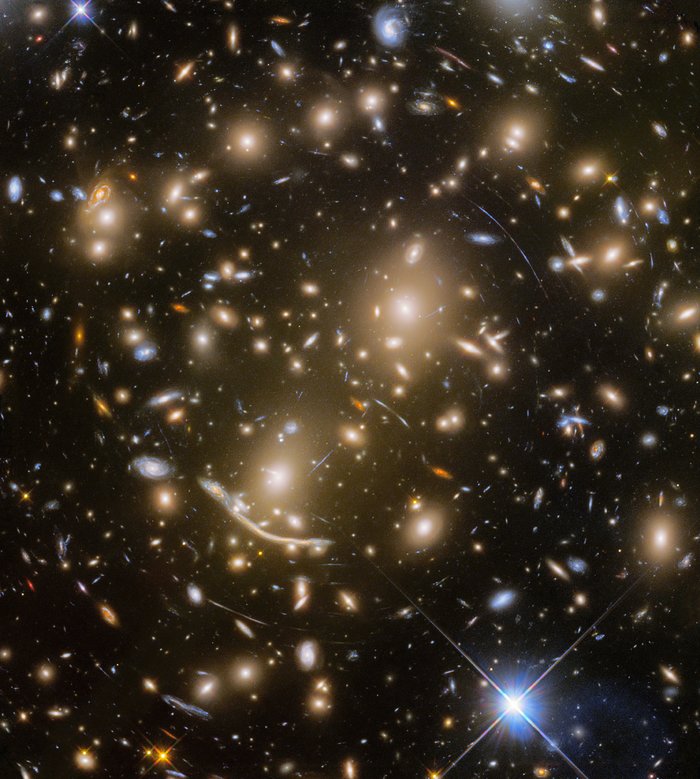
The NASA/ESA Hubble Telescope has peered across six billion light years of space to resolve extremely faint features of the galaxy cluster Abell 370 that have not been seen before. Imaged here in stunning detail, Abell 370 is part of the Frontier Fields programme which uses massive galaxy clusters to study the mysteries of dark matter and the very early Universe.
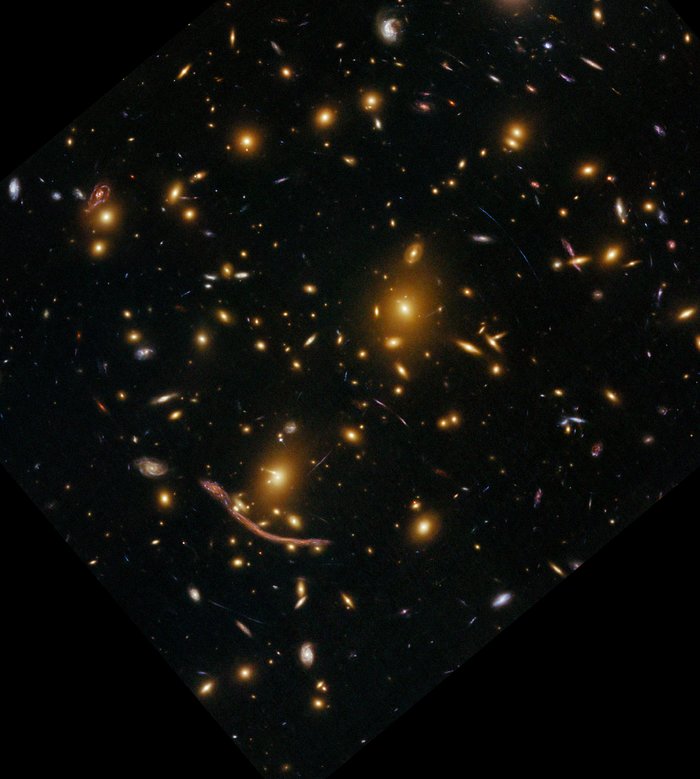
With the final observation of the distant galaxy cluster Abell 370 — some five billion light-years away — the Frontier Fields program came to an end. Abell 370 is one of the very first galaxy clusters in which astronomers observed the phenomenon of gravitational lensing, the warping of spacetime by the cluster’s gravitational field that distorts the light from galaxies lying far behind it. This manifests as arcs and streaks in the picture, which are the stretched images of background galaxies. [Larger version]Six billion light-years away in the constellation Cetus (the Sea Monster), Abell 370 is made up of hundreds of galaxies [1]. Already in the mid-1980s higher-resolution images of the cluster showed that the giant luminous arc in the lower left of the image was not a curious structure within the cluster, but rather an astrophysical phenomenon: the gravitationally lensed image of a galaxy twice as far away as the cluster itself. Hubble helped show that this arc is composed of two distorted images of an ordinary spiral galaxy that just happens to lie behind the cluster.
This zoom starts with a ground-based view of the sky and zooms in on the distant galaxy cluster Abell 370, as seen by the NASA/ESA Hubble Space Telescope. The mass of the cluster is large enough to bend the light of more distant objects along the line of sight. This creates interesting distortions, fascinating arcs and it even magnifies objects which would otherwise be to faint and tiny to be seen by Hubble. Credit: ESA/Hubble Music: Richard Hasbia “Stan Dart”
Abell 370’s enormous gravitational influence warps the shape of spacetime around it, causing the light of background galaxies to spread out along multiple paths and appear both distorted and magnified. The effect can be seen as a series of streaks and arcs curving around the centre of the image. Massive galaxy clusters can therefore act like natural telescopes, giving astronomers a close-up view of the very distant galaxies behind the cluster — a glimpse of the Universe in its infancy, only a few hundred million years after the Big Bang.
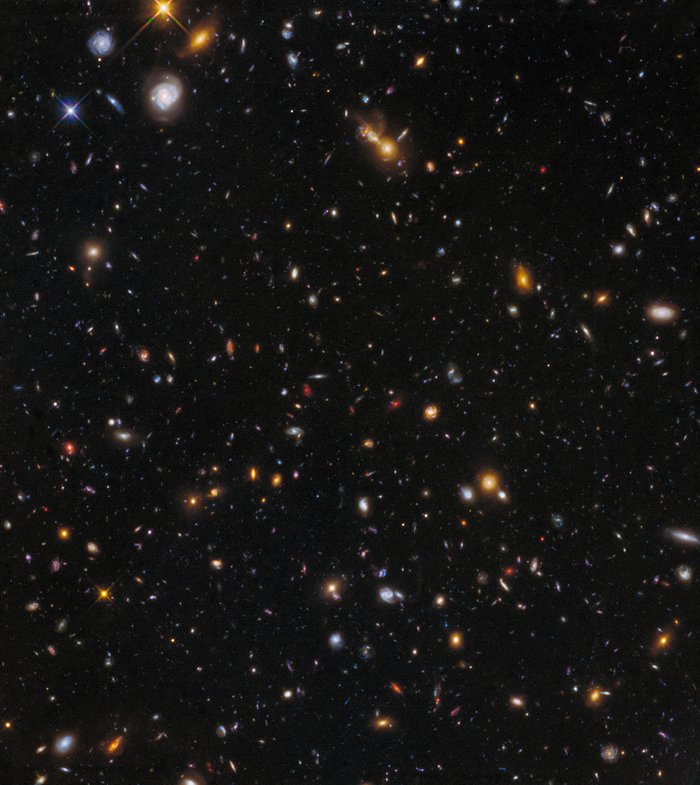
While one eye of Hubble was observing its main target, the massive galaxy cluster Abell 370, the second eye — another instrument — was looking at a part of the sky right next to the cluster. Although not as spectacular as the light-bending clusters, these parallel fields are as deep as the main images and can even compete with the famous Hubble Deep Field as regards depth. They are therefore a valuable tool for studying the evolution of galaxies from the early epochs of the Universe until today. Credit: NASA, ESA/Hubble, HST Frontier Fields [Larger version]This image of Abell 370 was captured as part of the Frontier Fields programme, which used a whopping 630 hours of Hubble observing time, over 560 orbits of the Earth. Six clusters of galaxies were imaged in exquisite detail, including Abell 370 which was the very last one to be finished. An earlier image of this object — using less observation time and therefore not recording such faint detail — was published in 2009.
During the cluster observations, Hubble also looked at six “parallel fields”, regions near the galaxy clusters which were imaged with the same exposure times as the clusters themselves. Each cluster and parallel field were imaged in infrared light by the Wide Field Camera 3 (WFC3), and in visible light by the Advanced Camera for Surveys (ACS).
This video pans across the massive galaxy cluster Abell 370, the last cluster to be observed as part of the Frontier Fields programme. The huge mass of the cluster bends the light from more distant objects, creating distorted and magnified images of them. This allows astronomers to calculate the total mass of the cluster — both normal matter and dark matter — and to investigate objects in the early Universe that would be otherwise too faint and tiny for Hubble to see. Astronomers believe this distortion is caused by dark matter that holds together the mix of galaxies and intergalactic hot gas. Credit:ESA/Hubble Music: Richard Hasbia “Stan Dart”
The Frontier Fields programme produced the deepest observations ever made of galaxy clusters and the magnified galaxies behind them. These observations are helping astronomers understand how stars and galaxies emerged out of the dark ages of the Universe, when space was dark, opaque, and filled with hydrogen.
Studying massive galaxy clusters like Abell 370 also helps with measuring the distribution of normal matter and dark matter within such clusters [heic1506]. By studying its lensing properties, astronomers have determined that Abell 370 contains two large, separate clumps of dark matter, contributing to the evidence that this massive galaxy cluster is actually the result of two smaller clusters merging together.
Now that the observations for the Frontier Fields programme are complete, astronomers can use the full dataset to explore the clusters, their gravitational lensing effects and the magnified galaxies from the early Universe in full detail.
This image of Abell 370 was released in 2009. Compared the the new image, which contains more observation time, less structures are visible and faint objects have disappeared — the new image has increased the depth of the image dramatically, clearly showing the benefit of additional observation time. A direct comparison between both images can be seen here. [Larger version]Notes
[1] Galaxy clusters are the most massive structures in the Universe that are held together by gravity, generally thought to have formed when smaller groups of galaxies smashed into each other in ever-bigger cosmic collisions. Such clusters can contain up to 1000 galaxies, along with hot intergalactic gas that often shines brightly at X-ray wavelengths, all bound together primarily by the gravity of dark matter.
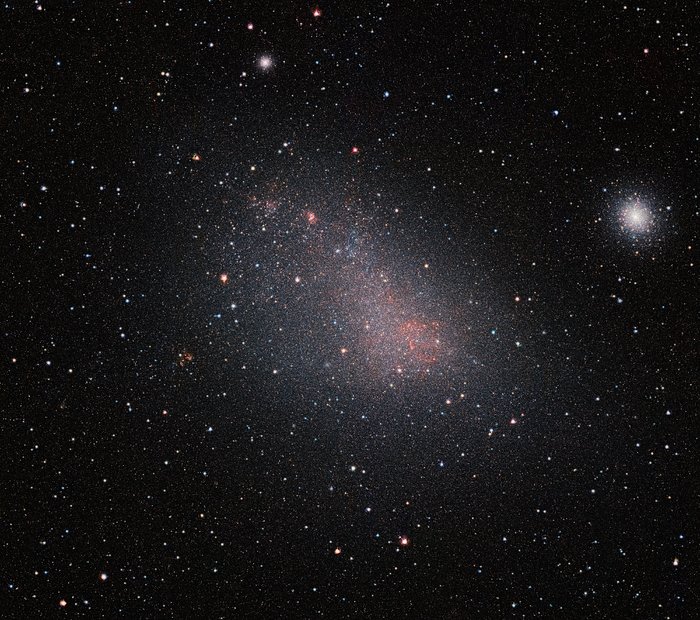
The Small Magellanic Cloud galaxy is a striking feature of the southern sky even to the unaided eye. But visible-light telescopes cannot get a really clear view of what is in the galaxy because of obscuring clouds of interstellar dust. VISTA’s infrared capabilities have now allowed astronomers to see the myriad of stars in this neighbouring galaxy much more clearly than ever before. The result is this record-breaking image — the biggest infrared image ever taken of the Small Magellanic Cloud — with the whole frame filled with millions of stars.
The Small Magellanic Cloud (SMC) galaxy is a striking feature of the southern sky even to the unaided eye. But visible-light telescopes cannot get a really clear view of what is in the galaxy because of obscuring clouds of interstellar dust. VISTA’s infrared capabilities have now allowed astronomers to see the myriad of stars in this neighbouring galaxy much more clearly than ever before. The result is this record-breaking image — the biggest infrared image ever taken of the Small Magellanic Cloud — with the whole frame filled with millions of stars. As well as the SMC itself this very wide-field image reveals many background galaxies and several star clusters, including the very bright 47 Tucanae globular cluster at the right of the picture. [Larger versions.]The Small Magellanic Cloud (SMC) is a dwarf galaxy, the more petite twin of the Large Magellanic Cloud (LMC). They are two of our closest galaxy neighbours in space — the SMC lies about 200 000 light-years away, just a twelfth of the distance to the more famous Andromeda Galaxy. Both are also rather peculiarly shaped, as a result of interactions with one another and with the Milky Way itself.
This video takes a quick look at a remarkable new image from ESO’s VISTA survey telescope at the Paranal Observatory in Chile. The huge picture shows one of our neighbouring galaxies, the Small Magellanic Cloud, in remarkable detail and in infrared light.
Their relative proximity to Earth makes the Magellanic Clouds ideal candidates for studying how stars form and evolve. However, while the distribution and history of star formation in these dwarf galaxies were known to be complex, one of the biggest obstacles to obtaining clear observations of star formation in galaxies is interstellar dust. Enormous clouds of these tiny grains scatter and absorb some of the radiation emitted from the stars — especially visible light — limiting what can be seen by telescopes here on Earth. This is known as dust extinction.
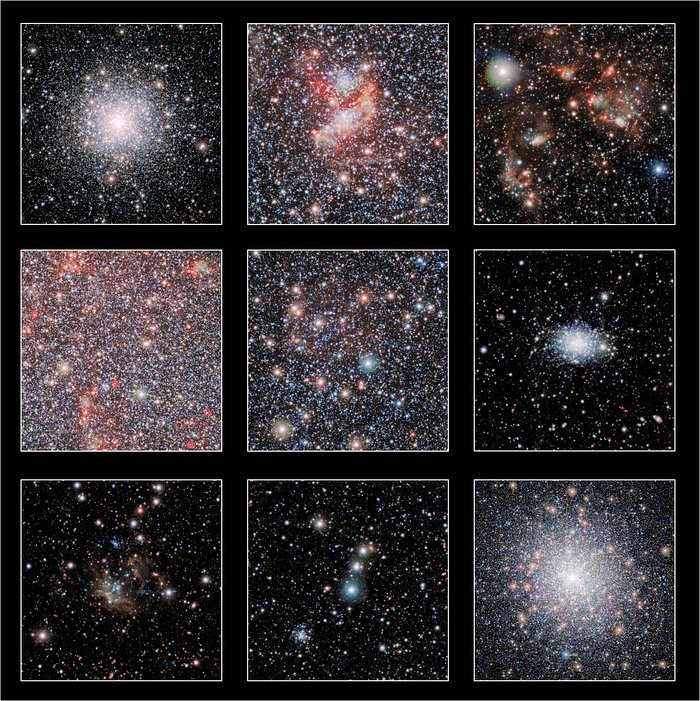
These cutout images show a few of the highlights from a huge new infrared image of our neighbouring galaxy, the Small Magellanic Cloud, that was taken with the VISTA telescope at ESO’s Paranal Observatory. The lower-right panel shows the bright globular star cluster 47 Tucanae, which lies much closer to the Earth than the Small Magellanic Cloud. [Larger versions]The SMC is full of dust, and the visible light emitted by its stars suffers significant extinction. Fortunately, not all electromagnetic radiation is equally affected by dust. Infrared radiation passes through interstellar dust much more easily than visible light, so by looking at the infrared light from a galaxy we can learn about the new stars forming within the clouds of dust and gas.
VISTA, the Visible and Infrared Survey Telescope, was designed to image infrared radiation. The VISTA Survey of the Magellanic Clouds (VMC) is focused on mapping the star formation history of the SMC and LMC, as well as mapping their three-dimensional structures. Millions of SMC stars have been imaged in the infrared thanks to the VMC, providing an unparalleled view almost unaffected by dust extinction.
The video sequence takes the viewer from a wide view of the southern skies deep into a small nearby galaxy, the Small Magellanic Cloud. The final close-up infrared views are from a very detailed huge image of the galaxy taken using ESO’s VISTA infrared survey telescope at the Paranal Observatory in Chile. Millions of stars and many star clusters and much more distant galaxies are visible. Credit: ESO/VISTA VMC/N. Risinger (skysurvey.org). Music: Astral electronic.
The whole frame of this massive image is filled with stars belonging to the Small Magellanic Cloud. It also includes thousands of background galaxies and several bright star clusters, including 47 Tucanae at the right of the picture, which lies much closer to the Earth than the SMC. The zoomable image will show you the SMC as you have never seen it before!
The wealth of new information in this 1.6 gigapixel image (43 223 x 38 236 pixels) has been analysed by an international team led by Stefano Rubele of the University of Padova. They have used cutting-edge stellar models to yield some surprising results.
This view compares a huge new infrared image of the Small Magellanic Cloud from ESO’s VISTA telescope to a more traditional view in visible light. By observing at longer infrared wavelengths VISTA can penetrate the dust clouds of this small neighbouring galaxy and reveal the stars much more clearly. Credit: ESO/VISTA VMC/Digitized Sky Survey 2. Music: Astral electronic. [Larger versions.]
The VMC has revealed that most of the stars within the SMC formed far more recently than those in larger neighbouring galaxies. This early result from the survey is just a taster of the new discoveries still to come, as the survey continues to fill in blind spots in our maps of the Magellanic Clouds.
A galaxy or other massive object can bend light. Light from a star far beyond and behind such an object from our point of view can be bent just like light going through a lens. This lens effect can result in multiple views of the same star. This gravitational lens phenomena has been studied for many years but no one till now has used it to see a special kind of “standard candle” supernova that provides a way to measure distances in the universe. Here is a report on these new observations with the Hubble space telescope:
A Swedish-led team of astronomers used the NASA/ESA Hubble Space Telescope to analyse the multiple images of a gravitationally lensed type Ia supernova for the first time. The four images of the exploding star will be used to measure the expansion of the Universe. This can be done without any theoretical assumptions about the cosmological model, giving further clues about how fast the Universe is really expanding. The results are published in the journal Science.
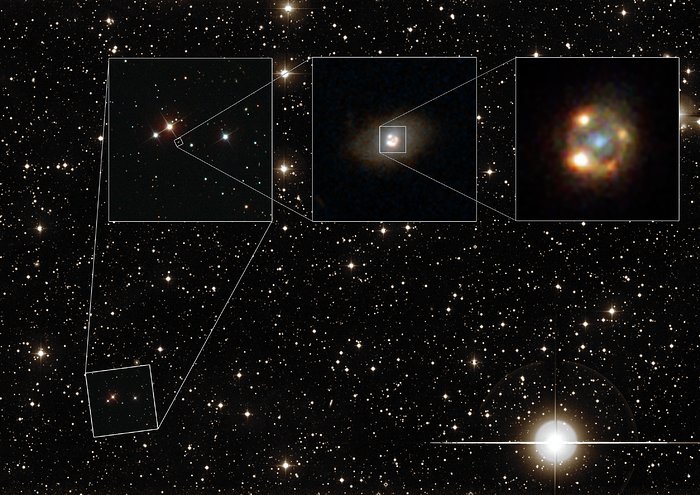
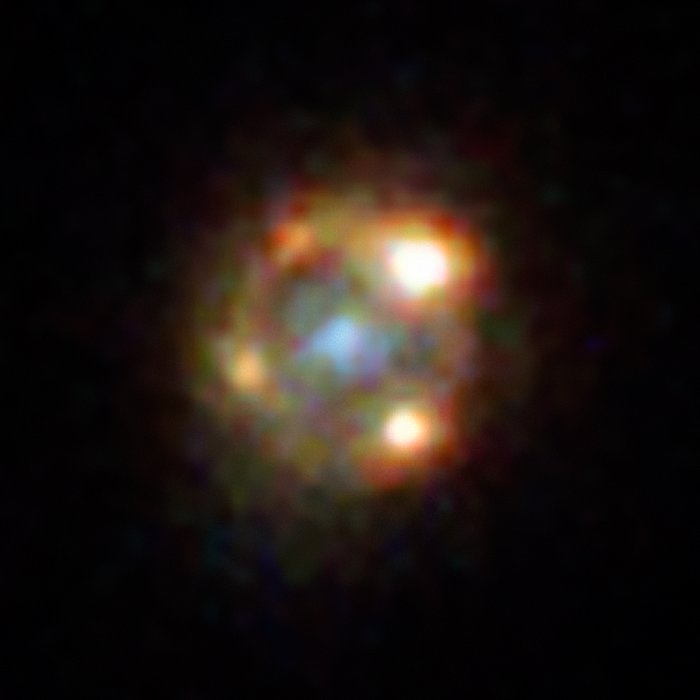
This composite image shows the gravitationally lensed type Ia supernova iPTF16geu, as seen with different telescopes. The background image shows a wide-field view of the night sky as seen with the Palomar Observatory located on Palomar Mountain, California. The leftmost image shows observations made with the Sloan Digital Sky Survey (SDSS). The central image was taken by the NASA/ESA Hubble Space Telescope and shows the lensing galaxy SDSS J210415.89-062024.7. The rightmost image was also taken with Hubble and depicts the four lensed images of the supernova explosion, surrounding the lensing galaxy. [Larger images]An international team, led by astronomers from the Stockholm University, Sweden, has discovered a distant type Ia supernova, called iPTF16geu [1] — it took the light 4.3 billion years to travel to Earth [2]. The light from this particular supernova was bent and magnified by the effect of gravitational lensing so that it was split into four separate images on the sky [3]. The four images lie on a circle with a radius of only about 3000 light-years around the lensing foreground galaxy, making it one of the smallest extragalactic gravitational lenses discovered so far. Its appearance resembles the famous Refsdal supernova, which astronomers detected in 2015 (heic1525). Refsdal, however, was a core-collapse supernova.
This animation shows the phenomenon of strong gravitational lensing. This effect caused the supernova iPTF16geu to appear 50 times brighter than under normal circumstances and to be visible on the sky four times. Credit:ESA/Hubble, L. Calçada
Type Ia supernovae always have the same intrinsic brightness, so by measuring how bright they appear astronomers can determine how far away they are. They are therefore known as standard candles. These supernovae have been used for decades to measure distances across the Universe, and were also used to discover its accelerated expansion and infer the existence of dark energy. Now the supernova iPTF16geu allows scientists to explore new territory, testing the theories of the warping of spacetime on smaller extragalactic scales than ever before.
The supernova iPTF16geu exploded at a distance corresponding to a time 4.3 billion years ago. It could only be detected because a foreground galaxy lensed the light of the explosion, making it 50 times brighter for observers on Earth. It also caused the supernova to appear in four distinct places on the sky, surrounding the lensing galaxy in the foreground. [Larger versions]
“Resolving, for the first time, multiple images of a strongly lensed standard candle supernova is a major breakthrough. We can measure the light-focusing power of gravity more accurately than ever before, and probe physical scales that may have seemed out of reach until now,” says Ariel Goobar, Professor at the Oskar Klein Centre at Stockholm University and lead author of the study.
The critical importance of the object meant that the team instigated follow-up observations of the supernova less than two months after its discovery. This involved some of the world’s leading telescopes in addition to Hubble: the Keck telescope on Mauna Kea, Hawaii, and ESO’s Very Large Telescope in Chile. Using the data gathered, the team calculated the magnification power of the lens to be a factor of 52. Because of the standard candle nature of iPTF16geu, this is the first time this measurement could be made without any prior assumptions about the form of the lens or cosmological parameters.
Last month saw the inauguration of a new Hubble observing program: Frontier Fields. This will use the powerful magnifying properties of massive galaxy clusters to peer even deeper into the space around us. Hubblecast 70 takes a look at this phenomenon — known as gravitational lensing — exploring how it works, and how it can help us to uncover the secrets of the very distant Universe.
Currently the team is in the process of accurately measuring how long it took for the light to reach us from each of the four images of the supernova. The differences in the times of arrival can then be used to calculate the Hubble constant — the expansion rate of the Universe — with high precision [4]. This is particularly crucial in light of the recent discrepancy between the measurements of its value in the local and the early Universe (heic1702).
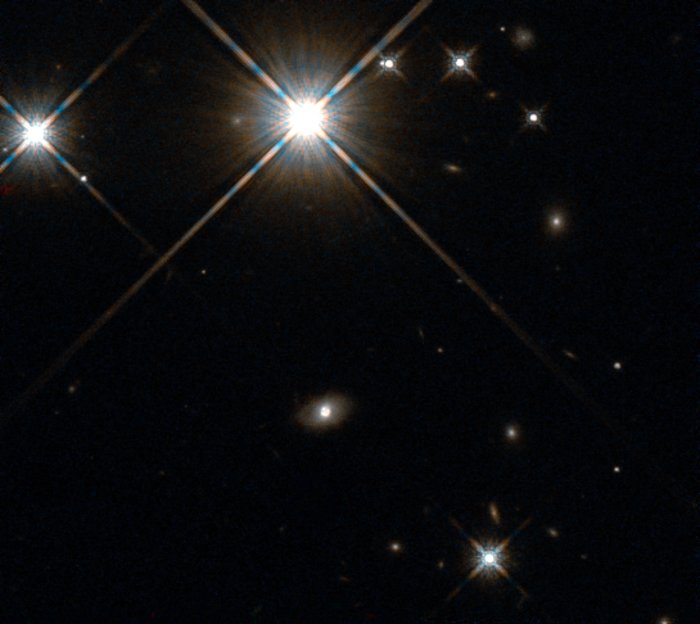
The galaxy SDSS J210415.89-062024.7 is located 2.5 billion light years away. It acted as a lens for a supernova at an even greater distance, creating four distinct images of the explosion — an effect created by strong gravitational lensing. [Larger images]As important as lensed supernovae are for cosmology, it is extremely difficult to find them. Not only does their discovery rely on a very particular and precise alignment of objects in the sky, but they are also only visible for a short time.
“The discovery of iPTF16geu is truly like finding a somewhat weird needle in a haystack,” remarks Rahman Amanullah, co-author and research scientist at Stockholm University. “It reveals to us a bit more about the Universe, but mostly triggers a wealth of new scientific questions.”
Studying more similarly lensed supernovae will help shape our understanding of just how fast the Universe is expanding. The chances of finding such supernovae will improve with the installation of new survey telescopes in the near future.
Notes
[1] iPTF16geu was initially observed by the iPTF (intermediate Palomar Transient Factory) collaboration with the Palomar Observatory. This is a fully automated, wide-field survey delivering a systematic exploration of the optical transient sky.
[2] This corresponds to a redshift of 0.4. The lensing galaxy has a redshift of 0.2.
[3] Gravitational lensing is a phenomenon that was first predicted by Albert Einstein in 1912. It occurs when a massive object lying between a distant light source and the observer bends and magnifies the light from the source behind it. This allows astronomers to see objects that would otherwise be to faint to see.
[4] For each image of the supernova, the light is not bent in the same way. This results in slightly different travel times. The maximum time delay between the four images is predicted to be less than 35 hours.