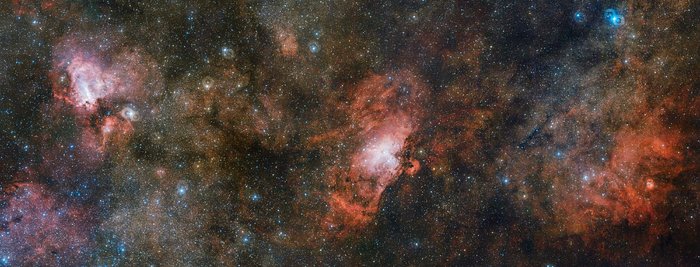
Two of the sky’s more famous residents share the stage with a lesser-known neighbour in this enormous three gigapixel image from ESO’s VLT Survey Telescope (VST). On the right lies the faint, glowing cloud of gas called Sharpless 2-54, the iconic Eagle Nebula (Messier 16) is in the centre, and the Omega Nebula (Messier 17) to the left. This cosmic trio makes up just a portion of a vast complex of gas and dust within which new stars are springing to life and illuminating their surroundings. [Larger images. See also the annotated version.]Two of the sky’s more famous residents share the stage with a lesser-known neighbour in this enormous new three gigapixel image from ESO’s VLT Survey Telescope (VST). On the right lies the faint, glowing cloud of gas called Sharpless 2-54, the iconic Eagle Nebula is in the centre, and the Omega Nebula to the left. This cosmic trio makes up just a portion of a vast complex of gas and dust within which new stars are springing to life and illuminating their surroundings.
This pan video shows the region around the Omega Nebula (Messier 17). It is part of a bigger image of the area taken by the VLT Survey Telescope (VST) at ESO’s Paranal Observatory in Chile. Credit: ESO
Sharpless 2-54 and the Eagle and Omega Nebulae are located roughly 7000 light-years away — the first two fall within the constellation of Serpens (The Serpent), while the latter lies within Sagittarius (The Archer). This region of the Milky Way houses a huge cloud of star-making material. The three nebulae indicate where regions of this cloud have clumped together and collapsed to form new stars; the energetic light from these stellar newborns has caused ambient gas to emit light of its own, which takes on the pinkish hue characteristic of areas rich in hydrogen.
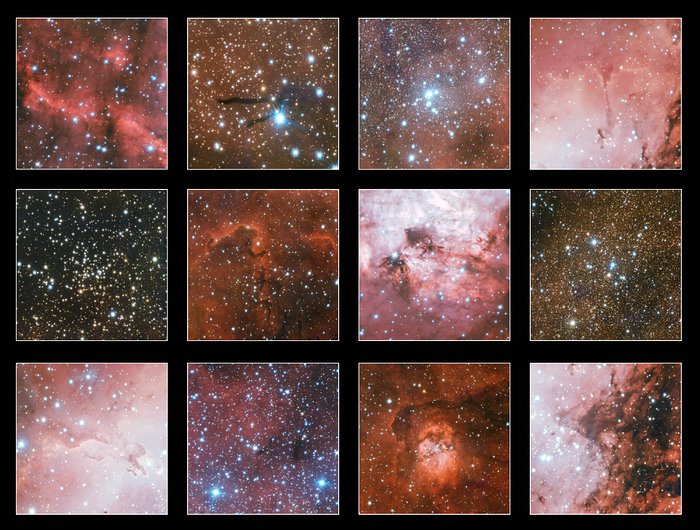
The compilation shows a few of the many highlights in an enormous three gigapixel image from ESO’s VLT Survey Telescope (VST) that includes the faint, glowing cloud of gas called Sharpless 2-54, the iconic Eagle Nebula and the Omega Nebula. [Larger images]Two of the objects in this image were discovered in a similar way. Astronomers first spotted bright star clusters in both Sharpless 2-54 and the Eagle Nebula, later identifying the vast, comparatively faint gas clouds swaddling the clusters. In the case of Sharpless 2-54, British astronomer William Herschel initially noticed its beaming star cluster in 1784. That cluster, catalogued as NGC 6604 (eso1218), appears in this image on the object’s left side. The associated very dim gas cloud remained unknown until the 1950s, when American astronomer Stewart Sharpless spotted it on photographs from the National Geographic–Palomar Sky Atlas.
This pan video shows the region around the Eagle Nebula (Messier 16). It is part of a bigger image of the area taken by the VLT Survey Telescope (VST) at ESO’s Paranal Observatory in Chile. Credit: ESO
The Eagle Nebula did not have to wait so long for its full glory to be appreciated. Swiss astronomer Philippe Loys de Chéseaux first discovered its bright star cluster, NGC 6611, in 1745 or 1746 (eso0142). A couple of decades later, French astronomer Charles Messier observed this patch of sky and also documented the nebulosity present there, recording the object as Messier 16 in his influential catalogue (eso0926).
This zoom video takes you deep into the central parts of the Milky Way, home to many regions of star formation. The final sequence shows the faint, glowing cloud of gas called Sharpless 2-54, the iconic Eagle Nebula (Messier 16) and the Omega Nebula (Messier 17). They are seen in a spectacular huge image from ESO VLT Survey Telescope (VST).
As for the Omega Nebula, de Chéseaux did manage to observe its more prominent glow and duly noted it as a nebula in 1745. However, because the Swiss astronomer’s catalogue never achieved wider renown, Messier’s re-discovery of the Omega Nebula in 1764 led to its becoming Messier 17, the seventeenth object in the Frenchman’s popular compendium (eso0925).
The pan video shows a few of the many highlights in an enormous three gigapixel image from ESO’s VLT Survey Telescope (VST) that includes the faint, glowing cloud of gas called Sharpless 2-54, the iconic Eagle Nebula and the Omega Nebula. Credit: ESO
The observations from which this image was created were taken with ESO’s VLT Survey Telescope (VST), located at ESO’s Paranal Observatory in Chile. The huge final colour image was created by mosaicing dozens of pictures — each of 256 megapixels — from the telescope’s large-format OmegaCAM camera. The final result, which needed lengthy processing, totals 3.3 gigapixels, one of the largest images ever released by ESO.
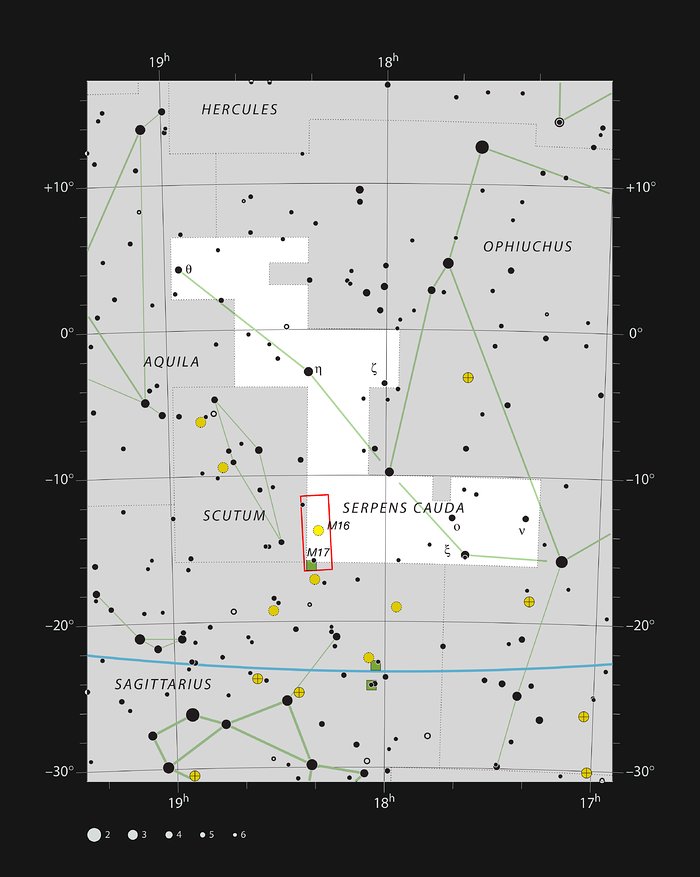
This chart shows the constellation of Serpens Cauda, the tail-part of the split constellation of Serpens (The Snake). The famous Eagle Nebula, Messier 16, lies in the corner of this constellation and its equally well-known campanion, the Omega Nebula, Messier 17, just across the border into Sagittarius (The Archer). Yellow circles represent star clusters and green squares nebulae. The region of sky covered by the huge VST image of this region is marked with a red rectangle. [Larger image]
Here is a NASA article about how artists create imagery of planets around other stars realistically despite the fact no one has ever seen such an exoplanet up close:
The moon hanging in the night sky sent Robert Hurt’s mind into deep space — to a region some 40 light years away, in fact, where seven Earth-sized planets crowded close to a dim, red sun.
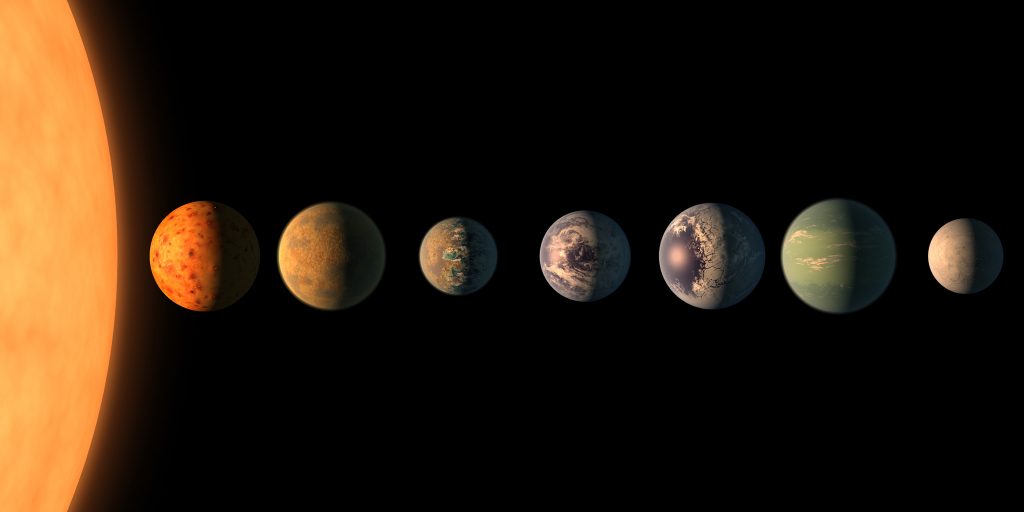
This artist’s concept shows what each of the TRAPPIST-1 planets may look like, based on available data about their sizes, masses and orbital distances. Credits: NASA/JPL-Caltech Full image and caption
Hurt, a visualization scientist at Caltech’s IPAC center, was walking outside his home in Mar Vista, California, shortly after he learned of the discovery of these rocky worlds around a star called TRAPPIST-1 and got the assignment to visualize them. The planets had been revealed by NASA’s Spitzer Space Telescope and ground-based observatories.
“I just stopped dead in my tracks, and I just stared at it,” Hurt said in an interview. “I was imagining that could be, not our moon, but the next planet over – what it would be like to be in a system where you could look up and see continental features on the next planet.”
So began a kind of inspirational avalanche. Hurt and his colleague, multimedia producer Tim Pyle, developed a series of arresting, photorealistic images of what the new system’s tightly packed planets might look like — so tightly packed that they would loom large in each other’s skies. Their visions of the TRAPPIST-1 system would appear in leading news outlets around the world.
Artists like Hurt and Pyle, who render vibrant visualizations based on data from Spitzer and other missions, are hybrids of sorts, blending expertise in both science and art. From squiggles on charts and columns of numbers, they conjure red, blue and green worlds, with half-frozen oceans or bubbling lava. Or they transport us to the surface of a world with a red-orange sun fixed in place, and a sky full of planetary companions.
“For the public, the value of this is not just giving them a picture of something somebody made up,” said Douglas Hudgins, a program scientist for the Exoplanet Exploration Program at NASA Headquarters in Washington. “These are real, educated guesses of how something might look to human beings. An image is worth a thousand words.”
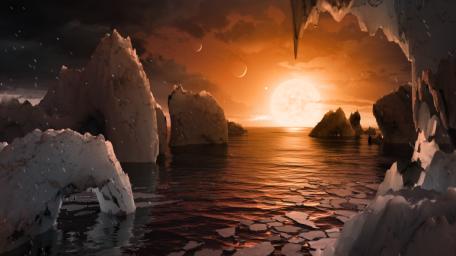
This artist’s concept by Tim Pyle allows us to imagine what it would be like to stand on the surface of the exoplanet TRAPPIST-1f, located in the TRAPPIST-1 system in the constellation Aquarius. Credits: NASA/JPL-Caltech. Full image and caption
Hurt says he and Pyle are building on the work of artistic pioneers.
“There’s actually a long history and tradition for space art and science-based illustration,” he said. “If you trace its roots back to the artist Chesley Bonestell (famous in the 1950s and ’60s), he really was the artist who got this idea: Let’s go and imagine what the planets in our solar system might actually look like if you were, say, on Jupiter’s moon, Io. How big would Jupiter appear in the sky, and what angle would we be viewing it from?”
To begin work on their visualizations, Hurt divided up the seven TRAPPIST-1 planets with Pyle, who shares an office with him at Caltech’s IPAC center in Pasadena, California.
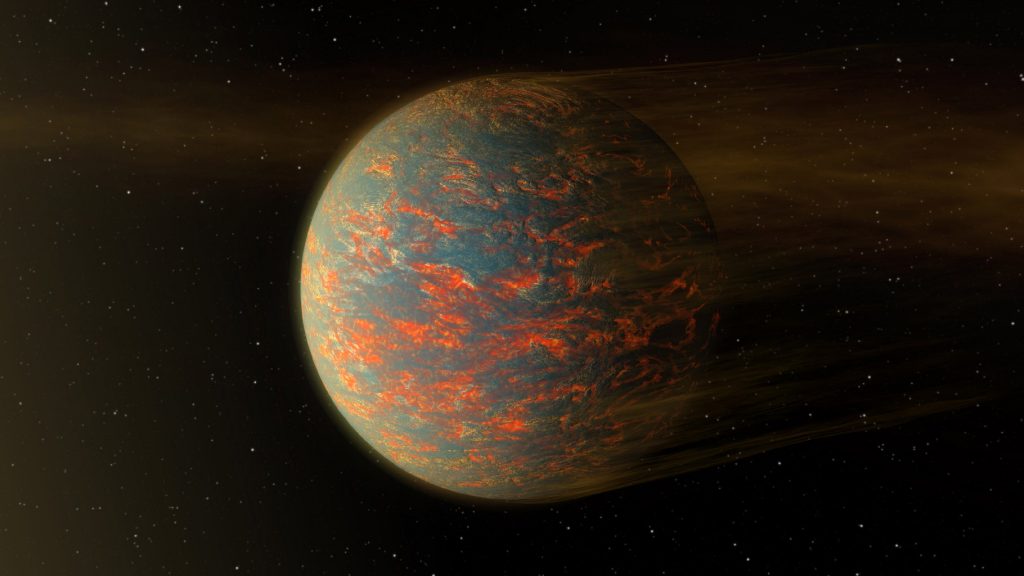
This illustration shows one possible scenario for the hot, rocky exoplanet called 55 Cancri e, which is nearly two times as wide as Earth. Robert Hurt created this in 2016. Credits: NASA/JPL-Caltech. Full image and caption
Hurt holds a Ph.D. in astrophysics, and has worked at the center since he was a post-doctoral researcher in 1996 – when astronomical art was just his hobby.
“They created a job for me,” he said.
Pyle, whose background is in Hollywood special effects, joined Hurt in 2004.
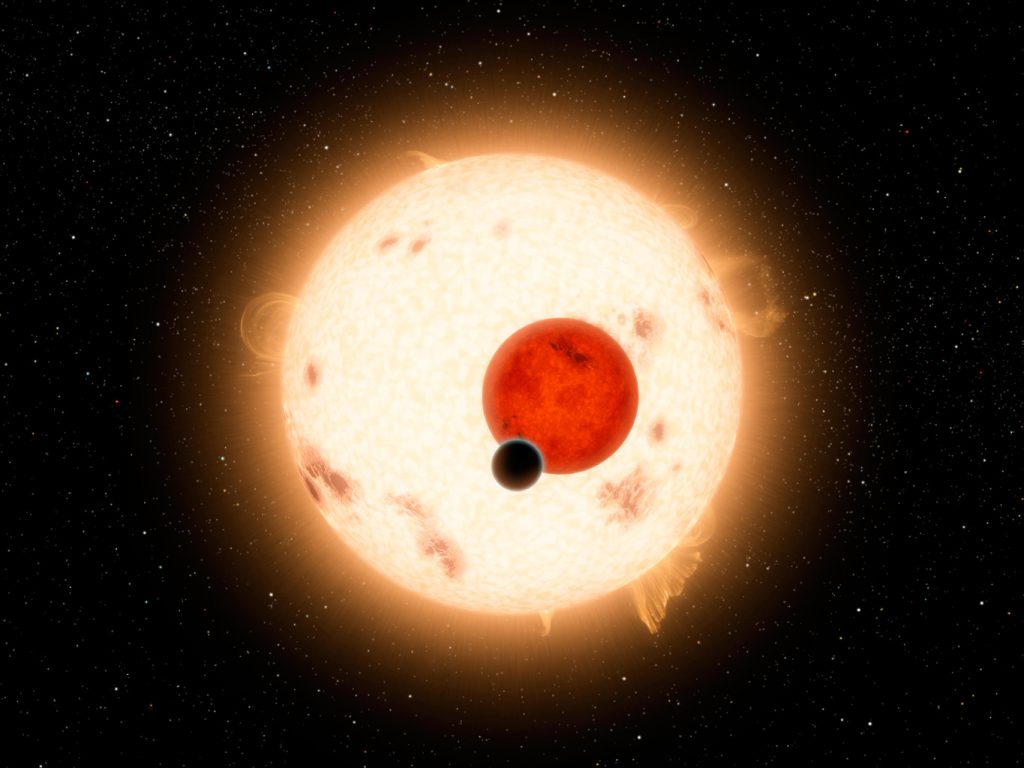
NASA’s Kepler mission discovered a world where two suns set over the horizon instead of just one, called Kepler-16b. Robert Hurt did this illustration of this fascinating world. Credits: NASA/JPL-Caltech. Full image and caption
Hurt turns to Pyle for artistic inspiration, while Pyle relies on Hurt to check his science.
“Robert and I have our desks right next to each other, so we’re constantly giving each other feedback,” Pyle said. “We’re each upping each other’s game, I think.”
The TRAPPIST-1 worlds offered both of them a unique challenge. The two already had a reputation for illustrating many exoplanets – planets around stars beyond our own — but never seven Earth-sized worlds in a single system. The planets cluster so close to their star that a “year” on each of them — the time they take to complete a single orbit — can be numbered in Earth days.
And like the overwhelming majority of the thousands of exoplants found in our galaxy so far, they were detected using indirect means. No telescope exists today that is powerful enough to photograph them.
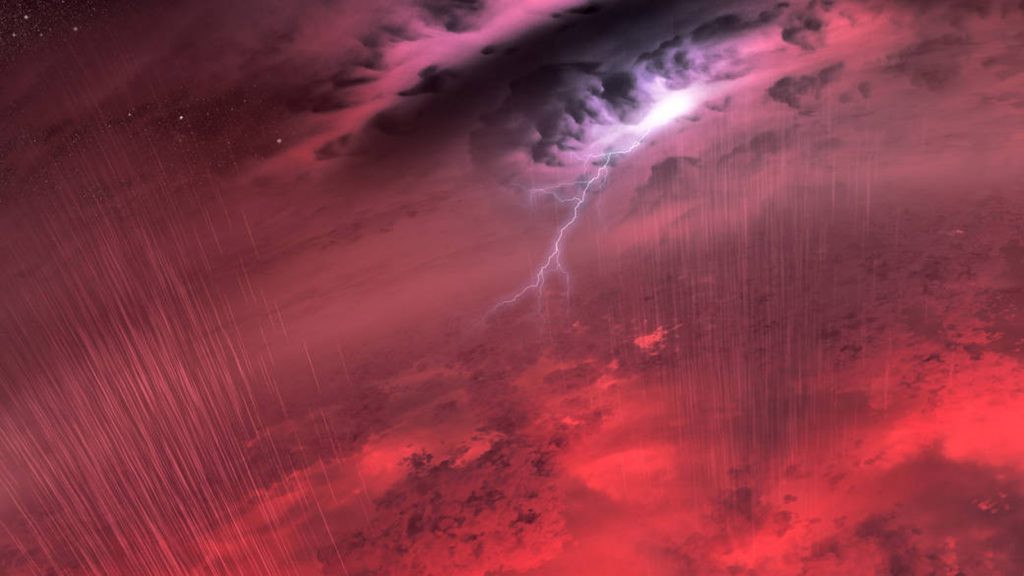
This artist’s concept by Tim Pyle shows what the weather might look like on cool star-like bodies known as brown dwarfs. Credits: NASA/JPL-Caltech/University of Western Ontario/Stony Brook University. Full image and caption
Real science informed their artistic vision. Using data from the telescopes that reveal each planet’s diameter as well as its “weight,” or mass, and known stellar physics to determine the amount of light each planet would receive, the artists went to work.
Both consulted closely with the planets’ discovery team as they planned for a NASA announcement to coincide with a report in the journal Nature.
“When we’re doing these artist’s concepts, we’re never saying, ‘This is what these planets actually look like,’” Pyle said. “We’re doing plausible illustrations of what they could look like, based on what we know so far. Having this wide range of seven planets actually let us illustrate almost the whole breadth of what would be plausible. This was going to be this incredible interstellar laboratory for what could happen on an Earth-sized planet.”
For TRAPPIST-1b, Pyle took Jupiter’s volcanic moon, Io, as an inspiration, based on suggestions from the science team. For the outermost world, TRAPPIST-1h, he chose two other Jovian moons, the ice-encased Ganymede and Europa.
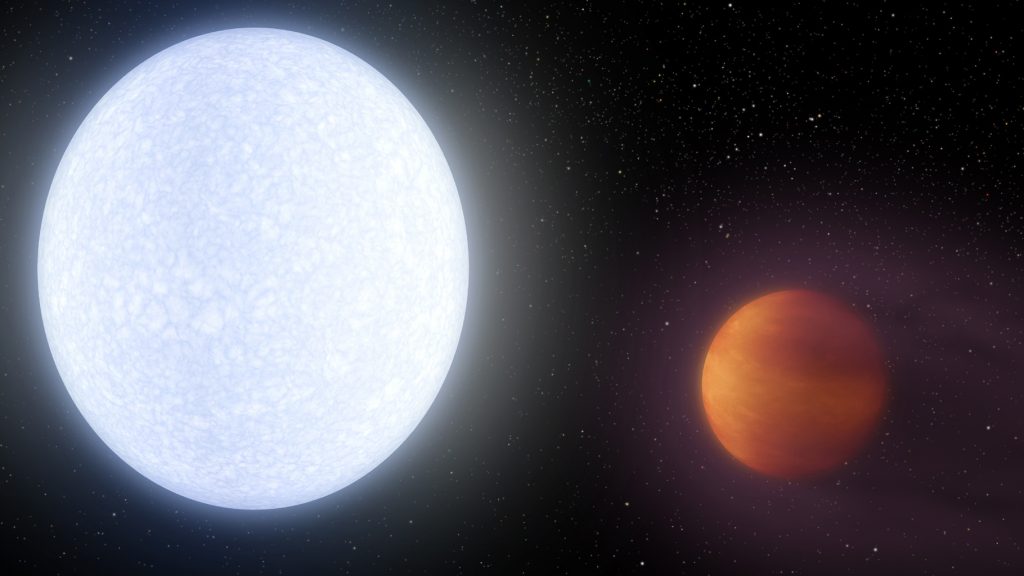
This artist’s concept shows planet KELT-9b orbiting its host star, KELT-9. It is the hottest gas giant planet discovered so far. Credits: NASA/JPL-Caltech. Full image and caption
After talking to the scientists, Hurt portrayed TRAPPIST-1c as dry and rocky. But because all seven planets are probably tidally locked, forever presenting one face to their star and the other to the cosmos, he placed an ice cap on the dark side.
TRAPPIST-1d was one of three that fall inside the “habitable zone” of the star, or the right distance away from it to allow possible liquid water on the surface.
“The researchers told us they would like to see it portrayed as something they called an ‘eyeball world,’” Hurt said. “You have a dry, hot side that’s facing the star and an ice cap on the back side. But somewhere in between, you have (a zone) where the ice could melt and be sustained as liquid water.”
At this point, Hurt said, art intervened. The scientists rejected his first version of the planet, which showed liquid water intruding far into the “dayside” of TRAPPIST-1d. They argued that the water would most likely be found well within the planet’s dark half.
“Then I kind of pushed back, and said, ‘If it’s on the dark side, no one can look at it and understand we’re saying there’s water there,’”
Hurt said. They struck a compromise: more water toward the dayside than the science team might expect, but a better visual representation of the science.
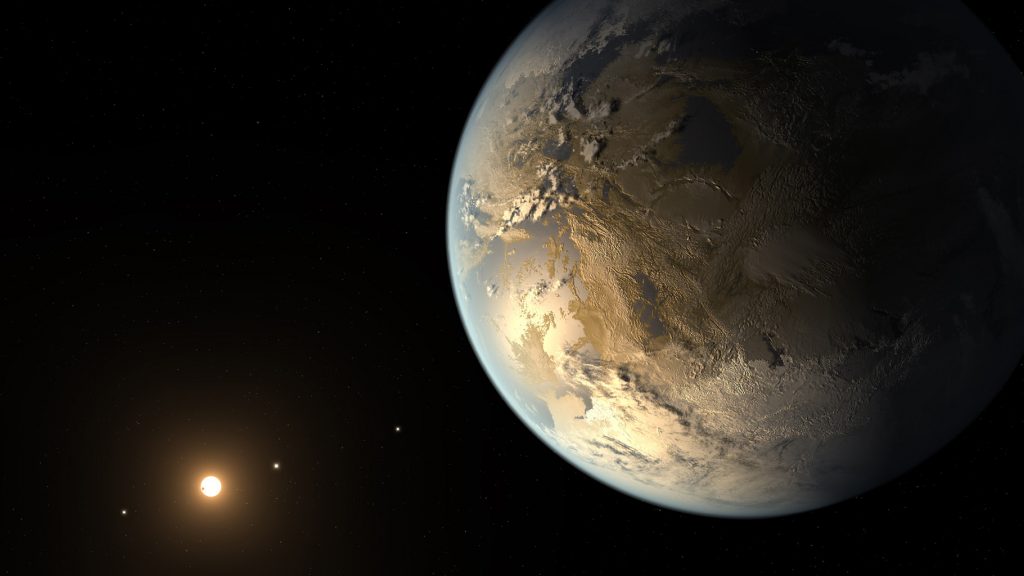
This artist’s concept by Tim Pyle depicts Kepler-186f, the first validated Earth-size planet to orbit a distant star in the habitable zone — a range of distance from a star where liquid water might pool on the planet’s surface. Credits: NASA/Ames/SETI Institute/JPL-Caltech. Full image and caption
The same push and pull between science and art extends to other forms of astronomical visualization, whether it’s a Valentine’s Day cartoon of a star pulsing like a heart in time with its planet, or materials for the blockbuster announcement of the first detection of gravitational waves by the Laser Interferometer Gravitational-Wave Observatory in February 2016. They’ve also illustrated asteroids, neutron stars, pulsars and brown dwarfs.
Visualizations based on data can also inform science, leading to genuine scientific insights. The scientists’ conclusions about TRAPPIST-1 at first seemed to suggest the planets would be bathed in red light, potentially obscuring features like blue-hued bodies of water.
“It makes it hard to really differentiate what is going on,” Hurt said.
Hurt decided to investigate. A colleague provided him with a spectrum of a red dwarf star similar to TRAPPIST-1. He overlaid that with the “responsivity curves” of the human eye, and found that most of the scientists’ “red” came from infrared light, invisible to human eyes. Subtract that, and what is left is a more reddish-orange hue that we might see standing on the surface of a TRAPPIST-1 world — “kind of the same color you would expect to get from a low-wattage light bulb,” Hurt said. “And the scientists looked at that and said, ‘Oh, ok, great, it’s orange.’ When the math tells you the answer, there really isn’t a lot to argue about.”
For Hurt, the real goal of scientific illustration is to excite the public, engage them in the science, and provide a snapshot of scientific knowledge.
“If you look at the whole history of space art, reaching back many, many decades, you will find you have a visual record,” he said. “The art is a historical record of our changing understanding of the universe. It becomes a part of the story, and a part of the research, I think.”
ALMA has observed stars like the Sun at a very early stage in their formation and found traces of methyl isocyanate — a chemical building block of life. This is the first ever detection of this prebiotic molecule towards solar-type protostars, the sort from which our Solar System evolved. The discovery could help astronomers understand how life arose on Earth.
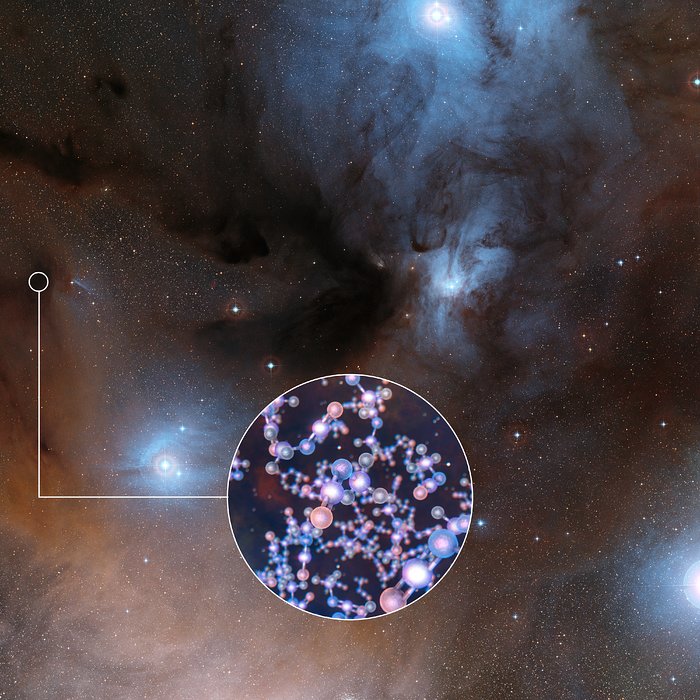
ALMA has observed stars like the Sun at a very early stage in their formation and found traces of methyl isocyanate — a chemical building block of life. This is the first ever detection of this prebiotic molecule towards a solar-type protostar, the sort from which our Solar System evolved. The discovery could help astronomers understand how life arose on Earth. This image shows the spectacular region of star formation where methyl isocyanate was found. The insert shows the molecular structure of this chemical. [Larger image.]Two teams of astronomers have harnessed the power of the Atacama Large Millimeter/submillimeter Array (ALMA) in Chile to detect the prebiotic complex organic molecule methyl isocyanate[1] in the multiple star system IRAS 16293-2422. One team was co-led by Rafael Martín-Doménech at the Centro de Astrobiología in Madrid, Spain, and Víctor M. Rivilla, at the INAF-Osservatorio Astrofisico di Arcetri in Florence, Italy; and the other by Niels Ligterink at the Leiden Observatory in the Netherlands and Audrey Coutens at University College London, United Kingdom.
[ Niels Ligterink and Audrey Coutens explain]
“This star system seems to keep on giving! Following the discovery of sugars, we’ve now found methyl isocyanate. This family of organic molecules is involved in the synthesis of peptides and amino acids, which, in the form of proteins, are the biological basis for life as we know it” [2].
ALMA’s capabilities allowed both teams to observe the molecule at several different and characteristic wavelengths across the radio spectrum[3]. They found the unique chemical fingerprints located in the warm, dense inner regions of the cocoon of dust and gas surrounding young stars in their earliest stages of evolution. Each team identified and isolated the signatures of the complex organic molecule methyl isocyanate [4]. They then followed this up with computer chemical modelling and laboratory experiments to refine our understanding of the molecule’s origin [5].
IRAS 16293-2422 is a multiple system of very young stars, around 400 light-years away in a large star-forming region called Rho Ophiuchi in the constellation of Ophiuchus (The Serpent Bearer). The new results from ALMA show that methyl isocyanate gas surrounds each of these young stars.
Earth and the other planets in our Solar System formed from the material left over after the formation of the Sun. Studying solar-type protostars can therefore open a window to the past for astronomers and allow them to observe conditions similar to those that led to the formation of our Solar System over 4.5 billion years ago.
Rafael Martín-Doménech and Víctor M. Rivilla, lead authors of one of the papers, comment:
“We are particularly excited about the result because these protostars are very similar to the Sun at the beginning of its lifetime, with the sort of conditions that are well suited for Earth-sized planets to form. By finding prebiotic molecules in this study, we may now have another piece of the puzzle in understanding how life came about on our planet.”
Niels Ligterink is delighted with the supporting laboratory results:
“Besides detecting molecules we also want to understand how they are formed. Our laboratory experiments show that methyl isocyanate can indeed be produced on icy particles under very cold conditions that are similar to those in interstellar space This implies that this molecule — and thus the basis for peptide bonds — is indeed likely to be present near most new young solar-type stars.”
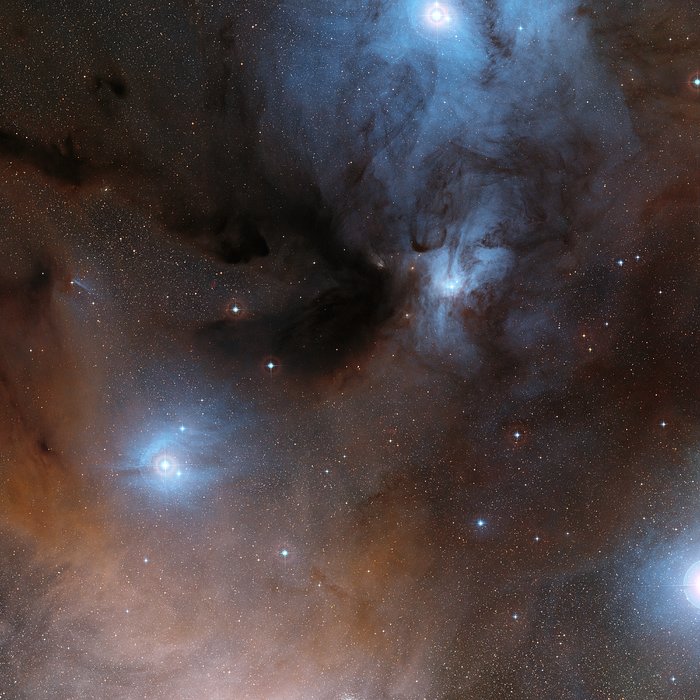
This wide-field view shows a spectacular region of dark and bright clouds, forming part of a region of star formation in the constellation of Ophiuchus (The Serpent Bearer). This picture was created from images in the Digitized Sky Survey 2. [Larger image.]Notes
[1] A complex organic molecule is defined in astrochemistry as consisting of six or more atoms, where at least one of the atoms is carbon. Methyl isocyanate contains carbon, hydrogen, nitrogen and oxygen atoms in the chemical configuration CH3NCO. This very toxic substance was the main cause of death following the tragic Bhopal industrial accident in 1984.
[2] The system was previously studied by ALMA in 2012 and found to contain molecules of the simple sugar glycolaldehyde, another ingredient for life.
[3] The team led by Rafael Martín-Doménech used new and archive data of the protostar taken across a large range of wavelengths across ALMA’s receiver Bands 3, 4 and 6. Niels Ligterink and his colleagues used data from the ALMA Protostellar Interferometric Line Survey (PILS), which aims to chart the chemical complexity of IRAS 16293-2422 by imaging the full wavelength range covered by ALMA’s Band 7 on very small scales, equivalent to the size of our Solar System.
[4] The teams carried out spectrographic analysis of the protostar’s light to determine the chemical constituents. The amount of methyl isocyanate they detected — the abundance — with respect to molecular hydrogen and other tracers is comparable to previous detections around two high-mass protostars (i.e. within the massive hot molecular cores of Orion KL and Sagittarius B2 North).
[5] Martín-Doménech’s team chemically modelled gas-grain formation of methyl isocyanate. The observed amount of the molecule could be explained by chemistry on the surface of dust grains in space, followed by chemical reactions in the gas phase. Moreover, Ligterink’s team demonstrated that the molecule can be formed at extremely cold interstellar temperatures, down to 15 Kelvin (–258 degrees Celsius), using cryogenic ultra-high-vacuum experiments in their laboratory in Leiden.
Tabby’s Star is currently one of the oddest objects observed in our galaxy. Citizen scientists working in the Planet Hunters program were the first to notice that the light output of the star, which is 1300 light years from earth, was fluctuating downward in an irregular manner never seen before with similar type stars. (See posts here and here.) Subsequent research looking back at telescopic images of the star indicated that the brightness may have been falling over the past 100 years.
The star (also known as Boyajian’s Star)is named after LSU assistant professor Tabetha Boyajian and on Friday she posted on Twitter: “#TabbysStar IS DIPPING! OBSERVE!!” This led observatories around the world to aim their telescopes and radio dishes at the star to observe it in as many wavelengths as possible. She also posted a graph showing the drop in brightness:
Currently, we are organizing and cataloging dozens of observations from multiple observers worldwide. Planned responses include photometric observations in multiple bands, spectrometry, and more exotic observations such as polarimetry. We are also continuing the monitoring with the Las Cumbres telescopes at an increased cadence (probably three or four sequences every hour),
Stay tuned for more news about this exciting event!