Those early space moguls did not fund rockets but instead back most of the large astronomical observatories in the USA. Lick Observatory, for example, funded by California railroad magnate James Lick in the 1870s, is comparable to a $1.5 billion dollar project today.
I’ll note that before World War II, the US federal government funded very little science or technology R&D. Most all such activities were supported either by private organizations such as companies, universities and institutions like the Smithsonian or by private individuals. This changed during WWII with the emergence of Big Science projects including the successful development of radar and the atomic bomb. Federal support for science and R&D after the war was further encouraged by the Cold War technology competition with the USSR.
For more about MacDonald’s book and the history of private space initiatives in the US, see:
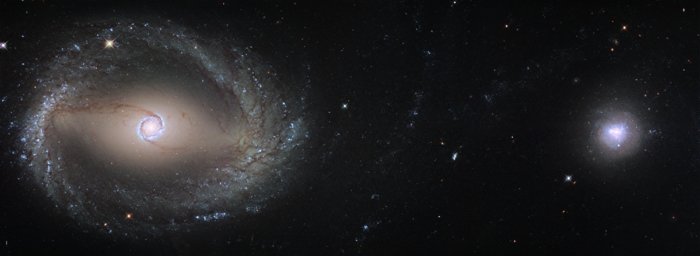
This composite image, created out of two different pointings from Hubble, shows the barred spiral galaxy NGC 1512 (left) and the dwarf galaxy NGC 1510 (right). Both galaxies are about 30 million light-years away from Earth and currently in the process of merging. At the end of this process NGC 1512 will have cannibalised its smaller companion. [Larger images]The gravitational dance between two galaxies in our local neighbourhood has led to intriguing visual features in both as witnessed in this new NASA/ESA Hubble Space Telescope image. The tiny NGC 1510 and its colossal neighbour NGC 1512 are at the beginning of a lengthy merger, a crucial process in galaxy evolution. Despite its diminutive size, NGC 1510 has had a significant effect on NGC 1512’s structure and amount of star formation.
Galaxies come in a range of shapes and sizes, and astronomers use this fact to classify them based on their appearance. NGC 1512, the large galaxy to the left in this image, is classified as a barred spiral, named after the bar composed of stars, gas and dust slicing through its centre. The tiny NGC 1510 to the right, on the other hand, is a dwarf galaxy. Despite their very different sizes, each galaxy affects the other through gravity, causing slow changes in their appearances.
This video zooms in from a view of the night sky, through the constellation of Horologium, to end on the NASA/ESA Hubble Space Telescope observations of the interacting galaxies NGC 1512 and NGC 1510. Credit: ESA/Hubble, Digitized Sky Survey, Nick Risinger (skysurvey.org) Music: Johan B Monell
The bar in NGC 1512 acts as a cosmic funnel, channelling the raw materials required for star formation from the outer ring into the heart of the galaxy. This pipeline of gas and dust in NGC 1512 fuels intense star birth in the bright, blue, shimmering inner disc known as a circumnuclear starburst ring, which spans 2400 light-years.
Both the bar and the starburst ring are thought to be at least in part the result of the cosmic scuffle between the two galaxies — a merger that has been going on for 400 million years.
This video pans over NASA/ESA Hubble Space Telescope observations of the interacting galaxies NGC 1512 and NGC 1510, about 30 million light-years from Earth. Despite the difference in size, each galaxy gravitationally affects the other. The ring of starburst and the bar in the centre of the large spiral galaxy NGC 1512 are both in part created by the gravity of the much smaller NGC 1510. The gas and dust in the smaller galaxy have been swirled up by NGC 1512. This kick-started star formation that is even more intense than in the large spiral galaxy. This causes the galaxy to glow with the blue hue that is indicative of hot new stars. Credit: ESA/Hubble, Digitized Sky Survey, Nick Risinger (skysurvey.org). Music: Johan B Monell
NGC 1512, which has been observed by Hubble in the past, is also home to a second, more serene, star-forming region in its outer ring. This ring is dotted with dozens of HII regions, where large swathes of hydrogen gas are subject to intense radiation from nearby, newly formed stars. This radiation causes the gas to glow and creates the bright knots of light seen throughout the ring.
Remarkably, NGC 1512 extends even further than we can see in this image — beyond the outer ring — displaying malformed, tendril-like spiral arms enveloping NGC 1510. These huge arms are thought to be warped by strong gravitational interactions with NGC 1510 and the accretion of material from it. But these interactions are not just affecting NGC 1512; they have also taken their toll on the smaller of the pair.
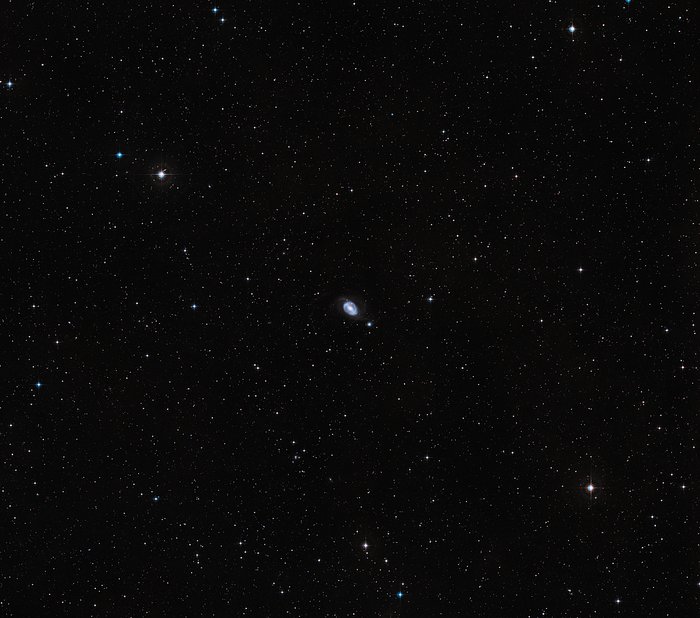
This image shows the sky around the two interacting galaxies NGC 1512 and NGC 1510. NGC 1512 is clearly visible in the very centre of the image. [ Larger images]The constant tidal tugging from its neighbour has swirled up the gas and dust in NGC 1510 and kick-started star formation that is even more intense than in NGC 1512. This causes the galaxy to glow with the blue hue that is indicative of hot new stars.
NGC 1510 is not the only galaxy to have experienced the massive gravitational tidal forces of NGC 1512. Observations made in 2015 showed that the outer regions of the spiral arms of NGC 1512 were indeed once part of a separate, older galaxy. This galaxy was ripped apart and absorbed by NGC 1512, just as it is doing now to NGC 1510.
Together, the pair demonstrate how interactions between galaxies, even if they are of very different sizes, can have a significant influence on their structures, changing the dynamics of their constituent gas and dust and even triggering starbursts. Such interactions between galaxies, and galaxy mergers in particular, play a key role in galactic evolution.
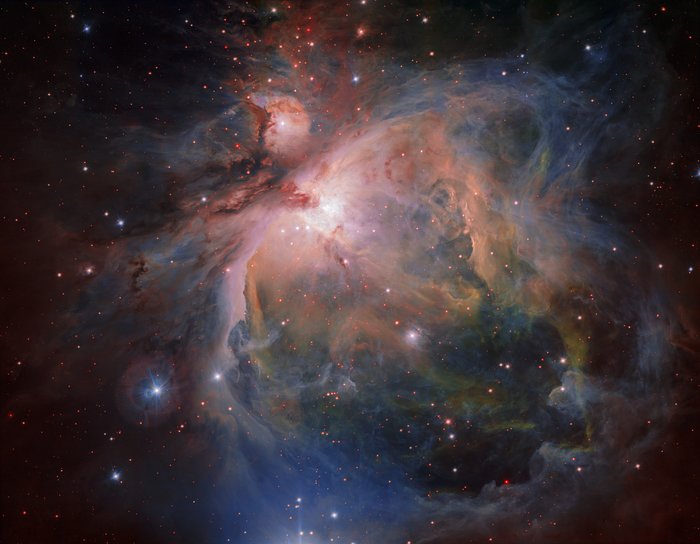
OmegaCAM — the wide-field optical camera on ESO’s VLT Survey Telescope (VST) — has captured the spectacular Orion Nebula and its associated cluster of young stars in great detail, producing this beautiful new image. This famous object, the birthplace of many massive stars, is one of the closest stellar nurseries, at a distance of about 1350 light-years. [Larger image]Using new observations from ESO’s VLT Survey Telescope, astronomers have discovered three different populations of young stars within the Orion Nebula Cluster. This unexpected discovery adds very valuable new insights for the understanding of how such clusters form. It suggests that star formation might proceed in bursts, where each burst occurs on a much faster time-scale than previously thought.
Surprise: astronomers have found what look like three different generations of baby stars within the Orion Nebula Cluster.
[Higher resolution video]
OmegaCAM — the wide-field optical camera on ESO’s VLT Survey Telescope (VST) — has captured the spectacular Orion Nebula and its associated cluster of young stars in great detail, producing a beautiful new image. This object is one of the closest stellar nurseries for both low and high-mass stars, at a distance of about 1350 light-years [1].
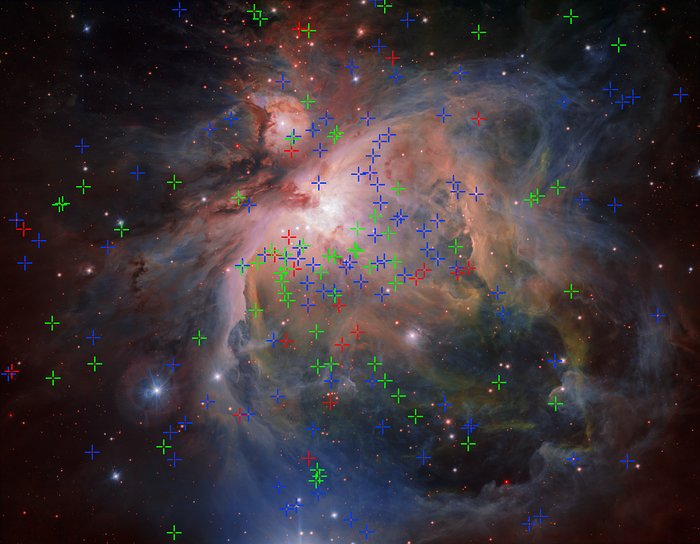
OmegaCAM — the wide-field optical camera on ESO’s VLT Survey Telescope (VST) — has captured the spectacular Orion Nebula and its associated cluster of young stars in great detail, producing this beautiful new image. This famous object, the birthplace of many massive stars, is one of the closest stellar nurseries, at a distance of about 1350 light-years. On this plot different populations of young stars are marked in different colours. The blue ones are oldest and the red youngest, with green ones an intermediate age. These stars seems to have formed in three bursts of star formation during the last three million years. [Larger image]But this is more than just a pretty picture. A team led by ESO astronomer Giacomo Beccari has used these data of unparallelled quality to precisely measure the brightness and colours of all the stars in the Orion Nebula Cluster. These measurements allowed the astronomers to determine the mass and ages of the stars. To their surprise, the data revealed three different sequences of potentially different ages.
“Looking at the data for the first time was one of those ‘Wow!’ moments that happen only once or twice in an astronomer’s lifetime,” says Beccari, lead author of the paper presenting the results. “The incredible quality of the OmegaCAM images revealed without any doubt that we were seeing three distinct populations of stars in the central parts of Orion.”
Monika Petr-Gotzens, co-author and also based at ESO Garching, continues,
“This is an important result. What we are witnessing is that the stars of a cluster at the beginning of their lives didn’t form altogether simultaneously. This may mean that our understanding of how stars form in clusters needs to be modified.”
This video sequence starts with a wide view of the Milky Way and slowly zooms in on the Orion Nebula, one of the brightest nearby regions of active star formation. The final view shows a very detailed new view of the stellar nursery from the VLT Survey Telescope. Credit: ESO, N. Risinger (skysurvey.org), Digitized Sky Survey 2. Music: Johan B. Monell (www.johanmonell.com)
The astronomers looked carefully at the possibility that instead of indicating different ages, the different brightnesses and colours of some of the stars were due to hidden companion stars, which would make the stars appear brighter and redder than they really were. But this idea would imply quite unusual properties of the pairs, which have never before been observed. Other measurements of the stars, such as their rotation speeds and spectra, also indicated that they must have different ages [2].
“Although we cannot yet formally disprove the possibility that these stars are binaries, it seems much more natural to accept that what we see are three generations of stars that formed in succession, within less than three million years,”
concludes Beccari.
This pan video shows a richly detailed new view of the Orion Nebula from the VLT Survey Telescope at ESO’s Paranal Observatory in Chile. This star formation region comprises glowing clouds of gas, veins of dark dust and many very young stars. Credit: ESO. Music: Johan B. Monell (www.johanmonell.com)
The new results strongly suggest that star formation in the Orion Nebula Cluster is proceeding in bursts, and more quickly than had been previously thought.
Notes
[1] The Orion Nebula has been studied by many of ESO’s telescopes, including images in visible light from the MPG/ESO 2.2-metre telescope (eso1103) and infrared images from VISTA (eso1701) and the HAWK-I instrument on the Very Large Telescope (eso1625).
[2] The group also found that each of the three different generations rotate at different speeds — the youngest stars rotate the fastest, and the oldest stars rotate the slowest. In this scenario, the stars would have formed in quick succession, within a time frame of three million years.
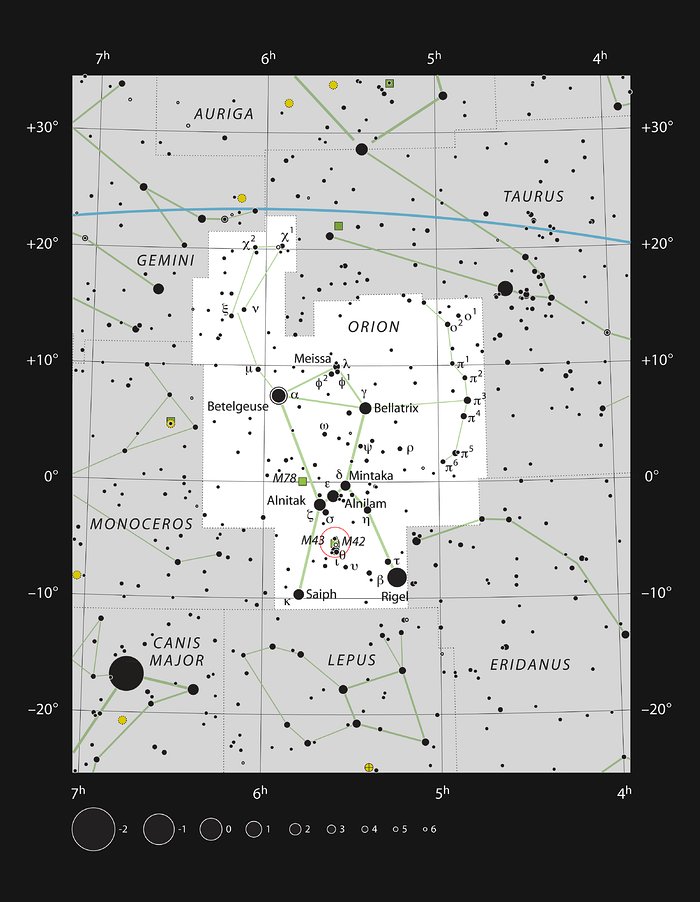
This chart shows the location of the Orion Nebula (Messier 42) in the sword of the famous constellation of Orion (the Hunter). This map shows most of the stars visible to the unaided eye under good conditions and the Orion Nebula itself is highlighted with a red circle on the image. This grand star formation region can be seen with the unaided eye and is an impressive sight in moderate-sized amateur telescopes.
Bill Nye explains the basics of a solar eclipses, the path of totality, and how to safely view a solar eclipse with National Park Ranger Coral O’Riley.
Bill Nye loves syzygy and Dr. Ashwin Vasavada from JPL talks about a curious eclipse on Mars
Bill Nye explains how to see the Milky Way after a solar eclipse and Dr. Tyler Nordgren shows an ancient eclipse petroglyph.