Here is NASA JPL’s latest monthly preview of the night sky, “What’s Up for September 2017”:
And here is the Hubble Space Telescope’s “Tonight’s Sky: September 2017”:
Here is NASA JPL’s latest monthly preview of the night sky, “What’s Up for September 2017”:
And here is the Hubble Space Telescope’s “Tonight’s Sky: September 2017”:
The latest ESO (European Southern Observatory) report:
ALMA Finds Huge Hidden Reservoirs of Turbulent Gas
in Distant Galaxies
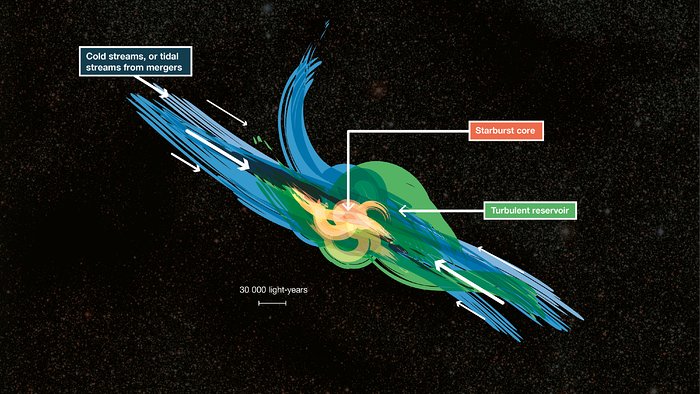
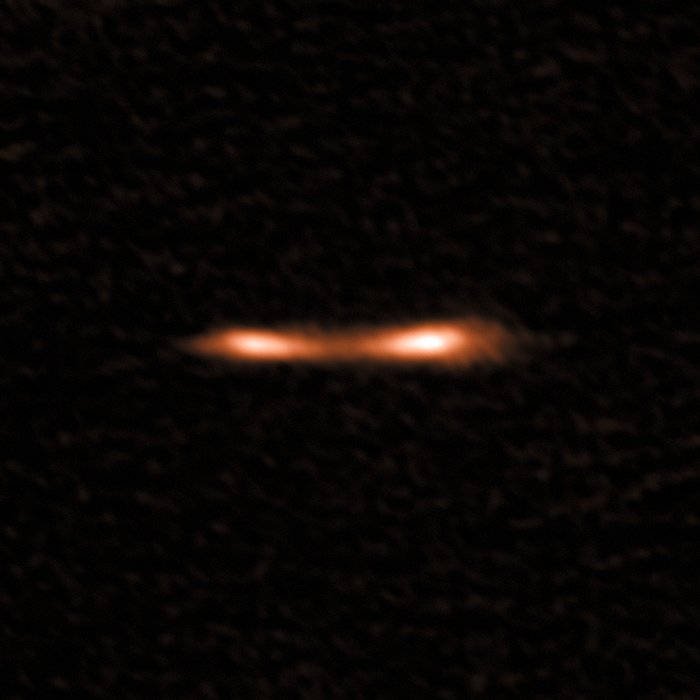
A team led by Edith Falgarone (Ecole Normale Supérieure and Observatoire de Paris, France) has used the Atacama Large Millimeter/submillimeter Array (ALMA) to detect signatures of the carbon hydride molecule CH+ [1] in distant starburst galaxies [2]. The group identified strong signals of CH+ in five out of the six galaxies studied, including the Cosmic Eyelash (eso1012) [3]. This research provides new information that helps astronomers understand the growth of galaxies and how a galaxy’s surroundings fuel star formation.
“CH+ is a special molecule. It needs a lot of energy to form and is very reactive, which means its lifetime is very short and it can’t be transported far. CH+ therefore traces how energy flows in the galaxies and their surroundings,” said Martin Zwaan, an astronomer at ESO, who contributed to the paper.
How CH+ traces energy can be thought of by analogy to being on a boat in a tropical ocean on a dark, moonless night. When the conditions are right, fluorescent plankton can light up around the boat as it sails. The turbulence caused by the boat sliding through the water excites the plankton to emit light, which reveals the existence of the the turbulent regions in the underlying dark water. Since CH+ forms exclusively in small areas where turbulent motions of gas dissipates, its detection in essence traces energy on a galactic scale.
This zoom sequence starts from a broad view of the sky and takes the viewer deep into the constellation of Aquarius (The Water Bearer). We pass the globular star cluster Messier 2 and go far beyond the galaxy into a distant cluster of galaxies. There we see a curious arc, a gravitationally lensed version of an even more distant galaxy, nicknamed the Cosmic Eyelash, seen using ALMA. Credit: ALMA (ESO/NAOJ/NRAO), DSS, Hubble. Music: Astral Electronic
The observed CH+ reveals dense shock waves, powered by hot, fast galactic winds originating inside the galaxies’ star forming regions. These winds flow through a galaxy, and push material out of it, but their turbulent motions are such that part of the material can be re-captured by the gravitational pull of the galaxy itself. This material gathers into huge turbulent reservoirs of cool, low-density gas, extending more than 30 000 light-years from the galaxy’s star forming region [4].
“With CH+, we learn that energy is stored within vast galaxy-sized winds and ends up as turbulent motions in previously unseen reservoirs of cold gas surrounding the galaxy,” said Falgarone, who is lead author of the new paper. “Our results challenge the theory of galaxy evolution. By driving turbulence in the reservoirs, these galactic winds extend the starburst phase instead of quenching it.”
The team determined that galactic winds alone could not replenish the newly revealed gaseous reservoirs and suggests that the mass is provided by galactic mergers or accretion from hidden streams of gas, as predicted by current theory.
“This discovery represents a major step forward in our understanding of how the inflow of material is regulated around the most intense starburst galaxies in the early Universe,” says ESO’s Director for Science, Rob Ivison, a co-author on the paper. “It shows what can be achieved when scientists from a variety of disciplines come together to exploit the capabilities of the world’s most powerful telescope.”
[1] CH+ is an ion of the CH molecule known as methylidynium to chemists. It is one of the first three molecules ever discovered in the interstellar medium. Since its discovery in the early 1940s, the presence of CH+ in interstellar space has been a mystery because it is extremely reactive and hence disappears more quickly than other molecules.
[2] These galaxies are known for a much higher rate of star formation compared to sedate Milky Way-like galaxies, making these structures ideal to study galaxy growth and the interplay between gas, dust, stars, and the black holes at the centres of galaxies.
[3] ALMA was used to obtain spectra of each galaxy. A spectrum is a record of light, typically of an astronomical object, split into its different colours (or wavelengths), in much the same way that rain droplets disperse light to form a rainbow. Since every element has a unique “fingerprint” in a spectrum, spectra can be used to determine the chemical composition of observed objects.
[4] These turbulent reservoirs of diffuse gas may be of the same nature as the giant glowing haloes seen around distant quasars.
====
The latest report from ESO (European Southern Observatory):
Best Ever Image of a Star’s Surface and Atmosphere
First map of motion of material on a star other than the Sun
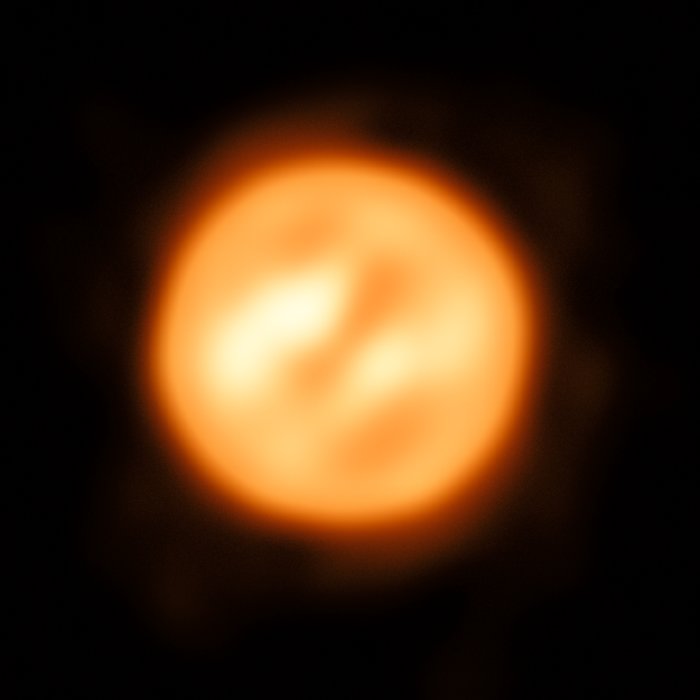
Using ESO’s Very Large Telescope Interferometer astronomers have constructed the most detailed image ever of a star — the red supergiant star Antares. They have also made the first map of the velocities of material the atmosphere of a star other than the Sun, revealing unexpected turbulence in Antares’s huge extended atmosphere. This short ESOcast takes a quick look at this remarkable result.
To the unaided eye the famous, bright star Antares shines with a strong red tint in the heart of the constellation of Scorpius (The Scorpion). It is a huge and comparatively cool red supergiant star in the late stages of its life, on the way to becoming a supernova [1].
A team of astronomers, led by Keiichi Ohnaka, of the Universidad Católica del Norte in Chile, has now used ESO’s Very Large Telescope Interferometer (VLTI) at the Paranal Observatory in Chile to map Antares’s surface and to measure the motions of the surface material. This is the best image of the surface and atmosphere of any star other than the Sun.
“How stars like Antares lose mass so quickly in the final phase of their evolution has been a problem for over half a century,” said Keiichi Ohnaka, who is also the lead author of the paper. “The VLTI is the only facility that can directly measure the gas motions in the extended atmosphere of Antares — a crucial step towards clarifying this problem. The next challenge is to identify what’s driving the turbulent motions.”
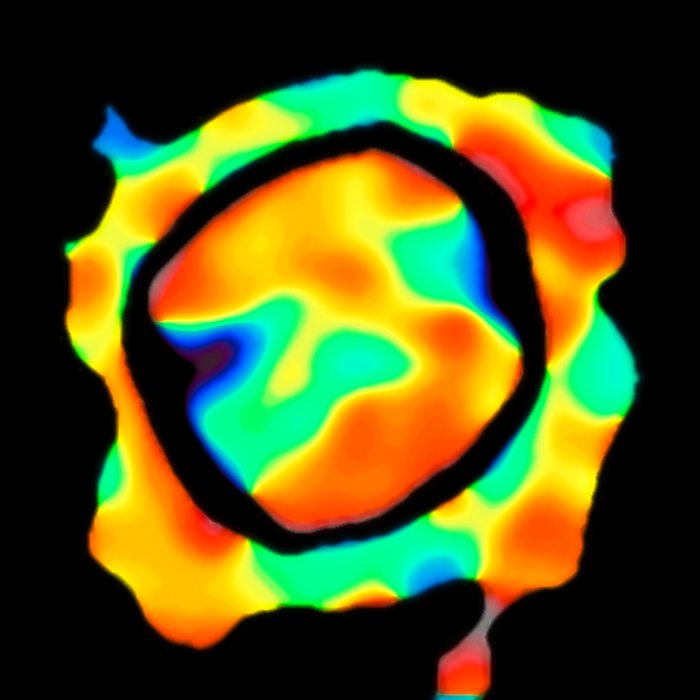
Using the new results the team has created the first two-dimensional velocity map of the atmosphere of a star other than the Sun. They did this using the VLTI with three of the Auxiliary Telescopes and an instrument called AMBER to make separate images of the surface of Antares over a small range of infrared wavelengths. The team then used these data to calculate the difference between the speed of the atmospheric gas at different positions on the star and the average speed over the entire star [2]. This resulted in a map of the relative speed of the atmospheric gas across the entire disc of Antares — the first ever created for a star other than the Sun.
This video starts from a wide field view of the Milky Way, including the prominent constellation of Scorpius (The Scopion). It zooms in towards Scorpius’s bright red heart — the red supergiant star Antares. The final view shows an image of the surface of Antares — the best ever of any star other than the Sun — taken with ESO’s Very Large Telescope Interferometer. Credit: ESO/K. Ohnaka/N. Risinger (skysurvey.org). Music: astral electronic.
The astronomers found turbulent, low-density gas much further from the star than predicted, and concluded that the movement could not result from convection [3], that is, from large-scale movement of matter which transfers energy from the core to the outer atmosphere of many stars. They reason that a new, currently unknown, process may be needed to explain these movements in the extended atmospheres of red supergiants like Antares.
“In the future, this observing technique can be applied to different types of stars to study their surfaces and atmospheres in unprecedented detail. This has been limited to just the Sun up to now,” concludes Ohnaka. “Our work brings stellar astrophysics to a new dimension and opens an entirely new window to observe stars.”
This 3D simulation shows a travel from Earth to the red supergiant Antares, in the constellation of Scorpius. Credit: spaceengine.org
Notes
[1] Antares is considered by astronomers to be a typical red supergiant. These huge dying stars are formed with between nine and 40 times the mass of the Sun. When a star becomes a red supergiant, its atmosphere extends outward so it becomes large and luminous, but low-density. Antares now has a mass about 12 times that of the Sun and a diameter about 700 times larger than the Sun’s. It is thought that it started life with a mass more like 15 times that of the Sun, and has shed three solar-masses of material during its life.
[2] The velocity of material towards or away from Earth can be measured by the Doppler Effect, which shifts spectral lines either towards the red or blue ends of the spectrum, depending on whether the material emitting or absorbing light is receding from or approaching the observer.
[3] Convection is the process whereby cold material moves downwards and hot material moves upwards in a circular pattern. The process occurs on Earth in the atmosphere and ocean currents, but it also moves gas around within stars.
The lastest report from ESO (European Southern Observatory):
Supermassive Black Holes Feed on Cosmic Jellyfish
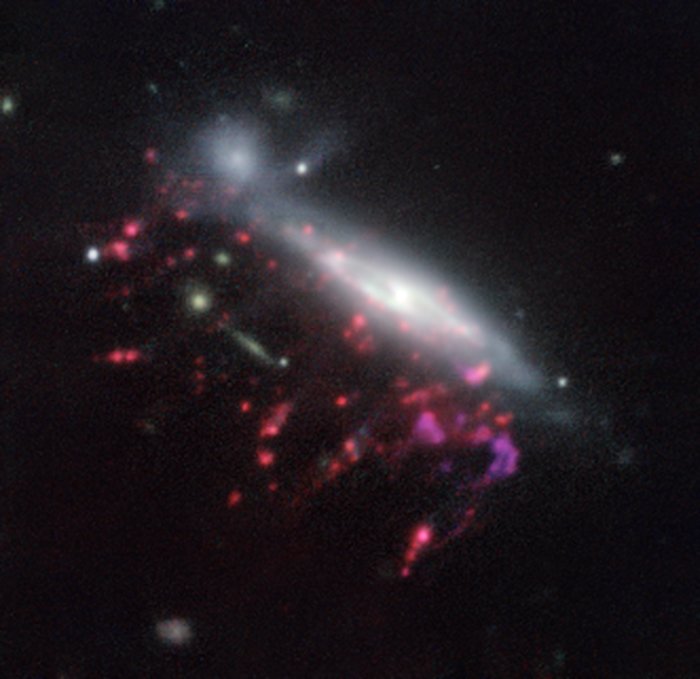
Observations of “Jellyfish galaxies” with ESO’s Very Large Telescope have revealed a previously unknown way to fuel supermassive black holes. It seems the mechanism that produces the tentacles of gas and newborn stars that give these galaxies their nickname also makes it possible for the gas to reach the central regions of the galaxies, feeding the black hole that lurks in each of them and causing it to shine brilliantly. This quick video explains the main points.
An Italian-led team of astronomers used the MUSE (Multi-Unit Spectroscopic Explorer) instrument on the Very Large Telescope (VLT) at ESO’s Paranal Observatory in Chile to study how gas can be stripped from galaxies. They focused on extreme examples of jellyfish galaxies in nearby galaxy clusters, named after the remarkable long “tentacles” of material that extend for tens of thousands of light-years beyond their galactic discs [1][2].
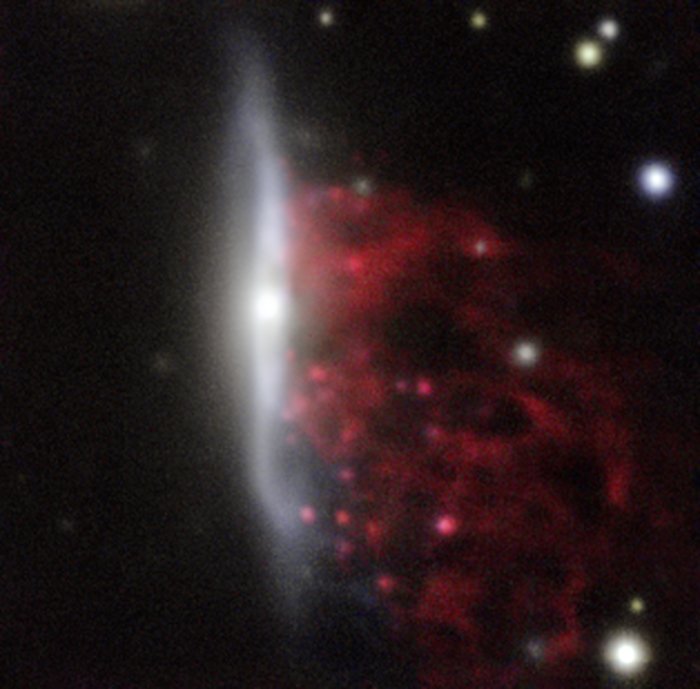
This visualisation shows a jellyfish galaxy in the three-dimensional view of the MUSE instrument on ESO’s Very Large Telescope. This combines the normal two-dimensional view with the third dimension of wavelength. This galaxy has undergone jam pressure stripping as it moves rapidly into the hot gas in a galaxy cluster, and streamers of gas and young stars are trailing behind it. These show up as the tentacles extending away from the galaxy as they have different velocities. A 3D interactive view of this galaxy is available. Credit: ESO/Callum Bellhouse and the GASP collaboration
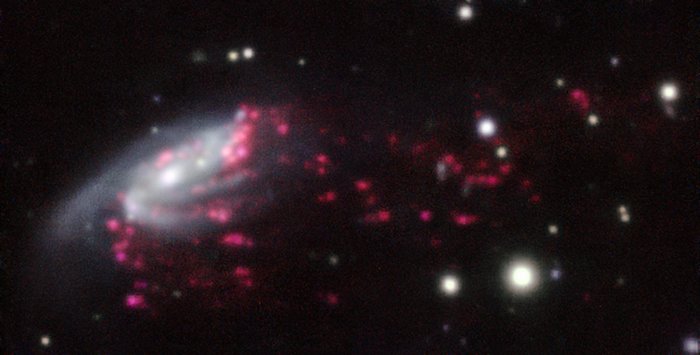
Six out of the seven jellyfish galaxies in the study were found to host a supermassive black hole at the centre, feeding on the surrounding gas [3]. This fraction is unexpectedly high — among galaxies in general the fraction is less than one in ten.
“This strong link between ram pressure stripping and active black holes was not predicted and has never been reported before,” said team leader Bianca Poggianti from the INAF-Astronomical Observatory of Padova in Italy. “It seems that the central black hole is being fed because some of the gas, rather than being removed, reaches the galaxy centre.” [4]
This artist’s illustration shows a spiral galaxy falling into a galaxy cluster. The galaxy is undergoing a process known as ram pressure stripping, where streaks of bright gas are being dragged out into space by the diffuse hot gas that it is moving through. Credit: NASA, ESA, and M. Kornmesser Acknowledgements: Ming Sun (UAH) and Serge Meunier
A long-standing question is why only a small fraction of supermassive black holes at the centres of galaxies are active. Supermassive black holes are present in almost all galaxies, so why are only a few accreting matter and shining brightly? These results reveal a previously unknown mechanism by which the black holes can be fed.
Yara Jaffé, an ESO fellow who contributed to the paper explains the significance: “These MUSE observations suggest a novel mechanism for gas to be funnelled towards the black hole’s neighbourhood. This result is important because it provides a new piece in the puzzle of the poorly understood connections between supermassive black holes and their host galaxies.”
The current observations are part of a much more extensive study of many more jellyfish galaxies that is currently in progress.
“This survey, when completed, will reveal how many, and which, gas-rich galaxies entering clusters go through a period of increased activity at their cores,” concludes Poggianti. “A long-standing puzzle in astronomy has been to understand how galaxies form and change in our expanding and evolving Universe. Jellyfish galaxies are a key to understanding galaxy evolution as they are galaxies caught in the middle of a dramatic transformation.”
This visualisation shows a jellyfish galaxy in the three-dimensional view of the MUSE instrument on ESO’s Very Large Telescope. This combines the normal two-dimensional view with the third dimension of wavelength. This galaxy has undergone ram pressure stripping as it moves rapidly into the hot gas in a galaxy cluster, and streamers of gas and young stars are trailing behind it. These show up as the tentacles extending away from the galaxy as they have different velocities. A 3D interactive view of this galaxy is available. Credit: ESO/Callum Bellhouse and the GASP collaboration
Notes
[1] To date, just over 400 candidate jellyfish galaxies have been found.
[2] The results were produced as part of the observational programme known as GASP (GAs Stripping Phenomena in galaxies with MUSE), which is an ESO Large Programme aimed at studying where, how and why gas can be removed from galaxies. GASP is obtaining deep, detailed MUSE data for 114 galaxies in various environments, specifically targeting jellyfish galaxies. Observations are currently in progress.
[3] It is well established that almost every, if not every, galaxy hosts a supermassive black hole at its centre, between a few million and a few billion times as massive as our Sun. When a black hole pulls in matter from its surroundings, it emits electromagnetic energy, giving rise to some of the most energetic of astrophysical phenomena: active galactic nuclei (AGN).
[4] The team also investigated the alternative explanation that the central AGN activity contributes to stripping gas from the galaxies, but considered it less likely. Inside the galaxy cluster, the jellyfish galaxies are located in a zone where the hot, dense gas of the intergalactic medium is particularly likely to create the galaxy’s long tentacles, reducing the possibility that they are created by AGN activity. There is therefore stronger evidence that ram pressure triggers the AGN and not vice versa.
The Latest ESO (European Southern Observatory) report:
Hint of Relativity Effects in Stars Orbiting Supermassive Black Hole at Centre of Galaxy
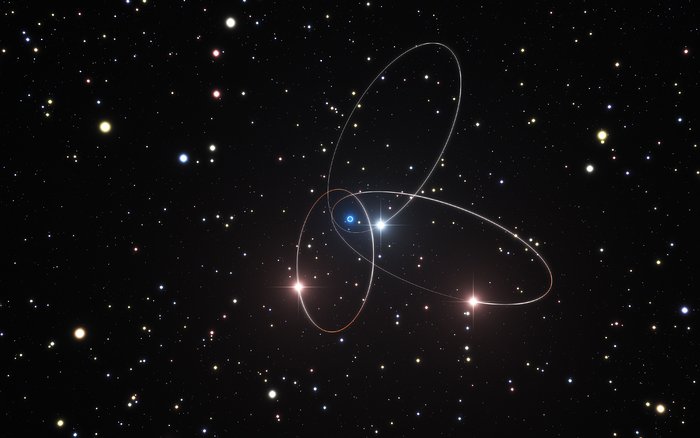
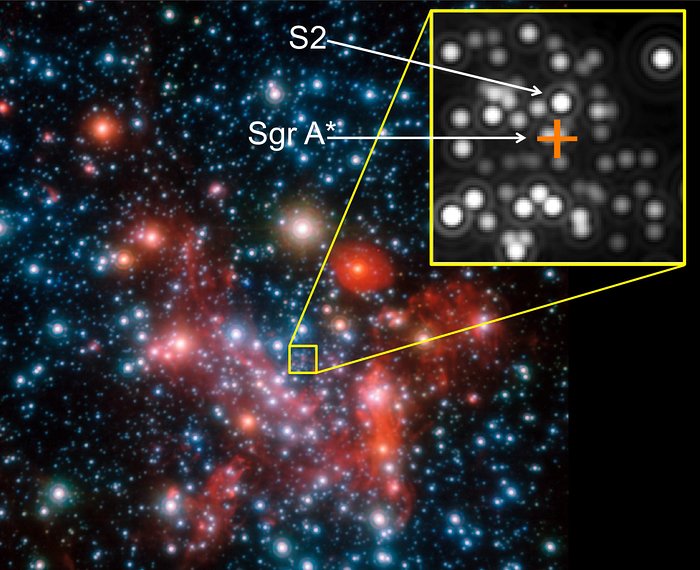
At the centre of the Milky Way, 26 000 light-years from Earth, lies the closest supermassive black hole, which has a mass four million times that of the Sun. This monster is surrounded by a small group of stars orbiting at high speed in the black hole’s very strong gravitational field. It is a perfect environment in which to test gravitational physics, and particularly Einstein’s general theory of relativity.
A team of German and Czech astronomers have now applied new analysis techniques to the very rich set of existing observations of the stars orbiting the black hole, accumulated using ESO’s Very Large Telescope (VLT) in Chile and others over the last twenty years [1]. They compare the measured star orbits to predictions made using classical Newtonian gravity as well as predictions from general relativity.
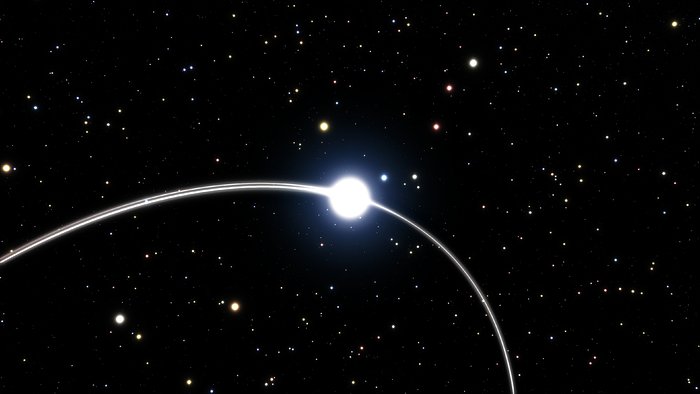
The team found suggestions of a small change in the motion of one of the stars, known as S2, that is consistent with the predictions of general relativity [2]. The change due to relativistic effects amounts to only a few percent in the shape of the orbit, as well as only about one sixth of a degree in the orientation of the orbit [3]. If confirmed, this would be the first time that a measurement of the strength of the general relativistic effects has been achieved for stars orbiting a supermassive black hole.
This artist’s impression video shows the orbits of three of the stars very close to the supermassive black hole at the centre of the Milky Way. Analysis of data from ESO’s Very Large Telescope and other telescopes suggests that the orbits of these stars show the subtle effects predicted by Einstein’s general theory of relativity. There are hints that the orbit of the star called S2 is deviating slightly from the path calculated using classical physics.
The end of this sequence highlights the tiny change in the orbit due to the relativistic effects. The position of the black hole is marked with a red cross. Credit: ESO/M. Parsa/L. Calçada
Marzieh Parsa, PhD student at the University of Cologne, Germany and lead author of the paper, is delighted:
“The Galactic Centre really is the best laboratory to study the motion of stars in a relativistic environment. I was amazed how well we could apply the methods we developed with simulated stars to the high-precision data for the innermost high-velocity stars close to the supermassive black hole.”
The high accuracy of the positional measurements, made possible by the VLT’s near-infrared adaptive optics instruments, was essential for the study [4]. These were vital not only during the star’s close approach to the black hole, but particularly during the time when S2 was further away from the black hole. The latter data allowed an accurate determination of the shape of the orbit and how it is changing under the influence of relativity.
“During the course of our analysis we realised that to determine relativistic effects for S2 one definitely needs to know the full orbit to very high precision,”
comments Andreas Eckart, team leader at the University of Cologne.
Co-author Vladimir Karas from the Academy of Sciences in Prague, the Czech Republic, is excited about the future:
“It is very reassuring that S2 shows relativistic effects as expected on the basis of its proximity to the extreme mass concentration at the centre of the Milky Way. This opens up an avenue for more theory and experiments in this sector of science.”
This analysis is a prelude to an exciting period for observations of the Galactic Centre by astronomers around the world. During 2018 the star S2 will make a very close approach to the supermassive black hole. This time the GRAVITY instrument, developed by a large international consortium led by the Max-Planck-Institut für extraterrestrische Physik in Garching, Germany [6], and installed on the VLT Interferometer [7], will be available to help measure the orbit much more precisely than is currently possible. Not only is GRAVITY, which is already making high-precision measurements of the Galactic Centre, expected to reveal the general relativistic effects very clearly, but also it will allow astronomers to look for deviations from general relativity that might reveal new physics.
Notes
[1] Data from the near-infrared NACO camera now at VLT Unit Telescope 1 (Antu) and the near-infrared imaging spectrometer SINFONI at the Unit Telescope 4 (Yepun) were used for this study. Some additional published data obtained at the Keck Observatory were also used.
[2] S2 is a 15-solar-mass star on an elliptical orbit around the supermassive black hole. It has a period of about 15.6 years and gets as close as 17 light-hours to the black hole — or just 120 times the distance between the Sun and the Earth.
[3] A similar, but much smaller, effect is seen in the changing orbit of the planet Mercury in the Solar System. That measurement was one of the best early pieces of evidence in the late nineteenth century suggesting that Newton’s view of gravity was not the whole story and that a new approach and new insights were needed to understand gravity in the strong-field case. This ultimately led to Einstein publishing his general theory of relativity, based on curved spacetime, in 1915.
When the orbits of stars or planets are calculated using general relativity, rather than Newtonian gravity, they evolve differently. Predictions of the small changes to the shape and orientation of orbits with time are different in the two theories and can be compared to measurements to test the validity of general relativity.
[4] An adaptive optics system compensates for the image distortions produced by the turbulent atmosphere in real time and allows the telescope to be used at much angular resolution (image sharpness), in principle limited only by the mirror diameter and the wavelength of light used for the observations.
[5] The team finds a black hole mass of 4.2 × 10⁶ times the mass of the Sun, and a distance from us of 8.2 kiloparsecs, corresponding to almost 27 000 light-years.
[6] The University of Cologne is part of the GRAVITY team (http://www.mpe.mpg.de/ir/gravity) and contributed the beam combiner spectrometers to the system.
[7] GRAVITY First Light was in early 2016 and it is already observing the Galactic Centre.