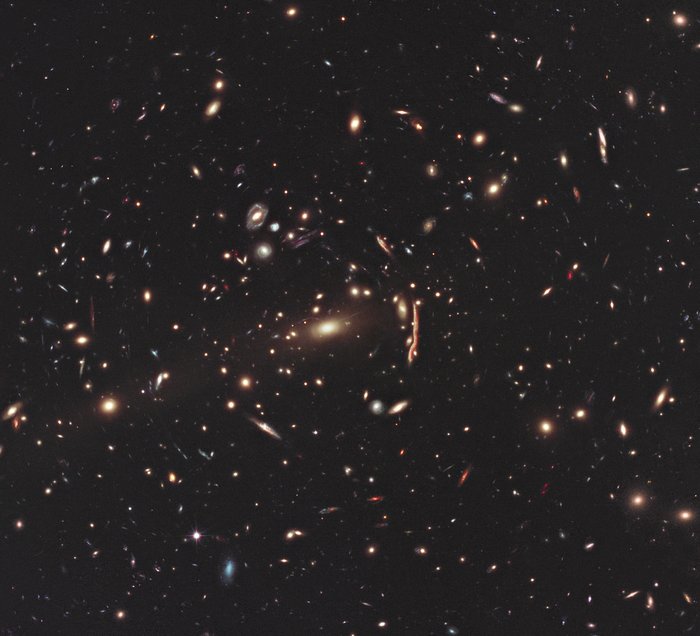
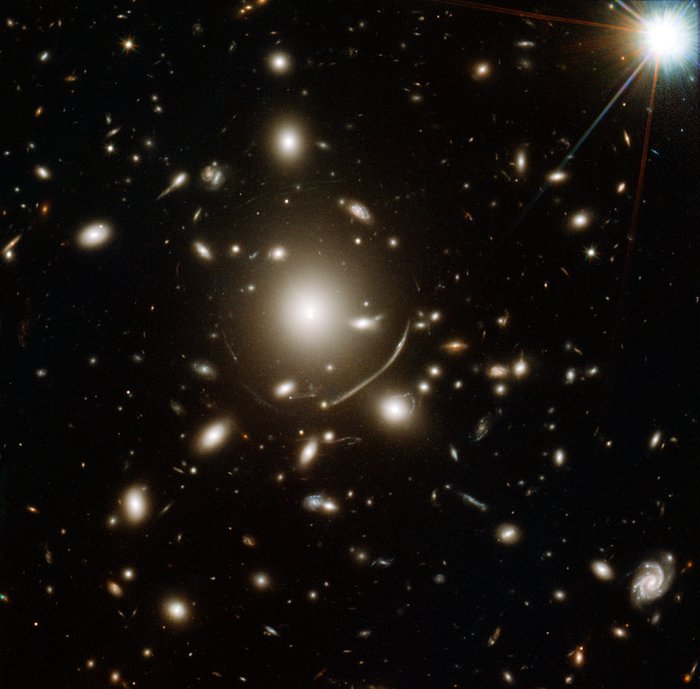
Abell S1063, a galaxy cluster, was observed by the NASA/ESA Hubble Space Telescope as part of the Frontier Fields programme. The huge mass of the cluster acts as a cosmic magnifying glass and enlarges even more distant galaxies, so they become bright enough for Hubble to see. [Larger images]
Using the NASA/ESA Hubble Space Telescope, astronomers have discovered that the brightest galaxies within galaxy clusters “wobble” relative to the cluster’s centre of mass. This unexpected result is inconsistent with predictions made by the current standard model of dark matter. With further analysis it may provide insights into the nature of dark matter, perhaps even indicating that new physics is at work.
This video pans over NASA/ESA Hubble Space Telescope observations of the galaxy cluster Abell S1063, which were made as part of the Frontier Fields programme. The many galaxies within the cluster become clearly visible, as well as the background galaxies, enlarged by gravitational lensing.
Dark matter constitutes just over 25 percent of all matter in the Universe but cannot be directly observed, making it one of the biggest mysteries in modern astronomy. Invisible halos of elusive dark matter enclose galaxies and galaxy clusters alike. The latter are massive groupings of up to a thousand galaxies immersed in hot intergalactic gas. Such clusters have very dense cores, each containing a massive galaxy called the “brightest cluster galaxy” (BCG).
This image from the NASA/ESA Hubble Space Telescope shows the galaxy cluster MACS J1206. Galaxy clusters like these have enormous mass, and their gravity is powerful enough to visibly bend the path of light, somewhat like a magnifying glass. These clusters are useful tools for studying very distant objects, because this lens-like behaviour amplifies the light from faraway galaxies in the background. They also contribute to a range of topics in cosmology, as the precise nature of the lensed images encapsulates information about the properties of spacetime, the expansion of the cosmos and the distribution of dark matter within the cluster. This is one of 25 clusters being studied as part of the CLASH (Cluster Lensing and Supernova survey with Hubble) programme, a major project to build a library of scientific data on lensing clusters. [Larger images]The standard model of dark matter (cold dark matter model) predicts that once a galaxy cluster has returned to a “relaxed” state after experiencing the turbulence of a merging event, the BCG does not move from the cluster’s centre. It is held in place by the enormous gravitational influence of dark matter.
This video pans across a giant cluster of elliptical galaxies which contains so much mass that its gravity bends light beams. This means that for very distant galaxies in the background, the cluster acts as a sort of magnifying glass, bending the path of the distant object’s light towards Hubble. These gravitational lenses are one tool that astronomers can use to extend Hubble’s vision beyond its normal range.
But now, a team of Swiss, French, and British astronomers have analysed ten galaxy clusters observed with the NASA/ESA Hubble Space Telescope, and found that their BCGs are not fixed at the centre as expected [1].
The giant galaxy cluster in the centre of this image contains so much dark matter mass that its gravity bends the light of more distant objects. This means that for very distant galaxies in the background, the cluster’s gravitational field acts as a sort of magnifying glass, bending and concentrating the distant object’s light towards Hubble. These gravitational lenses are one tool astronomers can use to extend Hubble’s vision beyond what it would normally be capable of observing. This way some of the very first galaxies in the Universe can be studied by astronomers. The lensing effect can also be used to determine the distribution of matter — both ordinary and dark matter — within the cluster. [Larger images]The Hubble data indicate that they are “wobbling” around the centre of mass of each cluster long after the galaxy cluster has returned to a relaxed state following a merger. In other words, the centre of the visible parts of each galaxy cluster and the centre of the total mass of the cluster — including its dark matter halo — are offset, by as much as 40 000 light-years.
“We found that the BCGs wobble around centre of the halos,” explains David Harvey, astronomer at EPFL, Switzerland, and lead author of the paper. “This indicates that, rather than a dense region in the centre of the galaxy cluster, as predicted by the cold dark matter model, there is a much shallower central density. This is a striking signal of exotic forms of dark matter right at the heart of galaxy clusters.”
The wobbling of the BCGs could only be analysed as the galaxy clusters studied also act as gravitational lenses. They are so massive that they warp spacetime enough to distort light from more distant objects behind them. This effect, called strong gravitational lensing, can be used to make a map of the dark matter associated with the cluster, enabling astronomers to work out the exact position of the centre of mass and then measure the offset of the BCG from this centre.
If this “wobbling” is not an unknown astrophysical phenomenon and in fact the result of the behaviour of dark matter, then it is inconsistent with the standard model of dark matter and can only be explained if dark matter particles can interact with each other — a strong contradiction to the current understanding of dark matter. This may indicate that new fundamental physics is required to solve the mystery of dark matter.
Co-author Frederic Courbin, also at EPFL, concludes:
“We’re looking forward to larger surveys — such as the Euclid survey — that will extend our dataset. Then we can determine whether the wobbling of BGCs is the result of a novel astrophysical phenomenon or new fundamental physics. Both of which would be exciting!”
This video pans across galaxy cluster MACS J1206.2-0847 (or MACS 1206 for short). The cluster has been observed by Hubble as part of CLASH (Cluster Lensing and Supernova survey with Hubble), a major programme to observe galaxy clusters whose gravity bends and distorts light passing through them.
Notes
[1] The study was performed using archive data from Hubble. The observations were originally made for the CLASH and LoCuSS surveys.
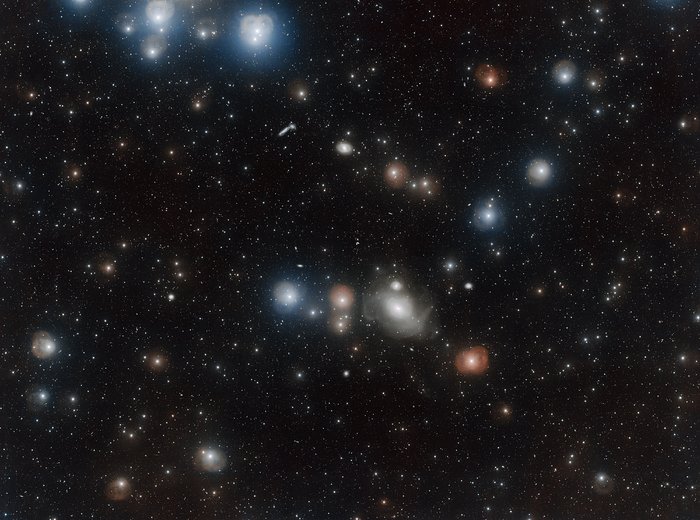
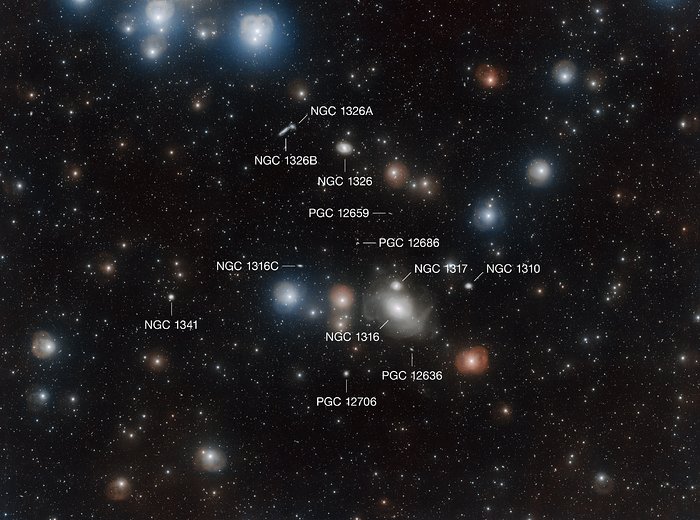
Countless galaxies vie for attention in this dazzling image of the Fornax Cluster, some appearing only as pinpricks of light while others dominate the foreground. One of these is the lenticular galaxy NGC 1316. The turbulent past of this much-studied galaxy has left it with a delicate structure of loops, arcs and rings that astronomers have now imaged in greater detail than ever before with the VLT Survey Telescope. This image was processed with the VST-Tube data reduction program. [Larger images]Countless galaxies vie for attention in this monster image of the Fornax Galaxy Cluster, some appearing only as pinpricks of light while others dominate the foreground. One of these is the lenticular galaxy NGC 1316. The turbulent past of this much-studied galaxy has left it with a delicate structure of loops, arcs and rings that astronomers have now imaged in greater detail than ever before with the VLT Survey Telescope. This astonishingly deep image also reveals a myriad of dim objects along with faint intracluster light.
Captured using the exceptional sky-surveying abilities of the VLT Survey Telescope (VST) at ESO’s Paranal Observatory in Chile, this deep view reveals the secrets of the luminous members of the Fornax Cluster, one of the richest and closest galaxy clusters to the Milky Way. This 2.3-gigapixel image is one of the largest images ever released by ESO.
Perhaps the most fascinating member of the cluster is NGC 1316, a galaxy that has experienced a dynamic history, being formed by the merger of multiple smaller galaxies. The gravitational distortions of the galaxy’s adventurous past have left their mark on its lenticular structure [1]. Large ripples, loops and arcs embedded in the starry outer envelope were first observed in the 1970s, and they remain an active field of study for contemporary astronomers, who use the latest telescope technology to observe the finer details of NGC 1316’s unusual structure through a combination of imaging and modelling.
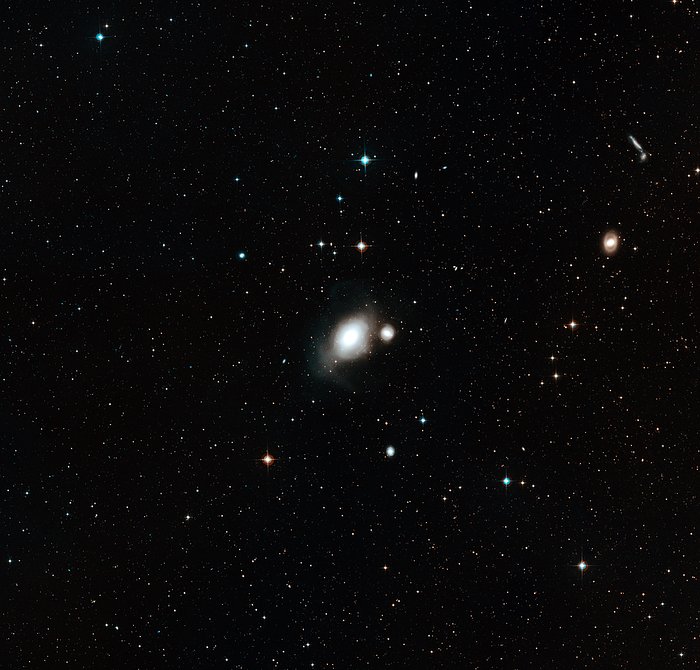
This picture shows the sky around the pair of galaxies NGC 1316 and 1317. It was created from images forming part of the Digitized Sky Survey 2. [Larger images]
The mergers that formed NGC 1316 led to an influx of gas, which fuels an exotic astrophysical object at its centre: a supermassive black hole with a mass roughly 150 million times that of the Sun. As it accretes mass from its surroundings, this cosmic monster produces immensely powerful jets of high-energy particles , that in turn give rise to the characteristic lobes of emission seen at radio wavelengths, making NGC 1316 the fourth-brightest radio source in the sky [2].
NGC 1316 has also been host to four recorded type Ia supernovae, which are vitally important astrophysical events for astronomers. Since type Ia supernovae have a very clearly defined brightness [3], they can be used to measure the distance to the host galaxy; in this case, 60 million light-years. These “standard candles” are much sought-after by astronomers, as they are an excellent tool to reliably measure the distance to remote objects. In fact, they played a key role in the groundbreaking discovery that our Universe is expanding at an accelerating rate.
This annotated view labels the major galaxies around NGC 1316, a lenticular galaxy that is both in the constellation of Fornax (The Furnace) and in the Fornax Cluster. This astonishingly deep view of the cluster was captured by the VLT Survey Telescope as part of the Fornax Deep Survey. [Larger images]This image was taken by the VST at ESO’s Paranal Observatory as part of the Fornax Deep Survey, a project to provide a deep, multi-imaging survey of the Fornax Cluster. The team, led by Enrichetta Iodice (INAF – Osservatorio di Capodimonte, Naples, Italy), have previously observed this area with the VST and revealed a faint bridge of light between NGC 1399 and the smaller galaxy NGC 1387 (eso1612) . The VST was specifically designed to conduct large-scale surveys of the sky. With its huge corrected field of view and specially designed 256-megapixel camera, OmegaCAM, the VST can produce deep images of large areas of sky quickly, leaving the much larger telescopes — like ESO’s Very Large Telescope (VLT) — to explore the details of individual objects.
Notes [1] Lenticular or “lens-shaped” galaxies are an intermediate form between diffuse elliptical galaxies and the better-known spiral galaxies such as the Milky Way.
[2] As this radio source is the brightest in the constellation of Fornax it is also known as Fornax A.
[3] Type Ia Supernovae occur when an accreting white dwarf in a binary star system slowly gains mass from its companion until it reaches a limit that triggers the nuclear fusion of carbon. In a brief period of time, a chain reaction is initiated that eventually ends in a huge release of energy: a supernova explosion. The supernova always occurs at a specific mass, known as the Chandrasekhar limit, and produces an almost identical explosion each time. The similarity of type Ia supernovae allow astronomers to use the cataclysmic events to measure distance.
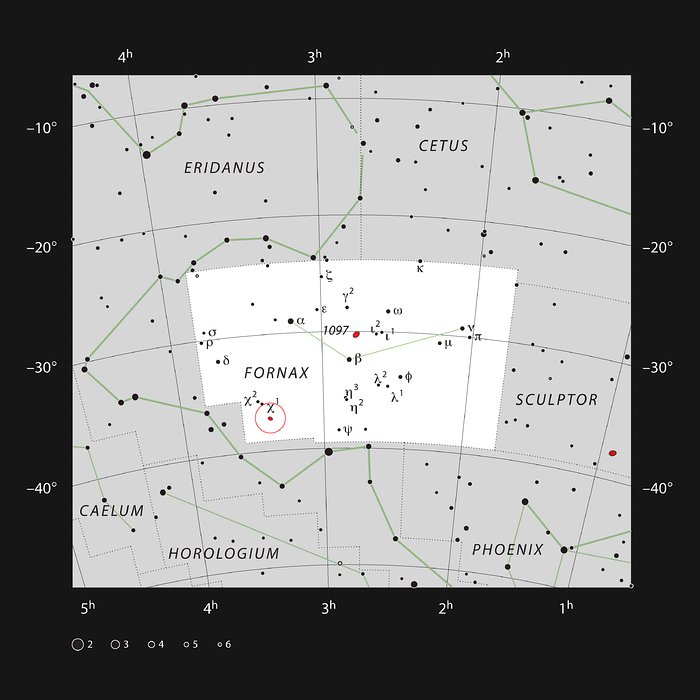
This chart shows most of the stars that can be seen with the naked eye on a clear dark night. The small constellation of Fornax (The Furnace) contains a concentration of nearby galaxies, including the galaxies NGC 1316 and 1317 (indicated with a red circle). These are bright enough to be seen as faint circular hazy patches in a middle-sized amateur telescope.
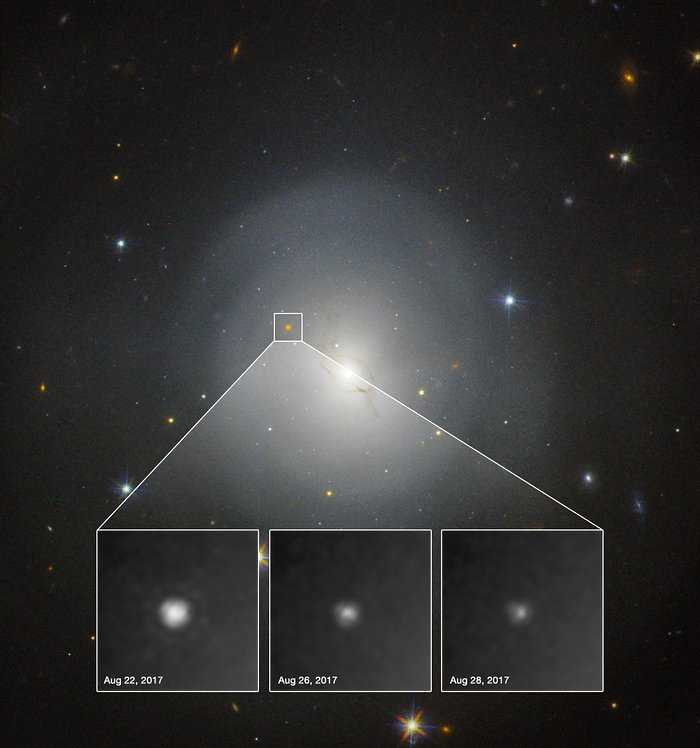
On 17 August 2017, the Laser Interferometer Gravitational-Wave Observatory (LIGO) and the Virgo Interferometer both detected gravitational waves from the collision between two neutron stars. Within 12 hours observatories had identified the source of the event within the lenticular galaxy NGC 4993, shown in this image gathered with the NASA/ESA Hubble Space Telescope. The associated stellar flare, a kilonova, is clearly visible in the Hubble observations. This is the first time the optical counterpart of a gravitational wave event was observed. Hubble observed the kilonova gradually fading over the course of six days, as shown in these observations taken in between 22 and 28 August (insets). [Larger images]The NASA/ESA Hubble Space Telescope has observed for the first time the source of a gravitational wave, created by the merger of two neutron stars. This merger created a kilonova — an object predicted by theory decades ago — that ejects heavy elements such as gold and platinum into space. This event also provides the strongest evidence yet that short duration gamma-ray bursts are caused by mergers of neutron stars. This discovery is the first glimpse of multi-messenger astronomy, bringing together both gravitational waves and electromagnetic radiation.
In the night following the initial discovery, a fleet of telescopes started their hunt to locate the source of the event. Astronomers found it in the lenticular galaxy NGC 4993, about 130 million light-years away. A point of light was shining where nothing was visible before and this set off one of the largest multi-telescope observing campaigns ever — among these telescopes was the NASA/ESA Hubble Space Telescope[2].
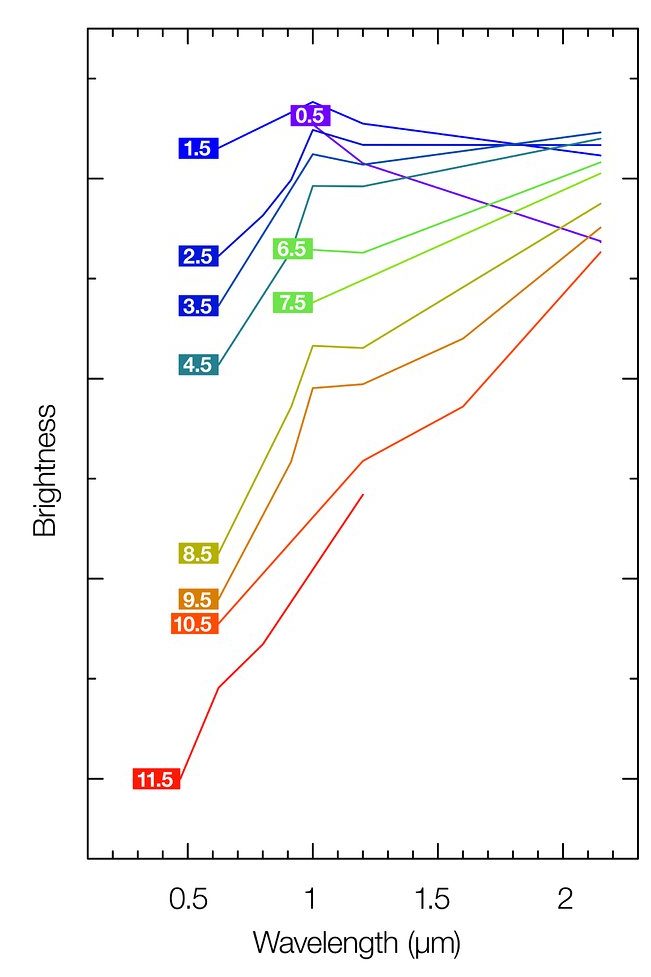
This plot shows how the spectrum and brightness of the kilonova seen in the galaxy NGC 4993 changed over 12 days following the detection of gravitational waves on 17 August 2017. In blue light the object faded rapidly, but at longer wavelengths, in the near infrared part of the spectrum, it brightened a little and then faded much more slowly. As a result this object changed colour from very blue to very red during this period. Each line is labeled with the number of days since the explosion and the horizontal axis is the colour of the light, from ultraviolet to near-infrared. The colours of the lines indicate the overall colour of the object at the different times. [Larger versions]Several different teams of scientists used Hubble over the two weeks following the gravitational wave event alert to observe NGC 4993. Using Hubble’s high-resolution imaging capabilities they managed to get the first observational proof for a kilonova, the visible counterpart of the merging of two extremely dense objects — most likely two neutron stars[3]. Such mergers were first suggested more than 30 years ago but this marks the first firm observation of such an event [4]. The distance to the merger makes the source both the closest gravitational wave event detected so far and also one of the closest gamma-ray burst sources ever seen.
“Once I saw that there had been a trigger from LIGO and Virgo at the same time as a gamma-ray burst I was blown away,” recalls Andrew Levan of the University of Warwick, who led the Hubble team that obtained the first observations. “When I realised that it looked like neutron stars were involved, I was even more amazed. We’ve been waiting a long time for an opportunity like this!”
Hubble captured images of the galaxy in visible and infrared light, witnessing a new bright object within NGC 4993 that was brighter than a nova but fainter than a supernova. The images showed that the object faded noticeably over the six days of the Hubble observations. Using Hubble’s spectroscopic capabilities the teams also found indications of material being ejected by the kilonova as fast as one-fifth of the speed of light.
“It was surprising just how closely the behaviour of the kilonova matched the predictions,” said Nial Tanvir, professor at the University of Leicester and leader of another Hubble observing team. “It looked nothing like known supernovae, which this object could have been, and so confidence was soon very high that this was the real deal.”
Connecting kilonovae and short gamma-ray bursts to neutron star mergers has so far been difficult, but the multitude of detailed observations following the detection of the gravitational wave event GW170817 has now finally verified these connections.
“The spectrum of the kilonova looked exactly like how theoretical physicists had predicted the outcome of the merger of two neutron stars would appear,” says Levan. “It ties this object to the gravitational wave source beyond all reasonable doubt.”
The infrared spectra taken with Hubble also showed several broad bumps and wiggles that signal the formation of some of the heaviest elements in nature. These observations may help solve another long-standing question in astronomy: the origin of heavy chemical elements, like gold and platinum [5]. In the merger of two neutron stars, the conditions appear just right for their production.
The implications of these observations are immense. As Tanvir explains:
“This discovery has opened up a new approach to astronomical research, where we combine information from both electromagnetic light and from gravitational waves. We call this multi-messenger astronomy — but until now it has just been a dream!”
Levan concludes:
“Now, astronomers won’t just look at the light from an object, as we’ve done for hundreds of years, but also listen to it. Gravitational waves provide us with complementary information from objects which are very hard to study using only electromagnetic waves. So pairing gravitational waves with electromagnetic radiation will help astronomers understand some of the most extreme events in the Universe.”
Notes [1] The ripples in spacetime known as gravitational waves are created by moving masses, but only the most intense waves, created by rapid speed changes of very massive objects, can be detected by the current generation of detectors. Gravitational waves detectable from Earth are generated by collisions of massive objects, such as when two black holes or neutron stars merge.
[3] A neutron star forms when the core of a massive star (above eight times the mass of the Sun) collapses. This process is so violent that it crushes protons and electrons together to form subatomic particles called neutrons. They are supported against further collapse only by neutron degeneracy pressure. This makes neutron stars the smallest and densest stars known.
[4] In 2013 astronomers published results on the evidence for a kilonova, associated with a short gamma-ray burst. The observations in 2013 were far less conclusive, and hence more controversial, than the new results.
[5] These observations pin down the formation of elements heavier than iron through nuclear reactions within high-density stellar objects, known as r-process nucleosynthesis, something which was only theorised before.
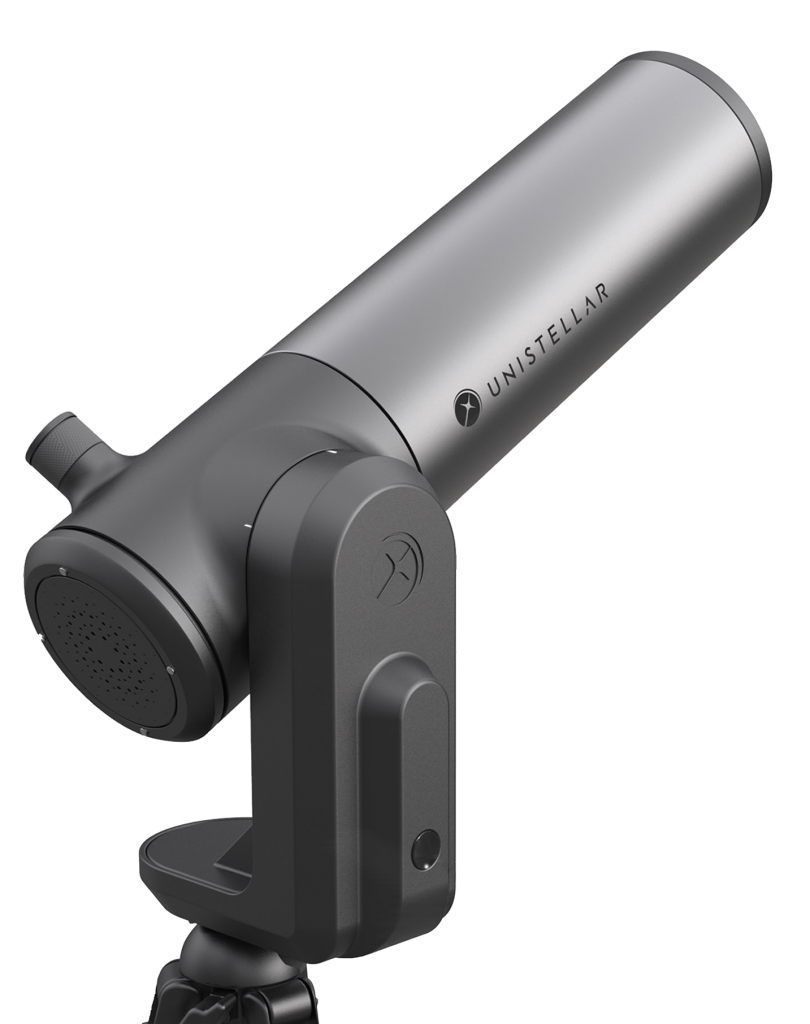
The company Unistellar is developing a small telescope called the evScope that includes an active light amplification system that greatly brightens and sharpens images:
Turn the Amplified Vision ON and the system will start to accumulate light from the objects you are viewing all the while projecting it directly into the eyepiece of the telescope: the image is progressively intensified and in a matter of seconds colors and shapes of galaxies and nebulae, invisible in normal telescopes, will appear. Turn Field Recognition ON and the system will recognize and name the objects in the field !
Called the “eVscope” (pronounced Ee-Vee Scope) for short, Unistellar’s product outwardly appears to be just a typical 4.5-inch Newtonian reflector—a simple small telescope that, along with its tripod, easily fits inside a backpack. But a peek through its eyepiece reveals the eVscope’s power: Using a proprietary system of sensors, optics and specialized software, the telescope can amplify and display the accumulated light from a faint target over time, stacking up and processing hundreds of images to correct for instrumental jitter and smeared exposures to build up vivid, sharp views that rival those from far larger and more expensive equipment. And, as Marchis intends to show with his demonstration from a Brooklyn graveyard, the technology even works under poor viewing conditions—such as in and around New York City, where the glare of city lights is so oppressive that even on clear nights one can practically count on fingers and toes all the stars visible to the naked eye. (The technology works so well, in fact, that Unistellar’s eVscope has managed to capture and display images of faraway Pluto in its eyepiece as a dim and distant dot hanging in the light-polluted skies over Marseilles, France, and San Francisco.)
The evScope is sensitive enough for amateurs to do real science with it. The company plans to encourage citizen science projects with the device:
Through a partnership with the SETI Institute, eVscope users will have the option of automatically uploading their observations to an online database for use by amateur and professional astronomers alike. “We’ll build it up slowly, with a thousand eVscopes providing millions of frames for any given region of sky that can be combined to get good signal to noise,” Marchis says. “We could use it to search for Earth-threatening asteroids and comets, stellar occultations, supernovae, variable stars; maybe even things we can scarcely imagine—a flash of light, a laser pulse from another cosmic civilization? Who knows what we might find—it’s not like we have been observing the sky continuously at these magnitudes.”
T
Unistellar plans to begin selling the evScope in 2018.
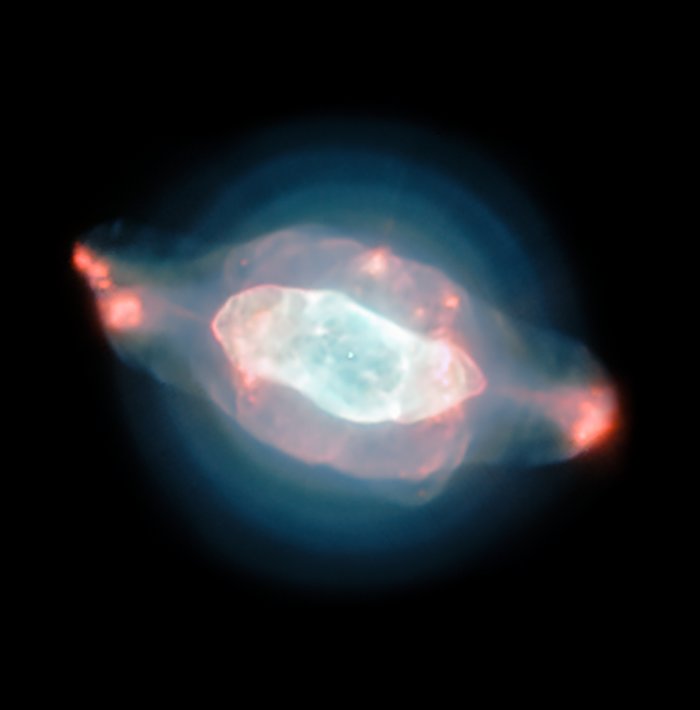
The spectacular planetary nebula NGC 7009, or the Saturn Nebula, emerges from the darkness like a series of oddly-shaped bubbles, lit up in glorious pinks and blues. This colourful image was captured by the powerful MUSE instrument on ESO’s Very Large Telescope (VLT), as part of a study which mapped the dust inside a planetary nebula for the first time. [Larger images.]The spectacular planetary nebula NGC 7009, or the Saturn Nebula, emerges from the darkness like a series of oddly-shaped bubbles, lit up in glorious pinks and blues. This colourful image was captured by the powerful MUSE instrument on ESO’s Very Large Telescope (VLT), as part of a study which mapped the dust inside a planetary nebula for the first time. The map — which reveals a wealth of intricate structures in the dust, including shells, a halo and a curious wave-like feature — will help astronomers understand how planetary nebulae develop their strange shapes and symmetries.
The spectacular planetary nebula NGC 7009, or the Saturn Nebula, emerges from the darkness like a series of oddly-shaped bubbles, lit up in glorious pinks and blues. This colourful image was captured by the powerful MUSE instrument on ESO’s Very Large Telescope (VLT), as part of a study which mapped the dust inside a planetary nebula for the first time.
The Saturn Nebula is located approximately 5000 light years away in the constellation of Aquarius (The Water Bearer). Its name derives from its odd shape, which resembles everyone’s favourite ringed planet seen edge-on.
But in fact, planetary nebulae have nothing to do with planets. The Saturn Nebula was originally a low-mass star, which expanded into a red giant at the end of its life and began to shed its outer layers. This material was blown out by strong stellar winds and energised by ultraviolet radiation from the hot stellar core left behind, creating a circumstellar nebula of dust and brightly-coloured hot gas. At the heart of the Saturn Nebula lies the doomed star, visible in this image, which is in the process of becoming a white dwarf[1].
In order to better understand how planetary nebulae are moulded into such odd shapes, an international team of astronomers led by Jeremy Walsh from ESO used the Multi Unit Spectroscopic Explorer (MUSE) to peer inside the dusty veils of the Saturn Nebula. MUSE is an instrument installed on one of the four Unit Telescopes of the Very Large Telescopeat ESO’s Paranal Observatory in Chile. It is so powerful because it doesn’t just create an image, but also gathers information about the spectrum — or range of colours — of the light from the object at each point in the image.
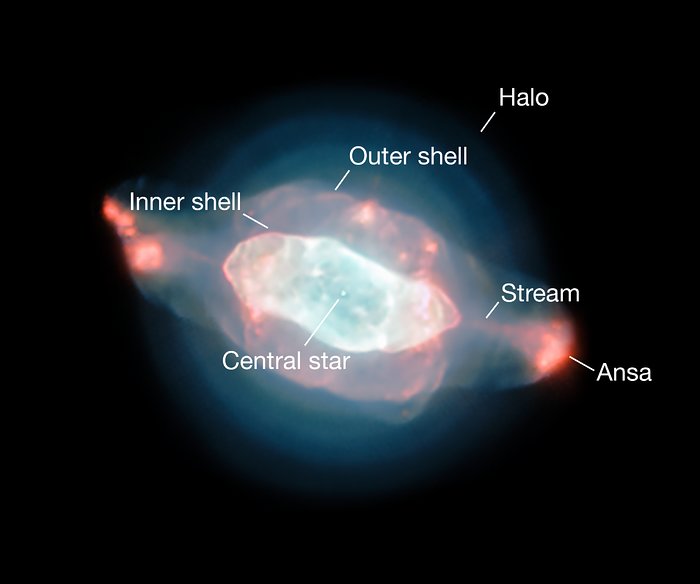
The spectacular planetary nebula NGC 7009, or the Saturn Nebula, emerges from the darkness like a series of oddly-shaped bubbles, lit up in glorious pinks and blues. This colourful image was captured by the powerful MUSE instrument on ESO’s Very Large Telescope (VLT), as part of a study which mapped the dust inside a planetary nebula for the first time. This annotated version labels the features of this curious object. [ Larger images.]The team used MUSE to produce the first detailed optical maps of the gas and dust distributed throughout a planetary nebula [2]. The resulting image of the Saturn Nebula reveals many intricate structures, including an elliptical inner shell, an outer shell, and a halo. It also shows two previously imaged streams extending from either end of the nebula’s long axis, ending in bright ansae (Latin for “handles”).
Intriguingly, the team also found a wave-like feature in the dust, which is not yet fully understood. Dust is distributed throughout the nebula, but there is a significant drop in the amount of dust at the rim of the inner shell, where it seems that it is being destroyed. There are several potential mechanisms for this destruction. The inner shell is essentially an expanding shock wave, so it may be smashing into the dust grains and obliterating them, or producing an extra heating effect that evaporates the dust.
Mapping the gas and dust structures within planetary nebulae will aid in understanding their role in the lives and deaths of low mass stars, and it will also help astronomers understand how planetary nebulae acquire their strange and complex shapes.
This zoom sequence starts from a very broad view of the sky and heads towards the constellation of Aquarius (The Water Bearer). After a while we see a bright tiny blue disc, which eventually turns into the spectacular planetary nebula NGC 7009, known as the Saturn Nebula because of its distinctive shape. The final image is from new data taken with the MUSE instrument on ESO’s Very Large Telescope in Chile. Credit: ESO/Digitized Sky Survey 2/N. Risinger (skysurvey.org). Music: Astral Electronic
But MUSE’s capabilities extend far beyond planetary nebulae. This sensitive instrument can also study the formation of stars and galaxies in the early Universe, as well as map the dark matter distribution in galaxy clusters in the nearby Universe. MUSE has also created the first 3D map of the Pillars of Creation in the Eagle Nebula (eso1518) and imaged a spectacular cosmic crash in a nearby galaxy (eso1437).
Notes
[1] Planetary nebulae are generally short-lived; the Saturn Nebula will last only a few tens of thousands of years before expanding and cooling to such an extent that it becomes invisible to us. The central star will then fade as it becomes a hot white dwarf.
[2] The NASA/ESA Hubble Space Telescope has previously provided a spectacular image of the Saturn Nebula — but, unlike MUSE, it cannot reveal the spectrum at each point over the whole nebula.